




Abstract
The quality of education provided in management institutions is a matter of debate in every country. With a rapid growth in the economy, the quality of management education provided in the United Arab Emirates (UAE) has also been a topic in the forefront. The burgeoning growth in this sector, with mushrooming “branch campuses” from around the world in the UAE, has led policy makers to reflect on the importance of quality of management education being imparted. The main purpose of this article is to explore the quality of management education in the UAE, and the study draws on the SERVQUAL model for the same. The study investigates the five dimensions (responsiveness, assurance, tangibility, empathy, and reliability) of service quality and identifies the gap between the perception and expectation, examining service standards across seven branch campus universities for management education providers in the UAE. A questionnaire survey with 300 university students from seven different branch campus universities in the UAE was conducted. The key findings of the study revealed a significant difference between the student’s expectations from management education and their perception in all five dimensions of service quality. The gaps were compared across the five dimensions, and the highest and the lowest service quality gaps were given to assurance and responsiveness, respectively.
Introduction
Quality in the management education is continuously being considered as highly important by governments and higher education institutions as it has a direct bearing on the present and future of the economy of every country. Management education institutions’ competitiveness is determined by its capability and promptness to adapt to the changing needs of the socioeconomic environment, and the latter can only be achieved by providing quality education and improving it continuously.
The higher education sectors, especially, the universities are the knowledge providers of the society. Its products are the intangible knowledge and competencies provided to the students, hence the universities can be categorized as service providers (ŞAVGA, 2013). The intangible products—knowledge and competencies—being dealt by the universities makes it appropriate to consider the same parameters to measure the service quality as other service providers. The services of the university would be considered to be of quality, if the university’s products and processes satisfy the needs and expectations of the students and other stakeholders.
Traditionally, there have been many research studies that have used the service quality instrument, SERVQUAL, introduced by Parasuraman, Zeithaml, and Berry (1988) across several industries. These industries have ranged from financial services (Lin, 1999), travel and tourism (Kaynama, 2000), retail management (Mehta, 2000), mobile industry (Abu-El Samen, Akroush, & Abu-Lail, 2013), and ecotourism (Yusof, Rahman, Jamil, & Iranmanesh, 2014).
Although a number of studies have been conducted in different facets of the service industry, studies in the higher education sector with a focus on management education have been mostly limited to developed countries, except a few studies based in other countries. With the higher education sector seeing an amazing growth trajectory in the United Arab Emirates (UAE), it is interesting to compare the quality parameters of the various international universities in the UAE. The main purpose of this article is to explore the quality of Management education in the UAE, and the study draws on the SERVQUAL model for the same. The study investigates the five dimensions (Responsiveness, Assurance, Tangibility, Empathy and Reliability) of service quality and identifies the gap between the perception and expectation, examining service standards across seven branch campus for Management education providers in the UAE. The findings will help the institutions focus on the dimensions of quality for generating an action plan for the overall improvement in service quality.
Conceptual Framework and Literature Review
A review of the previous research shows that quality is construed to be based on the assessment of the user or the consumer on the value he or she feels he or she got by using the product or service. The definition of quality in services that has been most quoted is that by Parasuraman, Zeithaml, & Berry (1985) who defined it as “the global evaluation or attitude of overall excellence of services.” Nitecki and Hernon (2000) defined service quality in terms of “meeting or exceeding customer expectations, or as the difference between customer perceptions and expectations of service.” These definitions point to two important issues: first, the quality is dependent on consumers’ expectation and the perception of the service delivered, and, second, it is different from consumer satisfaction which is more inclusive as it includes price, situational factors, personal factors besides the service quality (Arokiasamy, 2012). The construct of quality as conceptualized in the services literature is therefore based on perceived quality.
According to Parasuraman et al. (1988) and Zammuto, Keaveney, and O’Connor (1996), perceived quality is defined as the consumer’s judgment about an entity’s overall experience or superiority. According to Zeithaml, Parasuraman, and Berry (1990), perceived service quality is the extent to which a firm successfully serves the purpose of customers. Based on the experience of the customer with the service provider, he or she determines the perceived value of the service. While earlier the research focused on ‘missing service quality concept’ (Gronroos, 1982) and the various types of quality customers expect like technical quality, functional quality Lethinen and Lethinen (1982) viewed quality more as process and output quality.
Measuring Service Quality for the Education Industry
As quality in service is based on perception, the quality in higher education is about the students’ overall service experience in the university. According to Parasuraman et al. (1988) and Zammuto et al. (1996), perceived service quality is defined as the consumer’s judgment about an entity’s overall experience or superiority and could be based on the evaluation of a number of service encounters by the student (Hill, 1995). The service quality of an education institution is the level to which the university is able to satisfy the needs of its customers—both internal and external. SERVQUAL measures service quality as the discrepancy (gap) between a customer’s expectations for a service offering and the customer’s perceptions of the service received. The SERVQUAL customer perception tool requires customers to answer questions about both their expectations and their perceptions and to assign a numerical weight to each of the five service quality dimensions (Parasuraman, Zeithaml, & Berry, 1988). A study by Pariseau and McDaniel (1997) implemented the SERVQUAL model to measure service quality using the same questionnaire to a group of faculty and students and suggested that different stakeholders have different perspectives regarding the quality of the business school. A study on perception of international students in comparison with local students by Sherry, Bhat, Beaver, and Ling (2004) also implemented the SERVQUAL model to assess the various dimensions of service quality.
In recent years, quality in education has been the object of attention by researchers in education. The literature analyzed considers various facets of quality. Habibulah, Rouf, and Rana (2012) mention the importance that quality has taken in the education sector and cite the book by Andrea Bonaccorsi and Daraio (2007), University: Strategic Knowledge Creation, where they have recognized six broad areas to assess the quality of service provided in higher education. Those areas are as follows: general information on higher education institutions (HEIs), revenues, expenditures, personnel, education production, and research and technology production. Although some earlier studies consider the teacher and course evaluation as the primary construct (Babbar, 1995), teaching quality (Brocato & Potocki, 1996) has been the focus in a few other studies. Overall, there are more studies now being based on the whole gamut of perceived service quality (Mustafa & Chiang, 2006).
Another dominant perspective on the concept of quality in higher education was measured and identified by Barnett (1994):
Higher education provides the economy with qualified manpower, where quality is measured by the percentage of graduates employed or their career earnings.
Higher education as a research ground, where quality is measured by the research output of the faculty.
Higher education as an efficient management of teaching provision, where performance indicators are measured on all fronts of performance through students’ satisfaction.
Higher education as a means of social mobility, the performance indicators being the growth in student numbers and in range of student’s entrants.
According to Gibson (2009), the SERVQUAL has four broad themes, “which offer critical clues for achieving effective service quality control. It can be cast in the form of four key discrepancies or gaps pertaining to executive perceptions of service quality and the tasks associated with service delivery to customers” (Zeithaml et al., 1990, p. 36). The four themes or gaps were as follows:
Gap 1: Customer Expectation—Management Perception;
Gap 2: Management’s Perception—Service Quality Specification;
Gap 3: Service Quality Specification—Service Delivery;
Gap 4: Service Delivery—External Communication; and
Gap 5: Expected service-perceived service gap
On additional research the first four gaps were found to be major contributors to the gap(s) between customer expectation and customer perception, which was labelled as Gap 5 (Zeithaml, Parasuraman, & Berry, 1990). Each of the four gaps has an effect on the overall gap between customer’s expectation and perception of service quality (Gap 5). For instance, if the gap between customer expectation and management perception (Gap 1) which is about the misperceptions of the leaders of the organization regarding customer expectation, is greater, the overall gap (Gap 5) will become greater as a result of resources being directed toward and aspect of service quality that do not matter to the customer (Gibson, 2009). Gap 2 is about “potential gap between awareness of customers’ expectations and the translation of that awareness into appropriate service standards” (Zeithaml, Parasuraman, & Berry, 1990, p. 40), which, if influenced positively, will play a role in reducing Gap 5. Gap 3 is when the “organization’s service delivery performance fall short of the standards (Gap 3), which also suggests that it falls short of what customers expect (Gap 5)” (Zeithaml et al., 1990, p. 43). This suggests the importance of having the right people and systems to achieve the organization’s service standards and enhance the service delivery (Gap 3) which has an impact on customer’s perception of service quality (Gap 5). Gap 4 is about the discrepancy between the service delivery and external communications about it. When the service provider delivers as promised, Gap 4 is narrowed which also affects the customer’s assessment of service quality (Gap 5). In our study, we are focusing on Gap 5 to measure the overall gap in the students’ perception and their expectation from their universities.
In higher education literature, Browne, Kaldenberg, Browne, and Brown (1998) and Guolla (1999) consider students’ perceived service quality to be antecedent to student satisfaction. Positive perception of the service quality is important to create student satisfaction as well as attract new students through a positive word of mouth (Marzo-Navarro, Pedraja-Iglesias, & Rivera-Torres, 2005; Mavondo, Tsarenko, & Gabbott, 2004; Schertzer & Schertzer, 2004; Wiers-Jenssen, Stensaker, & Grogaard, 2002). As noted by Grönroos (1984) and Kotler (1997) who consider customer satisfaction to be a prime measure of service quality, universities too are becoming more customer oriented. Parasuraman et al. (1985) argued that when service quality is high, it will lead to customer satisfaction. A number of studies have further supported that customer satisfaction depends on service quality (Saravanan & Rao, 2007) and customer satisfaction has an effect on customer’s repurchase intentions and loyalty (Fen & Lian, 2005; Magi & Julander, 1996). Hence, it is important to measure the service quality of organizations to understand the levels of customer satisfaction.
UAE—An International Education Hub
The higher education system in the UAE has undergone substantial change since the establishment of the country almost 40 years ago. An aspect that needs mention here is that the country has a unique population composition. According to the National Bureau of Statistics, the total population of the UAE of 8.3 million, the UAE citizens account for just under 1 million (947,947) of the total population, against the expatriate population of 7.3 million, comprising of nationalities from Europe, other Arab countries, and the Asian subcontinent. To cater to the growing population of varied nationalities, the higher education institutions have increased in leaps since the last 10 years. The higher education sector has always been considered a priority with the government allocating a higher budget with an increase of 28% (Dh3 billion) going to national universities and colleges (UAE Interact, 2015). Apart from supporting the federal universities, a series of reforms has ensured the growth of international partnerships and setting up of private universities. Some of the renowned universities the world over have established their campuses in the UAE—the New York University, Paris Sorbonne University, INSEAD, and many others from different countries—and as mentioned by Mahani and Molki (2011), the country is moving toward becoming a competitor to countries such as China, Singapore, and the Kingdom of Saudi Arabia who have each invested considerably in establishing top-tier research universities. The efforts of the UAE in investing in its higher education system will most likely continue, given its wealth and the vision of its leaders. Apart from the HEIs that are accredited by the Ministry of Higher Education—Center for Academic Accreditation (CAA, 2011), there are a host of institutions operating in the free zones of the country, as in the Dubai International Academic City (DIAC, 2011) and the Knowledge Village (KV) in the emirate of Dubai. Having already developed its status as an international city in a relatively short period of time, Dubai considers development of a world class system as of great importance as it will equip young people with choices that will shape the future of Dubai and the UAE (Knowledge and Human Development Authority, 2012). Majority of these Universities have Management education as a part of their Program offering. In these lines, the UAE up to a large extent is shifting the responsibility of higher education to private universities and international branch campuses and is transforming the education imparted from an elite to a mass system. A market route of expansion into higher education is adopted and involving private players. Out of 120,000 students in the UAE, nearly 70% of the students are getting their education from private universities. However, critics have argued that when the education system submits to neo-liberal market forces, the quality of education imparted can be questionable and may also affect their long-term employability.
Therefore, the present study takes into account the “international” nature of the higher education landscape in the UAE and particularly in Dubai. The study attempts to assess whether the market forces are successful in achieving the expected service quality. Universities from six countries and having their base in Dubai were selected for the study to understand the quality dimensions as perceived by the students.
Method
Survey Instrument
Prior studies (Al-Alak & Alnaser, 2012; Stasiak-Betlejewska, Kaye, Dyason, Stachová, & Urbancová, 2014; Yousapronpaiboon, 2014; Zeshan, Afridi, & Khan, 2010) empirically tested whether SERVQUAL is an appropriate instrument to assess education. The study primarily had two parts to the questionnaire. The first part includes demographic information of the respondents and in the second part, the SERVQUAL questionnaire has been used to evaluate the students’ expectation and perception of service quality that comprises of the five dimensions of service quality. There was a revision of the SERVQUAL instrument after an initial pilot study consisting of 60 respondents. The wordings of some of the original questions have been changed to suit the vocabulary used in an education sector which is being analyzed by the Cronbach’s alpha results that had values of .85 and .83.
Sample Design and Data Collection
A self-administered questionnaire was administered to collect data from students of seven management universities which were the branch campuses in the UAE from six different countries. For the present study, students from the international branch campuses having management courses in the UAE were considered the population. Out of the 54 branch campuses in Dubai, 30 were having courses in management. These universities were branch campuses from different countries. To gain a better understanding and ensuring that the sample was representative, a stratified random sampling plan was followed based on the student population distribution across seven different international branch campuses in the UAE. A total of 350 questionnaires were printed and distributed for the purpose of data analysis. A total of 312 questionnaires were received.
The sample of the study which is given in Table 1 is based on the university branches surveyed.
Frequency Distribution of the Samples Based on the International University Branch Campuses.

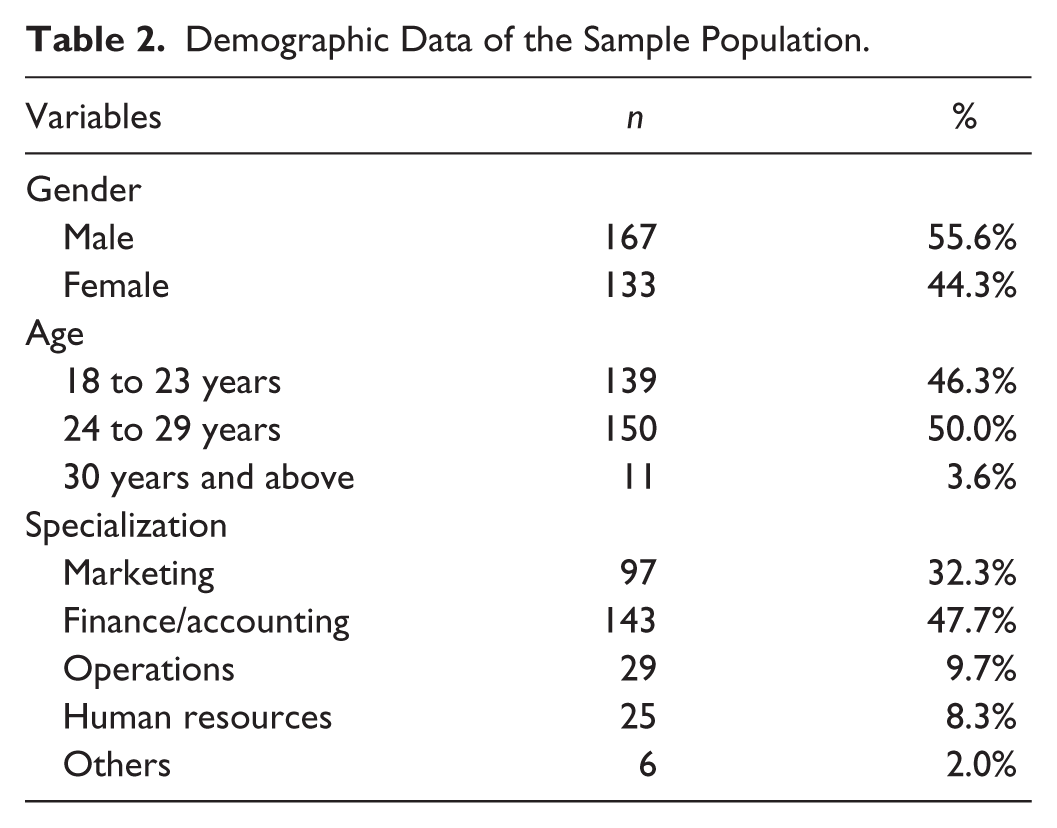
Demographic Data of the Sample Population.
Data Analysis Procedures
The analysis of this study was done using SPSS Version 1.7. The SERVQUAL score was measured using a difference between perceived and expected scores across the five service quality dimensions.
Demographic Profiles of the Respondents
Below mentioned is the demographic information of the participants which includes the age, gender, and specialization chosen for the management education. The demographic information is based on frequency distribution and percentage. Of the 300 respondents in this study, 167 (55.6%) were male and 133 (44.3%) were female students. The age groups of the students primarily had respondents aged between 18 to 23 years (46.3%) and 24 to 29 years (50%). The students were mainly from marketing (32.2%) and finance/accounts (47.7%) specialization.
Descriptive Statistics of the Variables in the Model of the Study
Table 3 shows the mean scores of service quality expectation and perception across five dimensions of quality and the mean gap scores. In the context of this study, the service quality is expressed as the gap score between the students’ perception (P) of management education and the expectation (E) of the students with regard to their education. The expectations and perception of Management Education was analyzed using statements ranging from five dimensions of service quality which included tangibility, reliability, responsiveness, assurance, and empathy. The value of the SERVQUAL model up to a great extent lies in the bearing of the statements used. The statements that were analyzed under the five dimensions of service quality were chosen to adapt to the management education perspectives that were identified in the process of pilot study. The research results in Table 3 show the mean scores of service quality expectation, service quality perception, and service gap. The total mean score of the management students in the UAE with regard to their expectation was 7.098 and the mean score of the students with regard to the mean perception for the seven universities rated was 4.28.The study showed a mean gap score of service quality for management education as −2.805.
Mean Scores of Dimension of Service Quality.

Comparing it across five dimensions of service quality, the students had highest expectation which related to the assurance (Total mean score = 7.7) dimension and the lowest expectation was relating to the empathy dimension (total mean score = 6.6). Apart from these two dimensions, students held very expectations with regard to two items of tangibility (Item: Materials associated with the university including databases, journals/facilities of the university to develop student interest and talent) and two items of reliability (Item: Providing management education as promised/shows genuine sincere interest in resolving any issues).
The perception of the students in relation to seven international universities, across five dimensions, was highest in relation to the assurance dimension (total mean score = 4.7) and lowest in relation to the responsiveness (total mean score = 3.7) dimension. The perception score was also high for one item of tangibility dimension (the material associated with the university such as journals and printed matter provides valuable information and is up to date) and an item of reliability (Item: Provides services at the time it promises to do so). The results also showed that an item in the empathy dimension (students are dealt within a very caring way) was rated under low perception for the management universities in the UAE.
Analysis of the gap scores (Q = P − E) also revealed that students’ expectations relating to certain dimensions of service quality with regard to management education were not completely met in relation to their perception. The biggest difference or gap was observed for the dimension relating to assurance dimension (gap score mean = −3.12) which primarily included items relating to the credibility of the degree provided and the provision of placement and career assistance. Also items like providing management education as promised (reliability dimension) and lecturers always willing to help students (responsiveness dimension) had a high gap score. The lowest gap score identified was relating to empathy dimension (gap score mean = −2.42). Table 3 also confirms that the Cronbach’s alpha values of more than .7 were calculated for the five dimensions. This implies that the items representing five items are statistically reliable.
Graphically, the average expectation and perception scores among the five dimensions of the SERVQUAL model reliability, tangibility, responsiveness, assurance, and empathy are shown in Figure 1, and the SERVQUAL index is represented in Figure 2.

Average expectation and perception score.
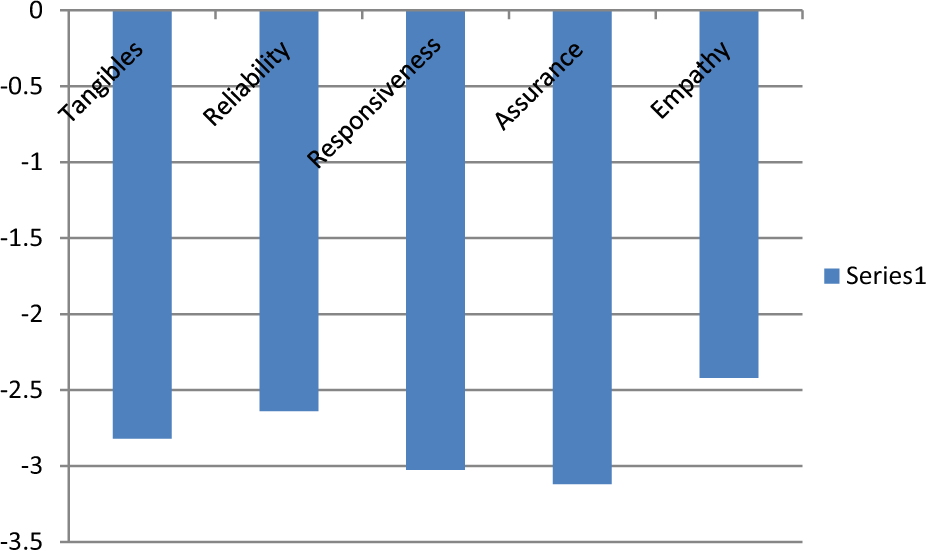
SERVQUAL index per dimension.
Discussion and Conclusion
The main purpose of this study was to identify those factors that play a significant role in improving the quality of management education in the UAE and thereby provide a conceptual and operational framework for this decision-making process. A basis of improving service quality in a university is by evaluating and controlling, which can be conducted by using the methodology given in this article. As a practical implication, the senior management of these universities could also focus on bridging these gaps and thereby attempt to gain a competitive advantage. Service quality was assessed across the standard five dimensions of responsiveness, assurance, tangibility, empathy, and reliability. The results of this study primarily showed that management students in seven international universities of the UAE held a negative perception of the education imparted to them, as the expectations held by these students were not met. The dissatisfaction held by the students spanned across all the five dimensions of service quality. This gap could be clearly explained by the gap theory (Parasuraman et al., 1985).
One of the most important issues highlighted in the study was a high Gap Score, the difference between the student’s perception and expectation that was noted in relation to the Assurance Dimension for Management Education in the UAE. The key contributor to this score were the statements on low credibility of the degree provided in these International Universities and the placement and career opportunities provided. This may be primarily due to the fact that most of these universities are branch campus of Universities from other countries. Although “international” as such, the regulating bodies like AbuDhabi Education Council (ADEC), DIAC, and Knowledge and Human Development Authority (KHDA) are trying to bring the quality of education to international levels while aligning it to the social and cultural milieu of the UAE, most of these are at various emirates. The institutes which are accredited by Ministry of Higher Education are the ones preferred by nationals and also the degrees are acceptable for employability in public sector. There is still a need for standard accrediting body or a national framework to regulate the quality of private institutions so that the quality is measurable and transferable in the international arena (Vardhan & Shahul Hameed, 2012) and also perceived by the student community that way.
With the number of management programs offered by universities in general and particularly in the UAE continually on rise, there is a growing concern about the quality. One of the greatest criticisms of the high growth of Universities imparting Management education comes from Altbach (2009b, cited in Tilak, 2011) who observes,
traders are interested in selling products in immediate demand, such as management studies, and not in sustaining research universities, enhancing access and equity for under-served communities, and the like. (p. 64)
However, the higher education system of the UAE is fairly young compared to the Western universities and many of the gaps may also be due to comparison with well-established Western universities by the respondents.
One of the other areas of the gap could be the lack of industry–academia collaboration. Although many of the federal universities in the UAE are successfully spearheading this, the branch campuses or the international universities are slowly working toward this collaboration. In the employment sector, there seems to be a bias toward the public sector occupations by the national population (Muysken & Samia, 2006). Also due to Emiratization which is about bringing the national workforce in the forefront of the economy, with many of the institutions catering to that goal.
The lowest gap of service quality scores was noted for the empathy dimension. The findings of the study also revealed that the students had high expectations in assurance dimension which is similar to the results of the study by Green (2014) in South Africa. Previous study results showed that the highest and lowest gap of service quality were on empathy and tangibility (Rasli, Shekarchizadeh, & Iqbal, 2012) for postgraduate Iranian students of Malaysian universities, empathy and reliability for faculty of law in Croatia (Legčević, 2009), tangibles and reliability (Yousapronpaiboon, 2014) for higher education in Thailand, tangibility and empathy (Enayati, Modanloo, Behnamfar, & Rezaei, 2013) of Islamic Azad University of Mazandaran.
The results are surprising for a country like the UAE, which as mentioned comprises of almost 70% population that are expatriates. Many of these universities have faculty as well as students from different nationalities. A much earlier study by Hannigan (1997) states that international students are usually dissatisfied when they do not share satisfactory relationships with their host students. It is remarkable to note that the lowest gap was on empathy dimension implying in general that the students were satisfied with the care and attention given by the staff and faculty, although they may be from a different nationality.
The negative gap scores suggest that these universities should prioritize and focus improvement efforts in order and in the areas of reliability, assurance, and responsiveness.
Management education is a direct contributor to the economy of a country, and the service quality gap should be considered by the institutions to improve the quality in the sector. Further analysis and comparison between the different nationalities on the service quality dimensions would provide a better idea on the expectations of the international community in the UAE. For future studies, an interesting area of research could also be to study these gaps in management education in other countries and compare it with leading management institutes in Western countries. A potential area of study could also focus on the factors that affect student’s expectations of management education.
Footnotes
Declaration of Conflicting Interests
The author(s) declared no potential conflicts of interest with respect to the research, authorship, and/or publication of this article.
Funding
The author(s) received no financial support for the research and/or authorship of this article.