




Abstract
This study describes the use of guided learning activities that exposed aspiring helping professionals to the challenges and discrimination experienced by individuals living in poverty. Pretest/posttest and qualitative analysis of participants’ reactions to a Poverty Simulation and a Bridges Out of Poverty Workshop were analyzed to explore perceived learning benefits reported by 43 master of social work (MSW) students. Incorporating poverty content into masters-level social work curriculum stimulated classroom discussions about how the lived experiences of individuals living in poverty impact the service relationship between helping professionals and clients. This observational study evaluated the effectiveness of the used strategies and methods in impacting individual assumptions about socioeconomic class and illustrated the value of university–community collaborations in supporting diversity education and awareness both on and off campus.
The neoliberal economic policies of the past 25 years have culminated in increased poverty rates and income inequality (Coburn, 2004). These policies include deregulation of private industry, privatization, and decreased public expenditures for safety net services and social service sectors such as education and health care, inevitably shaping individual views on causes and solutions to the social problem of poverty.
In 2014, the United States Department of Health and Human Services (USDHHS) set the poverty threshold for a family of four at $23,850. An impoverished family of four has just $1,987 a month to pay for housing, food, transportation, and utilities, among other costs (USDHHS, 2014). Many families at this income level work jobs that lack benefits and health insurance. They often live in substandard housing and many are just one crisis away from becoming homeless. Furthermore, the social problem of poverty impacts and impedes individuals’ ability to lead healthy and productive lives—impacting health and mental health outcomes, exposure to violence, access to services, and potential for social mobility (Seccombe, 2000, 2002).
Current Population Survey Annual Social Economic Supplement (CPS ASEC) 2013 findings indicate that individuals and families living below the poverty level comprised 14.5% of the U.S. population with 45.3 million people living in poverty (DeNavas-Walt & Proctor, 2014). In the county where this study was conducted, 10.1% of families and 13.6% of all individuals reported having an income at or below poverty level with only 9.8% receiving food stamps or Supplemental Nutrition Assistance Program (SNAP) benefits (U.S. Census Bureau, 2012). In addition, compared with the 50 most populous cities in the United States, the southeastern city in which this study was conducted was recently rated as having the lowest social mobility with only 4.4% of children born in the bottom fifth income level likely to move to the top fifth income level during their lifetime (Chetty, Hendren, Kline, & Saez, 2014).
This inability of a person to move up the economic ladder highlights tremendous racial and socioeconomic disparities in the region—factors which inhibit the ability of many individuals and families to reach goals of higher education and/or move out of poverty (Chetty et al., 2014; U.S. Census Bureau, 2010). As the only premiere urban research university in the region, it is the responsibility of the university to increase access and inclusion of community members of differing socioeconomic status.
Poverty-aware practice is advocacy and service provision that is grounded in an understanding of the centrality of poverty in the lives of those who experience it and acknowledge the intersection of poverty with other marginalized identities (Davis & Wainwright, 2005; Krumer-Nevo, Weiss-Gal, & Monnickendam, 2009). It also includes awareness of how living in poverty impacts the human experience at the individual-, micro-, mezzo-, exo-, and macro-systems levels. Rehner, Ishee, Salloum, and Velasques (1997) suggest that a helping professionals’ attitude about poverty impacts how they provide services, interact with their clients, choose interventions, and make referrals. To illustrate, a non-structural view of poverty increases the likelihood that helping professionals will be unsupportive, un-empathetic, and unable to challenge policy and organizational culture to best serve individuals living in poverty. These findings suggest that levels of poverty awareness impact helping professionals’ interactions and practice with individuals living in poverty.
Despite the broad impact of poverty, master of social work (MSW) programs have failed to adopt poverty curriculum to ensure poverty-aware practice (Davis & Wainwright, 2005). Protecting vulnerable and marginalized populations is a core value of the social work profession yet poverty awareness curriculum has not been a priority. A survey of the curriculum of 50 top social work schools found that only 12 offered more than one course on the topic of poverty (Harding, Ferguson, & Radey, 2005). Consequently, MSW students may overestimate the financial resources that impoverished individuals receive from benefits such as food stamps and welfare or minimum wage jobs (Ljubotina & Ljubotina, 2007; Rosenthal, 1993). Even though social workers make these acknowledgments, they fail to see themselves as agents of change whose role is to address the social ill of poverty (Davis & Wainwright, 2005).
Moreover, there is limited research on the role of graduate education in determining if future helping professionals view the cause of poverty from a cultural/behavioral or structural lens. MSW students who took a higher number of social work courses perceive causal factors associated with poverty to be related to societal factors such as situational or institutional factors that privilege some groups over others such as race, gender, class, and so on (Jordan, 2004). Gasker and Vafeas (2003) found social work students who had taken a social welfare course were more likely than students who had not to attribute poverty to structural factors and less likely to attribute causes of poverty to the characteristics of the individual (e.g., behavioral or cultural attributes). Yun and Weaver (2010) had similar findings reporting that of two groups of students with similar demographic characteristics, those who took a course that focused on the topics of food poverty policy, homelessness, and challenges faced by impoverished individuals were more likely to view poverty from a structural context than students who enrolled in a business class focused on the global economy.
Stigma is the devaluation of an individual based on his or her social identity; poverty stigma is the devaluation of an individual or group of individuals based on their financial standing (Reutter et al., 2009). In tandem with neoliberal economic policies, the neoliberal discourse in relation to poverty has characterized poverty as a result of individual failure and/or lack of competency (Beddoe & Keddell, 2016). Although reduction of stigma is in alignment with the social justice mission of social work, such discourse and policies may influence social work student perspectives about factors associated with poverty thereby influencing social work practice with individuals experiencing poverty (Beddoe & Keddell, 2016; Scheyett, 2005). Failure to acknowledge or address such stigma has scoping implications, as stigma is associated with social exclusion and exacerbates the impact of poverty (Crocker, Major, & Steele, 1998).
Educators have made a myriad of suggestions about components of poverty training that should be integrated into social work curriculum, ranging from courses focusing on social justice to decrease the fatalistic view of poverty to experiential learning exercises that require students to live at poverty level or apply for welfare benefits (Harding et al., 2005). Krumer-Nevo and colleagues (2009) have developed a conceptual framework for the integration of poverty-aware curriculum in social work education. This framework consists of four major themes: (a) theoretical knowledge acquisition, (b) practical knowledge acquisition, (c) acquisition of practical experience, and (d) development of self-reflection capabilities (Krumer-Nevo et al., 2009). The use of the framework has yet to be implemented on a broad scale and effectiveness of the framework in impacting social work students’ attitudes about poverty or practice behaviors has yet to be studied. To that end, this study incorporates the poverty-aware curriculum themes of theoretical knowledge acquisition and development of self-reflection capabilities. The poverty series provided students with opportunities to reflect upon their own ideologies and attitudes about poverty. This study, in part, aims to examine the effectiveness of these strategies in enhancing poverty awareness among social work students.
Methods
Poverty Series
The poverty series consisted of three events: a poverty simulation exercise, an adapted version of the Bridges Out of Poverty workshop, and a community conversation about poverty. The purpose of the poverty series was to provide campus and community members with meaningful experiences and tools to integrate into their classrooms, neighborhoods, agencies, and community interactions. Community partnerships were solicited to facilitate activities to enhance awareness about issues facing individuals living in poverty. The authors cultivated partnerships with the local Crisis Assistance Ministry to host the poverty simulation, with the Urban Ministry Center to host the Bridges Out of Poverty educational activity, and with local homelessness advocacy groups and school systems to promote and host a community conversation on poverty experiences of individuals and families.
Poverty simulation
Forty-eight MSW students and 32 community members participated in a poverty simulation designed to help participants begin to understand what it might be like to live in a typical low-income family. This experiential workshop lasted 3 hr and included an introduction, the simulation exercise, and a debriefing period in which participants and volunteers shared their reactions and experiences to the exercise. Resources were shared to help participants gain further knowledge about the concepts presented during the simulation.
A large room in a student center was transformed into a community with various service providers and vendors including a food bank, utility company offices, pawnshops, and other businesses and organizations. Participants were split into families of various sizes, income levels, and personal and financial responsibilities. During the simulation, the families were responsible for feeding themselves, paying their bills, caring for dependent children and aging or disabled family members, and going to work or school.
Bridge Out of Poverty (referred to as “Bridge”)
The Bridge was a half-day workshop focused on understanding and counteracting poverty and its effects and was attended by 43 MSW students. Based on models developed by Payne, DeVol, and Smith (2007), participants were encouraged to create a mental model of poverty, review poverty research, examine a theory of change, and analyze poverty through the prism of the hidden rules of class, resources, family structure, and language. The Bridge workshop provided participants with an understanding of class differences and common assumptions we make about people different from us. The workshop explored poverty from the perspective of individuals and families and provided strategies and tools that individuals/communities can use to address the pervasive problem of poverty.
Community conversation
The third event, a community conversation about child homelessness, consisted of the screening of the documentary Homeless: The Motel Kids of Orange County, followed by a panel discussion that was open to the public and was attended by 189 people. The community panel, which consisted of local school system social workers, service providers for homeless children, and faculty with a research focus on homelessness, acknowledged that there are many children and families affected by poverty and homelessness in the local community. The panel spoke about the barriers local homeless families face in exiting homelessness, local resources to address these barriers, and the problem of child/family homelessness in general. The discussion also addressed the systemic nature of social issues such as living wage rates, social fragmentation, and the need for advocacy, education, and greater individual awareness to address social issues.
Participants and Data Collection
The experiential learning activities of the poverty series were integrated with a macro-practice theory course that focused on the impact of organizations, communities, and social institutions and was taught by the first author. The focal point of each activity was to address and explore individual assumptions about socioeconomic status and how those assumptions intersect with a variety of diversity issues, most notably race, ethnicity, and social class.
This research study was approved by the Institutional Review Board for Research With Human Subjects at the research team’s university. MSW students were strongly encouraged to participate in both the poverty simulations and the workshops. Students were informed that their participation and feedback would not impact their course grade. Respondents were informed that data from the survey would be used to help develop an understanding of the impact that each type of event has on changing individual assumptions about socioeconomic status, as well as identify areas of improvement and focus for future diversity projects. Due to a scheduling conflict, only a few MSW students were able to attend this Community Conversation event. Hence, the study sample reported here is limited to 43 MSW students who attended both the poverty simulation and Bridge workshop (89.6% response rate).
Measures
A questionnaire was designed consisting of poverty-related measures, attitudinal items, and standard demographic characteristics. A modified version of the Beliefs About Poverty Scale (Smith & Stone, 1989) was used to assess attributions of poverty. Participants were asked to indicate the importance of 12 explanations for the causes of the “problems of poor people” on a scale from 1 to 5 (1 = not important, 5 = very important). Seven items of the original scale contained explicit, judgmental language, stating that poor people are “dishonest,” “dirty,” “lazy,” and have “lower intelligence.” As these items may not be applicable to measure social work students’ attitudes and are subject to social desirability bias, they were excluded.
The factors that represented the constructs of interest were (a) Individualism, or the belief that individuals are “responsible for their status in a system of social inequality,” and (b) Structuralism/Situationalism, or the belief that “disproportionately restrictive social structures do not provide equal alternatives for all people” (Smith & Stone, 1989, p. 95). A high score on the Individualism subscale indicates that the participant assigns causal responsibility for one’s poverty to individuals rather than systems, society, or social structures. A high score on the Structuralism/Situationalism subscale indicates that the participant assigns responsibility for the problems of people living in poverty to society or structural systems. Factor analyses by Yun and Weaver (2010) identified a third factor, namely, Stigma associated with poverty. This is particularly relevant for the sample of social work students.
Data Analysis
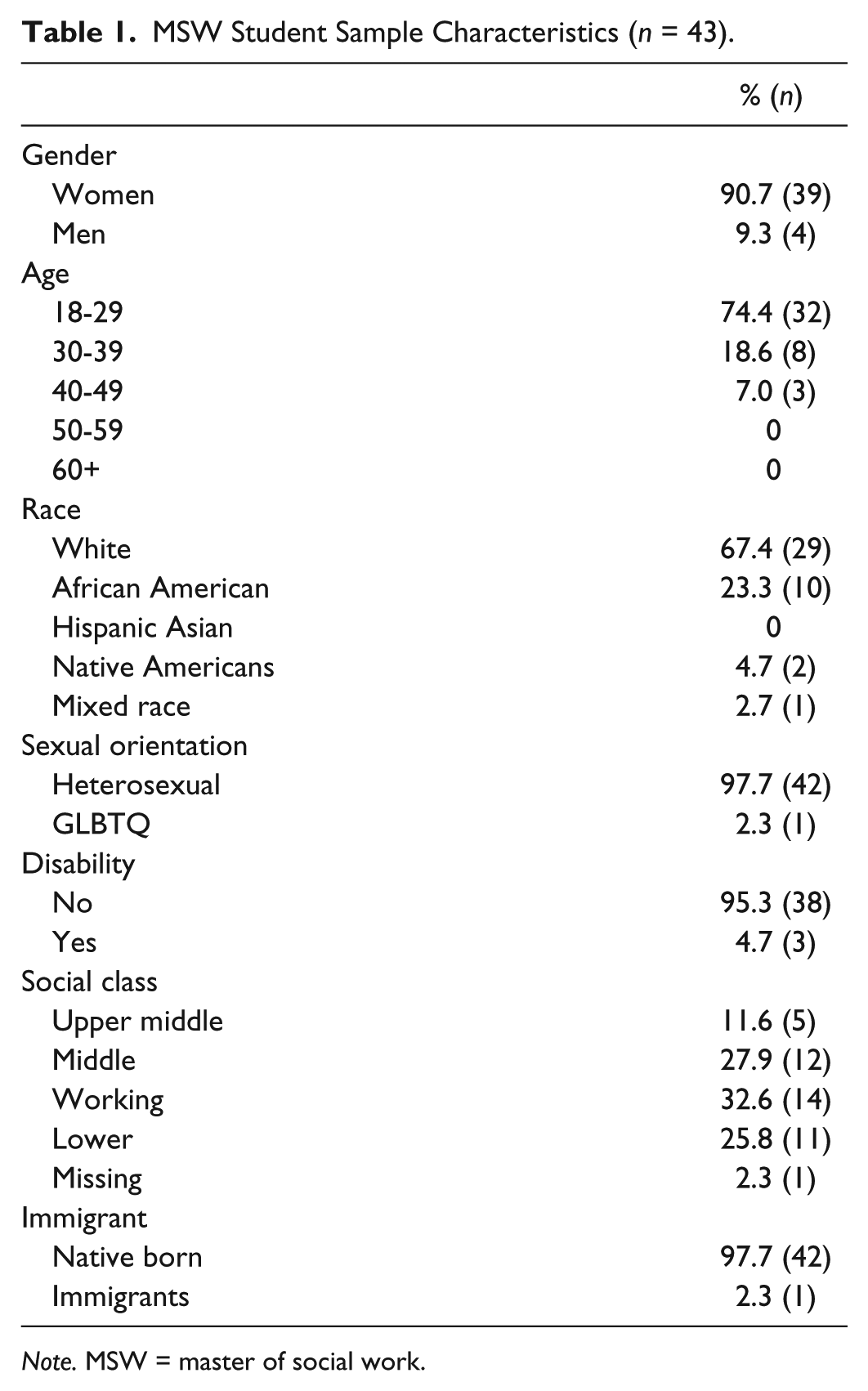
Descriptive statistics were used to report sociodemographic profiles of the poverty series event participants (see Table 1). Analyses of mean scores and paired t tests were conducted to examine any statistically significant change after the Poverty Simulation and Bridge workshop in MSW students’ beliefs and attitudes (Table 2).
MSW Student Sample Characteristics (n = 43).
Note. MSW = master of social work.
MSW Students’ Attitudes Toward Poverty Pre/Post Poverty Simulation and “Bridge” Workshop (n = 43).

Note. MSW = master of social work.
p < .05. **p < .01. ***p < .001.
Additionally, qualitative content analysis was conducted on MSW student reflection posts on an online discussion forum. To analyze this qualitative data, the authors used open coding derived from the grounded theory approach to examine the learning benefits reported by social work students (Glaser & Strauss, 1967). While reading (and re-reading) the text line-by-line, categories were generated through the “emic” process to capture experiences from the individual’s point of view (Denzin & Lincoln, 2005, p. 12). The interpretation was driven by themes that emerged from the data to guide the description of how poverty was understood and experienced by poverty series event participants.
Findings
Poverty Simulation
MSW students who completed the questionnaires had the following demographic distributions (rounded to the nearest percent): 91% were female; 67% were White, 23% African Americans, 5% Asian American, and 3% Native Americans; 74% were in their 20s, 19% in their 30s, and 7% in their 40s.
After the poverty simulation, participants were asked to share one word they thought captured their experience. Frequently mentioned responses were “frustrated,” “desperate,” “exhausted,” “hectic,” and “overwhelmed.” Positive reactions also included descriptions such as “interesting,” “informative,” “insightful,” and “eye-opening” about the kind of struggles that clients have to face. One learner reported,
This was an invaluable educational experience that changed my perspective. I was completely obliviousness to the realities poverty places on the lives of individuals and families. I never realized how impossible it was to escape poverty until I assumed the role of an individual in this situation.
The poverty simulation experience helped participants begin to understand what it might be like to live in a typical low-income family. Students expressed appreciation of the experiential learning opportunity. One student said, “It’s one thing to read about living in poverty, but experiencing it gives you a whole new perspective.” Another reiterated the sentiment stating, “Seeing my clients experience it and hearing the group mention it today . . . I took a step back. I’ve just never thought about it.”
Our content analysis indicated that four major themes emerged from students’ reflections postsimulation: (a) roles in the family, (b) a new understanding of stress and negative social behaviors, (c) difficult choices, and (d) implications for professional relationships.
Roles in the family
Participants assumed roles of 26 different families facing poverty. Roles included newly unemployed, “breadwinner” recently deserted, Temporary Assistance for Needy Families (TANF) recipients, individuals with disabilities/senior citizens receiving Social Security, among others. Students’ comments included their own reflection on taking a particular role in the family. Almost all students were able to put themselves in the shoes of each family member and speak from the perspectives of these assigned roles. Considering that over a half of students (58%) self-identified with working-class or lower-class families, they appeared to be very enthusiastic in empathizing with low-income families.
The task for each family was to obtain/maintain food, shelter, and basic necessities during four 15-min weeks while balancing the requirements of various service providers with the realities of daily life. A student who played a 9-year-old girl raised by a grandmother described,
From a child’s perspective I got to feel exactly how it felt to be ignored by my caregivers who were preoccupied with providing for the family. It is understandable that neglect is the highest form of abuse. Coming from an Education background, it brought back memories that many struggled with [Attentional Deficit Hyperactivity Disorders], a learning disability, or a mental health issue. Just like in today’s simulation, several of my [child] clients’ parents could not afford medications and it gravely affected their children’s work and classroom experience.
Another student who played a father and breadwinner for a family of four recalled,
I was laid off during the third week. If you are the only one working and the family depends on you, what do you do? You can’t have a pity party and you have to figure out different ways to make ends meet.
One student played a role of a father and husband concerned about his lack of engagement and connection with his family: “As the sole worker in the home, I found it frustrating that I didn’t know a lot about what was going on with my family. At the end of each week, some additional stressor had befallen our family.” Another student expressed that family engagement and involvement was secondary to meeting the basic needs of the family: “I spent most of my time working or running errands. I would only hear small bits about what was going on with my daughter. Life is tough when you have no choice but to miss important milestones.” Participants often found they did not have enough money or time to fulfill all of their obligations: They were required to face difficult challenges such as lack of transportation and having only enough money to pay for food or rent.
Enhanced understanding of stress and negative social behaviors
The second theme is related to daily stress encountered by impoverished families and related social behaviors. With regard to their family’s financial strain, a student reflected,
I was the only one working a low-income job. My income was spent on mortgage and utilities during the second and third week, and then on food and miscellaneous items the 4th week. My family was living paycheck to paycheck with some assistance from food stamps, my father-in-law’s disability check, and my daughter’s part-time job.
Another student who played a housewife developed gained insight regarding childcare-related stress and its effects on employment challenges experienced by her clients:
One of the clients I work with has been struggling trying to locate a job and care for her daughter and her boyfriend’s sons. Her grandmother will watch her daughter but not her boyfriend’s children, so she has had to turn down two jobs.
Some students gained a better understanding of “learned helplessness” and the feeling of being “stuck”: “Experiencing [service provider’s] lack of empathy for my hardships made me feel frustrated, like no one cared. I was so desperate to make ends meet that I began stealing without remorse.”
Narrative data revealed students’ understanding of negative social behaviors (e.g., robbery, steeling, revenge, etc.) as a consequence of stress associated with poverty.
Several participants admitted that they resorted to stealing to make ends meet. One remarked, “It was interesting how quickly I sought revenge when I was robbed. I bought a gun and began planning my revenge. I can see how robbery would be a real issue for someone in dire straits.” Another said, “Even kids were stealing money or whatever they could to help their own families.” One student expressed remorse for having to engage in negative social behavior: “I am sorry that my wife stole your money. We needed cash for my mother-in-law to get her prescription medicine. That does not excuse what we did.”
Reflecting on how the simulation captured the reality of poverty, students concurred that it was as real as it could be. One student stated, “It is no wonder that consumers and their families feel as stressed as they do. It is not a poor work ethic that has led to their life circumstances; it is a lack of access to resources.”
Difficult choices
Participants seemed to be in accord about lessons learned about difficult choices that individuals/families living in poverty face. For example, a student who learned that seniors on fixed incomes often must choose between buying medicine or food remarked, “These individuals have to work hard just to make it through 1 month. There’s always a trade-off; if they choose to do one thing, they must neglect another.”
Another student described the consequences of these difficult choices: “At one point, I had to choose between keeping our refrigerator or robbing someone to pay our bills. In the end, our bills were cut off.” The simulation allowed students to observe how difficult it can be for families to survive, reinforcing the realities of living in poverty. One student stated,
Many of our clients work harder to make ends meet than many of us. I stress about the extras and they stress about the basics. I think that this experience helped to show that the work ethic is not lacking in the working poor. They deserve our respect and admiration.
The poverty simulation led students to rethink the trade-offs that low-income families have to make. For example, lack of transportation limited some individual’s ability to go to work, seek child care or other services, and/or shop for their family:
Finally, it struck me that much of the stress was related to transportation. I thought about the number of hours people wait for buses with small children. Much of the week is spent waiting. We don’t give our clients the credit they deserve.
Implications for professional relations
Social work students in this study were sensitized to the challenges low-income people experience while navigating the complex service systems. Students shared their frustration about receiving services and what it was like to ask for help. One learner stated, “This simulation makes you more aware of the struggles our clients face. Social worker’s overwhelming caseloads and other things contribute to our attitude toward clients. I will be more mindful of my clients struggle in the future.” Another offered,
I have always been empathetic to those who struggle paycheck to paycheck but experiencing what they go through was helpful in understanding their frustration. Navigating the system and worrying about how you will keep your family afloat is too much to handle sometimes.
Some students also appreciated the opportunity for peer learning. One student shared,
It was interesting to see how people started to network among themselves instead of going to the agencies first. People only sought help when they were desperate. It is important for social workers to realize where clients are at and the stress that they are handling when they reach our office.
Another student who had previously attended a poverty simulation reflected that “repeating the simulation again opened my eyes to poverty on a larger scale. I gained a better awareness each time about poverty and how it affects individuals in the community.” Finally, a student speculated about the utility of administering the poverty simulation to high school students: “The exercise would give them insight into how difficult it is to manage basic life. It might encourage some students to make different choices.”
Bridges Out of Poverty Workshop
Qualitative analyses of reactions to the Bridges Out of Poverty Workshop were similar to student responses from the poverty simulation. However, the workshop had the added dimensions of focusing on the middle-class perspective and how the psychosocial stress response to poverty impacts behavior, skills, decision-making, and generational poverty.
One student offered, “The [bridge] workshop really made me understand the way the middle class sees the world compared with those in poverty. For examples, the way we think about money, relationships, and even social emphasis.” Another stated, “[The workshop] offered more insight into how there is a different mentality and set of skills that are required and developed in order to survive in poverty.” While still others noted that the workshop changed their view about low-income individuals’ willingness to take action to change their situation:
Yes, it helped me to see the stress involved and how you get caught in the present trying to survive. [The workshop] changed my expectations about client’s planning for the future and thinking of consequences . . . It also changed my idea that if they really wanted to they could improve their life.
At the end of the workshop, students discussed whether they had a perceptible change of attitude about what life might be like for their clients. The content analysis of students’ online discussion board posts revealed that the workshop as well as class discussion inspired empathy, understanding, and a greater ability to strive for social change. First, students appreciated knowledge gained with one participant stating as follows: “The workshop opened my eyes to a lot of the underlying stereotypes and beliefs that I have about poverty and individuals who are poor and helped me to see many things in a different light.”
Second, students reported developing a new understanding of social class. One learner commented,
I became aware of the hidden rules that affect how members of each socioeconomic class respond to the world. As a middle-class member, most of my time is devoted to work, achievement, and material security, and this notion was directly linked to this perspective. I also became aware of the family patterns and values of generational poverty. I was able to understand, find meaning, and connect with the identified cultural-elements of families in generational poverty.
Further, the workshop enabled some students to reflect on their own thinking and behaviors based on their social class. One participant shared, “Sometimes I’ll even catch myself thinking something and say “Wow, J. [student’s name], that’s very middle-class thinking of you.” Another stated,
[This workshop] enlightened us to the fact that regardless of our conscious thoughts, we still operate out of our personal idioms. It can take considerable effort to understand our client’s viewpoints unless we can let go of some of ours.
Overall, the poverty simulation and workshop helped students to see poverty from varied perspectives, examine their own biases about individuals living in poverty, and identify challenges to escaping poverty. Some students acknowledged that one of the most difficult things about living in poverty is being judged. One participant stated, “I also realized how challenging and stigmatizing it is for someone to receive government services and other service providers.” After participating in the simulation, students discussed a hope that participants took away a better understanding of people living in poverty and won’t be so quick to judge individuals living in poverty in the future. One African American student reflected,
The workshop helped me to see how I have judged other African Americans more harshly for not finding a way out of poverty, especially members of my family. I had always thought that because I was able to get away from poverty that they should be able to easily do the same if they really wanted to. This led me to feel that poor people were unmotivated or lazy.
The posttest of the Beliefs About Poverty questionnaire was conducted at the end of the Bridge workshop. Results of a paired t test indicated that 43 MSW students who participated in both the poverty simulation and the Bridge workshop reported significant changes on three items, one from each of the three subscales. Within the individualism factor, learners’ beliefs about different sets of values presented by low-income families were improved (t = −.4.78, p < .001). Within the Structuralism subscale, student willingness to support social programs for poor people was significantly improved (t = −2.65, p < .01). Among the stigma factors, students’ negative attitudes toward welfare recipients were improved (t = 2.38, p < .05).
Discussion
This observational study evaluated the effectiveness of teaching strategies and methods in impacting individual assumptions about socioeconomic class and to illustrate the value of university–community collaborations in supporting diversity education and awareness both on and off campus. Findings revealed that the poverty series helped students to enhance their understanding of the financial pressure, emotional strain, and difficult choices faced by families with living in poverty. Such understanding may encourage these students to rethink the positive and negative impacts that professionals can make in the lives of families with low resources.
Via this experiential learning, students reported increased empathy for clients who experience poverty-related stigma, acknowledging that individual factors influencing client situations may contribute to a negative self-image and decreased levels of personal agency to improve their situation. By participating in the Bridges workshop, MSW students were exposed to a framework through which individuals can take action to address poverty on an individual, community, and systems levels. This resulted in improved attitude toward welfare recipients and willingness to support welfare program. The Community Conversation on child homelessness provided participants with knowledge about the differential impact of implications of social phenomena on individuals living in poverty.
Applying the framework of theoretical knowledge acquisition and development of self-reflection capabilities (Krumer-Nevo et al., 2009), each activity enhanced participants’ understanding of the culture of poverty, provided an outlet for them to reflect on their own class status, and provided them with insight into the lens through which they view individuals who have a socioeconomic status different from their own. Hence, part of becoming poverty aware is not only acquiring knowledge about causal factors related to poverty but also about associated factors related to the stigmatization of poverty and the impact of such stigma on the individual.
Our findings align with previous research, which indicates that educated social work students are more likely to view the cause of poverty as structural in nature (Davis & Wainwright, 2005; Reutter et al., 2009). As evidenced by survey data and qualitative feedback, both the poverty simulation and the Bridges Out of Poverty workshop helped to educate social work students about the realities of the poverty and social justice locally and nationally (Jordan, 2004).
This study has important study limitations that merit attention. With regard to the validity of the modified Beliefs About Poverty scale (Smith & Stone, 1989), an obvious deficiency is that the scales use self-report and the items are relatively transparent. The students could respond with what they think to be professionally and socially acceptable responses. Further, this study was conducted with MSW students and may not be generalizable to all graduate students. Findings of this study should be interpreted in light of the study’s limitations.
In spite of these limitations, the poverty series provided MSW students with the opportunity for personal reflection, group discussion, and coordinated action. Particularly, our active outreach and partnership with community agencies is in alignment with higher education goals of external collaboration to support diversity both on campus and in the community. Our innovative community collaboration model is consistent with the University’s goal of institutional and community leadership in effectively addressing issues of diversity, access, and inclusion.
Finally, the Community Conversation event was able to engage a vast cross-section of community members including currently and formerly homeless individuals, faculty, students, service providers, and local government officials. While data from this event were excluded from the analysis, anecdotally, attendees of the event expressed gaining a greater understanding of the impact of programming for children experiencing homelessness through the client stories provided by the social workers and service providers.
Future series of community-engaged learning experiences should target campus and community members more broadly to provide more collaborative and diverse learning environments. Furthermore, future research should evaluate perceived learning benefits for this type of learning experience and the role of such community-engaged learning strategies in enhancing topical knowledge across community subpopulations.
Footnotes
Declaration of Conflicting Interests
The author(s) declared no potential conflicts of interest with respect to the research, authorship, and/or publication of this article.
Funding
The author(s) disclosed receipt of the following financial support for the research and/or authorship of this article: This study is funded by Chancellor’s Diversity Challenge Fund and the Scholarship for Teaching and Learning at University of North Carolina at Charlotte.