




Abstract
This article argues that understanding the relationship between welfare states and globalization can benefit from a “multi-typological” approach, in which a number of typologies are applied side-by-side as summaries of the relationships between particular aspects of social policy and globalization. Findings suggest that different welfare state typologies predict different aspects of globalization. The article concludes that the analysis of the connection between welfare states and globalization can benefit not from attempting to identify the most accurate welfare state typology, but from understanding the unique contributions made by each one.
Fundamentally, globalization is based on cross-border interactions between states, business, and people and therefore has a number of dimensions (Dreher, 2006). Within the recent work on welfare state regimes, globalization has been defined mostly in economic terms—in other words, consisting of the growth and pressure of international markets. Brady, Beckfield, and Seeleib-Kaiser (2005) apply a definition of globalization to the analysis of welfare states, defining it as the increase in international economic integration and exchange.
Kim and Zurlo (2009) argue that three main conclusions have emerged within analyses of the impact of globalization: that globalization undermines welfare states, welfare states can expand due to globalization, and globalization itself does not have a significant direct effect on welfare states. In the first case, welfare states lose much control over taxation revenues due to the capacity of corporations to move beyond political borders. At the same time, there is immense pressure on states to produce market-friendly policies that benefit trade investment, including austerity and reduced expenditure on social services. Within this argument, openness to trade is seen to be related to lower social spending and an inability to enhance existing programs.
In the second argument, globalization exposes states to the fluctuations of the global market, driving demand for social security. This tends to manifest in the shift from spending on benefits and transfers toward spending on services (Kim & Zurlo, 2009), usually targeted and means-tested, however. This argument also relies on the power of populations to demand social security policies from their governments. To ensure domestic consumption and mitigate economic exclusion, welfare states must protect domestic populations from the insecurities and fluctuations in global markets.
The third emerging argument suggests that welfare states maintain autonomy, and that policies are affected more by historical legacy and domestic institutional structures. This argument also holds that the popularity of welfare programs makes it difficult to dismantle. Some research has concluded that globalization has very little effect on welfare state policy structures (e.g., Brady et al., 2005).
Part of the reason for such diverse results in the study of globalization’s impact on welfare states is due to the complexity of welfare states, each one containing a wide range of policy strategies, structures, and areas, each of which is shaped by specific historical factors (Kasza, 2002). At the same time, globalization is extremely broad as a term and can be measured in many ways, even when the concept is reduced to economic aspects. The diversity of results identified by Kim and Zurlo (2009) suggests that the methods used to measure globalization have an impact on findings.
The purpose of this article is to examine the ways in which different welfare state regime typologies can contribute to the understanding of the relationship between welfare states and globalization. This will be done by identifying three recently developed, service-based welfare state regime typologies and examining the relationship between each typology and a range of globalization indicators. As each typology is based on a unique set of policy measures, the analysis performed in this article fundamentally assesses the connection between each of those policy sets (expressed as typologies) and globalization. This can help identify the specific policy areas within welfare states that are most affected by globalization.
The Typology Approach
Since Esping-Andersen (1990) applied a Weberian concept of ideal types to identify three main ideals that underlie Western welfare state policy structures, comparative welfare state research has studied a range of policy areas in scrutinizing the extent to which national approaches to social welfare resemble one or more of his major ideological types. This discourse has sought to encompass the main ways in which a state can, in the context of capitalism, respond to the needs of various segments of its population. Since 1990, much comparative literature on welfare states has focused to a great degree on verifying and improving (or critiquing) Esping-Andersen’s welfare state model (Danforth, 2014). There has been a concerted effort to modify his typology or develop alternative welfare state typologies and add new regime types (for a few examples, see Castles & Mitchell, 1992; Danforth, 2014; Ferrera, 1996; Korpi, 2000; Korpi & Palme, 1998). There has also been an increasing emphasis on the fact that social services are more difficult to quantify and have therefore lagged behind the use of expenditure-based measures in welfare state analysis (Stoy, 2014). The examination of social services is critical for another reason as well. Recent work has suggested that welfare states have not simply retrenched policies due to globalization but have shifted allotted funds away from transfers toward social service spending (e.g., Kim & Zurlo, 2009). The expenditure for such services has remained steady (or even increased), but the tax burden has shifted from capital to labor (Onaran & Boesch, 2014). For these reasons, it is imperative not only to include detailed analysis of welfare services within welfare state comparisons, but to measure as many aspects of welfare services as possible.
In the ongoing research into welfare state changes in a global era, many typological frameworks have emerged, each based on different aspects and areas of social policy. If we see the relationship between welfare states and globalization as an interactive one, emerging welfare state regime typologies should correlate with central aspects of globalization. In other words, globalization may not be unilaterally pushing states toward the neoliberal dismantling of social protections and programs, but rather the interaction between welfare states and global pressures may be forging new welfare state types, which therefore associate with both independent welfare state histories and emerging trends within globalization.
To explore the above issues, this article examines three recently developed welfare state regime typologies, each of which is based on particular aspects of social services. As each of the three studies measures different aspects of welfare state services, this method allows for an assessment of how different aspects of welfare services affect a state’s interaction with globalization. To expand the basis for comparison, two other welfare state typologies are included—the original typology of Esping-Andersen (1990) and a recent historical reassessment of that typology (Danforth, 2014). This allows for an assessment of the extent to which more traditional welfare state regime underpinnings may predict globalization indicators relative to the three typologies focusing on welfare services. The recent reworking provided by Danforth (2014) is used to represent how the original typologies have shifted during subsequent years (in other words, years of increasing globalization). If typologies based on different underlying welfare state dimensions are related to different aspects of globalization indicators, it would indicate the substantial depth of interaction between welfare states and global markets.
The three service-based welfare state regime typologies used here were chosen for three main reasons. First, they are all very recent. Second, they all operationalize welfare state services using measures related to health policy. The health policy field is service-heavy and has therefore been commonly used as a way to account for welfare services. Although the long-term goal should be to explore as many dimensions of social services as possible in the study of globalization, these three typologies are based on significantly different aspects of health policy and represent the recent tendency within research on welfare state services. Third, all three typologies were identified inductively using cluster analyses, meaning that the typologies emerged from the analysis of specific aspects of welfare services rather than being theoretically driven by previous welfare state regime typologies (even if they were thereafter compared with existing frameworks).
Each welfare state regime typology is built upon particular and unique state characteristics. A fuller picture of the relationship between globalization and the welfare state can be identified by examining the connections between such a range of typologies and key measures of globalization. In this way, this article illustrates a “multi-typological” approach to understanding the relationship between the welfare state and globalization wherein the underlying characteristics of each typology are associated with particular aspects of globalization. The goal, therefore, is not to identify the most accurate typology but rather to examine the contribution each one makes to understanding the complex interaction between welfare states and globalization.
Employment Patterns in Welfare Services
Stoy (2014) has laid the groundwork for a critical way of operationalizing welfare state services. Stoy’s analysis uses employment patterns in the fields of health care, child care, and long-term care to provide a “more holistic picture of welfare services regarding quantity, kind, and organization” (p. 346). Based on this analysis, Stoy generates an ideal typology based on social services (“Worlds of Welfare Services”). Stoy’s analysis builds directly upon Esping-Andersen’s (1990) welfare regime typology, arguing that the original formulations are still taken for granted and that this has entrenched the understudy of welfare services. In this way, Stoy’s typology is rooted directly within the foundations of welfare state regimes theory. Arguing that no welfare service can be delivered without personnel, Stoy uses public-sector employment levels as a measure of service quantity. Stoy also measures the kinds of services available using the share of personal service workers employed in the welfare sector, broadly distinguishing between work with a low level of personal care orientation and work focused on caring services (Stoy refers to this measure as “care intensity”). Stoy then measures public-sector employment levels using government expenditure on compensation paid to public-sector workers. Finally, Stoy incorporates the payer of services, measured as public expenditure on welfare services (minus spending on pharmaceuticals, housing allowances, and infrastructure) as a percentage of GDP. In these ways, Stoy’s welfare service typology is based on the person-to-person aspects of service delivery, which may address not only the shift toward services but also the ways in which individuals are affected by changes to policy that may be affected by global pressures.
Controlling and Regulating Access to Services
Reibling (2010) argues that the experience of patients themselves is a critical aspect of health care service structure that has been neglected in welfare state research. To address this, Reibling examines the regulations affecting individual access to services. She measures this using three central aspects of access that are governed by policies: gate keeping, cost sharing, and supply. Gate keeping reflects policies regarding how individuals can access and move through the system. In these systems, the general physician controls access to specialists and other aspects of the system through referral. This reflects the intention to control the use of expensive specialists and technology. Reibling measures several key aspects of gate keeping. The first is whether patients must be formally registered with a general physician. This registration may have restrictions based on things like rules governing how long a patient must remain registered to a particular physician. Access to a physician may also be subject to geographical limitations, either due to registration rules or travel barriers. A third aspect to gate keeping is how physicians are paid. Reibling measures this as whether physicians are paid using a capitation system, where they receive a fixed amount for every patient on their list, regardless of the services rendered to each patient. The final aspect of gate keeping measured by Reibling is whether patients require a referral from a general physician to see specialists. In some states, a referral is required, whereas in other states, patients can “skip” the referral (but then must pay a higher user fee) or can freely access specialists without a general physician’s input.
Reibling’s second indicator of access involves cost sharing. Cost-sharing requirements are used to limit the overuse of health services, particularly for less-severe health problems. Cost-sharing could involve a fixed fee, a percentage of the physician’s fee, or a deductible. Reibling creates a cost-sharing index that combines the above three aspects. The final aspect of access measured by Reibling involves supply. This is measured as the existence of medical personnel and technology, measured using physician, specialist, nurse, and MRI/CT scanner densities.
Welfare Liberalism
Pankratz (2014) argues that states’ responses to globalization may not be the general retrenchment of social democratic policies but rather the further development of particular aspects of liberalism. If welfare states are shifting within the context of globalization toward more liberal types of policies, it is important to develop comparative frameworks that account for a wider range of liberal possibilities. This is because welfare states can respond in different ways to increasing pressure to adopt market-friendly solutions. To address this, Pankratz identifies welfare-liberalism (as opposed to neo-liberalism) as a policy direction states may take. Pankratz argues that welfare-liberalism is composed of two main dimensions. The first is existence of social supports aimed at restoring an individual’s ability to participate in the market (e.g., by restoring health and allowing people to return to work). Importantly, these services are not designed to redistribute wealth (which would be a social democratic characteristic) but rather to ensure a more equal opportunity to compete for wealth. The second aspect of welfare-liberalism addressed by Pankratz is social class stratification. Pankratz argues that welfare-liberalism arose in opposition to historical social class distinctions (i.e., ascribed social status) and that welfare-liberalism can therefore be identified based on a lack of occupational distinction in social service structures. Pankratz measures the first dimension using inpatient health coverage, physician density, and acute-care bed density. He measures the second dimension using the number of occupationally distinct paid sick leave schemes and whether there is special sickness or injury support for government employees.
Esping-Andersen (1990): Decommodification and Stratification
For an assessment of whether traditional welfare state regime typologies correlate with globalization indicators, Esping-Andersen’s (1990) ground-breaking welfare state typology is also included in this analysis. His analysis classified capitalist welfare states based on two main dimensions: decommodification (whether state policies allow people to live independently of the market) and stratification (the extent to which policies maintain social class distinctions). His analysis identified three types of welfare states: liberal (which are based on private responsibility for welfare and means-tested access to support), social democratic (based on public responsibility for welfare and universal access), and conservative/corporatist (based on social insurance schemes connected to occupational areas and the assumption that family is the ideal source of care).
Because Esping-Andersen’s typology is based on two separate dimensions, in some cases, the classification of particular welfare states is debatable. For example, Belgium exhibited high levels of decommodification (and thus social democratic) but also high levels of stratification (which would suggest a conservative welfare state). Ireland is another example of a difficult-to-classify state, being liberal with regard to decommodification and conservative in terms of stratification. For the purposes of this analysis, less-decisive states are classified based on the detailed assessment by Ebbinghaus (2012), who calculated specific values assigned to each state as well as the consistency with which each state was classified in subsequent research using similar measures.
Historical Reassessment of Esping-Andersen
Danforth (2014) examined the extent to which Esping-Andersen’s original welfare state regime typologies have shifted over time. Using a wide range of measures to supplement Esping-Andersen’s original concepts, including public provision of services, income redistribution, poverty and defamilization, Danforth identifies the ways in which welfare state classifications have transformed between 1950 and 2000. Danforth concludes that the original liberal, conservative, and social democratic regime types have been succeeded by groups more closely tied to geographical location—European, Anglo-American, and Antipodean. Although Danforth uses three different sets of measures, the classifications used in this study are based on the measures identified by Danforth as representing the “fullest representation of the extended framework” (p. 174). Analysis of these measures revealed exactly the same classifications as Esping-Andersen for the years 1980-1995 and then transformed slightly thereafter. This shifting of welfare state classifications since 1995 suggests that increasing globalization has affected welfare state policy structures.
Indicators of Globalization
Globalization has, as an applied concept, included a number of aspects. These have included things such as global communication systems and information sharing, both of which emphasize the spread of cultural values. The globalized world has for the most part taken the form of a capitalist trading system. Because of this, national economies have become intertwined and governments have continued to depend on this market for financing (Kim & Zurlo, 2009). This has contributed to a shifting of tax burden from capital to labor (Onaran & Boesch, 2014). In a global system, borders have taken on different meaning for different social classes and different states—for example, while individuals remain constrained by border crossing regulations, free trade agreements have ensured that capital does not face similar obstruction.
Brady et al. (2005) operationalized globalization as the intensification of international economic exchange and economic integration, and this operationalization has been applied in subsequent study of globalization and the welfare state (e.g., Kim & Zurlo, 2009). In their analysis of the impact of globalization on the welfare state, Kim and Zurlo (2009) measured the dimensions of economic globalization using foreign direct investment (FDI), trade share, liberalization of trade (capital and currency), and openness of economic regulation. Koster (2009) reviewed existing studies on globalization and the welfare state and identified the most common ways in which economic globalization has been measured. In this way, Koster identifies three main dimensions of globalization that have been measured. The first dimension identified by Koster is trade openness, which is the sum of imports and exports divided by a country’s gross domestic product. This, for Koster and others, represents the actual level of trade performed by a state. A second commonly measured dimension identified by Koster is trade liberalization – the absence of trade barriers. The third common dimension in the measurement of globalization in welfare state research concerns FDI, which is used to represent the actual financial interactions between states. Koster points out that, regardless of how these dimensions have been used, they actually measure separate aspects of trade. Koster notes that there has been no attention paid to whether they have different impacts on the welfare state, even though particular studies that have used a range of globalization measures have actually reported different levels of association between each of these dimensions and welfare state structures.
At the same time, globalization may have direct impacts on the ability of individual people to participate in local society (and in particular, markets). Lightman, Mitchell, & Herd (2008) found that globalization has reduced the government’s tendency to invest in education and training for Canadian food bank users, and conclude that globalization has led to the prevalence of low-paid unstable work for those attempting to get off welfare. Honkala, Goldstein, Thul, Baptist, and Grugan (1999) found similar results in a study of homelessness in the United States. It is important to explore the extent to which welfare state characteristics mediate the above impacts of globalization.
Measuring Globalization Impacts
The analysis performed in this article attempts to gauge the relationship between each of the typological configurations and a range of globalization dimensions. The globalization measures used here represent traditional direct measures of globalization (such as international trade and investment) as well as factors that may be affected by globalization (such as population health and domestic employment). Data for globalization measures are taken from the Organisation for Economic Co-Operation and Development (OECD) Statistics Database (2014), World Bank Data (2014), and World Health Organization Database (2014). In each case, the most recent year of data available for each country is used. The measures are divided into six categories. The first category of globalization measures includes measures of each state’s actual trading activity. These measures address the aspects of economic globalization raised by Kim and Zurlo (2009) and Koster (2009). FDI inflows and outflows measure the direct investments by transnational corporations into foreign corporations, whereas imports and exports of goods and services as a percentage of GDP measure what Koster refers to as “actual level of trade” (p. 159). Finally, net trade in goods offsets imports against exports to address whether a state is exporting more than it is importing or vice versa.
The second category includes measures of a state’s ability to extract tax revenue. This is because the ability of a state to extract taxes is critical to its ability to provide welfare domestically or to trade within the global economy. Aizenman and Jinjarak (2009) demonstrate that globalization has generated a shift away from taxes that are easy to collect (like tariffs) toward taxes that are more difficult to collect (like value added and income taxes). Given the potential connection between globalization and tax revenue, the first measure used here is tax revenue per capita. This measure gives the amount of tax revenue a state has balanced against the number of people that state must provide for. The second measure is revenue from corporate tax as a percent of GDP, which measures the extent to which a state can extract revenue from companies that may be able to avoid taxes by investing (or moving) to foreign locations. The third measure is the proportion of the total population that is in the labor force, which is aimed at accounting for two things: first, the fact that a state must provide more support to a population where a greater proportion of the population is dependent rather than employed, and second, that a larger labor force means a larger base from which to draw income taxes.
The third measurement category includes measures of trade liberalization. These four measures are based on OECD Product Market Regulation Indicators, which are consistently collected and internationally comparable. The indicators measure the extent to which state policies constrain or facilitate competition and trade. The first measure used here, retail trade regulation, includes regulatory and licensing requirements for retailers as well as regulations about shop opening hours. This measure indicates the extent to which a state can influence domestic trade. Managing domestic trade can mediate the impact of global influences and also demonstrates the power of a state within local markets. The second measure, barriers to international trade and investment, includes policies that restrict FDI, tariffs, and differential treatment of foreign suppliers. The third measure, state control of business enterprise, includes the scope of state-owned enterprise, price controls, and government involvement in network sectors. While the second measure listed above includes policies that affect FDI indirectly, the final measure, statutory restrictions on FDI, is a specific OECD indicator that includes rules that explicitly seek to regulate FDI. The specific target of these policies means that this index gives a good indication of a state’s explicit approach to financial transactions between itself and other nation states.
The fourth category of measures includes measures of population health: infant mortality rate, life expectancy at birth, and adult mortality rate. Population health is a fundamental outcome of welfare provision. Recent research has demonstrated the potential connections between globalization and obesity (Goryakin, Lobstein, Philip, & Suhrcke, 2015), health services (Fernando, 2014; Grootjans & Newman, 2013), and infant, under-five, and adult mortality rates (Martens, Akin, Maud, & Mohsin, 2010). In addition, it has been demonstrated that globalization has affected health through changes in the trade of health-related services (Smith, Chanda, & Tangcharoensathien, 2009) as well as the growing requirement for the public health industry to address global trading (Lee, Sridhar, & Patel, 2009). For these reasons, the measures used here help assess how populations have been affected by globalization. Moreover, the three recent regime typologies compared here (Pankratz, 2014; Reibling, 2010; Stoy, 2014) are based on measures of health services, contributing to the importance of including health measures.
The fifth category of globalization measures includes the extent to which individuals are trained to participate in an information-based society. The first two measures, average Phenix Integrated Simulation Application (PISA) reading score for 15-year-olds and the proportion of 15-year-olds who have fewer than four educational possessions, address the ability to become literate—which is essential to participating in a society where more and more activity is information based. This also responds to the role of globalization in making new information technology available. Moreover, access to various forms of technology (e.g., the Internet) has become a considerable advantage in day-to-day life, and literacy is critical to their effective use. For this reason, the third measure is the number of cell phone subscriptions per 100 people.
The final category of measures includes unemployment and long-term unemployment. These measures capture the extent to which a population has access to paying work when businesses have global options for production and workers, such as outsourcing or streamlining production and service delivery. Insofar as unemployment is also used as a measure of the health of an economy, these measures help assess the impact of global pressures on local economies.
Analysis
The analysis performed in this article includes every one of the countries classified in each of the regime typologies for a total of 25 OECD countries. Table 1 shows each of the typologies as well as welfare state classifications.
Welfare State Regime Typologies.

The key objective is to assess the ability of each typology to predict each of the globalization measures. Therefore, correlations are done using eta2, which is a nonparametric measure suitable for correlating nominal-level variables (like welfare state types) with interval-level measures like the globalization measures. Eta measures the extent to which knowing a state’s regime classification improves the ability to predict its score for each measure. The calculation does this by comparing the error when using the overall mean to predict a country’s score on a measure with the error when using the mean only among countries in the same grouping. For example, if a country’s score for a particular measure is 5, and the overall average for all 25 countries is 9, then the prediction error is 4 (9 − 5) as the calculation uses the overall mean to predict that country’s score. Then, if the average score among only the countries within that county’s grouping is 7, then the prediction error using the within-group mean is 2. This means that prediction error has been reduced from 4 to 2 by using the county’s grouping within the typology. The eta2 statistic represents the percentage reduction and is expressed as a value between 0 and 1, which in this case would be 0.5 (50% prediction error reduction). In this way, the analysis reveals the extent to which a regime configuration predicts a state’s involvement in and response to globalized trading pressures.
Once eta correlations have been identified for each typology, key correlations will be elaborated using box plots. This will allow for an assessment of the specific aspects of policy (i.e., the underlying aspects of each typology) that seem connected to (or disconnected from) particular aspects of globalization.
Findings
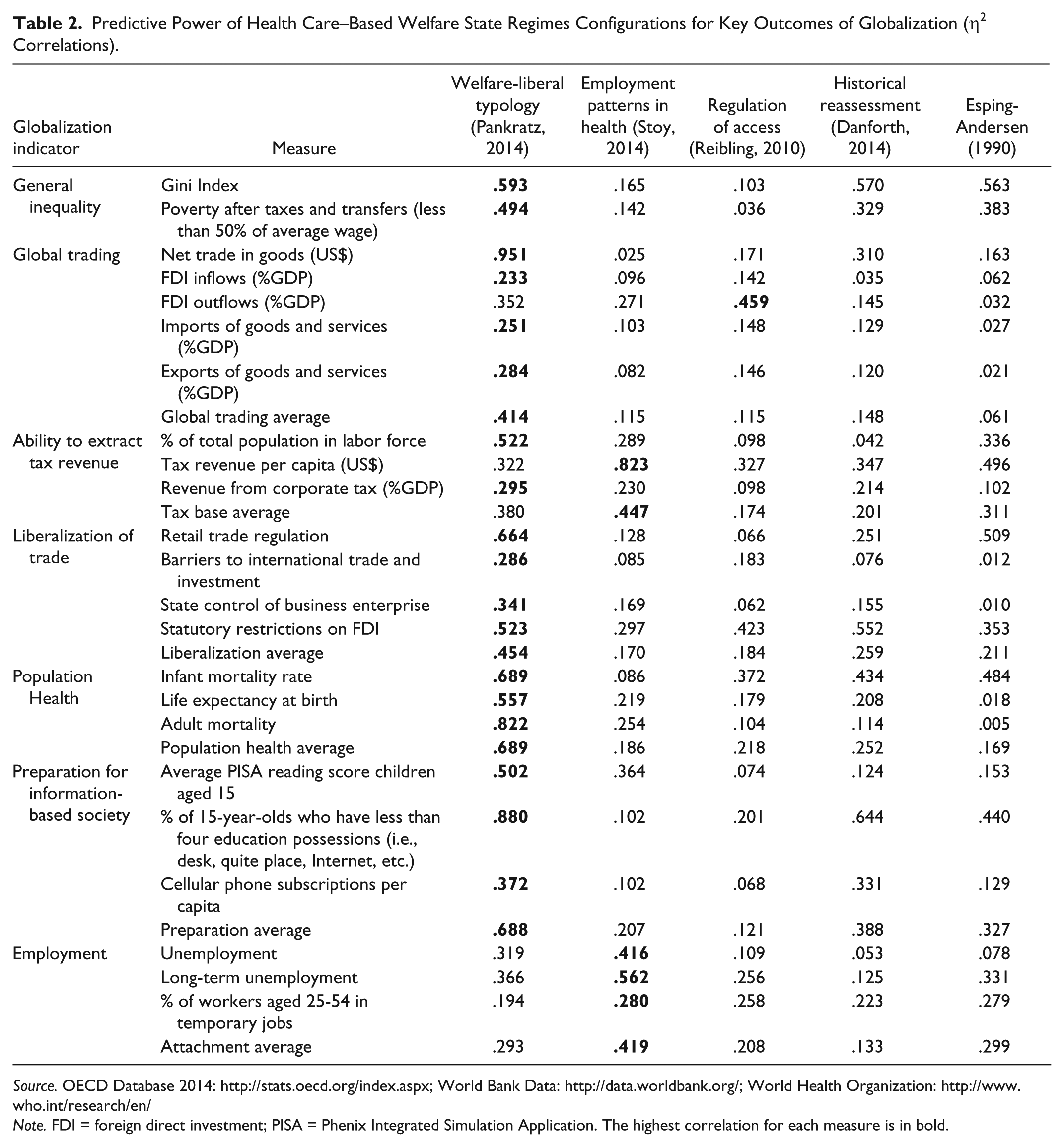
Table 2 shows all of the eta correlations between each of the five welfare state typologies and each of the measures of globalization. The figures in Table 2 suggest that typologies that are based on different underlying aspects of welfare states contribute in different ways to the understanding of the welfare state–globalization relationship.
Predictive Power of Health Care–Based Welfare State Regimes Configurations for Key Outcomes of Globalization (η2 Correlations).
Source. OECD Database 2014: http://stats.oecd.org/index.aspx; World Bank Data: http://data.worldbank.org/; World Health Organization: http://www.who.int/research/en/
Note. FDI = foreign direct investment; PISA = Phenix Integrated Simulation Application. The highest correlation for each measure is in bold.
Global Trading
Looking at the measures of global trading, the welfare-liberalism typology is the best predictor, but Esping-Andersen’s typology is virtually unrelated to these measures. This suggests that welfare state services are connected with a state’s trading behavior, as the welfare-liberalism typology is based on the availability of support for individuals who are unable to work as opposed to monetary transfers. The regulation of access typology (Reibling, 2010), based on the extent to which a state controls or facilitates individuals’ access to health care services, is the most strongly correlated with FDI outflows. In general, it appears that the availability of and access to services for individuals is correlated with a state’s global trading pattern. This may mean that the existence of and access to services is affected by global pressures.
Koster (2009) has argued that little work has paid specific attention to the fact that trade openness, liberalization, and FDI are different measures and that each may have a different effect on the welfare state. Koster argues that trade openness (measured as imports and exports as proportion of GDP) is more often correlated with the welfare state than liberalization of trade. This analysis, however, indicates that those measures are not strongly correlated with any of the typologies examined. The strongest correlations are with the welfare-liberal typology, but even those are relatively low (η2 = .251 for imports and .284 for exports). Correlations are even lower for Esping-Andersen’s (1990) original typology as well as Danforth’s (2014) reassessment of those regimes. In general, measures of global trading do not correlate strongly with any of the regimes other than two exceptions.
First, there is an extremely strong correlation between the welfare-liberal typology and net trade in goods (η2 = .951), which begs further consideration. The United States is extremely unique in this regard, which may contribute to the relationship as the welfare-liberal typology singles out the United States as its own type. This suggests that the measures used for that typology are sensitive to this uniqueness, which is why the United States is separated in that typology. To examine the extent to which this is driving the strong correlation, eta was calculated again excluding the United States from the calculation. In that instance, the correlation remained quite strong (η2 = .757). Figure 1 shows a box plot that allows for a fuller examination of this strong connection.
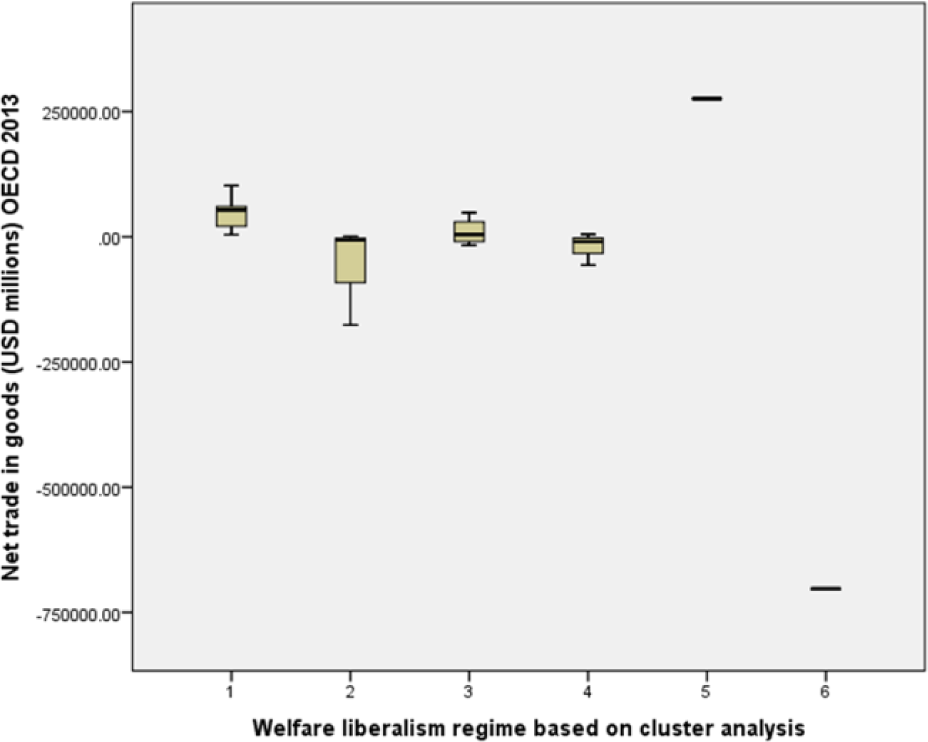
Net trade in goods across welfare-liberalism types.
Figure 1 clearly indicates the uniqueness of the United States (Type 6). However, the other country that is singled out by the welfare-liberal typology, Germany (Type 5), is also unique, having a value much higher than any other state. This suggests that the welfare-liberal typology is also sensitive to the uniqueness of Germany. Relative to the United States, the other countries look similar in the plot, but types remain fairly unique from one another. In particular, Type 1 (Australia, the Netherlands, Norway, Sweden, and Switzerland) tends to be uniquely high. These countries do not have special sickness support for government workers or occupationally distinct sick leave schemes, combined with higher physician density than the other states with no occupational distinctions (Canada, New Zealand, and United Kingdom).
The other relatively strong correlation with net trade in goods is the connection between FDI outflows (% GDP) and Reibling’s access regulation typology (η2 = .459). Figure 2 shows the box plot for this relationship.

Foreign direct investment outflows (% GDP) and health services access types.
Looking at Figure 2, it is clear why the eta correlation is moderate. The slightly lower correlation is because there is large variation within two of the types (cost sharing and strong gate keeping). However, it can be seen that cost-sharing countries tend to have the highest FDI outflows, while strong-access types and gate keeping and cost-sharing regimes tend to be lowest. This suggests that policies regulating access to social services may be affected by globalization or that such policies are related to the extent to which a state’s resources exit through direct investment by other countries. For example, a state that loses wealth and resources due to investment from other countries may tend to structure access to social services in various ways in response to the impact on social conditions.
Extraction of Tax Revenue
Measures of each state’s tax base reveal again a unique picture. The welfare-liberalism typology is again a strong predictor, but Stoy’s typology based on employment patterns in health services is overall the strongest predictor, particularly with regard to tax revenue per capita (η2 = .823). Considering also the fact that Stoy’s typology includes by far the largest number of countries (25), this indicates a clear and meaningful correlation. This suggests that public-sector employment patterns like the share of personal service workers within the welfare sector are connected with the taxes a state can collect. It is possible, therefore, that having a greater focus on personal care in welfare services mediates the impact of globalization on a state’s ability to extract tax revenue. This could also mean that as a state loses the ability to extract taxes, it shifts its focus within the public sector toward or away from personal care-related employment.
For measures of a state’s ability to extract tax revenue, the welfare-liberalism typology best predicts the proportion of the population in the labor force (η2 = .522). However, there is an extremely strong correlation between tax revenue per capita and the employment patterns typology from Stoy (2014). Figure 3 shows the box plot for this relationship.
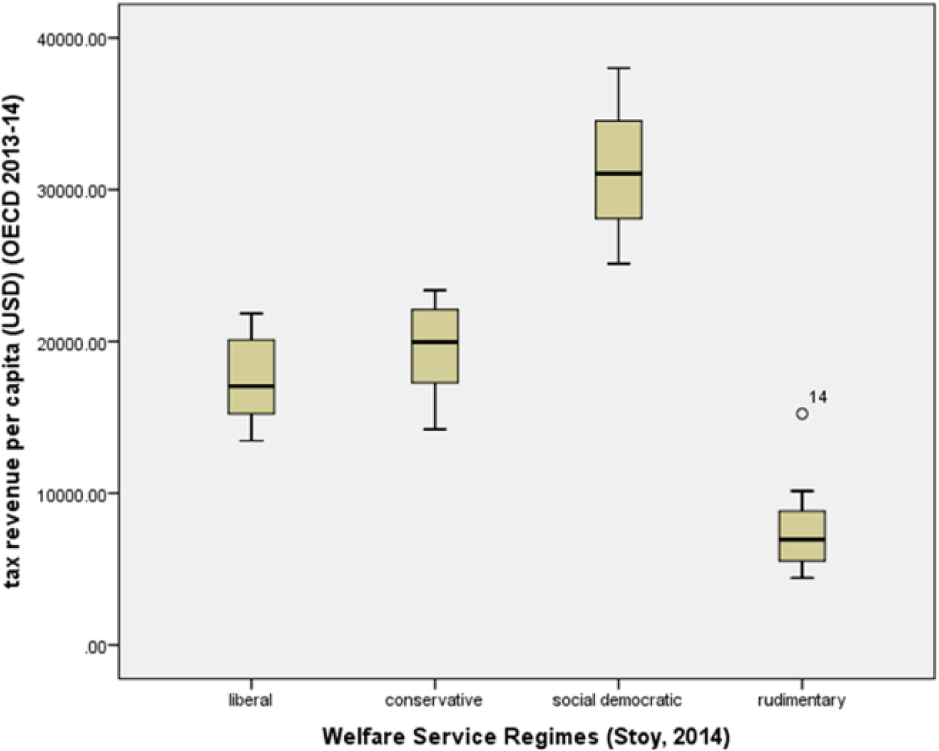
Tax revenue per capita and health employment types.
In Figure 3, it is clear that without exception, social democratic states extract the highest tax revenue per capita. In this typology, this type is characterized by a high level of social service provision (high employment in the public sector) and a high level of personal service workers among those employed in the welfare sector (i.e., workers who deal in caring for clients/patients rather than doing technical jobs independently of clients). These policy characteristics likely require the higher taxation revenue, and these findings suggest that if global trading pressure limits states’ ability to extract taxation revenue, it may lead to a reduction in public-sector employment, particularly in the caring work.
At the other end of the spectrum in Figure 3, it can be seen that the rudimentary states are associated with very low tax revenue per capita. Even the extreme high-end outlier (Italy, Case 14) remains below the average of the other three types. In this typology, rudimentary states are characterized by moderate levels of public-sector employment with a low proportion of those workers doing direct health or social care. These states are also characterized by low levels of welfare services and social expenditure. The finding in Figure 3 seems to support this, as these states clearly extract the lowest amount of tax revenue per capita. Interestingly, the United States falls within the conservative type, which tends to extract more tax revenue. This could be related to the fact that expenditures, which can necessitate taxation, are often cost driven. In other words, private-sector involvement in health care can drive up costs, requiring higher levels of taxation despite lower levels of actual services to the general population.
The correlation illustrated in Figure 3, then, supports the possibility that any global pressure bearing on the ability of a state to collect taxation revenue may have a direct impact on caring work and the availability of social support. Importantly, however, this correlation may work in the opposite direction. Namely, if a state can maintain higher levels of service and public-sector employment, it may insulate against global pressures on taxation facilitating faith in the state on the part of the general population.
Liberalization of Trade
Liberalization of trade is actually a measure of policy structures rather than policy outcomes. For example, retail trade regulation is not an outcome of policy, but a policy set in itself. However, it is important to understand the ways in which different welfare states configure their regulatory policies given the context of globalization. Liberalization of trade is strongly predicted by the welfare-liberalism typology. This is particularly the case for retail trade regulation and statutory restrictions on FDI, but it is the best predictor for all four of the measures. The typologies based on health service access and employment patterns are correlated with statutory restrictions on FDI, while Esping-Andersen’s and Danforth’s correlate with restrictions on FDI as well as retail trade regulation. In general, though, the welfare-liberalism typology based on availability of health services and occupational distinctions best predicts all measures, including state control of business enterprise and barriers to trade, both of which are not strongly predicted by any of the other three typologies. Findings also suggest that public-sector employment patterns (Stoy) and access to care (Reibling) are not correlated with a state’s trade regulation policies.
Part of the strength of the welfare-liberal typology in predicting trade regulation policies may come from the fact that this typology singles out the United States, which may be an outlier in this regard. However, recalculating the eta2 correlation excluding the United States does not change the typology’s ranking with regard to predictive strength. In the case of retail trade regulation and statutory restrictions on FDI (the two strongest correlations), eta2 reduces by only .002 in each case.
Figure 4 illustrates the correlation between welfare-liberalism types and retail trade regulation. Here, a fairly clear distinction can be seen between types. Type 1, which as noted earlier is characterized by a lack of occupational distinctions combined with higher physician densities, has the least restrictive trade regulation. The exceptional outlier is Norway, which is more regulated, but still below the overall average across all countries.
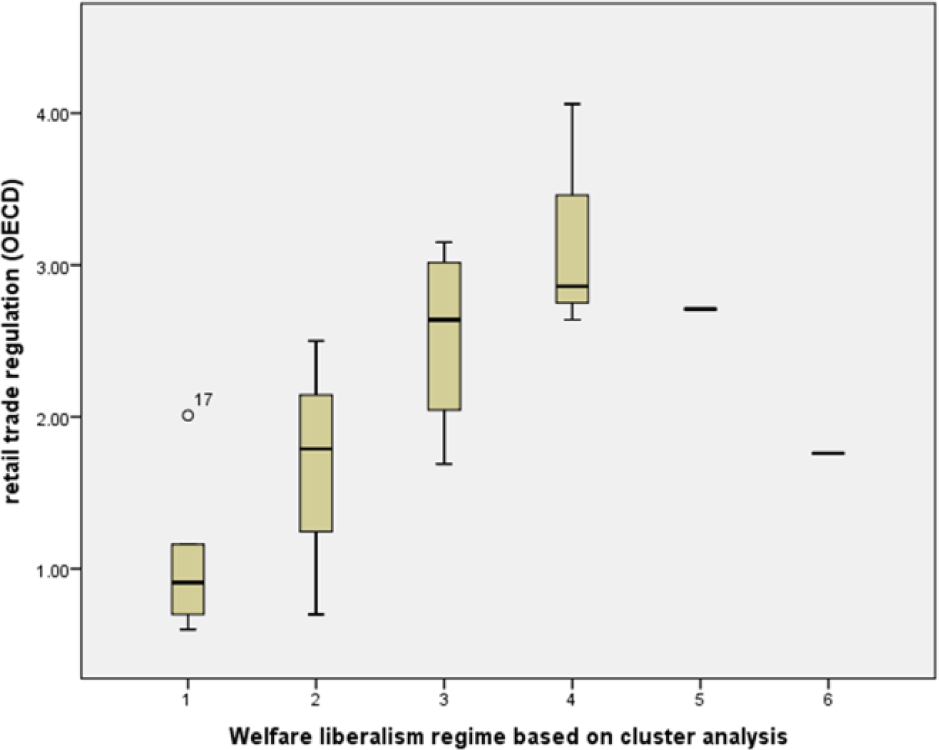
Retail trade regulation and welfare-liberalism regimes.
The highest level of trade regulation can be seen in Type 4. This group is characterized by occupational distinctions, moderate physician densities, and high inpatient care coverage. Germany (Type 5) scores similarly to Types 3 and 4, while the United States is similar to Group 2, suggesting that these two countries are not unique when it comes to retail trade regulation despite the fact that the welfare-liberalism typology singles out the two countries. Nevertheless, there is a visible pattern, with the other four types exhibiting different levels of regulation, suggesting that the underpinnings of welfare-liberalism are related to retail trade regulation policies.
We can learn more about retail trade regulation by examining the other typology that is strongly correlated—Esping-Andersen (1990), as illustrated in Figure 5.

Retail trade regulation and Esping-Andersen typology.
In this case, we can see that the correlation between the typology and retail trade regulation is based on the fact that one of the regimes in particular (conservative) has much higher levels of retail trade regulation than the other two types. The conservative type is based largely on occupational distinctions, so this supports the relationship illustrated in Figure 4—namely, that occupational distinctions within policy structures is associated with higher levels of trade regulation. Figure 5 also shows that liberal and social democratic regimes exhibit similar levels of regulation, suggesting that Esping-Andersen’s other central dimension (decommodification) may not be directly associated with trade regulation policies.
Population Health
Table 2 also shows that the welfare-liberalism typology does the best job of predicting population health outcomes. In this case, the gap is considerable, as the overall prediction error reduction average is .689, compared with a second best of .252 (the Danforth typology). Among the three typologies based on aspects of health services, this suggests that employment patterns and regulating access to care have a smaller connection with population health than physician density, acute-care bed density and inpatient health coverage, which are the underpinnings of the welfare-liberalism typology. Given the extreme uniqueness of the United States in the area of population health, the welfare-liberalism typology is advantaged by its ability to detect the United States’s uniqueness. To account for this, redoing the analysis excluding the United States still gives high eta2 values for all three measures: infant mortality (.507), adult mortality (.673), and life expectancy (.215). Prediction of life expectancy is affected the most, but it remains near the top while the ability to predict the other two health measures remains the best among the typologies. Figure 6 illustrates the association between the welfare-liberalism typology and adult mortality (the strongest correlation).

Adult mortality across welfare-liberalism regimes.
It is clear why the eta correlation dropped from .822 to .673, as the United States is an extreme outlier. But the correlation remains quite strong without the United States, driven by the fact that Groups 1, 2, and 4 do not overlap at all, with Group 4 having the highest adult mortality and Group 1 having the lowest. Group 1 countries have higher physician density than those in Group 4, which each have a high number of occupational distinctions. This suggests that adult mortality is lower in places where there are more physicians and higher where there are occupational distinctions within health care policy structures, which may indicate a more fragmented benefit delivery system.
Esping-Andersen’s (1990) typology is correlated with infant mortality (η2 = .484), with Social Democratic states having the lowest rates and liberal states having the highest. However, the typology does not predict either adult mortality or life expectancy.
Participation in an Information-Based Society
The next set of measures account for the extent to which individuals are prepared to participate in an information-based economy. The welfare-liberalism typology is the best overall predictor of these three measures, but Stoy’s typology based on employment patterns is correlated with children’s literacy. Danforth’s reassessment of Esping-Andersen is strongly correlated with children’s access to educational possessions and is the second highest predictor overall for these measures. It is also close to the top regarding per capita cell phone subscriptions. Nevertheless, children’s PISA reading scores are most strongly predicted by the welfare-liberalism typology (η2 = .502), and this correlation remains strong even when the unique United States is omitted (η2 = .493). That typology also best predicts cellular phone subscriptions per capita.
The proportion of 15-year-olds who have less than four educational possessions is strongly correlated with Danforth’s historical reassessment typology, with the European states having the lowest and the Anglo-American states the highest (see Figure 7).

Historical reassessment typology (Danforth) and children’s education possessions.
Figure 8 shows that among the welfare-liberalism clusters, the United States (Cluster 6) is an extreme outlier with a very high proportion of children owning less than four educational possessions, whereas Germany (Cluster 5) has the lowest. Besides those cases, Cluster 2 (characterized by low physician densities) contains the highest proportion of children with few educational possessions. As the United States (Cluster 6) also has a low physician density and a very high proportion of children with few educational possessions, it appears that in general, low physician densities lead to higher levels of educational deprivation. This relationship is supported by the fact that Cluster 3, characterized by high physician densities, has the lowest levels of educational deprivation.

Welfare-liberal regimes and children’s education possessions.
Employment
The final set of globalization measures, employment, shows an important contrast. The strongest predictor of unemployment and long-term unemployment is Stoy’s typology based on public-sector employment patterns. This is important because it suggests a connection between employment in the public sector and employment more generally. If globalization pressures affect employment, then, it may not be solely because of the impacts on industry but also because governments may alter their public-sector employment policies.
Figure 9 illustrates the correlation between the health services employment patterns typology and long-term unemployment. Long-term unemployment is the highest in the rudimentary states, which are characterized by moderate levels of public-sector employment, but low employment in the social and health care service areas. These states also exhibit low levels of social expenditure generally (Stoy, 2014). The lower level of employment in the social services may affect unemployment in two ways. First, that the state employs fewer people means there are fewer jobs in general. Second, having fewer people and less expenditure in the area of social welfare services could result in fewer employment support services for those seeking jobs. This would directly affect long-term employment, the measure most strongly correlated with this regime typology. Figure 9 also shows that Social Democratic states have the lowest long-term unemployment levels. In Stoy’s analysis, these states have the highest levels of employment in social welfare services, further indicating the connection between social service employment and long-term unemployment.
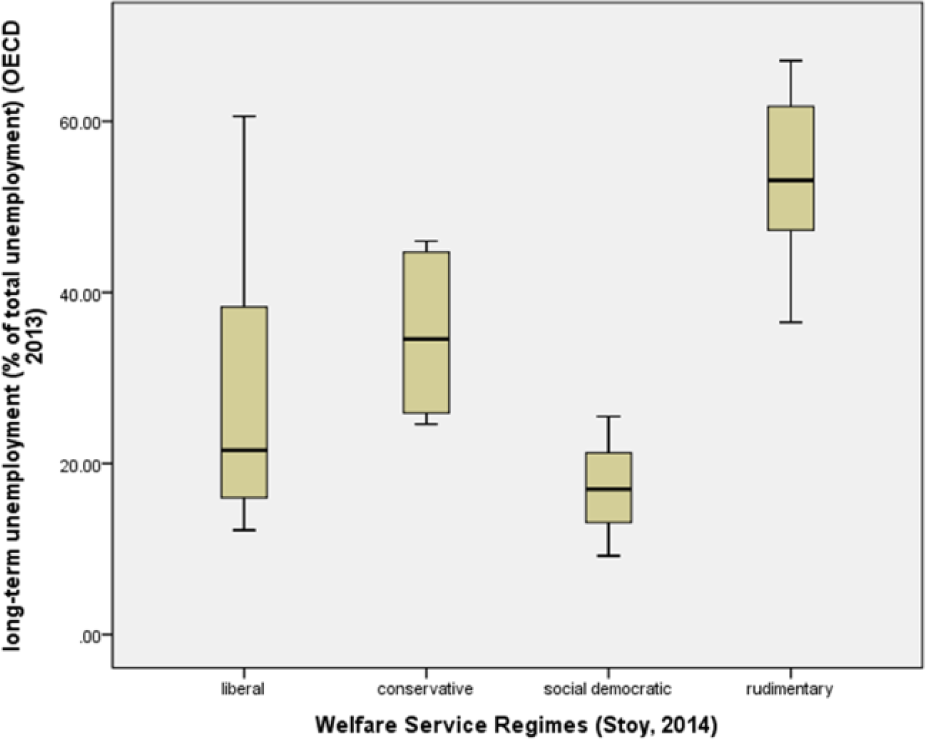
Long-term unemployment and health care employment patterns (Stoy).
Considerations Regarding the Comparison of Different Typologies
Welfare-liberal regimes use fewer countries (17) and have the most types (6), which increases the predictive power. In using typologies, there must be a balance—having too many clusters reduces the ability of a typology to identify important commonalities between different welfare states, while having too few clusters makes it difficult to identify important distinctions. This issue plagues Danforth’s (2014) reassessment of Esping-Andersen’s (1990) typology. In fact, one of Danforth’s resulting criticisms of Esping-Andersen’s measures is that they currently lack the ability to distinguish between welfare states, which affects the ability of both typologies to predict many measures of globalization.
At the other end of the spectrum is the welfare-liberalism typology of Pankratz (2014), which uses only 17 countries and yet identifies six distinct clusters. This boosts the predictive power of this typology. Results of this analysis suggest that the measures used by Pankratz are sensitive to the United States and Germany’s uniqueness, which also seems connected with those countries’ globalization indicators. In addition, excluding the United States from analysis of the welfare-liberalism typology does not change the typology’s predictive ability in any way that would change the conclusions drawn in this article.
Stoy’s typology uses the highest number of countries (25), which makes its reduction in prediction error more meaningful. For example, a 20% reduction in prediction error (an η2 value of .20) is more meaningful when there are more countries included because it tells us about a wider range of welfare states. At the same time, having fewer types suggests that Stoy’s measures are less sensitive to policy aspects that are closely correlated with globalization measures.
Finally, Reibling’s (2010) typology of health services access regulation does not include countries that are typically considered to be more market oriented (e.g., liberal welfare states). This is a general shortcoming with regard to the typology’s contribution to the analysis of globalization. However, this also means that Reibling’s typology offers a look into the relative structures of welfare states without the impact of market-oriented states on the clustering process. Because of this, Reibling’s typology allows for the identification of more subtle distinctions between a particular subset of welfare states. This may be why the eta correlations for this typology are in general lower than those of the other typologies.
Implications for Domestic Policy Structures and Globalization
The analysis performed here suggests that different aspects of welfare state policies, as measured within the development of various regime typologies, connect with different aspects of globalization. Policy aspects that do not correlate with globalization measures are critical because the lack of correlation suggests that such policies may be able to function regardless of global pressures and responses. The fact that the underpinnings of Reibling’s regulation of access typology are not correlated with general inequality or poverty suggests that the ways in which individuals move through the health care system may not be directly connected to poverty. This aspect of policy may also be relatively independent of the state’s control of business enterprise and retail trade regulation. Taken together, this suggests that the regulation of access within the health care system could potentially be improved despite globalization pressures.
Employment patterns in health and social services, which underlie Stoy’s (2014) typological distinctions, are not strongly correlated with any of the measures of global trading patterns. It is possible, then, that the ways in which a state manages public employment, while it has impacts on the domestic population, may not be directly affected by the state’s global trading patterns. This suggests that a state can forge its position within the global economy without having to restructure domestic social services. Public-sector employment patterns, however, are correlated with taxation characteristics, suggesting that global pressures to manipulate domestic taxation may have an impact on public-sector employment. Taken together, this may mean that to protect social services, a state may need to focus on strategic responses to taxation pressures rather than altering its global trading patterns. Finally, it appears that public-sector employment patterns are related to domestic unemployment, suggesting that unemployment resulting from global pressures (e.g., outsourcing of work) can be addressed by increasing employment in the public sector, and that this should be prioritized over the liberalization of trade, which is not strongly correlated with Stoy’s typology.
Keeping in mind the above-noted advantages held by the welfare-liberalism typology (e.g., that it uses fewer countries and has more clusters), correlations are high with inequality, liberalization of trade, and population health. This suggests that policies aiming at equalizing opportunity (a key element of welfare-liberalism) should be the focus of the state when responding to global pressures to liberalize trade.
Finally, it appears that the traditional typology of Esping-Andersen (1990) as well as the historical reassessment of it (Danforth, 2014) remains relevant for explaining factors that relate to globalization. This is particularly the case for domestic inequality, but also for the preparation of individuals for participation in an information-based society, retail trade regulation, and tax revenue per capita. In many of those areas, Esping-Andersen’s typology outperforms Danforth’s reassessment.
Conclusion
This article has demonstrated a multitypology approach to understanding the interactions between welfare state policies and global activities and pressures. In this way, established welfare state typologies can be used as representatives of the particular social policies and structures on which they are based. In this analysis, three service-based typologies were correlated with a range of globalization measures covering six aspects of involvement in global markets. Several key findings indicate specific policy areas that may function in relative independence from global pressures as well as some that seem closely correlated with external pressures. The quantity, kind, and organization of welfare services as identified through public-sector employment patterns seem correlated with a state’s ability to extract tax revenue from its population as well as domestic unemployment. Policies that regulate access to health services are not strongly correlated with most of the specific globalization measures, but seem correlated to some global trading characteristics, most notably FDI. Finally, welfare-liberalism (i.e., policy structures that level opportunity for individuals to participate in the market) is strongly correlated with population health, preparation for an information-based society, global trading activity, and trade liberalization.
Taken together, these findings suggest that social service employment policies may help to mediate against the impact of globalization on employment, the impacts of global trading activity could be insulated by policies ensuring access to health services, and policies that equalize opportunity could intercede globalization’s impact on individual health and participation in the emerging information-based society. At the same time, the analysis performed here constitutes an initial overview of the possibilities and findings of this approach. Future work should mine further into each of the potential correlations suggested here to contribute to a detailed picture of how domestic policies interact with international trade and affect their populations.
Footnotes
Declaration of Conflicting Interests
The author(s) declared no potential conflicts of interest with respect to the research authorship, and/or publication of this article.
Funding
The author(s) received no financial support for the research and/or authorship of this article.