




Abstract
This work is aimed at establishing key organizational strategies that push small and medium-sized enterprises (SMEs) in the information and communication technologies (ICT) services sector to be more innovative. Following an input and output approach, a theoretical model is built that helps determine such key factors. Then the model is validated with fieldwork carried out on a representative sample in Castile-Leon region (Spain). According to this model, the decision to innovate (and the trigger for research and development [R&D] activities in SMEs in the ICT services sector) is the result of needs that are presented by customers (public or private sector) in tailored projects. All the same, the factors leading to innovation are in order of importance, the technological level of the company, the effort made by the company in R&D, and finally, systems of incentives.
An Approach to the Information and Communication Technologies (ICT) Services Industry
The ICT service industry encompasses both telecommunication services (NACE 64) and software services (NACE 72) being characterized for high and intensive use of knowledge and technology, what makes that some authors such as Miles et al. (1995) refer to them as knowledge-intensive business sectors, sharing this classification with other specialized services sectors such as engineering, business consultancy, and research and development (R&D) services.
Businesses in the ICT services industries face a high competitive environment, because ICT industry is characterized by high rates of technological change and innovation, and new value chain and business models. At the same time, ICT industry is extremely globalized and dynamic and is highly concentrated in specific areas (García Manjón, 2008). According to Organisation for Economic Co-Operation and Development (OECD; 2015), the ICT sector is characterized by continued high R&D expenditures and a large number of ICT-related patents which reflect the key role of the ICT sector in innovation activities, resulting in an R&D business expenditure accounting for almost 0.5% of GDP. Working in such a highly demanding environment represents a challenge for all ICT businesses, especially SMEs.
Being aware of the aforementioned, we consider innovation as a key issue for business strategy, because it is expected that it triggers competitiveness and firm performance. Thus, scientific literature postulates that innovation represents a significant factor in determining firm’s success (Pratali, 2003; Ramadani, Gërguri, Rexhepi, & Abduli, 2013; Tse, Esposito, & Soufani, 2016) while others (Wilkinson & Thomas, 2014) alert that firms that do not innovate face underperformance or dissolution.
García-Manjón and Romero-Merino (2012) stated that “given the greater knowledge-intensity presented by these sectors in comparison with nontechnological or medium-tech sectors, it is reasonable to expect strong correlations between R&D (knowledge creation) and firm growth.” (p. 1085) Chan, Martin, and Kensinger (1990) and Zantout and Tsetsekos (1994) found a positive market response to increased R&D investment for high-tech industry firms, while the relationship turns out to be negative for low-tech industry firms. Accordingly, there are many authors who posit a positive relationship between innovation and firm performance (Bowen et al., 2010; Damanpour et al., 2009; Sok & O’Cass, 2011; Subramanian & Nilakanta, 1996). Price et al. (2013) noted that “firms that engage in developing innovative products and services are positioned to compete more successfully through the development of new products and processes, before competitors in first-mover advantage, increasing market share, return on investment (ROI), and overall firm success” (p. 1). Finally, Coad and Rao (2008) also studied the effects of innovation on firm growth in high-tech sectors (including computers and office equipment, electronics, medical instruments, and drugs); their results vary within the different sectors analyzed, but they generally find that growth is related to innovativeness for most firms.
Innovation Patterns in Intensive Knowledge and Tech SMEs
ICT service industries show two singular characteristics; on one hand, they belong to the service sector; on the other hand, they are technology and knowledge based sectors. So, it is expected that the innovation patterns in these sectors vary from other industrial or low-tech sectors. For instance, some authors report significant differences between the effect of R&D investment in the manufacturing sector, which contributes more positively to firm market value than in the service sector (Ehie & Olibe, 2010). Another difference between innovation in industrial and service sectors is the proper definition of innovation. Thus, it is worth posing a definition of service innovation as “an offering not previously available to a firm’s customers resulting from the addition of a service offering or changes in the service concept that allow for the service offering to be made available” (Menor, Tatikonda, & Sampson, 2002, p. 138).
Following with the description of service innovation, we can lean on the taxonomy of innovation (Pavitt, 1984) who distinguished among scale intensive, supplier dominated, specialized equipment suppliers and science-based firms. The latter category (science-based firms) is the one that better defines ICT service industries. The author stated that the main sources of technology for science-based firms are the R&D activities of firms while they appropriate their innovating leads through a mix of methods (i.e., patents, secrecy, natural technical lags, and firm-specific skills). It is also worth citing Den Hertog (2000), who studied the special features of innovation in services, proposing five types: supplier dominated innovation, innovation in services, client-led innovation, innovation through services, and paradigmatic innovation. The author affirmed that software firms, for instance, have to adapt their activities to new products from hardware companies and it involves near continual updating and expansion of software to exploit the facilities of new equipment. At the same time, ICT is an important input for innovation in other sectors, because the implementation of ICT-based solutions is an innovation process or product itself. It is likely that “client-led innovation” and “innovation through services” are dominant types of innovation in these sectors.
More specifically, De Jong, Bruins, Dolfsma, and Meijgaard (2003) studied the innovation in specialized service sectors. The authors found out that innovation is heavily dependent on the knowledge and skills of coworkers, being the innovative activities of the service firms themselves the main source of innovation, oriented to fit the specific customer needs and developing this work in close interaction with clients. Besides, these firms operate in a business-to-business environment, having only a few customers with relatively long client contact times, making considerable adjustments in their services to meet customer needs.
However, some authors, such as Miles (2008), indicated that some service organizations behave very much like high-technology manufacturing, being this especially true in technology-based, knowledge-intensive business services. The author states that there are “instinctive innovation patterns displayed by knowledge intensive business services are based more on professional knowledge and by large network-based service firms, while many smaller service firms conform to a supplier-driven pattern” (p. 115) and he adds “project management and on-the-job innovation are common ways of organizing service innovation.” (p. 115)
Once we have shed light on the patterns of innovation in service sector and specialized services sector, we want to cope with another relevant point to our research, which is the size of the businesses. Because we focus on small and medium-sized businesses in the ICT service industry, we would like to deep into the innovation patterns of SMEs. According to Yin and Zuscovitch (1998), innovative behavior in small companies faces different kinds of problems than in other organizations. Harris, Rogers, and Siouclis (2001) found that large companies are more innovative than SMEs. Malerba (1993) stated that
the innovative process in SMEs is in general not the result of formal R&D activities carried out at specific laboratories, but of informal accumulated learning that is manifested in the development of skills that allow them to assimilate, adapt and improve new technologies and adapt the company’s production better to specific market demands (p. 234).
Rothwell (1991) found that innovation activities of SMEs are important determinants of these SMEs’ successes, while other authors like Storey (1994) posited that SMEs in all industries do not innovate. According to Tether and Storey (1998), the impact of innovation on sales is an important measure of innovativeness, but the impact in SMEs is lower than in large companies.
Suh and Kim (2012) indicated that technology acquisition is the most efficient type of collaboration for R&D of service SMEs, while networking is not significantly related to any type of R&D performance. Yeonhee, Sooyoung, and Hyejin (2011) investigated whether R&D efforts influence the financial and nonfinancial business performance of ICT business with a focus on SMEs in South Korea. The authors postulated positive relationships between R&D efforts and a firm’s performance.
As a contribution to broaden the approach to study this problem, this article proposes to validate a theoretical model to shed light on the innovation process of SMEs in the ICT service industry. Thus, first a theoretical model is built, which is then validated against a sample of ICT service industry SMEs in Spain.
Model Development
Innovation Model
According to Ramadani, Abazi-Alili, Dana, Rexhepi, and Ibraimi (2016), firm performance is usually measured by indicators such as profit, revenue, growth, productivity, efficiency, stock price, new markets, and export.
Innovation models try to represent innovation procedures for a territory, sector, business, or group of particular businesses, including its relationships and behavior. However, there is a major methodological challenge on how to measure innovation behavior or technological change and its effect on firm performance and at the same time getting appropriate indicators or using proxies that reflect only some aspects of the innovation process (Gërguri-Rashiti, Ramadani, Abazi-Alili, Dana, & Ratten, 2015).
In this respect, Gërguri-Rashiti et al. (2015) posited that
the most common measures used in the literature analysing the innovation process are as follows: (1) a measure of the inputs into the innovation process, such as R&D expenditure or the number of scientists and engineers; (2) a measure of output, such as the number of inventions that have been patented; and (3) a direct measure of innovation output, such as new products or new processes (p. 5).
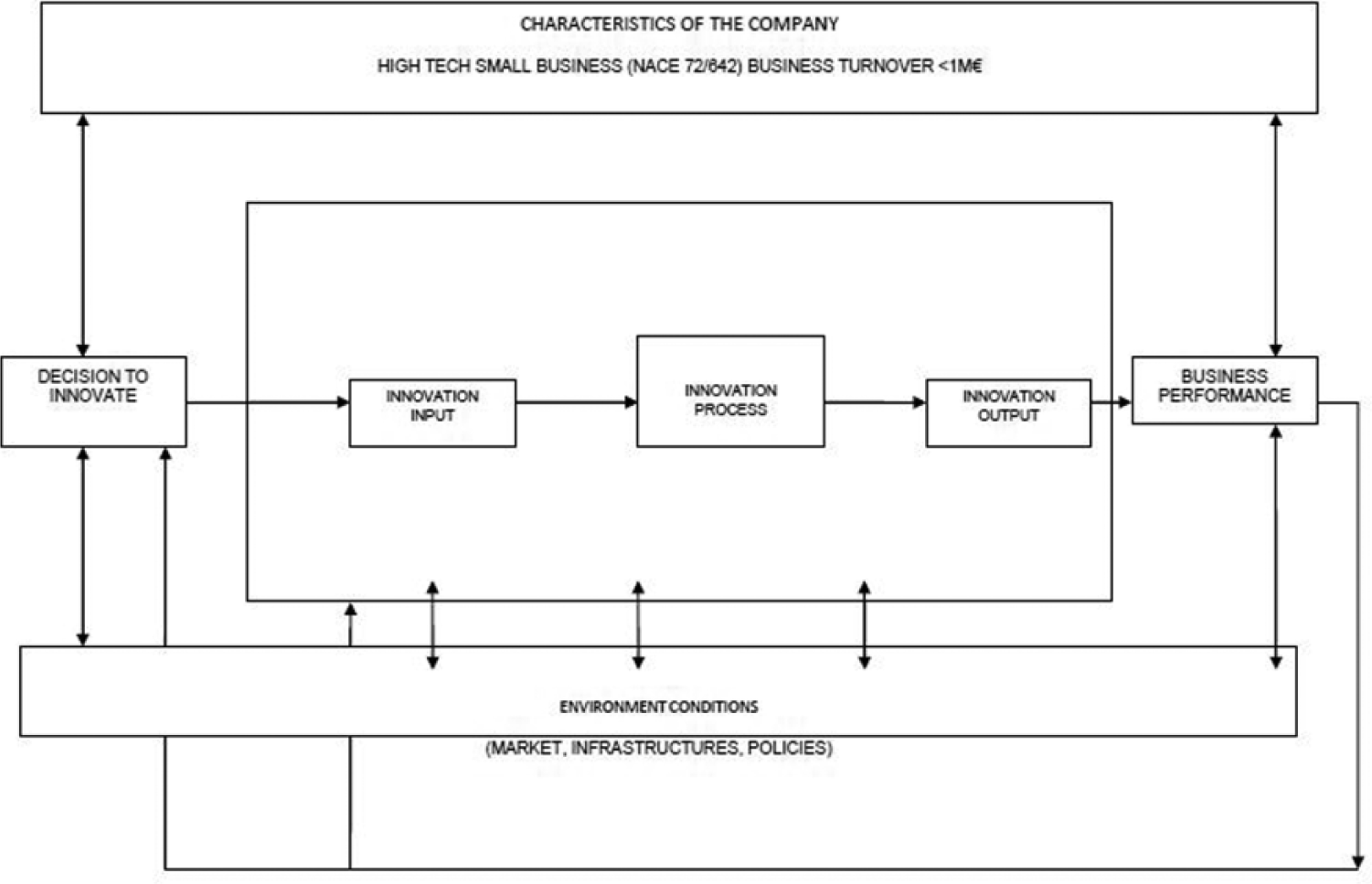
We have selected the conversion model (Crepon, Duguet, & Mairesse, 1998) to establish our theoretical model. We consider that innovation is a process that is driven by INPUTS or contributions in the form of R&D, technology acquisition, human or financial resources, that give rise to a series of OUTPUTS or results of innovation in the form of product innovations, process innovations or both. All this is based on the application of a particular innovation process. Thus, the model considers that the OUTPUT of innovation is a dependent variable that shows positive and significant correlations between the presence of some INPUT or PROCESS variables and the achievement of product or process innovations in the company.
In the logic of the model, it can be supposed that those companies that have developed new processes or products as a result of their innovation should obtain a superior business performance to those companies that do not develop innovative behavior. In this sense, companies that are innovative in products or processes should have a greater increase in sales, profits, markets, or type of customer. The advantages of Crepon et al. (1998) model is that it does not try to explain the innovation process as a sequence of a series of activities in developing new products or services; rather, the innovation process appears with much less structure, chaotic, and less rational. By its nature, the conversion model can define the innovation process in service companies much better.
Figure 1 includes a graphic representation of the model we propose (on the basis of the one of Crepon et al., 1998), in which we can see that once the decision to innovate has been taken (whether this is as a response to changes in the market or a decision based on the organization’s own strategy) the company will make a series of resources (INPUT) available to its innovation strategy to put new products onto the market or make significant improvements to those already existing, or to incorporate new or improved processes into the company (OUTPUT). The above is put into practice through an innovative practice which implies the implementation of a series of activities, strategies, interrelations, and management modes.
Graphic representation of the model.
When the innovation process obtains the expected results, a number of effects occur in the business development of the organizations. At this point, there is feedback across the whole model, as the business performance of the organization will have an influence on the decision to continue the commitment to business innovation as a strategy, and on the resources the organization will make available for the innovation strategy or the innovation process that is applied.
Variables Selection
There is a consensus in the literature about using multidimensional approaches for measuring the effects of innovation, although there are many theories about which such variables should be (Dewangan & Godse, 2014). Specific variables are established within the development of a model that makes up the set of input, process, output, and business performance variables. The set of variables depends on each case of study (Edison, Bin Ali, & Torkara, 2013; Gurhan, Ulusoy, Kilic, & Alpkan, 2011), and for that reason, the present research should take into consideration the case of service companies. To determine the proposed variables (input and process), we have analyzed the scientific literature and selected those that are considered factors of success for innovation in service companies (De Jong et al., 2003).
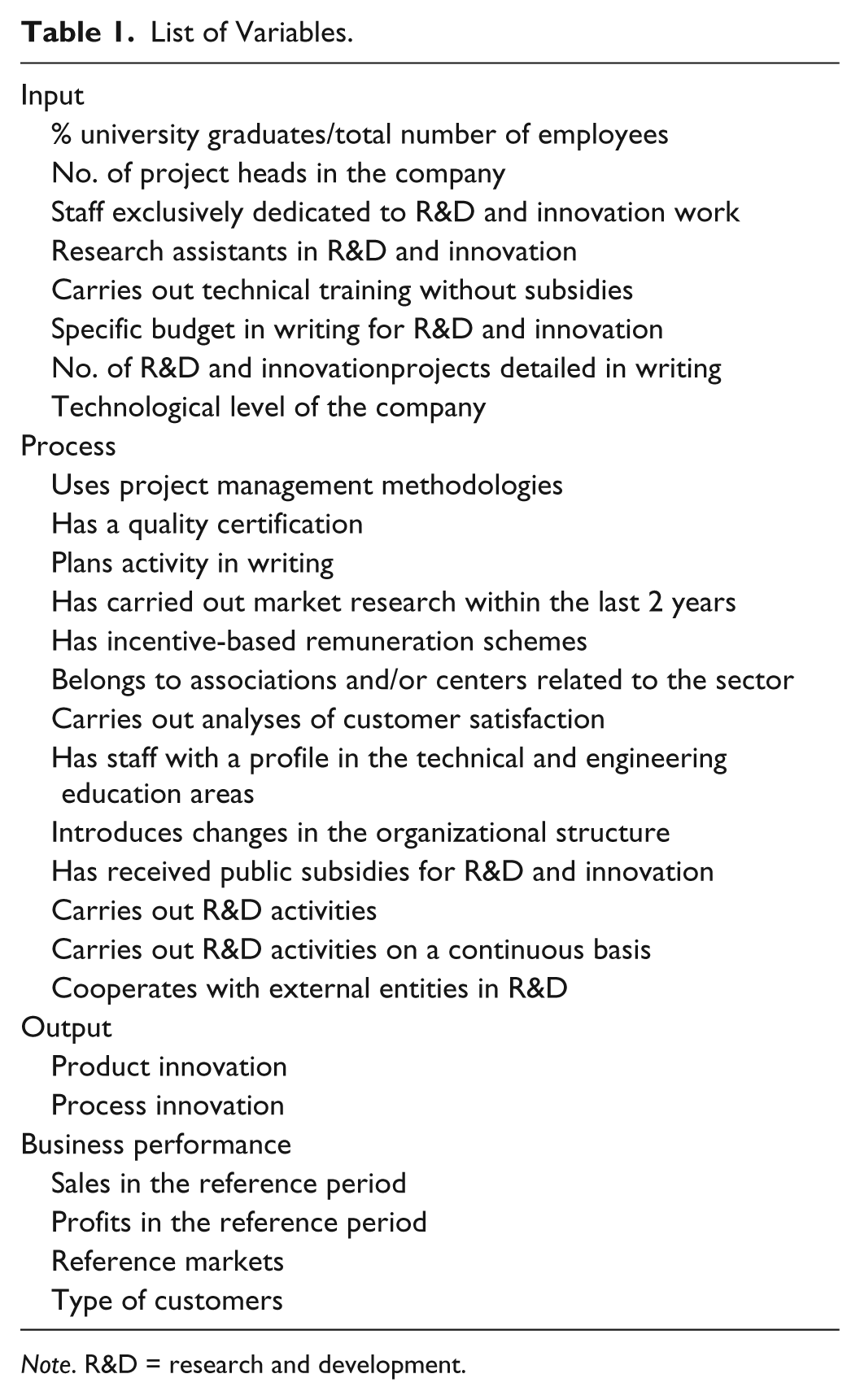
The proposed variables in the group of output and business performance variables have been selected in line with those used in the statistical studies in Spain for the case of output variables, and following the contributions of Kemp, Folkeringa, Jong, and Wubben (2003) for the case of business performance variables. Table 1 establishes the list of variables proposed.
List of Variables.
Note. R&D = research and development.
Input and Process Variables Validation
To validate and refine the input variables, an analysis has been made using companies located in a region of Spain (Castile-Leon) as a population. The population that is the subject of the study is composed of a total of 51 companies, of which 23 have between 6 and 9 employees, 24 have between 10 and 49 employees, and four have more than 50 employees. The research was carried out through the submission of a survey by post and telephone follow-up. A total of 45 valid surveys were obtained with a confidence level of 95% and a sample error of 0.05.
A factor analysis was made with the aim of reducing the dimensionality of the variables used and thus enabling work on a set of variables by exploring the existence of underlying factors or dimensions. This makes it much easier to handle the model and to carry out later analyses.
The extraction of the factors was carried out using the principal axes method, which explained more than 60% of the variation. This gave rise to the appearance of seven factors. By applying an orthogonal Varimax model, a matrix of rotated factors was obtained, which is set out in Table 2.
Rotated Factor Matrix.

Note. R&D = research and development.
After analyzing the matrix of rotated factors, it was determined that the composition of the factors is as follows:
Factor 1: The variables that mainly correlate with this factor are:
Staff exclusively dedicated to R&D activity No. of R&D projects set out in writing R&D activities have been carried out R&D activities have been carried out continuously
Factor 2: The variables that mainly correlate with this factor are:
University or vocational training grants for R&D work Public subsidies for R&D
Factor 3: The variables that mainly correlate with this factor are:
Percentage of university graduates out of total employees. Technical training is given without subsidies Project management methodologies are used Staff with a profile in the technical and engineering education areas
Factor 4: The variable that mainly correlates with this factor is:
It has a quality certification It belongs to associations in the sector
Factor 5: The variable that mainly correlates with this factor is:
Incentive-based remuneration plans
Factor 6: The variables that mainly correlate with this factor are:
Market research has been carried out Customer satisfaction analyses are carried out as a rule
Factor 7: The variable that mainly correlates with this factor is:
Technological level of the company
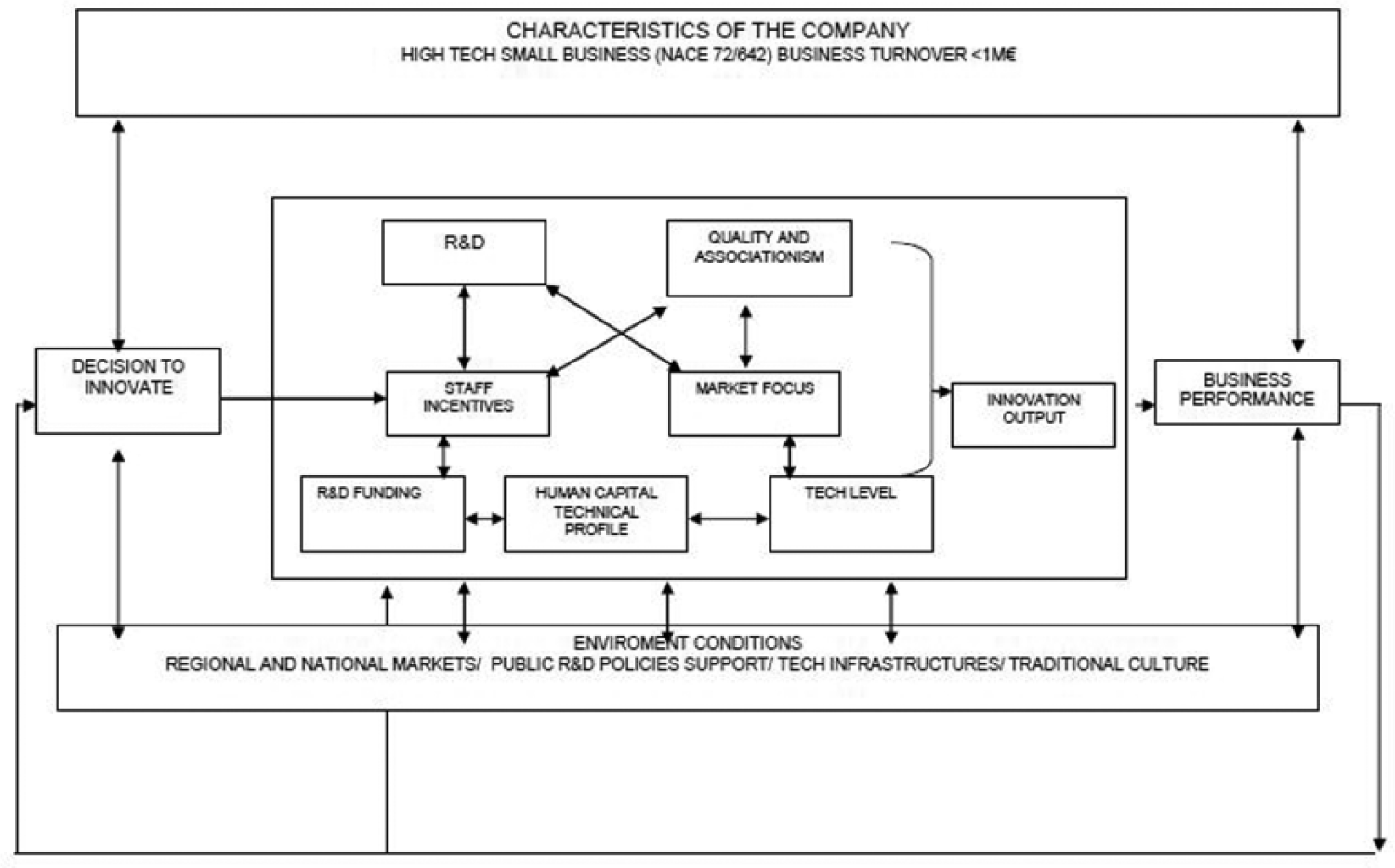
Based on the variables associated with each factor, we can label each of them in the following way:
Factor 1 (F1): R&D in the company
Factor 2 (F2): R&D and innovation finance
Factor 3 (F3): Technical profile of the human capital
Factor 4 (F4): Quality and involvement in associations
Factor 5 (F5): Staff incentives
Factor 6 (F6): Market orientation
Factor 7 (F7): Technological level
These factors conveniently explain the procedures, behavior, and strategies related to the process of innovation in SMEs in the ICT services sector. The improved model can thus be represented as in Figure 2.
Improved model.
Hypotheses
Once the factors that conveniently explain the INPUT and PROCESS variables for our model have been determined, the interest is to find out whether these factors have a positive and significant influence on the innovative or noninnovative character of the companies that apply them. In this case, we want to know how the presence or absence of various factors (those determined above) and their value or level, influence the probability of the appearance of a dichotomic event, such as the absence or presence of business innovation. This is the objective of Hypothesis 1 (Table 4).
Pavitt (1984), and Kline and Rosenberg (1986), pointed out that interaction with customers is key to the success of innovation in services. An examination of the characteristics of innovation in the service sector presents a taxonomy that is clearly dominated by customers and their needs. The companies analyzed declared that the main source generating change in products and services in the ICT sector is the needs of the customers themselves, with nearly 70% of the companies answering in this way. Table 3 shows details of the results corresponding to the inducement to innovation variables. This is the objective of Hypothesis 2 (Table 4).
Origin on the Changes in ICT Products and Services (INDUCEMENT TO INNOVATION).

Note. ICT = information and communication technologies.
Research hypotheses.

In the logic of the model, it can be supposed that those companies that have developed new processes or products as a result of their innovation should obtain a superior business performance to those companies that do not develop innovative behavior. In this sense, companies that are innovative in products or processes should have a greater increase in sales, profits, markets, or type of customer. This is the objective of Hypothesis 3 (Table 4).
Analysis and Results
Logistical regression analyses are used to determine whether a binomial variable depends or not on other variables (not necessarily binomial). In our case, the process is a binomial variable as there are only two possible results: “success” or “failure” (innovative or not innovative), with the probability of each being constant in a series of repetitions.
The individual significance analysis showed that F2, F3, and F6 variables were not significant for the model. The results of the logistical regression were that the factors leading to innovation are, in order of importance, the technological level of the company (F7), the effort made by the company in R&D (F1), and finally, systems of incentives (F5). Thus, Hypothesis 1 is only partially validated.
Finally, the specific Hypotheses 2 and 3 were validated. This was done by carrying out two correlation analyses that determined the relation between the inducement to innovation variables for innovations and the innovative output of the company; and a second showed the relations between the output variables and those of business performance.
The first correlation analysis (for validating Hypothesis 2) showed a Pearson correlation value of .432 for the correlation analysis between the inducement to innovations variables and the innovative output. This shows statistical significance for the analysis carried out, with a bilateral significance level of .004 (valid over .001). Results obtained for specific Hypothesis 2 show that the main sources of generating innovation in products and services in the ICT services sector for SMEs are those that come from products tailored to specific customers. Thus, Hypothesis 2 is validated.
The second correlation analysis (for validating Hypothesis 3) was a study carried out for each of the business performance indicators to undertake the correlation analysis between the innovative output and business performance. The first one (increase in company profits) showed a Pearson correlation of .339, with a bilateral level of significance of .028. The second (increase in the geographical market of reference) obtained a value of .332 in the Pearson correlation with a bilateral level of significance of .032. The third and last (extension of the number of type of customers) generated a value in the Pearson correlation of −.362, with a bilateral significance level of .017. Results confirm that the direct effect of product innovation is the extension of the geographical market of reference; in other words, innovative companies in the sector have geographically more extensive markets and companies that innovate in processes also extend the number or type of customers. On the other hand, such innovative companies do not necessarily show an increase in sales or profits. Thus, Hypothesis 3 is only partially validated.
Conclusion
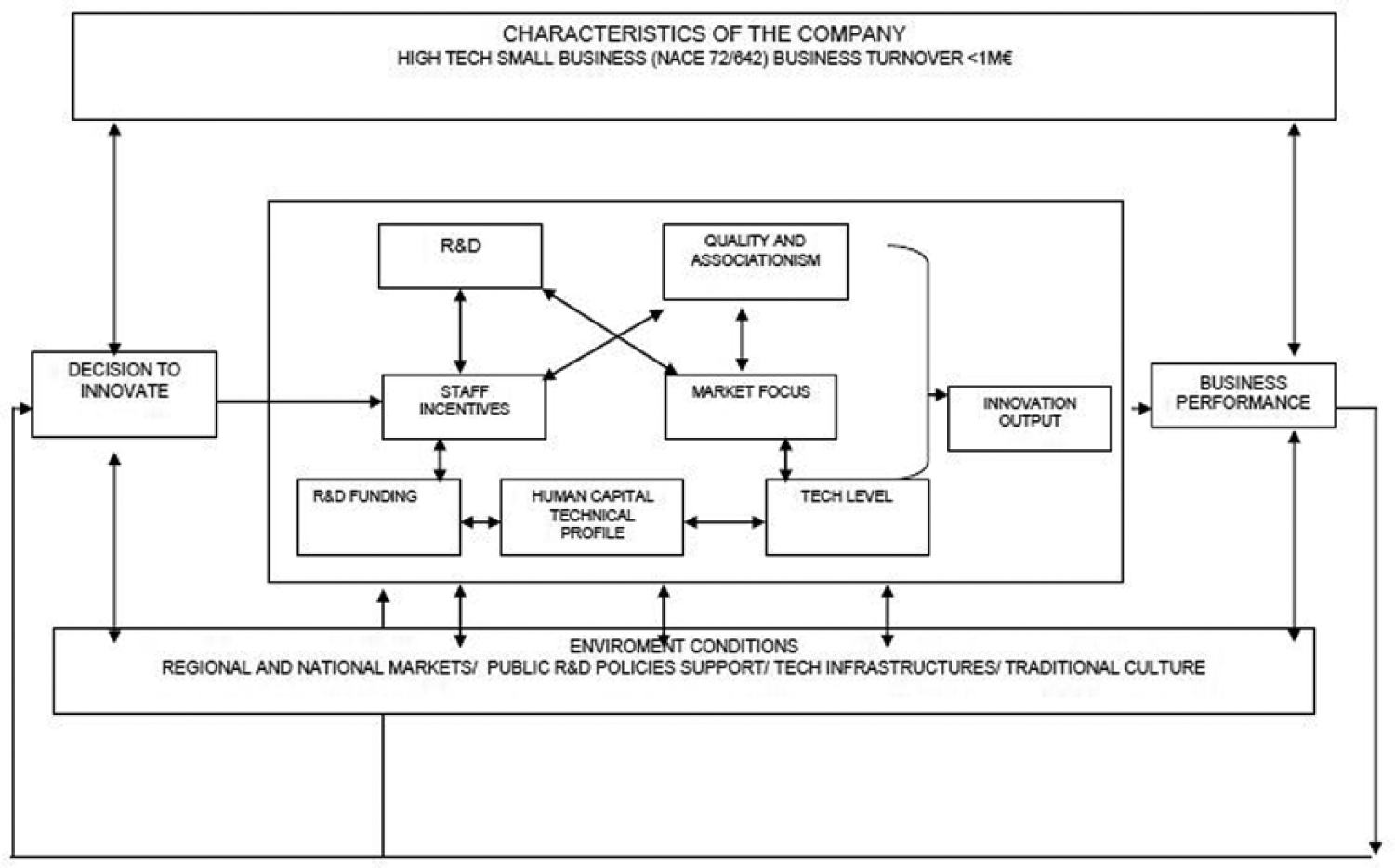
The results show that a more convenient theoretical innovation model for SMEs in the ICT services sector is that of Figure 3.
Theoretical innovation model.
According to this model, the decision to innovate (and the trigger for R&D activities in SMEs in the ICT services sector) is the result of needs that are presented by customers (public or private sector) in tailored projects. All the same, the factors leading to innovation are, in order of importance, the technological level of the company, the effort made by the company in R&D, and finally, systems of incentives.
Besides, innovative companies in the sector have geographically more extensive markets and companies that innovate in processes also extend the number or type of customers.
The result of the business policies expressed in the above paragraphs is an increase in innovation both in products and processes, but what influence does this increased innovation have on the company’s business performance? SMEs in the ICT services sector that have introduced new or substantially improved products onto the market have done so on the basis of extending their geographical market of reference and suffered a fall in sales over the same period. In addition, these companies have extended the number or type of their customers. In other words, innovation has been for them a market growth strategy.
From a managerial perspective, each company needs to identify which of the factors should be boosted more within the organization, and also the implications on the business strategy to be followed. Future research directions to deal with that question are the study of practical strategy models that should be followed according to their competitive position in the market. Zhou, Yim, and Tse (2005), as well as Mompó and Redoli (2009) proposed generic models that could be taken as a reference.
Footnotes
Declaration of Conflicting Interests
The author(s) declared no potential conflicts of interest with respect to the research, authorship, and/or publication of this article.
Funding
The author(s) received no financial support for the research and/or authorship of this article.