




Abstract
Attitudes toward intimate partner violence (IPV) are known predictors of IPV victimization and perpetration with more women generally believed to justify IPV than men. An understanding of the determinants of justification of IPV may provide information necessary for holistic interventions. This study sought to examine the magnitude, extent, and predictors of justification of physical IPV against women among men and women in Nigeria. Data from 33,385 women and 15,486 men from the 2008 Nigerian demographic and health surveys were analyzed using chi-square test and multiple logistic regressions. Results show that although larger proportions of women justified physical IPV, certain categories of men such as poor, illiterate men, and men with secondary education justified abuse more than women. Contrary to expectations, access to radio/TV increased the odds of justifying abuse among women thus casting doubts on program content. The gender differences observed for predictors of attitudes to physical IPV suggest a need for gender-tailored interventions to change attitudes toward partner violence in Nigeria.
Introduction
Intimate partner violence (IPV) is a global public health problem gaining attention worldwide due to the numerous known negative consequences including injury (Sheridan & Nash, 2007), alcohol and substance abuse (Campbell, 2002; Ellsberg, Jansen, Heise, Watts, & Garcia-Moreno, 2008), negative reproductive health outcomes (Okenwa, Lawoko, & Jansson, 2009, 2011), and mental health problems (Aidoo & Harpham, 2001; Ali, Mogren, & Krantz 2013). Research findings suggest that IPV against women may be more prevalent in low-income and more gender-stratified settings (Beauchamp, Lindsay, Hunter, & Talavera, 2012; Oyediran & Isiugo-Abanihe, 2005; Sabarwal, Santhya, & Jejeebhoy, 2014). Recent World Health Organization (WHO) estimates show that while the prevalence of physical IPV (such as wife beating) and sexual IPV in high-income countries is up to 23.2%, prevalence from low- and middle-income countries among ever-partnered women lie from 24.6% in the Western pacific region to as much as 36.6% in the African region (WHO, 2013).
There are many individual-level risk factors associated with IPV victimization, for example, being of a young age, low or no education, financial dependence on a partner, unemployment, and alcohol use (Jewkes, 2002; Uthman, Lawoko, & Moradi, 2009). One risk factor that is currently gaining more focus in research is attitude toward IPV. Substantial evidence suggesting associations between IPV justification and exposure (Abramsky et al., 2011) imply a need for understanding attitudes in especially middle and low-income countries. Again, research coming from Africa shows that men and women may vary in their attitude to IPV (Rani, Bonu, & Diop-Sidibe, 2004; Uthman et al., 2009).
A number of theories have been put forward to explain the existence of tolerant attitudes. One of them is the normalization theory which is a feministic theory that describes the continuous shifting of boundaries until acts of violence gradually take on a new meaning (Lundgren, 1993; Lundgren, Heimer, Westerstrand, & Kalliokoski, 2001). The woman primarily sees the man’s violence as an interpretation of her own failure. Normalization includes all kinds of assumptions that portray male violence within intimate relationships as normal. Examples of assumption are those arising from the practice of patriarchy and the misconception that violence is a normal part of a romantic relationship. Normalization theory provides a framework for understanding the misconceptions that violence is a marginal problem practiced under special circumstances (such as alcohol influence), directed at certain types of woman and practiced by certain categories of men (Lundgren, 1993).
Unlike the normalization theory, the social learning theory suggests that individuals learn and adopt behaviors which they have observed among their role models (Bandura, 1963; Bandura & Park, 1972). According to this theory, learning is a cognitive process occurring within a social context through observation or direct instruction. The extent and magnitude of what is learned is reinforced by rewards (of socially acceptable behaviors) or punishment (of socially unacceptable behaviors) during the learning process. Social norms and gender roles in a patriarchal society, for instance, are learned within social groups and transmitted from generation to generation. The social construction of gender which gives rise to specific defined ideas about what women and men are and what roles they play in a society is in many ways reinforced by the social learning theory. Gender is thus an achieved status, constructed through psychological, cultural, and social means (West & Zimmerman, 1987).
Although some studies in Sub-Saharan Africa have attempted to understand factors associated with justification of wife beating among women (Husnu & Mertan, 2015; Uthman et al., 2009), factors associated with such justification among men have not received equivocal attention in research. There are two main rationales for this study, first is that comparing the risk factors for IPV justification between men and women may prove vital in designing intervention that focus on attitudinal change for both the perpetrators and victims of wife abuse. Second is that although IPV is justified by both men and women, there appears to be a general claim that more women than men justify IPV and other harmful gender-based harmful practices against women (Ilika & Ilika, 2005; Rani et al., 2004). Not much, however, is known about differences n attitudes between men and women in Nigeria.
The main aim of this study, therefore, is to examine the magnitude and extent of justification of physical IPV against women and its predictors among women and men in Nigeria. A second objective is to study the relationship between exposure to IPV and attitudes to wife beating among women.
Method
Study Design
This study is based on the Nigerian Demographic and Health Survey (NDHS) of 2008. The DHS is a U.S. Agency for International Development (USAID)-funded survey carried out in many developing countries. These surveys are done on a 5-yearly basis with the purpose of monitoring demographic and health situation of the countries. The sampling method is done such that data collected is nationally representative. Ethical approval for the instruments and survey procedure is granted by the Institutional review board of the opinion research corporation Macro International. The 2008 Nigerian DHS was conducted in conjunction with the Nigerian National Population Commission (NPC [Nigeria] & ICF Macro, 2009).
Sampling Design
The NDHS covers a nationally representative sample of 36,298 households based on an estimate relying on the 2006 Population and Housing Census of the Federal Republic of Nigeria. Administratively, Nigeria is divided into states. Each state is subdivided into local government areas (LGAs), and each LGA is divided into localities. In addition to these administrative units, each locality was subdivided into convenient areas called census enumeration areas (EAs) during the 2006 Population Census. The primary sampling unit (PSU), referred to as a cluster for the 2008 NDHS, is defined on the basis of EAs from the 2006 EA census frame. The 2008 NDHS sample was selected using a stratified two-stage cluster design consisting of 888 clusters, 286 in the urban and 602 in the rural areas. Of the representative sample of 36,298 households selected for the 2008 NDHS survey, about 34,644 were occupied. A response rate of 98% was obtained, that is, 30,070 household were successfully interviewed. There was no difference in response rate between rural and urban participants.
Using equal probability sampling, an average of 41 households were selected in each cluster during Stage 2. All women aged between 15 and 49 years, resident or visiting the selected households on the night before the survey, were eligible to be interviewed. All men aged 15 to 59 years, residents visiting a subset of half of the selected households on the night before the survey, were eligible to be interviewed. For questions on domestic violence, a subsample of one eligible woman in each household was randomly selected to respond to questions on exposure to IPV. The questionnaire was administered in strict compliance of the WHO ethical and safety recommendation for research on domestic violence (WHO, 2001).
Participants
A total of 33,385 women of the 34,596 eligible women responded (response rate 96.5%). The domestic violence module was administered on a subsample made up of one randomly selected eligible woman in each household. This way, a subsample of 21,468 women responded to the domestic violence module (used here to explore the second part of the study objective). In a subsample of half of the households, 15,486 of the 16,722 eligible men were successfully interviewed giving rise to a response rate of 92.6%.
Questionnaire
A comprehensive questionnaire covering demographic and health issues was administered to eligible men and women. The aspects covered include women’s background, reproductive health, access to reproductive health facilities, fertility preferences, child care and nutrition, child mortality, awareness of and precaution against sexually transmitted diseases, marriage and sexual behavior, gender roles, empowerment factors (e.g., autonomy in the household and access to information), and IPV. For this study, the questions on attitudes to wife beating, domestic violence empowerment factors, and sociodemographic factors were of primary interest. However, questions on exposure to partner violence were administered to only women.
Measures
Dependent variable
Attitudes to physical IPV
This was assessed using responses to five hypothetical situations. These questions are commonly used in Africa in this field of research (Kenyan DHS, 2003; Nigerian DHS, 2003, Zambian DHS, 2003), and probe whether physical IPV (defined in this study as wife beating) is okay in the following scenarios: if the wife goes out without informing husband, neglects the children, argues with her partner, refuses to have sex with partner, or cooks bad food/or food is served late. Answer options were yes, no, or don’t know). An affirmative response to one or several of these questions was considered having a tolerant attitude toward wife beating, while a “no” response on all five situations denoted a non-tolerant attitude. This categorization is in line with recent discussion of achieving “zero-tolerance” of violence against women.
Independent variables
Sociodemographic variables
These included the following: age 15 to 49, for both women and men; literacy (1 = can read little or nothing, 2 = can read whole sentences); religion (1 = Catholic, 2 = other Christian, 3 = Muslim, 4 = Traditional, 5 = Other); ethnicity (1 = Hausa/Fulani, 2 = Yoruba, 3 = Ibo, 4 = Others); wealth index (1 = poorest, 2 = poor class, 3 = least poor); region (1 = north central, 2 = northeast, 3 = northwest, 4 = southeast, 5 = southwest, 6 = south), and place of residence (1 = urban, 2 = rural).
Wealth index
Constructed from the household’s ownership of goods and facilities (coded as 1 = poorest, 2 = poor, 3 = least poor), is used as a proxy for economic status. Asset information was collected in the 2008 NDHS on household ownership of a number of consumer items, such as television, bicycle, or car. Information about dwelling characteristics such as source of drinking water, type of sanitation facilities, and type of material used in flooring were collected. Each household was assigned a score from each asset, and the scores were summed for each household; individuals were ranked according to the total score of the household in which they resided. The sample was then divided into quintiles, from one to five. The level of wealth index ranges from the first to the fifth quintile, corresponding to the least and most well-off, respectively. For this study, the first two quartiles were merged to form one group, poorest, the middle quartile formed the group “poor” while the last 2 quartiles were merged to form one group, least poor.
Empowerment indicators
These included the following: access to information, assessed by a woman’s frequency of reading newspapers, listening to radio, or watching TV; response (coded as 1 = not at all, 2 = less than once a week, 3 = at least once a week, 4 = almost every day). Decision autonomy, assessed by asking respondents who in the household had the final say on household expenditures, health care, and household purchase with the following response options (coded as 1 = woman only/woman and her husband, 2 = husband or husband and someone else).
Exposure to IPV
One of the independent variables used in the women’s analysis, was assessed using a modified version of the Conflict Tactic Scale (CTS; Straus & Gelles, 1990), which assesses whether participants have, since the age of 15 years and during the past 12 months, experienced abuse perpetrated by the current husband/partner. Experience of IPV in the past 12 months was of primary interest for this study. Exposure to Physical IPV in the past year was operationalized as being slapped, kicked, bitten, pushed, punched, choked, burnt on purpose, or assaulted using a knife or other weapons during the past year (coded as 1 = no, 2 = yes). Exposure to Sexual IPV in the past year was operationalized as having been physically forced to have sexual intercourse when she did not want to; degrading or humiliating sexual acts, or engaging in sexual intercourse out of fear in the past year (coded as 1 = no, 2 = yes). Exposure to Psychological IPV in the past year was operationalized as having been exposed to verbal abuse, insults, made to feel bad about oneself, belittled in front of other people, scared or intimidated, threatened with violence or threats to harm loved ones, and so on in the past year (coded as 1 = no, 2 = yes).
Statistical Analyses
Data impute and analysis was done using the SPSS program Version 15.0. Missing data were relatively low and were thus analyzed simply as missing. The foregoing implies that no measures such as substituting missing data with the national or sample average were taken in the analysis. No measures were taken to, for example, substitute with the national/sample average, common practices when data sets are relatively small. Chi-square test was used to assess for crude associations between dependent and independent variables. The independent contribution of the explanatory variable in explaining attitudes toward wife beating was assessed using multiple logistic regression as a measure to control for potential confounders. Direction and magnitude of associations were expressed as adjusted odds ratio (OR), and the contribution of each set of variables (i.e., sociodemographic, empowerment indicators and IPV exposure) was expressed in terms of R2. The significance level was set at p < .05 for all statistical analysis.
Results
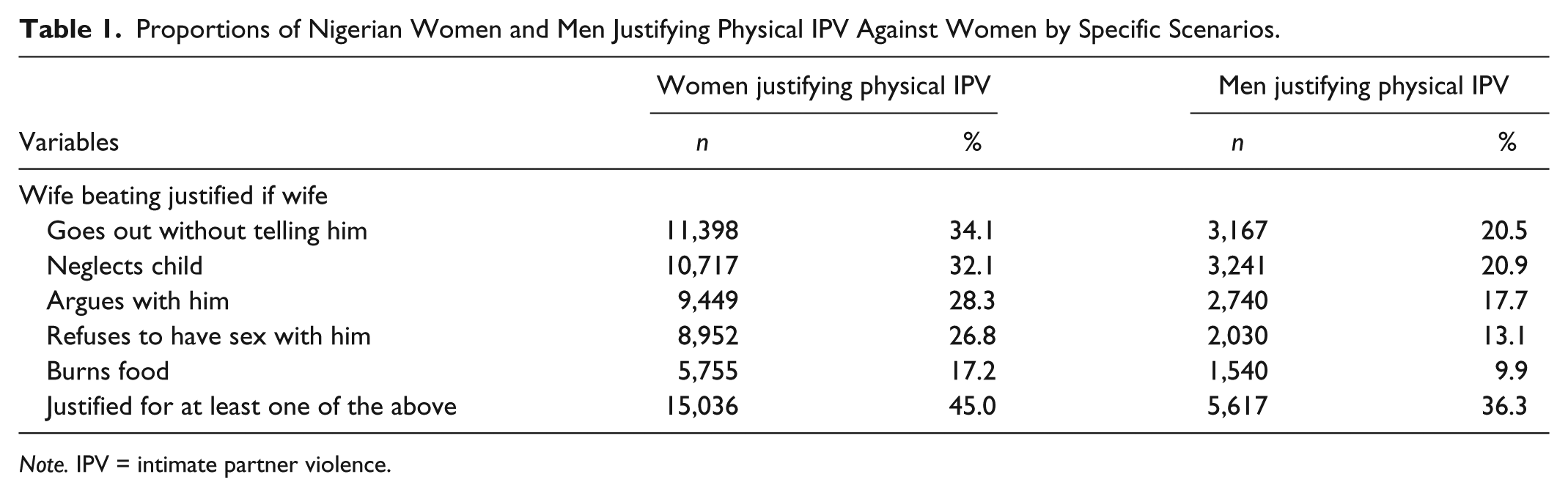
As shown in Table 1, significantly more women than men would justify physical IPV in all the scenarios indicated. Similarly, more women than men justified abuse for at least one of the stated reason. For both men and women, two scenarios most likely to lead to justification of physical IPV were if the wife went out without telling her husband and if she neglected the children.
Proportions of Nigerian Women and Men Justifying Physical IPV Against Women by Specific Scenarios.
Note. IPV = intimate partner violence.
Proportions of Women Justifying Physical IPV by Sociodemographic Factors, Access to Information, Autonomy and Exposure to IPV
As indicated in Table 2, proportions of women and men endorsing physical IPV varied according to demographic factors, access to information and autonomy indicators. Endorsement of physical IPV increased with increasing age among men and women. For both women and men, higher numbers endorsed physical IPV among the illiterate, low-educated, rural residents and those of traditional religions. Among women, the endorsement physical IPV was most prevalent in the Hausa/Fulani ethnic group and women living in the North Western region. Physical IPV justification among men was most prevalent in the Ibo/other ethnic groups and men residing in the North eastern region. Men and women living in households where women lacked autonomy in domestic decisions were more likely to endorse wife beating and physical IPV. Among both men and women, the proportion endorsing IPV reduced with increasing wealth and access to information. Finally, women exposed to IPV more often than un-exposed peers endorsed physical IPV.
Attitudes Towards Physical IPV Against Women by Demographic Factors.

Note. IPV = intimate partner violence.
Factors Associated With Attitudes Toward Wife Beating: Adjusted Estimates
Block 1: Social demographic indicators
From Table 3, it can be seen that after controlling for other variables within the model, an inverse relationship was observed for the age variable, that is, increasing levels of justification with decreasing age for both males and females. The likelihood of endorsing wife abuse tended to decrease with increasing age quite opposite to what was observed in Table 1. Justification of wife beating also reduced with increasing levels of education for both men and women. Urban settlement and belonging to the rich quintile reduced the likelihood of endorsing wife abuse among both men and women. Belonging to ethnic Yoruba or Igbo groups reduced the likelihood of justifying wife abuse when compared with other ethnic groups. Contrasting with peers from the south western region, men and women from the north eastern, south eastern, and south regions exhibited a higher likelihood of justifying abuse. Religion did not affect significantly the likelihood of justifying abuse among both women and men. Sociodemographic indicators accounted for 9% and10% of the variation in justification of IPV among women and men, respectively.
(Block Regressions): Predictors of Attitudes Toward Physical IPV Against Women Among Men and Women in Nigeria.

Note. IPV = intimate partner violence; OR = odds ratio; CI = confidence interval.
Block 2: Access to information and autonomy in decision making
Although increasing access to information via newspapers/magazines increased the likelihood of justifying physical IPV among men, justification of abuse tended to increase with frequent access to such media among women. Listening to radio, however, was associated with an increased likelihood of justifying abuse among women but with a reduced likelihood among men. Men and women living in households where husband had full autonomy in household decisions reported a higher likelihood of justifying abuse than peers living in household with shared autonomy or household with women having full autonomy. Access to information and autonomy indicators accounted for about 10% and 12% of the variation in justification of IPV among women and men, respectively.
Block 3: Exposure to IPV
Exposure to physical and sexual IPV among women was associated with an increased likelihood of justifying wife abuse. Exposure to IPV accounted for about 11% of the variation in justification of IPV among women.
Discussion
The current study examined the magnitude, extent, and determinants of justification of physical IPV against women among males and females in Nigeria. After controlling for other sociodemographic and economic characteristics, results show overall justification of abuse higher among women than among men. This observation is consistent with data from other Sub-Saharan and other context (Rani et al., 2004; Uthman et al., 2009; WHO, 2005). However, findings from this study also show that whereas more women than men will justify abuse for at least one hypothetical scenario, there are strong indications that more men than women justify abuse in certain circumstances. Although the reasons for the above observations are not exactly clear, the social learning theory provides a framework within which the observations can be explained. For example, justification of abuse observed in this study was significantly higher in younger age groups among men and women but higher among men in age groups 15 to 19 and 20 to 29 (OR = 1.430 and 1.456, respectively) than women of same age groups (OR = 1.370 and 1.278, respectively). The explanation may lie in the social learning theory, i.e. young people learn and accept the physical abuse of women as punishment for bad behavior. Similar findings among younger have been found in other studies (e.g., Abramsky et al., 2011).
Considering that there is contradictory trend of less justification with increasing age seen in this study, the high rates of justification of abuse among younger people may indeed be a clear indication of an effective system of transfer of traditional values to younger generation simply to keep in line with tradition and not because the older custodians truly believe in what they are handing down. Low levels of justification of abuse were also observed among men and women in urban settings compared with rural settings. This is in line with findings by others (Faramarzi, Esmailzadeh, & Mosavi 2005; WHO, 2005; Yount & Li, 2009) but in contrast to comparably equal levels of justification of abuse in urban and rural settings observed by Rani et al. (2004). Studies have, however, shown that having a rural upbringing is as much an important determinant as living in rural settings.
Haj-Yahia (2000) argues that many victims of IPV are conditioned to justify abuse to secure sustenance for themselves and their children. Findings from the present study regarding economy is in line may be explained in part by this argument. The reward and punishment system is again seen here because there is evidence that women without strong means of livelihood fare poorly when they challenge norms of male dominancy by leaving the violent partner (Haj-Yahia, 2000). This is also explainable by the normalization theory with the women interpreting partner’s violence as an indication of her failure and learns to consider it as normal.
Although the social learning theory explains learning by observation, Rani et al. (2004) explain that as women gain education, employment, and thereby financial freedom, the myth of male superiority becomes directly or indirectly challenged resulting in a conflict between reality and myth. Female participants in this study with secondary or higher education, with better wealth index, and who had certain autonomy in decision making were least likely to justify physical IPV. Among the men, however, justification of abuse among men increased with increasing education up to secondary level. The odds for justification of abuse were comparatively higher among men than women in categories such as men with secondary education, illiterate, and those with poorer wealth index. This corroborates previous findings showing a social gradient in attitudes toward wife beating (Lawoko, 2008). Because the aforementioned factors are well-known indicators of socioeconomic status (SES), a lot can be deduced from this finding. For example, Men are more likely to resort to intimate partner violence when their traditional status of economic and social superiority is threatened (Atkinson, Greenstein, & Lang 2005). The justification of physical IPV seen in these groups of men must be addressed rather than resting on the general assumption that women justify abuse more than men. Ethnic Yoruba and Igbo participants had a lower likelihood of endorsing wife abuse supporting the notion that some ethnic groups may be less gender restrictive than others.
The association between indicators of access to information and endorsement of wife abuse were in some cases contradictory. In the case of newspaper reading, the finding is in the expected direction, that is, women who do not read newspapers are more likely to justify abuse. On the contrary, with increasing frequency of listening to radio and watching television, there was an increased tendency to justify wife beating among women, but a reduced tendency among men. Given the above findings, the role of mass media as a means of information and empowerment against violence against women becomes questionable. The Nigeria film is acclaimed as the largest in Africa, it was reported by the UN news center as having surpassed Hollywood and Bollywood in terms of productivity as at 2009 (United Nations, 2009). However, some researchers and activists in the field of violence against women have raised concerns regarding the content of Nigeria films and television dramas (Adewoye, Odesanya, Abubakar, & Jimoh, 2014; Ojukwu & Ezenandu, 2012). Many of these emphasize traditional beliefs and gender stereotyping, thereby reinforcing existing gender inequalities. These programs are often packaged in a manner intended for women to learn lessons about the consequences of non-conformity with women themselves championing these opinions. For example, Adewoye et al., in a 2014 analysis of Nigerian movie content, found that educated, successful career women were often depicted as insubordinate to their husbands and uncaring of their children.
The lower likelihood of men who watch TV less than once a week to justify physical IPV against women compared with those who watch almost every day further cast questions on program content. On the contrary, the tendency for men who listen to radio more frequently to be less supportive of wife beating may be suggestive of other factors. For example, considering that this is contrary to the findings among women, it may be that men and women differ in their choice of radio programs. This may have implications for research and practice. In research, for example, it may no longer be enough to ask only about access to information, asking about program preference may provide useful information. For practice, it can no longer be assumed that improved access to information will contribute in changing attitudes to IPV. The need for improving program content through collaborating with stakeholders (e.g., film makers and sponsors) may prove important for evidence base interventions.
The current study also assessed the association between exposure to IPV and attitudes toward physical IPV defined here as wife beating. Women experiencing physical and sexual abuse exhibited a higher likelihood of endorsing abuse, supporting the social learning theory discussed previously. Another plausible explanation could stem from the fact that repeated abuse may diminish a woman’s self-esteem and thereby increase her propensity to blame herself for whatever reason is triggering the abuse (e.g., burning the food). At that point, the foundation has been set to justify any action to “punish” transgression from her normative roles. The psychosocial impact of conditioned abuse and how this may impact on attitudes toward abuse deserves attention in the research.
In conclusion, findings from this study show that Nigeria does not differ from most other low country setting where more proportions of women than men have been found to justify abuse. However, more men than women justify physical IPV when specific factors, for example, wealth index and educational level are examined. Attitudes toward physical IPV varied across different sociodemographic factors, access to information and autonomy in decision making as well as exposure to IPV. These findings may prove useful in designing interventions to confront IPV with focus on groups at risk. Another potential contribution of the findings from this study is the likelihood to start discussions regarding the contribution of Nigerian media programs in propagating female submission and male dominance.
Strengths and Limitations
The strength of this study lies in its large, nationally representative data sets based on good sampling procedures. These have been gathered in strict adherence to ethical standards for domestic violence research ensuring women’s safety (WHO, 2001). One limitation is that the analysis of secondary data generally places a limitation to the extent to which factors can be explored. For example, measure of attitudes to IPV captures only women’s normative roles in the domestic arena. Other plausible motivating factors for IPV such as women’s participation in income generating activity, education, husband’s drunkenness, to mention but a few, are not incorporated in the measurement of attitudes to IPV. Broader measures including the above-mentioned variables are necessary as they have been previously proven to play roles in explaining IPV (Hoffman, Demo, & Edwards, 1994; Krishnan, 2005; Malcoe, Duran, & Montgomery, 2004). Another limitation comes from face-to-face interviews. Participants may tend to underreport attitudes when contrasted with responses from self-administered questionnaires. This, however, may have been improved by the use of trained personal and the guarantee of anonymity which are part of ethical issues surrounding research in this field.
Footnotes
Declaration of Conflicting Interests
The author(s) declared no potential conflicts of interest with respect to the research, authorship, and/or publication of this article.
Funding
The author(s) received no financial support for the research and/or authorship of this article.