



Abstract
Violence against women (VAW) is a hidden aspect of humanitarian emergencies, especially during conflicts, and prevalence estimates remain scarce. An adequate response to VAW in humanitarian contexts requires information regarding the extent of the problem and associated factors, including the role of past violence. This study is a questionnaire survey of a random sample of 452 Syrian refugee women resettled in Sweden. Findings show that the prevalence of any violence preflight and during flight was 25.1% and 7.8%, respectively. Older women and women exposed to violence preflight were more likely to experience violence during flight. Findings suggest the need for more trauma-informed systems of handling asylum seekers and refugees, as a humanitarian principle. Other implications for research and practice are discussed.
Introduction
Despite international humanitarian law, which protects women and children, and the responsibility of humanitarian agencies to prevent and report abuse in humanitarian settings, violence against women (VAW) remains a significant problem due to lack of systematic surveillance (Department for International Development [DFID], 2013; International Committee of the Red Cross, 1988; United Nations, 2003). Lack of data is a significant challenge to understanding the prevalence and risk factors of violence against refugee women, which is a hidden systematic, opportunistic, and organized problem (DFID, 2013; European Union Agency for Fundamental Rights [FRA], 2016a; Freedman, 2016; Pickering, 2011; World Health Organization, 2019). VAW is a violation of human rights and discrimination against women; it includes any violence that results in or is likely to result in physical, sexual, psychological, or economic harm or suffering to women, including threats of such acts, coercion, or arbitrary deprivation of liberty, whether occurring in public or private life (Council of Europe, 2011). The social-ecological model describes VAW risk factors at four levels, that is, the individual, relationship, community, and societal levels (Heise, 1998; Krug et al., 2002). At the individual level are factors such as age and education, whereas the relationship level has to do with family and those around. The community level includes factors connected to the context in which relationships occur, for example, school and workplace. Factors at the societal levels include norms and others, which create an enabling environment for VAW (Heise, 1998; Krug et al., 2002). During conflicts and war, societal-level factors for VAW, such as preexisting discrimination and violations of the rights of women and girls, become exacerbated, resulting in, for example, forced marriage, torture, killings, and sexual violence, including rape as a weapon of war (Baaz & Stern, 2009; Manjoo & McRaith, 2011; Office of the High Commissioner United Nations Human Rights, 2020).
Similarly, while fleeing the violence in their home countries, women are at increased risk of forced labor and sexual exploitation for basic needs, transportation, and documents (Horn, 2010; Stark & Ager, 2011; United Nations High Commission for Refugees [UNHCR], 2013; Wachter et al., 2018). Much of the available information about VAW in refugee settings are from situation analysis, site visits, and field investigations (Cox et al., 2007; United Nations Population Fund, 2016, 2017). Although these are useful data, the methodologies employed sometimes do not provide the needed estimates of the problem’s extent, trends, intervention evaluation, all of which are important for informing policy. Previous researchers have thus emphasized the need for population-based studies (Stark & Ager, 2011). Despite increased exposure to violence among refugee women, not much is known about the prevalence of VAW during various phases of forced migration and associated risk factors, which are useful information to address the problem (FRA, 2016b). Moreover, apart from adverse consequences on well-being, integration, family functioning, and children’s behaviors (European Commission on Integration, 2018; Masterson et al., 2014; Sangalang et al., 2017), past exposure to VAW is also a known risk factor for future abuse (Cole et al., 2008; Stein et al., 2019). Not many studies have investigated the relationship between past exposure to VAW and future abuse among refugee women.
The Syrian conflict resulted in a near doubling of new asylum applications in Europe by Syrians (Eurostat, 2014). In addition, there was an increase in women coming to Europe, especially those traveling alone or with children (Bonewit & Shreeves, 2016; Hersh & Obser, 2016; Hynes & Cardozo, 2000; UNHCR, 2016). In Sweden, Syrian refugees are among the largest refugee groups due to a resettlement program for Syrians. Therefore, this study aims to estimate the prevalence of VAW preflight and during flight and to examine whether specific sociodemographic factors are associated with exposure to violence among female Syrian refugees resettled in Sweden. The study also intends to investigate whether there is an association between exposure to violence preflight and violent experiences during flight.
Method
Study Design, Sampling Method, and Participants
This study is a cross-sectional study based on a combined data collected in 2016 using questionnaires and databases. Statistics Sweden coordinated data collection. Statistics Sweden is a government agency responsible for maintaining and managing several national databases for research and monitoring demography and health (Ludvigsson et al., 2016; Statistics Sweden, 2019). Data were collected from three specific databases, that is, the Total Population Register (information about all persons with permanent residency in Sweden); the longitudinal database for studies on integration, also known as STATIV (contains migration-related information for individuals who have applied for residency in Sweden); and finally, the Longitudinal Integrated Database for Health Insurance and Labour Market Studies.
The sample frame for this study was identified through the Total Population Register. Information regarding education and sociodemographic factors were obtained from the Total Population Register and the Longitudinal Integrated Database for Health Insurance and Labour Market Studies. The longitudinal database for studies on integration information provided information about the grounds on which residence permits were granted. Thus, the study population consists of 1,459 randomly sampled Syrian refugee women who were aged 18 to 64 years and had been granted permanent residency in Sweden, on the grounds of asylum, between 2011 and 2013. Statistics Sweden distributed the questionnaire to the study population; the response rate was 31%, that is, 452 women responded. Statistics Sweden delivered the collected data material as a file containing anonymized and coded survey data to the researchers in line with standard practice.
Questionnaire Description and Measures
The questionnaire distributed by Statistics Sweden was a structured questionnaire consisting of several previously validated instruments to cover aspects such as mental health, social support, and exposure to violence (Gottvall et al., 2019). As the study population’s language was Arabic, available validated Arabic versions of relevant instruments were incorporated into the questionnaire (e.g., Bekairy et al., 2018). Instruments and scales not available in Arabic were translated from the English language to Arabic, using a standard double-blind translation and back-translation procedure. The questionnaire’s translation and adaptation processes were done in consultation with relevant community experts, with revisions and amendments made where necessary. The questionnaire’s usability was tested through interviews conducted on 10 native Arabic speakers at a war and torture rehabilitation center. They were instructed to read the questions out loud and to follow a think-aloud protocol (TAP). TAP is a method that provides information about difficulties that may arise due to problems with comprehension, memory retrieval, judgment, and response formatting (Drennan, 2003). The research group and language and community experts followed up any indication of such difficulties in several ways. The first is by further scrutinizing the target item. Second, the items’ psychometric profile (i.e., from data compiled from a small pilot study) was also examined. Third, a modification of the item was then made if deemed necessary.
Main Outcomes
The main outcomes were exposure to violence preflight and during flight; these outcomes were assessed using previously validated constructs (Sigvardsdotter et al., 2017). The variables are described below.
Violence preflight
Respondents were asked whether they had experienced various forms of violence before leaving home. For example, “Did you face any of the following situations or events before you left your home?” The situations and events listed are physical violence or assault, sexual violence, and torture. The definition of torture conforms with the United Nation’s official definition (UNHCR, 1987). The response alternatives for the above question were “yes” or “no.” A summary variable capturing exposure to any of the listed forms of preflight violence was created and dichotomized into “yes” or “no.” A “yes” response to at least one form of the violence listed above is classified as exposure to violence.
Violence during flight
Violence during flight was operationalized using similar questions and process as above. The same questions were asked but for exposure to violence “after leaving home and before arriving in Sweden.” The response alternatives were categorized in a similar way as for preflight.
Sociodemographic factors
Information regarding age, education, and year of arrival in Sweden were obtained from the relevant database (as earlier described). Information about marital status was obtained through the questionnaire and categorized as married, unmarried, or divorced/widowed. Age (i.e., age at data collection) was categorized into four age groups, that is, 18–29 years, 30–39 years, 40–49 years, and 50–64 years. Educational level was categorized as ≤9 years (compulsory education), 10–12 years (high school), and >12 years (university or higher education). The year of arrival in Sweden included in the study was specified as 2013, 2012, and 2011. Note that the “year of arrival variable” indicates when the individual arrived in Sweden and should not be confused with the year for being granted residency used as inclusion criteria. Information about age, education, and year of arrival in Sweden was retrieved for nonrespondents and was used to construct weights for nonresponse.
Statistical Analysis
Statistical analyses were performed on a weighted data set as the respondent sample was not entirely representative of the sample frame with regard to sociodemographic characteristics. The weights used for this purpose were constructed through a logistic regression analysis in which the main effects of age groups, educational level, and year of immigration and all two-way interaction terms were entered as independent factors to predict study participation. Robust standard errors, obtained through Taylor linearized variance estimation, were used to calculate all 95% confidence intervals (95% CIs) that are presented in this study. The unweighted sociodemographic distribution and the weighted data set were calculated and contrasted with the sample frame’s sociodemographic profile. Mutually adjusted multivariable analyses were conducted using logistic regressions, and two models were created. Model 1 assesses the independent associations between sociodemographic factors and exposure to violence preflight and during flight. Model 2 assesses the independent associations between sociodemographic factors, exposure to violence preflight, and exposure to violence during flight. The associations are presented as risk ratios (RR) with 95% CI.
Ethics approval and consent to participate
The regional ethical review board in Stockholm, Sweden, granted ethical approval for the research project (Reference number: 2015/14631431 and 2016/549-32). Consent was obtained from participants. Steps were taken to avoid re-traumatizing the participants as they recall unpleasant events. For example, clear instructions were included in the questionnaire encouraging participants to either take a break or skip questions likely to trigger distress (Sigvardsdotter et al., 2017)
Results
Table 1 shows the sample frame’s sociodemographic distribution (i.e., eligible participants) and respondents, weighted and unweighted for nonresponse. Table 1 also contains information regarding bivariate associations between sociodemographic characteristics of respondents and nonrespondents. Nonresponse analysis showed that refugee women with a lower level of education (≤9 years) and those in Sweden since 2011 were less likely to participate in the study than women with more education and those who arrived in Sweden after 2011, respectively. The age distribution of the respondents, nonetheless, corresponded closely to that observed in the sample frame. When the nonresponse weights were applied to the sample, the distribution of all included sociodemographic factors corresponded closely to the sociodemographic profile observed in the sample frame.
Sociodemographic Characteristics Among Syrian Refugee Women Resettled in Sweden, Shown as Percentage for Respondents, Sample Frame, and Weighted Sample and Supplemented With Nonresponse Analysis.

Note. NA = not applicable.
This variable indicates the year the individual arrived Sweden and should not be confused with year for being granted residency used as inclusion criteria.
The weighted prevalence of physical violence, torture, and sexual violence preflight was 13.0%, 19.8%, and 5.1%, respectively (Table 2). Although the prevalence of violence differed across different sociodemographic factors, the differences were not statistically significant.
Prevalence of exposure to physical violence, torture and sexual violence (preflight and during flight) among Syrians refugee women resettled in Sweden, with 95 % confidence intervals (CI).

Note. CI = confidence interval.
Analysis impossible due to too few cases.
The prevalence of exposure to any violence preflight and during flight was, respectively, 25.1% and 7.8% (Table 3).No statistically significant differences were observed in the prevalence of any violence by sociodemographic factors.
Prevalence of exposure to any violence pre-flight and during flight among Syrians refugee women resettled in Sweden, with 95 % confidence intervals (CI).

Note. CI = confidence interval.
The multivariate analysis adjusting for various factors is presented in two models in Table 4. Adjusting for only social demographic factors in Model 1 shows that the risk of exposure to any form of violence preflight was significantly lower among women who arrived in Sweden in 2012 compared with those arriving in 2011 (RR = 0.471, CI = [0.25, 0.89]). When social demographic factors and preflight exposure to violence are controlled for in Model 2, the significance of year arrived in Sweden, seen in Model 1, disappears. However, in Model 2, women aged 50 to 64 years (RR = 2.87, CI = [1.11, 7.48]) and those exposed to preflight violence (RR = 15.4, CI = [6. 47, 36.69]) were almost 3 times and 15 times, respectively, more at risk of violence during transit.
Associations Between Potential Risk Factors and Violence Exposure Presented as Crude and Adjusted RR With 95% CI.*
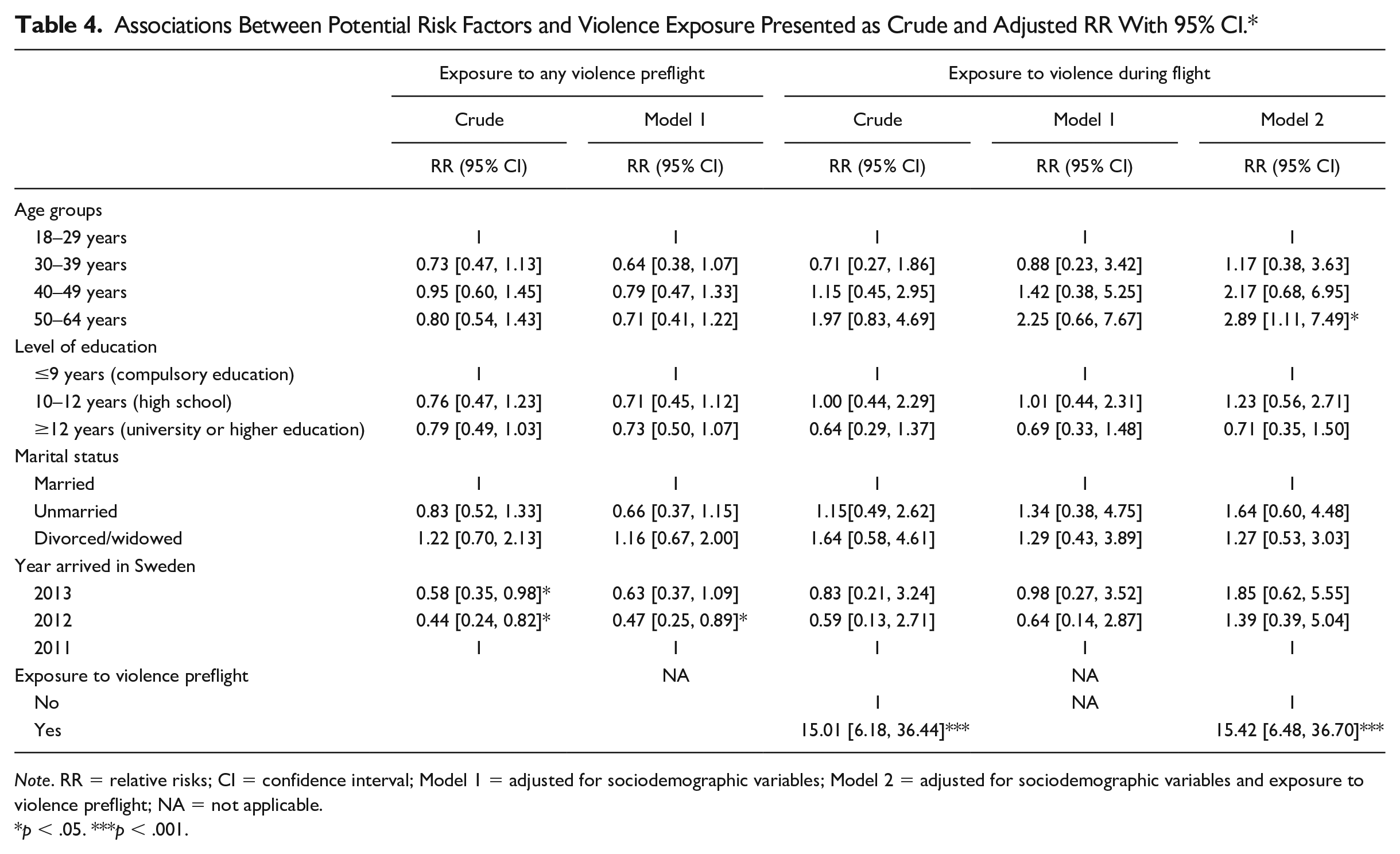
Note. RR = relative risks; CI = confidence interval; Model 1 = adjusted for sociodemographic variables; Model 2 = adjusted for sociodemographic variables and exposure to violence preflight; NA = not applicable.
p < .05. ***p < .001.
Discussion
This study aimed to estimate the prevalence of violence preflight and during flight among female Syrian refugees resettled in Sweden and to examine whether specific sociodemographic factors are associated with VAW. The study also investigated whether previous exposure to violence preflight is associated with exposure to violence during flight. Findings show that one in every four women and almost one in every 10 women (i.e., 7.8%) had been exposed to at least one form of violence preflight and during flight, respectively. Women continue to experience violence as they try to escape the violence in countries of origin. Although measures like lifetime and past-year prevalence are useful measures, prevalence estimates based on recall period related to the crisis are crucial in understanding the problem’s extent (Stark & Ager, 2011).
Multivariate analysis shows that age, marital status, and education do not predict exposure to violence preflight and during flight, meaning that women were equally exposed to violence. The reason for the foregoing statement may be related to the breakdown of social controls and traditional support systems that ordinarily protect women (Burton & Breen, 2002; DFID, 2013; Parker, 2015). On the contrary, the risk of exposure to violence preflight was higher among women who arrived in 2011 than those who arrived later. Thus, although the risk of exposure to violence does not quite differ among women, the year factor might give clues regarding the extent of the breakdown in protective structures occurring during a given period.
During flight, refugees encounter bureaucratic deadlocks, stricter migration policies, and stricter border controls implemented in various European and other transit countries. While such measures ensure border integrity of sovereign nations, the resulting limited human rights and limited refugee protection create an enabling environment for increased risk of VAW (Gupta et al., 2009; Horn, 2010; UNHCR, 2013; Wachter et al., 2018). Thus, vulnerable subgroups (e.g., older women and women with prior history of exposure to VAW) may suffer the most. The complications of aging (Brownell, 2015; Brownell & Heiser, 2006), reduced mobility, and dependence on others for passage and transport during flight are possible explanations for older women’s increased vulnerabilities (Ward, 2013). Violence against older women is under-researched and there is a need for more research on the subject, including in humanitarian contexts.
Our findings show that preflight exposure to violence resulted in a 15-fold risk for violence during flight. The likely explanation for the association between preflight exposure to violence and exposure to violence during flight are numerous. First, women may continue to be at risk of violence during the flight if the factors that increased their risk of victimization preflight remain unchanged (Daigle et al., 2008). For example, victims of family violence traveling with their abusers continue to remain at risk. Studies of VAW in humanitarian emergencies show that family violence, for example, intimate partner violence, forced marriage, and child marriages, tend to increase and is the most common form of VAW in this context (Gupta et al., 2009; Peace Women, 2020; Stark & Ager, 2011; Wachter et al., 2018). An increase in family violence during flight may be related to factors such as stress and perceived threat to gender norms (Wachter et al., 2018).
Another explanation for the observed association between preflight and during flight violence is that adverse mental health outcomes of VAW, such as depression, may mediate initial victimization and future victimization through mechanisms such as decreased assertiveness, avoidance, and inability to recognize and respond to future danger cues (Iverson et al., 2011, 2013; Katz et al., 2010). Screening refugee women for those with a history of past violence and delivering adequate responses are essential for improving women’s well-being, adaptation, and integration in postflight contexts (Phillimore et al., 2018).
This study is based on a comprehensive sample size, with participants selected from reliable databases with a complete and known sample frame. While the low response rate (i.e., 31%) is a threat to validity, the availability of database information for all eligible study participants was useful in constructing nonresponse weights used to obtain reliable estimates. Weighted estimates show that the study sample’s sociodemographic characteristics correspond closely to that of the randomly selected sample frame from the target population. Other measures include the use of a double-blind translation and back-translation procedure and cognitive interviewing to ensure that the questionnaire was appropriate and valid for the target population. Finally, the risk of overreporting by respondents (e.g., due to migration status) is unlikely as only participants with residence permits were included in the study. For future studies, including information regarding perpetrator profile (e.g., partner, family, and external persons), may help to understand the type of violence, that is, domestic violence or violence from external persons. The decision to exclude information on perpetrator profiles was based on the sensitivity of the subject matter and the fact that the study population is vulnerable and difficult to reach. Moreover, the United Nations ethical guidelines on researching VAW stipulate the importance of ensuring and prioritizing women’s safety during data collection (World Health Organization, 2001). Knowledge about perpetrator profiles would clarify the specific forms of violence against refugee women to inform policy and interventions.
Conclusion
The dearth of data results in little or no response to VAW and the lack of support for victims (FRA, 2016a, 2016b). Population-based studies can contribute to increased knowledge about the problem of violence against refugee women to improve response, advocacy, and funding. Thus, findings from the present study provide useful insights regarding the need for incorporating prevention and response to VAW during humanitarian emergencies and in the resettlement process. Although ensuring the safety and well-being of refugee women is a critical ethical aspect of data collection, findings from this study show that collecting data on VAW is possible irrespective of the phase of flight in which they are encountered. For example, reception camps and coordinated resettlement programs provide good opportunities for surveys and interviews (Ward, 2013). VAW interventions, including screening, should be incorporated into resettlement programs while considering the need to prioritize the safety of the women. Above all, findings from this study point to the need for more trauma-informed systems of handling asylum seekers and refugees, as a humanitarian principle.
Footnotes
Declaration of Conflicting Interests
The author(s) declared no potential conflicts of interest with respect to the research, authorship, and/or publication of this article.
Funding
The author(s) disclosed receipt of the following financial support for the research, authorship, and/or publication of this article: This study was made possible by funding from FORTE (Swedish research council for health, working life and welfare), grant number 2017-07194, and The Swedish Red Cross University College.

