



Abstract
Despite reportage of the impending flood by the mass media, the 2012 flood was the most devastating in the history of Nigeria as it adversely affected 33 out of 36 states in the country. Therefore, this study examines people’s perception of and attitude toward mass media reportage of the 2012 flood. A structured questionnaire was used to collect data from 300 households in rural communities in Delta and Anambra states while data analyses were by descriptive statistics, analysis of variance, and regression analysis. More than 75% of the respondents received information about the flood from either radio or television, and there were significant spatial variations in perceptions of flood reportage. Furthermore, the regression results showed that generally, mass media reportage of the flood was not too effective in influencing people’s attitude. Subsequently, recommendations were made on how to ensure that populations affected by floods have access to comprehensive, easily accessible, and effective information.
Introduction
Globally, the impacts of natural disasters such as droughts, earthquakes, and floods include loss of livestock and farmlands, destruction of infrastructure, and the displacement of populations and loss of human lives (Famine Early Warning Systems Network [FEWS NET] Nigeria, 2012-2013) Specifically, floods have been identified as the most common of all natural hazards (Jha, Bloch, & Lamond, 2012) and are responsible for more than half of all the fatalities, and a third of total economic losses from natural disasters (Adelekan & Asiyanbi, 2016; Kellens, Zaalberg, Neutens, Vanneuville, & De Maeyer, 2011). In Nigeria, floods remain the most common and significant natural disaster, and according to Onwuka, Ikekpeazu, and Onuoha (2015), floods constitute a major environmental problem in Anambra state as more than 30% of the state’s population reside in riverine areas with fishing and agriculture as their main sources of livelihood.
Other parts of Nigeria have also been experiencing floods, and the first flood recorded in Nigeria was at Ibadan, the capital of Oyo State in 1948, followed by other serious floods. According to Etuonovbe (2011), an estimated 1,549 have lost their lives to floods whereas more than a million have been displaced by flood events in Nigeria since 1948. However, Nigeria experienced the worst flood in the past 40 years in 2012, and it is estimated by the United Nations Office for the Coordination of Humanitarian Affairs (OCHA, 2012) that between July and October 2012, about 7,705,378 people were affected by the flood, 2,157,419 were registered as internally displaced persons (IDPs), 363 people reported dead, and more than 618,000 houses damaged or destroyed in 33 out of 36 states in the country. Subsequently, in the aftermath of the flood, Odidi (2012) reported that “even the flood is worse than Boko Haram menace in Nigeria.”
The first prediction of the 2012 flood came at the beginning of the year. Meteorologists at the Nigerian Meteorological Agency (NIMET) warned Nigerians to prepare for more rains, which would last until the third week of July as there were indications of an “above normal rainfall in some parts of the country.” This information was handed down to the populace through the mass media (radio, television, and newspaper), informing them about the risks associated with the flood. The populace was also advised to engage in proactive measures that could combat the effects of the floods and minimize its effects. These mass media messages were seemingly ignored, which led to the devastating effects of the flood as almost all states of the federation reported colossal destruction of properties, farmlands, animals, and even loss of human lives (OCHA, 2012).
Evidence from studies in Nigeria indicates that people seem to have a negative perception of media reportage of issues. For instance, Afolabi (2010) noted that the mass media have not been timely in their reportage of conflicts and insurgencies. Other researchers also show that the Nigerian media have not effectively played a surveillance function in the reportage of conflicts and insurgencies, neither have they displayed a high level of objectivity in their reports (Okpara, 2010; Oputa, 2011; Lawrence, 2011; Hamida & Baba, 2014). This can partly be attributed to the fact that most media organizations in the country are owned by state (sub-national) governments and individuals, and as such, they are primarily used to promote the interests of their owners. In addition, it has been revealed that the Nigerian mass media do not give significant coverage and provide effective awareness on climate change issues even as they fail to offer adequate explanations to environmental issues in general (Batta, Ashong, & Bashir, 2013; Moeti, Maraisane, & Marou, 2008; Ukonu, Akpan, & Anorue, 2012). This can be seen in the reports on the 2012 flood as majority of the flood messages were presented in the straight news format, devoid of in-depth reports that could increase the knowledge of the populace on the causes and risks associated with the flood.
In the event of disasters such as the 2012 flood, the importance of risk perception in disaster risk reduction and mitigation has been highlighted to include the anticipation and comprehension of people’s responses to disasters, effective communication of risks information, and initiation and implementation of disaster prevention and mitigation strategies (Adelekan & Asiyanbi, 2016; Bradford et al., 2012; Intergovernmental Panel on Climate Change [IPCC], 2012, 2014). Despite studies in Nigeria on the need for the populace to understand their environment and also assess their perception and knowledge of environmental disasters (Babalola, Babalola, & Okhale, 2010; Urcan, 2012), there is a dearth of research on people’s perception of the 2012 flood as reported by the mass media. In this context, the perception of flood risks by population based on mass media reportage is indispensable in minimizing the impacts of future disasters. This underscores the urgent need for in-depth reports and research on mass media reportage on natural disasters in the Nigerian environment.
Therefore, the aim of this study is to appraise people’s perception of and attitude toward mass media reportage of the 2012 floods in Nigeria. To achieve this aim, the study specifically seeks to find out whether there were differences in media reportage of the flood and in the perception of mass media reportage of the floods. It also examines the predictors of people’s perception of mass media reportage of floods. The results will be an addition to the literature on people’s perception of environmental disasters as reported by the mass media especially in rural areas of developing countries. The findings will also assist governments and policy makers to initiate policies that will ensure effective mass media reportage of environmental issues so as to minimize losses and damages due to future environmental disasters.
Method
Theoretical Background
This work is anchored on the selective perception theory. The selective perception theory came up when scholars discovered that the audience of mass communication are not passive as the all-powerful media effects theory proposed. The Royal Institute of British Architects (RIBA, 2011) subsequently identified four factors that determine the effects of floods on humans as the level of predictability of floods, the rate of onset of the flood, the speed and depth of the water, and the duration of the flood.
In the context of this study, the level of predictability involves the timing, accuracy, and communication of warnings given before a flood. McCarthy and Dolfsma (2014) argued that the media shape our opinion “by choosing what events to report on, how much and how frequent to report on a subject and what language to use when describing an event, thus the media can influence public perception” (p. 48). Although some scholars believe in the persuasive power of the media, others go a step further to look at certain elements that can also shape the perception of an individual (Barone & Swan, 2007;Jones & Rainey, 2006). Friedman (2015) believes that several factors such as socio-demographic characteristics can influence people’s perception as “the mass media are not the only source of environmental information for people” (p. 144). Subsequently, Sampel and Aoyagi-Usui (2009) after their study on media coverage and influence of public opinion on climate change in Japan suggested that “. . . effective communication of climate change, strategies aimed at maintaining mass-media coverage of global warming are required” (p. 203).
Folarin (2002) therefore argues that “each of us tends to perceive and then decode communication messages in the light of our previous experiences and current dispositions-our needs, moods and memories. The language we speak, and the words we use tend to circumscribe our perception” (p. 71). Okunna and Omenugha (2012) assert that “how people understand or interpret mass media messages is important in deciding their responses to the messages and the influence of the messages” (pp. 250-251). To Leckenby (2000),
Selective perception means that different people can react to the same message in very different ways. No communicator can assume that a message will have the intended meaning for all receivers or even that it will have the same meaning for all receivers. (p. 73)
Consequently, the theory of selective perception “has been conceptualized as a four-part process consisting of selective exposure, attention, comprehension, and retention” (Taylor, Franke, & Bang, 2006, p. 23). Therefore,
People can selectively expose themselves to media messages, they can selectively pay attention to certain elements of a message, they can select how to perceive or interpret a message and they can select what to retain and recall, or learn from the media. (Werder, 2009, p. 633)
Perception, therefore, entails the interpretation an individual gives to certain events around them. A study of people’s perception of the 2012 flood will go a long way in assessing the impact media reportage of the event had on the people. How did they interpret the messages they received from the media? Did this lead to a change in perception about the floods and possible attitudinal change? This work will proffer answers to these questions.
Study Area and Data Collection
This study was conducted from November 2013 to March 2014, about a year after the 2012 flood occurred. The target population for the survey comprises of people who had access to information concerning the impending 2012 flood from the mass media. In this context, the mass media refers to television, radio, or newspapers. These three were used because the study was carried out in the rural areas, and these rural areas have no or minimal access to social media or cable news media. The research design for this work was the survey method, and the instrument for data collection was the questionnaire. A well-structured questionnaire was used to assess people’s perception of and attitude toward the 2012 flood based on mass media coverage of events. Because the study took place in Ibo-speaking areas of Delta and Anambra States, the research was conducted using Ibo language as many of the respondents were not well-educated and can only communicate effectively in the local Ibo language.
This research was conducted in two severely flood-ravaged states in the southern part of Nigeria—Anambra and Delta states. Both states were listed under “category A” by the Federal Government of Nigeria, which shows that they were among the worst hit in the country by the flood. Listing all the Local Government Areas (LGAs) that were ravaged by the flood in each state, the researchers randomly picked out one LGA each from the two states, namely, Ogbaru LGA in Anambra state and Ndokwa West LGA in Delta state. Ogbaru LGA has 17 communities, whereas Ndokwa West has a total of 11 communities. Thereafter, three communities were randomly selected from each of the LGAs under study. These communities are Akiri, Odekpe, and Osomala for Anambra state, whereas Kwale, Onicha Ukwuani, and Utabuogbe are for Delta state. In each of the communities, 50 respondents were interviewed with the questionnaire. Therefore, a total of 300 respondents, 150 in each of the two states, were used for this study.
Data Analysis
Descriptive statistics were used to highlight socio-economic characteristics of the study population, their sources of mass media messages about the flood, and their perception of media reportage of the floods. In addition, ANOVA was used to test for significant differences in people’s perception of the effectiveness of mass media reportage of the flood. Descriptive statistics were also used to explain the attitudes of the respondents toward mass media reportage of the flood, and finally, binary logistic regression analysis was used to estimate the socio-economic predictors of respondents’ attitude toward mass media reportage of the flood. The outcome binary variable for attitude was whether or not the people anticipated unusual flood devastation based on mass media reportage. However, the independent variables were socio-economic characteristics of the study population and spatial locations in the study area. All analyses were carried out at .05 level of confidence using Stata 12.0
Results and Discussion
Socio-Economic Characteristics of the Study Population
The total percentage of male respondents across the two states is 54, whereas that of the females is 46. The age range that had the highest number was 20 to 29 years with 24%, followed by 40 to 49 years having 22.30%. Others are 30 to 39 years (14.70%), 50 to 59 years (10.70%), 70 years and above (10%), and less than 19 years (6.30%). As regards marital status, 47.70% were married, 23.70% widowed, 19% single, 9.30% separated, whereas 0.30% were divorced. Thirty-one percent of the respondents had no formal education, 28.70% had secondary education, 22.70% had primary education, and 16.70% had university education, whereas 1% had vocational/technical education, respectively (Table 1).
Socio-Demographic Characteristic of the Study Population (%).

Note. US$1 = 160 Nigerian Naira.
Mass Media as Sources of Information on the 2012 Flood
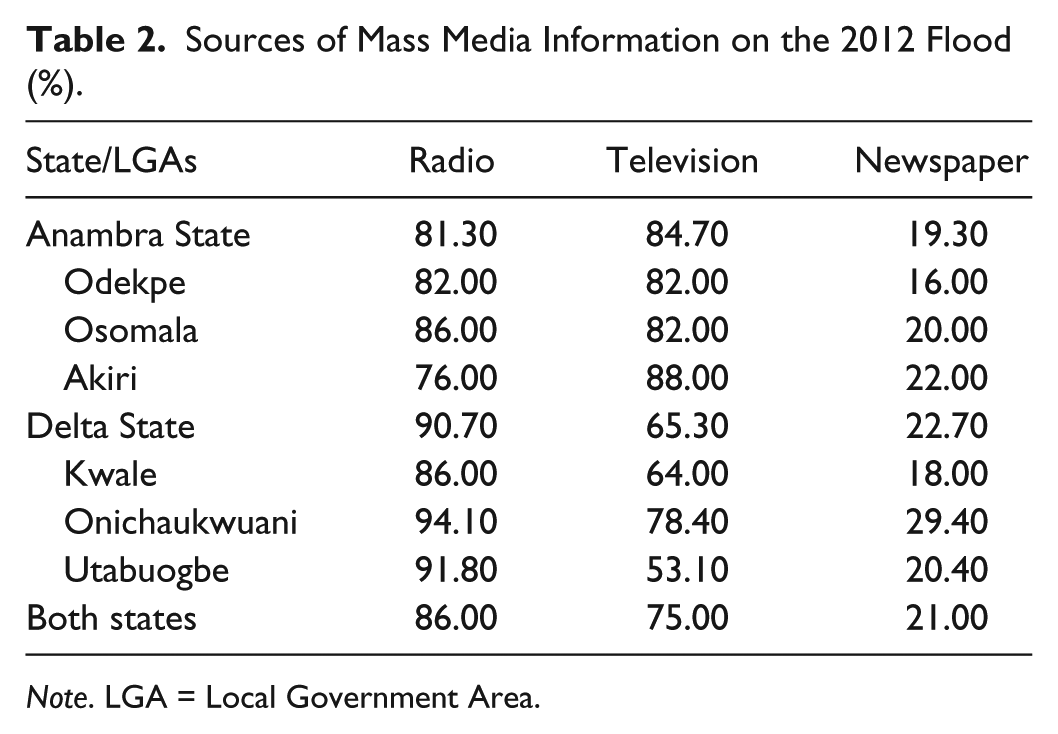
In the study area, radio was the most important source of mass media reportage of the 2012 flood, whereas the least important mass media source is the newspaper (Table 2). This result suggests that radio remains the preferred medium of communication for rural dwellers in Nigeria. Radio being the main source of information about the floods is not surprising as the study area comprises of rural areas, and newspapers and television stations are not easily accessible in rural areas compared with radio, which is owned by virtually all the households. In addition, the preference for radio may be because of it makes more use of local languages/dialects in information dissemination compared with television and newspaper. It should be noted, however, that these radio broadcasts may not be totally objective as factors such as media ownership, coverage, and resources available to the radio stations may affect their news reports.
Sources of Mass Media Information on the 2012 Flood (%).
Note. LGA = Local Government Area.
Last, whereas more respondents (90.70%) from Delta state got information from radio, more respondents (84.70%) from Anambra got information from television. It is also repeated for the LGAs in each of the states. For the entire study area, 86% of the respondents got information about the flood from radio, whereas 21% of the respondents got their information from newspapers.
Perception of Mass Media Reportage on Floods
This section highlights people’s perception of the effectiveness of the mass media reportage of the 2012 flood based on pre-flood warning, emergency readiness, proffered solutions, damages caused by the floods, and the experiences of the victims of the flood disaster. About 48% of the people of Odekpe agreed that the media did well in warning the people about the floods, 40% believed that they did little, whereas 12% said they did not do well. This is a sharp contrast from the report of other communities as a good number of them (92.20% from Onicha Ukwuani) said that the media did not do well in giving pre-flood warnings. In proffering solutions, 72% of the respondents from Kwale said that the media did well as against 18% from Odekpe. Kwale had the highest percentage of respondents (58) who said that the media did well in reporting the damages caused by the flood, whereas 45.10% from Onicha Ukwuani said that they did little.
In reporting the experiences of victims of the floods, 39.20% of respondents from Onicha Ukwuani said that the media did well, 54.90% of them said that the media did little, whereas 5.90% agreed that the media did not do well as against 42% of respondents in Odekpe who said that the media did not do well in reporting the victims (Table 3). Between the two states, a total of 79% and 90% of the respondents in Anambra and Delta, respectively, were of the view that the media did not do well in giving out pre-flood warnings. About 55% in Anambra and 87% in Delta said that the media did not effectively inform them about emergency readiness strategies for the impending floods. When it came to proffering solutions and reporting the damages done by the floods, 53% and 38% in Anambra, and 52% and 48% in Delta, respectively, agreed that the media did well.
Perception of Effectiveness of Media Reportage of 2012 Flood Events (%).

These results clearly show that prior to the flood, media reportage of the impending flood was not convincing enough for the populace to take appropriate mitigation measures. In addition, the results indicate that media reportage was less effective in Delta when compared with Anambra State. The inability of the media to convince most of the people may also be due to the fact that these communities usually experience perennial floods, and the populations believed that 2012 flood will not be unusual. Also, the lower effectiveness of the media reportage in Delta state maybe due to the fact that the communities in Anambra State are situated very close to the banks of River Niger (a major river in Nigeria and Africa) and are more used to floods from the overflowing of the river. However, the communities of Delta State have smaller or no rivers, and the occurrence of floods here is less regular and devastating when compared with Anambra State communities.
However, there was an improvement in the perceived effectiveness of media reportage in terms of proffering solutions to damages by flood. This means that although the peoples did not take media reportage seriously prior to the flood when the devastations from the flood occurred, they began to marginally take media reportage more seriously during and after the flood. Most importantly, it can be seen that even after the communities in the study area experienced the flood disaster, media reportage was not that effective as about 53% and 52% of the population in Anambra and Delta States, respectively, perceived the proffered solutions as effective. With regard to reporting damages, only 38% and 48% of populations in Anambra and Delta States, respectively, perceived reportage of damages as effective and just 19% of people of Anambra State perceived media reportage of the experience of victims as effective against 28% in Delta State. Conclusively, these findings indicate that the media did not effectively report the floods prior, during, and after the disaster.
To ascertain whether there exist significant variations in the way respondents perceive the performance of the mass media in giving out pre-flooding warnings in the study area, the results of the responses from the respondents were subjected to analysis of variance and homogeneity tests. The results of the ANOVA and homogeneity tests for the states in Table 4 show that there exist significant variations in the way all the variables of mass media flood warnings were perceived across the states of the study area. The only exception being on how the respondents perceived the solutions proffered by the mass media, which has an F value of 0.565 at .453 level of significance. The results of the homogeneity test also indicated that all the variations observed in the ANOVA results are significant (see Table 4). These results then mean that other factors apart from mass media reportage may have influenced people’s attitude toward the flood. The next section, therefore, explores the influence of spatial and socio-economic characteristics on people’s attitude toward mass media reportage of the flood
ANOVA of Perception of Effectiveness of Media Reportage of 2012 Flood Events.
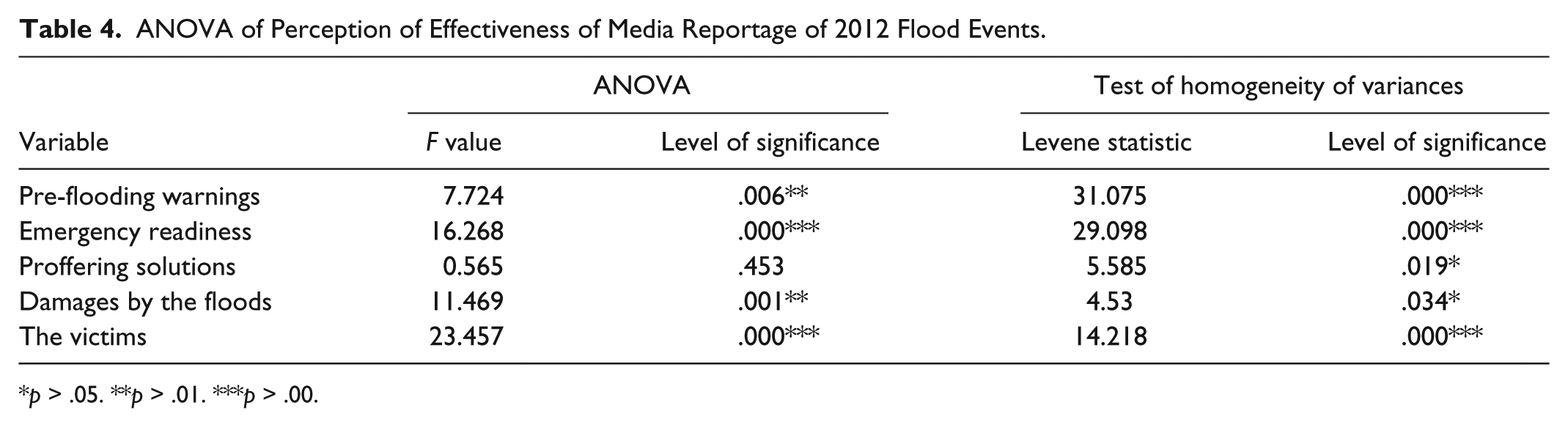
p > .05. **p > .01. ***p > .00.
An Appraisal of People’s Attitude to Mass Media Reportage on Floods
The attitude of the people to mass media reportage of the flood was represented by their anticipation or otherwise of the unusual predicted nature of the 2012 flood. Their levels of anticipation, therefore, mirror their comprehension and acceptance of mass media reportage—that is, the effectiveness of the mass media in influencing their attitude toward the flood. Only 39% (less than half) of the population of the study area comprising 44% from Anambra and 35% from Delta anticipated unusual nature of the flood based on mass media reportage (Figure 1). This also underscores the ineffectiveness of mass media reportage of the flood events.

Anticipation of unusual nature of 2012 flood in the states and the study area based on mass media reportage (%).
Among the communities, mass media reportage was also more effective in Anambra than in Delta State (Figure 2). This pattern may not be unconnected with the fact that communities in Anambra State have more access to television and may have seen visuals of flood devastation. These television visuals may have gone a long way in making them anticipate the flood more than their counterparts in Delta that has lesser access to television visuals. Based on the results above, we decided to carry out a logistic regression to estimate the spatial and socio-economic predictors of people’s attitude to floods based on mass media reportage of the event.
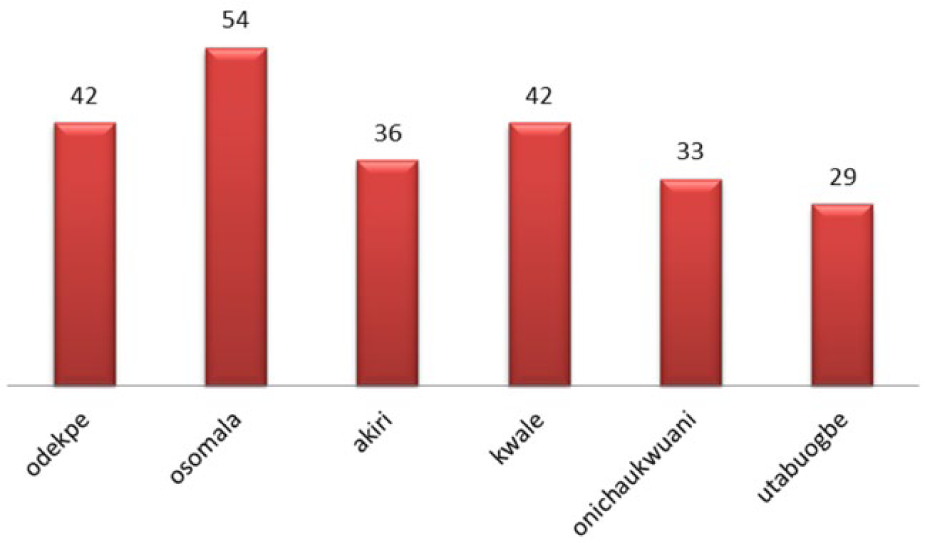
Anticipation of unusual nature of 2012 flood across the communities based on mass media reportage (%).
The odds ratios from the binary regression results, in relation to their reference categories, show negative values of anticipation of the unusual nature of flood based on mass media reportage (Table 5). The exceptions are the coefficients for Osamala and Akiri communities in Anambra State, and people aged between 50 and 59 years. In other words, the regression estimates show that any increase in mass media reportage of 2012 floods leads to varying degrees of decrease in the socio-economic groups except those aged 50 to 59 years, and the communities in Anambra State. Furthermore, in each of the socio-economic and spatial categories, the most significant predictors of anticipation or otherwise of unusual nature of the flood based on mass media reportage are people aged 70 years and above (odds ratio [OR] = 0.012; p = .002), the married (OR = 0.129; p = .000), secondary education (OR = 0.055; p = .000), income of between N31,000 and 50,000 (OR = 0.050; p = .000), and Delta State (OR = 0.390; p = .030). The regression results have also shown clearly that mass media reportage of the flood events was not as effective as expected. It shows that prior experiences of a flood, as evidenced in the coefficients of the communities in Anambra State, were more efficient than the media reportage in influencing people’s anticipation of the unusual nature of the flood.
Socio-Demographic Predictors of Attitude Toward Mass Media Reportage of the 2012 Flood.

Note. US$1 = 160 Nigerian Naira.
Significant at .05 level of confidence.
Conclusion
The selective perception theory came to play in this study as the respondents in this study attested to the fact that certain information about the flood was gleaned from the mass media. The way the communities studied perceived media reports on flood differed; whereas some believed the media did well, others said they did little, whereas a good number said that they did not do well. The results of the ANOVA show that there exist significant variations in the way all the variables of mass media flood warning were perceived in different parts of the study area. The only exception to the perception is how the respondents perceive the solutions proffered by the mass media, which has an F value of 0.565 at .453 level of significance. The regression model was significant at .000 level of confidence, and a summary of the regression estimates shows that any increase in mass media reportage of 2012 flood leads to varying degrees of decrease in the tendency of all age groups except the 50- to 59-year bracket, and the communities in Anambra State to anticipate unusual nature of the flood, all other factors remaining constant.
In all, this study has shown that mass media reportage of the flood events was not really effective in making the people anticipate that the 2012 flood will be unusual and will have devastating effects. The consequences of this ineffective reportage were manifested in the colossal damages to lives and property as highlighted in the introductory part of this article. However, the role of the mass media in the reportage of events, especially disasters, cannot be overlooked. Unfortunately, prior to the occurrence of the flood, the media were not convincing enough, but during and after the flood, respondents for this study agreed that the media did well in proffering solutions to the floods they suffered.
Based on the information from the media, the populace engaged in different activities such as the building of silt and runoff collection pits, sand filling of their lands, and the elevation of their buildings to prevent future occurrence of the devastation they experienced. This clearly shows that the mass media to a large extent can influence people’s perception, thereby spurning them into action. What is needed in future is for the mass media to engage in comprehensive coverage of natural disasters before they occur. In this context, due consultations with experts in these disasters should be carried out so as to give factual and convincing reportage of the causes, predictability, and impacts of the disasters. The media should also be involved in periodic public service announcements and programs aimed at proactively educating the people on the dangers of some of their activities to the environment. In addition, the media should endeavor to frame and communicate natural disasters using local languages/dialects to ensure maximum comprehension of their messages by vulnerable populations, especially in rural communities of Nigeria.
Last, due to the proliferation of mobile phones and telecommunication operators in the country, the social media have also come to be known as the media of choice for youths in the country. In addition, the country is witnessing the penetration of cable television networks, especially in the rural areas. Therefore, future research should assess the role both the cable television networks and the social media can play in disseminating information about natural disasters such as floods to Nigerians and other developing countries.
Footnotes
Declaration of Conflicting Interests
The author(s) declared no potential conflicts of interest with respect to the research, authorship, and/or publication of this article.
Funding
The author(s) received no financial support for the research and/or authorship of this article.