




Abstract
This article attempts to illustrate the relationships between Tenor dimensions and pronominal reference in standard Thai. It argues for additional consideration of Thai pronouns as negotiators of interpersonal relationship. In addition to making deictic reference and being part of the Mood elements in major clauses, these resources can mark interpersonal social differentiation as well as attitudinal or emotional involvement. Based on examples of data collected from 40 contemporary Thai novels, the study has attested that usage of first and second person pronominal forms reflects the interplay among the three Tenor dimensions—“status,” “contact,” and “affect.” The study further suggests a new approach of pronominal categorization in Thai—pseudo T-pronouns with informal forms, pseudo V-pronouns with deferential flavor, and N-pronouns or pronominally used nominal terms. They all are found strategically used in novels to construe Tenor relations. By means of expressive pronominal switching and discriminatory pronominal choice, Thai pronouns can be employed to differentiate between positive and negative affective involvement of interactants in dialogical texts.
Keywords
Introduction
Thai pronominal reference reflects a complex system of social relationships between interactants in communicative situations. The term “pronominal” is used in this study as an “adjective” meaning “pertaining to personal pronouns, or occurring in first or second person contexts and with first or second person meanings in much the same way as personal pronouns do” as defined by Cooke (1968, p. 1). Linguists with published works on the Thai pronouns have all recognized that Thai pronouns are linguistic resources, which play a significant role in marking social statuses and roles relationships of communicative interactants (Baron, 1998; Cooke, 1968; Hoonchamlong, 1992; Iwasaki & Horie, 1995; Kanittanan, 1984; Palakornkul, 1972; Prasithrathsint, 2001; Simpson, 1997). According to Levinson (1983), there are five kinds of deixis: person, time, place, discourse, and social. In my view, only person and social deixis are clearly interpersonally relational. The former refers to grammaticalization of referencing the participants in a speech event as first, second, or third person, whereas the latter concerns encoding of their role relationships. The Thai language system comprises several dozens of pronouns functioning as both person and social deixis which are semantically characterized by different sociocultural factors such as age, sex, social status or position, and degree of familiarity (Cooke, 1968; Palakornkul, 1972). Pragmatic awareness of Thai pronominal usage is derived from a long-term process of learning development through daily socializations with family members, peer groups, friends, co-workers, and others in the societies. Thai communicative interactants naturally adopt appropriate pronominal strategies on the course of their socialization with others, to clearly mark referents and simultaneously to recognize their social differences. Due to variations in pronominal usage and the huge inventory of Thai pronouns, which contains personal pronouns proper, names or nicknames, kinship terms, title terms, rank terms, and occupational terms, it is necessary for Thai individuals to first evaluate their relationships with message receivers before forming their utterances with appropriate pronominal choice to effectively convey the right social meaning across in both verbal and written modes.
Personal pronouns proper are mostly monosyllabic and semantically defined to specifically denote first, second, or third person with a few exceptions of homonymous forms functioning as different person categories (Palakornkul, 1972) such as the first person tɕhàn and phǒm, the second person khun, and the third person man. The pronoun proper kæ: can be used as second person to reference an intimate social, equal, or inferior, or as third person to address a familiar social superior. The other types of pronoun are nominal terms and may be contextually employed to denote first, second, or third person.
In addition to conveying social meanings, Thai pronouns can be used for a socially expressive purpose. Generally perceived as resources of venting one’s anger or dissatisfaction and socially stigmatized as impoliteness markers are the pronominal pair ku:-mшŋ (Cooke, 1968; Simpson, 1997). In a dyadic speech situation, a native Thai male may abruptly change his pronominal usage by replacing the polite forms phǒm-khun with ku:-mшŋ to express his emotional outburst when provoked by the other conversational participant. However, the expressive function of Thai pronouns is not limited to only ku:-mшŋ but is extended to different pronominal forms. Palakornkul (1972, p. 32) considered this kind of linguistic strategy as “switching of pronouns” or “pronominal switching or breakthrough” as coined by Friedrich (1966, cited in Palakornkul, 1972, p. 17) which is applicable to positive as well as negative emotional manifestation. By playing the role of signifying the speaker’s affective state of mind, Thai pronouns can be branded as part of the repertoire of “expressive resources.”
Both social and expressive functions of Thai pronouns have qualified them as negotiators of interpersonal relationship in major clauses similar to the functions of Vocatives. Systemic Functional Linguistics (SFL) views that Vocatives or terms of address are “a very potent area of realisation of interpersonal meanings” (Eggins, 2004, p. 101). The choice of Vocatives in English correlates with the three dimensions of the Tenor register—“status,” “contact,” and “affect” in each context of situation (Poynton, 1990). And it is the interplay among these three Tenor variables that entails the choice between the informal and the formal language use in realization of interpersonal social differentiation and affective involvement. In contrast with Vocatives, an English pronoun is generally analyzed as an interpersonal resource for deictic referencing and being part of the Mood element of a major clause. The Mood system belongs to the interpersonal metafunction, which realizes the selection of mood (i.e., declarative, imperative, and interrogative) in a clause. It consists of two major parts—Subject, a nominal group, and Finite, a verbal group (Halliday, 1994). While a Vocative is characteristically thematic and always stays outside the Mood (Halliday & Matthiessen, 2004), a pronoun may function as Subject itself or part of it, or as part of Finite, for example, a verbal or prepositional object. The similar approach was used to analyze Thai pronouns in a pioneer SFL study of the Thai language system by Patpong (2006) which explored the metafunctions of its major components—Field, Tenor, and Mode as well as its lexicogrammatical structures. The role of Thai pronouns as negotiators of social meanings was excluded. In another SFL study on Thai, an Appraisal analysis of Thai journalistic texts by Arunsirot (2012), the role of Thai pronouns as tokens of emotional manifestation was also ignored.
The following interrogative clauses in Thai can be literally translated into English as “What did you say just now?”
(a) (b)
(c) (d)
(e)
To recognize that the underlined pronominal Subject in the Mood of each clause has merely a deictic function referencing an addressee is not adequate to capture the essential meanings of designating interactants’ social roles and affective involvement that are encoded through each pronominal form. These five pronouns proper are grammatically not different in terms of denoting the second person referent without gender specification. However, they are not equivalent in terms of revealing social differentiation and expressive connotations. The interpersonal relationship that each of them negotiates over each clause could be unique and possibly cannot be directly decoded without considering the context of use. Furthermore, Thai nominal address terms may be pronominally used in person reference, and second person pronouns, as Vocatives (Banthuchai, 2006). When a pronoun functions as a Vocative or as a Subject or a verbal or prepositional object, its role as a negotiator of interpersonal relationship never changes. Likewise, when an address term functions as a pronominal subject or an object, its negotiatory role remains intact. My current study will attempt to illustrate how the pronouns of standard Thai regardless of their forms and grammatical functions, except being Vocatives, are used to construe the Tenor dimensions.
Data Collection
In this study, my analysis of the relationships between Thai pronominal reference and the three Tenor dimensions is based on the collected data of pronominal usage in conversational texts selected from 40 Thai novels initially published between 1927 and 2009. The list of the 40 novels has been provided in the appendix. All Thai pronominal forms, both first and second person, except those used to address royalty or monks or used by members of both social statuses, are the targets of my study. Their usage and the contexts of utilization are both taken into account for analysis of their negotiatory role as markers of social and expressive meanings.
Tenor Dimensions and Their Relationships with Thai Pronominal Usage
SFL has identified three important aspects of a language situation, which have linguistic consequences. These three aspects are called register variables including Field, Tenor, and Mode (Banks, 2002; Christie, 2004; Eggins, 2004; Halliday, 1994). In short, Field is concerned with the social activity in the discourse that language is used to talk about. Tenor refers to the role relationships between the interactants in the discourse. Mode is about the role language is playing in the interaction; it refers to the manner and channel of communication of the discourse. In text, each situation context is always composed of these three aspects which correlate respectively with the three metafunctions or functional components in the semantics of all languages, that is, ideational, interpersonal, and textual which are realized through the grammar of a language. “These metafunctions are the functions that are embraced across all areas of the language and that reflect the fundamental purposes for which the language has evolved” (Christie, 2004, p. 20). The language has an ideational metafunction to conceptually encode the nature of experiences in the world, processes of actions, events, or states of socialization where communicative interactants are involved. The language has an interpersonal metafunction to realize the nature of the relationships between the participants in a communicative interaction. The language also has a textual metafunction to deal with how a text can be organized as a message for communication in a situation. The focus of this article is about realization of the interpersonal metafunction through pronominal usage, so the Tenor register together with its relationships with Thai pronouns will be the target of the discussions to follow.
The Tenor register consists of three different dimensions: “power,” “distance,” and “affect” (Poynton, 1990) which have later appeared as “power,” “contact,” and “affective involvement” (Eggins, 2004, p. 99-101). “Power” positions a language situation as to whether the interactants are of equal or unequal social status. “Distance” or “contact” concerns with defining a language situation in terms of whether the role relationship between the interactants is close or distant. “Affect” or “affective involvement” refers to a language situation in which the interactants are emotionally involved or affectively committed.
The concepts of the first two dimensions were greatly influenced by the notions of “power” and “solidarity” established by Brown and Gilman (1960) as a result of their analysis of the usage of second person pronouns in some European languages. They symbolized T to represent the pronoun of reciprocity or mutual choice, and V, the pronoun of non-reciprocity used by a social inferior to refer to a social superior. “Power” dictates a non-reciprocal or asymmetrical relationship between two persons, both cannot be equal in terms of exercising power in the same area of behavior. When one speaker uses the T-pronoun, the other can only use the V-pronoun. “Solidarity” is established when both speakers are socially equal and/or well familiar, then V-pronoun will be replaced by T. The use of V-pronoun indicates the great distance between the speakers or the decline of solidarity. The concept of “power” and “solidarity” is also extended to explain the social meanings in English address terms (Brown & Ford, 1961). In the Appraisal theory, “power” is termed as “status”; both “status” and “contact” are taken as essential contextual variables in configuration of a Tenor environment. However, “affect” or “affective involvement” has been considered as a different categorical element of Tenor configuration and repositioned as a discourse semantic system of emotional assessment and attitudinal evaluation of Tenor relations (Martin & White, 2005).
According to Poynton (1990), the Tenor variable “status” (p. 90) is the key determinant of the vertical social distance between two interactants whose roles in a speech event can be categorized as (a) the social superior, (b) the social inferior, and (c) the social equal. In a hierarchical Thai society, the important factors that play significant roles of conditioning “status” include relative age, social position, and non-intimacy (Cooke, 1968, p. 58). These factors are vital to influence one’s pronominal choice as well as usage of other language forms. With age difference, the older is always treated with respect by the younger. Without interference by other social factors, two interactants of the same relative age would treat each other as equal. For example, two non-managerial male colleagues working in the same company can interact with each other as socially equal and exchange the same set of non-deferential pronominal forms or even strongly impolite forms if they are close enough. When age is significantly different, the younger one may show his or her courtesy toward the older one by pronominally addressing him or her as an elder brother or sister and avoiding using any impolite pronominal form. In many different situations, however, the age factor may lose its significance in conditioning one’s status; it can be overridden by the factor of social position. One’s social position is defined by his or her relationship role in a role set that he or she is part of. An individual can play different relationship roles depending on the role sets that he or she is involved as a role player (Palakornkul, 1972). For example, at home, a man can play the role of “father” in the role set of which he and his child are the members. His role relationship with his child is a “father–son” relationship. A father is, by familial hierarchy, superior to his child. At his workplace, he may play the role of “supervisor” or “manger” in the role set of which he and his direct reports are the members. His role relationship with his subordinates is a “superintendent–subordinate” relationship. A manager, by position in the office, has a higher authority than his direct reports who are older though. One’s relationship role may be shaped by different social factors such as birth (royalty vs. commoner), religious, officialdom, rank, title, occupation, wealth, education as well as family relationship. A royalty member earns a superior social status by birthright as compared with a commoner regardless of seniority. A Buddhist monk, young or old, is always revered by the Buddhist laymen. A general has a higher authority than an officer. A young master can demand obedience from a senior servant. A student should show courtesy to his or her teacher. A patient usually holds his or her doctor in high regard. The rich usually have an influence over the poor who are financially dependent on them. A well-educated person is more often treated with respect by an undereducated person. A mother is respected by her children. In a traditional couple relationship, the husband has a louder say than his wife. In an asymmetrical relationship, there exists a vertical dimension of interpersonal relationship cline maneuvered by the social hierarchy. Between the social superior and the inferior, there is always a vertical distance in their relationship. And both parties shall observe the communicative protocol by choosing the language forms appropriate for their levels, such as pronoun, address term, final particle, or politeness particle, and so on. Regarding their pronominal usage, the social superior and the inferior do not entirely reciprocate the same set of pronominal forms in their conversations. They need to ensure that their usage does not upset any “status” norms. In Thai societies, a social inferior is not supposed to speak to a superior using those informally used pronominal forms such as first person ku:, rau, or second person kæ:, lɔ̀:n, mшŋ, thɤ:, tua-ʔe:ŋ, ʔeŋ, and so on. These pronominal forms can be used in person reference among social equals or spoken by social superiors. The factor of non-intimacy as mentioned above does not directly influence “status” in the context of Tenor register but is related to its second variable.
The Tenor variable that conditions the positioning of interactants as close or distant is “contact.” It is concerned with the horizontal dimension of social distance. Poynton (1990) modeled “contact” or “distance” as a choice between the two features of intimacy and distance on a horizontal relationship cline. In a conversational interaction, not only does the speaker have to take into account the status difference but also the degree of closeness or distance between himself or herself and the addressee. Moreover, it may happen that “Through particular configurations of linguistic choices, interactants may lay claim to a greater intimacy or distance than the actual circumstances of their relationship would predict . . .” (Poynton, 1990, p. 90). In Thai culture, it is not uncommon that one may address a non-kin acquaintance or a stranger as though the addressee was his or her own relative by using a displaced kinship term (Cooke, 1968). Such a strategy of flagging uncalled-for solidarity is a means of establishing a good rapport or camaraderie. In a Western culture, such claims of uncalled-for intimate relationship through usage of an intimacy-oriented address term can be subject to acceptance or rejection by the addressee (Poynton, 1990), which is also possible in Thai culture depending on each individual. In Thai culture, in an unfamiliar relationship, the speaker should address the casual acquaintance or the stranger with courtesy especially when the latter’s social position is ambiguous. Even in an intimate relationship, one’s pronominal usage remains subject to the conditions of “status.” Deference must remain when one verbally interacts with someone older or socially higher. To flag solidarity in his or her speech, the speaker needs to take heed of these status-related factors in addition to the degree of familiarity and closeness. Regardless of “contact,” it is socially appropriate for a social inferior to keep a vertical distance far below a superior by identifying himself or herself as lower in status realizable through different pronominal forms. Therefore, in a solidarity but asymmetrical relationship, reciprocity of informally used pronominal forms as mentioned above is culturally not possible. This is different from some European contexts, in which a mutual exchange of an identical T-pronoun is possible in an asymmetrical relationship.
In Thai, under normal circumstances, the range of pronominal selection enjoyed by the social superior is different from the pronominal resources available for the inferior. In an unfamiliar relationship, the former may resort to first or second person deferentially used pronominal forms to express politeness. However, in an intimate relationship, the former has more freedom to decide whether to use such forms or not, but the latter is obliged to flag a deferential flavor albeit with a mild degree. Unlike some European languages, solidarity may take precedence and thus permits the social superior and the inferior to mutually exchange a single T-pronoun. In Thai, pronominal usage can be reciprocated provided that both interlocutors are socially equal. Between a male and a female, their exchanging of different pronominal forms that are gender-specific is not necessarily always indicative of an asymmetrical relationship. There exist pronouns that are semantically exclusive for either sex, such as first person phǒm for male, and dì-tɕhàn for female, which are equivalent partners and may be used to signify an equal relationship between two speakers of different genders.
“Affect” addresses the affective dimension of social distance. Poynton (1990) suggested two types of language choice used to construe “affect,” namely marked and unmarked choice. The marked choice is concerned with emotional manifestation or attitudinal evaluation that can be flagged as positive or negative through pronominal usage. The unmarked choice is related to the repression of undesirable emotional or attitudinal expressiveness. The social superior is generally privileged to enjoy the freedom of either choice, while the inferior is left with only the unmarked choice. The notion of being marked and unmarked echoes some similarities to pronominal markedness and unmarkedness as proposed by Mühlhäusler and Harré (1990) in their argument against the notion of “power” and “solidarity” (pp. 131-167). They argued that it was inadequate to attribute pronominal phenomena in, for example, Russian, Greek, German, Polish, and Japan to “power” and “solidarity.” They suggested that in Russian, T-pronoun was for emotional expressiveness. In Greek and German, T-pronoun was for intimates and V-pronoun was formal without non-reciprocity of usage. In Polish, there were more than two second person pronominal forms with specific usage for different social classes. They both then proposed the concept of “markedness” and “unmarkedness” to account for such linguistic phenomena. T-pronoun is considered as marked choice, for its usage is more specific for signaling intimacy and emotional expression. V-pronoun is considered unmarked. As for Japanese, they explained that all honorific pronominal forms were marked because they were used for an emphatic purpose. The omission of pronoun or zero-pronoun usage which was salient in Japanese was considered unmarked.
The notion of “markedness” and “unmarkedness” is worth considering in the context of Thai pronominal reference. It is improbable to categorize T- and V-pronouns in standard Thai, despite that there are some informally as well as formally used pronominal forms in its system. However, they are not always used to construe interpersonal relations in the same fashion as T- and V-pronoun. Thai pronominal system is highly culturally driven and is more complex than those of European languages. To classify a presence of pronoun as marked usage and dropping of pronoun as unmarked usage like in Japanese can also be problematic. In Thai, pronominal omission is not unusual, but the presence of pronoun in one’s utterances is not uncommon either. As a matter of fact, it is salient in daily casual conversations, in a formal speech, or in writing. During the course of conversation, it is natural that one drops out pronouns when deictic reference in a clause or series of clauses is clearly unmistakable. It is not always the case that a Thai native speaker utters a pronoun only for an emphatic purpose. There are times when we utter a pronoun or an address term to attract the conversational partner’s attention, but with an irregular or unusual choice. The practice of not dropping a pronoun does not always mean that the speaker needs the addressee’s attention. In fact, in both Japanese and Thai, usage of zero-pronoun may occur under different conditions (Runggeratigul, 2004). Zero pronouns in Thai usually aim for expressing solidarity between two = whereas in Japanese, a pro-drop can be used to express deference toward a superior acquaintance as well as a superior casual acquaintance. Thai people usually omit their self-reference rather than the second person pronouns; while the Japanese do the opposite as a means of showing courtesy. Furthermore, generally, in a situation whereby the social status of the conversational counterpart is unidentifiable, a zero pronoun is also employed (Palakornkul, 1972) to avoid the speaker’s awkward pronominal choice. Culturally, a social inferior is obliged to use deferential pronominal forms to pronominally address a social superior as well as select the appropriate first-person form for him/herself. So the presence of pronoun is unavoidable, which cannot be considered as marked usage. On the contrary, in reality when the social inferior intentionally leaves out the deferentially used pronominal forms, such pro-drop could be an indication of an unpleasant attitude; this kind of practice can thus be considered as marked usage.
Brown and Gilman (1960) also discussed the mechanism of utilizing pronominal resources to emotionally express one’s transient attitude by switching between T- and V-pronoun. Depending on the usage norm, a change from a regular choice of pronoun to an unexpected choice indicates the speaker’s contemporaneous feeling or attitude. Such a mechanism is also applicable to Thai pronominal system. There are three types of pronominal switching including normal, etiquette, and expressive switching (Palakornkul, 1972). Normal switching is about shifting of pronouns that are applicable for a particular role set and role relationship. As regards Tenor variables, the speaker switches between pronominal forms that are appropriate for the conditions of “status” and “contact” applicable between him or her and the addressee. The switching is not to signify any change of mood or social distance. In quite a number of novels, a motherly affection for her child may be pronominally expressed interchangeably through the child’s nickname, or the kinship term lû:k “child,” or the status term nǔ: literally meaning “rat or mouse.” The term nǔ: has been generally used as a deprecatory self-reference form by a child or a female speaker younger than her conversational counterpart. It is also a friendly, affectionate, or intimate term used as a second person form to pronominally address a child or a female younger than the speaker (Cooke, 1968). The second type is about changing of pronoun in the presence of someone else for the sake of politeness. For example, intimate students may avoid using ku:-mшŋ in the presence of their teachers for fear that the latter might consider such usage as crude or impolite, and temporarily use rau-na:i or other pronominal forms instead. The third type is expressive pronominal switching, a kind of linguistic behavior adopted as an impermanent emotive reaction to a psychological cause rather than a social one. Expressive switching is a language mechanism to indicate different attitudes or feelings such as affection, anger, emphasis of friendship, facetiousness, insult, reproach, and sarcasm (Palakornkul, 1972). To express a negative feeling or attitude, the speakers essentially are psychologically provoked by the target referents and may momentarily violate the norms of pronominal behavior by intentionally selecting pronominal choices that do not conform to the proper standards of the concerned Tenor conditions. In one novel, a school janitor has been cheated out of his money by the school headmaster. Being so frustrated and enraged, he is so emotionally uncontrollable that in his talk to the latter, he changes his usual pronominal choice of the deferentially used pair phǒm-khru:jài “school headmaster” to ku:-mшŋ. With his job position, he is socially inferior to the school headmaster, and his former pronominal choice is appropriate for their relationship roles. However, his later choice is considerably crude and not aligned with social norms. In another novel, a male adolescent is enraged learning that his mother was assaulted by her new husband. In his argument with his stepfather, he switches his usual pronominal usage of phǒm-ná: “uncle/aunt—one mother’s younger brother/sister” to khâ:-ʔeŋ. Considering their age difference and the status of the older, usage of khâ:-ʔeŋ is considered extremely aggressive.
It is also possible that expressive switching is operated without any violation of “status” norms. Being emotionally provoked, some individuals may resort to novel pronominal forms that are not used on a regular basis but meet the status conditions of their Tenor relations. This kind of switching can be considered as violation of one’s customary practice, a departure from his usual pronominal usage for a particular role set. For example, in a father–son role set, the father may occasionally change his usual pronominal choice of phɔ̂:-kæ: to tɕhàn-kæ: whenever he is emotionally provoked by his own son. In terms of the Tenor conditions, his status as a father is socially superior to his son’s. Usage of either the senior-kin term phɔ̂: “father” or the pronoun proper tɕhàn “I” does not violate any acceptable “status” norms for this particular role set. However, the father’s pronominal switching is meant to temporarily express his displeasure, “marked affect.” In doing so, he temporarily widens a horizontal distance, reducing the degree of solidarity between him and his son. The motive triggering pronominal switching could also be a result of a positive emotional reaction. In one novel, as soon as the younger sister has discovered the truth that her elder sister, whom she never liked, has been so caring for her and doing all possible behind her back to secure her well-being, she bursts out in tears replacing her usual first person form tɕhàn with the junior-kin term nɔ́:ŋ “younger sibling.” Both tɕhàn and nɔ́:ŋ are acceptable first person pronominal forms used by a younger sibling speaking to an older one. Nevertheless, by identifying herself as nɔ́:ŋ, the speaker humbly and intimately has acknowledged her own inferior status and simultaneously narrowed the horizontal distance between herself and her elder sister to show her respect and appreciation. The expressive pronouns used for pronominal switching in realization of positive or negative emotions are characterized as marked forms (Palakornkul, 1972).
With “power” and “solidarity” being integrated into SFL as Tenor variables “status” and “contact,” the notion of “markedness” and “unmarkedness” can as well be employed to differentiate between non-expressive and expressive pronominal approaches in Thai. When the Tenor conditions are not well respected, norms of “status” or “contact” or both can be violated, resulting in the linguistic phenomenon of markedness. “Markedness” for expressive or emphatic usage can complement Poynton’s concept of “marked affect.” According to her, the choice of “marked affect” or expression of any attitude toward or evaluation on someone or something can be equally enjoyed between two social equals. To signal one’s affective involvement with others in association with different kinds of attitude, according to Poynton (1990), involves two different perspectives—emotion and evaluation. Emotion focuses more on the personal aspect or internal affective states of the speaker. Evaluation focuses on judgment or assessment of behavior such as good or bad, right or wrong, which can be associated with one’s beliefs, values, and ideologies. The latter is basically more socially than personally oriented.
In an unequal relationship, it is the social superior who has the privilege of expressing attitude or evaluation especially when the target is a social inferior. The latter is supposed to behave deferentially putting on “unmarked affect” in which overt manifestation of any negative attitude or reacting emotionally toward the former is inhibited. Apparently, there is an interrelationship between “markedness” versus “unmarkedness” and “marked affect” versus “unmarked affect.” The first pair is concerned with pronominal behavior, while the second pair deals with the positive and the negative aspects of interpersonal relations. It can be stated that as regards realization of an interpersonal relationship by pronouns, marked pronominal usage is meant to signal “marked affect,” and unmarked usage, to construe “unmarked affect.”
As earlier discussed about pronominal switching, only under normal circumstances in which all socioeconomic differences between the social superior and the social inferior are not overlooked that the latter does restrict himself or herself to display only “unmarked affect.” When norms of “status” are violated, Tenor environment will consequentially be ignored temporarily, and it is possible that the social inferior will suspend his or her usual or customary pronominal usage and resort to “marked” pronominal usage to express “marked affect.” Similarly, the social equal or the social superior may adopt marked pronominal usage unless norms of “contact” are observed.
I would contend that both “power” and “solidarity” are relevant to Thai pronominal system. However, under normal circumstances, “solidarity” does not override “power” in an asymmetrical relationship: A social inferior can never share the same pronominal resources with a superior. Any pronominal usage compliant to social or group norms in the language system or one’s customary pronominal practice is considered “unmarked.” Any usage mobilized by a breach of the norms of “power” or “solidarity” is considered “marked.” And pronominal expressive switching is considered as an act of “marked” usage. There appear to be two systems working in parallel in the process of pronominal usage in Thai. On one hand, “status” and “contact” work hand-in-hand to manipulate processing of appropriate pronominal usage, they are mandatory to condition Tenor relations. On the other hand, “markedness” is needed in the situation of being emotionally or attitudinally expressive; otherwise “unmarkedness” prevails in all normal situations. Both are not Tenor variables directing one’s pronominal behavior but they represent the two different approaches of pronominal strategy, which are optional as to deliver or not to deliver affective involvement. The key components of the system network of Tenor as proposed by Poynton (1990) have been illustrated in Figure 1.
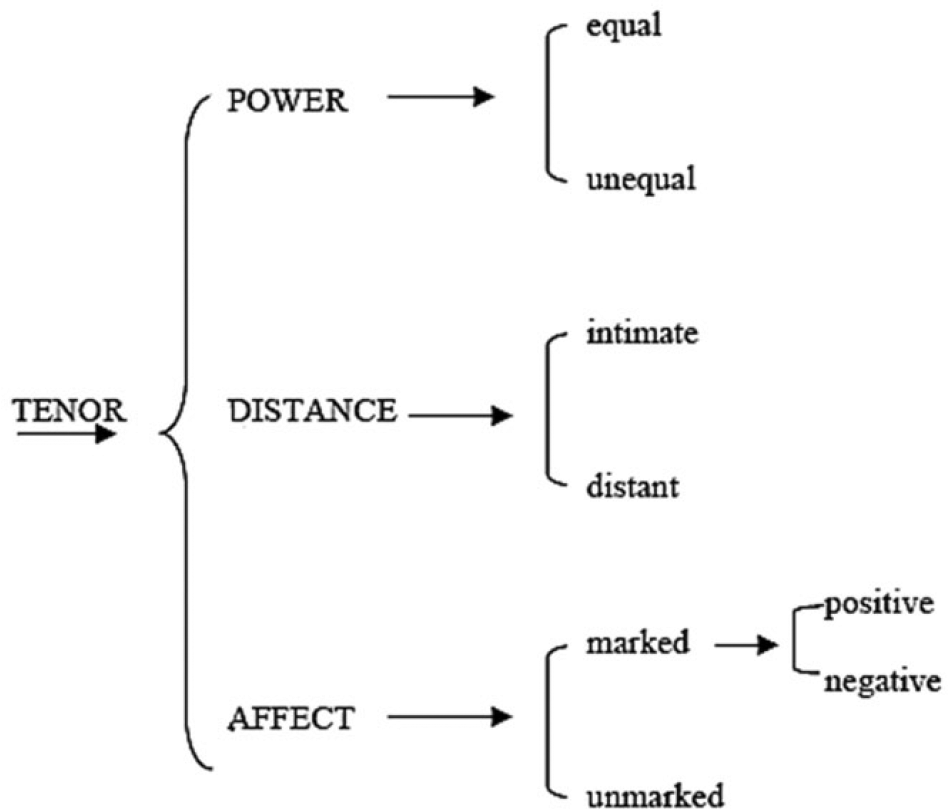
The system network of Tenor (1990, p. 89)
Poynton (1990) further suggested that there was a cross-dependency between an intimate relationship and “marked affect,” and between a distant relationship and “unmarked affect” (p. 95). The most obvious dependency is found on the intimacy end on the horizontal cline of relationship. An intimate relationship should generally be characterized by positive “affect.” Based on such an assumption, there lies an implication that in an intimate relationship, expressing positive attitude or evaluation is regarded as “unmarked choice,” and signaling negative “affect” is considered as marked choice. Therefore, in a role relationship between a mother and a daughter, for example, the mother’s expression of her affection for her daughter is considered as a normative or unmarked behavior. On the contrary, her manifestation of a distant attitude toward her child can be viewed as a marked behavior. In Thai, it is possible that a motherly affection expressed toward a young, an adolescent, or an adult child is realized through a certain set of pronominal nouns, while a distant relationship can be construed via a different set. As such, a mother’s pronominal choice to express distance in her relationship with her child can be considered as marked usage. In one novel, a mother with two daughters is affectionately close to one but simultaneously unkind to the other, she makes use of different pronominal pairs to distinguish between the two opposing kinds of “affect.” She highlights her affectionate attitude toward one daughter with the pair mæ̂:- lû:k: meaning “mother”–“child.” Meanwhile, by using the other pair tɕhàn-kæ: speaking to the other daughter, she obviously discriminates against the other girl. The first type of usage is considered unmarked, and the second one, marked. This consequently leads to a conclusion that markedness does not apply only to expressive pronominal switching but also to pronominal usage with a discriminatory purpose or “discriminatory pronominal choice.”
Findings and Discussions
Before discussing my findings, I would like to reiterate the strategies for deployment of Thai pronominal reference to realize affective involvement in the novels under studied. Thai pronominal usage can be categorized into two main methods. The first method is “unmarked usage” to construe “unmarked affect” which can be positive or neutral. “Unmarked usage” can be in the form of regular pronominal choice or of normal or etiquette pronominal switching, which conforms to the conditions of Tenor “status” and “contact.” The second method is “marked usage” intended to indicate “marked affect.” To encode “marked affect,” it is possible that the speaker resorts to expressive pronominal switching or discriminatory pronominal choice. As earlier discussed, through expressive pronominal switching, the speaker intentionally violates the current conditions of “status” or “contact” to signify either positive or negative “affect.” However, with discriminatory pronominal choice, although both of the two Tenor variables are well respected, the purpose of the speaker is to express a negative feeling or attitude toward the addressee. This is in sharp contrast with his or her emotional or attitudinal involvement with another addressee who plays the same or similar relationship role as the former addressee. For example, a father speaks to his two adolescent sons using two different pronominal pairs, one with phɔ̂:-lû:k, and the other with thɕàn-kæ:. The first pair is perceptually associated to a fatherly affection, and the other, contrastively sounds rather unfavorable. Through his choice of different pronominal pairs, the father has affectively discriminated in favor of one son against the other. Discriminatory choice can also be made in the situation whereby the speaker intentionally uses non-restraint forms to pronominally address an unfamiliar individual or non-acquaintance. In Thai societies, a stranger or a non-acquaintance is customarily treated with respect in a communicative situation regardless of his or her social status which may be ambiguous to the speaker (Cooke, 1968). Considering that this is a social norm, such behavior can be viewed as impolite and non-compliant to standard social proprieties, which violates the Tenor “status” and “contact” though without switching of pronouns. This kind of inappropriate usage is also characterized as “marked usage.” The relationship between different methods of Thai pronominal usage and the Tenor variable of “affect” have been summarized in Figure 2

The relationships between Thai pronominal usage and the Tenor variable “affect.”
To present the findings, I have grouped examples of pronominal pairs according to their forms and unmarked usage as follows: (a) non-deferentially or informally used pronouns proper (b) deferentially used pronouns proper, (c) pronominally used nouns with or without combination with pronouns proper, (d) expressive pronominal switching, and (e) discriminatory pronominal choice. I have attempted to point out how Thai pronouns are used in fictions in association with Tenor variables—“status” and “contact” as well as how they are strategically used to realize “unmarked affect” and to signal “marked affect.”
In regard to “status,” I have categorized the levels of speakers into “social superior,” “social inferior”, and “social equal.” With respect to “contact,” I have classified horizontal interpersonal relations based on a dichotomy between familiarity and unfamiliarity. A familiar relationship is not necessarily characterized with closeness or intimacy; it can be attached to distance. Hence familiarity can exist in either an intimate or a distant relationship. Having said that, it must be noted that the horizontal cline of a relationship is a continuum, not a binary entity that can be independently split into two different halves. In my classification of an intimate relationship, the involved interactants have to show their positive relations. And a distant relationship is evaluated based on the interactants’ negative attitudes or undesirable behaviors. Although the degree of intimacy as manifested by different interlocutors can vary from one relationship to another, the purpose is to draw a line of demarcation between pronominal behaviors that are tended toward the intimacy end, and those inclined toward the distance end on the cline. Manifestation of intimacy can be observed through pronominal behavior construing solidarity or affection. Distance is observed though marked pronominal choice accompanying a negative or undesirable attitude or “marked affect.” Two familiar characters might not like each other and thus have a distant relationship. Therefore, distance can apply to both familiar and unfamiliar relationships.
In an unfamiliar relationship, without signifying any “marked affect,” pronominal usage is considered as unmarked but is not necessarily associated to intimacy nor distance. Toward an unfamiliar addressee or a stranger, it is socially acceptable not to express intimacy. Nevertheless, to display a distant relationship toward them is not culturally appropriate either. Therefore, unfamiliarity does not always necessitate the choice between intimacy and distance. Pronominal usage in realization of that kind of relationship is, hereby, viewed as a means of expressing a neutral state of “non-intimacy” rather than distance, which is not associated to any negative feeling or attitude. Such usage is considered as “unmarked.”
In the presentations of data and discussions to follow, I am not trying to pinpoint or determine as to the varying degrees of intimacy or distance which different pronouns serve to construe. Different individuals may have different perceptions as to which pronominal forms are absolute markers of intimacy or of distance. According to Cooke (1968), variations in Thai pronominal usage are unavoidable and can exist at two different levels—at a given individual and between two individuals. Variations in the usage of a given individual include differences in the speech in a variety of situations or at different periods of his or her life. Within an individual, developmental changes of pronominal usage are conditioned by age, sex, and day-to-day contacts with others. As time goes by, one may be or is obliged to adjust his or her pronominal strategies and modify his or her pronominal inventory for the betterment of communication. Such strategic and inventorial modification consequently embodies uniqueness of his or her pronominal system and differences. Two different individuals can possibly possess their own uniqueness of pronominal usage patterns, which is not only conditioned by those key sociocultural factors as already discussed but also influenced by the speaker’s social background and personality.
Relationships between Informally Used Pronouns Proper and Tenor Dimensions
Listed in Table 1 are Thai pronouns proper that are used in informal situations in the novels. I only selected some pronominal pairs as examples to illustrate the correspondence between Thai pronouns and the Tenor variables “status” and “contact.”
Relationships between Informally Used Pronouns Proper and Tenor Dimensions.

Note. M-F = male speaking to female; F-M = female speaking to male; M-M= male speaking to male; F-F = female speaking to female.
Non-restraint pronouns.
These pronouns are used among familiar interlocutors but are not used by a social inferior speaking to a superior to signal solidarity. And some are used in consideration of gender differences as well. As discussed above, usage variation depends on different sociocultural factors as well as social structures. It thus cannot be generalized as to which pronoun signals the highest degree of solidarity. Possible relationship roles to employ these pronouns include parent, senior-kin, older sibling, older cousin, spouse, friend, peer, neighbor, employer, master or mistress, and so on. Reciprocation of such pronominal choice by the social inferior is socially unacceptable; or else, it will be considered as a disrespectful behavior.
The pronouns marked with an asterisk have a primary linguistic feature of non-restraint. According to Cooke (1968), non-restraint encompasses the characteristics of one’s defiance or disregard of certain standards of social proprieties of polite or refined usage. These non-restraint pronominal forms can be used to express uninhibited intimacy, assertiveness, or downright anger. In an intimate equal relationship, the speaker usually feels less obliged to exercise restraint over his or her pronominal choice. However, in an unequal or a non-intimate relationship, pronominal reference has to be dealt with great care. Misuse of these pronouns speaking to a stranger or a casual acquaintance regardless of their social status is unacceptably rude. To a familiar social inferior or equal, usage of these non-restraint forms can convey two opposing aspects of interpersonal relationship. On one hand, it can be regarded as a means of solidifying a relationship. In the novels, non-restraint pronouns are exchanged among male intimate equals who are not upper-class people. Such pronouns can also be used by a high-class superior speaking to a low-class inferior to signify his superior position alongside their mutual intimacy, for example, by an aristocrat to his servant. On the other hand, despite their familiarity, the speaker may use these pronominal pairs to signal his or her non-congenial relationship with an addressee, which will be discussed as part of “marked affect” in “Relationships Between Thai Pronominal Switching and Tenor Dimensions” section. In the novels, the collected data show that some characters vary their pronominal usage depending on their social backgrounds and who the target conversational partners are. Toward those with whom they have unpleasant attitudes, the speakers will use non-restraint pronominal pairs. And they avoid using these pronominal forms upon congenial relationships. The feature of non-restraint can be both associated with negative and positive affective involvement depending on “status” and “contact” of the interactants. Usage of these pronouns can, therefore, be considered as “marked” or “unmarked” depending on these Tenor variables as well as the contexts of situation.
The pronouns ku:-mшŋ are considered having the highest degree of non-restraint. They are, however, exchanged among very intimate social equals, especially at present among the young regardless of their gender differences to signify group solidarity (Simpson, 1997). In real life, not every individual constantly uses such pronouns in daily communication. Some do avoid using these forms in referring to anyone in their speeches.
Usage of the pronominal pair (1h) is, to some, generally meant to create an atmosphere of camaraderie. However, in the novels, to an unfamiliar social equal or inferior, such usage could lead to a perception of uncalled-for solidarity which is viewed as inappropriate.
With respect to usage variation over time, it is possible that two individuals change their pronominal reference as their relationship has developed to become more familiar and more intimate. This is very common in real life situations as well as in fictions. For example, two male social equals may start their relationship reciprocating formal pronominal forms which afterward are changed to Pattern (1e) and finally to (1c) as tokens of their affirmed solidarity. Such changes are not considered as marked pronominal switching, but they serve to demonstrate the transformational stages of “contact” development between the two. Between a superior female and an inferior female, the former could start their relationship out of unfamiliarity by using the Pattern (1h) and afterward changes her choice to Pattern (1i) with a view to flagging a departure from “distance” to “intimacy.” These instances of usage are not linked to markedness either. Usage involving the pronoun lɔ̀:n in some novels written prior to World War II was not meant to carry any positive or negative connotation, so it is considered here as unmarked choice, indicating a state of “neutrality.” It can also be used to flag “marked affect,” which will be presented later.
As regards their realization of solidarity, these first and second person pronouns proper cannot be considered as comparable to Brown and Gilman’s T-pronoun. They are used to signal intimacy among social equals or by a social superior speaking to a social inferior but not vice versa. However, their usage can vary from one person to another depending on the speakers’ social backgrounds. Variation in usage can never be common across every individual, unlike, for example, “tu” which is only a single second pronoun in French signifying solidarity between interlocutors. In Thai, both first and second person forms in this group can be used as representations of interpersonal intimacy but are not spoken by interlocutors across all social levels. Although the most non-restraint pronominal pair ku:-mшŋ are sometimes purposively used to indicate the highest degree of solidarity in some novels by some characters, the practice is applied to only certain social categories. Some other pronouns can selectively be used for expressive pronominal switching rather than signaling solidarity in familiar relationships, which will be discussed later. Therefore, these Thai pronouns are not conceptually equivalent to T-pronoun in terms of usage or interpersonal function. I have, therefore, classified them as pseudo-T pronouns owing to their common feature of unmarked informality.
Relationships between Deferentially Used Pronouns Proper and Tenor Dimensions
Presented in Table 2 are the pronominal pairs that are mostly used among adults in the novels to demonstrate formality or to express politeness or courtesy in both formal and informal communicative situations.
Relationships between Deferentially Used Pronouns and Tenor Dimensions.

Note. M-F = male speaking to female; F-M = female speaking to male; M-M= male speaking to male; F-F = female speaking to female.
According to Halliday (1978), the term “formality” can be used in two different senses: “ . . .On one hand, it refers to the use of forms of the language—words, grammatical structures—that are conventionally associated with certain modes. On the other hand it is used to refer to the degree of respect that is shown linguistically to the person who is being addressed . . .” (p. 224).
Formality is used here to refer to a respectful verbal behavior and the sense of compliance to social proprieties, which can apply to both familiar and unfamiliar relationships in the novels. In Thai fictions as well as in reality, it is not uncommon that intimate interactants exchange formality-oriented pronominal forms to culturally observe politeness in their conversations. To a non-intimate addressee, a non-acquaintance, or a stranger, the speaker can opt for the pronominal pairs in Table 2 as a means of showing courtesy. As mentioned earlier, in Thai culture, it is customary to treat them with a respectful or polite verbal behavior.
These pronouns can be used speaking to both familiar and unfamiliar addressees, but the second person khun and thâ:n are never used among family members (parents, children, and siblings) or close relatives. Usage of these two pronouns among kinsmen are extremely rare and usually accompanies an utterly distant relationship. Possible relationship roles for Pattern (2a), (2b), and (2c) include spouse, friend, peer, colleague, acquaintance, neighbor, superintendent, and subordinate, who are middle- or upper-class people. Pronominal reciprocity may be possible among them. It can be noted that the informal pronoun tɕhàn can collocate with some second person pronouns in Tables 1 and 2. So this pronoun by itself is not truly deferentially designated. In the context that it is paired with the second person khun, the overall tone of formality is, therefore, low. Pattern (2d) and (2e) are reserved only for speaking to a social superior who is highly respectable. Servants are considered socially inferior to their masters or mistresses and may use any of these five patterns speaking to the latter but not vice versa. Therefore, the addressee’s social background is as important as the speaker’s in terms of being a social factor determining this kind of pronominal choice.
These pronouns are not exactly V-pronoun in terms of signaling formality or distance. Although, they may be replaced by T-pronouns when a relationship has developed from a familiar to a very familiar stage, they have some distinctive social features that do not belong to European V-pronouns. In the novels, these pronouns can be mutually exchanged as a norm of showing courtesy between intimate equals (except Pattern 2d and 2e) without association with distance. They can also be reciprocated between a social superior and an inferior. In comparison with the previous group of pronouns, this group is obviously very distinctive as regards their semantic properties of marking politeness that the former are lacking. Still they are distinct from European V-pronouns with respect to usage or function as well as interpersonal meanings they may convey. To distinguish them from European V-pronouns, these first and second person pronouns (except tɕhàn) will be branded as pseudo-V pronouns.
Relationships between Pronominally Used Nouns and Tenor Dimensions
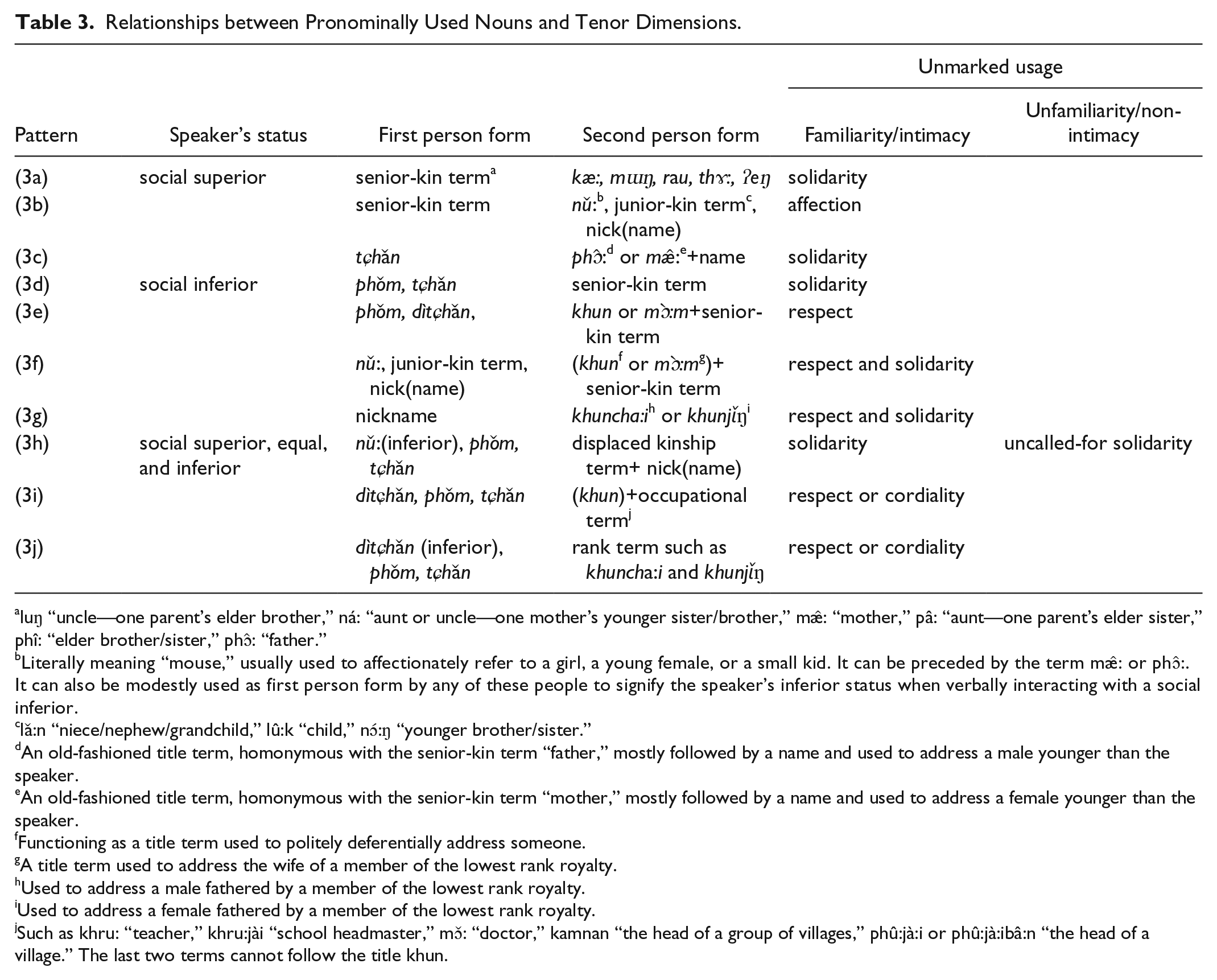
As mentioned earlier, Thai pronominal system contains not only pronouns proper but also pronominally used nouns or noun-like pronouns including name or nickname, address term, kinship term, title, rank, and occupational term. Some instances of pairing combination between different types of pronominal forms have been presented in Table 3.
Relationships between Pronominally Used Nouns and Tenor Dimensions.
luŋ “uncle—one parent’s elder brother,” ná: “aunt or uncle—one mother’s younger sister/brother,” mæ̂: “mother,” pâ: “aunt—one parent’s elder sister,” phî: “elder brother/sister,” phɔ̂: “father.”
Literally meaning “mouse,” usually used to affectionately refer to a girl, a young female, or a small kid. It can be preceded by the term mæ̂: or phɔ̂:. It can also be modestly used as first person form by any of these people to signify the speaker’s inferior status when verbally interacting with a social inferior.
là:n “niece/nephew/grandchild,” lû:k “child,” nɔ́:ŋ “younger brother/sister.”
An old-fashioned title term, homonymous with the senior-kin term “father,” mostly followed by a name and used to address a male younger than the speaker.
An old-fashioned title term, homonymous with the senior-kin term “mother,” mostly followed by a name and used to address a female younger than the speaker.
Functioning as a title term used to politely deferentially address someone.
A title term used to address the wife of a member of the lowest rank royalty.
Used to address a male fathered by a member of the lowest rank royalty.
Used to address a female fathered by a member of the lowest rank royalty.
Such as khru: “teacher,” khru:jài “school headmaster,” mɔ̌: “doctor,” kamnan “the head of a group of villages,” phû:jà:i or phû:jà:ibâ:n “the head of a village.” The last two terms cannot follow the title khun.
Kinship terms can be used to address kinfolk as well as non-kin interlocutors. Kinsfolk include both blood kin and affinal kin. Affinal kin refer to people related to an individual by marriage or through a spouse link. It is salient in Thai culture to use a displaced kinship term to address someone not related by blood, regardless of familiarity. This kind of uncalled-for-solidarity is quite acceptably prevalent in Thai societies. Usage of displaced senior-kin terms, rank, or occupational terms to represent socially superior addressees is generally tied to a deferential flavor. Usage of displaced junior-kin terms, rank, or occupation terms by social superiors or social equals is associated to cordiality rather than deference. Usage of nicknames, junior-kin terms, or the status term nǔ: is linked to an amiable attitude. These pronominally used nouns can be used as first or second person forms. They can collocate with pronouns proper as well as pronominally used nouns. In the novels, most pronominally used nouns are meant for construing a closer relationship, except rank and occupational terms. And they must be used in accordance with their laded semantic features which obviously identify interactants’ social roles and roles relationships and thus at times with deferential implication. They can neither be categorized as T- nor V-pronouns. Although most of them are intimacy-driven, some are semantically deferential such as senior versus junior-kin terms and applicable only to asymmetrical relationships in which pronominal reciprocity is out of question. I have categorized these pronominally used nouns as N-pronoun mainly because of their self-evident semantic features. Some of these noun-like pronouns are used to flag a more highly congenial relationship as compared with the informally used pronominal forms in Table 1, which will be discussed afterward.
Relationships between Thai Pronominal Switching and Tenor Dimensions
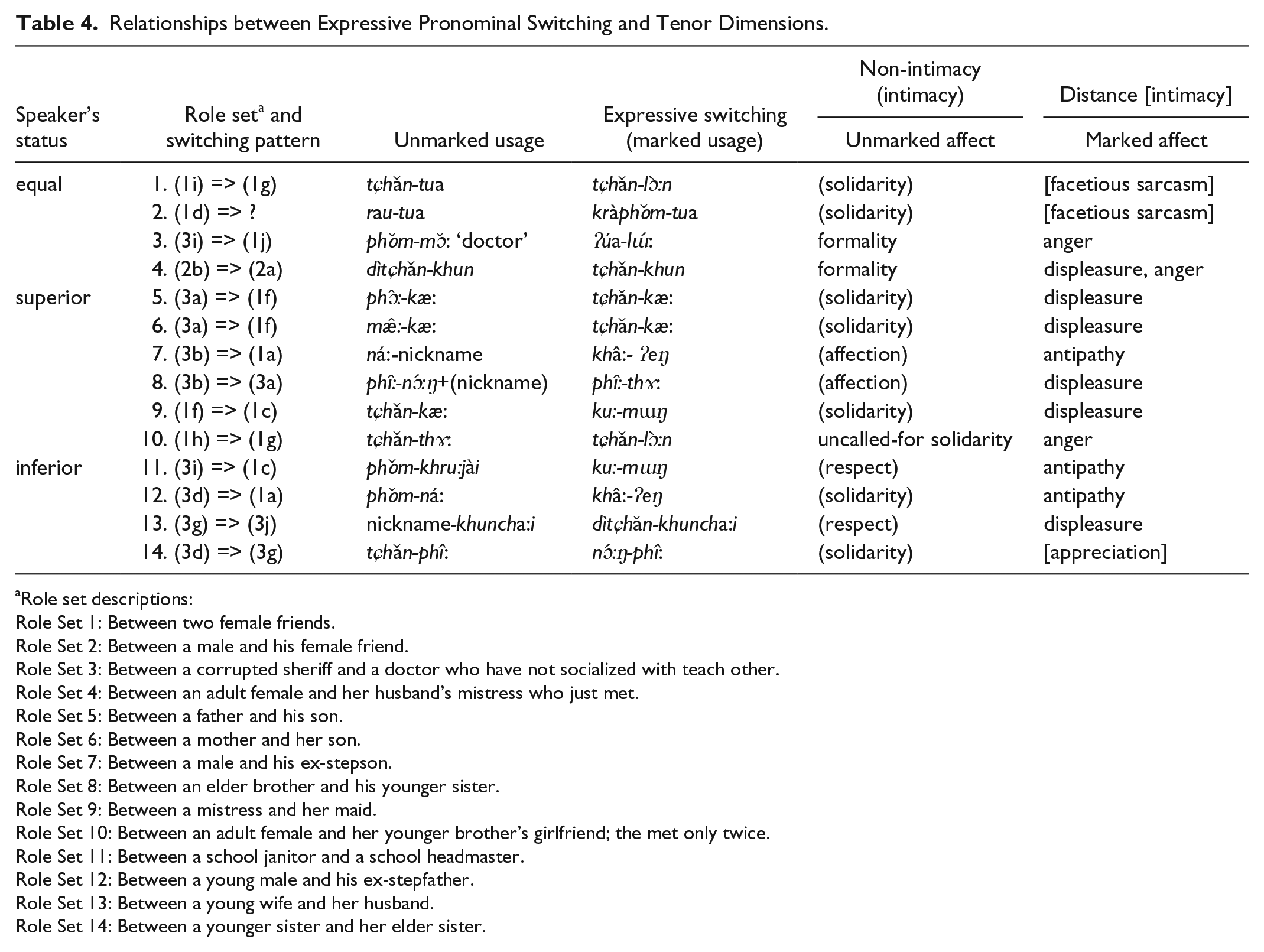
In Table 4, I have gathered some examples of expressive pronominal switching used in different novels to change “unmarked affect” to “marked affect” and to shift between “intimacy” and “distance” in different role relationships. The patterns of switching from unmarked to marked usage are indicated alongside different role sets which are numbered from 1 to 14. To differentiate between “unmarked affect” signifying non-intimate “contact” and “unmarked affect” indicating intimate “contact” or intimacy, the latter is marked with a bracket. Similarly, between positive “marked affect” signaling intimacy and negative “marked affect” signaling distance as a result of pronominal switching, the former is distinguishable by means of a square bracket.
Relationships between Expressive Pronominal Switching and Tenor Dimensions.
Role set descriptions:
Role Set 1: Between two female friends.
Role Set 2: Between a male and his female friend.
Role Set 3: Between a corrupted sheriff and a doctor who have not socialized with teach other.
Role Set 4: Between an adult female and her husband’s mistress who just met.
Role Set 5: Between a father and his son.
Role Set 6: Between a mother and her son.
Role Set 7: Between a male and his ex-stepson.
Role Set 8: Between an elder brother and his younger sister.
Role Set 9: Between a mistress and her maid.
Role Set 10: Between an adult female and her younger brother’s girlfriend; the met only twice.
Role Set 11: Between a school janitor and a school headmaster.
Role Set 12: Between a young male and his ex-stepfather.
Role Set 13: Between a young wife and her husband.
Role Set 14: Between a younger sister and her elder sister.
In conclusion, to mark negative “affect,” some possible options include the following:
Between pseudo T-pronouns, an informally used term is replaced by a non-restraint term.
A pseudo V-pronoun is replaced by a pseudo T-pronoun.
An N-pronoun is replaced by a pseudo T- or V-pronoun.
The data suggest that pronominal switching is used in the novels to express negative and positive attitudes or emotions. “Marked affect” or a negative attitude or emotion can occur between two familiar as well as unfamiliar interactants. And the switching may happen to only first or second person pronoun or both. The negative “affect” is always associated with “distance.” Violation of social norms by debasing the addressees’ social statuses occurs when the speakers are socially inferior; non-restraint forms are used to replace intimacy and respect with antipathy or insult, which is not socially appropriate (see Role Set 11 and 12). There is one instance of negative affect (see Role Set 13) whereby social norms are not breached but the horizontal gap is enlarged by means of elevating the degree of formality indicating a polite but temporarily distant attitude out of the speaker’s displeasure. Given Role Set 3 and 10, the social etiquette is not respected, as the speakers do not take into account the contexts of non-intimacy because of their anger. The second person pronoun lɔ̀:n is used in this context as a non-restraint form signifying a negative attitude. For Role Set 4, “status” is well respected but the level of courtesy due to an unfamiliar addressee is unduly lowered by the change of the first person pronoun to construe the speaker’s displeasure. Between social equals in Role Set 1 and 2, the marked usage is not meant to distance the speakers from the targeted referents, but the switching of pronoun entails a change in the vertical distance. For Role Set 1, the addressee’s status is facetiously lowered by the change of the second person pronoun, while it is humorously elevated by the switching of the first person pronoun for Role Set 2. The first person kràphǒm and the second peson tua are not compatible, for the former denotes high respect, but the latter, intimacy and equality in this context. In fact, kràphǒm is generally used in pair with thâ:n as in Pattern (2d) or with other deferentially used forms. For Role Set 5, 6, 7, 8, and 9, all the pronominal changes made by the social superiors have not violated any social status norms, but the degree of congeniality or affection in the relationships originally fostered by “contact” is negatively distorted, marking the speakers’ unpleasant attitudes and feelings which distance them from the addressees. One instance of positive affect is found in Role 14 where the variable “status” remains intact, but the level of solidarity is improved with the integration of a higher degree of respect through the choice of a junior-kin term as the first person form.
Relationships between Thai Discriminatory Pronominal Usage and Tenor Dimensions
Apart from the method of switching, Thai pronominal forms can as well be employed to distinguish negative from positive affective involvement by means of discriminatory choice. The comparison of pronominal variations between marked discriminatory choice and unmarked usage is presented in Table 5.
Relationships between Discriminatory Pronominal Choice and Tenor Dimensions.

Role set descriptions:
Role Set 1: Between two nieces and their aunts.
Role Set 2: Between an adult female and two male acquaintances.
Role Set 3: Between a mother and her two daughters.
Role Set 4: Between a father and his two sons.
Role Set 5: Between an aunt and her two nieces.
Role Set 6: Between two noblemen and a phû:jà:ibâ:n “the head of a village.”
Role Set 7: Between a young mistress and two different maids who were older.
Thai pronominal reference can be employed for discriminatory purposes. Pronominal discriminatory choice in the novels is recognizable through comparison of an individual’s pronominal usage in their verbal interactions with different target addressees participating in similar relationship roles. It can be seen that N-pronouns are used mostly to signal unmarked positive “affect.” By replacing a pronominally used noun with a pronoun proper, novelists can vividly form negative affective involvement between characters, except the last example in which a senior-kin term is replaced by a title term. By comparing between different pronominal pairs used for each role set and participants’ interactions, the unmarked usage can be perceived as relational to intimacy and positive affective involvement, and the marked usage or discriminatory choice, to distance and negative feelings or attitudes.
As a summary, for discriminatory pronominal choice, positive affective involvement is realized mostly through N-pronouns, and negative, pseudo T- or V-pronouns. It can be seen that, across both social levels—superior versus inferior—the pseudo T-pronouns are not always the resources for construing solidarity or intimacy for every role set. Especially in asymmetrical role relationships, they are mostly used for an unfavorable emotional manifestation through expressive pronominal switching or for a negative discriminatory purpose. In the novels, among familiar young social equals and among familiar adults, pseudo T-pronouns are saliently in use. Usage of these pronouns can vary in accordance with the interactants’ social categories. Among kids and young females, usage of N-pronouns, especially nickname, is more popular. Among socially equal adults, usage of pseudo V-pronouns could be considered as a norm.
Obviously pronouns in standard Thai have another important role in addition to marking deictic reference and being part of the Mood structure in major clauses. They also function as negotiators of interpersonal relationship similarly to Vocatives. In standard Thai, a pronoun can by itself function as a Vocative and simultaneously as Subject of the Mood that essentially plays a central role of construing social and expressive meanings. It must be noted that the Vocative and the pronominal Subject are frequently not in an identical form, although they are referring to the same person in the discourse. In this situation, the pronoun, which is contemporaneously the anaphor of the thematic Vocative, will take the dominant role of signifying interpersonal relationship. For example, in the following text with two consecutive clauses, the pronominal Subject in the interrogative clause (g) is making anaphoric reference to the Vocative in the imperative clause (f).
(f) (g)
Although the nickname ʔíam is functioning as the Vocative in (f) signaling familiarity between the interactants, it is the pronominal Subject kæ: in (g) which significantly negotiates the Tenor relations. As discussed in “Relationships Between Pronominally Used Nouns and Tenor Dimensions” section, pronominal usage of a nickname by a social superior to address a social inferior signals an affectionate attitude. However, when a nickname is used as a Vocative, it does not always encode the same kind of positive affect. Moreover, the Subject kæ: referring back to the Vocative is subject to the coding of an equal or asymmetrical relationship (see “Relationships Between Informally Used Pronouns Proper and Tenor Dimensions” section) with or without negative connotation (see “Relationships Between Thai Pronominal Switching and Tenor Dimensions” section). According to the novel, the speaker and the addressee are father and daughter, who have a very unhealthy relationship.
In comparison with the second text below which is spoken by the same father but to his son whose nickname mшaŋ is used as the Vocative in the imperative clause (h) and the Subject of the interrogative clause (i), there is a marked contrast between his interpersonal relationship with his daughter and with his son.
(h) khît du: sì (i)
The key distinction is the father’s pronominal choice in referring his daughter as kæ: and his son as mшaŋ. Based on my discussion in “Relationships Between Thai Discriminatory Pronominal Usage and Tenor Dimensions” section, the father’s usage of the pronoun kæ: is considered as a discriminatory choice signifying distant relations, which is in sharp contrast with the pronominally used nickname signaling congeniality. Despite his usage of their nicknames as Vocatives in addressing them, it is the pronominal Subjects in (g) and (i) that potently realize their interpersonal relations. For Thai pronouns, irrespective of their grammatical functions in the Mood structure, they play a more dominant role than Thai Vocatives in negotiating social and expressive meanings throughout the discourse. In this respect, Thai is very different from English. In English, it is Vocatives, not pronouns in the Mood, which potently realize interpersonal meanings, but it is the opposite in Thai. However, whether such a statement is generalizable across linguistic interactions between Thai pronouns and different kinds of Vocative is subject to further investigations.
Conclusion
In this article, I have attempted to demonstrate how Thai pronouns are used in association with the three different dimensions of Tenor register based on dialogues and conversations in 40 different Thai contemporary novels. As discussed, pronominal forms in standard Thai are interpersonal resources that novelists or writers can strategically use to vividly support their illustrations of social relations and affective involvement among characters in their works. In accordance with their forms and usage features, first and second pronominal forms in standard Thai can be categorized into three different groups—pseudo T-pronoun, pseudo V-pronoun, and N-pronoun. Pseudo T-pronouns can never be reciprocated in an asymmetrical relationship to accentuate the sense of mutual camaraderie. Although pseudo V-pronouns are deferentially related and mostly applicable to all social levels, they do not necessarily signal relational distance between two individuals. N-pronouns, especially kinship term and nickname, are notably markers of social intimacy. Rank and occupational terms may be coding of deference. By means of pronominal switching across these pronominal categories, it is possible to conceptually paint pictures of positive or negative interpersonal relations in different contextual situations. In addition, by means of discriminatory pronominal selection, the pronouns across these three categories can be used to distinguish an intimate positive from a distant negative relationship between one speaker and multiple addressees.
The literary evidence has substantiated my earlier claim that there are connections between Thai pronominal reference and all the three dimensions of Tenor. “Status” determines one’s choice of pronoun to match appropriate social differentiation between interactants. “Contact” collaboratively aligns the choice with the degree of intimacy or distance between them. And “affect” operates between “unmarked” and “marked” pronominal choice for an expressive purpose. Any investigation of interpersonal meaning in a clause with the presence of a pronoun(s) must involve the exploration of their roles as both person and social deixis together with their affective attributes. That Thai pronouns have a negotiatory function of marking interpersonal relationship is clearly attested.
Footnotes
Appendix
List of the Novels Used in the Study.

| 1. khû: kam [1969] Star-Crossed Lovers by Thommayanti |
| 2. sì: phæ̀ndin [1951] Four Reigns by Kukrit Pramoj |
| 3. kham phíphá:ksà: [1981] The Judgement by Chart Korpjitti |
| 4. phû:jài li: kàp na:ŋ ma: [1968] Master Li and Miss Ma by Kanchana Nakkhanan |
| 5. we:la: nai khuatkæ̂u [1985] Time in a Bottle by Praphartsorn Seiwikun |
| 6. khâ:ŋlàŋ phâ:p [1936] Behind the Painting by Siburapha |
| 7. pi:sà:t [1957] The Ghosts by Seinee Saowaphong |
| 8. prìtsànà: [1951] Prissana by W. Na Pramuanmak |
| 9. th
|
| 10. tɕòtmà:i tɕà:k mшaŋthai [1970] Letters from Thailand by Botan |
| 11. khàu chш̂: ka:n [1971] Doctor Kan by Suwanni Sukhontha |
| 12. mæ̂:bîa [1987] The Hood of the Cobra by Wa-nit Jarungkit-anan |
| 13. phiˇ:sш̂a lǽʔ dɔ̀:kmá:i [1978] Butterflies and Flowers by Nipphan |
| 14. thûŋ m
|
| 15. tàʔlìŋ sǔ:ŋ suŋ nàk [1988] High Banks, Heavy Logs by Nikom Rayawa |
| 16. phû:di: [1937] A Person of Quality by Dorkmai Sot |
| 17. lákhɔ:n hæ̀ŋ chi:wít [1927] The Circus of Life by Momchao Arkartdamkeung |
| 18. khâ:u nɔ́k na: [1973] Rice Plants off the Paddy Fields by Sifa |
| 19. pràcha:thíppatai bon sênkhàʔnà:n [1997] Democracy, Shaken & Stirred by Win Lyovarin |
| 20. khwa:msùk khɔ̌:ŋ kàthíʔ [2003] The Happiness of Kati by Jane (Ngamphan) Vejjajiva |
| 21. là:i chi:wít [1951] Many Lives by Kukrit Pramoj |
| 22. phài dæ:ŋ [1955] Red Bamboos by Kukrit Pramoj |
| 23. we:la: [1994] Time by Chart Korbjitti |
| 24. rш̂aŋ khɔ̌:ŋ tɕanda:ra: [1966] The Story of Jandarra by Utsana Phleungtham |
| 25. phan mà: bâ: [1988] Mad Dogs & Co. by Chart Korbchitti |
| 26. khɔ̌: mɔ̌:n bai nán thî: tɕhàn fàn ja:m nǔn [1991] My Sweet-Dream Pillow by Praphartsorn Seiwikun |
| 27. jiˇŋ khon tɕhùa [1937] The Prostitute by K. Surangkhanang |
| 28. phla:i m
|
| 29. pu:n pìt thɔ:ŋ [1985] Poon Pid Thong: Gold-Pasted Cement by Krisna Asoksin |
| 30. ʔàm
|
| 31. bâ:n sa:i thɔ:ŋ [1950] Golden Sand Mansion by K. Surangkhanang |
| 32. phóttɕàma:n sàwà:ŋwoŋ [1951] Potchaman Sawangwong by K. Surangkhanang |
| 33. chûa fá: din sàlà:i [1951] Till the End of Time by Riam-eng |
| 34. sàwàn bìaŋ [1967] A Diverted Way to Paradise by Krisna Asoksin |
| 35. phæ̀n-din khɔ̌:ŋ rau [1951] Our Land by Mae Anong |
| 36. lamnau pà: [1984] Edge of the Forest by Sirem-on Unnahathup |
| 37. ka:wàu thî: ba:ŋphle:ŋ [1989] The Blackbirds at Bangphleng by Kukrit Pramoj |
| 38. fá: plían ši: [1974] Colourful Skies by Phenkhae Wongsa-nga |
| 39. kha:u ná:mkhá:ŋ [1987] A Stench of Dew by Krisna Asoksin |
| 40. láplæ: kæ̀ŋkhɔi [2009] The Brotherhood of Kaengkhoi by Uthis Hemamool |
Author’s Note
This article is a partial revision of my thesis entitled “Thai Pronouns as Interpersonal Resources Signifying ‘Involvement’ and ‘Attitude’” submitted in partial fulfillment of the requirements for the Degree of Doctor of Philosophy (Linguistics), Research Institute for Languages and Cultures of Asia, Mahildol University, Thailand.
Declaration of Conflicting Interests
The author(s) declared no potential conflicts of interest with respect to the research, authorship, and/or publication of this article.
Funding
The author(s) received no financial support for the research and/or authorship of this article.