




Abstract
The purpose of this study is to investigate the relationship between parental psychological control (PPC) as perceived by adolescents, emotion inhibition, emotion regulation, and depression in adolescents using a structural equation model. The participants were 316 middle school students in metropolitan areas of South Korea who completed the Domain-Specific Assessment of Psychological Control (DAPC), Children’s Sadness Management Scale (CSMS) and Children’s Anger Management Scale (CAMS), and the Center for Epidemiological Studies–Depression Scale (CES-D) survey. Data were analyzed using descriptive statistics, correlation analysis, structural model verification, and bootstrap analysis. The results of this study indicated that PPC had a direct effect on depression. In addition, PPC had a significant effect on the emotion inhibition of dysfunctional emotion regulation, and emotion inhibition significantly affected depression. Therefore, emotion inhibition had a mediating effect between PPC and depression. Finally, this study’s implications and limitations are presented.
Adolescence is a transitional stage and a critical period of psychological growth. Adolescents might experience stress and strain as they lack confidence or are uncertain about their future (Rönnlund & Karlsson, 2006). Depression is a common problem in this developmental process, and it is acknowledged to strongly influence adolescents’ relationship with their parents (Blatt, 2004).
Parental rearing attitudes are divided into two types: supportive and controlling (Davidov & Grusec, 2006; Soenens & Vansteenkiste, 2010). “Supportive parenting” is closely related to children’s positive development, while “controlling parenting” has various characteristics, such as discipline, demands, coercion, supervision, punishment, restrictions, and the withdrawal of affection. The latter has ambivalent effects on children’s development, which can eventually cause the separation of “psychological control” from “behavioral control” (Barber, 1996; Soenens & Vansteenkiste, 2010). Behavioral control includes supervising children’s behavior and has a positive effect on children’s psychosocial function (Barber, Stolz, Olsen, Collins, & Burchinal, 2005; Stolz, Barber, & Olsen, 2005). In contrast, psychological control refers to manipulation by parents who try to influence their children while ignoring their emotional needs and obstructing their autonomy (Steinberg, 1990).
Parental psychological control (PPC) negatively affects adolescents’ adjustment by suppressing both their autonomy and their desire for independence (Olsen et al., 2002). Previous studies have reported negative effects from PPC ranging from behavioral problems, such as drug abuse and deviant behavior (Barber & Harmon, 2002; Barber et al., 2005), to internalized problems, including anger, fear control disorder, and sadness awareness issues (Roth & Assor, 2010; Roth, Assor, Niemiec, Ryan, & Deci, 2009). In this way, PPC is related to both the internalized and externalized problems of their children. Many previous studies report a relationship between PPC and adolescent depression (Barber, Bean, & Erickson, 2002; Finkenauer, Engels, & Baumeister, 2005; S. Y. Park & Lee, 2010; Soenens, Luyckx, Vansteenkiste, Duriez, & Goossens, 2008; Soenens, Park, Vansteenkiste, & Mouratidis, 2012; Stolz et al., 2005).
In accordance with these results, Soenens, Vansteenkiste, Duriez, and Goossens (2006) found that when children experience PPC and fear being abandoned by their parents, they are likely to develop an overdependence on their parents or self-criticism, which can result in depression. Soenens, Vansteenkiste, and Luyten (2010) also assumed that there would be mediating variables between PPC and adolescent depression based on Blatt’s (2004) theory of personality vulnerability to depression. Although the relationship between PPC and depression seems obvious, the factors involved in the process of experiencing depression are more complex. One important factor that affects depression is adolescents’ functional/dysfunctional emotion regulation.
Emotion regulation is defined as both external and internal processes that regulate, evaluate, and manage emotional responses and physiological processes to accomplish goals (Eisenberg & Morris, 2002; Thompson, 1994). Emotion regulation can minimize or maximize the influence of emotional arousal, and it is considered a major factor in interventions for the prevention of the development of psychopathology (Ehrenreich, Fairholme, & Buzzella, 2007). According to emotion researchers, emotion regulation coping (the ability to control emotional expressions and effectively manage negative emotions) is important in improving emotional competence (Saarni, 1999; Zeman, Shipman, & Penza-Clyve, 2001). Therefore, children and adolescents should adaptively manage their emotion regulation in accordance with the social situation.
The three key characteristics of effective emotion regulation are emotion awareness, emotion expression, and emotion copying (Zeman, Shipman, & Suveg, 2002). If these three aspects of regulation are not performed appropriately, emotion regulation will not function properly, which might cause various problems, including childhood psychopathology (Cicchetti, Ackerman, & Izard, 1995), social functioning problems (Hubbard & Coie, 1994), decreased physical function (Salovey, Rothman, Detweiler, & Steward, 2000), internalized problems such as depression, and externalized problems (Eisenberg, Spinrad, & Eggum, 2010; Silk, Steinberg, & Morris, 2003).
According to the literature concerning social and emotional development, anger and sadness are important emotional experiences related to depression in children and adolescents (Zahn-Waxler, Klimes-Dougan, & Slattery, 2000), and internalized problems can occur when suppressing or uncontrollably expressing anger and sadness (Zeman et al., 2002). Although sadness appears to be a core emotion in internalized symptoms, anger also plays an important role in affecting depression. If one regulates sadness and anger in a dysfunctional manner, this dysfunctional emotion regulation can result in depressive symptoms (Zeman et al., 2002), while regulating anger and sadness effectively can lessen internalized symptoms (Cui, Morris, Criss, Houltberg, & Silk, 2014; Zeman et al., 2002). For example, adolescents who have difficulty communicating emotionally might have increased psychological flexibility when they learn to regulate sadness in the context of a relational attack and learn to regulate anger in the context of a physical attack (Sullivan, Helms, Kliewer, & Goodman, 2010).
On the contrary, PPC is related to the emotion regulation of their children. Psychological control is inherently controlling children emotionally by varying parents’ love and acceptance depending on children’s behavior, which consequently has an important effect on children’s emotion regulation (Morris et al., 2002). Parents who control their children psychologically provide a kind of environmental context that affects their children’s emotion regulation by creating a coercive, unpredictable, or negative family atmosphere (Morris, Silk, Steinberg, Myers, & Robinson, 2007; Steinberg, 2005). In this environment, the child feels pressure from the authority exercised by the parent, and, as a result, becomes emotionally unstable or overly dependent (Morris et al., 2002). As such, PPC has a negative effect on the child’s healthy emotion regulation. In addition, Zeman, Cassano, Perry-Parrish, and Stegall (2006) found that the effects of PPC on children’s adjustment vary according to the child’s type of psychological problems. With severe PPC, children and adolescents with externalized problems are more likely to experience anger control problems, and children and adolescents with internalized problems have difficulty controlling grief.
In this way, the previous studies explored the relationships between PPC and their children’s depression, children’s emotion regulation and depression, and PPC and their children’s emotion regulation. However, the relationships among PPC, emotion regulation, and depression remain unclear. As Cui et al. (2014) point out, “studies have begun to examine mediating factors between parental psychological control and adolescent adjustment” (p. 49). Cui et al. (2014) also report the inconsistent effects of PPC on depressive symptoms; PPC had both direct and indirect effects on depressive symptoms through adolescent anger regulation, while it had only a direct effect on depressive symptoms during adolescent sadness regulation. McEwen and Flouri (2009) showed that difficulties in emotion regulation mediate between PPC and various pathological symptoms in adolescents. In accordance with this result, Brenning, Soenens, Braet, and Bosmans (2012) found that both the difficulty in controlling children’s emotions and emotional suppression played a mediatory role in the relationship between parental autonomy support and children’s depression. Researchers presume that there are constructs for mediating the relationship between PPC and adolescent adjustment (Cui et al., 2014), and identifying these constructs might lead to academic and therapeutic implications.
The present study, based on the relationship between PPC and their adolescents’ depression, focused on the functional and dysfunctional regulation of anger and sadness. We assumed that PPC would lead to depression through the inhibition and regulation of these emotions. In addition, PPC was supposed to relate more to inhibition than the regulation of anger and sadness, which will be examined in this study.
With respect to cultural differences, the psychological control of Korean parents might have different aspects from that of parents in western countries, since Korean culture is characterized by strong collectivistic characteristics and excessive educational emphasis. It is not uncommon to find a close relationship between psychological control and depression in Korea. In this regard, S. Y. Park, Lee, and Song (2008) suggest that Korean parents have a tendency to control the whole life of their child and influence their academic achievements, friendships, and career until their child gets married rather than change their control style according to their child’s growth. In addition, in Korean culture, where relationship-oriented and collectivistic characteristics are strong, adolescents ambivalently desire independence from their parents due to the formation of their identity. On the contrary, they are intent on maintaining an intimate relationship with their parents (S. Y. Park et al., 2008). As a result, Korean adolescents tend to suppress their sadness and anger instead of expressing their emotions in a controlled manner when PPC is strong. Consequently, they might experience depression. Diener and Lucas (2004) found that, in Korea, parents were more likely to expect their children to suppress anger expression than Americans. Therefore, the greater the PPC is, the less emotion regulation the child engages in and the greater their emotion inhibition.
The intent of this study was to explore how PPC affects adolescents’ depression and identify the role of emotion inhibition and regulation. Based on the research precedents, we set two models (Figures 1 and 2). The research model (see Figure 1) was based on the results of Barber and Harmon (2002) and Barber et al. (2005), which showed the relationship between PPC and adolescents’ depression. This model assumes that the greater the PPC, the more likely it is to have both positive and negative effects on their children’s emotion inhibition and regulation, respectively. In addition, it was assumed that the greater the emotion inhibition and/or the less emotion regulation they engage in, the more they experienced depression.

Research model.

Competitive model.
We suggest a complete mediation model as a competitive model (see Figure 2) that has no direct pathway between PPC and depression. Although a previous review showed a close relationship between PPC and children’s depression, others have suggested that PPC indirectly affects depression (Garnefski, Teerds, Kraaij, Legerstee, & van den Kommer, 2004; Ko & Lee, 2013). These results suggest that raising the emotional controllability of adolescents is more important than reducing PPC for decreasing adolescents’ depression. The competitive model assumes that PPC affects adolescents’ emotion inhibition and regulation, which results in depression.
Based on these assumptions, the specific research questions set out in this study are as follows. First, does PPC affect adolescents’ depression? Second, does PPC affect adolescents’ emotion inhibition and regulation? Third, do adolescents’ emotion inhibition and regulation affect their depression? Fourth, do emotion inhibition and regulation mediate the relationship between PPC and depression?
Method
Participants
The participants were 328 middle school students in metropolitan areas in Korea. There were 12 with unfinished data, which were excluded from analysis. The final participants (N = 316) were 60 males (19%), 252 females (79.7%), and four who preferred not to mention their sex (1.3%). The female students’ participation rate was much higher at 79.7% because one of the three schools participating in the study was a female middle school, and the percentage of female students who voluntarily agreed to participate from the other two schools was higher than that of boys. The participants ranged in age from 13 to 16 years (M = 15.31, SD = .90), and the average time required to complete the 62 questions in the survey was 15 to 30 min.
Data Collection
This study was conducted with the cooperation of three middle schools randomly selected for this study. One of the three schools is a female middle school, and the others are coeducational schools, all of which are located in a metropolitan area. Participation in the survey was entirely voluntary and anonymous. Before starting, the students were provided with the research protocol as a group and informed about its confidentiality and anonymity. They understood that there would be no negative consequences if they did not participate or if they quit the questionnaire at any point. The students chose whether to participate after the questionnaires were distributed. The researchers collected all the questionnaires, including completed and uncompleted ones, together, thus guaranteeing anonymity. The data collection period lasted 2 months from November 1, 2016 to December 30, 2016.
Measures
Domain-specific assessment of psychological control (DAPC)
We used DAPC (Soenens et al., 2007), which was translated into Korean and validated by S. Y. Park, Lee, and Song (2008), to measure PPC. DAPC consisted of Separation Anxious Psychological Control (SPC) and Achievement-Oriented Psychological Control (APC). The SPC items were related to parents’ control behavior when they became anxious about their children trying to take control of their own actions away from their parents’ supervision (e.g., “My mother/father is disappointed when I do not depend on my mother/father for a problem”). The APC items were composed of parents’ achievement-oriented attitudes or control behaviors related to perfectionism (e.g., “My mother/father treats me less affectionately if I do not act perfectly”). The Psychological Control Scale was composed of 20 items, with 10 items per subscale, and participants were asked to select the extent of their general feeling about these items. This was rated on a 5-point Likert-type scale (1 = not at all, 3 = somewhat, 5 = extremely); the higher the sum of the scores, the higher the parents’ psychological control. Soenens et al. (2010) report that the Cronbach’s α was .80 for SPC and .86 for APC in their study. In this study, we found that Cronbach’s α was .95 for SPC and .90 for APC.
The Children’s Sadness and Anger Management Scales
The dysfunctional emotional expression of adolescents was measured using the Children’s Sadness Management Scale (CSMS) and the Children’s Anger Management Scale (CAMS; Zeman et al., 2001). This scale is reportedly appropriate for children aged 9 to 12 years in the United States, but is widely used for children aged 6 to 14 years (Penza-Clyve, Zeman, & Sim, 1999; Shipman, Zeman, Penza-Clyve, & Champion, 2000). As there was no translated version of the scales, the author and two researchers translated them into Korean, and the translated scales were then retranslated into English to check the translation. In addition, graduate students were asked to measure each of the original and translated scales, and agreements were reached for the items that differed between the two versions.
The CSMS and the CAMS were each composed of 11 items and consisted of the following subdimensions: Inhibition, Dysregulated-Expression, and Emotion Regulation Coping (Zeman et al., 2001, p. 192). People were asked to select the extent of their general feeling about these items. The questionnaire consisted of four items for Inhibition, three items for Dysregulated-Expression, and four items for Emotion Regulation Coping. The Inhibition items consisted of items about suppressing or repressing expressions of sadness or anger (e.g., “I hold my sadness in”), and items for Dysregulated-Expression included questions about inappropriate expressions of sadness or anger (e.g., “I cry and carry on when I’m sad”). The Emotion Regulation Coping items describe the appropriate control of sadness and anger (e.g., “I try to calmly deal with what is making me feel sad”).
Dysregulated-Expression and Inhibition are regarded as dysfunctional emotional expressions, while Emotion Regulation Coping corresponds to functional emotional expressions. Among these, we used Inhibition and Emotion Regulation Coping, which were rated using a 3-point Likert-type scale (1 = hardly ever, 2 = sometimes, 3 = often). The reliability of the subscales was relatively low, as they had a smaller number of questions. The reliability coefficient of CSMS and CSAS in the original study was found to be 0.60 to 0.77 for the three subdimensions. In the present study, Cronbach’s α was .75 (inhibition) and .59 (dysregulated-expression) for CSMS, and .77 and .64 for CSAS.
The Center for Epidemiological Studies–Depression Scale (CES-D)
We measured depression in adolescents using the Korean version of the CES-D (Chon & Lee, 1992). CES-D was developed as an easy method of measuring the depression experienced by the general public. Participants were asked to select the extent of their feeling about their depressive symptoms over the past week. This scale was composed of 20 items in total, including four positive and 16 negative items; positive items were processed inverted. These used a 4-point Likert-type scale (1 = never, 2 = sometimes, 3 = often, 4 = always); the higher the sum of the scores, the greater the degree of depression. The reliability coefficient (Cronbach’s α) in Chon and Lee’s study was .89, and it was .91 in this study.
Data Analysis
Data were analyzed using IBM SPSS 21.0 and IBM SPSS AMOS 21.0. Measurement variables that represent the potential variables of PPC, emotion inhibition, and emotion regulation were each scale’s subfactors.
First, correlation analysis was performed using the measurement variables for PPC, emotion inhibition, and emotion regulation. Next, we examined the skewness and kurtosis of the distribution to determine the distribution normality for each measurement variable and verified the regularity of the normal quantile–quantile (Q-Q) time plot. The hypothetical model was tested by first estimating the measurement model to evaluate whether the measurement variables appropriately represented the latent variables. We then estimated the structural model and examined the pathways between potential variables while controlling the measurement error. In this study, χ2/p and the root mean square error of approximation (RMSEA) were used as indices for the absolute fit index. The fit of the proposed model was evaluated using the nonstandard fit index (Tucker–Lewis index [TLI]) and the comparative fit index (CFI). According to J. H. Kim, Kim, and Hong (2009), the TLI and CFI indexes being more than .90 means that this is regarded as an appropriate fit. In addition, when the RMSEA index is less than .05, it is a good fit; when the value is greater than .05 and less than .08, it is a moderate fit; and when the RMSEA is more than .10, it is a poor fit. Finally, we conducted a bootstrap test to verify the significance of the mediating effects of emotion inhibition in the relationship between PPC and depression. Because the sample distribution of the indirect effect does not assume a normal distribution, a bootstrapping method is preferable (Cheung & Lau, 2008). The original data in this study were resampled more than 10,000 times in the 95% confidence interval, as proposed by Shrout and Bolger (2002).
Results
Descriptive Statistics and Correlation Between the Main Variables
Before examining the structural model, we examined the skewness and kurtosis of the observed variables to verify whether the normal distribution condition of the data was satisfied and performed regularity verification of the normal Q-Q plot. The Q-Q plot is the most commonly used diagnostic tool for checking the normality of data (Razali & Wah, 2011). The results showed that the skewness of each variable ranged from −.06 to 1.21 and the kurtosis varied from −.77 to 1.00 (see Table 1). This can be said to satisfy the normal distribution assumption, since the distribution of each observation variable did not exceed the absolute values of 2 and 7 (Byrne, 2001), and the Q-Q plot test result indicated no serious deviation from normality.
Correlation Between Observed Variables, Means, Standard Deviation, Skewness, and Kurtosis (N = 316).
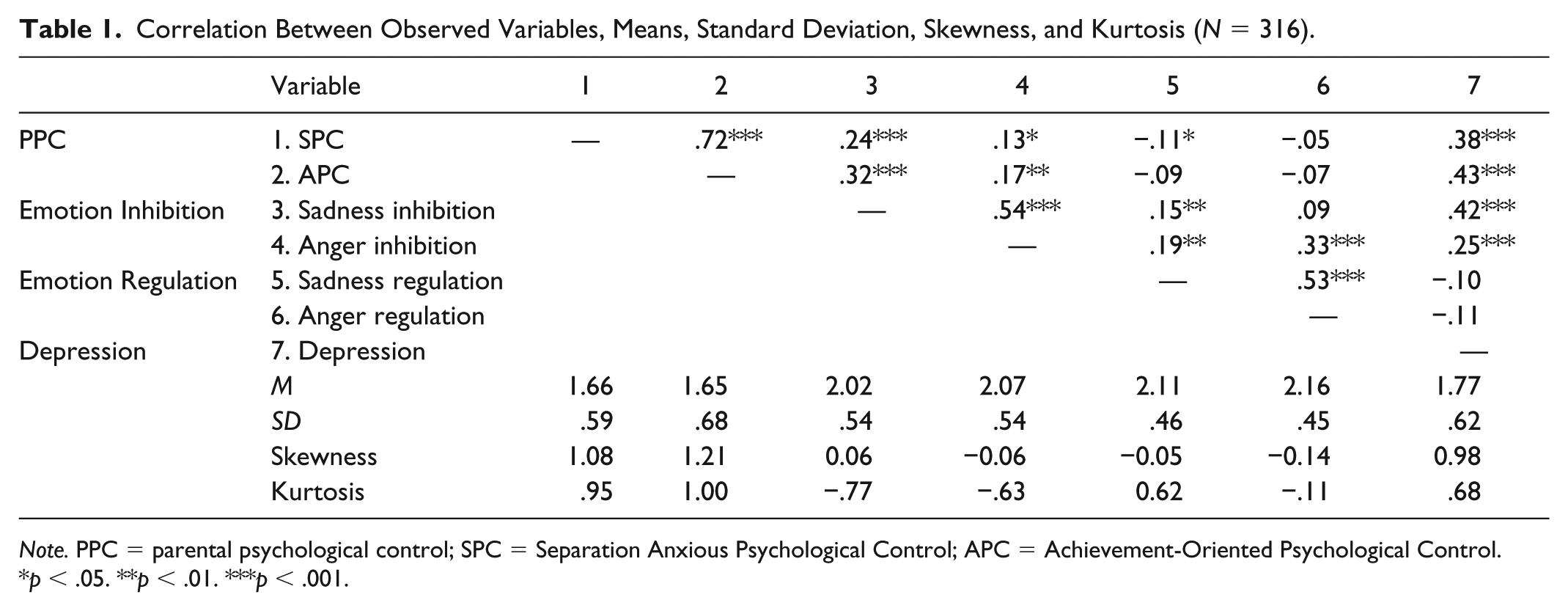
Note. PPC = parental psychological control; SPC = Separation Anxious Psychological Control; APC = Achievement-Oriented Psychological Control.
p < .05. **p < .01. ***p < .001.
In addition, correlation analysis was performed between variables, and the mean and standard deviation of each were calculated. The results of the correlation analysis showed that PPC had a positive correlation with emotion inhibition and depression in adolescents, while it had a weak negative correlation with emotion regulation. There was a positive correlation between emotion inhibition and regulation. Emotion inhibition showed a positive correlation with depression, while emotion regulation had no significant correlation with depression.
Hypothesis Test Results
Measurement model verification
Before we verified the hypothesis model of this study, we verified the measurement model to confirm the measurement variable’s validity. In this case, we verified the measurement model of all potential variables through confirmatory factor analysis to verify the whole measurement model (H. S. Lee & Lim, 2007). We found the following results: χ2 (N = 316, df = 9) was 35.99 (p < .01), CFI was .96, TLI was .90, and RMSEA was .09. Therefore, the overall fit of the measurement model used in this study was moderate.
Structural model verification
We confirmed that the process of PPC affected depression through emotion regulation and inhibition, both of which are involved in functional and dysfunctional emotion regulation, by setting up two models: a research model that included the direct path between PPC and depression and a competition model that did not include the direct path (Figures 1 and 2). Covariance analysis was performed on the models.
The results of comparing the two models are presented in Table 2. First, the research model was suitable for the data, χ2 (14, N = 316) = 35.99 (p < .01), CFI = .96, TLI = .90, RMSEA = .09. Second, the competition model had a slightly worse fit for TLI and of RMSEA than that of the research model, χ2 (15, N = 316) = 51.23 (p < .01), CFI = .93, TLI = .86, RMSEA = .11. Third, both the research model and the competition model were nested models, χ2 difference test was possible. When the two models were compared, the difference of χ2 was 15.24 and the p value was smaller than .001. Therefore, the research model explained better than the competition model, and the research model was selected as a final model. In addition, the variables of the final model were estimated, and the direct and indirect effects of related variables are shown in Figure 3 and Table 3.
The Fit of the Research Model and the Competition Model.

Note. CFI = compared fit index; RMSEA = root mean square error of approximation; CI = confidence interval; TLI = Turker–Lewis index.

The final model’s path: All estimates are standardized coefficients.
The Results of Path Coefficient.

Note. PPC = parental psychological control; Β = unstandardized coefficients; β = standardized coefficients; CR = critical ratio.
p < .001.
The results show that PPC had a significant effect on emotion inhibition (.37, p < .001) and depression (.27, p < .001), while PPC did not affect emotion regulation (−.12, ns). Both emotion inhibition and regulation were found to have a significant effect on depression (.45, p < .001; −.24, p < .001, respectively).
In this study, bootstrap analysis was conducted to verify the mediating effects of emotion inhibition in the relationship between PPC and depression; the results of this are shown in Table 4. In interpreting the bootstrap results, statistical significance was assumed when there was no 0 between the lower and upper limits (Bollen & Stine, 1993). As shown in Table 4, the lower limit of the indirect effect was .13 and the upper limit was .33, which did not include 0 at the 95% confidence level. In the pathways from PPC to depression, an indirect effect was mediated through emotion inhibition (β = .27, p < .01). These results implied that PPC influenced depression through the mediation of emotion inhibition.
The Results of Verifying the Mediating Effect.

Note. PPC = parental psychological control; CI = confidence interval.
p < .01.
Discussion
The purpose of this study was to investigate the relationship between PPC, emotion inhibition, emotion regulation, and depression in adolescents and to examine the mediating role of emotion inhibition and regulation in this relationship.
The main findings and discussion are as follows. First, we assumed two models—the research model and the competition model—and selected the research model as the final model due to its simplicity. In the research model, PPC had a direct effect on adolescents’ emotion inhibition, which had a direct and significant effect on depression, while PPC did not affect adolescents’ emotion regulation. In addition, it was found that PPC directly affected the depression of adolescents.
These results showed that PPC has a significant effect on the dysfunctional emotion regulation rather than functional emotion regulation of adolescents. Although PPC has a clear correlation with both the functional and dysfunctional emotion regulation of adolescents, a more strong effect was found in the relationship with dysfunctional emotion regulation. The present study showed a strong relationship between PPC and dysfunctional emotion regulation, which supports previous findings: When parents provided rearing and became involved in their children’s personal and psychological domains, the children became emotionally dependent on their parents (Garber, Robinson, & Valentiner, 1997) and experienced failures when taking initiative (Barber, 1996), which turned out to negatively influence their emotional expression (U. L. Kim & Kim, 2013). This study also corresponds with previous research studies that showed that the more negative the mothers’ rearing attitudes, the more maladaptive their children’s emotion regulation when expressing and avoiding emotions (Lim, 2001; S. J. Park & Kim, 2005).
Based on the fact that emotion inhibition significantly affected depression, we can confirm the previous findings that the inability to manage emotions effectively might cause psychological problems, such as depression and anxiety (Eisenberg et al., 2010; J. S. Park, Kim, Hyun, & Yu, 2008; Silk et al., 2003). Simultaneously, the findings also support the fact that internalized problems could be caused by adolescents’ inhibition of anger and sadness (Cui et al., 2014; Zeman et al., 2002). In addition, these results support previous findings that showed that the suppression of anger causes an increase in depression and other negative emotions, decreased subjective well-being, and declines in social adjustment (Gross & John, 2003; Ha, 2017; K. S. Lee & Han, 2011).
This study confirmed an indirect relationship between PPC and depression as well as a direct relationship between them. These results support the previous studies that showed a relationship between PPC and depression (Barber et al., 2002; Finkenauer et al., 2005; S. Y. Park & Lee, 2010; Soenens et al., 2008; Soenens et al., 2012; Stolz et al., 2005).
The results of this study also confirmed the mediating role of the dysfunctional emotion regulation of adolescents in the relationship between PPC and adolescents’ depression. Similarly, McEwen and Flouri (2009) have also shown that dysfunctional emotion regulation plays a mediating role in the relationship between PPC and the various symptoms of adolescents. Brenning et al. (2012) found that emotion inhibition plays a mediating role in the relationship between autonomy-support parenting and children’s depression. In this study, we examined the mediating effect of the PPC and depression relationship by dividing dysfunctional emotion regulation into the inhibition and expression of anger and sadness. As a result, PPC itself had a direct effect on depression, but the greater the PPC, the more the children were affected by emotion inhibition and the more depression they experienced.
There has been growing interest in exploring the mediating variables in the relationship between PPC and depression (Cui et al., 2014; McEwen & Flouri, 2009; Soenens et al., 2007), while traditional research has reported the relationship in a simple form (Barber et al., 2002; Finkenauer et al., 2005; Stolz et al., 2005). As we found the more economical explanation that PPC leads to depression through mediated variables rather than leading directly to depression, this study added supportive evidence of the role of mediating variables. In other words, parental rearing attitudes that manipulate the emotional dependency of the child by invading their psychological area can cause sadness and anger in the child (K. A. Kim & Kwon, 2015). Adolescents who are afraid of confronting PPC might disconnect and deny their feelings and experiences; as a result, they may experience depression (U. L. Kim & Kim, 2013).
The implications and meanings of this study lay in examining “the process” of how PPC affected adolescents’ depression. As we examined the mediatory roles of emotion inhibition and regulation in the relationship between PPC and adolescents’ depression, we underlined the importance of raising the emotion regulation capabilities of adolescents who experience depression. It is necessary to pay close attention to adolescents’ emotion regulation style when they experience depression in response to negative discipline from their parents. If adolescents are suppressing sadness or anger, they need to be aware of their emotions and learn to express them in a healthier manner. In contrast, if adolescents inappropriately express sadness or anger that is evoked by PPC, they need to better understand their emotions and learn how to express them appropriately.
Next, the importance of this study can be found in the fact that when Korean adolescents experienced PPC, they became depressed because of emotion inhibition rather than a lack of emotional control related to sadness or anger. Although the relationship between PPC and emotional control has been proven through previous studies, it is meaningful to reveal that PPC is more closely related to emotion inhibition than emotional control. This result can be better understood when considering the cultural characteristics of Korea. Regarding inhibition, a cross-cultural study found that Koreans use emotional suppression more often than Americans and that Koreans’ emotional suppression may not affect individuals’ subjective well-being, which is not the case for Americans (E. Lee, Suh, Chu, Kim, & Sherman, 2009). Diener and Lucas (2004) found that, in Korea, parents were more likely to expect their children to suppress anger expression than Americans. Therefore, the norm of emotional expression can be understood as learned naturally from childhood through cultural customs and the socialization process. Academic and educational significance can be obtained if we explore the differences in the results and the process of emotion inhibition and regulation in Korea and western countries.
The limitations of this study and suggestions for future research are as follows: First, the results were not generalizable to all adolescents, since the participants were Korean middle school students, and 80% were female. It would be desirable to include adolescents of various ages and some consideration of participants’ gender ratio. Second, because this study used a self-report questionnaire, it is difficult to exclude the possibility that respondents’ responses were conservative or exaggerated compared with reality. Third, we used DAPC to measure PPC as perceived by adolescents, and the adolescents themselves were asked to evaluate their parents together instead of rating their father and mother separately. While it is meaningful to evaluate both parents as a whole, it is also important to understand the results of the psychological control of the father and mother individually. In addition, the inclusion of behavioral tasks to measure parental control and emotion dysregulation would strengthen future studies. Finally, we translated the Children’s Sadness and Anger Management Scales to measure dysfunctional emotion regulation. Although we exerted significant efforts to translate the scale precisely, there was no validation process with a Korean population, which could be a limitation of this study. If a validity study is conducted on these scales, more rigorous comparative studies will be possible in relation to adolescents’ emotions.
Footnotes
Declaration of Conflicting Interests
The author(s) declared no potential conflicts of interest with respect to the research, authorship, and/or publication of this article.
Funding
The author(s) received no financial support for the research, authorship, and/or publication of this article.