




Abstract
This article analyzes the microfoundations of support for governors in Brazil based on a decision model in which deputies attempt to reduce their electoral risks. This model considers the effects of the individual backgrounds of legislators, party strength, and the dynamics of political competition in states. We used ordinary least square regression models to estimate the chances of a legislator to adopt an oppositional stance. The results confirm the multidimensional nature of the government-building process in Brazil. Adhesion is not only coordinated on a partisan basis, but it is also shaped by perceptions of electoral risks, as well as by expected rewards that different political careers and partisan linkages shape.
Introduction
A pattern of governance characterized by cooperation between the legislative and executive branches describes the Brazilian experience over the past 25 years, at least at the federal level. This phenomenon is not trivial. Previous studies of the stability of this pattern—“coalitional presidentialism”—have helped us to understand the institutional and political formation of what are relatively stable governmental majorities in Brazil. Such empirical studies shed light on the controversial institutional features of Brazilian democracy, especially their effects on cooperation between the branches of government. However, it is worth emphasizing that these analyses have been limited, to a large extent, to examining political dynamics at the national level. What about the formation of governments at the subnational level? How do legislators define their positions relative to the executive? What affects the adhesion of the individual legislator to the government? Is that support coordinated in a partisan fashion or not?
Studies of the diverse dynamics of state government formation and analyses of the relationship among branches of the Brazilian government are not a novel. Researchers are concerned about these issues, as a recognition that conditions of political competition vary both vertically and horizontally. On the vertical axis, scholars have emphasized the impacts of the territorial dimension on the strategic and organizational coordination of political actors who work at different levels in the political system (Brown & Bruce, 2002; Hopkin & Van Houten, 2009; Lima, 1983; Samuels, 2003). Regarding the horizontal axis, scholars are paying increasing attention to the endogenous political dynamics of each subsystem, as well as to differences between them, despite the fact that states share several institutional features (Hogan, 2003; Lodola, 2009).
Our study is based on the analysis of the horizontal axis. The central argument is that there are variations in the willingness of state legislators to support governors in Brazilian states. We recognize that these variations are associated with characteristics of particular politicians and with the configuration of political competition in each state. We develop an individual decision-making model, which estimates the chances of state legislators to oppose the governor, based on the costs and rewards involved on that decision. We argue that dispositions for being part of a government coalition are influenced by the level of electoral risks that legislators face in their respective districts. The strategies and resources available to the individual representatives is one of the determinants of this risk. At the aggregate level, the shape and dynamics of political competition within each electoral district also shape the level of electoral risks. The factors that influence individuals in decisions about whether or not to support the state government are related to the type of electoral connections of the representative, to the relative party strength, and to the distance between ideological positions.
The scope of this article is limited to analyze the propensity of a state legislator to support the government. We do not intend to push this analysis further to establish connections between this propensity and effective participation in government. Rather, we seek to uncover under which conditions a deputy declares himself or herself as a supporter or an opponent to the governor. The construction of an adequate analytical framework for understanding this process is a prior step to the analysis of coalitions. Given these objectives, our study implemented a cross-sectional analysis of the perceptions and attitudes of state legislators regarding their relationship with their state government. The study utilized data from a 2007 survey conducted with state legislative deputies in 12 Brazilian states. These data provide information at the individual level and offer an interesting empirical basis for the analysis of the microfoundations of coalitional presidentialism in Brazil.
This analysis is organized in the following sections. The next section discusses the theoretical model we propose, concentrating on the multidimensionality of legislator’s support for their state government. In the “Data and Method” section, we present our database and hypotheses, as well as the strategies we utilized to estimate our statistical models. The “Results” section introduces the findings from our multivariate analyses, in relation to the determinants of legislator’s proximity to the state government. Finally, the section “Final Considerations” evaluates these findings based on the proposed framework.
Support for Government in Brazilian States: Building Coalitions in the Legislative Arena
In Brazil, the postelectoral formation of legislative majorities is already present in the repertoire of strategies that heads of executive and parliamentary parties use (Amorim Neto, 2002; Figueiredo & Limongi, 1999; Inácio & Nuno, 2005). Studies of the practice of coalition government in Brazil maintain that the standard of governance rests on a chain of relationships involving delegations. These relationships are of two main types: (a) between legislators and party leaders and (b) between these leaders and the head of the executive. The party basis of governmental coalitions is structured by a flow of sequential delegation that travels from the first to the second type of relationship. Put another way, the government coalitions gain operational capacity when they solve collective action problems within the parties, and the parties coordinate the relationships of legislators with the government. However, this flow is not inevitable. Instead of supporting partisan-coordinated government coalitions, deputies have another alternative: ad hoc coalition of votes derived through direct negotiations and bargaining with the head of the executive.
Indeed, the deputy’s concerns regarding how to feed up his or her political network is a recurring argument in explanations for the formation of legislative coalitions. In this perspective, participation in coalitions expands the electoral chances of incumbents because such participation increases the flow of resources and benefits that matter to the deputy’s constituencies (Mayhew, 1974). In the Brazilian case, the influence of the executive over the production of public policies and control over the allocation of budgetary resources makes support for a government an important part of any legislator’s parliamentary strategy (Pereira & Mueller, 2003; Pereira & Rennó, 2001; F. Santos, 2001; Abrucio, 1998). Whether this support is the product of an individual’s or a party’s adhesion to the government is the subject of an extensive debate in the specialized literature. Explanations have focused on the distributive goals of legislators that they pursue to construct political careers on personal reputation (Ames, 2003; Samuels, 2003). It is assumed that a legislator’s approach to a government is not constrained by party organizations even in situations in which conflict exists between the respective positions of a party and the government. 1 Intraparty competition, generating by open-list system of proportional representation, has been seen as an incentive for individual strategies of adhesion to the government. Therefore, tensions between individual and partisan orientations can motivate the individual negotiations with the government, and consequently, the formation of oscillating coalitions.
Other approaches have focused on the incentives that legislative organizations offer; these studies highlight the strategic nature of partisan coordination of support for a government. Legislators restrain their individual initiatives, subjecting themselves to party guidelines regarding participation in government. Deputies’ self-restraint is based on expectations of increasing returns from negotiations between their party and the government (Figueiredo & Limongi, 1999; F. Santos, 2001). These expectations include not only access to the budgetary and bureaucratic resources that are controlled by the executive but also the strengthening of the party’s position within the legislature’s power structure. These argue that interparty competition in the parliamentary arena is an important component of the calculations involved in the formation of a majority to control the executive and legislative branches. The alignment of individual strategies with the leadership’s instructions is intended to reduce representatives’ electoral risks through participation in more competitive party organizations. 2
Individual and partisan rewards are, in fact, key elements of legislators’ adhesion to the government. However, we have to uncover how these expected rewards shape the deputy’s decision regarding his or her position in relation to the government. We must explain the personal or party nature of adhesion to the government by focusing on the interconnections among these incentives. Taking into account these considerations, we have introduced three dimensions in the analysis of legislators’ support for a government: (a) the type of legislator’s electoral connection; (b) the ideological distance between the deputy, other party members, and the governor; and (c) the political resources and the structure of opportunities the deputy’s party provides.
Electoral Risks and the Adhesion to the Government
The legislator’s adhesion to the government in Brazil is puzzling because the mixed incentives that electoral rules, party organization, and internal organization of the legislatures offer. The first dimension refers to the type of electoral connection that the deputy pursues, particularly the deputy’s strategy for cultivating a supportive political network. A deputy whose electoral success depends on brokerage networks at the local or regional level has more incentives to serve as a link between the state and local governments. In this case, proximity to a governor is a resource that a deputy can use to attract mayors and local or regional leaders, and the deputy’s adhesion to the government is part of this calculus. In another study, Inácio (2009), using the same data as this study, showed that deputies aligned to governors are more inclined to pursue pork barrel politics that favor their constituencies; this inclination is particularly true among deputies who define regional interests as a focus of their parliamentary action. Castro et al. (2009) verified that particularistic behavior is more likely among deputies whose victory is attributed to regional supporters.
The second dimension involves the ideological distance between deputies, party leaders, and governor. The distribution of political preferences matters in the definition of the costs of participating in government, both for the party and for individual adhesion. From legislator’s point of view, the definition of these costs depends on the relative position of the deputy in relation to the party and government. Thus, ideological distances among the legislator, party, and government might elucidate the intraparty conflicts related to the participation in government. Our hypothesis is that legislators who are ideologically closer to the governor’s party than they are to members of their own party may have additional incentives to support the government individually.
The third dimension relates to the prospective rewards of following the partisan decision to take part in the government or not. The competitive position of the party in the electoral and parliamentary arena affects the expected return from this alignment. A member of a competitive party with chances of future victory is less subject to the government’s gravitational force. Therefore, parties controlling a large number of legislative seats can offer rewards for deputies even though it declares itself as a parliamentary opposition.
If the party’s relative strength affects the legislator’s calculations, it is important for us to consider also the external resources that the party controls beyond the parliamentary arena. The party’s ability to direct resources and more immediate benefits to legislators’ constituencies varies according to its access to and control of administrative machinery in other levels of government. In a federative context such as Brazil’s, which has experienced a large increase in the municipalities’ role in the implementation of public policies, it is worth considering the party’s strength at the municipal level. The strategic advantages of municipal governments in the execution of public policies change the flow of access to public resources and, in consequence, the rewards associated with control of governments at that level. We hypothesize that a legislator is less inclined to support the government at a given level of government when his or her party is competitive at another level.
Mapping Electoral Risks in a Subnational Level
We assumed that the type of electoral connection, ideological distance, and the party’s strength are factors influencing individual decisions about the proximity or distance in relation to the government. However, legislators can define different levels of support for the government, even among affiliated members of a same party. This level of support varies because the electoral districts shape different levels of electoral risks.
Brazil has a mixed electoral system, or an open-list system of proportional representation for legislative races and majority election for executive branch; the state is the electoral district in legislative elections at the federal and state levels; the district magnitude varies from 24 to 94 seats in the state level. Although a multiparty system is a common feature, the conditions of intra and interparty competition vary in each federal state, particularly in terms of the supply of candidates, the electoral volatility in proportional and majority races, and the governor’s attractiveness. Thus, the electoral risks that the deputy faces vary considerably, and it turns adhesion to the government in subnational level into a very interesting puzzle.
To understand interstate oscillations in electoral competition, we present the following indicators (Table 1): (a) competitiveness average, (b) average electoral volatility in state government, and (c) average electoral volatility in legislative assemblies.
Average Indices of Political-Party Competition in 12 Brazilian States, 1994–2006.
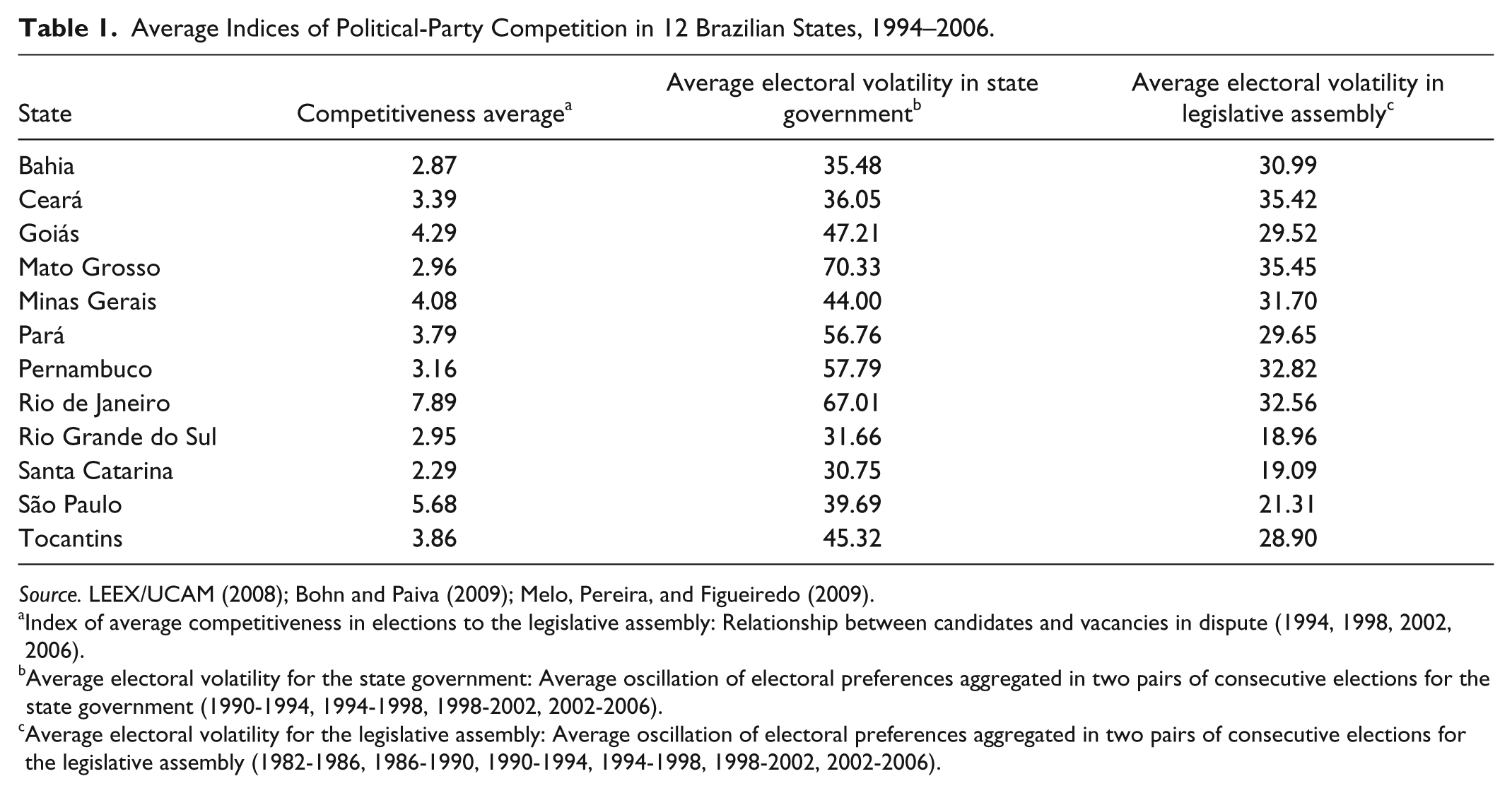
Index of average competitiveness in elections to the legislative assembly: Relationship between candidates and vacancies in dispute (1994, 1998, 2002, 2006).
Average electoral volatility for the state government: Average oscillation of electoral preferences aggregated in two pairs of consecutive elections for the state government (1990-1994, 1994-1998, 1998-2002, 2002-2006).
Average electoral volatility for the legislative assembly: Average oscillation of electoral preferences aggregated in two pairs of consecutive elections for the legislative assembly (1982-1986, 1986-1990, 1990-1994, 1994-1998, 1998-2002, 2002-2006).
Each deputy’s electoral risk level varies according to the supply of candidates in elections vis-à-vis the number of vacancies in dispute (competitiveness index). 3 In proportional elections to legislative assemblies, which occurred between 1994 and 2006 in Brazil, we observe considerable variations in this indicator in the states we analyzed. The competitiveness index varied from 2.29 (Santa Catarina) to 7.89 (Rio de Janeiro). Oscillations in voting preferences between elections is a key measure of party system institutionalization, indicating a lesser or greater degree of instability in electoral preferences vis-à-vis the party’s offerings. 4 The legislator’s electoral risk is directly affected by such oscillations. We argue that such oscillations increase the chance of trade-offs among the individual’s or party’s strategies, as they raise the discount rate of long-term party investment. That is, the instability of electoral support increases uncertainty regarding future gains in the party’s reputation. Recent studies show interstate variations in the rate of electoral volatility for legislative offices, even though they signal a declining trend of oscillations in the last elections. 5 In the last six elections, electoral volatility for the legislative assemblies oscillated between 19% and 53% (Bohn & Paiva, 2009). In the 12 states we analyzed, the variation was smaller, from 18.96% to 35.45%.
A deputy’s willingness to support the government is also affected by oscillations in electoral preferences in contests for the state governorship. In these contests, we observe considerable differences among the average rates of volatility in the states. The relevant point, however, is that volatility is higher in the race for major offices than in proportional elections. Among the states considered in our study, the differences between the rates of volatility of elections for governor and state deputy are most notable in the states of Mato Grosso, Pará, Pernambuco, and Rio de Janeiro. While the average electoral volatility in the proportional elections can encourage support for the government, the oscillation in gubernatorial contests may curb that approach as a strategy for reducing electoral risk.
In the next section, we explain how we operationalize all variables. We explain how we implement our framework in our examination of the data and how, by using this framework, we can assess reasons for a legislator to decide to pursue a pro-government, independent, or oppositional course.
Data and Method
We explored the propensity of state representatives to support the government by analyzing data from a survey carried out with 513 deputies in 12 Brazilian states. These politicians were located in all five major regions of the country: (a) South (Santa Catarina and Rio Grande do Sul), (b) Southeast (Minas Gerais, São Paulo, and Rio de Janeiro), (c) Northeast (Bahia, Ceará, and Pernambuco), (d) North (Pará and Tocantins), and (e) Central-West (MatoGrosso and Goiás). These data were collected between October 2007 and April 2008. 6
The proximity of the deputy to the government (dependent variable) was operationalized from a scale in which the representative reports his or her position in relation to the state government. The scale varies from 1 (pro-government) to 10 (opposition), as exposed on Table 2. This measure is used as a proxy of the deputy’s inclination to participate in a legislative coalition and to support the governor.
Distribution of State Deputies on the Pro-Government-Opposition Scale, Brazil, 2007-2008.
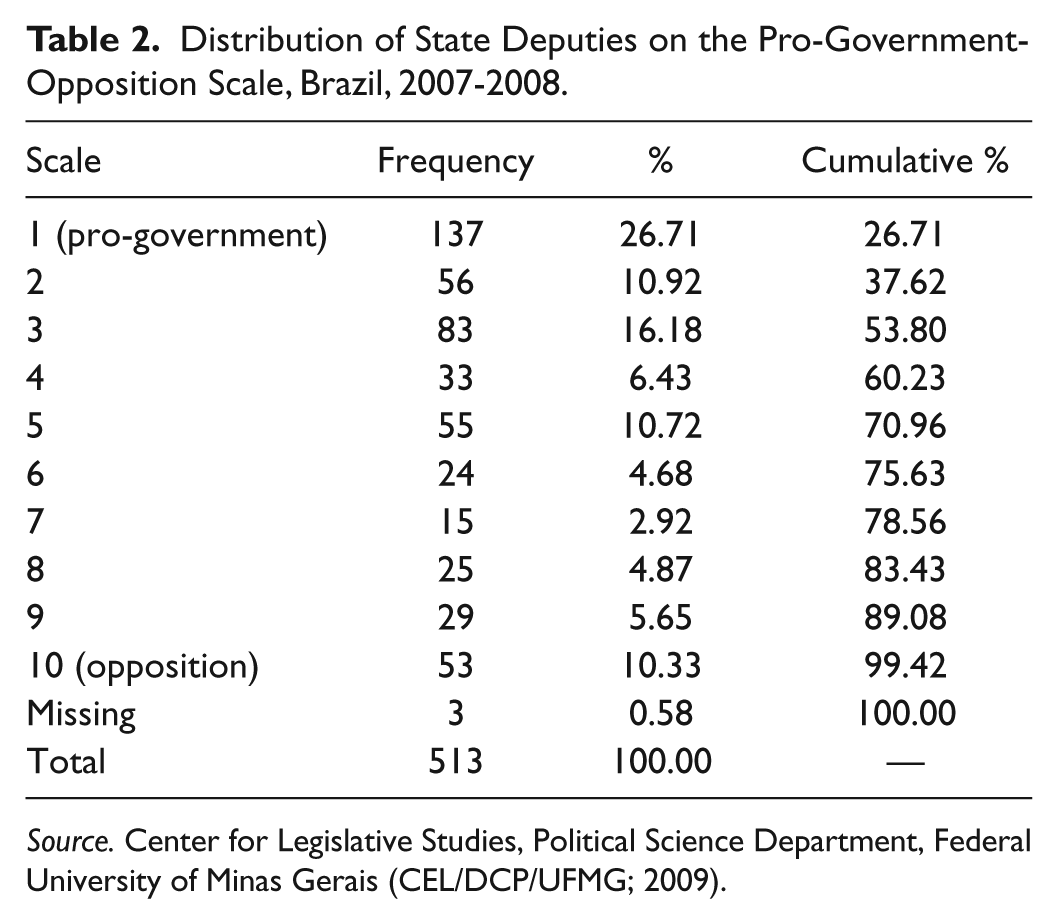
Source. Center for Legislative Studies, Political Science Department, Federal University of Minas Gerais (CEL/DCP/UFMG; 2009).
Regarding the independent variables, individual-level measures include three dimensions that we considered central to an analysis of the determinants for adherence to a government. These dimensions are (a) the deputy’s political path, his or her networks of supporters, and his or her preference for distributive parliamentary action (background); (b) the deputy’s ideological distance in relation to his or her party’s other members and to the governor; and (c) the political resources and opportunity structure of the deputy’s party. Our analysis also includes a set of dummies variables for states to address the level of political competition in each geographic area, as well as to capture the dynamics of the electoral and partisan contests in each federal unit.
We explore the dimension related to the deputy’s background by gathering information on three variables. The first variable indicates the deputy’s prior political experience, grouped in three categories: (a) freshman legislator and/or no previous experience in elective office; (b) prior experience solely in elective office; and (c) prior experience in elective and nonelective offices. The hypothesis is that a deputy with some experience in elective and/or nonelective offices (Categories 2 and 3) tends to position himself or herself farther away from the governor than does a freshman legislator.
The second variable associated with a deputy’s background refers to the focus of the deputy’s action, that is, to which activity the deputy assigns greater importance. The original variable included the following categories: (a) making laws, (b) solving problems of his or her state, (c) controlling the government actions of his or her state, (d) protecting the interests of his or her party, and (e) proposing amendments to the budget which benefit his or her region. The first four categories of this variable were grouped and are compared with the fifth category. The hypothesis is that a deputy concerned with diverting resources to his or her region will be more likely to adopt a pro-government stance, because he or she will depend on the proximity to the state apparatus to push through measures that directly benefit his or her region.
The third variable addressing a deputy’s background refers to the deputy’s network of supporters. We used information reported by the deputy regarding his or her candidacy’s main supporters during the last election. We created a dichotomous variable to inform whether the deputy received support from mayors or council members of his or her region. The idea is that deputies who depend mainly on mayors or council members for their election are linked to regional or local brokers. These local agents, on their side, may depend on benefits and resources allocated by the state deputy. The other group of deputies includes those who received their main support from their party, business leaders, church, community leaders, other groups, or no person or group. The hypothesis is that the deputy who attributes his or her victory to the support network of local governments (mayors or city council members) tends to be closer to the government regardless of party.
Regarding the ideological distance dimension, we created a two-stage indicator. The first stage estimates (a) the intraparty distance and (b) the deputy’s distance from the governor’s party. The intraparty ideological distance was measured as the difference between (a) the position assigned by the deputy regarding his or her position on the ideological scale, which varies from 1 (left) to 10 (right) and (b) the average position of his or her own party on the ideological scale, as derived from the collective assignment of party position by all deputies in the respective legislative assembly. The deputy’s ideological distance in relation to the governor’s party was calculated by the difference between (a) the position assigned by the deputy in the ideological scale and (b) the average position of the governor’s party in the ideological scale, as assigned by all state deputies. 7 The second stage estimated the difference between the intraparty distance and the deputy’s distance in relation to the governor’s party. This final ideological variable is positive when the deputy is farther away from the average of his or her party (intraparty distance) than from the average of the governor’s party. Thus, the greater the final ideological distance (Figure 1), the greater is the probability that the deputy will be closer to the government. The two stages used to estimate the ideological distance of the deputy in relation to his or her party and to the governor are these ones:

Histogram of the ideological distance of the deputy in relation to his party and to the governor, Brazil, 2007-2008.
First stage:


Second stage:

The first variable that addresses the party dimension indicates the number of municipalities that each party controls in the state. The party’s municipal strength indicator is calculated as the proportion of mayors affiliated with each party. We use the logarithm of this variable, because its distribution was originally skewed to the right.
In terms of party dimension, we also understand that preelectoral alliances between governor candidates and parties can forge political commitments. Thus, these alliances can restrain the postelectoral choices regarding which parties the deputy will support or oppose. To control for the effect of a deputy belonging to parties already aligned with the governor, we estimated models (not shown) using a dichotomous variable to indicate the participation of the deputy’s party in the coalition that elected the state governor. As expected, the fact that the deputy’s party had participated in the governor’s electoral coalition increased the chances of the deputy being pro-government. However, this variable would introduce an endogeneity problem in our models, as it explains, as well as it is explained by our dependent variable (pro-government-opposition scale). Instead of introducing this variable in our models, we used information on party’s parliamentary strength (PPS) and the deputy’s party, as another set of variables to measure the party dimension. The party’s parliamentary strength is the proportion of seats held by the deputy’s party in the legislative assembly. The hypothesis is that the higher this proportion, the less likely a deputy will be pro-government, as compared with a deputy from a small party. However, the effect of party’s parliamentary strength is conditional on the deputy being a member of the governor’s party. Usually the governor’s party is the largest party in the legislative branch. Thus, our models include the party’s parliamentary strength, a dummy informing whether the deputy is a member of the governor’s party, as well as an interaction term of these variables (Party’s parliamentary strength × Not at the governor’s party).We expect that the representatives with higher party’s parliamentary strength will tend toward opposition, mainly among deputies not affiliated to the governor’s party.
In summary, the dependent variable (pro-government-opposition scale) was introduced in the regression models and it is explained by a series of independent variables, which address the background, ideology, party, and state of the deputy. The background variables are (a) the experience of the deputy in the office, (b) regional amendments, and (c) political network. The first of these variables was broken down into three dichotomous variables: (a) freshman legislator and/or no previous experience in elective office, (b) prior experience solely in elective office, and (c) prior experience in elective and nonelective offices. The ideological variable indicates the ideological distance of the deputy in relation to his or her party and to the governor. The party’s variables are (a) the logarithm of the party’s municipal strength, (b) party’s parliamentary strength, (c) indicator that the deputy is not at the governor’s party, and (d) party’s parliamentary strength interacted with the indicator that the deputy is not at the governor’s party. Finally, we included a series of state dummy variables, to control for no observable variations in the electoral environment.
Before estimating the regression models, we removed observations without information (missing values) for our dependent and independent variables. This procedure reduced our dataset to 442 observations, compared with the original 513 state deputies. Then we estimated a series of ordinary least square regression models to explain the deputy’ self-placement in the pro-government-opposition scale.
Results
The percentage distributions of discrete variables, as well as descriptive statistics for continuous variables illustrate the main trends of the characteristics for 442 state representatives in Brazil (Table 3). We also present the mean and standard deviation of the position of state deputies on the pro-government-opposition scale for each category of our discrete variables. The global mean of this scale is 4.21, which is below the median and indicates a greater concentration of state representatives toward the government (lower values) than the opposition (higher values).
Descriptive Statistics of Dependent and Independent Variables for 442 State Deputies, Brazil, 2007-2008.

Source. Center for Legislative Studies, Political Science Department, Federal University of Minas Gerais (CEL/DCP/UFMG; 2009).
Note. This data refers to a census of state deputies from 11 states in the federation (Bahia, Ceará, Goiás, Minas Gerais, Pará, Pernambuco, Rio de Janeiro, Rio Grande do Sul, Santa Catarina, São Paulo, and Tocantins). Mato Grosso was excluded due to insufficient information to estimate the variable “ideological distance.”
In terms of political experience, we expected that a freshman legislator would be more pro-government than a deputy with some experience in elective and/or nonelective offices. However, our results suggest that representatives with prior experience solely in elective office have the lowest mean in the pro-government-opposition scale (3.89) than the other deputies (Table 3). This lowest mean indicates a greater proximity to the governor. However, representatives with prior experience in elective and nonelective offices have the highest mean in the pro-government-opposition scale (4.43), suggesting the biggest distance to the governor.
The information on which activity the deputy assigns greater importance informs whether the representative is concerned with diverting resources to his or her region or with other issues. Our hypothesis was that deputies concerned with regional amendments would be more pro-government than the others. The mean of the pro-government-opposition scale corroborates this hypothesis, that is, deputies with regional interests have a lower mean (3.29) on this scale than the other deputies (4.39) in Table 3.
In relation to political network, we expected that representatives who attributed their victory to the support of local governments (mayors or city council members) would be more pro-government than other representatives. This hypothesis is followed by the results in Table 3, in which deputies more related to mayors or city council members are more pro-government (4.05) than the other deputies (4.28).
As expected, information on the deputy’s party indicates that those not in the governor’s party are more likely to be in opposition (mean of 4.74 in Table 3), compared with representatives in the governor’s party (1.84). The deputy’s party could be seen as endogenous to our pro-government-opposition scale. However, this variable was introduced only to permit its interaction with the party’s parliamentary strength (PPS). We expect that representatives with higher party’s parliamentary strength will have a higher mean on the pro-government-opposition scale, that is, they will move toward opposition (as can be seen on the first graph of Figure 2). Moreover, this pattern changes depending whether the representative is in the governor’s party. On one hand, the deputies affiliated to the governor’s party have low values in the pro-government-opposition scale. They are strongly concentrated toward the government (second graph of Figure 2), independent of the quantile of the party’s parliamentary strength, as expected. On the other hand, representatives not affiliated to the governor’s party (third graph of Figure 2) have high values in the pro-government-opposition scale (strongly oppositionists) when they are in a party with high parliamentary strength (forth quartile of PPS).

Box plot of the pro-government-opposition scale by party’s parliamentary strength (PPS) quantiles and participation in the governor’s party, Brazil, 2007-2008.
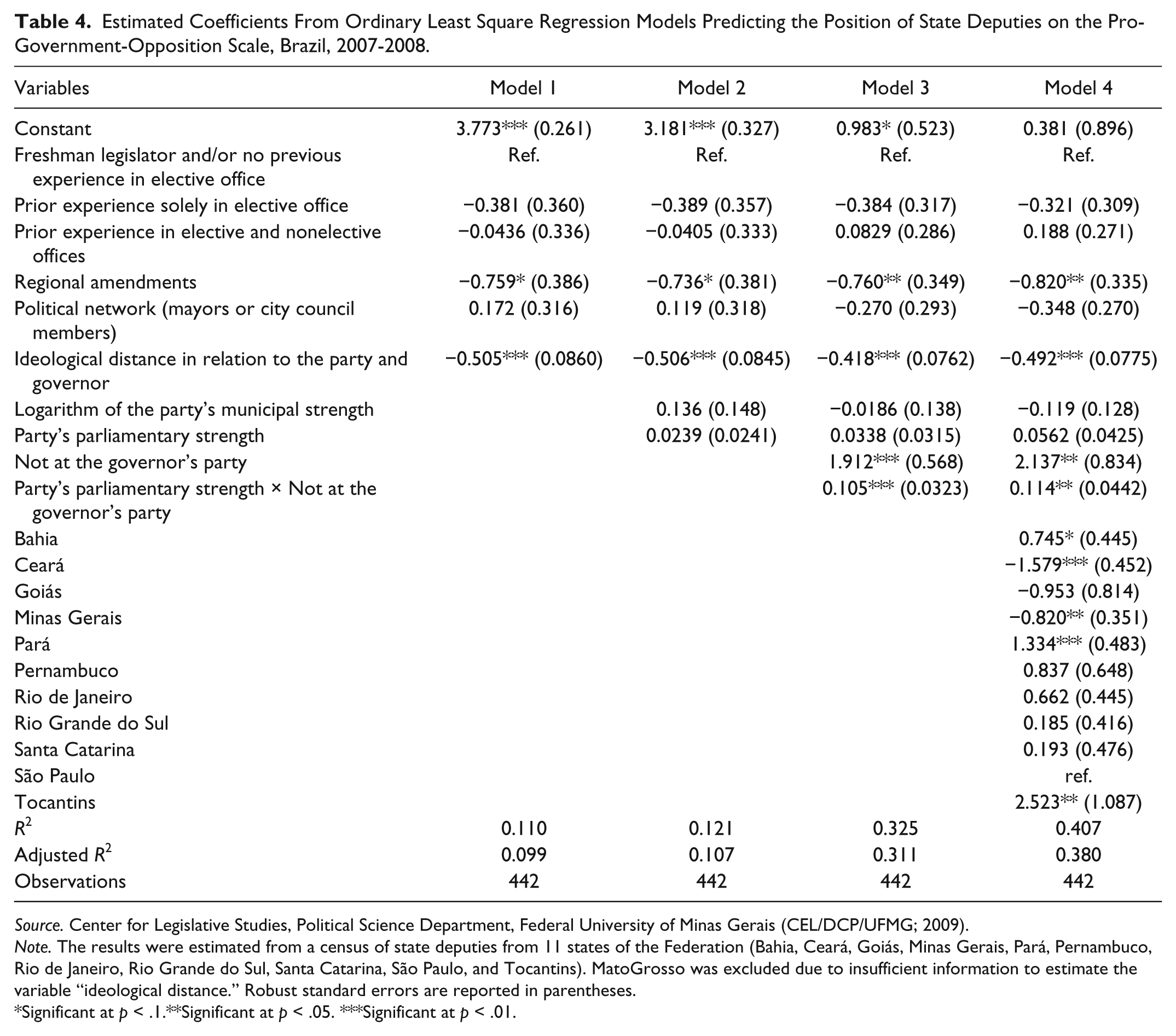
Following the analysis of descriptive statistics, we estimated ordinary least square regression models to analyze the impact of independent variables on the pro-government-opposition scale (Table 4). The estimated coefficients assigned to deputies derived from a set of four different models.
Estimated Coefficients From Ordinary Least Square Regression Models Predicting the Position of State Deputies on the Pro-Government-Opposition Scale, Brazil, 2007-2008.
Source. Center for Legislative Studies, Political Science Department, Federal University of Minas Gerais (CEL/DCP/UFMG; 2009).
Note. The results were estimated from a census of state deputies from 11 states of the Federation (Bahia, Ceará, Goiás, Minas Gerais, Pará, Pernambuco, Rio de Janeiro, Rio Grande do Sul, Santa Catarina, São Paulo, and Tocantins). MatoGrosso was excluded due to insufficient information to estimate the variable “ideological distance.” Robust standard errors are reported in parentheses.
Significant at p < .1.**Significant at p < .05. ***Significant at p < .01.
Model 1 on Table 4 indicates that if the deputy has political experience in elective and nonelective offices, he or she tends to be pro-government (negative coefficients), in relation to those without experience. However, these differences are not statistically significant. When the deputy places greater importance on regional amendments, he or she moves toward the government with a statistically significant coefficient. By having the mayors or city council members of his or her region as the political network, the deputy tends toward the opposition, but with no statistical significance. The ideological variable indicates that by being more ideologically distant from his or her party than from the governor, a deputy will be more likely to be pro-government (negative coefficient) with a statistically significant impact.
Model 2 includes variables on the logarithm of the party’s municipal strength and the party’s parliamentary strength (Table 4). Both these variables move the deputy toward the opposition, but without statistical significance. The other coefficients still indicate no significance in the variables for political experience and political network. The impact of regional amendments moves slightly toward zero on Model 2, compared with Model 1. The ideological variable continues to have a significant impact on pro-government.
Model 3 adds an indicator of whether the deputy is not at the governor’s party, as well as an interaction of this variable with party’s parliamentary strength. The variables on existence of prior political experience in elective and nonelective offices are still not significant. The coefficient for regional amendments is still significant, and more negative when compared with Model 2. The political network of mayors or city council members now points to a negative effect (pro-government), but with no statistical significance. The logarithm of the party’s municipal strength and the party’s parliamentary strength continue to have a positive impact, but without statistical significance. By not being part of the governor’s party, the deputy has a great tendency to the opposition. This strong result is not surprising, but the interaction between this indicator and the party’s parliamentary strength shows an interesting trend. If the deputy is not at the governor’s party, and is located in a party with high parliamentary strength, he or she will have higher chances to be in opposition. In other words, a deputy who is not at the governor’s party has a high chance to be in opposition. Furthermore, if this same deputy is in a party with high parliamentary strength, this positive impact will be even stronger toward opposition, with statistical significance. These two new variables increased the adjusted R2 from .107 (Model 2) to .311 (Model 3).
Model 4 includes a series of state dummy variables. These variables control for geographical differences, such as difference of voting in the first round, legislative volatility, government volatility, and number of legislative seats. The previous variables indicate the same trends as Model 3. The statistically significant variables (regional amendments, ideological variable, whether the deputy is not at the governor’s party, as well as an interaction of this variable with party’s parliamentary strength) are even strong in Model 4, compared with Model 3, moving away from zero.
Final Considerations
This study sought to understand the microfoundations of state deputies’ support for governors in Brazil, on the basis of a decision model focused on legislators’ attempts to reduce electoral risks. Adherence is organized in a partisan fashion, and participation in the coalition does not merely express an individual’s quest to extract advantages from government. However, adherence is shaped by perceptions of electoral risks and by return expectations from different political profiles and paths. Our analysis demonstrates that variations on the deputies’ proximity to the government are related to party’s calculations, as well as to individual differences regarding the electoral connection and ideological position of each deputy.
The party’s strength had a remarkable effect as we have hypothesized. The relative size of the parliamentary party and its strength at the municipal level increase the chances of the deputies to move away from governors. Indeed, when a deputy is not affiliated to the governor’s party and his or her party has high parliamentary strength, this representative will have even higher chances to be in opposition to the governor. Contrasting to arguments that executives operate in the aggregate level and opposition is a inhabited terrain, our analysis shows that deputies have incentives to declare themselves as opposition if their parties are electorally competitive. We should take into account the fact that strong parties may be the target of coalition politics when such parties were not part of the governor’s electoral coalition. Therefore, strong parties are attractive for the government, but those parties also have incentives to present themselves as an alternative to the government and to remain in opposition.
The attraction exerted by Brazilian executives over deputies is largely associated with the importance of the resources the executive branch controls to political careers. The results highlight that attraction is not related to deputies’ political experience, but rather to the type of electoral connection that they purse. Our model of individual decision making stressed that deputies focusing on budgetary transfers for their constituencies value entering in the government. The results presented here confirm this hypothesis. In fact, the chances of supporting a government are greater among state deputies who pursue pork for their constituencies. However, our findings did not provide evidence of whether representatives move toward government as a strategy for maintaining the support of regional brokers, or as a strategy related to partisan or social networks. In further analysis, we seek to improve our measures of political network for properly capturing the relationship of regional or local configurations and political decisions.
The analysis of the effect of ideological distance sheds light on the possible implications of intraparty conflicts over the government’s position. This measure seeks to capture individual incentives to join the government, which can affect loyalty to the party if a deputy decides to join the opposition. The result indicates that deputies support the government when they are more closely identified with the head of the executive than with members of their own party. This finding points to intraparty variations to be pro-government or to be in opposition. Thus, the format of the party system and the interstate preferences’ variations are aspects that define the alignment of parties on the pro-government-opposition scale at the subnational level. Therefore, considerable differences between party subsystems can explain part of the state variations in relation to the relationship between government and opposition. The state contexts matter when a deputy engages in calculations regarding the benefits of being pro-government, as well as the government’s potential coattail effects in future contests.
The results about the position of state deputies along the pro-government-opposition scale are intriguing and point to the complexity of the dynamics of coalition governments in Brazil. These coalitions are formed in the election, but are modified over the mandate of the election. Thus, the deputy’s decision to be pro-government or opposition is a strategic decision for future negotiations with the government. Unlike other studies, our models indicate that the opposition stance can be valued by deputies when their parties are able to offer an electoral future. We argued that deputies’ decisions involve a trade-off tactic, regarding the rewards that parties and governors can offer. Our findings have important implications to study subnational politics in Brazil, particularly concerning the size of governments and the probability of independents or oppositionists challenging the government. We argue that the competitiveness of party system matters and the governors’ attractiveness is not so overpowering.
Footnotes
Acknowledgements
We are grateful for the collaboration of research assistants at the Center for Legislative Studies (CEL), Universidade Federal de Minas Gerais (UFMG), Brazil, as well as for suggestions from Professor Enivaldo Rocha, Universidade Federal de Pernambuco (UFPE), Brazil.
Declaration of Conflicting Interests
The author(s) declared no potential conflicts of interest with respect to the research, authorship, and/or publication of this article.
Funding
The author(s) received no financial support for the research and/or authorship of this article.