




Abstract
The present research aims at investigating the effects of Afghans’ informal settlement in the villages located near Sistan and Afghanistan border in the southeast of Iran. It was attempted to identify the relationship between the levels of development of villages with Afghan informal settlers with the number of Afghan immigrants per village. The study was conducted in 31 villages located in Sistan border area in the southeastern corner of Iran. The study is based on an analytical-correlational research design using library resources, field observations, and questionnaire survey data. The collected data were analyzed using taxonomy method and Spearman correlation on SPSS. The results of the taxonomy classification showed that out of the 31 villages under study, six villages were at a favorable development level and the other 25 villages were at lower levels of development. Moreover, the results of Spearman test at a confidence level of 99% revealed a reverse relationship between Afghans’ settlement and physical development (−.845) of villages, that is as the number of Afghans increased, the development level of villages decreased and vice versa. Overall, the results indicate that due to immigration from an underdeveloped country such as Afghanistan with an underdeveloped social culture and their lack of sense of belonging to Iran, Afghan immigrants who are residing in the eastern border areas of Iran negatively influence the physical development of their immediate rural environment.
Keywords
Introduction
In today’s world, regional-spatial inequalities are regarded as one of the key factors that aggregate instability in the national development. Accordingly, the national development planning in general and rural development planning in particular are considered as a requirement for different regions (Saeidi, 2008, p. 147). In fact, issues related to village and rural development have long been a concern for the Iranian state authorities which make sense as a large part of the country’s population resides in rural areas. Although change in the proportion of urban population is to the disadvantage of rural population, as more than 31% of the country’s population still resides in villages that require attention (Deputy of Rural Development, Islamic Revolution Housing Foundation, 2009, p. 7). However, according to modern views in geography, geographic phenomena are studied in the form of spatial systems and within the framework of a systemic approach. In this approach, the spatial system includes a set of related parts that follows the general laws of systems (Saeidi & Sadough, 2006, p. 9). Rural settlements as spatial-local systems are subject to perpetual dynamism and change. Focusing on one part of a system without regarding its connection and interaction with other parts is not scientific and logical and suitable to development (Saeidi, 2011, p. 377). In other words, without regarding rural development and progress of villages and villagers, one cannot envisage development and progress at a national scale (Eftekhari, 2007, p. 3). In the meantime, success in transformation and progress of villages and their eventual spatial development depends on development plans of a country as well as consistent measures to strike a logical balance between rural and urban habitats and norms and eliminating existing inequalities in the quality of life nationwide (Rabieifar, SanatiMonfared, Sashurpour, & Hazrati, 2015, p. 76). According to the center-periphery theory, border habitats of developing countries including Iran are totally left overlooked due to being located in peripheral areas far from the center; thus, these areas achieve the least development (Andalib, 2001, p. 33).
Sistan, which is located on the eastern border of Iran and hosts Afghan refugees, influences spatial-physical structure of the region and this has created several problems for the local residents of Sistan, especially those residing in border villages. Nevertheless, it seems essential to study and identify negative effects of Afghan settlement in these rural areas on the southeastern border of Iran to prevent its further expansion.
Based on the above background, this study attempts to address the following question:
What is the relationship between Afghan’s settlement and level of spatial-physical development of Sistan border villages?
Theoretical Background
Necessity of Rural Development in Border Areas
The process of rural development is one of the main issues in land discussions especially in developing countries. Also, realization of development requires benefiting from people’s potentials and their active presence and participation throughout the stages of development (Hashemi, MotieiLangarudi, GhadiriMasoum, Rezvani, & Moghimi, 2011, p. 94). Improving villagers’ socio-economic quality of life is regarded as the rural development policy which requires effective management (Mahdavi & Najafi Kafi, 2005, p. 23). In terms of the importance of rural development, border villages are one of the new topics in the country’s development planning.
Due to neighboring several insecure countries in the Middle East including Pakistan and Afghanistan (and because of Islamic fundamentalist ideas and groups such as Taliban, Al-Qaeda, and ISIS), Iran’s border areas are highly important in strategic and security terms. These areas have witnessed various political upheavals throughout their thousand-year history. Under these conditions, it is observed that some parts of border areas in Iran have long been vulnerable due to the following reasons:
Existence of continuous military threats.
Illegal immigrations of citizens of neighboring countries, activities of insurgent groups, and drug trafficking.
Underdevelopment and deprivation (Andalib, 2001, p. 154).
Moreover, border conflicts with the neighboring countries as well as insecurity in these areas, expansion of lucrative illegal activities (e.g., drug trafficking), lack of interest in investment in productive sections, and cultural separationist orientations of some of these regions due to the existence of ethnic-religious minorities cause these areas to lag behind the process of development (Eftekhari, 2007, p. 8). Nevertheless, it should be noted that eliminating regional inequalities and border regions’ development requires appreciating physical-spatial complexities and various factors affecting the region, as too much emphasis on centralization in developmental or spatial planning leads to the emergence of central and peripheral areas (Ezzati, Heidaripour, & Eghbali, 2011, p. 189).
Necessity of Physical Development of Rural Areas
Physical development as a basis for socio-economic development and population settlement in rural areas has been the focus of attention for planners and executives of rural development. Also, investigating spatial-physical structure of rural settlements has particular complexities (Saeidi, 2005, p. 107), andhen these settlements encounter structural-functional problems, the complexity is intensified. Some of these problems stem from poverty and underdevelopment in villages, and some are due to environmental problems (Rezvani, 2004, p. 151). Yet, forgetting physical-spatial management and neglecting the role of rural foci in socio-economic development of country led to intangible physical changes as well as socio-cultural chaos and inability to appropriate rural spatial-economic role-taking in the country (Saeidi, 2004, p. 16). Hence, socio-economic problems such as low production efficiency, low income and savings, lack of marketing and pricing of the products, inappropriate condition of land ownership, lack of credit facilities and resources, lack of villagers’ collaboration, unbalanced relationship between cities and villages, emigration from villages, among others as well as physical problems in rural settlements are some of the important factors of underdevelopment of the country’s rural areas; therefore, overcoming spatial-physical problems in the country’s rural settlements requires integrated macro and micro planning (Pourtaheri, 2011, p. 22).
Factors Affecting Pull and Push of International Immigration
Immigration across any country’s borders is called international immigration. Nowadays, international immigrations have become a part of socio-economic structures of countries and their positive and negative consequences have affected most countries. According to the United Nations, international immigrants comprise 3.1% of world population in 2010 and their annual changing rate is increasing, and as such in the past decades, this has been discussed as a sensitive, political issue in developed countries (Miguet, 2008, p. 637). International immigration takes place for the purpose of improvement of the quality of lives of the immigrants. In fact, low standards of living in the source country as well as not satisfying social, economic, and political needs lead people to resort to international immigration to seek a better life and provide for their needs. Thus, the target countries’ pull factors in terms of security and satisfaction of socio-economic needs drive immigrants to stay in those countries (Vothughi & Hojjati, 2012)
Immigration, especially international immigration, has been investigated in various schools of thought and the positive and negative factors affecting international immigration from different dimensions are largely discussed. Table 1 shows pull and push factors related to immigration.
Push-Pull Factors of International Migration.

Effects of International Immigration on the Host Country
Economic Effects of International Immigration on the Host Country
The immigrants are usually economically weak and are imposed considerable costs in terms of housing, education, health, transportation, among others. Moreover, most immigrants are added to the low-income population and thus directly influence deprivation of the society (Balbo & Marconi, 2006, p. 710).
Socio-Cultural Effects of Immigration on the Host Country
International immigrants commit many social crimes such as drug trafficking, rape, street misbehavior, among others (Wagner, 2005, p. 56). In fact, by violating the cultural norms of the society, immigrants provoke anger in the citizens of the host country. To prove this, mention can be made of Bazzy’s (2006) study in which immigrants in the eastern areas of Iran are introduced as the main factor behind insecurity, corruption, crime, and drug trafficking.
Political Effects of International Immigration on the Host Country
Effects of international immigration on the host country can be assessed politically in terms of issues such as political instability, combination of immigrants’ ideologies (absorption, combination, and unification), violence resulting from xenophobia (Waters, 2009, p. 311), weakened cultural identity, lack of integrity, and ethnic-racial conflicts. These negative political elements jeopardize the immigrant-receiving country and might face the host country with internal threats. These threats can be the result of restrictions imposed by the host country on immigrant individuals or groups. Moreover, continuation of these restrictions leads to movements for independence and might risk the political stability of the country. On the other hand, conflict of different ideologies of immigrants and host country residents could be a threat to the political identity of the host country (Zarghani & Mousavi, 2012, p. 12).
Physical and Environmental Effects of International Immigration on the Host Country
The main concern is about the increase in water consumption, environment destruction, and change in the physical appearance of settlements by immigrants, especially refugees. In many cases, immigrants are not well aware of consumption standards of the host country or they do not cooperate well with the host country to prevent the waste of resources. Despite the importance of the relationship between immigration and environmental security, this area has not received much attention.
In the international immigration and development literature, emphasis is mainly put on the negative rather than the positive impacts of immigration on development. For example, Borjas (2003) provides evidence that immigrants cause stagnation in job and investment market. Pessimists believe that political refugees have negative effects on countries’ development (Nyberg-Sorensen, Van Her, & Engberg-Pedersen, 2002, pp. 40-41). Several studies support the hypothesis that international immigration increases underdevelopment. They believe that immigration endangers human development and is followed by deterioration of traditions and economy of the stable host communities (Vothughi & Hojjati, 2012, p. 27).
Migration in Afghanistan: History, Current Trends, and Future Prospects
Migration in Afghanistan has had a long history and has significantly shaped the country’s social and cultural landscape. The main reason people leave Afghanistan is civil war and conflicts within the country since 1978. People started to emigrate in 1978 when the Soviet Union invaded the country, but in 1992 when the Mujahedin came to power, it was the most devastating time in Afghan history, where they killed many people and this is when numerous people started leaving Afghanistan, either fleeing to neighboring countries (Pakistan, Iran, and Russia) or emigrating to the West, if they had money (Monsutti, 2006).
Today, refugee movements no longer characterize the primary source of Afghan migration. Migration in search of livelihoods is currently the primary reason for migration, and this occurs through rural–urban migration in Afghanistan or circular migration patterns as Afghans cross into Pakistan and/or Iran. Afghans resort to their social networks to find low-skilled work in cities or neighboring countries. Afghans’ transnational movements have led to the development of the Afghan Diaspora, which has been essential in providing remittances to families in Afghanistan to meet their daily needs. Migration is thus an integral part of the historical identity of the country. The following section presents an overview of the complex migration patterns with a historical perspective (Kuscminder & Dora, 2009, p. 10).
Migration Patterns From Afghanistan to Pakistan and Iran Prior to 1978
Migration from Afghanistan to Pakistan and Iran has a long history. The migration relationships are rooted in the ethnic ties that go beyond the borders between the countries. For instance, Pashtuns make up 20% of the population in Pakistan and 30% in Afghanistan. The Pashtuns are separated by the Pakistan–Afghanistan border, which is referred to as the Durand Line. The Durand Line was established during British colonialism to demarcate British India from Afghanistan, and has been acknowledged to be an arbitrary divide of Pashtun land. Cross-border migration of the Pashtuns between Afghanistan and Pakistan has thus been a way of life. Similarly, the Hazara of Afghanistan is Shiia Muslims, which is the majority religion in Iran. Hazaras regularly engaged in migration to and from Iran via religious ties. These ethnic and cultural ties led to cross-border migration for decades prior to the Soviet invasion of Afghanistan (Kuscminder & Dora, 2009, p. 10).
The poor economic position of Afghanistan prior to 1978 led to further economic migration to the better-off states of Pakistan and Iran. Stigter (2006, p. 109) states, “The economic differences between Afghanistan and Pakistan and Iran have long led Afghans to migrate to these countries to find employment and enjoy the benefits of a higher income.” In the 1960s and 1970s, industrialization in Afghanistan was minimal, and there were limited opportunities for the newly educated and growing urban population (Stigter, 2006). A widespread drought in the 1970s led to large-scale crop failure and further migration of many Afghans from north and north-western Afghanistan into Iran (Monsutti, 2006). In addition, the oil boom of 1973 caused further increasing numbers of Afghans to cross into Iran and other Middle Eastern countries to capitalize on the labor opportunities. Studies have also confirmed that prior to the Soviet occupation, migrants from northern Afghanistan travelled to Pakistan during the winter, illustrating that seasonal migration occurred between the two countries (Stigter, 2006).
These pre-established migration movements reveal that social networks were established between Afghanistan and Pakistan and Iran prior to the Soviet Invasion and the proceeding wars. Monsutti (2006) states that “channels of pre-established transnational networks exist between Afghanistan, Pakistan and Iran—the movement of individuals to seek work, to escape drought or to flee war has been a common experience in Afghanistan” (p. 97).
Literature Review
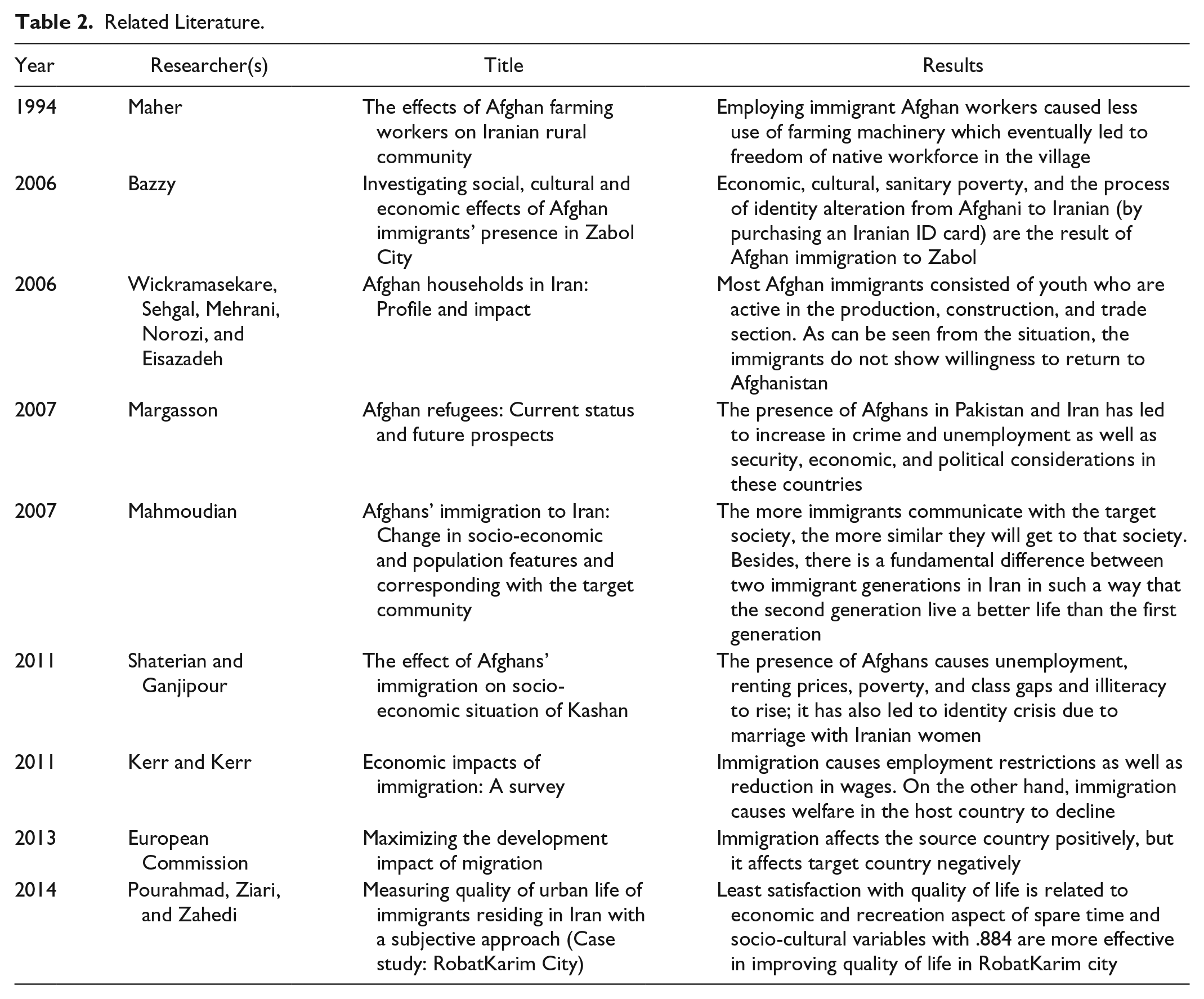
The previous research in this area is presented through a table (Table 2).
Related Literature.
Method
This descriptive-analytical study aims at applied and developmental purposes. To collect the required data, library and field resources were used. Library studies are conducted to gather secondary statistics and documents. Field studies in the form of surveys have been done to observe the status quo, gather data from villages, collect questionnaire survey data, and interview samples of the target population. By collecting authentic, first-hand information about Afghans’ presence in border villages of Sistan, the present research attempted to investigate their effects on the physical development of villages with Afghan’s residing in them in the area under study. Therefore, using research factors obtained from review of the literature and earlier studies as well as random interviews with Afghan and Iranian sampled population in terms of environmental–physical criteria, the questionnaire was designed accordingly, and was based on a Likert scale (ranging from 1 = very little to 5 = too much).
Following objective and place-to-place analyses, as well as consulting local experts and political organization data, it was learnt that Sistan border area contains 31 villages with Afghans residents. Accordingly, to better achieve the expected results, the sample population includes all the 31 villages with Afghans residents which, according to the 2011 census, involved 3,669 households.
The volume of sample households was determined as 347 heads of households using Cochran formula at 95% level. Moreover, to better ensure the results of field studies, 51 copies of the questionnaire more than the required sample was used. To check the reliability of questionnaire data, Cronbach’s alpha was measured and found to be .90 for environmental–physical dimension. It should be noted that the principle of entering input is observed while entering the data from the questionnaires, and data from negative indicators are entered in the positive form into the SPSS datasheet (see Table 3).
Indicators of the Research.
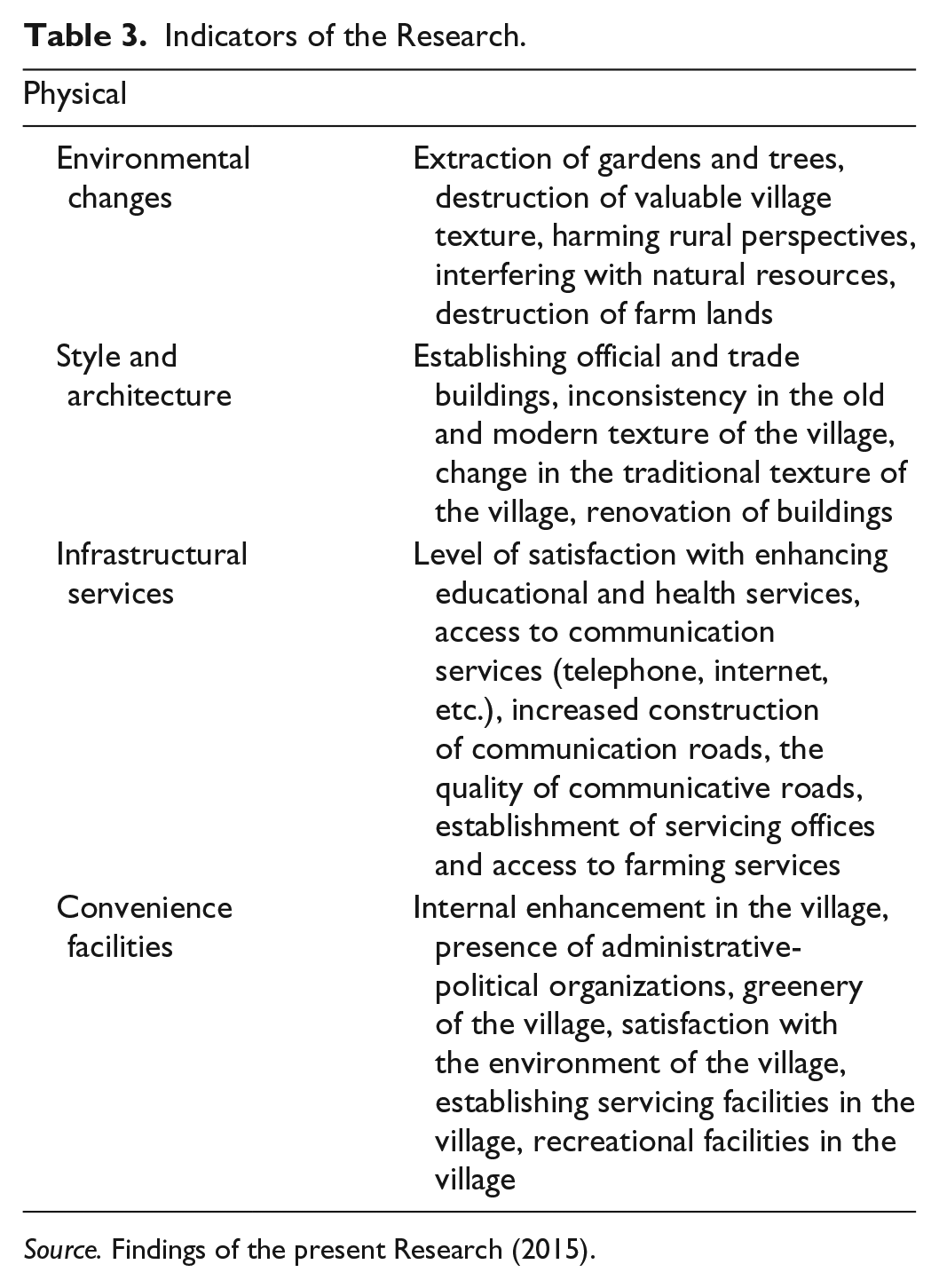
Source. Findings of the present Research (2015).
The Area Under Study
Sistan region with an area of 15,197 square kilometers is located between 30°:5’ N to 31°: 28’ N, and 60°:15’ E to 61°: 50’E in southeast of Iran and the far north of Sistan and Baluchestan Province; it comprises 8.1% of the total area of the province. This region borders Afghanistan from the north and east, and includes the five towns of Zabol, Zahak, Hirmand, Nimruz, and Hamun as can be seen in Figure 1 (Results of Population and Housing Census, 2011).

Introducing the area under study.
The target population in this study consists of all the villages located in Sistan border area (within a radius of 10 km) which includes 170 villages of the whole Sistan region. Following field studies and gathering organizational and local information to select the sample population, it was found that out of the 170 villages, 31 accommodated Afghan settlers. Accordingly, all Afghan-residing villages were selected as the target population.
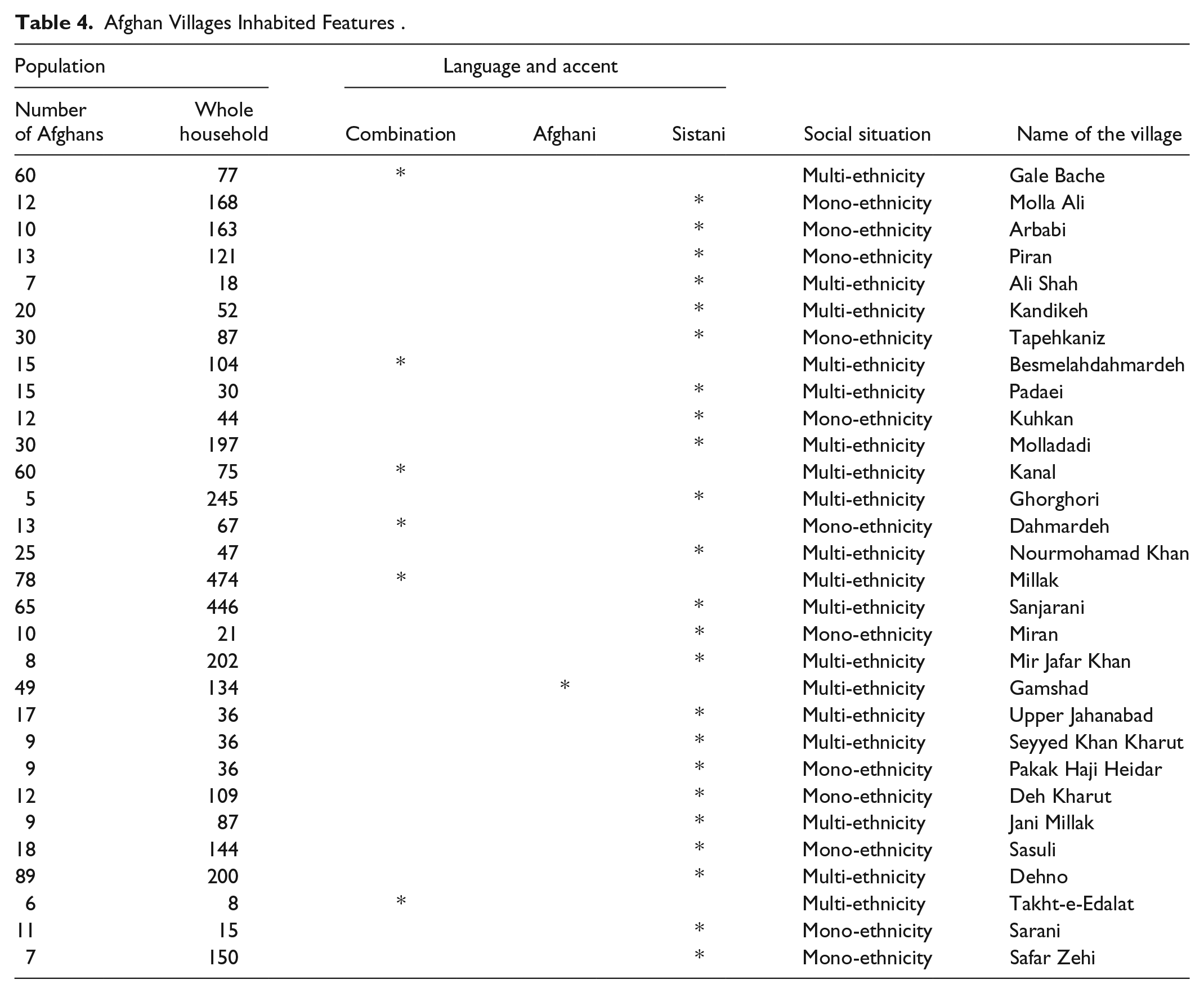
All these villages are located in the northern Sistan border with Afghanistan (Hirmand Town), the reason for which could be Afghans conservatism to hide from Iranian border guards. Table 4 summarizes the characteristics of the villages under study. Multi-ethnicity villages refer to villages with Iranian (Sistani) and Afghan ethnicities who speak different languages (i.e., Persian and Dari languages).
Afghan Villages Inhabited Features .
Findings of the Research
Some Features of the Respondents
Questionnaire data were collected in person. In all, 99% of the respondents were male (n = 394) and 1% were female (n = 4). The average age of the sample (heads of 398 households) was 35.4 years old, ranging from 21 to 63. The mean of family size was 5.21 people. A total of 41.6% of the respondents were illiterate. In all, 53.5% of the respondents were farmers, whereas others were engaged in other activities such as fishing, trade, or state employment. The average income of the respondents was approximately 342 dollars per month (1,200,000 tomans), and the average size of a family was six members. Gender distribution was as follows: 50.12% were male and 49.87% were female.
Investigating the Effects of Afghan’s Residence on Environmental Changes in the Villages Under Study
To measure the extent of the effects of Afghans settlement on environmental changes of the sampled villages, five items were identified and tested based on the priority of the responses. The results indicated that the highest mean was for the dimension “environmental changes” related to destruction of gardens and trees (M = 3.93). The indicators “destruction of valuable village texture” (M = 2.37) and “interfering with natural resources” (M = 2.41) had the lowest mean scores, respectively (see Table 4). The results showed that the settlement has had very little and slightly negative effect on environmental changes (see Table 5). The reason for the small effect on the environmental changes is the recent drought in the eastern part of Iran that reduced the share of human in affecting the environment.
Frequency, Mean, and Standard Deviation of Environmental Change Features.

Investigating the Extent of Effects of Style and Architecture Resulting From Afghans Settlement on the Villages Under Study
Four items were designed and investigated the effects of Afghans’ settlement on the style and architecture of the villages under study. As Table 6 shows, the item, “change in the traditional texture of the village” (M = 3.37) was the most effective, and the item “establishing administrative and trade buildings” (M = 2.27) was the least effective. The overall results revealed that Afghans’ settlement had not had any positive effects on the style and architecture of the villages in the sample (Table 6).
Frequency, Mean, and Standard Deviation Features of Style and Architecture.

Investigating the Extent of Effects of Afghans’ Settlement on Developing Infrastructural Services of the Sample Villages
To investigate the effects of Afghan settlement on developing infrastructural services of the sampled villages, the related seven items were analyzed. Results shown in Table 7 revealed that the item “satisfaction with the quality of communicative roads” (M = 3) had the highest effect, and the item “satisfaction with construction of communicative roads” (M = 2.46) had the lowest effect. The overall results showed that Afghans’ settlement had affected the development of infrastructural services negatively. The reason might be that the government is not willing to invest in areas with Afghan immigrants residing.
Frequency, Mean, and Standard Deviation Features of Infrastructural Services.

Investigating the Extent of Effects of Recreational Facilities Due to Afghans’ Settlement on the Villages Under Study
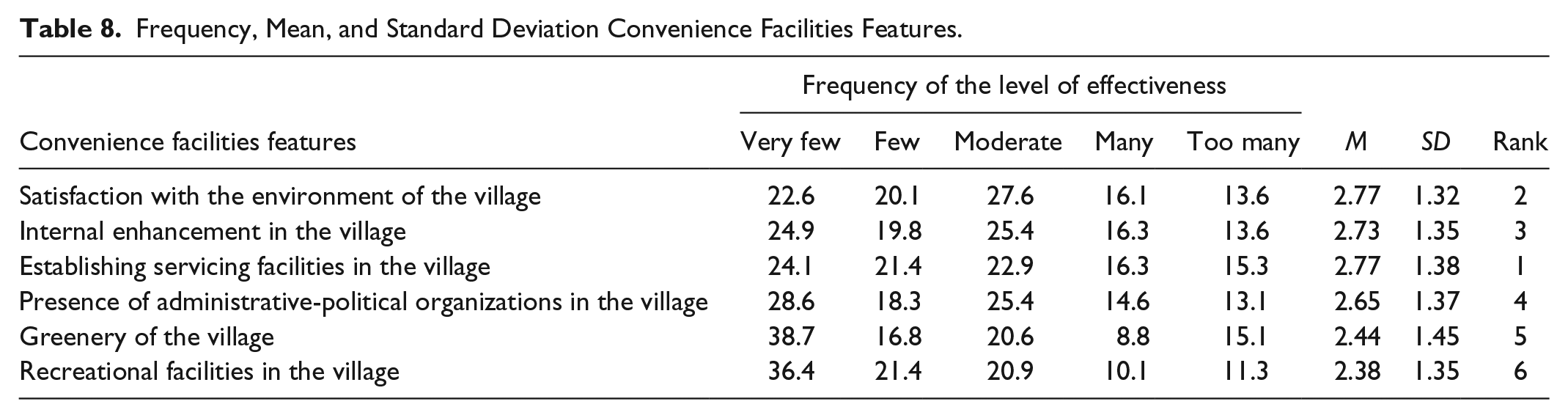
The results in Table 8 indicated that among the items regarding the development of recreational facilities of sampled villages, the item “satisfaction with establishment of servicing facilities in the village” had the highest effect (M = 2.77) and the item “satisfaction with recreational facilities in the village” (M = 2.38) was the least effective. The overall results in Table 8 indicated that Afghans’ settlement had negatively influenced the development of infrastructural services of villages as all items had low mean scores.
Frequency, Mean, and Standard Deviation Convenience Facilities Features.
Results of Classifying Development of the Villages Using Taxonomy Model
In this section, to classify sampled villages, numerical taxonomy, which is more applicable in local classification and is one of the most valid methods of classifying regions in terms of development, was used. The results of the taxonomy ranking can be seen in Table 9.
Taxonomic Rank Results.

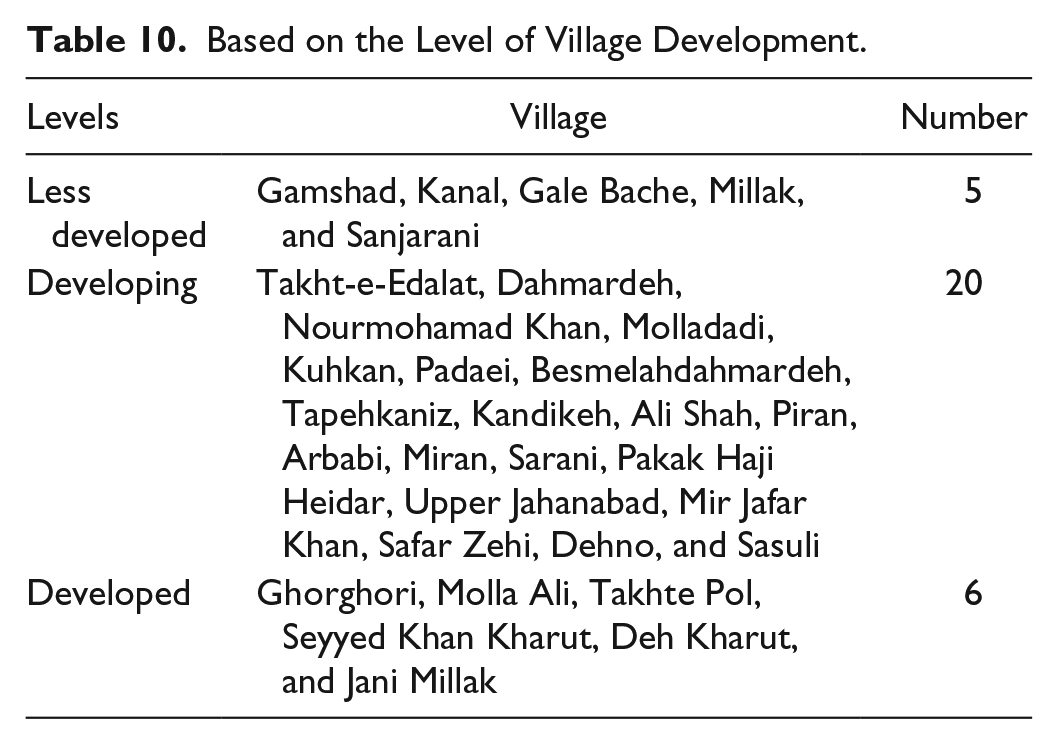
The results of the numerical ranking showed that, out of the 31 villages under study, five villages were in the first group and were less developed, 20 villages were placed in the second group with an average level of development, and only six villages were in the third group and could be considered developed. It can be inferred that these villages were not highly developed (Table 10).
Based on the Level of Village Development.
Determining the Relationship Between the Level of Afghans’ Settlement and Physical Development Level of the Villages
Given the quantitative data, to study the relationship between Afghans’ influence on the level of physical development of the villages under study, Spearman coefficient correlation was used. Based on the statistical analyses, it was found that the correlation between Afghans’ settlement and the level of physical development of the villages was −.845 in such a way that as the number of Afghans would increase in the villages, the level of development would decline and vice versa (see Table 11). As the number of Afghans residing in the villages including Gamshad, Kanal, Gale Bache, Millak, and Sanjarani would increase, the level of spatial development in these villages would decrease. Also, as the number of Afghans increased, the level of spatial development in villages including Ghorghori, Molla Ali, Takhte Pol, Seyyed Khan Kharut, Deh Kharut, Jani Millak increased, too (see Table 9).
Spearman Correlation Test Results.

Conclusion and Suggestions
The physical development of villages is a dynamic and continuous process, and with quick and chaotic measures several problems can occur for the villages in terms of access to various services besides creating an improper composition for rural spaces. Many factors can influence physical-spatial development of villages, some of which are economic and others are social and political. However, the situation in border villages of Sistan and immigrant Afghans’ settlement in Sistan border areas are different from other parts of the country, and they had turned into a big problem for physical development of the villages.
Sistan region has long been a host for Afghan illegal immigrants. These immigrants’ presence has led Sistan border villages to suffer from underdevelopment including political, economic, and social problem for the region. This research is an attempt to analyze the relationship between Afghans’ settlement and physical development of border villages.
To classify the villages under study and to determine their status in terms of development, the numerical taxonomy method was applied. The results of the classification of the villages revealed that out of the 31 villages under study, six villages were developed, 20 villages were developing, and five were underdeveloped. Looking at the situation of villages under study, it can be concluded that border villages of Sistan are not very developed and require state’s serious attention.
The results of the Spearman correlation showed that there was a significant negative relationship between the level of Afghans’ settlement and the level of development of border villages.
Based on the obtained results it can be inferred that the presence of Afghans, besides some spatial imbalances among the central and peripheral regions in the country, had aggregated underdevelopment in villages with Afghans residents. Everyone is entitled to sustainable development of justice and a good quality of life, but the existing physical-spatial structure and underdevelopment is not toward such direction. Therefore, multi-level regional development which includes both top-down and bottom-up processes of development is proposed as the pattern for border area development. Thus, the fundamental solution for raising the level of desired development (regional development) through regionalism and democracy, and increasing the role of local people based on spatial planning should be applied as one of the main purposes of spatial planning is to change the level of management from national to local and regional, the realization of which requires decentralization and increasing the role of local people’s collaboration in regional mechanisms. As a result, the above-mentioned factors could improve social justice in underdeveloped areas of Sistan located in the border regions in which Afghan refugees reside.
Thus, to enhance the physical situation of villages with Afghans residing in them and to improve the quality of life of their residents, the following are suggested:
Providing facilities (educational, medical, recreational, and cultural) to prevent border-settlers from emigration and evacuation of critical villages in the region;
Improving the quality of life in villages and border areas by establishing proper infrastructures such as communication networks, waste water treatment systems, among other;
The best solution for the development of marginal communities is spatial improvement as well as socio-economic and cultural empowerment;
Identifying foreign immigrants and deporting them to their own home country, as their presence in these villages is a key factor in their underdevelopment;
Improving rural health care in Sistan border areas, although providing health care services in a marginal, chaotic, and populated region lacking basic facilities is very difficult;
Developing rural infrastructure and providing economic facilities and amenities in these villages to increase socio-economic dynamism toward the direction of indigenous securitization; and
Regarding rural housing, administering rural guide plans as well as constructing and improving new houses are among measures that can be taken for spatial development of rural areas.
Footnotes
Declaration of Conflicting Interests
The author(s) declared no potential conflicts of interest with respect to the research, authorship, and/or publication of this article.
Funding
The author(s) received no financial support for the research and/or authorship of this article.