




Abstract
School-based physical activity can promote health and improve learning outcomes, but efforts to increase school physical activity have had limited success. This study evaluates the sustainability of a multicomponent school-based physical activity intervention and identifies important factors for implementation and sustainability. Results are based on focus group interviews with 18 teachers at five implementing schools 10 months after the termination of the intervention period. The intervention comprised components related to physical education, recess, and the classroom, and focuses on inclusion for all students. The descriptive analysis of the interviews shows that the intervention is sustained with variation, and activities are adapted differently at the five schools. The deductive content analysis, based on the Framework for Effective Implementation, reveals several important factors for sustainable implementation: School management plays an important role in setting a long-term perspective and giving the intervention priority by securing the necessary organizational infrastructure for implementation and sustainability. The teachers must find the intervention advantageous and to have clear requirements, which entail convincing communication and education by both external and internal intervention advocates. A collective start-up with training and easy-to-use materials should gradually be altered toward individual feedback and development of teachers’ personal curriculum.
Keywords
Introduction
Physically active children and adolescents are more likely to have better physical and mental health and show enhanced cognitive function and academic performance compared with their inactive peers (Bailey et al., 2013; Singh et al., 2019; Strong et al., 2005). Unfortunately, many children and adolescents meet neither national nor global recommendations on physical activity (World Health Organization, 2018) and, therefore, miss out on the potential benefits. This is also the case in Denmark, where just 26% of children between 11 and 15 years comply with the recommendations (National Health Authority, 2019). Public schools have been identified as a key setting for the promotion of physical activity, due to the extended possibilities for reaching almost all children and adolescents for prolonged periods of time and the availability of existing resources (i.e., professional teachers and curriculum for health and physical education; Naylor & McKay, 2009; Webster et al., 2015). Thus, schools are key settings for influencing children and adolescents’ physical activity behavior, as well as increasing their knowledge about and their motivation for being active.
Numerous school-based physical activity interventions have, over the last decades, been conducted with mixed findings (Demetriou & Höner, 2012; Naylor et al., 2015; van Sluijs et al., 2007). Two recent meta-analyses found no overall significant effect of the included interventions on physical activity (Love et al., 2019; Watson et al., 2017). One explanation for the lack of effect could be inadequate implementation of the interventions in the school setting, which most times are complex and long-term processes (Naylor et al., 2015). Processes which include the early steps of communicating and planning the interventions’ content with a given target group (pre-implementation), the training and support of the teachers and their decision to adopt the intervention and their execution (implementation), as well as sustained intervention over time, when external support has been removed (sustainability) (Durlak & DuPre, 2008; Han & Weiss, 2005). Even though the interest in how interventions are delivered in real-world settings has increased, there is still a need for further insight into, not least, how implemented changes are sustained over time (Friend et al., 2014; Han & Weiss, 2005; Schaap et al., 2018).
Several models exist for conceptualizing important factors for implementation in different settings (Nilsen, 2015). They typically include the where, what, how, and who of the implementation (Durlak & DuPre, 2008; Greenhalgh et al., 2004; Han & Weiss, 2005; Koorts et al., 2018). In their extensive review, Durlak and DuPre (2008) grouped factors influencing implementation of prevention and health promotion into five different categories in the Framework for Effective Implementation. These categories are, in this study, applied in relation to the school context—with a specific focus on teacher-delivered interventions: The first category is the design and adaptability of the intervention itself (innovation characteristics) and how it aligns with school needs and priorities. The second category is the support system, which involves training and instruction of the teachers who deliver the intervention to the students. Characteristics of the teachers, for example, competencies and attitudes, constitute the third category (provider characteristics). The teachers must recognize the need to change existing routines, be able to see the advantage of the intervention, and trust their abilities to contribute to the adaptations of current practices. The school context is the fourth category and comprises the organizational capacity in relation to the intervention. Leaders and champions in the organization must advocate and visibly promote the intervention and invest time and energy in propelling the intervention forward. The fifth and last category is factors related to wider contextual conditions (community-level factors). Local and national regulations and the cultural and professional norms regarding physical education (PE) and physical activity in schools can support or prevent the implementation of the intervention (Durlak & DuPre, 2008; Naylor et al., 2015).
It is imperative that the content delivered by the teachers honor the intended design with regard to both quantity and quality (Borrelli, 2011). This remark touches on the relationship between intervention fidelity (i.e., delivering the intervention as intended) and adaptations (i.e., changing the intervention to the local setting and population), which is an ongoing discussion within implementation science (Blakely et al., 1987; Bopp et al., 2013; Schaap et al., 2018). On one hand, adaptations are undesirable, as they reduce intervention fidelity and can thereby cause a reduced effect or lead to false conclusions about the effectiveness of a described intervention (Borrelli, 2011). On the other hand, adaptations have been shown to induce a higher degree of implementation and sustainability. Durlak and DuPre (2008) stress the need to find the right mix between fidelity and adaptations and point out that they are not mutually exclusive—as long as the intervention’s fundamental principles are sustained. Recently, Schaap et al. (2018) reviewed measurement for fidelity in school obesity prevention interventions and found substantial variability in the approaches. Furthermore, most of the fidelity components measured were found to be of low quality, and the researchers called for more research about implementation, adaptation, and sustainability in real-world settings (Schaap et al., 2018). This highlights the need for further studies of intervention implementation and clarification of which factors are important for sustainability, including the role of adaptations. The aim of this study is to evaluate the adaptation and sustainability of a multicomponent school-based physical activity intervention and identify important factors for implementation and sustainability from the perspective of teachers.
Materials and Methods
Study Design and Participants
This study is multiple case study qualitatively exploring current implementation status at selected schools 10 months after the intervention, and retrospectively identifying important factors for implementation and sustainability. For this purpose, focus group interviews were conducted with teachers at the selected intervention schools. Building on data from the quantitative process evaluation (Smedegaard et al., 2017) and class-based interviews at all schools (not published), six schools, with the best indication of implementation, were identified and invited to participate. Specifically, results from the teacher surveys were compared with results from the student interviews and an overall ranking of the schools from high to low implementers was produced. This information-oriented selection of schools for the case study was chosen to ensure that the participating units (i.e., schools) had a sufficient amount of experience with and practical insight into implementation, adaptation, and sustainability of a complex intervention (Flyvbjerg, 2006). Of the six invited schools, five chose to participate in the study. The schools differed in size ranging from 17 students to 70 students per grade level with an average of 40 students. Furthermore, the schools could be described as average Danish schools, without major socioeconomic challenges. They all had access to green areas, playground facilities, and indoor gym.
The Intervention
The Move for Well-being in School (MWS) intervention targeted students in Grades 4 to 6 (11–13 years) and comprised components for PE, in-class activities, and recess (Figure 1). It was grounded in the Self-Determination Theory (SDT) and designed to target the three innate psychological needs: competence, autonomy, and relatedness to improve intrinsic motivation for physical activity for all students (Deci & Ryan, 1985). The three psychological needs were operationalized into three fundamental principles, by which the intervention was developed. As an example, fostering a mastery climate instead of a performance climate should promote the perception of competence for more students during PE and recess; an increased focus on an inclusive social environment should promote the feeling of relatedness (Holt et al., 2019). MWS did not increase time for physical activity during recess or PE. The aim was to include all children in activities through motivational strategies and practices. By legislation, all Danish students are, on average, to be physically active 45 min per day. Some schools occasionally use in-class activities to meet this requirement, but it is not a common practice in Grades 4 to 6.

The intervention components in Move for Well-being in School.
To promote implementation, teachers took part in a competence development program supported by educational materials, planning guides, and PE lesson plans. The program consisted of four full-day workshops (three in the beginning and one halfway through the intervention) focusing on the underlying theoretical approach (SDT) and opportunities to test core activities in practice. At each school, an internal coordination group was established to guide and motivate the teachers’ delivery of the intervention. The group consisted of a teacher from each grade level and a school management representative. The group received support from the research group via biweekly information emails and two supervision visits during the intervention period. Furthermore, the implementation was reinforced by three school theme days focusing on inclusive physical activity. These days were conducted by the teachers, supported by guides and materials developed by the research team. After the 9-month intervention, schools were offered continued support from the research staff with less frequent email prompts, two supervision visits, and two workshops. The intervention and continued support was free of charge.
The intervention has been evaluated in a randomized controlled design, including 12 intervention schools and 12 comparison schools (Smedegaard et al., 2016). A thorough quantitative effect and process evaluation has been conducted and reported elsewhere (Christiansen et al., 2018; Smedegaard et al., 2017). In addition, students’ perceptions of the intervention were scrutinized via an in-depth interview study (Holt et al., 2019).
Teacher Focus Group Interviews
For this study, the management at each of the schools was asked to assign four to six teachers to participate in focus group interviews. Selection criteria were variability in terms of gender, years of professional experience, and attitude toward school-based physical activity in general and MWS in particular. The aim was to capture a broad selection of teachers’ opinions.
A total of 18 teachers participated in groups of three to four per interview at the five schools (April–May 2017). Six were males, 11 taught mathematics, 10 taught Danish, 10 were PE teachers, and six were part of the MWS internal coordination group. Both senior teachers and relatively newly educated teachers were represented in the sample. The focus group interviews had a duration of approximately 60 min.
The focus group interviews were performed using an interview guide informed by published implementation frameworks and models (Durlak & DuPre, 2008; Glasgow et al., 1999; Greenhalgh et al., 2004; Naylor et al., 2015). The guide included the core intervention components in MWS and consisted of three main parts. The first part concerned the teachers’ basic understanding of the intervention and which components were implemented, adapted, and sustained. The second part centered on the respondent’s perception of important factors for sustainable implementation, and the last part consisted of formative evaluation to collect the teachers’ advice on how to improve implementation of MWS (Supplementary file). All interviews were conducted and transcribed by K.C., who was not involved in the implementation of MWS.
Ethical Considerations
Prior to the focus group interviews, all teachers gave written consent to video and sound recording of the interviews, and they were guaranteed anonymity in the presentation of results. There was a high priority on creating a confident and comfortable interview setting, encouraging open dialogue stressing that all opinions were equally important and valued. The study has been approved and registered by the Danish Data Protection Agency (2014-54-0693) and reported to the Danish Health Research Ethics Committee, where no formal approval was found to be required, and registered at the ISRCTN registry (DOI 0.1186/ISRCTN12496336).
Analyses
The analyses were carried out in two steps. Step 1 consisted of a descriptive analysis of how intervention components had been sustained and possibly further adapted at the school level. To provide an overview and comparison between schools and components, an overall rating was summarized with a “star-based” system. One star was given for a minimum sustained component and three stars were given for an optimal sustained component. The subjective rating was based on comparison with the original intervention description and focused especially on alignment with the fundamental principles of the intervention (i.e., promoting a mastery climate, engaging and empowering students, and creating an inclusive environment).
The second step was a systematic data analysis based on the principles of deductive content analysis and with the aim of establishing factors important for sustainable implementation (Elo & Kyngäs, 2008). After transcription and thorough reading of the interviews, a categorization matrix was developed based on the five categories previously presented (innovation characteristics, provider characteristics, support system, organizational capacity, and community-level factors). Data were grouped and analyzed within these five categories using an inductive approach described as an unconstrained matrix (Elo & Kyngäs, 2008). The analysis is presented using the five categories and associated subcategories. Data were coded in NVivo in relation to the categories and linked across the five schools. Schools were given letters A, B, C, D, and E, and teachers were given a number following the school letter. Initial coding and categorization were conducted independently by K.C. To ensure coding reliability and accuracy, L.B.C. read the transcribed interviews and discussed and revised the analyses with K.C. (Barbour, 2001).
Results
Sustained and Adapted Intervention Components
Despite being the schools rated with the best overall implementation during the initial intervention period, the focus group interviews revealed substantial variation between the five schools and between teachers working at the same school. Table 1 presents an overview illustrating to what degree the five schools kept working with the core components of MWS. To some degree, all schools sustained the three core components. Concerning in-class activities, teachers at Schools B and D reported sustaining daily activities to a higher extent compared with the other schools. At Schools A, C, and E, less than half of the teachers performed this type of activity daily (Table 1). As for recess, most schools kept a focus on increased variation in activities, for example, providing equipment and opening indoor facilities, but few schools maintained active teacher involvement. Prior to the intervention, some schools already had a focus on active and social inclusive recess (Schools B and C). School D was not satisfied with their own level of implementation during the intervention period and applied extra focus the following year (Table 1). Concerning PE, all schools—except School C—continued with parts of the MWS approach and used the specially designed lesson plans (Table 1).
Descriptive Analysis of Sustained Components of MWS at the Five Participating Schools (A–E).
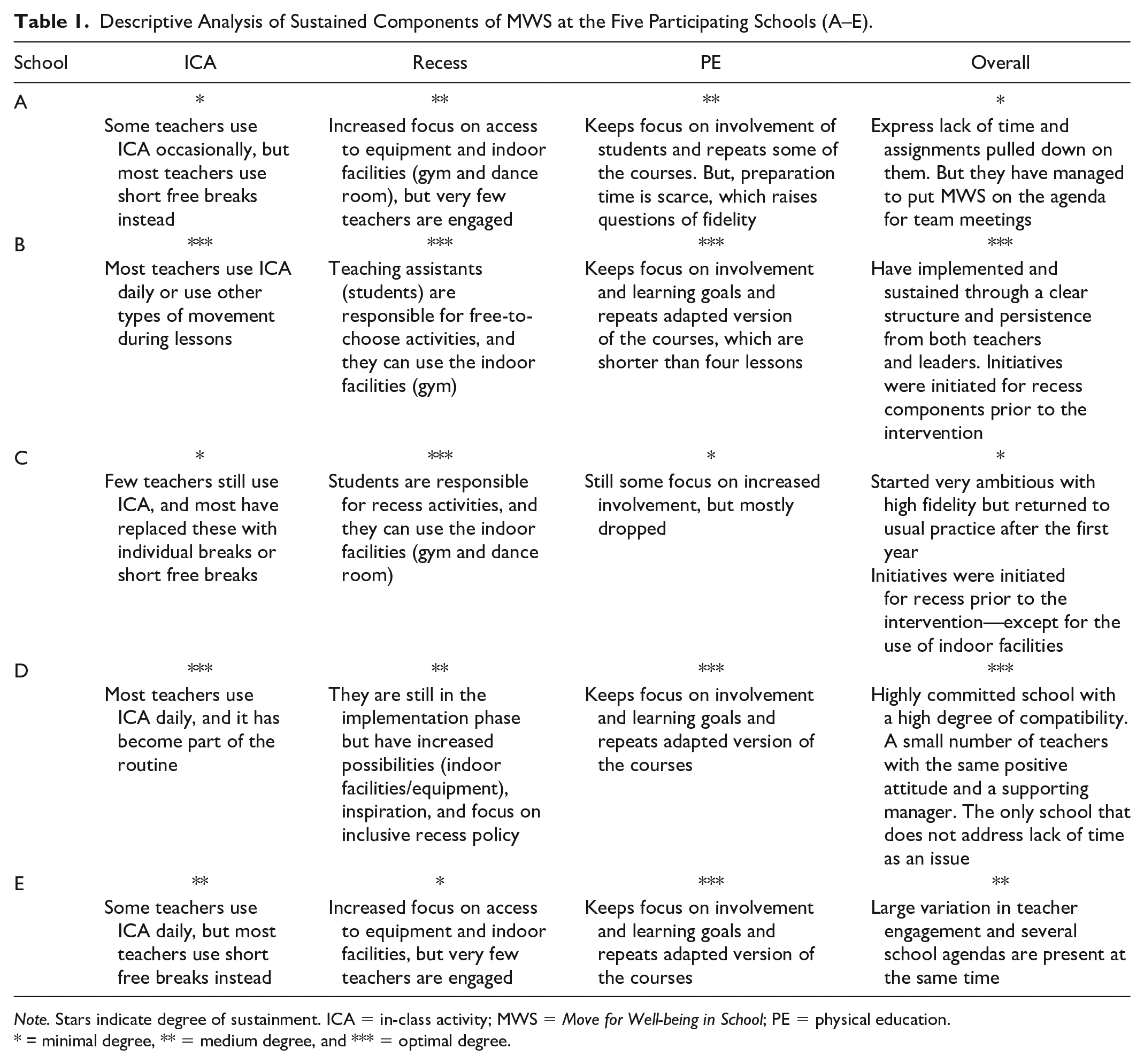
Note. Stars indicate degree of sustainment. ICA = in-class activity; MWS = Move for Well-being in School; PE = physical education.
= minimal degree, ** = medium degree, and *** = optimal degree.
General Approach to Intervention Implementation
Schools B and D seemed most engaged in all intervention components and had the highest degree of sustainability. These two schools had a similar approach to intervention implementation and adaptations. As a common trait, the teachers expressed a more involved and systematic process in the pre-implementation phase with a stronger focus on securing alignment between the intervention and their own school context, values, and structure. The teachers were generally positive toward the intervention and its main components. Teachers from School D described how they support and push each other to achieve the best possible results. Both schools are relatively small (<7 teachers involved in the implementation) and they expressed having a close relationship with school management and felt included in decisions regarding the intervention. At School B, teachers also expressed having a development-oriented approach in general, in which they are committed to implement necessary changes to everyday practice. Finally, the teachers at the two schools reported clear active support from the school management to implement and sustain the intervention. In other words, these two schools showed a higher level of readiness and deeper understanding of the intervention, which are indicators of an integrated school development approach grounded in the pre-implementation phase (Han & Weiss, 2005).
The teachers at Schools A, C, and E had a more instrumental approach to the intervention and did not associate MWS with long-term school development. Implementation of all three components was high from the beginning (Smedegaard et al., 2017). However, the interviews identified high internal variation in teacher engagement and insufficient sustainment of components at these somewhat larger schools. At Schools A and E, the teachers pointed to lack of time and several parallel school agendas as being detrimental to the implementation process and their personal commitment. The focus of the internal coordinators during the intervention period was primarily on ensuring high levels of fidelity without taking specific school context into account: The first year we were very “let’s do it how it is described,” but later it has become more optional. At least that’s how I see it as a coordinator—it has been easier to work with it this way. We’ve selected what we can use and have been able to fit in. (A4)
In the focus group interviews, the teachers at the three schools (A, C, and E) focused mostly on barriers and lack of time instead of opportunities and potential effects. School C demonstrated the lowest degree of sustainability and is also the only school who declined continued support from the research team after the intervention period.
Factors Influencing Implementation and Sustainability
Several factors were found to impact the implementation and sustainability of the intervention. An overview of the most consistent factors is presented in Table 2 and further described below applying categories of the Framework for Effective Implementation (Durlak & DuPre, 2008). The factors are often interdependent and some factors could fit into several categories. The interviews only briefly address the fifth category concerning the community-level and external factors. This aspect is not outlined further.
Overview of Most Consistent Factors Found Important for Implementation and Sustainability From a Teacher Perspective in Categories of the Framework for Effective Implementation (Durlak & DuPre, 2008).
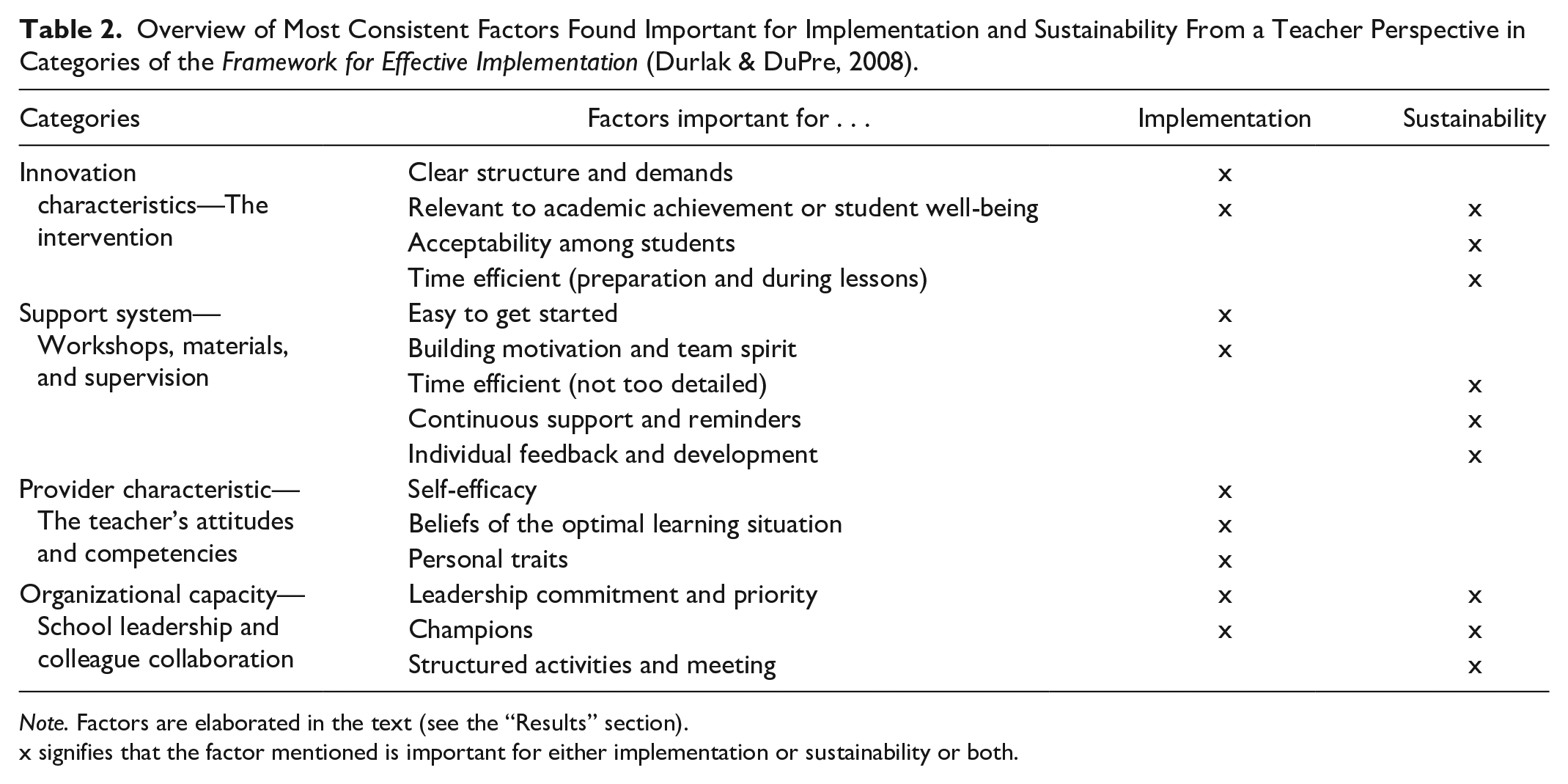
Note. Factors are elaborated in the text (see the “Results” section).
x signifies that the factor mentioned is important for either implementation or sustainability or both.
Innovation characteristics—The intervention
In-class activities constitute the most fundamental change. Very few teachers had, on a regular basis, conducted these before MWS. The activities in this study can be described as active breaks without curricular focus (Watson et al., 2017). Several teachers requested more curricular-oriented breaks, which complement the content of the lesson instead of “taking” time away from academic work. Thus, one common adaptation in the schools has been to include more activities with curricular focus. Other teachers were predominantly positive toward the active breaks and used them to adjust students’ energy levels. They found it important that the activities remained non-curricular to constitute a break where students got an actual time-out from the ongoing learning activities. Some teachers replaced the active break with a free break (a short recess), which for some students (but not all) included physical activity and social interaction. The in-class activities were easier to implement in 60- or 90-min modules than in modules of 45 min. Furthermore, many teachers found it advantageous to schedule and plan the active breaks in advance instead of trying to come up with an activity if students became unfocused. The scheduling of active breaks was a clear implementation strategy even though some teachers found it frustrating in the beginning: In some way, you had to adapt your lessons to the active breaks instead of just taking a break when the moment was there. But of course, when you need to adopt something and learn to use active breaks, it makes sense to require us to do it. But in the beginning, it was frustrating. (C1)
Regarding PE, several teachers expressed time constraints as a barrier to implementing the new PE courses. As one teacher expressed it: . . . why did we return to the old routines so quickly? Well, I guess it also has something to do with the fact that the preparation time required for those lessons was much higher, and time is something we are all short on. Therefore, it is sometimes easier to go back to doing things the old way. (C2)
Some teachers also experienced resistance from students who liked their old PE better. Mostly, the resistance was ascribed to lower activity levels due to groupwork and reflection assignments, and discontent with activity types such as dance and gymnastics in favor of ball games. Interestingly, several PE teachers sustained the core principles of MWS and transferred them to other activity types, for example, learning teams, co-creation, and focus on feedback and individual skill development.
When it comes to recess, most schools sustained the improved access to equipment and some kept providing access to indoor activity spaces. Few succeeded in promoting increased teacher involvement during recess periods. In Denmark, recess is considered a break for the teachers as well as time for coordination and preparation of teaching. Schools are obliged to have supervision of students during recess to prevent accidents, injuries, and conflicts. Furthermore, some teachers find it important for recess to be unrestricted time for the students without teacher-led activities. Conditions and viewpoints such as these may explain the relatively limited implementation of the teacher component during recess.
In summary, the intervention was, on the whole, implemented if teachers found the purpose clear and relevant with regard to either academic achievement or student well-being. It was also found advantageous—though annoying—that clear formulation of implementation demands was stated. The teacher’s experience of success with the new practice is crucial for their sustained engagement—as described in the process model by Han and Weiss (2005). Such positive experiences are dependent on student visible acceptance and forthcoming behavior. Finally, time efficiency in both preparation and execution during lessons is very important for sustaining intervention components (Table 2).
The support system—Materials, workshops, and supervision
The support system in MWS aims to explicate how teachers are to implement the intervention components in their daily routines through lesson plans, guides, and manuals. The teachers emphasized these materials as important for implementation and found it easy to start up the described activities. However, some teachers found the course descriptions for PE to be too time-consuming and expressed lower fidelity to the detailed lesson plans.
Materials and approaches were introduced in the first workshops and the teachers’ attitudes toward the workshops were predominantly positive. Several teachers expressed high motivation for implementation of the intervention components—especially after the first workshop. The teachers stressed the importance of participation by as many teachers at the schools as possible. This supported a shared commitment to the intervention. They had a common understanding, shared vision and goals, and were able to support and help each other through the new challenges. Some teachers expressed that subsequent workshops did not yield the same kind of strong outcomes. They, for instance, would have wished for more locally targeted courses and individual feedback.
Twice during the intervention period, the research team observed examples of the new practice at the schools and met with the internal coordination groups. These visits informed the research team of current progress and implementation challenges and they gave advice to the schools’ coordination groups on how to continue the process. Together with the biweekly email prompts, the research team visits were found to be important by the teachers (especially the coordinators), which highlights the importance of continuous support and follow-ups from an external stakeholder.
In summary, teachers found the easy start-up with detailed information and manual of activities important for implementation. However, too much detail in the manuals decried time efficiency and might lead to a decrease in sustainability. Furthermore, the start-up workshops led to a high initial motivation for implementation. The ongoing support by the research team and midterm workshop was found to be important for continued implementation, but some teachers requested more individual feedback and tailored personal development (Table 2).
Provider characteristics—The teacher’s attitudes and competencies
Teachers’ belief in their own physical activity–related competencies (self-efficacy) was found to be important for implementation—especially for the in-class activities. The teachers expressed that PE teachers or “sporty teachers” had an advantage, in that they could transfer methods and approaches from PE lessons and/or personal practice to in-class activities. Most of the “sporty teachers” expressed a positive attitude toward the intervention, for example: “. . . yes, I just think it fits really well with us. The fundamental principle in MWS. So, I think that is really what motivates us” (D3).
Some of the “non-sporty teachers” also had a positive attitude toward the intervention, for example, the focus on inclusive activities. Others were more skeptical—especially concerning in-class activities: For me, they are bloody annoying. I don’t use them much, because I simply think that students are so hard to calm down afterwards. Often it becomes a tremendous waste of time, and it ends up being “now we just do whatever” because we have to do something. What makes sense to me is when you have prepared something that can be used in the context of the lesson. (B3)
Other relevant provider characteristics for implementation of in-class activities were the teachers’ personal preferences and beliefs regarding optimal learning situations. Some teachers described themselves as energetic, restless, and finding sedentary time challenging, which increases the likelihood of integrating physical activities into the classroom. Other teachers preferred calm, uninterrupted learning situations and felt disturbed by breaks. Another personal preference connects to the degree of readiness for innovation. Some teachers were more prone to choose easy solutions (do as we always do), while others were more motivated toward professional development and trying new approaches.
In summary, the teachers expressed self-efficacy and being a sporty type as important factors for implementation. It is also evident that personal preferences and beliefs about the optimal learning situation have an impact on implementation (Table 2).
Organizational capacity—School leadership and colleague collaboration
Some teachers in the interviews expressed a high degree of ownership and commitment, which can be related to the approach by school management: We’re so lucky here to have the whole school engaged. School management is as eager to get this to work as the rest of us. So, there is a kind of push from all directions. Meaning that you push each other, so to speak, because you think it’s good. And believe in it! (D2)
The teachers in the local coordination groups acted as champions of the intervention and were a source of motivation for others. In the interview, one teacher expressed the influence of the local champion’s high enthusiasm: “And she is so good at selling it . . . you can almost get as enthusiastic as she is just listening to her talk about it” (E2).
Apart from personal enthusiasm and engagement, the management can promote implementation through organization and planning. Many teachers stressed the importance of regularly discussing the intervention in joint meetings to keep shared goals and collaboration in focus. “It is something that we discuss on regular basis. And therefore, it is not forgotten. And I think that is necessary” (D3).
Several teachers proposed organizing supplementing initiatives for knowledge sharing at school level. This way teachers could distribute activities, ideas, and give feedback on implementation and adaptation. Emphasis was put on the crucial role of school management in clearly prioritizing the intervention and supporting teachers in implementing and sustaining the changes by dedicating time for planning and meetings. Only teachers at School D expressed having had the time they needed for the intervention: But that is also one of the things we need to address if it has to . . . work at other schools. You need to be aware that you need to dedicate some time to it. You need that time, otherwise, you won’t succeed. (D1)
Time is important in the implementation phase, but many teachers found the new practice less time-consuming after the first year due to development of routines and structures. Still, it was, more than once, stressed that the time it takes to implement new practice should not be underestimated: I don’t think you can succeed in something like this within a year or two. If you really want to implement it, I think it takes time—and more time than you think. Also, because public schools are continuously exposed to new changes. (A1)
In summary, the organizational capacity, primarily consisting of school management and champions, appeared to be important for both implementation and sustainability. Together with engagement of school champions, the initial commitment and clear prioritization of the intervention by school management formed a crucial basis for long-term development. After the external resources had been removed, the role of the local management and champions was critical for sustainability. Continued prioritization and support consists, among other things, of reserving time for joint meetings, supporting the champion, and visibly highlighting achievements related to the new practice (Table 2).
Discussion
The aim of this study was to evaluate the sustainability of a multicomponent school-based physical activity intervention and identify important factors for implementation and sustainability from the perspective of the teachers. Nine months after the intervention, all schools sustained one or more of the key components (PE, recess, and classroom activities). As described, there are differences between schools and between teachers. Based on this study, several essential factors for sustainable implementation can be highlighted in relation to the pre-implementation, implementation, and sustaining phase of interventions. An overview is presented in Table 3 and further discussed below.
Overview of Nine Essential and Practically Relevant Factors for Sustainable Implementation in Relation to the Pre-Implementation, Implementation, and Sustaining Phase of Interventions.

Note. Factors are discussed in the text (see “Discussion” section).
Pre-Implementation Is Important for Sustainability
Ideally, an intervention is compatible with the school, teachers, and students, but fundamentally, an intervention has to inflict change and challenge a given practice. In school contexts, such changes may not be desired by neither the teachers nor the students in the first place. Thus, interventions in real-world contexts like schools should include plans on preparing, educating, convincing, supporting, and incentivizing the people involved (Bauman et al., 1991; Schaap et al., 2018). This process already begins in the pre-implementation phase, where it should be assessed how the new pieces fit into the puzzle and how existing pieces must be rearranged (Han & Weiss, 2005). It is not the piece itself which makes a sustainable difference—but the well-fitting piece. A systematic approach to this initial process has recently been described in the PRACTIS guidelines, where one important focus is to find out how the new intervention best aligns with the context and make decisions on how to implement prescribed changes (Koorts et al., 2018). It is an important management task to analyze, formulate, and visualize the intervention as a piece in the puzzle—its contribution—and long-term sustainability. This process also includes user involvement, securing knowledge transfer, and shared meanings and support (Greenhalgh et al., 2004; Han & Weiss, 2005; Koorts et al., 2018).
The interviews, included in this study, revealed that teachers from Schools B and D expressed more clearly how the intervention was compatible with their school setting and how the intervention was considered to fit into their contextual puzzle. They had an integrated focus on how the intervention contributed to or supported their existing goals, profile, and values—and that they felt involved in the adoption of the intervention. From a sustainability perspective, this approach appeared to be the most successful, as both Schools B and D reported a high degree of intervention implementation and expressed a positive experience with the implementation process. The other three schools had a more instrumental approach to the intervention. They were more focused on delivering the activities as described without much consideration of their own starting point. Their perspective was characterized by less autonomy and a feeling of forced adoption. They focused on the extra work caused by participating in MWS, and lack of enough time for both preparation and implementation.
Teacher Motivation
Teacher acceptance and motivation for interventions depends on both the amount of time required and the perceived relevance and effectiveness of the activities to solve a given challenge (Dyrstad et al., 2018; Naylor et al., 2015). Dinkel et al. (2017) emphasized the importance of teachers being able to see the relevance and purpose of implementing physical activity in the classroom and its relation to academic learning. A similar point of view was evident among some of the interviewed teachers. Even though the relationship between improved mental health and academic performance was outlined (Bailey et al., 2013; Singh et al., 2019; Strong et al., 2005), they requested clearer academic content in the physical activities as they still perceived the non-academic active breaks to taking time away from more important learning activities. Teachers’ attitudes can either be reinforced or challenged during the implementation. Han and Weiss (2005) emphasized the importance of positive reinforcement of implementation when teachers experience success with the new practice and improvements in learning or well-being. In MWS, this feedback loop was experienced differently among the teachers. Some of the teachers experienced positive feedback from, for example, students, while others experienced resistance or decreased concentration in connection with especially in-class activities. Increased support or feedback for the teachers experiencing resistance might have increased teacher motivation and thus intervention sustainability.
Desirable and Undesirable Adaptations
Adaptations of the intervention to local contexts are both expected and desired in MWS, where there exists a hard core and soft periphery (Greenhalgh et al., 2004). The hard core consists of the fundamental principles and a set of minimum acceptable activities, while the soft periphery is made up of the freedom to structure and adapt the activities locally. The crucial element of adaptations is to ensure that both the quality and quantity of an intervention’s causal mechanisms are sustained (Durlak & DuPre, 2008). In MWS, many of the adaptations incorporated by the teachers were performed in accordance with the interventions’ fundamental principles, for instance, ensuring feedback and fostering a mastery climate in PE. These adaptations have likely increased the likelihood of sustaining the intervention without compromising fidelity. On the other hand, there are also examples of adaptations which were visibly not in line with the intervention principles, resulting in decreased fidelity. These included competitive soccer tournaments during recess or decreased duration of in-class activity to 30-s individual breaks. These examples were not in line with the fundamental principles or the minimum acceptable activities of the intervention, decreasing the fidelity and compromising the possibility of drawing valid conclusions based on the intervention. Accepting the premise that interventions must be flexible and adaptable to the context (Schaap et al., 2018), future studies should prioritize the description, promotion, and evaluation of quality and adaptations in intervention and implementation research. To do this, they should also take into account the crucial role of feedback for teachers’ motivation and individually tailored competence development (Han & Weiss, 2005).
Strengths and Limitations
The current study evaluates the implementation and sustainability of a school-based physical activity intervention. This, in itself, is a unique feature (Schaap et al., 2018). The evaluation is based on the theoretical framework, Framework for Effective Implementation, developed by Durlak and DuPre (2008), which previously has been applied to the school setting by Naylor et al. (2015). The study design and findings are closely related to practice, which also entails recommendations on pre-implementation, implementation, and sustainability.
Focusing on sustainability issues, we chose to interview the schools rated to have, most fully, implemented MWS. This was to ensure sufficient information and experience with instituting core intervention components. Interviews with the other schools would have entailed other perspectives and insights and might have pointed to important barriers for implementation. This perspective in MWS is partly covered in another publication (Smedegaard et al., 2017). Furthermore, the interviews did not focus on community and external factors—the fifth element in the Framework for Effective Implementation. Such a focus could have enriched this study further.
The 18 participating teachers varied in terms of gender, age, seniority in teaching, subjects of teaching, and attitudes, but it could be questioned whether they could be considered a representative group of all teachers at the five schools. The teachers were assigned to the interview by the school management, and even though they were asked to select a representative sample of teachers, it could still pose a selection bias. The interviewer was not part of the research group during implementation, and it was emphasized that all opinions were equally important and anonymous. However, it is still likely that the 18 teachers predominantly represent teachers with a positive attitude to MWS and that they, to some degree, refrained from overly critical comments.
Conclusion
This study shows that MWS is sustained at the five best implementing schools 10 months after the intervention period. The two smaller schools had a more development-oriented approach and reported sustaining the intervention to a higher degree than the other three schools. Adaptations of original intervention components were evident at all schools and found to be crucial to intervention sustainability by the teachers. However, it remains unclear to what degree the adaptations compromised the fidelity and potential effect on the primary student-level outcome measure related to psychosocial well-being.
Several factors were important for sustainable implementation—including all phases from pre-implementation to sustainability. School management plays an important role in setting a long-term perspective and securing the necessary resources for implementation and sustainability. Teachers must find the intervention advantageous and to have clear requirements, which entail convincing communication and education. A collective start-up with training and easy-to-use materials is important but should gradually be altered toward individual feedback and development of teachers’ personal curriculum.
Supplemental Material
sj-pdf-1-sgo-10.1177_21582440211000053 – Supplemental material for A Qualitative Exploration of Implementation, Adaptation, and Sustainability of a School-Based Physical Activity Intervention: Move for Well-Being in School
Supplemental material, sj-pdf-1-sgo-10.1177_21582440211000053 for A Qualitative Exploration of Implementation, Adaptation, and Sustainability of a School-Based Physical Activity Intervention: Move for Well-Being in School by Lars B. Christiansen, Kristine Clausen, Søren Smedegaard and Thomas Skovgaard in SAGE Open
Footnotes
Acknowledgements
The authors sincerely appreciate the participation, effort, and support from all schools, teachers, and children involved in Move for Well-being in School. A special thanks to the interviewed teachers for their time and valuable insights, and The Danish foundation TrygFonden for financial support.
Declaration of Conflicting Interests
The author(s) declared no potential conflicts of interest with respect to the research, authorship, and/or publication of this article.
Funding
The author(s) disclosed receipt of the following financial support for the research, authorship, and/or publication of this article: This work was supported by The Danish foundation TrygFonden (Grant Number 2013—pulje no 24).

Supplemental Material
Supplemental material for this article is available online.
References
Supplementary Material
Please find the following supplemental material available below.
For Open Access articles published under a Creative Commons License, all supplemental material carries the same license as the article it is associated with.
For non-Open Access articles published, all supplemental material carries a non-exclusive license, and permission requests for re-use of supplemental material or any part of supplemental material shall be sent directly to the copyright owner as specified in the copyright notice associated with the article.
