




Abstract
Privately provided accommodation is a growing service in Uganda’s higher education sector due to education liberalization and demand for education. This research took a case study of Nsamizi Training Institute of Social Development (NTISD) to determine the relationship between privately provided accommodation service quality and customer satisfaction. Specifically, the objectives of the study were (a) to find out the relationship between security and NTISD students’ satisfaction with privately provided accommodation, and (b) to find out the hierarchical level of importance of NTISD student satisfaction of the three service quality dimensions (reliability, security, and tangibles) with privately provided accommodation. Using quantitative and qualitative modes of data analysis and a sample of 300 students from 20 private hostels, this study established a strong positive significant relationship between security and satisfaction regarding privately provided accommodation. This implies that accommodation service providers should increase the quality of security so as to increase the satisfaction of students regarding privately provided accommodation. The study established the hierarchical order of importance from the most important service quality dimension, respectively, as follows: reliability, security, and tangibles. Therefore, private accommodation service managers should pay extra attention to the dimensions in the same order.
Introduction
Uganda’s political instability and unstable governments before 1986 reduced expenditures on education; and emphasis was put on war financing. Provision of accommodation facilities in education institutions was not a priority (Musisi, 2003). The National Resistance Movement Government reforms since 1986 in the education sector include liberalization, outsourcing, and private–public partnership (Tinderwesire, 2006). Education liberalization increased the demand for Uganda’s education in the Great Lakes region and necessitated not only the privatization of education provision (teaching) but also the privatization of accommodation services to match the demand that the public sector could not effectively finance.
Uganda’s annual average rate of increase in higher education enrollments has been 46% per annum in the last decade (Kasozi, 2006). The increase in enrollment mainly from the Great Lakes region is due to Uganda’s comparatively good quality education in the region; this, however, has rise without corresponding improvement in accommodation facilities to sustain the increasing student numbers. The increased demand for Uganda’s education has therefore necessitated not only the privatization of education provision but also the accommodation services. It is noted that the quality of accommodation is dependent on the financial capacity of the private investors (Kasozi, 2006). Students’ private accommodation and hostel are words used interchangeably in Uganda, and in this article, it means students housing facilities. The increase in student numbers and low government funding forced many tertiary institutions to privatize the accommodation function including Nsamizi Training Institute of Social Development (NTISD; 2013). Private accommodation provision in Uganda’s Institutions is, however, characterized by lack of supervision and monitoring from the local government authority, insecurity, and molesting students (“Death in Makerere University Hostel,” 2005; Uganda, 2008). On Monday, March 15, 2010, three students were fired at and injured by a gunman, whereas one Kenyan student was killed at Makerere University hostel (Parliament of Uganda, 2010). These were some of the many cases reported by the press.
The case study of higher education institution in this article, NTISD, is a public tertiary institution under the Uganda Ministry of Education and Sports founded in 1952. NTISD conducts a number of certificate, diploma, and degree programs with 3,070 students at its Mpigi Campus. The students’ enrollment at this campus has increased at a rate of 30% since 1997 (NTISD, 2013). The increase in student numbers has not rhymed with government funding; funding falls short by 82%. NTISD decided to leave the accommodation function to be provided by the private sector in the neighboring community, which has constructed hostels. The hostels at NTISD increased from one to 30, and students increased from 240 to 3,080, as from 1990 to 2013, respectively (NTISD, 2013). This increase also came with challenges: Female students have been found killed in rooms, high competition for students between hostel owners has led to rivalry between hostel owners, and this has resulted in some students being misdirected to poorly facilitated hostels; they only find later that there are better hostels. Some hostels lack power and water for long periods. As a selling business in the local area, accommodation provision to students has attracted new entrants, but the quality of hostel facilities depends on the financial capacity of the investor (NTISD, 2011).
Generally, demand for higher education in Uganda is reflected in the rising enrollments in higher education, which is partly as a result of the introduction of universal primary education and universal secondary education, and the liberalization of the education subsector (Kasozi, 2006). The increase in enrollments has caused a lot of pressure on the existing old and inadequate facilities including accommodation (Kasozi, 2005; Uganda, 2008). Students need decent accommodation facilities, whether provided by the private sector or the public institutions, to enable them learn effectively. Students are clients in higher education institutions in the business sense; they can encourage other students to join the institution on the basis of satisfaction of accommodation facilities provided among other attractions.
Despite the undoubted increase in the enrollment levels caused by education liberalization and student private sponsorship, little effort has been done by the Ministry of Education and Sports to increase the infrastructure especially accommodation facilities (Asifiwe & Rubanju, 2008; National Council for Higher Education [NCHE], 2005), which has forced students to find alternative accommodation from private accommodation service providers. Due to inadequate government funding, NTISD could not provide sufficient accommodation services to students. The management of NTISD, therefore, liberalized the provision of accommodation facilities in 2005 and utilized the former hostel buildings for lecture rooms. The private sector provides all accommodation for students. There is no policy or guidelines to the private sector regarding the quality of accommodation provided to students. Households in the neighborhood community have been transformed into accommodation for students; the quality of housing and services is not regulated; there have been cases of insecurity, rape, conflict, and deaths of students in privately provided accommodation in the community (NTISD, 2011). This is likely to reduce competitiveness of the institution if no interventions are made considering the intensive competition in higher education provision in Uganda (Lovenheim, & Reynolds, 2010; Mugerwa, 2004). Mavondo and Zaman (2000) noted that student satisfaction is central to students recommending the institution to prospective students and should be managed effectively to benefit the institution. Although a number of studies have been done on students’ satisfaction regarding accommodation such as Gallifa and Batalle (2010), Hanaysha, Addullah, and Warokka (2011), Ijaz and Irfan (2011), Zafiropoulos and Vrana (2008), Kaya and Erkip (2001), Mamalis, Ness, and Bourlakis (2005), among others, the studies reviewed are outside Africa and have neglected security, which is a key additional feature of social interest today (Mirsky, 2009), a gap that this study fills. This study investigated the satisfaction of clients (students) regarding privately provided accommodation service quality at NTISD. The conceptual framework in Figure 1 illustrates the study variables in the study.
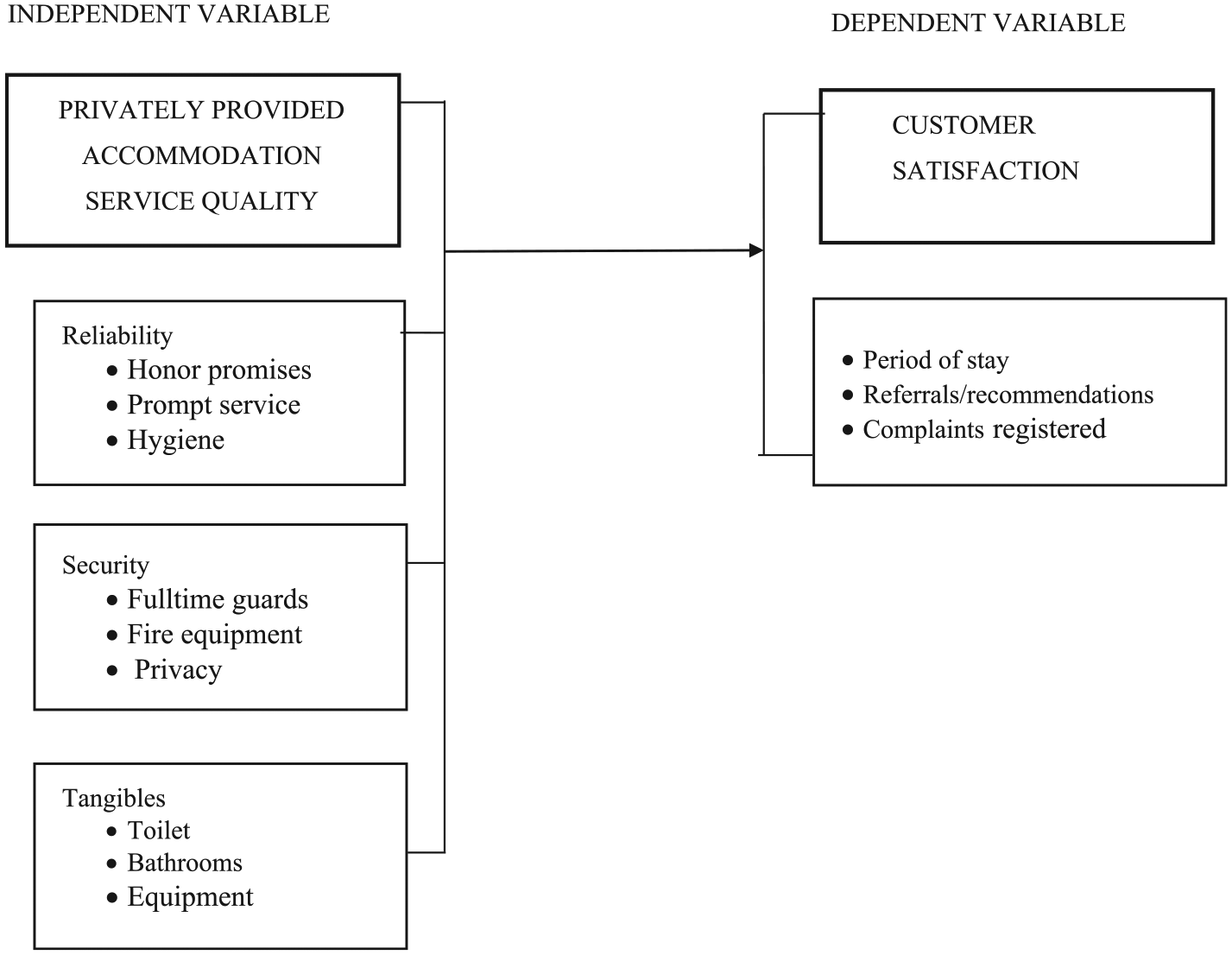
Conceptual framework.
The general objective was to determine the relationship between privately provided accommodation service quality and customer satisfaction. The specific objectives of the study were (a) to find out the relationship between security and NTISD students’ satisfaction with privately provided accommodation and (b) to find out the hierarchical level of importance of NTISD student satisfaction of the three service quality dimensions (reliability, security, and tangibles) with privately provided accommodation. Accordingly, the research questions were as follows:
The research was guided by the following hypotheses:
Privately Provided Accommodation Service Quality and Customer Satisfaction
Letitinen and Letitinen (2002); Khan Khadem and Islam (2011); Hooley, Piercy, and Nicouland (2008); and Little and Marandi (2003) stated that service quality has three dimensions: physical quality, which indicates the physical aspects of the service (e.g., equipment and building); corporate quality, which involves the organization’s image or profile; and the interactive quality, which derives from the relationship between the organization’s personnel and the consumer, as well as the interaction between customers. They further argued that it is necessary to differentiate between the quality associated with the process of service quality and the quality associated with the outcome of the services. Parasuraman, Zeithalm, and Berry (2008) proposed the following determinants of service quality: tangibles, reliability, responsiveness, empathy, and assurance; satisfaction of customers regarding accommodation service is evaluated on the basis of those variables. Amole (2005) and Hassanain (2008) argued that students can perform well in their studies if they have good and comfortable living conditions in their places of residences. Continuous evaluation of satisfaction is necessary to establish the emerging housing needs and take corrective action (Melnikas, 2008). Satisfied students recommend others to the housing facility, stay long, complain less, and pay promptly. Salleh, Rosline, and Budin (2008) and Mohit, Ibrahim, and Rashid (2010) explained that residential satisfaction is the positive experience expressed by occupants when their home meets their expectations for unit features, housing services, and neighborhood facilities. Thus, Foubert, Tepper, and Morrison (1998), and Najib and Yusof (2010) specified that residential satisfaction among students stems from high-quality facilities, positive roommate relationships, strong floor communities, and quiet study environments in their living accommodations. However, Kaya and Erkip (2001) contended that students satisfaction is based on having wider and brighter rooms with less noise and stress in the living areas, whereas Amole (2005) claimed that students assess residential satisfaction based on levels of crowding and privacy in their rooms (Najib, Yusof, & Osman, 2011).
Most customer satisfaction surveys focus on how something is done and not what is done. Some research has focused on a relationship between satisfaction and identity with the mission of the organization (Kihuguru, 2006). Additional research conducted on service satisfaction of specific services in public enterprises (Goodsell, 2004) shows that security is one of the key aspects of students’ accommodation (Foubert et al., 1998). Reviewed research on service quality does not specifically mention it. This study focused on service quality satisfaction in privately provided accommodation services. We used a modified servqual model as demonstrated in the conceptual framework in Figure 1 and incorporated security. The study considered reliability, tangibles, and security as service quality dimensions.
Privately Provided Accommodation Service Reliability and Customer Satisfaction
One of the dimensions studied was reliability. Reliability involves consistency of performance and dependability. Reliability is measured against expectations, particularly responsiveness, assurance, and empathy (Booms & Bitner, 2001). Delivering quality service means conforming to customer expectations on a consistent basis (Zeithalm & Bitner, 2002). Reliability means that the private accommodation performs the service right the first time like honoring its promises and keeping to agreements made with the customers and other stakeholders. Reliability delights and satisfies the customers (Karr & Blohowiak, 2008; Kotler & Keller, 2006). Furthermore, customers reveal willingness to pay higher prices for more reliable or continuous service (Bouckaert, Halligan, & van Dooren, 2005). Responsiveness as one of the measures of reliability is the willingness to and readiness of employees to provide service when needed. It is timeliness of service such as the immediate reinstallation of new bulbs, repairs, and fixing faulty electric connections immediately. The issues of timing responsiveness with response speed have to be addressed for customer satisfaction (Bitner, 1990; Booms & Bitner, 2001; Clark & Wood, 1998; Zeithalm, 2009).
Tangibles and Customer Satisfaction
The second dimension studied was tangibles. The tangibles dimension corresponds to the physical environment aspect. Tangibles are the appearance of physical facilities, equipment, personnel, and communication materials used. Reviewed literatures in the services industry suggest that there is a significant positive relationship between tangibles and customer satisfaction. Andaleeb and Conway (2005); Becker and Murmann (1999); Khan Khadem and Islam (2011); Mamalis et al. (2005), however, argued that tangible components are less of a priority for customer assessment of quality and enhancing customer satisfaction.
Student housing facilities (tangibles) are considered essential to cater for student housing needs (Hassanain, 2008; Najib et al., 2011). Previous studies have identified characteristics that influence resident satisfaction with student housing. Koch, Wesse, and Stickney (2009) specified that kitchens, private bathrooms, study lounges, and social spaces are considered basic necessities in student housing. Najib et al. (2011) highlighted the value placed on Internet access, either through a network connection or Wi-Fi, in each student’s room. Torres-Antonini and Park (2008) emphasized essential features as communal facilities such as laundry rooms, kitchens, study rooms, and television rooms; they also specified the use of carpet and air-conditioning in these rooms. Abramson (2009) argued that extra amenities such as ATM machines, parking lots, mini markets, bookstores, and cafeterias should also be provided in student housing. The inclusion of these sophisticated student housing features results in a higher level of residential satisfaction (Abramson, 2009; Khozaei, Hassan, & Khozaei, 2010; Torres-Antonini & Park, 2008). However, in much of the developing world, equipping all student housings with these sophisticated facilities would be prohibitively expensive and illustrate those students as too demanding. This obstacle has prompted some researchers in the developing world to investigate the actual needs of students. Khozaei et al. (2010) postulated that feeling attached to the place can be originated from the overall residential satisfaction. Facilities (tangibles) relevant to the developing world students were found to be study bedrooms, washrooms (i.e., bathrooms and laundry rooms), pantry, leisure rooms (i.e., study areas, computer centers, television lounges, meeting rooms, and a “musalla,” or prayer room for Muslims), and other support services (i.e., parking lots, cafeterias, mini markets, ATM machines, Closed Circuit Television [CCTV] surveillance systems and security guards, and “musalla,” or prayer rooms; Najib et al., 2011).
Private Accommodation Security and Customer Satisfaction
In their study, Nash, Thyne, and Davies (2006) found that guests’ perceptions of hotel security increase when there is limited access to the hotel, a secure guestroom door, and visible staff presence. Guests were impressed and put at ease when the hotel’s processes limited access to selected areas of the hotel. Tangible elements of security included requiring keys to enter elevators and a design that requires those entering the hotel to pass employees or security stations. Hotels with good interior lighting in public areas (especially hallways, stairways, and elevators) and ample exterior lighting made guests feel secure. Parking lots that had good lighting (bright lights that illuminated all of the lot) and that can be seen from the guestroom increase a guest’s sense of security. Hotels with noticeable security efforts, such as cameras and security patrols, added to a feeling of security and a belief that the hotel was being controlled. The most important security feature of the guestroom itself was a secure door and personal safety. Knowing that everyone is screened before entering the hotel builds confidence and trust in the hotel. Simply having hotel staff members in evidence, especially security staffs, made guests feel more secure with their presence is the hotel, whether it was working at the front desk or patrolling parking lots. The ability to see staff members and know that they are available contributes greatly to a sense of security. Satisfaction caused by security increases customer loyalty, which is the principal driver of profits, along with continuing to stay at a brand’s properties.
Another related study in Malaysia by Khozaei et al. (2010) on “Predicting Students’ Satisfaction With University Hostels” established that satisfaction with hostel security, room safety, fees, distance from university facilities, room size, and hostel facilities are the most important factors that predict undergraduate students’ satisfaction with their hostel.
The Hierarchical Level of Importance on Customer Satisfaction of the Three Service Quality Dimensions (Reliability, Security, and Tangibles)
There is little work done on the hierarchy of the service dimensions in students’ accommodation service. However, there are related studies in other sectors; in the banking service industry, it is interesting to learn that the tangible factor was identified as the most important service quality dimension to customers in the area of Nakhonratchasima province. This was done using seven key performance attributes, namely, tangible, reliability, responsiveness, assurance, empathy, price, and differentiation (Kitti & Nuttawuth, 2010).
In a restaurant study, regression model findings suggested that customer satisfaction was influenced mostly by the responsiveness of the frontline employees, followed by price and food quality (in that order). Physical design and appearance of the restaurant did not have a significant effect. This implies that to explain customer satisfaction better, it may be important to look at additional factors or dimensions. So, full service restaurants should focus on three elements—service quality (responsiveness), price, and food quality (reliability)—if customer satisfaction is to be treated as a strategic variable (Andaleeb & Conway, 2005).
Ariffin, Salleh, Aziz, and Asbudin (2010), in a study on “Service Quality and Satisfaction for Low Cost Carriers.” The results revealed that “caring and tangible” were the most important dimension of service quality for low-cost carriers, followed by “reliability,” responsiveness,” “affordability,” and “visual attractiveness.” However, only “caring and tangible” dimension contributes significantly to the prediction of satisfaction on the services of low-cost carriers. The studies reviewed on hierarchical level of importance on customer satisfaction show that the hierarchy varies with a service sector. The variation of relative importance of the variables justified this study to establish what is valued most in private accommodation service.
Some studies have been done on service satisfaction in higher institutions of learning using the servqual model analysis, namely, Hanaysha et al. (2011) and Becker and Murmann (1999) in Malaysia, Mavondo and Zaman (2000) and Ayeni (2002) in Australia, Ijaz and Irfan (2011), and Zafiropoulos and Vrana (2008) in Greece, and Hanaysha et al. (2011) in Malaysia. Other studies have been done on satisfaction in other service sectors such as hotel, transport, and sports services. Researchers on accommodation service satisfaction studied students’ accommodation service quality using the servqual model dimensions; all the mentioned researchers studied accommodation provided by public higher institutions of learning, which in most cases is homogeneous (Tananitikul & Muenjohn, 2010). It should be noted that the studies reviewed on accommodation service quality are all out of Africa. The studies were further interested in tangibles, which are one aspect of service quality; they did not study the effect of security. This study expanded the examination of service quality dimensions to include security and reliability. Reviewed studies did not use observation as a method of inquiry, which this study used. This study examined private accommodation service quality and satisfaction of students. In addition, this research covered Uganda, a country in Africa, and specifically accommodation provided by private service providers with heterogeneous service provision due to liberalization.
Method
This study adopted a cross-sectional survey design to answer the research questions (Amin, 2005; Denzin, 2008). Quantitative and qualitative modes of data analysis were used to provide ways of examining and interpreting patterns of data basing on the objectives of the study. Triangulation of the different data sources allowed validation of the data (Green & Thorogood, 2004). The study population included 30 private hostels in Mpigi that accommodate an average of 20 students of NTISD each, of these 300 students were randomly sampled; other stakeholders that contributed to the study included town council administrators (two) and senior residents and local councils (13), and hostel administrators (20). The overall number of participants was 335. The unit of analysis was the different student hostel residents and other key stakeholders (town council management and local leaders), from whom required information was collected basing on their knowledge and experience. We used Sekaran (2005) sample size determination model to arrive at sample size of hostel residents, hostel managers, local leaders, and municipality management. Sekaran sample size determination model provides a wider variety of sample size analysis such as the level of confidence and margin of error (Sekaran, 1992). Sampling was advantageous for reducing costs and economized time, and provided greater accuracy in our study (Amin, 2005).
Data Collection Methods
Quantitative measures were obtained by a questionnaire, and in-depth interviews for key informants were used for qualitative measurements. Questionnaires were administered to all respondents with their answers expressed in terms of numbers corresponding to precoded responses. The interview guide had questions on security, reliability, tangibles, and customer satisfaction to students, leaders, and staff of accommodation facilities/hostels. Questionnaires were used because all interviewees could read, understand, and write. A Likert-type scale was followed by the five category response continuum: very satisfied, satisfied, neutral, not satisfied, and very dissatisfied; each respondent selected the response that best described his or her reaction to that statement. A Likert-type scale was used because it is flexible and can be constructed more easily than most other types of attitude scales. The attitude statements in the Likert-type scale reduce the tendency of respondents to respond with a certain preconceived mental set (Amin, 2005). Interviews were conducted in person with selected respondents to generate detailed responses to the set questions (Becker & Murmann, 1999; Corbin & Strauss, 2008). In addition, we critically observed the environment and made judgments relevant to the study. The list of areas of observation was derived from literature and experience. The reason for using observation is given by that it is not unusual for persons to say they are doing one thing but in reality they are doing something else. The only way to know this is through observation. Observation was used with interview to verify interpretations with participants (Patton, 2002).
Validity
Content validity was done by giving the questionnaire to 10 respondents who were used to test the appropriateness of the questions and their comprehension. This helped to rectify any inadequacies before administering the questionnaire to respondents and thus reduce biases. It ensured that the respondents understood the questions, and no ambiguities in questions. Amin (2005) noted that validity ensures that findings are in agreement with the theoretical values.
Content validity was determined by expert judgment. Experts in service quality and customer satisfaction were asked to assess the content of research instruments for validity. Content validity index (CVI) was found to be 0.84. Because the instrument had an average of more than 0.7, it was accepted as valid (Amin, 2005).
Reliability
A pretest instrument was used to test for reliability of findings. The indicators of private accommodation service quality were tested—reliability, security, and tangibles—whereas satisfaction was measured using referrals, period of stay, and complaints. These indicators were also tested whether they adequately measure the variables using the Cronbach’s alpha test as shown in Table 1, which shows that all the variables’ tests scored a coefficient of more than .7. The findings are therefore reliable and consistent as were set. Reliability tests enabled the instrument to be dependable and to consistently measure whatever is measured (Amin, 2005). The detailed reliability test results are in Table 1.
The Reliability Test.

Source. Primary data.
Data Analysis
Statistical tests were conducted using SPSS to determine the relationship between privately provided accommodation service quality and customer satisfaction at NTISD. The relationship between the independent variable (privately provided accommodation service quality) and dependent variable (customer satisfaction) was analyzed using Pearson’s correlation.
Measurement of Variables
A 5-point Likert-type scale with responses from 5 as very satisfied to 1 as very dissatisfied was used to get quantifiable primary data from respondents. Nominal measurements were used whereby numbers were assigned to observations that corresponded to statements of sameness or difference. Numbers were assigned to an observation as its name (Amin, 2005). The hierarchical importance was measured as 1 as list important to 5 as very important.
Findings, Analysis, and Managerial Implications
The data presented were from questionnaires, observations, and interviews with respondents. They also present inferential statistics in regression and correlation form to show the magnitude of the effect the independent variable has on the dependent variable. The study had a total response rate of 83%. The questionnaires that were given to students as clients in hostels as well as key informants had a response rate of 83%. Out of the 300 questionnaires given out to students, 249 were returned. This was attributed to students’ reluctance in responding to issues where they do not expect to benefit directly. Thirty-seven students were interviewed out of the 40 targeted, which is 92.1%; and 29 hostel managers were interviewed of the 40, which is 72.5%; whereas both the town council administrators were interviewed, which is 100%. Efforts were made to have immediate responses to questionnaires and interviews to increase the response rates. Amin (2005) argued that for any results to be relied upon, the response rate should never go below 50%. With this in mind therefore, the results obtained from the study are considered to be reliable and valid because the people who participated are representative of the target group as a whole.
Security and Students’ Satisfaction of Privately Provided Accommodation
There were 20 questionnaire items on accommodation security, which were given to the respondents for their opinion. The questionnaire required respondents’ experience at the hostel and to check the most appropriate choice between the following options with regard to service quality: 1 = very satisfied, 2 = dissatisfied, 3 = neutral, 4 = satisfied, and 5 = very satisfied. The item was coded Sec_sat_1 to Sec_sat_20. The responses were expressed as in the following discussion. In Item1, the study established whether the hostel keeps records confidential; 49.2% were dissatisfied, 50.8% were satisfied. In Item 2 it established whether the hostel has security person all the time; 75.4% were dissatisfied, 24.6 were satisfied. In Item 3, it established whether the hostel allows nonresidents to stay over the night; 59.2% were dissatisfied, 40.8% were satisfied. In Item 4, the study checked whether the hostel doors are secure; 37.1% were dissatisfied, 62.9% were satisfied. In Item 5, it checked whether there were instances of theft at the hostel; 55% were dissatisfied, 45% were satisfied. Item 6 checked for privacy (e.g., in rooms, washrooms); 64.2% were dissatisfied, 35.8% were satisfied. Item 7 checked for firefighting equipment availability; 89.2% were dissatisfied, 10.8% were satisfied. Item 8 checked whether emergency exit was available; 83.7% were dissatisfied, 16.3% were satisfied. Item 9 checked whether only safe and fully maintained equipment was used; 76.6% were dissatisfied, 17.4% were satisfied. Item 10 checked for frequency of theft; 63.7% were dissatisfied, 36.3% were satisfied. Item 11 checked for security personnel presence; 69.6% were dissatisfied, 30.4% were satisfied. Item 12 checked for the presence of general crime (assaults, damage, noise, drugs, hoax); 66.7% were dissatisfied, 33.3% were satisfied. Item 13 checked whether equipment and cleaning chemicals were used safely; 67.5% were dissatisfied, 32.5% were satisfied. Item 14 established whether there were warnings on safety precautions when necessary; 74.6% were dissatisfied, 25.4% were satisfied. Item 15 established whether safety hazards were reported to the appropriate authority; 74.2% were dissatisfied, 25.8% were satisfied. Item 16 checked whether dangerous substances were stored safely; 67.9% were dissatisfied, 32.1% were satisfied. Item 17 checked whether simple first aid procedures were carried out; 82.7% were dissatisfied, 17.3% were satisfied. Item 18 checked for emergency information in the rooms (police, hospital, etc.); 85.9% were dissatisfied, 14.1% were satisfied. Item 19 checked whether there was warning on food poisoning; 76.3% were dissatisfied, 23.7% were satisfied. Item 20 checked for lightening and protective gadgets; 87% were dissatisfied, 13% were satisfied. The implication of frequency data above is that there is laxity in security at the hostels; this poses danger to the safety of students in the hostels and their property.
Respondents were most dissatisfied with firefighting equipment availability (89.2%), emergency exit availability (83.7%), simple first aid procedures (82.7%), emergency information in the rooms and vital places such as the police and the hospital (85.9%), lightening and protective gadgets (87%), and availability of security personnel all the time (75.4%). Interview and observation visits showed that these facilities were nonexistent in hostels. Students take care of themselves in case of emergencies. No first aid is offered. Lightening is rampant in Uganda. Hostels do not have lightening and protective gadgets. The absence of protective facilities risks the lives of the students in privately provided accommodation.
Respondents were, however, most satisfied by low instances of theft at the hostel (45%), not allowing nonresidents to stay over the night (40.8%), and use equipment and cleaning chemicals safely (32.5%). The scores and therefore the levels of satisfaction in the above items were not above average but were the highest scores among the items where respondents expressed satisfaction. The low scores point to the need for hostel owners to improve the weak security areas.
The importance of security in accommodation was emphasized by Mugerwa (2004); Reichheld and Sasse (1990); and Albayrak, Caber, and Aksoy (2010). They noted that security features to attract and satisfy clients. Visible Staff presence contributes to a sense of security and increases customer loyalty, a principal driver of profits. A fence and security personnel enhance security. Carturight (2000) and Churchill and Suprenant (2002) noted that satisfaction caused by security increases customer loyalty, which is a principal factor of profits, by continuing to stay and referring new business.
Interviews
Through interviews, the study was informed by students that in many hostels, there were frequent incidences of petty theft at night. The thieves manipulated the windows to open and stole mainly mobile telephones and ladies’ hand bags. Many hostels were not fenced off; the study was informed that the open space attracted thieves. One of the students stated that
the Askari comes beyond mid-night and says we do not need to see him . . . one day a thief manipulated the door, opened it and took my mobile telephone. The Askari claimed he saw the man enter my room but thought he was my visitor . . . . he only got the thief’s jacket as he ran away. We asked around but failed to find the owner of the jacket . . . (student, hostel resident)
Some students liked unfenced hostels because this would enable easy escape in case of emergencies. The study found out that security personnel were present only at night. One person worked as manager and security officer to save costs, but this was risky as thieves would steal when the officer is away on administrative tasks. There was occasional use of cleaning chemicals in some hostels, which exposed the hostel residents to possible infections. The hostel administrators revealed in this study that hostels do not employ security personnel so that the hostel can reduce expenditures.
Observation
The hostels were visited by the researcher, and observation results indicated that most hostels had no security person available, no security precautions such as a gate, no firefighting equipment, no emergency information in the rooms, no lightening/protective equipment, no warning on food poisoning, and no first aid materials. Observation and interview results illustrate low security concern in the private hostels and low satisfaction from the students.
Relational Results for Security and Customer Satisfaction
Information on the relationship between security and satisfaction of NTISD students regarding privately provided accommodation was collected using a 5-point Likert-type scale. Respondents were given 20 items to respond to, and correlation was carried out as shown in Table 2. There was a strong positive significant relationship of .605 between security and satisfaction of NTISD students regarding privately provided accommodation and a significance of .000 at .01 level. This implied that with increased quality of security, the satisfaction of students regarding privately provided accommodation is likely to increase in the same direction. This finding was in line with the study hypothesis (H1) and answered the research question positively (RQ1).
Correlation Between Security and Student Satisfaction Regarding Privately Provided Accommodation.

Source. Primary data.
Correlation is significant at the .01 level (two-tailed).
The Hierarchical Level of Importance on NTISD Student Satisfaction of the Three Service Quality Dimensions (Reliability, Security, and Tangibles) of Accommodation
The study established the hierarchical level of importance on NTISD student satisfaction of the three service quality dimensions (reliability, security, and tangibles) of accommodation service quality. A 5-point Likert-type scale was used to rate the hierarchical importance between the reliability, security, and tangibles. The respondents were required to give their judgment on the hierarchical importance of the three service quality dimensions (reliability, security, and tangibles) regarding their contribution to overall accommodation service satisfaction. The options included 1 = least important, 2 = important, 3 = neutral, 4 = important, and 5 = very important. This item was coded Hier_Serv_dim. The regression statistics results were as in Table 3.
Regression Statistics Results on Hierarchy of Service Quality Dimensions.

Source. Primary data.
The results in Table 3 illustrate a summary of regression results. Considering the highest percentage adjusted R2, reliability has 48.7%, security has 38.5%, and tangibles 33.9%. This means the hierarchical importance of the service quality dimensions from the most important is reliability, followed by tangibles and security. This implies that the hostel officers should pay extra attention to reliability.
Interviews
Interviews sought to establish the hierarchical ranking of the three service quality dimensions and justification for the ranking. Interview results informed the researcher that security was preferred as one respondent commented, “when you have security, your life and property are secure and life goes on smoothly.” Some students preferred some hostels because they were fenced and had full-time security. From the focus group discussions, it was noted that courtesy of staff and good interpersonal relations also contributed to reliability and satisfied clients.
Observation
Hostels that had security items such as a gate and fence, as well as managers who responded to client requests timely, also had many students. Some hostels had wooden doors, which appeared weak for thieves to easily break in. Adjusted R2 results established that the hierarchical order of importance from the most important was as, respectively, as follows: reliability (48.7%), security (38.5%), and tangibles (33.9%). It should be noted that observation and interview results emphasize security, whereas quantitative data score reliability as the most important. Logically, the contradiction is not strong because attention to security is part of reliability. This was unlike in the banking sector where tangibles were considered most important (Kitti & Nuttawuth, 2010); reliability also mattered most in sports (Kim, Lavetter, & Lee, 2006). Responsiveness was found key in frontline employees of restaurant business (Andaleeb & Conway, 2005). Caring and tangibles were found important in low-cost couriers (Ariffin et al., 2010). This finding shows that the hierarchy of service dimensions varies with a service sector. Hostel owners therefore need to emphasize provision of service considering the dimensions in the order of their significance of dimensions. Satisfaction may be expressed by long stay, referrals, and complaints in hostels. The finding on quantitative analysis established that security was higher in hierarchy than the other dimensions and against the study hypothesis (H2), which had it that the hierarchical level of importance of NTISD student satisfaction of the three service quality dimensions from the most important is security, reliability, and tangibles.
Managerial Implications
Findings of this study imply that with increased quality of security, the satisfaction of students regarding privately provided accommodation is likely to increase in the same direction. Hostel owners and managers have to address areas of insecurity in the hostels such as providing firefighting equipment, emergency exit, carrying out simple first aid procedures, providing emergency information in the rooms such as police and hospital emergency telephones, installing lightening and protective gadgets, and ensuring presence of security person all the time. Interview and observation visits showed that these facilities were nonexistent in most hostels. Nonresidents should not be allowed to stay over the night; safety should be ensured by secure use of equipment and cleaning chemicals.
It was established that the hierarchical order of importance from the most important was, respectively, as follows: reliability, security, and tangibles. This finding focuses on the need for hostel owners to emphasize provision of dimensions in the order of their significance. Satisfaction can be assessed periodically to improve satisfaction by monitoring period of stay, referrals, and complaints.
Conclusion
Whereas most service quality satisfaction literature does not consider security as an independent dimension (Parasuraman, Zeithalm, & Berry, 1985), this study established a strong positive significant relationship of .605 between security and satisfaction of NTISD students regarding privately provided accommodation and a significance of .000 at .01 level. This implied that with increased quality of security, the satisfaction of students regarding privately provided accommodation is likely to increase in the same direction. Respondents were most dissatisfied with the following security items in the hostels: firefighting equipment availability, emergency exit availability, capacity to carry out simple first aid procedures, emergency information in the rooms for police and hospital, lightening and protective gadgets, and security person presence all the time. Interview and observation visits showed that these facilities were nonexistent in hostels.
Respondents were, however, fairly satisfied by low instances of theft at the hostel, nonacceptance of nonresidents to stay over the night, and use of equipment and cleaning chemicals safely. The scores and therefore the levels of satisfaction in the above items were not above average but were the highest scores among the items where respondents expressed satisfaction. The low scores point to the need for hostel owners to improve the weak areas. The study established that the hierarchical order of importance from the most important service quality dimension was as, respectively, as follows: reliability, security, and tangibles. Reliability therefore is most essential in hostel service. Future studies can take the following directions: the effect of gender occupancy (male or female) in hostels and its effect on customer satisfaction. A study on accommodation service satisfaction can be done on hostel students’ expectations and the process of appreciating what is on offer. This study was conducted in one higher institution of learning, but a comparative study can be undertaken on many institutions. This will provide more accurate response regarding the services delivered to the students.
Footnotes
Declaration of Conflicting Interests
The author(s) declared no potential conflicts of interest with respect to the research, authorship, and/or publication of this article.
Funding
The author(s) received no financial support for the research and/or authorship of this article.