




Abstract
Based on the idea that researchers may better understand attitudes regarding homosexuality by focusing on acceptance rather than heterosexism, we utilized an online survey to ask 437 undergraduate and graduate students at a medium-sized, Midwestern, public university to what extent they would agree that a list of 24 statements matched their views of what the complete acceptance of homosexuality in the United States would look like. The findings indicated that participants generally endorsed a range of statements, though the level of support and the number of endorsed items varied. The relationships between the items participants endorsed, and either their sexual orientation, experiences with gay men and lesbians, or levels of heterosexism, are also discussed, as are implications and suggestions for future research.
Introduction
“If you woke up tomorrow, and your problem had disappeared, what would be different?” This question is referred to in the clinical psychology literature as the “miracle question” and was pioneered by Insoo Kim Berg and Steve de Shazer (e.g., De Shazer, 1982, 1988), two therapists whose work focused on having clients first imagine their lives without a problem and then make changes that fit with this new conceptualization of their lives. Although this approach was developed as a therapeutic tool, it arguably has utility outside of the therapeutic context. Consider the problem of heterosexism or homonegativity, which the majority of the literature in disciplines like sociology and psychology has understandably focused on reducing. Although this research has been necessary and informative, it may be useful to incorporate an approach that focuses not on the problem of heterosexism but rather on what the world would look like if it did not exist and homosexuality was completely accepted. Worthington, Dillon, and Becker-Schutte (2005) appeared to support such a focus when they noted the following: [R]esearch on heterosexual attitudes toward LGB [lesbian, gay, and bisexual] individuals typically relies on instruments that are intended to measure homophobia. In fact, the term LGB-affirmativeness (i.e., positive, affirmative attitudes toward LGB individuals) is often assumed to be the absence (or reduction) of homophobia and heterosexism, or it is not specifically defined at all. Therefore, as heterosexual attitudes toward LGB individuals reflect widening complexities, it is critical that scientific measurement provides increasing precision of range and dimensionality. (p. 104, emphasis in original)
To that end, we asked undergraduate and graduate students to what extent they would agree that a list of statements represented or matched their views of what the complete acceptance of homosexuality in the United States would look like. As we will discuss in more detail in the “Measures” section, the majority of these statements were derived from measures of heterosexism. While we agree with Worthington et al. (2005) that the acceptance of homosexuality is more than the absence of heterosexism, this absence would at least partially constitute acceptance, so the conceptualization of heterosexism can provide a foundation for the conceptualization of acceptance. In addition, the literature on heterosexism includes numerous measures that cover a range of attitudes and behaviors. Because these measures have already been created and tested, we decided to reframe them to address acceptance rather than create completely new measures.
Method
Participant Selection
During the spring 2014 semester, undergraduate and graduate students from a medium-sized, Midwestern, public university were recruited in three ways. First, the study was one of the options provided to a subject pool, which included all of the undergraduate students currently enrolled in any general education course in psychology. Second, an email message was sent to 500 randomly selected graduate students and 5,500 randomly selected undergraduate students who were not part of the psychology subject pool, with a reminder email sent about 1 week later. Third, we announced the survey at a meeting of the university’s Lesbian, Gay, Bisexual, Transgender, Questioning, Queer, Asexual and Ally (LGBTQA) student organization, and the organization’s president sent an email message with a link to the survey to the organization’s members shortly after this meeting. This link was the same as the link in the email sent to the 6,000 randomly selected students, whereas a different link was provided to the psychology pool so their participation could be tracked and they would receive course credit. The participants solicited by email or the organizational meeting did not receive any compensation. The researchers did not have access to any identifying information for the psychology subject pool. Regardless of how they were solicited, students had until the end of the semester to complete the survey.
Sample
The sample consisted of 437 students, 191 of whom were recruited from the psychology subject pool and 246 of whom were solicited via email or the LGBTQA student organization. Only 15 of the 246 participants responded after the project was announced at the organization’s meeting, so we estimate that this is the number of participants solicited from the organization and that the remaining 231 participants responded to the recruitment email, which had been sent more than 1 week earlier. This would provide a response rate of 3.9% for those who received the email; the response rate would be 4.1% if all 246 respondents were assumed to have been solicited by the email message. Although it is possible to calculate a response rate for the psychology subject pool, such a rate would be tentative because of other factors that influenced participation (e.g., the amount of credits students needed and their personal preferences for one study over another).
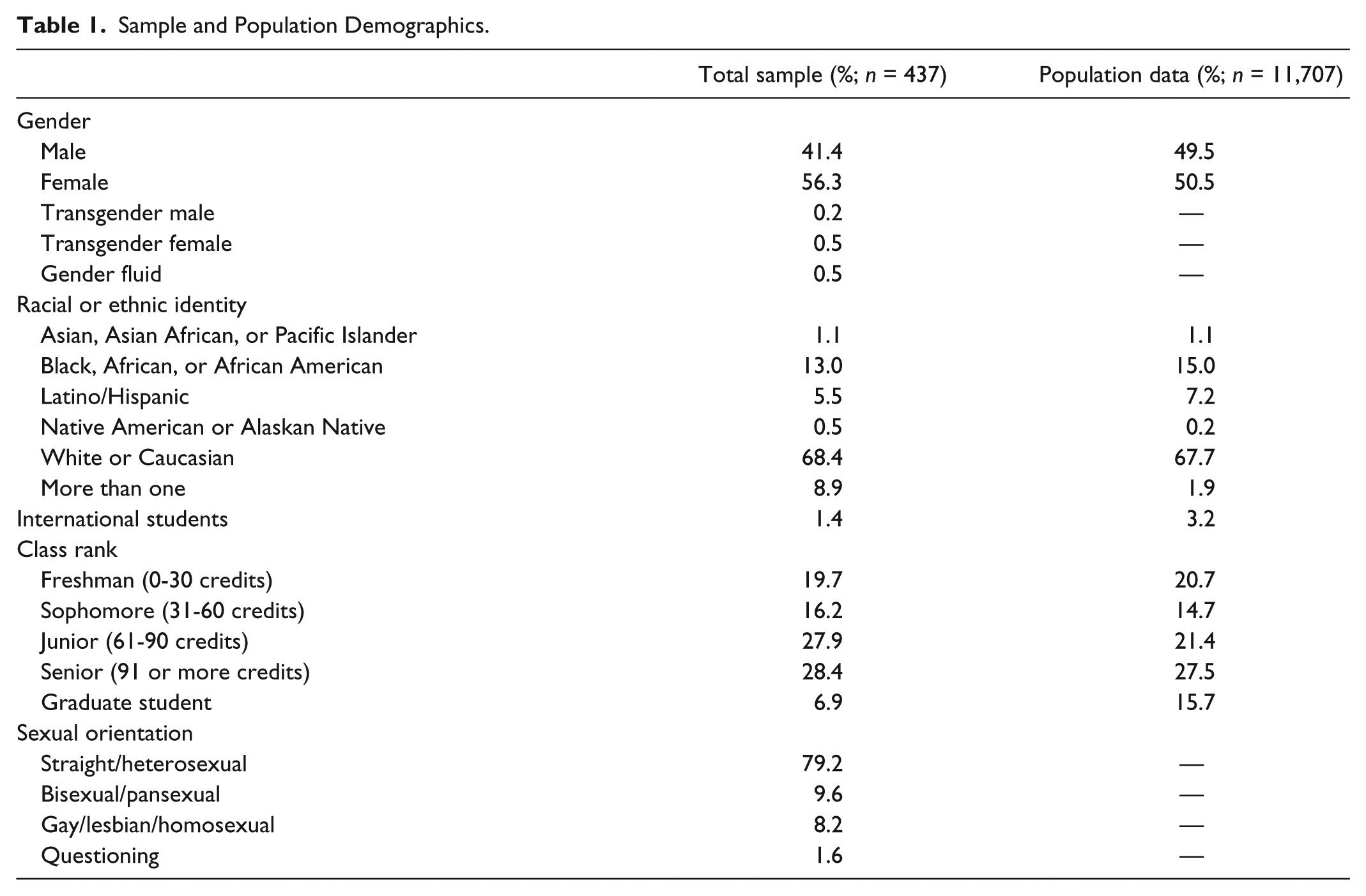
Table 1 presents the demographic information for the sample and the population. The population data came from the university and were based on the fall 2013 semester as data for the spring 2014 semester were not publicly available. The sample appeared to be largely representative of the population, and the difference in the percentages of graduate students may simply result from graduate students not being included in the psychology subject pool.
Sample and Population Demographics.
Procedure
The survey received institutional review board (IRB) approval and was conducted online via SurveyMonkey. The first page of the survey contained the informed consent document. The survey itself consisted of three sections, which assessed of heterosexism and other attitudes regarding homosexuality, descriptions of the acceptance of homosexuality, and demographic items, respectively. We will discuss acceptance first as it is the central variable.
Measures
Descriptions of the acceptance of homosexuality
Given the relative absence of literature that directly addressed the acceptance of homosexuality, we needed to construct the measures of this concept. As noted in the “Introduction” section, the literature on heterosexism provided some guidance in the construction of these measures, which assessed the extent to which participants agreed that a given statement matched their personal definitions of acceptance. There were 24 items, and participants endorsed each item using the following options: strongly disagree, disagree, slightly disagree, slightly agree, agree, strongly agree, and unsure/don’t know. Table 2 provides the full wording of each item, and the items were preceded by the following phrase: “If homosexuality was fully accepted in our society, I would expect that . . .” In the following paragraphs, we will discuss our rationale for the inclusion of each of the 24 items.
Responses to Description of Acceptance Questions.
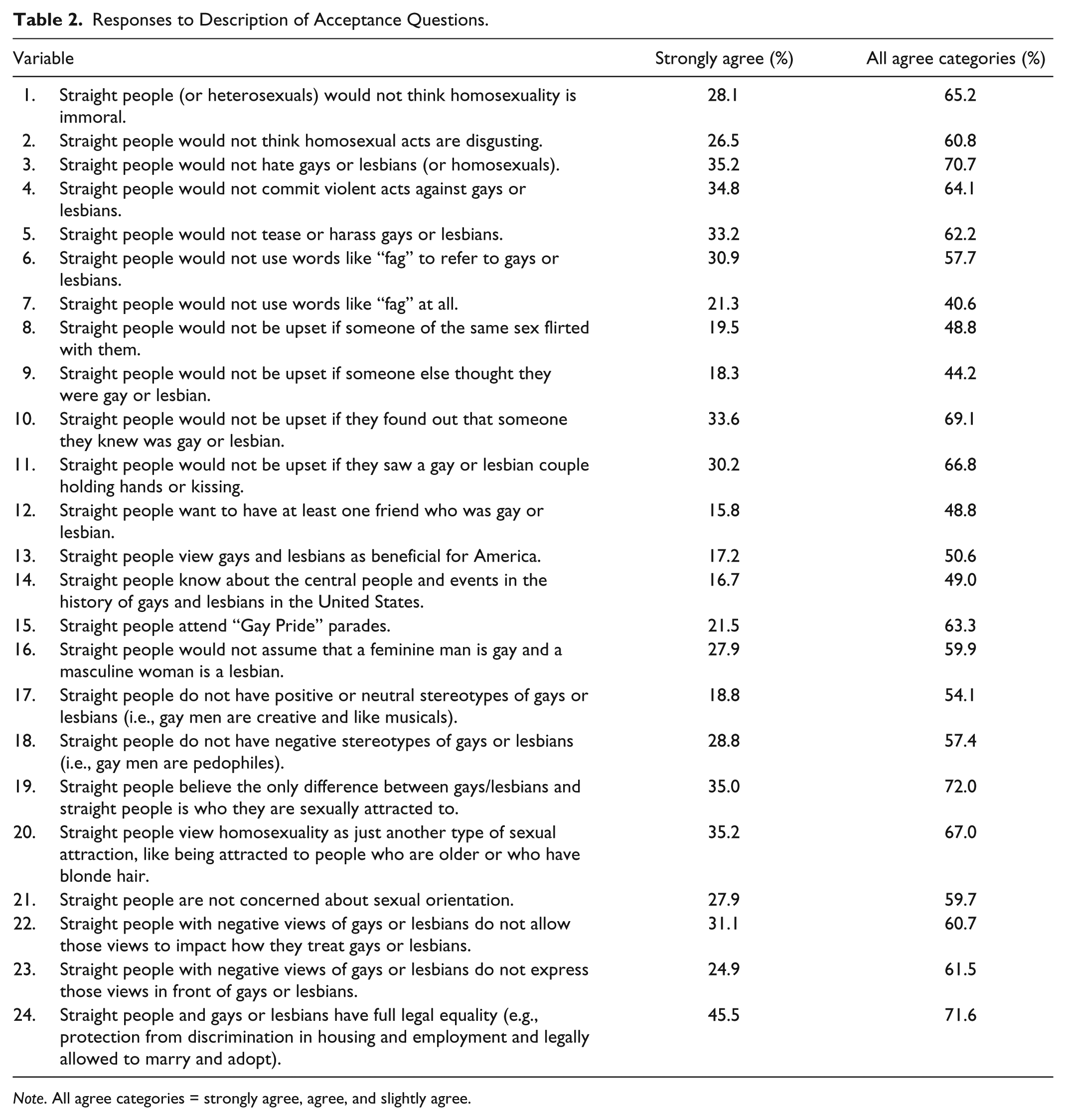
Note. All agree categories = strongly agree, agree, and slightly agree.
Six of the items (Items 1-5 and Item 10) addressed more traditional forms of heterosexism, including viewing homosexuality as immoral and committing violent acts against gays and lesbians (Adolfsen, Jurjen, & Keuzenkamp, 2010; Morrison, Morrison, & Franklin, 2009; Rankin, Weber, Blumenfeld, & Frazer, 2010; Worthington et al., 2005; Yang, 1997). Including these items enabled us to assess whether the participants endorsed the decrease in heterosexism as part of their personal descriptions of the total acceptance of homosexuality.
Eight other items (Items 11-18) addressed more expanded conceptualizations of heterosexism. The inclusion of these items enabled us to determine whether participants endorsed these additional ideas (or more accurately their reduction) as part of their descriptions of acceptance. Items 16 to 18 addressed positive and negative stereotypes of gays and lesbians, as well as the belief that gays and lesbians are gender atypical or nonconforming. These items addressed two of the forms of heterosexism discussed by Walls (2008). The first form was hostile heterosexism, or negative beliefs and attitudes about gays and lesbians (e.g., gay men are pedophiles and lesbians hate men), and the second was positive stereotypic heterosexism, or positive or neutral beliefs and attitudes that reinforced stereotypes about gays and lesbians (e.g., gay men are creative and lesbians are independent), including the belief that gay men and lesbians violate gender roles (e.g., Blashill & Powlishta, 2009). We included Item 11, which addressed the absence of a negative reaction to public displays of affection between same-sex couples, because Adolfsen et al. (2010) argued for including similar questions because “[h]ow people react to homosexuals in their personal environment or what they think of the visibility of homosexuality in public (like two men kissing) is not taken into account” in the literature (p. 1238).
Items 12 to 15 were included to directly focus on “affirmative” behaviors, to borrow language from Worthington et al. (2005). These items specifically addressed heterosexuals wanting to have gay and lesbian friends (Item 12), viewing gays and lesbians as beneficial to the country (Item 13), knowing the central figures and events in “gay” history (Item 14), and attending “Gay Pride” parades (Item 15). Similarly, Brown, Clarke, Gortmaker, and Robinson-Keilig (2004) included measures that addressed participants’ involvement in LGBT programs and interest in learning about LGBT concerns, history, and culture, and the item regarding a desire for gay and lesbian friends (Item 12) also connects to the literature on courtesy stigma (i.e., the belief that someone who associates with gays and lesbians is also gay or lesbian, for example, Neuberg, Smith, Hoffman, & Russell, 1994; Sigelman, Howell, Cornell, Cutright, & Dewey, 1991).
Items 6 to 9 were inspired by other literature related to heterosexism, though this literature did not focus on the measurement of this concept. Items 6 and 7 centered on the meaning of “fag.” Although this term has generally been presented as homophobic (e.g., Burn, 2008), a handful of researchers have begun arguing that young men who engage in “fag discourse” actually focus on masculinity instead of sexuality (e.g., McCormack, 2012; Pascoe, 2007). As at least some people disconnect terms like “fag” from sexuality, they may not view the elimination of such terms as one aspect of the complete acceptance of homosexuality. Items 6 and 7 were included to assess this possibility. Item 8 was included given the literature that discussed people’s, particularly men’s, discomfort at being hit on by members of the same sex (e.g., Pirlott & Neuberg, 2014) to see whether participants would endorse the absence of such discomfort as part of their personal descriptions of acceptance. Finally, Item 9 was included to address the concept of homohysteria, which McCormack (2012) defined as “the cultural fear of being homosexualized” (p. 44), and Anderson (2011) defined as “the fear men maintain of being socially perceived as gay” (p. 253). As with the previous item, this item was included because participants could endorse the absence of homohysteria as part of their descriptions of acceptance.
Items 19 to 23 were included because we believed participants might endorse the ideas contained in them. The first two of these items addressed the ideas that acceptance could be described as heterosexuals seeing sexual attraction as the only thing differentiating gay men and lesbians from heterosexuals (Item 19) and as heterosexuals seeing homosexuality as just another form of attraction (Item 20). These items were similar to questions Yang (1997) described being used in various polls, which asked participants whether they viewed homosexuality as an acceptable alternative lifestyle. Similarly, Item 21 addressed the idea that acceptance could be described as heterosexuals not being concerned about sexual orientation. Items 22 and 23 differed from the items discussed so far in that they included people having negative views of homosexuality within the description of acceptance. In these questions, respondents were asked whether they would endorse heterosexuals not expressing their negative views of homosexuality or not allowing those views to affect how they treated gay men and lesbians in their descriptions of acceptance. These items were similar to those included among Worthington et al.’s (2005) measures.
Finally, Item 24 addressed legal equality. This item was included given the extent to which legal equality has been put forward as a marker of acceptance in the literature (Brewer, 2008; Jones, Cox, & Navarro-Rivera, 2014; Mucciaroni, 2008) and included in previous surveys and polls regarding heterosexism or broader attitudes toward homosexuality (Adolfsen et al., 2010; Worthington et al., 2005; Yang, 1997).
Additional demographic variables
In addition to the items included in Table 1, we also asked participants whether they were members of the university’s LGBTQA student organization and whether they personally knew anyone who was gay or lesbian, with “yes” and “no” as the response options for both questions. Participants who indicated they knew someone who was gay or lesbian were also asked to provide the number of gay men and lesbians they knew.
These items, as well as the item that measured sexual orientation (see Table 1), were included because participants’ sexual orientation, experiences with gay men and lesbians, and exposure to “gay culture” could all affect their knowledge of the lived experiences of gay men and lesbians. This knowledge could, in turn, affect which statements the participants endorsed. For instance, heterosexual participants with gay and lesbian friends may have heard from those friends about being harassed when they engaged in public displays of affection. As a result, these participants may endorse the absence of such harassment as part of their description of the complete acceptance of homosexuality. In addition, previous research has described how membership in LGBTQA organizations affected members’ identities and preferred strategies for seeking social change (e.g., Renn, 2007), which supports the idea that organizational membership can affect people’s ideas. The contact hypothesis, which posits that interpersonal contact with a minority group (e.g., gay men and lesbians) may lead to lower levels of prejudice (e.g., Allport, 1954; Dovidio, Gaertner, & Kawakami, 2003), also supports the idea that the number of gay men and lesbians known to the participants, particularly the heterosexual participants, could impact which statements they endorsed because increased contact could increase understanding.
Heterosexism
We used Walls’s (2008) Multidimensional Heterosexism Inventory (MHI) to measure participants’ levels of heterosexism. The MHI included 23 statements, to which the participants indicated their levels of agreement. The responses options for these items matched those for the descriptions of the acceptance. Each item in the MHI addressed one of four different types of heterosexism Walls discussed. The first type was paternalistic heterosexism or “subjectively neutral or positive attitudes, myths, and beliefs that express concern for the physical, emotional, or cognitive well-being of non-heterosexual [sic] persons while concurrently denying, denigrating, stigmatizing, and/or segregating any non-heterosexual form of behavior, identity, relationship, or community” (e.g., “I would prefer my daughter not be homosexual because she would unfairly be stopped from adopting children”; Walls, 2008, pp. 27-28). The second type was aversive heterosexism or “attitudes . . . that dismiss or trivialize the importance of sexual orientation on life chances” (e.g., “Gay men should stop shoving their lifestyle down everyone’s throat”; Walls, 2008, pp. 29-30). The third type was amnestic heterosexism or “attitudes . . . that dismiss, belittle, or disregard the impact of sexual orientation on life chances” (e.g., “Discrimination against lesbians is virtually nonexistent in today’s society”; Walls, 2008, p. 46). The fourth type was positive stereotypic heterosexism, which was discussed above and was measured with items like “Lesbians are better than heterosexual women at physically defending themselves.”
Following Walls (2008), we conducted a factor analysis to confirm that the items intended to measure one type of heterosexism loaded on the same factor. Our findings, which are available upon request, were similar to Walls, and we further followed him by calculating four indices. Each index provided the average score for the items that measured a given type of heterosexism. A higher score for each index or subscale indicated stronger agreement to the items in that subscale and, therefore, higher levels of that type of heterosexism.
We included the MHI because it can serve as a measure of the participants’ understanding of the discrimination and prejudice that gay men and lesbians experience. More specifically, the items in the Paternalistic subscale acknowledge this discrimination, whereas the items in the Amnestic and Aversive subscales challenge or dismiss it. As we mentioned in the previous section, participants’ beliefs about the experiences of gay men and lesbians could affect their endorsement of the descriptions of acceptance. We expected that participants with lower scores on the Amnestic and Aversive subscales and higher scores on the Paternalistic subscale would be more likely to endorse the descriptions of acceptance because these participants would arguably be more aware of the various forms of discrimination gay men and lesbians face. The Positive Stereotypic subscale addressed a different set of beliefs, namely, the extent to which participants endorsed positive or neutral stereotypes of gay men and lesbians. Including this last subscale enabled us to determine whether the participants’ scores for this subscale correlated with their responses to the descriptions of acceptance that focused on positive or neutral stereotypes (Items 16 and 17). We anticipated that participants with higher scores would be less likely to endorse these descriptions of acceptance because they may not view the elimination of these stereotypes, which they hold, as necessary for homosexuality to be completely accepted.
Results
Almost three fourths of the sample selected either of the three agree categories (strongly agree, agree, or slightly agree) for the statements regarding heterosexuals not hating gay men and lesbians, heterosexuals believing that only sexual attraction differentiates gay men and lesbians from heterosexuals, and full legal equality (Items 3, 19, and 24, respectively; see Table 2). About two thirds of the participants selected any of the agree categories for the statements regarding heterosexuals not thinking homosexuality is immoral, not thinking homosexual acts are disgusting, not committing violent acts against gay men or lesbians, not teasing or harassing gay men or lesbians, not being upset if they found out someone they knew was gay or lesbian, not being upset if they saw a same-sex couple showing affection, attending “Gay Pride” parades, viewing homosexuality as another type of attraction, not allowing negative views to affect how they treat gay men and lesbians, and not expressing negative views in front of gay men or lesbians (Items 1, 2, 4, 5, 10, 11, 15, 20, 22, and 23, respectively). At least half of the participants selected any agree category for all of the remaining items except those regarding heterosexuals not using “fag” at all, not being upset if someone of the same sex flirted with them or if someone thought they were gay or lesbian, wanting to have gay and lesbian friends, and knowing “gay” history (Items 7, 8, 9, 12, and 14, respectively).
Similarly, the highest percentage of participants (45.5%) selected “strongly agree” for the item regarding legal equality (Item 24). The other items with the higher percentages of participants who selected “strongly agree” (30% or higher) addressed heterosexuals not hating gay men or lesbians, not committing violent acts against gay men or lesbians, not teasing or harassing gay men or lesbians, not using “fag” to refer to gay men or lesbians, not being upset if someone they knew was gay or lesbian or if they saw a same-sex couple showing affection, believing that only attraction differentiates gay men and lesbians from heterosexuals, viewing homosexuality as another type of sexual attraction, and not allowing any negative views to affect how they treat gay men and lesbians (Items 3, 4, 5, 6, 10, 11, 19, 20, and 22, respectively).
To measure how many items each participant endorsed, we created a variable that provided the number of items for which each participant selected any of the three agree categories. To construct this variable, we first dummy coded all 24 items, with participants receiving a value of 1 if they selected any of the agree categories, and then we calculated a simple count of those dummy coded variables. The counts were constructed so participants who selected “don’t know” or skipped one or more of the acceptance items still had a number calculated. Only participants who skipped and/or answered “don’t know” for all of the items had a missing value. The count variable had a possible and actual maximum of 24, and participants with higher values endorsed more items. The distribution was negatively skewed, with a mean of 14.46, a median of 16, and a mode of 24. In addition, the range was 24, the standard deviation was 8.10, the first quartile was 7, and the third quartile was 22.
We conducted additional analyses to see whether the number of items participants endorsed varied depending on their sexual orientation, membership in the university’s LGBTQA student organization, and the number of gay men and lesbians they knew. For these analyses, we combined the sexual orientation minority categories because of their relatively low frequencies, and we transformed the variable regarding how many gay men and lesbians participants knew into a categorical variable. The categories for this new variable were none, 1, 2 to 5, 6 to 10, and more than 10.
Heterosexuals had a significantly lower mean than nonheterosexuals—13.58 compared with 18.26, respectively, t(145.67) = 5.37, p < .001. Although members of the university’s LGBTQA student organization had a higher mean than nonmembers (16.48 compared with 14.27, respectively), this difference was not significant, t(418) = 1.48, p = .139, perhaps because only 31 participants (7.3%) indicated they were members. There was a positive and significant relationship between the number of items participants endorsed and the number of gay men and lesbians they knew (Gamma = .262, p < .001), though it should be noted that only 13 participants (3.7%) indicated they did not know any gay men or lesbians, and only 16 (4.5%) indicated they knew only one.
As the results for sexual orientation were significant and the sample contained 85 (19.7%) nonheterosexual participants, we conducted additional analyses to determine whether those participants were more likely to endorse certain items than the heterosexual participants. The results of these analyses, presented in Table 3, indicated that heterosexuals were less likely to select any of the agree categories for all 24 items, and this difference was significant for all but three of the items. The results were not significant for the items that addressed heterosexuals attending “Gay Pride” parades, believing that only attraction differentiated gay men and lesbians from heterosexuals, and not expressing negative views in front of gay men and lesbians (Items 15, 19, and 23, respectively).
Proportion of Agree Responses to Acceptance Questions by Heterosexual and Nonheterosexual Participants.

Note. Any agree categories = strongly agree, agree, and slightly agree. df = 1.
The final set of analyses included the MHI subscales. We calculated Pearson correlation coefficients for the count variable and the Aversive, Amnestic, and Paternalistic subscales. Two of these coefficients were significant. The Aversive subscale had a moderate, negative correlation (r = −.441, p < .001), and the Amnestic subscale had a weak, negative correlation (r = -.212, p < .001). The higher the participants’ scores were on both of these subscales, the more of each of these two types of heterosexism they endorsed and the fewer of the acceptance items they endorsed. The Paternalistic subscale also had a weak, negative correlation, but this coefficient was not significant (r = −.066, p = .212).
For the Positive Stereotypic subscale, we calculated Gammas for the subscale scores and the responses to the two acceptance items that addressed positive or neutral stereotypes (Items 16-17). Both correlation coefficients indicated the relationship was weak, negative, and significant (for Item 16, Gamma = −.152, p = .004; for Item 17, Gamma = −.123, p = .024). The more participants agreed with the items in the Positive Stereotypic subscale, the less likely they were to endorse Item 16 or 17.
Discussion
Overall, these findings demonstrate the value of applying the “miracle question” to people’s attitudes regarding homosexuality. One benefit is that separated but related concepts (e.g., homohysteria, “fag discourse,” courtesy stigma, and different types of heterosexism) can be brought together to address the argument that measures of heterosexism should be more exhaustive (e.g., Adolfsen et al., 2010; Worthington et al., 2005). Focusing on the acceptance of homosexuality rather than on the problem of heterosexism also provides valuable information, which we will review below.
While none of the 24 items were endorsed by all of the participants, there was a tendency for participants to endorse multiple items. The most direct evidence of this trend is that the participants tended to have scores on the upper end of the distribution of the count variable. These findings indicate that the participants generally endorsed relatively broad descriptions of the acceptance of homosexuality. It would appear that the descriptions of acceptance are just as multifaceted as other attitudes regarding homosexuality, and future research should be aware of and expand upon this finding.
The responses to the 24 items also indicate the potential importance of items that were not included in the literature. The most notable examples are the items regarding heterosexuals viewing homosexuality as just another type of attraction and believing that only attraction differentiates gay men and lesbians from heterosexuals. Both of these items were endorsed by at least two thirds of the participants, though they were not included in previous studies. Given their prevalence, future research should arguably incorporate these measures, as well as determine whether people describe the acceptance of homosexuality in other ways that have not been presented in the literature.
Another contribution provided by the responses to the 24 items is that the participants were more likely to endorse some items than others. More specifically, the items with the highest level of support (70% or more of the participants selecting any of the three agree categories) addressed full legal equality for gay men and lesbians, heterosexuals not hating gay men and lesbians, and heterosexuals believing that only sexual attraction differentiated gay men and lesbians from heterosexuals. In contrast, the items regarding heterosexuals not using “fag” at all, not being upset if someone thought they were gay or lesbian or if someone of the same sex flirted with them, wanting to have at least one gay or lesbian friend, and knowing about “gay history” had the lowest levels of endorsement, with less than 50% of the participants selecting any of the three agree categories for these items. The majority of the items were between these two extremes.
One possible explanation for the different levels of endorsement is that the participants were more likely to endorse statements that were more commonly presented in the public discourse regarding homosexuality. After all, this discourse has arguably focused more on legal equality, particularly in terms of marriage, than on having gay and lesbian friends or teaching “gay history” (e.g., Brewer, 2008; Mucciaroni, 2008). Future research could directly measure people’s exposure to the various discourses regarding homosexuality and assess the impact of this exposure on people’s views of homosexuality, including their descriptions of acceptance.
A related explanation would be that participants’ beliefs regarding homosexuality affected their endorsement of specific items. For instance, the lower percentages for the items regarding the use of words like “fag” can be connected to the participants’ disagreement regarding the meaning of “fag.” In addition to the questions discussed in the “Measures” section, the participants were asked to what extent they agreed that “fag” referred to a person being gay or lesbian. About 60% of the participants disagreed with this statement. Having a majority of the participants disagree that “fag” was connected to sexuality could explain why relatively smaller percentages of participants endorsed the “fag discourse” items. In addition, the analyses with the Positive Stereotypic subscale of the MHI indicated that participants who held more positive or neutral stereotypes of gay men or lesbians were less likely to endorse the items regarding the elimination of positive or neutral stereotypes. Future research could further test these connections, as well as seek out other possible explanations for the variation in the participants’ levels of endorsement.
The results of the analyses with the other MHI subscales similarly indicated that participants’ beliefs about heterosexism affected how many of the acceptance items they endorsed. The participants who agreed with the statements in the Aversive or Amnestic subscales essentially did not believe that gay men and lesbians experienced discrimination and prejudice, and these same participants tended to endorse a lower number of the acceptance items than the participants who disagreed with the items in the Aversive and Amnestic subscales. These findings imply a connection between people’s views of gay men and lesbians’ experiences and the breadth of their description of the acceptance of homosexuality. Future research can further explore this, as well as address an unanticipated finding. The participants who agreed with the items on the Paternalistic subscale also tended to endorse fewer acceptance items, though this correlation was not significant. Because the items on this subscale imply that gay men and lesbians face discrimination, we expected the opposite relationship.
The results of the analyses with the demographic variables provided indirect support for the possible impact of beliefs and discourses, in that the participants with more experience with or exposure to gay men and lesbians endorsed more of the items. More specifically, the nonheterosexual participants had a significantly higher average than the heterosexual participants, and the averages also increased with the number of gay men and lesbians the participants knew. Although members of the university’s LGBTQA student organization also had a higher mean score than nonmembers, indicating that organizational membership may also affect participants’ descriptions of acceptance, this difference was not significant. Future research can further explore the apparent impact of sexual orientation and interaction with gay men and lesbians, both to determine why only these items and not organizational membership affected participants’ endorsement and whether participants with different nonheterosexual identities and levels of experience are more likely to endorse certain items. The analyses comparing the nonheterosexual and heterosexual participants did not reveal specific items that nonheterosexuals were more likely to endorse than heterosexuals, as nonheterosexuals were more likely to endorse every item, and the data did not allow for similar comparisons for members and nonmembers or for people who did and did not know gay men and lesbians.
Additional research is certainly needed as this study was preliminary and essentially the first one that directly addressed this topic. At the very least, additional research is needed to determine whether the results of the various analyses can be replicated with other samples, including people who are not college students and samples with higher response rates. Comparative analyses of the subsamples, which are available upon request, indicated that the participants from the psychology pool were generally less likely to endorse the items than the other participants. Because the subsamples in this study had significantly different responses, replication would appear to be particularly important, as it would indicate how common the responses presented above are.
Future research is also needed to further test the items. The fact that all of the participants did not select one of the agree categories for any of the items, particularly the one addressing legal equality, appears counterintuitive, as we would assume that essentially everyone would endorse legal equality as a part of their descriptions of acceptance. This concern has been allayed by the results of a small, separate interview project we conducted, in which the seven participants did not mention the same topics. Even so, it would be beneficial to have corroborating data from other samples. Future research could also alter the wording of the acceptance items so they are consistently in the same tense and, in so doing, explore the possible impact of the mismatching tenses in the questions used in the current study.
Footnotes
Declaration of Conflicting Interests
The author(s) declared no potential conflicts of interest with respect to the research, authorship, and/or publication of this article.
Funding
The author(s) received no financial support for the research and/or authorship of this article.