




Abstract
This article shows the main results of an empirical research about the relation between emotions and urban lighting scenarios. The focus is on the emotions experienced by participants in outdoor public spaces, such as pedestrian areas, parks, and other spaces. To understand subjects’ emotions, we followed a procedure of surveys using situation–response questionnaires in a closed, controlled environment with participants (N = 217) belonging to three universities of different countries: the University of Guadalajara in Guadalajara, Mexico; Polytechnic University of Catalunya in Barcelona, Spain; and Via Domitian University in Perpignan, France. The set of 10 frequent emotions related to urban lighting mentioned by Calvillo Cortés was used for the study. Cross-cultural comparison of answers about the emotions felt by participants allowed us to classify the emotions in two types: the emotions commonly perceived among the three groups and the emotions particularly perceived by each group attributable to their cultural background. Based on that, we present conclusions about the relation between the emotions and the lighting parameters of the scene. In addition, we present a theoretical exploration of other researches related to subjective approaches on lighting, pointing out that emotions are not as widely studied as other psychological responses to lit places. This requires further conceptualization of the theoretical framework to increase the focus on the importance of emotions in the design of urban lighting spaces, providing more pleasant and healthy user experience.
Introduction
The awareness of emotions in other domains, out of social sciences, is relatively recent. We can mention the Kansei Engineering in the 1970s as one of the precursors that linked the emotions to industrial processes. The term Kansei refers to sensitivity (Kan) and sensibility (Sei) of human factors that can be transformed onto decisions of design (Nagamachi & Imada, 1995). Since then, several proposals emerged with similar purposes, remarkably, the concept called “emotional design” (Calvillo Cortés & León, 2014; Emotional Design Society, 2015). On the lighting field, the emotional considerations have been mainly implemented by technicians or lighting designers based on their experiences and intuition lacking theoretical background, which can be seen in the book titled Light and Emotions (Laganier & van der Pol, 2011) that includes the talks with artists and technicians on lighting design.
Overall speaking, the history of lighting research has been dominated by the investigations of luminance and visual performance, mainly because the economic considerations linked to productivity have mostly driven the lighting interest (Blackwell, 1959; Boyce, 1973; Rea & Ouellette, 1991; Veitch & Newsham, 1996). That is reflected on the primacy of indoor lighting studies in offices, commercial or workplaces, with comparatively less investigations occurring in other settings as outdoor or public spaces (Veitch & Newsham, 1996). This tendency had provided a vast source of knowledge in how light levels affect visibility and task performance. However, there are other lighting exposure consequences, including emotional and subjective effects that should be taken into account to achieve a better quality of lighting.
Some authors sustain that quality of lighting includes mood states, happiness, alertness, satisfaction as well as preferences and aesthetic judgments (DiLaura, Houser, Mistrick, & Steffy, 2011; San Martín Páramo, 2003; Veitch & Newsham, 1996). When people refer to an aesthetic or preference assessment of a place, it is often mediated by affective words and emotional terms such as liked/disliked, exciting, lovely, and boring (Flynn, Spencer, & Martyniuk, & Hendrick, 1973; Russell, 1980). Academics agree that light has a recognizable subjective implication over the observers, by exposure either to the lighting or to the appearance of an illuminated place.
Studies of subjective implications of lighting are mainly focused on mood states and preferences. In mood-states approaches, there are researches about assessing the lighting exposure effects on mood (Flynn & Spencer, 1977; Laufer, Láng, Izsó, & Németh, 2009; Veitch & Newsham, 1998; Wang et al., 2014), including parallel references to daylight effects (Küller, 1991; Küller & Wetterberg, 1993; Veitch, Hine, & Gifford, 1993) or the variability of lighting parameters to induce certain mood states (Izsó, Láng, Laufer, Suplicz, & Horváth, 2009; Kuijsters, Redi, de Ruyter, Seuntiens, & Heynderickx, 2015). In the preferences studies, the interest is mainly centered on lighting levels preferred by a specific demographic group—gender, age (Boyce, 1973; Nelson, Nilsson, & Johnson, 1984), a specific task like consumption or study concentration (Park & Farr, 2007; Ryu & Jang, 2007), or in a positive or negative mood (Calvillo Cortés & San Martin Páramo, 2009; Nelson et al., 1984). Preferences studies may also include the lighting parameters needed for the sense of security, for example, reinforced by better recognition of the facial emotions of others (Fotios, Yang, & Cheal, 2015; Yang & Fotios, 2015). Other studies also consider color, lighting arrangements, and lighting sources on the effects over subjective impressions of illuminated places (Abbas, Kumar, & Mclachlan, 2006; Flynn & Spencer, 1977; Flynn et al., 1973).
A relevant study is the research of Flynn et al. (1973) which explores the effect of lighting on the observers’ impression of six indoor lighting arrangements, using a semantic differential rating scale (Osgood, Suci, & Tannenbaum, 1957). The assessment includes five categories: evaluative, perceptual clarity, spatial complexity, spaciousness, and formality (Flynn et al., 1973). These categories cover lighting, place, and affective perception assessments. The importance of Flynn et al.’s research is that they emphasized the interest of lighting impression as a factor in the subjective quality perception of space.
The mood effects and the preferences studies of lighting indicate conditions that people prefer, which satisfy them or make them have certain reaction, mood, or behavior (Veitch & Newsham, 1996). They also include interesting results of subjective implications of lighting, which in many cases should imply emotions aroused by those conditions. Moreover, the specific study of the emotions on lighting is not covered properly in these studies.
One of the main problems in the study of the effects of lighting on emotions is the ambiguity of the terms used in the academic literature such as “subjective impression” (Flynn & Spencer, 1977; Flynn et al., 1973); “mood-state” and “preferences” (Veitch & Newsham, 1996); “psychophysiological effects” (Izsó et al., 2009; Laufer et al., 2009); “atmosphere perception” (Wang et al., 2014); and “emotions” (Calvillo Cortés, 2010; Calvillo Cortés & San Martin Páramo, 2009). In the final section of this article, we try to clarify some of those terms with respect to their academic usage and their boundaries.
Method
We define emotion as the common language term that summarizes the cultural and individual understanding of a sensation, feeling, and perceived value in front of a stimulus: agent, object, or event (Fernández, 1995; Ortony, Clore, & Collins, 1996; Russell, 2003; Russell, 1980). It is what people mention as “fear,” “joy,” and so on, without making a distinction between physiological, cognitive, and behavioral nature, as it differs on many academic approaches (Fernández, 1995). Russell (1980) asserted that emotions are the expressions on language of the affect. As we cannot experience the emotions for the other, we communicate them in words or body language that are culturally learn and understood (Russell, 1991). There is no universal definition of emotions, even the universal capacity of humans to experience them.
Ortony et al. (1996) argued that the emotions can differ according to the nature of the stimulus—object, agent, or event. Depending on that, the emotion will summarize the value on the basis of the aesthetics if the stimulus is an object; plausibility if it is an agent; or desirability if it is an event. These authors gave some emotional terms in reference to this (see Ortony et al., 1996).
Relevant observations about the emotions indicate the possibility to induce them through images or words as stimuli, appealing to the memory of experience (Lang, 1968). Particularly on lighting, Hendrick, Martyniuk, Spencer, and Flynn (1977) proved the efficacy of slides with lighting images in the study of subjective impressions of lighting on observers.
Based on this background, we designed a laboratory experiment with the purpose of inducing lighting stimuli under similar conditions for all participants, so that their responses could be statistically analyzed. We used slides of lighting images that were shown to the participants and registered their emotions through situation–response questionnaire (QSR) that are widely tested in psychology (Fernández-Ballesteros, 1980). We made some inferences about the relations of the emotions mentioned, with respect to the characteristics of the four lighting parameters of each image.
The lighting images used as stimuli were pictures taken by the authors of parks, gardens, squares, and pedestrian areas in Barcelona, Spain; and Paris, France. Twenty-five images were selected based on their variation of four basic lighting parameters—color, intensity, diffusion, and direction (Rinaldi, 2006; Sirlin, 2005). We showed the images randomly in groups of five, labeled from A1 to A5, B1 to B5, C1 to C5, D1 to D5, and E1 to E5.
We implemented the experiment in three universities: University of Guadalajara (GDL = 103), Mexico; Universite de Perpignan Via Domitia (FR = 59), France; and Universitat Politecnica de Catalunya (BCN = 55), Spain, with local students between 18 and 25 years old of both genders (N = 217). The three universities allowed us to use a classroom with similar noise and light isolation facilities. The participants were seated separately in the classroom, and we used a video projector for showing the lighting images on individual slides for 15 s each. The participants were asked to express the emotion they experienced when imagining they were in the place of each slide. They were provided with the QSR prefilled with the 10 frequent lightings’ emotions mentioned by Calvillo Cortés (2010): pleasant surprise, inspiration, affection, fascination, entertainment, uncertainty, fear, unpleasant surprise, contempt, and disappointment. They were not allowed to express an emotion different from those on the list, but they were allowed not to answer if none of the options reflected their emotion. The answers of the three groups were collated in a table with one column per image and one row per participant. Each cell, then, contains the selected emotion by the participant. This table structure is presented in Figure 1.

Example of the table where the answers of participants were concentrated.
To relate the lighting parameters to the corresponding emotion expressed by participants, we differentiated the four lighting parameters on each image: color, intensity, diffusion, and direction, and we contrasted them with analysis of the data of the predominant emotion for each image. To analyze the direction and the diffusion of lighting, we used Photoshop to minimize and to maximize the lighting exposition. To analyze the intensity level, we used Matlab R2009a to get histograms of each image that gave us the intensity level in values of 0 for darkness—black—to 255 for brightness—white. The color parameter was obtained by direct observation. In Figure 2, we show an example of the corresponding lighting parameters analysis of Image A1.
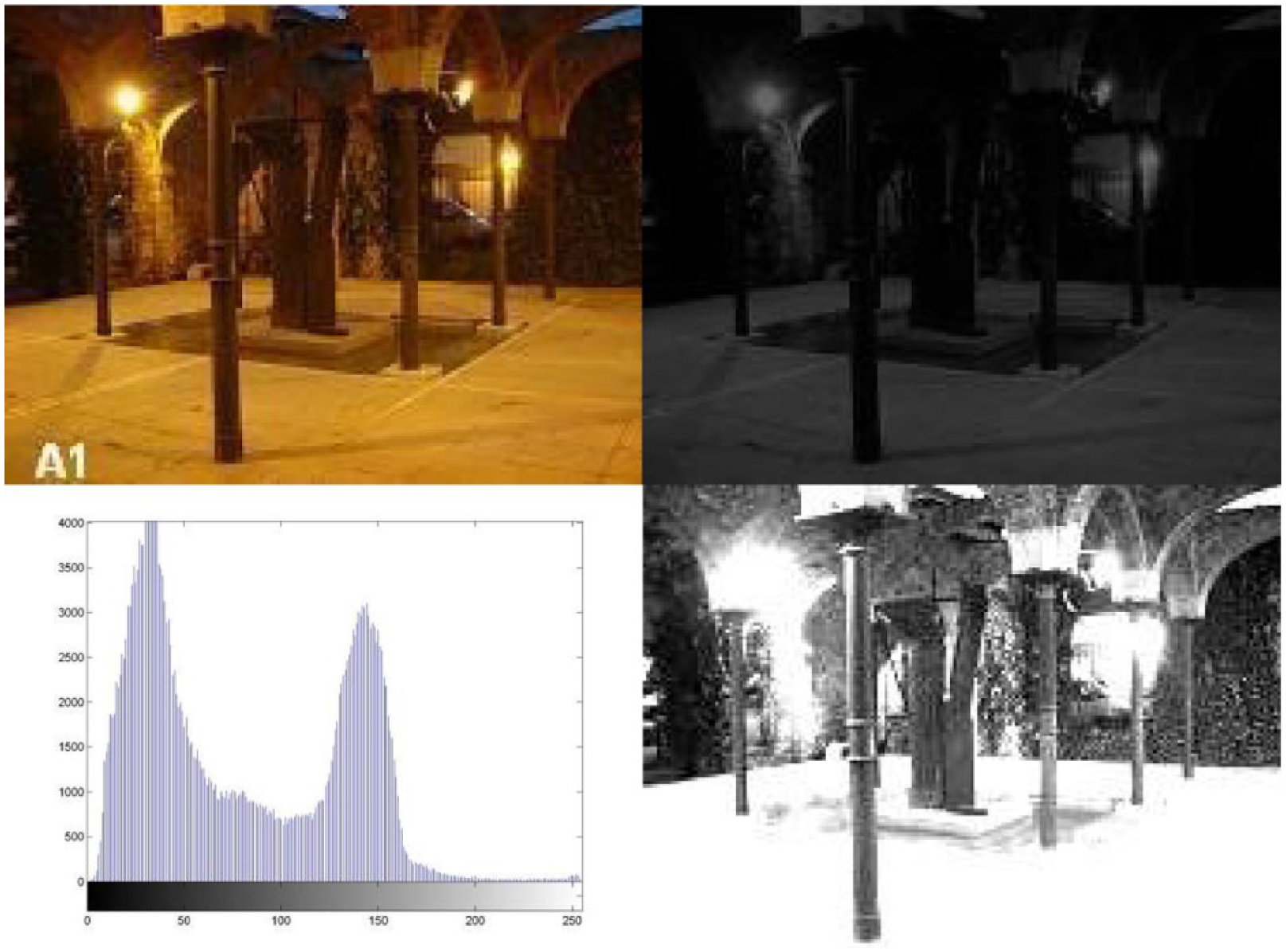
Example of the processing of Image A1.
Data Analysis
It was interesting to notice that, with a statistical significance, the three populations (GDL, FR, BCN) are not identical in terms of emotions generated by the light in the test images; that is, the emotions are affected in a different way by the lighting of the open spaces, depending on the cultural background. To validate this asseveration, we applied the non-parametric test of Mann–Whitney–Wilcoxon (MWW) or Wilcoxon rank-sum test for the ordinal data of the questionnaire S-R (QSR). The question raised was whether the population of students of Guadalajara (GDL) was identical to the population of students of Barcelona (BCN), in terms of the emotions generated by the lighting of the different images. The following hypotheses, null and alternative, were considered:
Table 1 provides a summary of the results.
MWW Test for GDL and BCN.

Note. MWW = Mann–Whitney–Wilcoxon; GDL = Guadalajara; BCN = Barcelona.
Then, at a .01 level of significance, we can reject the Null Hypothesis H0, and we conclude that the two populations of Guadalajara and Barcelona are not the same in terms of the emotions generated by the lighting of the open spaces.
In a similar way, the MWW test was applied to the populations of Guadalajara (GDL) and Perpignan (FR), and for Barcelona (BCN) and Perpignan (FR). In both tests, the null hypothesis is that the two populations are identical in terms of the emotions generated by each image. Table 2 provides a summary of these results.
MWW Tests for GDL and FR, and for BCN and FR.

Note. MWW = Mann–Whitney–Wilcoxon; GDL = Guadalajara; FR = Perpignan; BCN = Barcelona.
Thus, we can observe from these two tables that, with a .01 level of significance, the population of Guadalajara is not identical to the populations of Barcelona and Perpignan in terms of the emotions. The populations of Barcelona and Perpignan are also not identical in terms of emotions, but with a .05 level of significance. That is, the European culture is a factor that would be important for further studies.
To determine if there was a predominant emotion of each image, we made a frequency analysis with the emotions expressed by participants, making a frequency graphic by each image that contained the answers of emotions expressed by the three groups. From the resulting graphics, four types of tendencies were noticed:
Graphics of frequency where we can observe the agreement between the three study groups in the chosen term of emotion related to an image (Figure 3).
Graphics of frequency where a similitude did not exist in none of the emotions expressed by the three groups in relation to an image (Figure 4).
Graphics of frequency where an agreement of emotions existed in a positive sense but not in the chosen term given by the three groups (Figure 5).
Graphics of frequency where an agreement of emotions existed in a negative sense but not in the chosen term given by the three groups (Figure 6).
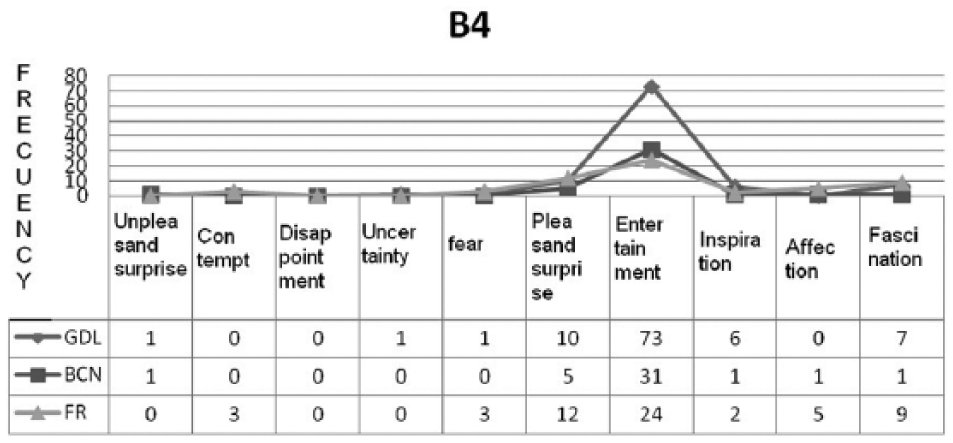
Graphics of frequencies of the Image B4 classified as “agreement” graphic.

Graphics of frequencies of Image B2 classified as “non agreement” graphic.

Graphics of frequencies of Image E3 classified as “positive agreement” graphic.

Graphics of frequencies of Image D2 classified as “negative agreement” graphic.
We show the examples of the four kinds of graphics of frequency in Figures 3 to 6.
Results
The statistical analysis using MWW or Wilcoxon rank-sum test demonstrated the difference in the cross-cultural comparison of answers for the three groups with statistical significance. Yet, some commonalities were found between the answers of the European cultural groups BCN–FR in contrast with those from the Mexican group GDL.
The frequency analysis indicated that in some images, the three groups agreed on the emotions selected. We could distinguish two groups of emotions, those in which the three groups agreed such as uncertainty, fear, affection, fascination, and entertainment; and the emotions understood by each cultural group such as pleasant surprise, inspiration, unpleasant surprise, contempt, and disappointment. It can be inferred that the agreed emotions are recognized by the three groups of study in a similar way.
We analyzed the lighting parameters—color, intensity, diffusion, and direction—of those images that evoke the emotional agreement. The results are summarized in Table 3.
Relation of the Four Lighting Parameters of Images With the Emotions of Uncertainty, Fear, Fascination, Entertainment, and Affection.

Note. NO = not observed; CRI = color reproduction index.
In the images related to the emotion of fear and uncertainty, big areas without lighting or with few lighting points with very low intensity were observed. The images did not provide enough visual information about the urban spaces, such as sidewalks, spatial dimensions according to the participants. The emotion of fear or uncertainty depends on how much visual information is perceived about place. Fear was the chosen emotion when visual information was barely available, whereas uncertainty was chosen when there was slightly more visual information. The main lighting parameter that influenced these emotions was the intensity of lighting.
The images related to the fascination emotion contained high-intensity and focused lighting over decorative elements. They had colored lighting over specific areas and a strong factor of surprise, like lighting where normally it would not be expected, for example, bottom-up lighting, and so on.
The images related to the entertainment emotion share characteristics of the lighting parameters with those related to fascination with the difference that lighting enhanced areas used for recreational activities instead of decorative characteristics.
The images related to affection presented medium- and low-intensity levels as well as warm colors and blurred lighting parameters. They did not have a high contrast of lighted elements in the overall scene.
The examples of the lighting scenes corresponding to these emotions are illustrated in Table 4.
Lighting Scenes Corresponding to Emotions of Uncertainty, Fear, Fascination, Entertainment, and Affection.

From these results, we observed that the lighting parameters are all interrelated, but it is interesting to notice a special relation between these pairs of parameters: intensity diffusion and color direction. We observed that high-intensity and focused lighting are related to emotions that involve more action and movement, such as entertainment; whereas low intensity and blurred quality lighting are related to emotions that involve affectivity, in a positive or negative sense, such as fear or affection. We observed that color and direction are related to emotions that involve originality, such as pleasant surprise or fascination.
Discussion
Here, we compare some common terms used in other subjective studies of lighting, based mostly on indoor environments; against those used in this work, which are based on lighting outdoor environments. This helps better situate the context and contribution of our research.
Most terms are used in the academic literature related to subjective studies on lighting of indoor environments. Veitch and Newsham (1996) used the terms mood states and preferences. The term mood state is associated with the change in attitude of people in studies of exposure effects of lighting conditions—color, intensity, distribution, and so on. The term preference is used for pointing out what people consider to be the better choice when they have the option to compare different lighting arrangements. The terms mood state and preference are associated with the attitude and the choice of lighting condition. These attitudes and choices could be motivated by emotions linked to the experience of lighting, but emotions are not covered in these studies.
Flynn and colleagues (Flynn & Spencer, 1977; Flynn et al., 1973) used the term subjective impression to define the effect of lighting on how the observer perceived a room with six different lighting arrangements. Authors used five assessment categories: perceptual clarity, spatial complexity, spaciousness, formality, and evaluative. In the category of perceptual clarity, the authors assessed the impression of the lighting with descriptions such as clear-hazy and bright-dim, and four other pairs of adjectives. In the spatial complexity, spaciousness, and formality categories, they assessed the impression of the room as simple-complex, large-small, rounded-angular, and four other pairs of descriptors. In the evaluative category, they assessed what we call the “affective quality” of the room, with words such as friendly-hostile, pleasant-unpleasant, beautiful-ugly, and six other pairs of terms (see Flynn & Spencer, 1977; Flynn et al., 1973). The authors proved how the impression of a place changes due to the lighting.
We argue that the term subjective impression in the Flynn et al.’s research refers to the “appearance” of the place due to the lighting arrangements. These different impressions of a place could arouse different emotions in observers, but this topic is not covered in the study. The impression or appearance of a place should be distinguished from the emotions or experience of observers.
We distinguish between the affective quality and emotions in relation to a stimulus. The affective quality refers to an affective property that can be attributed to a place (Russell, Ward, & Pratt, 1981), such as “lovely” and “friendly”; whereas emotions come from the experience of the people; there is difference between “It is a lovely place” or “I love this place.” This differentiation is relevant because we cannot assume that the affective quality of a lighting place will be equivalent to the emotion that people could experience there. The affective quality of a lighting place should be distinguished from the emotion of the people.
In some cases like in images where the three groups agreed on the emotions of uncertainty, fear, affection, fascination, and entertainment, there is a closer link between emotions and the affective quality of the place. We observed that lighting parameters associated with the agreed emotions are related to the affective quality of the place in images.
It seems possible that some emotions are more clearly related to the affective quality than others. The emotions that are understood by a specific cultural group are related to the affective quality that would be experienced by a specific population. The results are important because they indicate that a clear relation between the affective quality and emotions would facilitate the design of a lighting place, to stimulate a positive emotional experience or to avoid a negative emotional experience.
We hypothesize that the results can help understand how a lighting environment influences a specific reaction according to the differentiation of stimulus proposed by Ortony et al. (1996). This means that based on emotions expressed by observers, we could understand whether the lighting stimulus is experienced as an event, object, or agent, as illustrated in Figure 7.

Synthesis of the valuable structure proposed by Ortony, Clore, and Collins (1996).
It could be possible to predict the valuable bases in terms of aesthetic if the stimulus is an object, or plausibility if it is an agent, or desirability if it is an event. Further research is needed to confirm this argument.
Conclusion
Our research is about the lighting of outdoor environments, while most of the currently available subjective studies are based on the lighting of indoor environments. According to our results, emotions are more related to the experience of the lighting than to the appearance of the place. We can differentiate the affective quality attributed to the place from the emotions evoked by the lighting.
The urban lighting influences the emotions of observers. The emotions are linked to a cultural background as in the case of pleasant surprise; inspiration; unpleasant surprise; contempt; and disappointment. A slight variation was noticed in the cultural differences of the three groups of participants. The two European groups had similar answers that were different from the Mexican group, according to the statistical analysis of MWW or the Wilcoxon rank-sum test. This indicates that cultural differences between Europeans and Latin Americans would be an important focus for further studies.
However, there were other emotions where the cultural background was not a distinctive factor in the answers of the three groups. These agreed emotions were uncertainty, fear, affection, fascination, and entertainment.
We conclude that there are emotions of lighting places which are experienced by a wider population. They could be related to the respective lighting parameters of images. In those cases, the affective quality of the lighting place is more directly related to a particular emotional experience. By contrast, in the case of the emotions culturally understood this relation would be valid for a particular population.
A special relation between the positive emotions and the visual information of the images was observed. In the images with clear visual information of the urban space, the participants agreed with positive answers; whereas in the negative reported images, visual information about the use or orientation of urban space was unclear.
We should acknowledge some limits in this study, like the lack of numerical data related to the lighting parameters of the physical places where the images were taken. This was in part due to the fact that, at the moment when the research was conducted, we did not have the appropriate measurement instruments. However, this missing information, together with potential usage of advanced image-processing methods, could be the basis for further research on this topic.
Footnotes
Declaration of Conflicting Interests
The author(s) declared no potential conflicts of interest with respect to the research, authorship, and/or publication of this article.
Funding
The author(s) received no financial support for the research and/or authorship of this article.