




Abstract
Usually, sentinel events and gender are useful variables to propose appropriate intervention strategies for promoting public health. The Italian legislation has incorporated aspects of the scientific literature of stress into law 81/08 and the ministerial circular of November 18, 2010, obliging the detection of work-related stress with specific reference to gender and working environment characteristics. Specifically, the Italian law requires the discovery of sentinel events in the working environment. This study evaluates the role of sentinel events in the detection of work-related stress in relation to gender. The sample includes 249 Italian subjects of a debt collection company divided into two groups (male and female) and distributed in two different categories: Inside Sentinel Events and Outside Sentinel Events. A multifactorial questionnaire, the Organizational and Psychosocial Risk Assessment (OPRA), was administered. The application of two-way ANOVA did not show any statistically significant differences due to gender between the subjects who belonged to the sentinel events group and those who did not belong, as assessed by the Risk Index, the Inventory of Source of Risk, and variables linked to work conditions (work function and seniority). Significant differences were found between men and women only on the index of physical and mental health. Subsequently, three performed linear regression confirm the same results.
Keywords
Work-related stress is recognized as one of the major issues in the workplace (Damiani, Federico, Pinnarelli, Sammarco, Ricciardi, 2006; Marinaccio et al., 2013). It has a significant effect on both the health of employees (Cooper, Lawson, & Price, 1986; Damiani et al., 2006; Deitinger et al., 2009; Nahar, Hossain, Rahman, & Bairagi, 2013; Nieuwenhuijsen, Bruinvels, & Frings-Dresen, 2010; Sakketou, Galanakis, Varvogli, Chrousos, & Darviri, 2014; Thorsteinsson, Brown, & Richards, 2014; Turk, Davas, Tanik, & Montgomery, 2013; Von Onciul, 1996; Xiang, Coleman, Johannsson, & Bates, 2014) and the productivity and business competitiveness (Damiani et al., 2006; Magnavita & Garbarino, 2013; Van der Klink, Blonk, Schene, &Van Dijk, 2001; Xiang et al., 2014).
In the literature, there are several contributions that have enriched the scientific debate by defining theoretical models and tools for its detection. Karasek (1979) developed the Question-Control model to explain that individual working conditions do not lead to the manifestation of stress-related diseases, but their interaction might (Magnani & Majer, 2011). This model is based on two principal factors: (a) job demand (the load and complexity of the work), conceived in terms of the mental and physical effort required to perform a specific task, and (b) job control (decision-making autonomy), tied to the ability to organize and carry out the assigned task (Favretto, 1994). Studies show that the simultaneous presence of high “job demands” and poor job control is often associated with malaise and with a low level of job satisfaction (job strain; Magnani & Majer, 2011). However, Karasek’s studies do not take into account psychosocial factors that are closely related to the work environment, such as social support (social-emotional and instrumental support received from colleagues and superiors; Fraccaroli & Balducci, 2011). This dimension was integrated by J. V. Johnson and Hall (1988), with a revision of the Karasek model. Other studies have shown the need to make a clear identification of the various sources of risk in the workplace, including the weight of the personality variables too (Magnani, Mancini, & Majer, 2011).
Cooper and Marshall (1976) define the sources of stress in terms of “pressures” from the environment that affect individual-level psychophysical states, resulting in reduced work, performance, absenteeism, and poor job satisfaction (Gilboa, Shirom, Fried, & Cooper, 2008; Magnani & Majer, 2011). These sources can be divided into five categories: intrinsic sources at work (e.g., noise, lighting), role-related factors, career development (CD), work relationships (relationship difficulties), and finally the structure and organizational climate (constraints on decision making, budget, participation). Personality characteristics and behavior (e.g., locus of control, flexibility/rigidity) are other elements that contribute to determining the reaction of the subject to the sources of stress in terms of adaptability. The main novelty of Cooper’s (1986) proposed model lies in the introduction of work–life balance (WLB). Gatrell and Cooper (2008) recognize the close relationship between work and private life, emphasizing how the stress response also depends on factors related to the family context and the ease/difficulty of reconciling professional demands and personal-family life. The interdependent relationship between the work and private spheres is demonstrated by the fact that on one hand, family-related problems, life crises, financial difficulties, conflict between friends and family demands can expose the individual to strain on work; on the other hand, work-related stress can have negative consequences on family and personal life (Favretto, 1994). Simultaneously, however, private-life factors can mitigate the effects of job stressors, and conversely, job satisfaction can help the individual to compensate for unsatisfactory aspects of private life (Favretto, 1994).
Job satisfaction is considered a condition of well-being at work that promotes a positive attitude toward employees, increasing their availability in the working environment and improving business productivity (Lee, An, & Noh, 2012; Visser, Smets, Oort, & De Haes, 2003). It is known that job satisfaction is linked primarily to characteristics of the work environment rather than to individual variables (Cotton & Hart, 2003; Kohantorabi & Abolmaali, 2014; Lee et al., 2012; Xanthopoulou, Bakker, Demerouti, & Schaufeli, 2007).
The evaluation parameters of the working environment are absenteeism, overtime, interpersonal conflicts, complaints, letters of recall, injury rate, which can be considered indicators of the possible development of work-related stress (Deitinger et al., 2009; Magnavita & Garbarino, 2013; Marcatto, D’Errico, Di Blas, & Ferrante, 2011; Patronella et al., 2011) or, more generally, as an expression of a condition of organizational malaise (Bennett, Cook, & Pelletier, 2003; Parks & Steelman, 2008). They seem to be related to both the content (e.g., load and place of work, rotations, and time) and the working context (e.g., CD, WLB, quality of relationships [QR], lack of decision-making autonomy, lack of control; Bosma, Peter, Siegrist, & Marmot, 1998; Giorgi, Leon-Perez, Cupelli, Mucci, & Arcangeli, 2014; Homer, James, & Siegel, 1990; S. Johnson et al., 2005; Kerr, McHugh, & McCrory, 2009; Mausner-Dorsch & Eaton, 2000; Urbanetto De Souza et al., 2013).
These aspects are considered in the literature as factors that not only contribute to defining a general condition of work-related stress but are also markers of gender differences in responses to environmental pressures (Bellman, Forster, Still, & Cooper, 2003; Conti, 2009; Davidson & Cooper, 1983; Turk et al., 2013).
According to the majority of studies, WLB (Bolino & Turnley, 2005; Clays, Kittel, Godin, De Bacquer, & De Backer, 2009; Gyllensten & Palmer, 2005; Hagqvist, Gådin, & Nordenmark, 2012; Loosemore & Waters, 2004; Premeaux, Adkins, & Mossholder, 2007), CD (Loosemore & Waters, 2004), and social and organizational support — that is, the quality of the relationship (Colombo, Zito, & Ghislieri, 2012; J. V. Johnson & Hall, 1988; Narayanan, Menon, & Spector, 1999; Thompson, Kirk, & Brown, 2005) — represent the dimensions that strongly determine the development of a condition of work-related stress, which is greater in women than in men. There are several aspects that may help explain these differences. For example, some studies have revealed that women, unlike men, often find themselves in roles of minor organizational power in social relations (Schmid Mast, 2010). Social and organizational support is a dimension within which the female gender experiences a form of empowerment because of the constant social recognition they receive (Fraccaroli & Balducci, 2011). Recognition, which can also be achieved through CD, can lead to career progression with obvious growth of social prestige. Furthermore, women seem to be characterized primarily by the use of emotion-focused coping strategies instead of problem-focused coping, which is peculiar to the male gender (Nelson & Burke, 2002). In this sense, a high-quality relationship appears to be an important protective factor.
Several studies have identified how the system of family–work balance is a matter that is still strongly connected to the female gender rather than to the male gender because of women’s role of caring for their children, their house, and their elderly family members (Clays et al., 2009; Marinaccio et al., 2013; Miller et al., 2000; Naldini & Saraceno, 2011; Premeaux et al., 2007). A survey of the Italian National Institute of Statistics (2006) related to gender differences in leisure time has shown that male workers spend an average of 2 hr per day helping the family, whereas women spend an average of 5.5 hr.
The Legislative Decree no. 81/2008 and the subsequent circular of the Ministry of Labour and Social Policy of November 18, 2010, made mandatory in Italy the assessment of work-related stress (Deitinger et al., 2009; Magnavita & Garbarino, 2013; Marcatto et al., 2011; Patronella et al., 2011), as established by the Framework Agreement on Work-Related Stress (October 8, 2004) and the findings in the literature on the subject, described above.
Italian law determines the guidelines that leave operators free to use the methods deemed most appropriate. The guidelines prohibit the measurement of stress based on individual and subjective indicators, such as variables and personality characteristics, to protect the privacy of the worker and above all to protect it from possible discriminatory actions. On the contrary, it prescribes the use of “objective and verifiable indicators, where possible numerically significant, belonging to three distinct categories: sentinel events, factors of job content and context factors of labour.”
The factors related to the content and context of the work coincide with those that have been defined by the scientific community and previously reported.
Sentinel events are a general category used in the conceptual framework of health policies to indicate possible “red flags” related to a potential occurrence of disease. They have different declinations and nomenclatures in relation to the scope, such as surgery or radiology (Office of Public Health Informatics and Epidemiology, Nevada Division of Public and Behavioral Health, 2013). The work of The Joint Commission (2008, 2009, 2014) provided the basis for their definition in 1998 (McLaughlin, 2008): They are, an unexpected occurrence involving death or serious physical or psychological injury, or the risk thereof. Serious injury specifically includes loss of limb or function. The event is called “sentinel” because it sends a signal or a warning that requires immediate attention.
The phrase “or the risk thereof” includes any process variation for which a recurrence would carry a significant chance of a serious adverse outcome (Sollecito & Johnson, 2011; Wilf-Miron & Lewenhoff, 2001). Basically, sentinel events are “a type of clinical indicator used to monitor and appraise the quality of care, including events that require immediate attention” and “an adverse event in health care delivery or other service, which either leads to or has potential to lead to catastrophic outcomes (near miss), thereby often mandating initiation of emergency intervention or of preventive measures” (MediLexicon, 2015). This notion therefore refers directly to the legal responsibility of the employer in terms of health and safety of workers, something that cannot be ignored by the organizations.
The Italian law therefore recognizes a cumulative effect of stress—as shown by the literature (Cooper, Sloan, & Williams, 1988; Magnani & Majer, 2011)—that occurs within the organization field with sentinel events, that is, with the increase in, for example, turnover, disciplinary procedures, accidents, sickness absences, and complaints formalized by workers. Sentinel events have a prominent role in the development of work-related stress to the point that operators are asked to detect their presence and distribution in the preliminary measurement of work stress. In particular, sentinel events are considered strategic elements in the construction of homogeneous classes of psychosocial risk (Andrisano-Ruggieri et al., 2015). These classes may represent risk indicators of stress that are objective and verifiable (Bosma et al., 1998; Giorgi et al., 2014; Homer et al., 1990; S. Johnson et al., 2005; Kerr et al., 2009; Mausner-Dorsch & Eaton, 2000; Urbanetto De Souza et al., 2013).
The legislation requires simultaneously taking into account gender differences by virtue of the different responses that differently gendered workers provide to stressors.
However, there are no studies that measure the role played by sentinel events, let alone because of gender.
The Present Study
This study aims to understand the role of sentinel events and gender in the measurement of work-related stress on the basis of the constraints imposed by the Italian law. Our hypotheses are as follows:
Method
Sample
The sample is non-probabilistically balanced and reasonably chosen in relation to organizational variables related to the job content. It is comprised of 249 subjects (98 male and 151 female) from a population of 770 employees of a single debt collection company; thus, it represents approximately 30% of the population. It is comprised of individuals who fall into the following risk categories: Inside Sentinel Events (ISE) and Outside Sentinel Events (OSE). Considering this partition, groups were formed taking into account their WFs—corporate (C group), governance (G group), back office (B group)—the organizational conditions, and their length of service (LoS): Cluster 1 (<5 years), Cluster 2 (5-15 years), Cluster 3 (16-25 years), Cluster 4 (≥25 years).
Materials and Procedure
An OPRA (Organizational and Psychosocial Risk Assessment) questionnaire was used to assess work-related stress (Magnani et al., 2011). OPRA is a multifactorial questionnaire that was developed by the Academy to evaluate effectively the presence of psychosocial risk factors and work-related stress conditions in accordance with the requirements of Legislative Decree no. 81/08 and with the findings in the literature. It is structured in three parts, each of which evaluates different aspects of the work experience based on a 5-point Likert-type scale (from never to always) through three indexes:
Risk Index (RI)
The RI consists of five items that assess the malaise resulting from a condition of low identification with the group and organization to which the participants belong due to low job satisfaction, poor confidence in the organization, and the desire to leave their place of work (e.g., What is your level of satisfaction in your current job? How confident are you in the ability of the organization to best use the results of this survey to improve the current work conditions?). This index has a Cronbach’s alpha of .71.
Inventory of Sources of Risk (ISRs)
The ISR consists of 65 items distributed over nine factors responsible for evaluating the sources of stress at work that may cause distress or discomfort. It consists of nine subscales:
Culture & Organization (10 items), where formal and informal aspects in the definition of objectives and management changes are recognized (e.g., organizational goals are well defined)
Role (seven items), where ambiguities, conflicts, and self-awareness are investigated (e.g., you are asked to perform tasks that make no sense or are demeaning)
CD (six items), where perceptions of opportunities for professional development are investigated (e.g., you are excluded from the possibility of professional advancement)
Autonomy (five items), which investigates participation in decision making (e.g., you have a say in the organization of your work)
WLB (five items), where pressures from work outside of the work context and vice versa are investigated (e.g., relationships with family members and/or partners are problematic because of work)
Environment and Safety (seven items), which investigates structural and cultural aspects related to security (e.g., workplace is comfortable and well-lit)
Workload (eight items), which investigates the conditions of overstimulation caused by the amount of work and its rhythm (e.g., if forced to neglect certain tasks due to having too much work to do)
Working Time (six items), where stresses derived from shifts and work schedules are investigated (e.g., you are forced to stay and work after hours)
QR (11 items), which investigates forms of conflict and cooperation present in work processes (e.g., your colleagues and/or managers refuse to work with you)
The literature considers them central in the development of work-related stress and relevant to gender differences. This index has a Cronbach’s alpha of .71.
Mental and Physical Health (MPH)
The MPH is a two-dimensional scale (16 items) that assesses the presence and frequency of physical and psychological disturbances. It provides an aggregated score that estimates the effects of stressful working conditions (e.g., feelings of excessive tiredness, difficulty falling asleep or disrupted sleep, headaches, neck pain). This index has a Cronbach’s alpha of .90.
Procedure
A Sentinel Events Database (SED) comprised of a double-entry table was created: The line includes the ID codes of the subjects, whereas the column contains the variables related to sentinel events (e.g., turnover, sick days, overtime, working unit shift, absences). Thus, we were able to perform the intersections between structural variables—that is, elements that structure work activities (e.g., role, WF)—and sentinel events. Moreover, the sentinel events were monitored in relation to the parameters of average and duration. Thus, the homogeneous classes of risk were obtained. This survey shows that 71.89% of the population was affected by sentinel events, and the remaining 28.11% was left out. Thus, we proceeded to perform a sampling that considered the presence or absence of sentinel events according to the WF based on role, working unit, territorial unit, and gender.
The results obtained after the administration of OPRA were then subjected to statistical analysis using the Software STATA 12.1 (StataCorp, 2011). The Shapiro Wilk Test was used to ensure that the data were in accordance with a normal distribution. Subsequently, a two-way ANOVA was run to examine the effect of gender and SE (independent variables) on three OPRA indexes, also taking into account variables such as LoS and WF. The same procedure was applied to the scores obtained in the subscales of the ISR related to the interface of WLB, the QR, and CD.
Gender, sentinel events (both dichotomous variables), the LoS (ordinal variable), and job functions (nominal variable) were considered independent variables, and the three OPRA indexes and subscales WLB, CD, and QR were considered dependent variables.
Results
The results are presented in sequence for each OPRA index and for each subscale taken in account.
RI
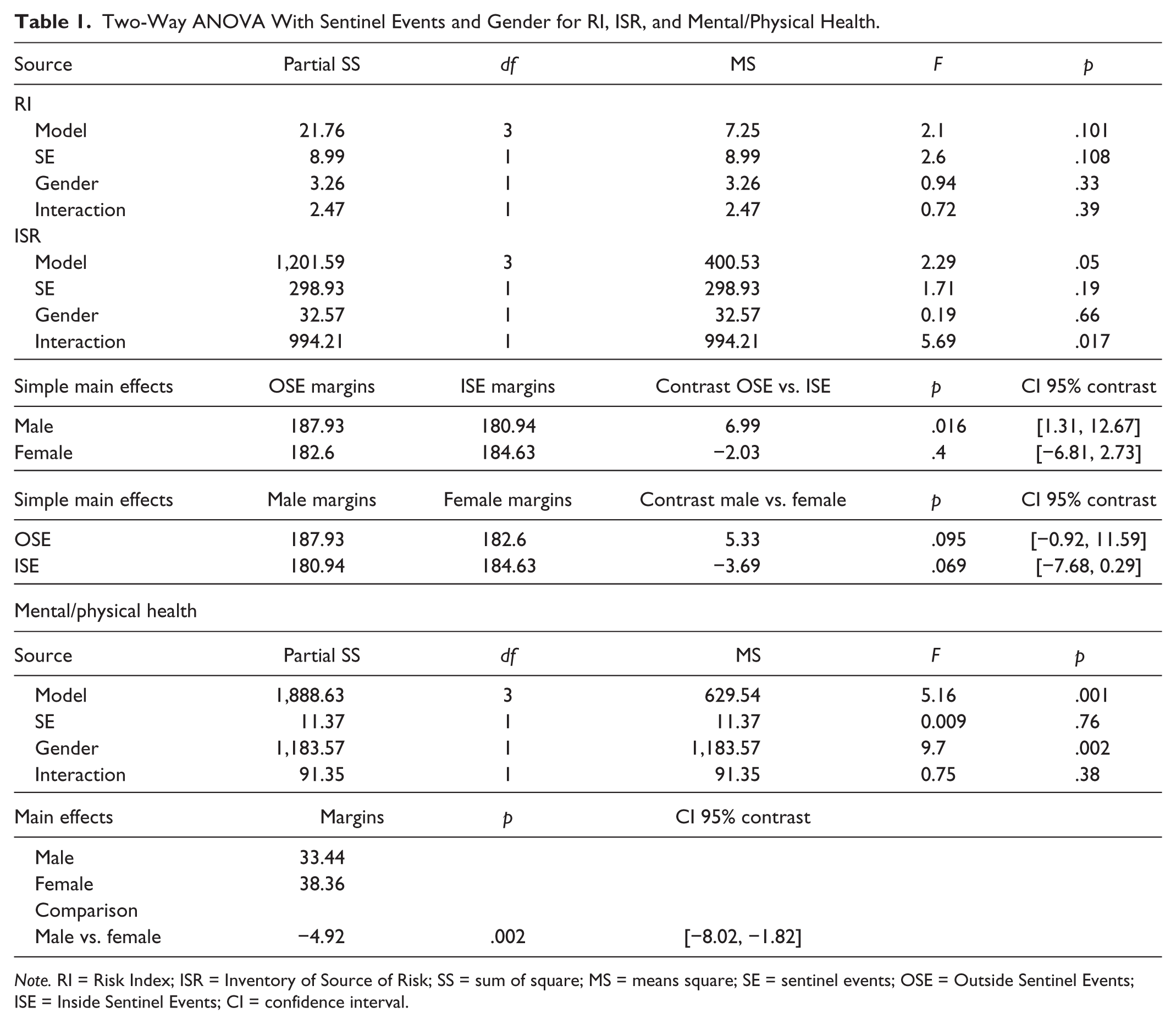
For the RI, there is no influence of independent variables (SE = 0.108; gender = 0.33), and there are no indicative significant interactions between the two independent variables (p = .39; Table 1). Therefore, sentinel events have no influence on the RI; that is, they have no function of alarm. Even gender does not in any way affect the RI.
Two-Way ANOVA With Sentinel Events and Gender for RI, ISR, and Mental/Physical Health.
Note. RI = Risk Index; ISR = Inventory of Source of Risk; SS = sum of square; MS = means square; SE = sentinel events; OSE = Outside Sentinel Events; ISE = Inside Sentinel Events; CI = confidence interval.
ISR
In this case, sentinel events and gender did not show any significance; they in no way influenced the ISR. On the contrary, the interaction between the two variables is statistically significant (F = 5.69, p = .017). The simple main effect analysis showed that this interaction was due to the OSE and ISE variables’ relationship to the male gender. The simple main effects analysis showed that the mean scores of ISR in male subjects were significantly different, split by SE: 0 (187.93), 1 (180.94), p = .016; whereas in female subjects, there was no significance difference, SE: 0 (182.6), 1 (184.63), p = .40. In fact, the contrast between males OSE and ISE (6.99) was statistically significant (p = .01). Therefore, males OSE appear on average more exposed to sources of risk. It is also possible to identify the opposite reaction of females in relation to males: Females ISE obtained a higher average score than females OSE (Table 1). Although not significant, the finding highlights a trend that suggests that there is likely a different mode of reaction and perception to the sources of risk between genders.
Mental/Physical Health
For the MPH index, only the variable gender has a statistically significant influence (p = .002), whereas the SE does not have any influence. There are no significant interactions between variables. The main effects analysis shows that females obtained a higher average score than males, who recorded a significant score almost 5 points lower than females (−4.92, p = .002, CI = [−8.02, 1.82]). These data show that there is a higher sensitivity in women to self-perceive their MPH. However, sentinel events do not appear to be related to this change in score.
WLB, the QR, and CD
As shown in Table 2, no statistically significant interaction appears for gender and sentinel events–related WLB (p = .17), and they have no influence on this subscale (SE: p = .42; gender: p = .46).
Two-Way ANOVA for WLB, CD, and QR.

Note. WLB = work–life balance; CD = career development; QR = quality of relationship; SS = sum of square; MS = means square; SE = sentinel events.
Similarly, there were no significant interactions between SE and gender for the dependent variable CD (p = .56), and there were no influences of the two independent variables on the CD (SE: p = .76; gender: p = .93).
For the subscale QR, there are no influences of SE (p = .71) or gender (p = .89), much less interactions between them (p = .15).
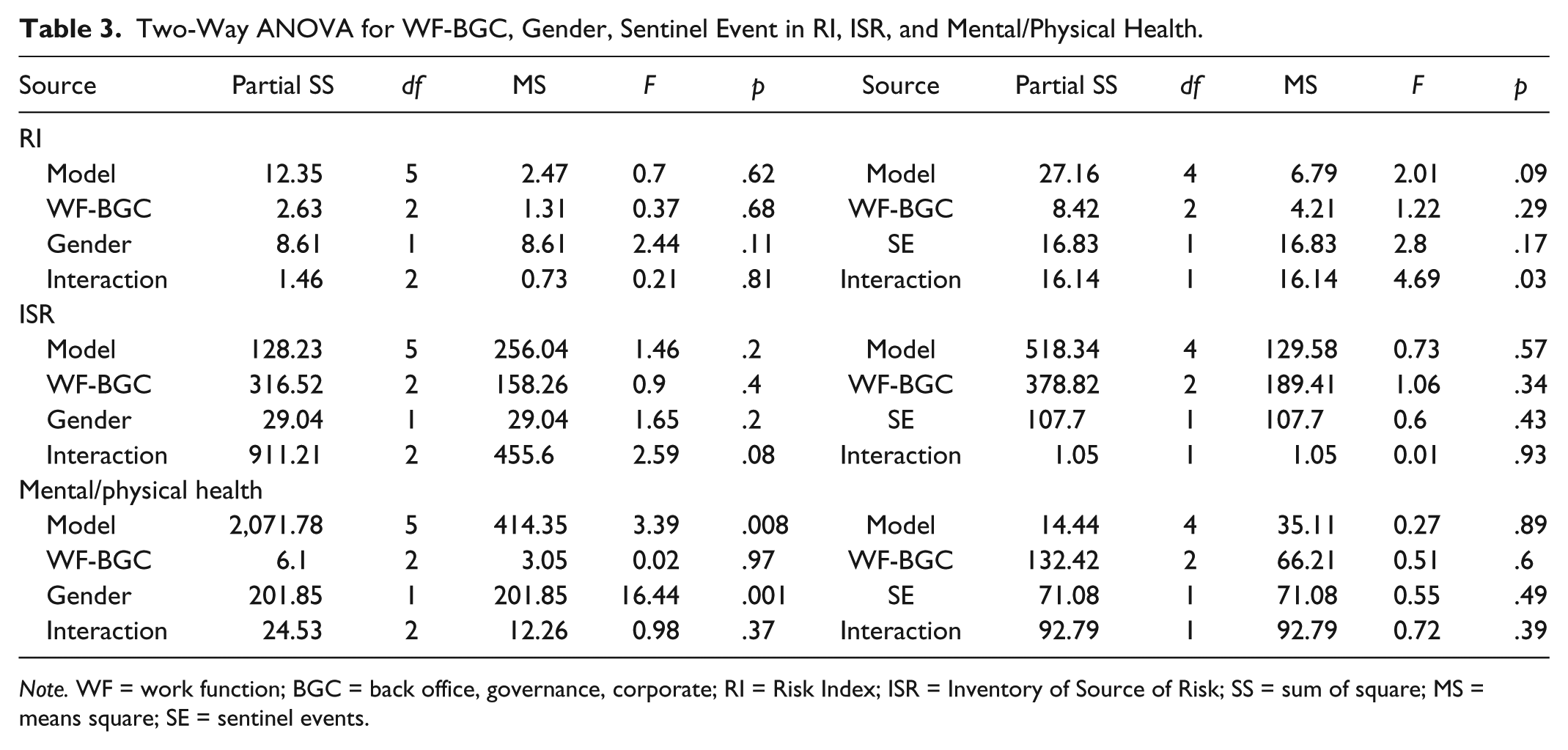
The subsequent searches operated on the organizational variables, such as LoS and job functions, in relation to gender, and the sentinel events show no significance for the three OPRA indexes. Therefore, organizational dimensions have no influence on the three OPRA indexes, and there is no interaction between the independent variables (Table 3 and Table 4).
Two-Way ANOVA for WF-BGC, Gender, Sentinel Event in RI, ISR, and Mental/Physical Health.
Note. WF = work function; BGC = back office, governance, corporate; RI = Risk Index; ISR = Inventory of Source of Risk; SS = sum of square; MS = means square; SE = sentinel events.
Two-Way ANOVA for LoS, Gender, Sentinel Event in RI, ISR, and Mental/Physical Health.

Note. LoS = length of service; RI = Risk Index; ISR = Inventory of Source of Risk; SS = sum of square; MS = means square; SE = sentinel events.
Discussion
The importance of sentinel events in the promotion of good health is widely shared. Different agencies in the world provide annual reports in which the ratio of sentinel events and conditions is monitored (Accettura et al., 2015; Baker, 1989; Clancy, 2015; Raghavan, 2015).
Contrary to what the literature says, in our work, sentinel events appear to lose consistency with regard to their alarm function, thus failing in their managerial action to promote health in the workplace, acknowledged by National Institute for Occupational Safety and Health (Sauter, Murphy, & Hurrell, 1990).
In fact, our results show a substantial absence of differences between the scores obtained by the ISE and OSE subjects in relation to the OPRA indexes RI, ISR, and MPH irrespective of gender. Based on what is reported in previous work (Andrisano-Ruggieri et al., 2015), this could be explained by the time that elapsed between the detection of sentinel events and the subsequent administration and processing of the OPRA. Gabassi (2006) showed that the constant duration of the action of stressors can slowly erode the psychophysical defense system.
Moreover, the Diagnostic and Statistical Manual of Mental Disorders (5th ed.; DSM-5; American Psychiatric Association, 2013) states that the development of disease is related to the continuous and persistent exposure to stressors. The DSM notes, therefore, the importance of a time span. As a result, the time gap between the various steps of the study (detection of sentinel events, construction of the database sentinel events, definition of the sample, and administration of the OPRA questionnaire) may have changed the working conditions (e.g., workload, pressures at work, conflict at work), thus affecting the role assumed by sentinel events in the measurement of work-related stress. These facts, once again, suggest that sentinel events are not in themselves indicative of the presence of stress-related pathologies (Faragher, Cooper, & Cartwright, 2004).
On the contrary, sentinel events must be considered elements within an organizational process that is in itself dynamic and subject to the variability of the production process. Therefore, they must be subject to constant monitoring in the specific conditions of the context. For example, overtime is not systematic, but it is greatly related to extemporaneous productivity requirements.
Generally, data on subscales do not provide relevant information in terms of gender differences in relation to the categories ISE/OSE.
Further evidence in this direction comes from the results of the two-way ANOVA, which shows no statistically significant differences between genders in the ISE/OSE categories because of stratification results for WFs (B, C, G groups) and LoS (Clusters 1, 2, 3, 4) for all three OPRA indexes.
Even this finding of our research appears to contradict what most of the literature reports, such as the fact that factors such as CD (Loosemore & Waters, 2004), the home–work interface (Clays et al., 2009; Hagqvist et al., 2012; Loosemore & Waters, 2004; Premeaux et al., 2007), and organizational support (Colombo et al., 2012; J. V. Johnson & Hall 1988; Narayanan et al., 1999; Thompson et al., 2005) can significantly influence the development of work-related stress, particularly in women.
However, we think that these results reflect a setting of research that is still strongly stereotyped by gender and that binds women and men into specific social roles: for example, the idea of a lower status of women relative to men; the idea of a woman who is a mother, daughter, and wife, and thus finds herself playing many more roles than men (Fotinatos-Ventouratos & Cooper, 2005; Galanakis, Stalikas, Kallia, Karagianni, & Karela, 2009; Ghorayshi, 2002); and the idea that the full-time commitment is tied to masculinity and virility (Gatrell & Cooper, 2008).
In this regard, some of the literature has highlighted that the new socio-family configuration is characterized by a progressive increase in the number of single-parent families, single men who have care responsibilities toward their loved ones, and married men who, like their wives, address issues related to their household (Frone, Russell, & Barnes, 1996; Premeaux et al., 2007). Obviously, this social matter is accompanied by another economic factor, which is shown in the substantial 4.9% increase in the female employment rate in recent years in Europe (Eurostat, 2014; Naldini & Saraceno, 2011). Therefore, we must acknowledge that these changes have a significant effect on redefining the role of gender in the workplace.
For example, it is difficult today to imagine a workplace of only men or only of women, just as it is hard to imagine that a male figure is anchored only in job functions and without commitment to home care. According to us, our results can be explained in a cultural reduction of gender differences: Women increasingly occupy positions of power, have more responsibility and receive social and organizational support.
Lately, there has been an increase in studies on the effect of labor flexibility, on working hours, on WLB and, more generally, on the welfare of workers (Shagvaliyeva & Yazdanifard, 2014). Some studies have shown that workers who have more access to flexible work showed low levels of conflict between home and work (Bond, Thompson, Galinsky, & Prottas, 2002; Hill et al., 2008). These issues concern not only the organizational processes per se but also their management in terms of budget and legislative constraints. For example, we know that in the company under study, overtime corresponded not to monetary compensation but to an equivalent number of hours of rest and/or recovery. We believe that this business strategy that further explains the differences between the absence is generally in WLB subscales, making our data consistent with studies that have shown that the right balance between the level of stress due to daily work and the recovery from “fatigue “outside of working shifts has positive effects on employee performance (Geurts & Sonnentag, 2006; Sonnentag, 2003; Sonnentag & Natter, 2004). In fact, inadequate recovery from fatigue increases the risk of developing chronic work-related stress (Winwood, Winefield, Dawson, & Lushington, 2005). It seems that the perception of stress can be reduced significantly under this compensation system (Shagvaliyeva & Yazdanifard, 2014), and it also seems clear that measurements of work-related stress are not possible without a clear understanding of the policies of human resources management operated by the company.
In the literature, there are no works that analyze sentinel events and gender in relation to organizational variables in work or job functions. Shirom, Gilboa, Fried, and Cooper (2008) have considered the LoS as a moderator of the stress condition because it is closely connected with high knowledge and familiarity of the context of work and organizational processes. Therefore, along LoS corresponded to a low level of uncertainty. However, our results do not allow any discrimination between LoS, WFs, sentinel events, and gender. We believe this lack of differentiation between seniority and WFs has to be explained in specific aspects of the company under consideration, such as the organizational culture. If we accept the reasoning of Shirom et al. (2008), for example, the lack of differentiation of service suggests the presence of varying culture capable of moderating and/or playing a protective role in work-related stress. In other words, the roles, functions to be covered, tasks, and activities are clear from the very first day of work. Therefore, we think that the organizational culture should be seriously considered when working in this direction (Andrisano-Ruggieri et al., 2015).
However, the significant differences reported between females and males for the MPH allows us to understand some important aspects and to advance different explanations of why. If it is true that the current legislation—related to the most reliable theories on stress connected to environmental factors such as the characteristics of the workplace (e.g., autonomy, variety of tasks, job application, social support)—plays a prominent role in relation to the individual variables in the possible development of work-related stress (Deitinger et al., 2009), in our view, other factors cannot be excluded because they may adversely affect the worker and his behavior, such as individual components (e.g., self-esteem, self-efficacy, strategies coping; Sakketou et al., 2014).
In fact, in some studies, the higher levels of stress in women are explained by the general tendency of women to speak with fewer reservations about issues related to stress (Baldasseroni et al., 1998; Iwasaki, Mckay, & Ristock, 2004; Lim & Teo, 1996). Unlike men, who usually underestimate their levels of stress, women manifest more openly their feelings and consequently also their hardships. Based on the reported studies on health in the workplace (Antoniou, Ploumpi, & Ntalla, 2013; Peter et al., 2002; Xanthopoulou et al., 2007), we believe that the scores recorded are also linked to personal resources, with particular reference to coping strategies. It is widely known that the style of coping varies with gender, significantly affecting the response to stressors (Antoniou et al., 2013; Austin, Shah, Polychroni, & Vlachakis, 2005; Betoret & Artiga, 2010). This difference between the genders, although not statistically significant, results in terms of trends in relation to the sources of risk, confirming a different perception of threat between males and females.
The MPH index seems to take the role of a stress condition indicator. However, in our opinion, this figure is only partially true. In fact, the administration OPRA and the correction of the score points mediating T points does not imply a clinically relevant difference between males and females; this difference emerges exclusively in subsequent statistical analyses reported in this study, for which sentinel events maintain a function indicator that is not necessarily anchored to a stress condition for gender.
Conclusion
The results show a substantial absence of differences between the scores obtained by the workers ISE and OSE, irrespective of any gender. This result confirms an aspect that is partially present in the literature, that is, that sentinel events do not necessarily represent critical elements in the development of work-related stress. The role of these factors seems to be significantly influenced by the time dimension, with the consequence that the levels of work-related stress vary according to the precise moment when their measurement is carried out due to variations in the work conditions. These data remain unchanged, stratified by gender, function, and LoS. Gender differences occur only on the MPH index. The higher scores for the MPH index suggest that the responses of workers to stressors vary particularly in light of individual variables, such as cognitive styles and coping strategies.
Finally, our study shows that the consistency and/or inconsistency of sentinel events appear to be closely related to the organizational dimensions of the manufacturing process, where a factor such as the organizational culture can play an important role in the interests of their greater understanding. In our view, the study on occupational stress needs to integrate the nomothetic approach with ideography, where the second warrants seizing the variability of the company’s human resources management and to bringing it to the macro-scientific constructs, which define work-related stress (Zhang & Lee, 2010). This assessment is conspicuously absent in the literature, where macro-conceptual categories (e.g., role, flexibility) are applied and studied by deprivation of their business operations.
Limitations and Future Research
This work presents some limitations. Based on the results obtained, we believe that a correct evaluation of the relationship between sentinel events, gender, and work-related stress is only possible through a longitudinal study. This would allow for the proper assessment of the effects of continuous exposure to stressors in terms of duration and frequency (Gorrese & Ruggieri, 2012, 2013).
Another factor to consider is the weight of personality variables in the development of work-related stress, with particular reference to coping strategies. It is generally accepted that these factors significantly influence the perception and evaluation of stressors, favoring the emergence of different responses among individuals due to their singularity and gender (Cotton & Hart 2003; Miller et al., 2000; Rothmann, Steyn, & Mostert, 2005). However, the Italian legislation does not allow such a measure because it is able to detect data only in an aggregated and anonymous form to avoid possible discrimination for workers. Moreover, variables such as organizational culture should be further deepened because they can mediate the terms of work-related stress, promoting protective behaviors and/or risks. Although this aspect in the literature is widely shared, there is a lack of studies in this direction that are able to meet individual and cultural variables in relation to occupational stress.
Moreover, access to some structured dimensions related to sentinel events is not without weaknesses. In fact, many aspects related to socio-demographic variables that could explain some items on the sources of risk have been lost. For example, in the company studied, overtime was compensated not by higher wages but by a decrease in working hours in the period in which the company needed less work. In this case, it was not possible to detect how the overtime of a subject X has been compensated. It was not possible to detect useful variables for WLB because of privacy laws; for example, if the subject X is married and has children, what type of relationship is maintained with his or her family? Such data would provide fundamental information for understanding the relationship between sentinel events, gender, and work-related stress (Galanakis et al., 2009).
Future research should therefore, on one hand, focus on the relationship between stress and the time of exposure to stressors, taking into account the active dynamics in the workplace; on the other hand, it should deepen the relationship between personality and culture variables and the development of stress-related diseases. In this regard, a focus should be placed on the role currently played by risk factors such as WLB, CD, and the social support and organizational health of the workers in consideration of the socio-family configuration (Premeaux et al., 2007).
Footnotes
Declaration of Conflicting Interests
The author(s) declared no potential conflicts of interest with respect to the research, authorship, and/or publication of this article.
Funding
The author(s) received no financial support for the research and/or authorship of this article.