




Abstract
This case study examines the integration of religion and spirituality (RS) into disability issues from the perspective of social work in Sri Lanka. Participant observation was applied in the model administrative division of the national community-based rehabilitation (CBR) program in Anuradhapura from February 2013 to January 2015. Theravada Buddhists constitute more than 99% of the population in the area studied. The participation opportunities included group activities, home visits to disabled people, and informal interviews with stakeholders. This study used the author’s field notes, which were based on the participant observation. By applying qualitative analysis, episodes and narratives were summarized into two main categories: RS-related activities and secondary RS-related phenomena. We found that the possible functions of RS practices, by disabled people and the other stakeholders, were alternative education, promotion of participation, and a sense of unity. These findings suggest that integration can be the practice to reconstruct RS aspects in disability issues.
Keywords
Introduction
With disability issues, it is significant “to work with religious leaders and members of all faiths within the community to promote the inclusion of people with disabilities in their activities” (World Health Organization [WHO], United Nations Educational, Scientific and Cultural Organization [UNESCO], International Labour Organization [ILO], and International Disability and Development Consortium [IDDC], 2010, p. 32). From the perspective of community-based inclusive development (WHO et al., 2010), inclusiveness in various areas, which consist not only of health, education, and livelihood but also of religion and spirituality (RS), is essential.
While having a relation with postmodernism and contemporary social theory, in some cases by comparison with evidence-based practice (Gray, 2008; Mosher, 2010), great attention has been paid to RS in social work practice (Oxhandler & Pargament, 2014). It includes social work education (Morgan, Berwick, & Walsh, 2008) and a perspective of greening (Besthorn, 2002; Mosher, 2010; Pulla, 2014b).
As some researchers have argued (Canda & Furman, 2010; Oxhandler & Pargament, 2014; Zapf, 2005), distinguishing spirituality from religion is important in the context of spiritually sensitive social work practice. While religion is a visible expression of a faith and belief system, via a formal or ceremonial activity, spirituality seems to be a border concept (Zapf, 2005). Canda and Furman (2010) describe spirituality as “a universal quality of human beings and their cultures related to the quest for meaning, purpose, morality, transcendence, well-being, and profound relationships with ourselves, others, and ultimate reality” (p. 5). Various researches have been conducted to examine the components and dimensions of spirituality. Drawing on the answers to a questionnaire, Hardt, Schultz, Xander, Becker, and Dragan (2012) identify the four dimensions of spirituality as being a belief in God, engaging in a search for meaning, mindfulness, and a feeling of security.
It is also important to consider the relationship between religious issues and other social and cultural phenomena (Yinger, 1957), although it can be difficult to distinguish RS from culture or community activities, owing to the ways in which aspects of RS are woven into daily life. This article, therefore, focuses not only on religion but also on the related sociocultural activities and phenomena in a community.
Few studies, however, have examined the views of social workers and how they integrate their clients’ RS into their practices (Oxhandler & Pargament, 2014). Yet, the implications of RS with respect to disability issues have been discussed by researchers and practitioners, particularly in the mental health arena. For example, spirituality is considered to be a factor in promoting recovery from psychiatric disabilities such as schizophrenia (Davidson, 2003; Repper & Perkins, 2003), especially since a recovery movement in the 1990s (Anthony, 1993). Corrigan and Ralph (2005) describe the role of spirituality, in the context of recovery from severe mental illness, as “looking beyond the exigencies of the immediate world for inspiration and guidance” (p. 6). It is likely to be inadequate, however, that the implications of RS in the context of other specific disabilities (Baldwin et al., 2015; Johnstone, Glass, & Oliver, 2007)—such as physical, intellectual, and developmental disabilities—are stated.
In addition, community-based rehabilitation (CBR) guidelines (WHO et al., 2010), which have been utilized by various stakeholders including social workers, address the RS-related issues in the element of “culture and arts” of the “Social” component. The role of CBR is shown to be to “work with relevant stakeholders to enable people with disabilities to enjoy and participate in cultural and arts activities” (p. 25). The guidelines emphasize the importance of promoting the inclusion of disabled people in RS activities, improving the accessibility of places of worship, as well as challenging discrimination against disabled people, while collaborating with religious leaders and groups working to achieve social change.
My research investigates aspects of RS in Sri Lanka, which is a multireligious as well as multiethnic country. Approximately 70% of the total population are Theravada Buddhist. Hindus constitute about 13% of the population. Then there are the Sri Lankan Muslims (Moors) and Catholics, who make up about 10% and 7% of the population, respectively (Department of Census and Statistics, 2011). Syncretic aspects and mutual interactions are common among some of the religions. For instance, a veneration of Hindu gods is important for Sinhala Buddhists. The veneration of Hindu gods plays a role in the holding of certain ritual proceedings and festivals, as well as when praying for practical benefits in this world (Dake, 2004; Holt, 1982).
In terms of disability issues in the country, 7% of the total population are estimated to live with disabilities (Economic and Social Commission for Asia and Pacific, 2011). Article 12 of the constitution of the Democratic Socialist Republic of Sri Lanka, which was enacted in 1978, provides for the right of equality. It holds that “[n]o citizen shall be discriminated against on the grounds of race, religion, language, caste, sex, political opinion, place of birth or any such grounds” (Article 12), though it does not clearly state that discrimination on the grounds of disability is impermissible (Campbell, 2015). After the Protection of the Rights of Persons with Disabilities Act (No. 28 of 1996) was certified in 1996, the Disability Rights Bill was drafted in 2006 to institute domestic laws, though the feasibility of legislative instruments is unclear due to the political and systematic conditions (Peiris-John, Attanayake, Daskon, Wickremasinghe, & Ameratunga, 2013). As the dominant framework for disabled people in a community (Campbell, 2015), the National Program on Community-Based Rehabilitation for Persons With Disabilities was enacted in 1994 (Ministry of Social Services, 2012). Collaborative practices with religious organizations and leaders were included in the draft of the CBR action plan, which is based on the CBR guidelines (WHO et al., 2010), by the Ministry of Social Services. Therefore, it is essential to shed light on the role and function of RS practices in the CBR program in Sri Lanka.
The aim of this study was to examine the integration of RS into social work practices having to do with disability issues. For this purpose, the research was conducted in a rural area of Sri Lanka, using qualitative methodology based on participant observation from the CBR program. The research questions are as follows:
Method
After the author commenced the overseas volunteer activity in a rural area in Sri Lanka, participant observation was applied to collect and analyze data on the integration of RS into the CBR program. The main reason for selecting this methodology is that it is suitable for a participant from the outside trying to understand the construction of social reality (DeWalt & DeWalt, 2002; Flick, 2002). The research period was from February 11, 2013 to January 6, 2015.
Study Site and Religion
The participant observation was conducted in R-division (fictitious name), which is located in the North-Central Province. The population of the division is estimated to be 32,684, as of December 2013. Sixteen Buddhist temples and one Christian church are officially registered in the divisional secretariat, but there are also other religious structures, such as Hindu statues of Ganesha. The Sinhalese people, who are mostly Theravada Buddhists, constitute more than 99% of the population. Therefore, this study mainly focuses on the RS associated with Buddhism in the community.
Buddhist insights that can be brought into spiritually sensitive social work are utilized by some social workers (Canda & Furman, 2010). Although it is beyond the scope of this article to analyze the theory and history of Theravada Buddhism in Sri Lanka (see Kariyawasam, 1995; Perera, 1988; Yong, 2007), a brief explanation of some of the concepts in the religion, which are relevant to this article’s analysis and discussion, is provided below.
“Pin” ( ) and “Paw” (
 ) are important concepts that are utilized in the daily conversations of locals and show a way of life. “Pin” means merits or good deeds, which believers accumulate through 10 different methods such as, for example, donation (“Daana”/
 ). The donation involves donating to marginalized groups such as beggars, orphans, older adults, and disabled people. Ceremonies of “Pirit” (
 ) chanting are often followed by another one such as “Sanghika daana” (
 ), which is alms given to monks. The opportunity to observe precepts at a temple, called “Sil ganna awastawak” (
 ), is also an important beneficence for worshippers who, wearing white, gather and listen to monks preaching (“Bana”/
 ). In contrast, “Paw” (
 ) means demerits, misdeeds, or sin, which Buddhists must avoid in their everyday life. It includes the prohibitions that stem from the five precepts (“Pas Paw”/
 ), which consist of killing, theft, sexual misconduct, lying, and intemperance (Kariyawasam, 1995).
“Karma” ( ), namely, the sum of a person’s “Pin” and “Paw” actions, which determines a person’s fate in their next incarnation, has important implications for disability issues. The main reason is that disability is often seen as the effect of a personal or parental sin in a previous life (Miles, 2002; Singh, Sinha, Banerjee, & Jaswal, 2013). In addition, Pulla (2014a) describes Karma in spiritually sensitive social work practice as not only “the universal causal law” but also “the ethical dimensions of life processes itself or the satvik karma or karma without an attachment to the action” (p. 186). It is therefore important to consider the contexts of the phenomena, while being sensitive to the negative impacts it can have on disabled people.
Observer’s Position and Data Collection
The observation was conducted in line with the key elements of the method that DeWalt and DeWalt (2002) summarize as follows: staying in the local environment for a long period of time, using local language, actively participating in various activities with locals, using usual conversation as an interview method, recording narratives and observations in field notes, among others. In addition, based on the typology of participant observer roles (Gold, 1958), the author’s position was described as “the participant as observer,” albeit partly “the complete participant.” In what were representative episodes, some stakeholders, such as the counterpart officer, would introduce the author as “brother(ly)” (Sahodara/ ) to the others. The author seemed to be in rapport with the stakeholders, whereas the author as an outsider, or observer, unintentionally had an impact on the interaction with the locals. The local stakeholders, for instance, would remark on the positive sides of their activities in front of the author.
The author was in charge of an overseas social worker in the social services section of the divisional secretariat in R-division, while participating in various local activities in the CBR program. The participation opportunities included CBR steering committees, community workshops, home visits, key stakeholder meetings, events related to disability issues, and research programs (Higashida, 2014; Higashida, Kumara, & Illangasingha, 2015). The author spoke only Sinhalese, which is one of the national languages in Sri Lanka, during the participation phase.
In terms of RS in the CBR program, the author mainly participated in the activities that the counterpart, who was a social services officer (SSO) in the divisional secretariat, disabled people, and the other stakeholders planned and held. For the purposes of this article, the SSO is regarded as a social worker, in line with previous research (Higashida, 2015).
Through the participant observation in the CBR program, descriptive data on the RS activities and other related material, including informal interviews with stakeholders, such as disabled people and the SSO, were collected in the author’s field notes.
Data Analysis
During the process of qualitative analysis (DeWalt & DeWalt, 2002; Flick, 2002), episodes that suggested the integration of RS into social work practices were extracted from the author’s field notes and photo data. A category of meaningful episodes, including activities and narratives, was developed, and some of them were combined into superordinate ones. Each episode was given equal consideration and significance. The meaning of different episodes was confirmed with a local officer to add to the reliability of the analysis. The data were summarized into two main categories, each of which consists of three subcategories, as shown in Table 1. After the types of activities have been categorized and analyzed in the “Findings” section, the functions are mainly interpreted, based on the categorization and analysis, in the “Discussion” section.
RS-Related Practices in R-Division.

Note. RS = religion and spirituality; CBR = community-based rehabilitation.
Ethical Consideration
The local government office and the Japan International Cooperation Agency (JICA) approved the research and practice.
Findings
RS-Related Activities
The RS-related activities were classified into “daily activities,” “religious activities,” and “private activities” in which mainly primary stakeholders of CBR, such as disabled people, participated.
“Daily activities” were conducted in the CBR program, including religious observances. For instance, at the start of some activities, such as the CBR steering committees and community workshops, participants usually chanted a Buddhist sutra (“Pansil gannawa”/ All members have to participate in “Pansil gannawa.” People without disabilities hold the ritual in their everyday life. However, it is very important for disabled people, particularly who spend most of time in their home without any activities and don’t have such opportunities. ) while burning incense in front of an image of Buddha. People with intellectual disabilities, who had difficulties chanting alone, followed the other participants. In terms of this ritual, the SSO stated,
Perhaps these activities were integration of RS in daily programs of disabled people rather than inclusive practice in the community.
“Religious activities” in the CBR program were promoted by the SSO. For example, “Sil ganna awastawak” was held on the day close to a full moon day (“Poya”/ Not only spending time at a temple but also providing opportunities to learn the “good” and “bad” things is important for disabled children, particularly those who don’t have experience of attending school. They don’t have opportunities to gain discretion. It is also good opportunities for their family members to rethink the way of bringing up their children. ), on which many Sinhala Buddhists attend worship at a temple for observances (Figure 1), in each month from July 2013 to January 2014. “Sanghika daana” was carried out after the series of “Sil ganna awastawak.” More than 50 members, such as disabled people and their family members, including many disabled people who did not attend any usual activities due to household, financial, and physical problems, participated in each “Sil ganna awastawak.” One of the disabled people (36 years old) with cerebral palsy said, “Although I cannot take part in our program because of the condition of my legs, I am happy to visit a temple with our (‘Ape’/
 >) group members.” The SSO also explained,
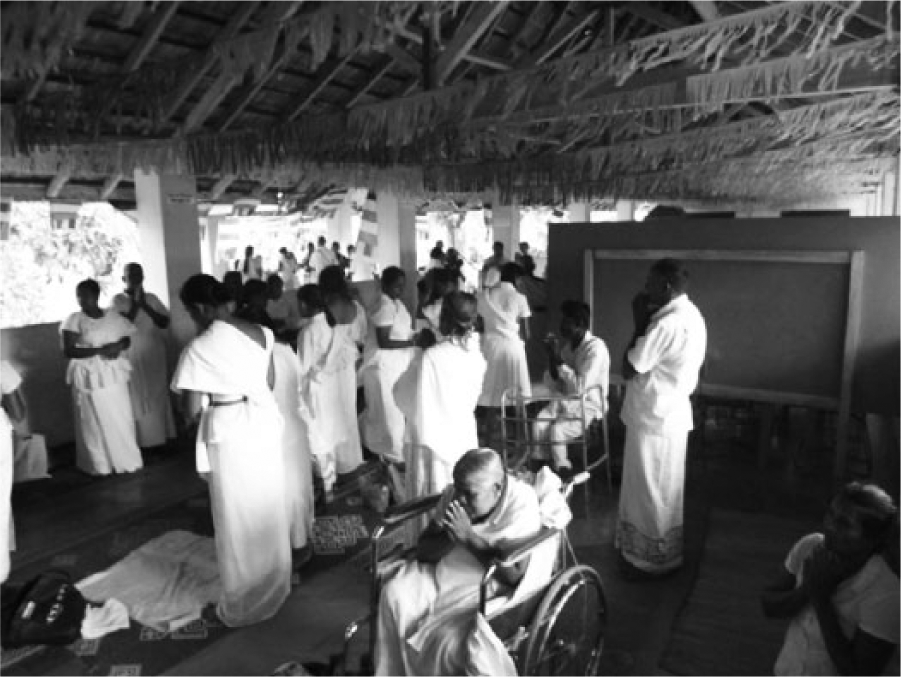
“Sil ganna awastawak” on September 28, 2013.
Although this practice also does not involve the inclusion of disabled people into the community’s religious activities, due to the integration of special RS activities for them, there are episodes that illustrate the further possibilities. A youth with Down’s syndrome (26 years old), for instance, began to visit a temple on a regular basis after the youth and the priest started getting along better as a result of “Sil ganna awastawak,” including the previous promotion of the priest’s understandings of disability issues by the SSO and a CBR volunteer. These daily activities can lead to inclusive religious opportunities.
Trips to places related to Buddhism—namely, the famous temples of Kalutara in 2013 and Kelaniya in 2014 (Figure 2)—were held 3 times during the research period. Although one of them was subsidized by the Department of Social Services, the rest of the trips were planned and implemented through discussions at the CBR steering committee coordinated by the SSO. More than 80 participants took a trip by two chartered local buses each time at their own expense.

Trip to Kelaniya on February 8, 2014.
In contrast to the disabled people’s position as service consumers and participants, the SSO also promoted activities that the disabled people made contributions to the community. They donated food to older adults at the committee of senior citizens in the Senior Citizen’s Day (Figure 3). In addition, they donated sachets, which had been made in their community workshop, to a local hospital. The SSO said, “Our members can do something to make a contribution in society. We should think of that.”

Donation to the committee of senior citizens in October 2014.
Some disabled people and their family members, who participated in the CBR program, invited the members to “private activities.” For example, the members were invited to a Buddhist memorial service on an anniversary of the host’s parent, and a funeral for the host’s relatives. When the day was announced to the CBR group members and the SSO, other programs, such as community workshops and village meetings, were often postponed, while the SSO recommended to other members to visit the services. Funerals of disabled children were also held in R-division during the research period. The author participated in the funerals of disabled children twice with the SSO and the CBR members. These kinds of ceremonies are possibly related to everyday community activities, but these can include highly religious aspects such as Buddhist manners.
Secondary RS-Related Phenomena
The category of the secondary RS-related phenomena consists of “CBR volunteers,” “youth club members,” and “the others.” All of the episodes are not necessarily RS activities, but these include RS-related phenomena in sociocultural activities that secondary stakeholders of the CBR program participate in.
“CBR volunteers” are registered as official supporters of disabled people and their families in each village by the SSO. The first CBR volunteer group was organized in R-division in 1998. A total of 16 volunteers implemented supportive activities, such as visiting disabled people’s homes, holding the CBR village steering committee, and supporting events, including religious ones, at the grassroots level during 2 years from 2013 to 2014. As previous research (Higashida, 2014) has revealed through interviews with CBR volunteers, some of the volunteers were motivated by religious thinking, believing that they accumulated good deeds (“Pin”) through various activities. A CBR volunteer (60 years old) stated, “The happiness I receive through supporting socially vulnerable people is beyond description.”
“Youth club members,” who were registered and organized by the youth services officer, held several social events with the CBR steering committee. For example, disabled children and youth participated in youth camps (“Kandawura”/ ) held about twice annually, while the youth services officer and SSO collaboratively coordinated their activities. Tamil disabled people from the other province took part in one of the “Kandawura” held in R-division in 2014, which led to cultural and religious exchanges. Two months after the “Kandawura,” the CBR members in R-division visited the province by a chartered bus.
A youth club member (22 years old) mentioned, I believed the effect of “Karma” and felt they were “Paw” until I participated in disabled people’s activities. Like other members, I also changed my way of thinking. I hope villagers also change their attitude against disabled people. Now, I think that disabled people are not “Paw.”
It therefore appears to represent the possibility of an attitude change occurring as a result of interactions with disabled people.
“The others,” such as the relatives and neighbors of disabled people, as well as “CBR volunteers,” support the CBR program, whereby the SSO promoted their participation. With regard to the RS activities, they donated local cuisine (“Daana”), that is to say, curry and rice, to disabled people who worshiped at temples for “Sil ganna awastawak” and “Sanghika daana.” In this case, it can be said that the SSO promoted the stakeholders’ participation by including RS-related aspects in the CBR program.
Discussion
Summary and Implications
The present study attempted to examine the integration of RS into social work practice in the CBR program. The goals of this article were twofold. The first was to investigate the types of integration of RS into the social work practice. The second was to analyze the functions served by the integration, with regard to the CBR program at the grassroots level.
First, we found various types of RS-related practices, ranging from individual and group activities to community mobilization. While the SSO promoted these activities through discussions with disabled people and their family members, RS was integrated into the CBR program.
Second, one of the most interesting aspects concerns a far-reaching function of the integration of RS into the CBR program, which can be interpreted based on the findings and episodes in the following way. The integration functioned as an alternative education, promotion of participation, and a sense of unity.
As the SSO described, an activity that includes religious aspects is likely to provide an alternative education for disabled children and youth, particularly for those who have trouble accessing formal education. The activity would provide opportunities for making “good” and “bad” things confirm to the religious moral norms that they need to live in the community. It supports the arguments of Canda (2013), who has emphasized the importance of the “spiritual search for meaning, life purpose, moral ways of relating with the world, including (but not limited to) engagement in religious communities’ practices and beliefs” (p. 81).
It would be ideal for disabled children and youth to receive formal education through inclusive classes, and stakeholders, such as the government, should promote inclusive education. From the short-term perspective, however, activities that include religious aspects are probably a feasible complement in a rural area where there is a shortage of local resources. Furuta (2006) also argues the importance of developing alternative educational resources in rural areas of Sri Lanka. Because the alternative resources may not undermine the development of an inclusive educational environment, the simultaneous development of various resources is probably required.
Perhaps the integration of RS promoted the participation of stakeholders in the CBR program. The number of primary and secondary stakeholders who participate in the CBR program has increased since the commencement of various activities featuring RS practices in 2008, according to the SSO. Although RS-related activities were not the only factors promoting participation in the CBR program, and even though other aspects, such as the localization of activities, also contributed, the integration was one of the key triggers of community mobilization.
The increasing number of participants in the CBR program is also possibly associated with a sense of unity, which is similar to “the belief in the unity of all” and “equality of power” (Mosher, 2010). There is no clear evidence that shows the relationship with RS-related activities in the analyzed data, but the word “Ape” appears to be symbolic, as it has a semantic connection to “Ekamutu”/ , meaning “united” or “harmonious.” For example, through participating in “Sil ganna awastawak” and singing religious songs on the way to a religious trip, they often utilized each other’s words, although the usage of words is not limited in RS-related activities. It can therefore be argued that the integration of RS into sociocultural and community activities probably boosts the feeling of unity and activates CBR practices, although it may lead to difficulties distinguishing RS from sociocultural aspects in many cases.
In addition, there is the controversial phenomenon that the participation of disabled people as contributors in society leads to their empowerment and inclusion (WHO et al., 2010). As discussed in the “Study Site and Religion” section, the inclusion of disabled people in religious activities can also be associated with preventing their exclusion from religious issues and challenge negative attitudes toward them, such as the views regarding “Karma.” In terms of analyzed cases in this study, some may argue that the episode of disabled people contributing implicates their engagement in the common belief system to gain “Pin” to offset their disabled “Paw.” It seems irrelevant to interpret the issue more deeply, given the lack of evidence, the exception being the episode and the narratives of a youth member changing his attitude. Nevertheless, the discussion of this study indicates the importance of promoting an inclusive perspective with respect to RS and sociocultural activities. It includes the importance of challenging the attitudes stakeholders have toward disabled people to overcome the exclusion of disabled people from society.
With regard to overall aspects in social work, it is reasonable to describe the integration of RS into CBR as reconstructing RS in practice. Most of the types of activities may not necessarily be unique from the perspective of the locals in Sri Lanka. The integrated practice, however, enhanced functions of the CBR program, widening the range of applications to accommodate the real practice.
Finally, it is important to discuss the issue of awareness of antioppressive action. Social workers must be mindful of antioppressive issues (Morgan et al., 2008) and the effect of long-term conflicts within the country (Yong, 2007). In the case of Sri Lanka, there are areas that have great religious diversity, such as Sinhala Buddhists, Tamil Hindus, Sri Lankan Muslims, and Catholics. Recognizing the diversity of religious and ethnic groups, whose model case is the Tamil Sinhala event in R-division, is essential for social workers when they try to integrate RS into their practice.
Limitations and Future Research
This study contains some notable limitations. The data were derived from only one site, which might not be representative of religious diversity of Sri Lanka. Some discussions about RS activities relied on the author’s interpretation without clear evidence. In addition, as mentioned with respect to the observer’s position, the data collection and analysis might be biased owing to the author’s subjectivity and interpretation. Thus, we recommend that future research on RS in disability issues focuses on the practice of social work in religiously diversified places, collecting and analyzing a more representative case in Sri Lanka. In relation to the focus of future research, it may be meaningful to examine the impact such things as changing attitudes toward disabled people have on the community, to shed light on the factors shaping the inclusion and exclusion of disabled people that this article could not completely unpack.
Footnotes
Acknowledgements
The author would like to express sincere gratitude to the Department of Social Services and the author’s counterpart, Ms. Saroja Priyani, for providing this valuable research opportunity. The author is very grateful to Dr. Venkat Pulla of Australian Catholic University for his useful comments on an earlier draft of this article.
Declaration of Conflicting Interests
The author(s) declared no potential conflicts of interest with respect to the research, authorship, and/or publication of this article.
Funding
The author(s) received no financial support for the research and/or authorship of this article.