




Abstract
For mental health professionals who are social workers and counselors, the role of clergy is sometimes a missing link. Both the United States and Japan have suffered multiple natural disasters since the 21st century began: Hurricanes Sandy (2012) and Katrina (2005) in the United States and an 8.9 magnitude earthquake (2011) occurred in Japan. Immediately after these devastating natural disasters, victims needed shelter, water, food, and blankets. However, 2 to 3 weeks after the disasters, they needed mental health support more than material supplies as they cope with the after effects of trauma. Hope might be important for natural disaster relief in the long term. A lack of support might contribute to the development of posttraumatic stress disorder (PTSD) symptoms. The investigators hypothesized that religious belief would reduce the natural disaster victims’ PTSD symptoms. In May and June 2013, they sent 500 mailing surveys to Christian and Buddhist clergy in the New Orleans, New York, Tokyo, and Fukushima areas. They asked what these areas did for natural disaster relief. They found cultural differences between the two religious communities: (a) More American Christian clergies thought natural disaster relief efforts are their obligation. (b) American clergies focus more on “comfort,” “reducing pain,” and “hope,” whereas Japanese clergies focus more on “listening” and “praying” when they talk with family members who lost their loved ones.
Keywords
Introduction
Both the United States and Japan have suffered multiple natural disasters since the 21st century began. For instance, Hurricanes Sandy (2012) and Katrina (2005) struck the United States, and the 8.9 magnitude earthquake (2011) befell Japan. Immediately after these devastating natural disasters, survivors needed shelter, water, food, and blankets. However, 2 to 3 weeks after the disasters, they needed mental health support more than material assistance. Mental health endeavors focused on restoring or maintaining hope are just as important for long-term relief. Hope may also allay the development of posttraumatic stress disorder (PTSD) symptoms. 1
According to Rajkumar, Mohan, and Tharyan (2011), levels of PTSD might be different between Western and Eastern cultures. For example, Western researchers focused more on PTSD; however, according to Rajkumar et al., posttraumatic stress symptoms (PTSS) were more common than PTSD after the 2004 Asian tsunami. According to the Diagnostic and Statistical Manual of Mental Disorders (5th ed.; DSM-5; American Psychiatric Association, 2013), the major differences between PTSD and PTSS are (a) duration and (b) symptoms. For a diagnosis of PTSS, symptom duration is less than 1 month, and symptoms focus more on anxiety than on depression. Davidson et al. (2013) found that African Americans were more vulnerable to the residual effects of natural disaster because of lack of proper insurance coverage and financial supports. They stated, “Specifically, the extent of personal disaster exposure, property damage, and loss of services made significant contributions to PTSD status among White survivors” (p. 98).
Hope, like any other psychological construct, is difficult to define. Ward and Wampler (2010) described it as a life force needed to promote physical and psychological health and the ability to function as an individual. This perspective has been adopted as the basis of this article and applied to both Christian and Buddhist clergy and congregants. Although dogmatic differences may mitigate this basic definition, subjective views from this research lend credibility to life force as a basis for conceptualizing this highly complex and subjective construct.
Therefore, the investigators focused on the following issues: (a) clergy roles in natural disaster response, with particular emphasis on restoring and maintaining hope among survivors; (b) comparing attitudes of Christian and Buddhist clergy and mental health professional responders; and (c) exploring obstacles to collaboration between clergy and mental health professionals. 2
The purpose of this study was to examine American and Japanese clergies’ perception of their role in natural-disaster-related PTSD relief efforts, including a comparison of attitudes of Buddhist and Christian caregivers. The investigators believe that this study might be a further step to considering collaboration between mental health professionals and religious leaders in their efforts to provide both material and emotional/spiritual supports. Scholars mention that the concept of collaboration between clergy and mental health professionals is still controversial (Bland, 2005; Bledsoe, Setterlund, Adams, Fok-Trela, & Connolly, 2013). Although collaborative efforts between clergy and mental health professionals are dubious, the efficacy of such partnerships would be examined on an international level.
This study is quantitative as well qualitative, international and cross-cultural. The investigators examine cultural and spiritual factors that might influence the development and course of PTSD symptoms. While these two factors might at first seem to be contradictory, a pattern of reciprocal influence appears to emerge.
In an international and cross-cultural study, Chui and Cheng conducted research on clergy who worked with prisoners in Hong Kong using in-depth interviews based on three themes: the range of religious activities performed, the importance of religion for the rehabilitation of inmates, and the hope of continued religious support to prisoners after release. They also compared the work ethic and motivational differences between Christian and Buddhist clergy. They found that hope and peace of mind were keys to supporting inmates (Chui & Cheng, 2013). Chui and Cheng did not address natural disaster relief; however, their research had some similarities to this study, in that it compares a focus on hope in the Christian and Buddhist culture.
Other researchers stressed the importance of maintaining hope. For instance, Bradfield, Wylie, and Echterling (1989) found that hope is the key to recovery from natural disasters when they studied the collaborative efforts between clergy and mental health professionals after the floods in West Virginia in November 1985. However, they also mentioned that maintaining hope was not easy for all clergy because they themselves might be victims of the natural disaster. Bradfield et al. explained the challenges of offering hope by clergy members who were also victims. One individual said, “I wanted to share a sense of hope and to provide help, but I was feeling hopeless myself” (Bradfield et al., 1989). In addition, the authors mentioned that the clergy’s personal stress levels might affect their ability to offer support. When clergy and mental health professionals work together, they would consider their own stress levels as their own emotional distress might negatively affect clients’ levels of stress and ability to maintain hope.
Inspiring hope is not an easy task for clergy, mental health professionals, or clients; however, maintaining or restoring hope might be essential to recovery from natural disaster. For example, McCombs (2010) referred to the correlation between maintaining hope and the role of clergy and said, “When spirituality is affirmed in counseling, clients are empowered to draw on their spiritual resources to regain hope and reconnect” (p. 131). McCombs further stated that “the underlying premise in attending to spiritual issues is the clients’ hope” (p. 131). McCombs did not directly mention religion but used the word spirituality for explaining the clergy’s role in natural disaster relief. For the purposes of this study, while not necessarily synonymous, both terms relate to connection with something beyond oneself and might, therefore, be considered somewhat interchangeable within this context.
Throughout self-restructuring process, clerical counseling could be essential. Benedek and Fullerton (2007) mentioned the five essential elements of postdisaster practice and said, “Post-disaster practices would promote (1) a sense of safety, (2) calming, (3) self- and community efficacy, (4) social connectedness, and (5) hope” (p. 345). To realize these five factors, collaboration among clergy, mental health professionals, and other community responders increases the chance that these elements are seamlessly provided.
Collaboration allows for members of response teams to maximize their respective strengths in a complementary manner. Clergy might be more familiar with grief therapy and pastoral counseling (VanderWaal, Hernandez, & Sandman, 2012). On the contrary, mental health professionals would be familiar with coping with stress and community integration (Bledsoe et al., 2013).
Theoretical Framework
Buddhist Hope and Reducing PTSD Symptoms
Somjai and Chaipoom (2006) made a comparison between Buddhist and Muslim female cancer survivors in Thailand, and found that maintaining hope is essential in both religious communities. Furthermore, according to the New York Times (March 11, 2012), Buddhist monks in Kamaish City, Japan, site of the November 2011 tsunami, found that the Buddhist ritual of cleaning the faces of those killed by the tsunami might comfort family members and thereby reduce their vulnerability to PTSD (Tabuchi, 2012).
Marley and Ulmer (2001) mentioned that the Buddhist conceptualization of hope might reduce PTSD symptoms in the aftermath of ethnic cleansing under the communist regime in Burma. In sum, Buddhist hope might not be shown as dynamic, because it does not focus more on expressing itself in goal-directed activity, but rather static, involving rituals and prayers. Rituals and prayers are static, but they are still dynamic, because these behaviors give a sense of agency, as they are something a survivor can do. Thus, even believers who are not active might experience a reduction in PTSD symptoms through rituals and prayers.
Collaborative Effort: Clergy and Mental Health Professionals
For many years, scholars have argued the difference between spirituality and religion. There are clear differences between two terms. For example, spirituality includes nonreligious activities, such as yoga, meditation, and breathing techniques. However, even if there are clear differences, we sometimes cannot differentiate between these two terms. Overlap may exist between spiritual and religious activities. For the purpose of this study, we are using the terms synonymously.
Professional literature presents collaborative efforts between clergy and mental health professionals as controversial. Bledsoe et al. (2013) stated, “Historically, the relationship between traditional religious leaders and mental health practitioners has included elements of mistrust” (p. 23). However, the authors noted no clear evidence of mistrust, saying, “There were no clear factors that appear to determine effective collaboration other than clergy and Christian mental health professionals building a relationship of mutual trust and referral” (Bland, 2005, p. 33). Even if there is no clear evidence of mutual trust between clergy and mental health professionals, many clergies would know of some mental health professionals to whom they can refer parishioners. For example, Openshaw and Harr (2009) said, “The majority of clergy knew at least one mental health professional or had a list of mental health professionals to whom they made referrals” (p. 301). In addition, they implied that clergy in small communities might have closer relationships with mental health professionals than clergy in cities, and said, “In small rural communities, there seemed to be a stronger preference among the clergy to refer to someone they knew personally” (Openshaw & Harr, 2009, p. 313).
Other researchers raised concerns that cooperative efforts might be affected by certain factors, including clergy’s stress level, sexual orientation, and race. Bledsoe et al. (2013) raised issues related to congregational participants’ and clergy’s increased stress levels, and found that participants sometimes joined the church because of stress-related situations such as suicide, crisis intervention, homeless assistance, unemployment, and abuse related to stress. Working with traumatic situations is very stressful in itself for both clergy and mental health professionals. Under such conditions, both clergy and mental health professionals can support each other by exchanging knowledge and experience.
Anakwenze and Zuberi found that collaborative efforts worked effectively in the inner city, especially in Latino and African American communities and said, “Clergy represent a significant mental health resource for people who otherwise lack sufficient access to care” (Young, Griffith, & Williams, 2003, p. 688). In other words, for Latino and African American populations living in the inner city with few resources, churches may be the only source of mental health support.
Christian Humanitarianism and Buddhist Mercy
According to Janzekovic (2005), “Humanitarianism is about assumptions. The fundamental assumptions are that: human values are important, how humans treat each other is important, and there are certain human behaviors deemed to be appropriate and others deemed to be inappropriate” (p. 6). The International Committee of the Red Cross (ICRC) stressed the importance of humanitarianism at all times, but especially in times of conflict. The ICRC did not mention natural disaster relief efforts in this statement; however, it is clear that one of the ICRC’s most important tasks is natural disaster relief.
According to the Merriam-Webster dictionary, the term humanism is defined as “a system of values and beliefs that is based on the idea that people are basically good and that problems can be solved using reason instead of religion” (“Humanism,” 2003), while the term, humanitarianism focuses more on humanitarian practices rather than values and ethics (“Humanitarianism,” 2003). In short, “humanism” is a philosophy that support mental health professionals’ ethics and “humanitarianism” is a guideline for their practice.
For example, Abramowitz, Marten, and Panter-Brick (2014) defined “Medical Humanism” as humanitarian actions in the medical fields. They mentioned about governance that is based on humanitarian ethics and politics. In the humanitarian context, health insurance should be provided by the governments because of the humanitarian ethics. Janzekovic also introduced President George W. Bush’s collaborative work with philanthropic organizations and said, “There is a requirement for a sense of obligation and empathy from those who could provide relief against human suffering” (Abramowitz et al., 2014, p. 6). Thus, the term Philanthropy (2003) may most accurately describe Christian churches’ activities. Buddhists place more emphasis on living one’s life in harmony by having a nonconfrontational approach to life, practicing the ideals of charity, tolerance, and loving kindness (Hirono, 2013; Tuicomepee, Romano, & Pokaco, 2012). Tuicomepee et al. (2012) discussed counseling in Thailand and said, “The role of counselors in recent political and natural disasters is highlighted, along with the importance of adapting Western counselor training and services to better meet the needs of the Thai population” (p. 357).
It is true that there are cultural and religious differences between Western and Eastern countries; however, many researchers mentioned that collaborative efforts were essential beyond cultural differences.
Shame, Guilt, and Hope
The investigators assumed that there are correlations between shame, guilt, and survivors’ residual hope. Few researchers have mentioned these correlations. However, some researchers introduced the correlation between residual hope and shame or guilt among women who are domestic violence survivors. According to Giesbecht and Sevcik, vulnerable populations, such as divorced mothers who are victimized by their former husbands, have a tendency to be blamed by religious leaders (p. 230). They are victimized twice—once by abuse and subsequent divorce, and once by their preachers. The article said,
The conservative evangelical subculture is characterized by certain basic assumptions and values, namely: a conviction that all human beings need to be “born again,” . . . a focus on the hereafter and corresponding devaluation of the social issues that characterize “this world” and a trust in the supernatural activity of God and accompanying mistrust of human ability and understanding. (Noll, 1994)
Asante (2011) explained about the Haitian survivors’ residual hope after the earthquake in 2010. The survivors would have mixed feeling that included shame and guilt. According to the Asante’s article, “Haiti: Three Analytical Narratives of Crisis and Recovery,” race and class issues in Haiti between White and Black Haitians victimize African Haitians after natural disasters (p. 278). African Haitians are regarded as second-class citizens because of their behaviors in their former lives (p. 279). African Haitians believe that natural disasters are punishment from their behaviors in this life and previous lives, and they might have shame and guilt feelings. These imprinted inferior feelings are based on their immigration history according to “African and European perspectives” (p. 282).
Sugiyama’s (1983) Shame and Guilt and Scheff’s (2000) Shame and Social Bond were employed as the theoretical framework for this project. Many investigators mention that American Christian culture is based on the concept of sin, while Japanese Buddhist culture is based on the concept of shamefulness (Sugiyama, 1983). Feeling guilty is similar in Western (European or American) culture and Eastern (Asian) culture; however, many scholars also mentioned that Western society is based on a culture of “guilt,” and Eastern or Asian Society is based on a culture of “shame” (Benedict, 1946; Scheff, 2000; Sugiyama, 1983). It is true that shame also exists in Western countries; however, this feeling of shame is often transmitted through parental relationships of those who are religious and those who are not. In Eastern countries, shame comes from other community members.
Many researchers raised the hypothetical proposition that a “culture of shame might affect the relationship between mental health professionals and their clients” (Harder & Lewis, 1987, p. 89). However, some researchers were suspicious about this proposition for the following three reasons: (a) the difficulty of defining shame, (b) constructed images of shame, and (c) limitations of relationships between God and individuals.
Black, Curran, and Dyer (2013) hypothesized that the level of shame might affect the therapeutic alliance and intimate relationship between mental health professionals and their clients. They found that “client methods of controlling intimate relationships were heavily influenced by self-shame coping style, suggesting that a self-blaming style of managing shame leads clients to feel less in control of their relationship” (p. 646). They did not find any significant relationship between self-shame and coping mechanisms; however, they found a significant correlation between shame coping style and PTSD, and said, “In PTSD samples, a specific, definable trauma, or multiple traumas (e.g., childhood abuse, rape), can clearly be linked to the emergence of shame-related coping; however, the nature and origins of shame coping styles in non-trauma groups is less clear” (p. 646). In short, the definition of shame is very subjective, and it might differ based on a client’s self-concept (Black et al., 2013; Harder & Lewis, 1987; Tangney & Dearing, 2002). Thus, researchers would more carefully define shame because it might be different in diverse social and cultural contexts.
Some researchers even pointed out that the concept of shame itself is constructed and unrealistic (Cover, 2012). According to Cover (2012), sexuality-related youth suicide and its causes were affected by stereotypical news media coverage that emphasized bullying, harassment, or guilt and shame, and attributed these suicides to trauma. Cover said, “Knowing the extent to which news media have a role in creating public awareness of an issue such as youth suicide is important for understanding the conceptual framework in which health, intervention, and policy development occurs” (p. 1173). Although the situations are very different, both private tragedies and natural disasters receive extensive air time. It is possible that such media frenzies have the potential to create false or socially constructed images of shame with regard to natural disasters and relief efforts. Thus, in this study the investigators try to reduce the influence of media-constructed images of shame.
Callahan (2006) alluded to the political and cultural aspects of shame and guilt and referenced National Humiliation Day, historically observed in both the United Kingdom and the United States in which the shameful acts of the nation are remembered. In other words, feelings of shame and guilt might be promoted by national governments, perhaps for political reasons. Although there are unsolved questions about shame and guilt among mental health professionals, there might be cultural differences between Western and Eastern countries that better define shame and guilt. Although there are differences between Western and Eastern countries, there are some similarities: God or Buddha influences perceptions of guilt and shame.
There is truth in the question of whether one’s relationship with God influences perceptions of guilt and shame. For example, in Western countries, those survivors with an embedded conservative Christian theology may think a natural disaster is part of divine punishment, or an Act of God (Callahan, 2006), from which human beings cannot escape because of their original sin (Callahan, 2006). Thus, survivors may experience guilt, shame, or condemn themselves because of their original sin. Likewise, Eastern countries view natural disaster as a punishment; however, they do not consider it an Act of God. For example, in many Asian religions, Mother Nature is a part of their God. There is no clear boundary between Mother Nature and God. Thus, the people in Japan feel shame before Mother Nature because they are powerless before her. The investigators’ hypothesis is that conceptual differences between guilt and shame might affect survivors’ ability to sustain residual hope. They also hypothesized that there might be differences among different denominations attributing the occurrence of natural disasters to human sinfulness.
Both Western and Eastern countries have multiple Christian denominations, sects, and schools. According to the one of investigator’s former research, there are no significant differences between sin and suicide among different sects (Hirono, 2013). Although Durkheim (1897) mentioned that Protestants are more accepting of suicide and Catholics more strictly prohibit it, the investigator got a contradictory result indicating “no difference by Christian denominations.” This study focused on “sin” and “suicide”; however, the investigator assumed that there were no differences among denominations pertaining to “sin” and “natural disasters.”
Western countries are home to many Hindu, Buddhist, and Muslim believers as well. Natural disasters’ survivors who are Hindu, Buddhist, and Muslim might have different reactions after the disasters. According to Furer-Haimendorf’s (1974) article, “The Sense of Sin in Cross-Cultural Perspective (Furer-Haimendorf, 1974),” it was suggested that Hindu culture regards women as more sinful than men because of their seduction, and said, “This notion that the evil consequences of wife’s unfaithfulness affect her husband rather than herself is certainly very different from the Christian concept of ‘wages of sin” (p. 546). Furthermore, some Hindu myths imply that evil did not arise from accident but was created by the gods as an element necessary for the balance of human society. In this basis, there is a concept of “Karman (Karma)” both in Hindu and in Buddhist religious communities. According to the concept of “Karman (Karma),” people must die, but people’s souls would never die, and “Karman (Karma)” takes into account both positive and negative credits of a human soul. Furer-Haimendorf said,
This concept of Karman (Karma) is basic to Hindu thinking on moral problems, and though misfortune may not necessarily be attributed to sins committed in a previous life, such an explanation is at least one of the options in an attempt to account for apparently undeserved blows of fate. (p. 549)
Furer-Haimendorf also mentioned the Buddhist conceptualization of sin and said,
In Buddhist thinking the whole universe, men as well as gods, are subject to a reign of law. Every action, good or bad, has an inevitable and automatic effect in a long chain of causes, an effect which is independent of the will of any deity. Beyond acceptable sins, if a person commits suicide or homicide, then he or she would be penalized. (p.550)
In addition, good things would be cancelled with bad things. The total number of good things and bad things might affect his or her life after life. In Christian culture, there is no concept of “Karman (Karma)”; however, some Christians believe the concept of Acts of God.
According to McCombs’s (2010) framework, religious communities that endured a serious natural disaster would face conflict. Based on two contradictory values, (a) natural disasters might be interpreted as Acts of God, and (b) survivors who have struggled with PTSD would be rescued by Acts of God. McCombs did not say survivors who have struggled with PTSD would be rescued by Acts of God; however, McCombs (2010) implied that spiritual resources would reduce survivors’ pain and said, “It (research) overlooks important spiritual resources such as stories, rituals, and communities to alleviate suffering” (p. 131). Furthermore, Connor, Davidson, and Lee (2003) posited that religion may buffer the effect of violent trauma. In addition, Drescher and Foy (1995) noted, “A spiritual approach can be helpful in restoring hope, and acquiring a more balanced view about justice and injustice, safety and danger, and good and evil” (p. 487).
Natural disaster survivors often use stories, rituals, and ceremonies as part of their religious activities as a strategy for reducing their trauma. Stories, rituals, ceremonies, and religion can reduce psychological pain when survivors feel guilty about loved ones who lost their lives in natural disasters by reducing survivors’ guilt and increasing their hope (McCombs, 2010). In PTSD, the acceptance of a spiritual power may lead to a spiritual awakening which, in turn, can assuage survivor guilt (Connor et al., 2003; Khouzan & Kissmeyer, 1997). VanderWaal et al. (2012) said, “Christian clergy play an important role in identifying individuals with mental health and substance abuse disorders and providing education, support, and referrals to needed services” (p. 27).
In other words, the role of clergy is to provide education, support, and referrals to mental health professionals, as some church members feel more comfortable working with clergy than mental health professionals (VanderWaal et al., 2012, p. 38). They also said, “Almost two-thirds believed church members usually felt more comfortable receiving pastoral counseling than going to a professional helper” (p.39). However, “Christian mental health professionals can strengthen these connections through clergy and congregational education, collaboration, and support services” (p. 39). Collaboration between clergy and Christian mental health professionals would be crucial toward this end.
To explain survivors’ behavior, many researchers use symbolism as an analytic tool. For many Christian clergies, a ministry of presence, that has a symbolic connection to the divine, is key. In many cases, clergy himself or herself is a symbol. Furthermore, multiple faith-based organizations, such as the Salvation Army and National Disaster Interfaith Network (NDIN), work for natural disaster relief efforts. These organizations offer more developed rubrics, such as the Salvation Army’s disaster guidelines. The NDIN’s appropriation of the model Presence, Connect, Assess, Intervene, and Develop a Plan of Care (PC-AID) shows a more complex provision of disaster spiritual care (www.salvationaryarmy.usawest.org).
One of the Salvation Army’s disaster guidelines mentioned “Spiritual and Emotional Care” (www.salvationaryarmy.usawest.org) and said, “Salvation Army counselors, who are ordained clergy . . . or lay personnel, will offer a ‘ministry of presence’,” along with “spiritual and emotional care activities that include comforting the injured and bereaved, conducting or participating in funeral and memorial services and providing chaplaincy services to disaster workers management personnel” (www.salvationaryarmy.usawest.org).
The mission statement of the NDIN is, “NDIN is a national network of disaster interfaith organizations working together to reduce disaster-caused human suffering through the exchange of information and cooperative support” (www.n-din.org). The website noted,
In May 2011, the National Disaster Interfaiths Network launched its Be A Ready Congregation campaign. Keys to this campaign are the NDIN “Disaster Tip Sheets for U.S. Religious Leaders.” Each tip sheet offers religious leaders in the U.S. all-hazards best practices and resources, links about disaster migration, preparedness, response, and recovery—specifically of relevance to religious leaders, faith communities and faith-based organizations. (www.n-din.org)
However, the role of clergy differs by culture. Many researchers mentioned that African American and Latino Christians have closer relationships with clergy. Thus, clergies in African American and Latino communities play an important role as mediators between their congregants and Christian mental health professionals (VanderWaal et al., 2012). Furthermore, Bledsoe et al. (2013) introduced cultural differences related to the role of clergy as alternative therapists and said, “Culture beliefs can affect the way that pastors perceive mental health treatment and the etiology of certain mental health conditions such as depression, which may be a factor in congregants’ receiving proper treatment” (p. 28).
Furthermore, many people who lose their loved ones in natural disasters might be religious and desire to speak with clergy about the meaning of life and hope when planning a funeral. Thus, before and after the funerals, the main roles of clergy are counseling, reducing PTSD symptoms, and maintaining hope. Grief support is key in reducing PTSD symptoms (Kristensen, Weisaeth, & Heir, 2010; Lensing, 2001; Salloum & Overstreet, 2008). Lensing (2001) mentioned the need for grief counseling, specifically mentioning aftercare, which “includes a wide range of services from referrals to local grief counselors to facilitating bereavement support groups” (p. 45). Salloum and Overstreet (2008) emphasized the importance of group work among children who suffered from PTSD symptoms after Hurricane Katrina. In addition, Kristensen et al. (2010, p. 137) focused more on the importance of grieving processes for recovering from PTSD after the 2004 Southeast Asian Tsunami. Both articles stressed the urgency of “story telling their experience” (Salloum & Overstreet, 2008, p. 495). The key role of clergy during and after funerals might be that of an active listener with a nonjudgmental attitude. Yang, Yang, and Chiou (2010) explained the difference between shame and guilt by examining self-absorption. They mentioned that many Christians reflect on their selfishness in church and feel guilty, which might lead to increased philanthropy. On the contrary, shame leads to self-absorption. They said, “Shamed individuals tend to focus on self-enhancement activities in order to repair their injured self-image” (p. 607).
In sum, shame, guilt, and survivors’ residual hope are interrelated. Central to these three factors are churches or temples and clergy. Furthermore, feelings of shame and guilt might be different in relation to natural disasters as opposed to so-called human-caused disasters, such as the September 11th terrorist attacks in the United States and radiation leaks in Japan (DiGrande et al., 2008). Although this article did not focus on those human-caused disasters, they might be hidden factors or variables. In the next section, the investigators will introduce the similarities and differences between natural and human-caused disasters relief efforts, and the roles of religious leaders.
Human-Caused Disaster Versus Natural Disaster
The investigators focused only on clergy’s natural disaster relief efforts in this article; however, human-caused disaster might be a variable in New York, the United States and Fukushima, Japan. As the investigators collected the data in those two cities, but did not ask about human-caused disasters, it might be a hidden variable. According to “Disaster Spiritual Care,” spiritual care was the key to recovery from the trauma of the September 11th terrorist attack in New York City. Furthermore, New York Disaster Interfaith Services provided disaster spiritual care training courses. Almost 1,000 clergies joined activities started by American Red Cross volunteer movements after the September 11th and provided spiritual care to victims and survivors. In Fukushima also, spiritual care was an important element of recovery (Niwano Peace Foundation, 2013). There might be similarities and differences between human-caused and natural disasters. The main similarities of the two types of disasters might be that they were (a) unpredictable and (b) unavoidable. The main differences might be caused by (a) human factors and (b) Mother Nature. Furthermore, feelings of guilt and shame might be different between human-caused and natural disasters. The victims or survivors might blame terrorists or the electrical company, and try to find the guilty persons; however, after natural disasters, victims or survivors might have a tendency to blame themselves.
Method
Using Both Quantitative and Qualitative Methods
To explore the role of clergy in natural disaster relief, the primary investigators sent questionnaires to U.S. and Japanese clergy (See Appendix) The investigators mailed 500 surveys to Christian clergy in the greater New Orleans and New York areas, and 500 surveys to Buddhist clergy in the greater Tokyo and Fukushima areas. The questionnaire included fixed-choice, closed-ended questions for quantitative analysis and open-ended questions for qualitative analysis. The researchers chose mixed methods because each method would complement the other’s weaknesses. For example, closed-ended questions might yield more scientifically or empirically analyzed data; however, the data could not reveal why clergy responded as they did. Thus, the investigators decided to analyze open-ended questions asking “Why” and “How” using computer software. To increase objectivity, the investigators made a self-guideline for qualitative data analysis. First, they retyped what clergy wrote in their computer. Second, they counted the key words and made order of frequency of appearances of keywords. Then, they summarized the themes. For analyzing quantitative data, SPSS was employed, and for analyzing the qualitative data, MaxQda was used.
In the first phase, the investigators quantitatively analyzed closed-ended questions by using chi-square and t tests to compare the two religious communities. Although data were analyzed using two quantitative methods, the investigators also wanted to analyze clergy attitudes concerning natural disaster relief efforts in more depth. Thus, the investigators analyzed open-ended questions by using qualitative analysis in the second phase.
Sample
Before conducting the research, the investigators submitted their research proposal to Austin Peay State University’s Institutional Review Board (APSU, IRB, Clarksville, Tennessee) and received approval on December 12, 2011 (Case No. 11-058). The investigators created lists of 1,500 Christian churches and 1,500 Buddhist temples in two countries. A total of approximately 3,000 churches and temples in New York, New Orleans, Tokyo, and Fukushima included the sampling frames taken from the Eastern suburbs of New York City (NYC), which encompass Queens, Nassau, and Suffolk counties (Long Island, NY state), and the Western suburbs of Tokyo, the Three Tama Area, Nerima, Setagaya, and Toshima wards. The churches and temples were selected, respectively, from Verizon (NY and New Orleans) and NTT (Tokyo and Fukushima) phone books. A 30% random sample, 500 churches and temples in each country, was generated from the list of all churches and temples using SPSS. Then, the investigators mailed 500 surveys to Christian clergy in the greater New Orleans and New York areas (Louisiana, Mississippi, Alabama, New York City, and Long Island, USA) and 500 surveys to Buddhist clergy in the greater Tokyo and Fukushima areas.
They received 67 American and 70 Japanese clergy replies. This response rate is low, about 14%. Despite the low return rate, the investigators found several significant differences between the two religious communities related to the role of clergy in natural disaster relief efforts. One possible reason for the low response rate might be the result of some clergy experiencing depressed feelings after working with traumatized individuals. Many researchers mentioned the “Compassion Fatigue” that may affect many mental health professionals and volunteers (Adams, Boscarino, & Figley, 2006; Berzoff & Kita, 2010; Bride, Radey, & Figley, 2007; Thieleman & Cacciatore, 2014). The investigators are not sure exactly how many numbers have actually been involved in disaster relief efforts; however, according to FEMA and Citizen Corps Research (2009) in the United States and the Niwano Peace Foundation’s (2013) research in Japan, about 60% of Japanese Buddhist and 57% of American Christian clergy might have been involved in natural disaster relief efforts.
According to Adams et al. (2006), “Compassion Fatigue” is defined as the reduced capacity for empathy toward clients resulting from the repeated exposure to their trauma, and affects professionals and the clients they serve (Thieleman & Cacciatore, 2014). Furthermore, Baird and Jenkins (2003) said, “Although individuals in volunteer roles may spend fewer hours engaged with traumatized clients, research suggests they are nevertheless at risk of secondary traumatic stress and burnout” (p. 82). In many cases, clergy are also victims of natural disasters. Working with traumatized individuals in their congregations might be a trigger for “Compassion Fatigue.” It is true that the investigators cannot be sure whether an individual clergy respondent has actually been active in disaster response; however, many clergies mentioned direct and indirect participation in natural disaster relief efforts.
Possible reason for the low response rate might be the month that the investigators sent their questionnaires. They sent their survey in May 2013 (first wave) and June (second wave and follow-up); however, May and June are very busy months for clergies both in the United States and in Japan. In the United States, it is a popular season for weddings, and some denominations have their own annual meetings. In Japan, there is the vernal equinoctial week, and many people visit Buddhist temples and pray for their ancestors. The investigators would have diversified data collection methods, such as using Internet-based and/or telephone survey. The investigators’ future research will incorporate such data collection methods.
Research Questions and Hypotheses
The research questions were as follows:
The hypotheses are as follows:
Results
Sample Profile
Although the response rate was low, the investigators believe that these findings may enhance the understanding of clergy’s roles and attitudes with regard to natural disaster relief, and thereby suggest how they may contribute to natural disaster relief efforts.
Demographic characteristics of the sample are as follows: see Table 1, 85.4% male (the United States: 77.6% male; Japan 92.9% male), 14.6% female (the United States: 22.4% female; Japan 7.1% female), 37.3% Caucasian, 51.1% Japanese, 8.8% African American, 1.5% Native American, 0.7% Latino, and 0.7% Asian and Pacific Islanders. The total average age was 55.9 years, and the range was 30 to 91 (median 57.0, mode 58.0, SD = 13.1). The U.S. clergy’s average age was 55.3 (median 56.0, mode 58.0, SD = 12.7), and the Japanese clergy’s average age was 56.4 (median 58.0, mode 63.0, SD = 13.4).
Empirical Profile of Sample (N = 137).

Note. Data for Empirical Profile of Sample were collected by Dr. Hirono and Dr. Blake in between 2013 and 2015.
The number of clergies in the U.S. sample was 67, and that of Japan was 70. U.S. clergy constituted 49.0% of the total sample, and Japanese clergy 51.0%. In the United States, there were 52 males (77.6%) and 15 females (22.4%). In Japan, there were 65 males (92.9%) and five females (7.1%). Age demographics were similar in the two countries. The average age in the United States was 55.3 and 56.4 in Japan. The median and mode in the United States were 56.0 and 58.0, respectively, and those in Japan were 58.0 and 63.0. The difference in the standard deviation (SD) between the two countries was relatively small: SD in the United States was 12.7, and that in Japan was 13.4.
In the U.S. sample, race or ethnicity was mainly divided into Caucasian (76.1%), African American (17.9%), Latino (1.5%), and Asian and Pacific Islanders (1.5%). In the Japanese sample, Buddhist clergies were exclusively Japanese (100.0%), and therefore far less diverse than the U.S. sample.
The U.S. sample somehow reflected the entire population in a suburb of New York City. According to the Suffolk County’s government website (http://www.co.suffolk.ny.us/), 2000 Census racial demographics included Caucasian (84.6%), Latino (10.5%), African American (6.9%), Asian (2.4%), and Native American (0.3%). Demographic characteristics were very similar in Nassau County (New York). Compared with all clergies, the number of Latino clergies was relatively small. Although there were more diverse races or ethnicities, there might be less diverse clergy in the greater NYC area. In short, clergy’s racial demographic characteristics might be less diverse than those of the believers in this area. All 13 Roman Catholic priests answered single for marital status for obvious reasons. The number of married U.S. clergies is 50.
Various denominational religious leaders participated in this project. In the U.S. Christian Church data set, numbers and percentiles of the religious denominations were Roman Catholic Christian 13 (19.4%), Baptist 11 (16.4%), Episcopal 9 (13.4%), Lutheran 8 (12.0%), United Methodist 7 (10.5%), Southern Baptist 4 (6.0%), Unitarian Universalist 3 (4.5%), Latter-Day Saints 2 (3.0%), Assembly of God 2 (3.0%), Evangelical Lutheran 2 (3.0%), United Church of Christ 2 (3.0%), and Christian Science 2 (3.0%). In the Japanese Buddhist Temple data set were as follows: Sodou (Zen)-shu 17 (24.3%), Shingon-shu 12 (17.1%), Rinzai-shu 7 (10.0%), Tendai-shu 7 (10.0%), Jhodo Shin-shu 6 (8.6%), Jhodo-shu 4 (5.7%), and Nichren-shu 3 (4.3%).
According to a study by the City University of New York (Kosmin, Mayer, & Keysar, 2001), the percentage of American Christians was 24.5% Catholic, 16.3% Baptist, 6.8% Methodist, 4.6% Lutheran, 2.7% Presbyterian, 2.2 % Protestant, 2.1% Pentecostal, 1.7% Episcopalian or Anglican, and 1.3% Latter-Day Saints. Although there were some percentile differences, the clergy’s sample ratio may partially reflect the entire Christian clergy population in the United States.
According to the Statistic Bureau of Japan (2003), the number of Temples in Japan were: (a) Jodo and Jodo Shin-syu: 30,000; (b) Sodou-shu: 21,000; (c) Shingon-shu: 15,000; (d) Nichiren-shu: 14,000; and (e) Tendai-shu: 5,000. There were no official data regarding Buddhist sects population ratios; however, the numbers of temples might reflect the ratio for schools of Buddhism. By comparing those numbers, we can infer the data that the researchers collected to reflect the entire Buddhist monks’ population in Japan.
Obligation to Help or Not?
The question, “Do you think that you have an obligation to help people who have been victimized by a natural disaster?” was intended to explore clerics’ individual stances regarding natural disaster relief efforts.
As shown in Table 2, there was a significant relationship between the type of clergy (Christian or Buddhist) and considering natural disaster relief as an obligation. About 85% of Japanese clerics thought that they had an obligation. There was a similarity between the two countries. Although the results might be rooted in religious or spiritual differences, in qualitative questions, some Buddhist clergy stated that they lacked both time and finances for natural disaster relief. In other words, they wished to help people who are affected, but they did not have the proper time or resources.
U.S. Christian Versus Japanese Buddhist Clergies: Obligation to Help?

Number of “No (N = 12)” includes “Not Sure (1)” and “Both Yes and No (1).”
It indicates chi-square (χ2), df = 1, p < .001. This is statistically significant.
Can Counseling With Pastors Help?
The question, “Do you think that counseling with pastors can help people’s natural disaster relief efforts?” showed significantly different results between the United States and Japan (See Table 3).
Can Counseling With Pastors Help People’s Natural Disaster Relief Efforts?

Number of “No (N = 4)” includes “Both Yes and No (1).”
Number of “No (N = 44)” includes “Both Yes and No (2),” “No Answer (1),” “Not Sure (1).”
It indicates chi-square (χ2), df = 1, p < .001. This is statistically significant.
Believing that religious or spiritual power could aid in natural disaster relief was much clearer for Christian than for Buddhist clergy. However, attitudes toward natural disaster relief efforts cannot be oversimplified, because there might be hidden organizational and/or financial pressures in the Japanese Buddhist community. In addition, as the researchers will mention later in the qualitative section, we can find cultural differences: Christian clergies focus more on speaking, while Buddhist clergies stress active listening. We cannot say which clergy attitude is superior or inferior.
Denominational Differences
When the researchers asked the question, “Do you think that counseling with pastors can help people’s natural disaster relief efforts?” they found that there was a significant difference between Lutheran and Roman Catholic clergies (See Table 4).
Denominational Differences among U.S. Christians: Counseling with Pastor?

It indicates chi-square (χ2), df = 1, p < .05. This is statistically significant.
More Roman Catholic clergies said, “Yes,” than Lutheran did (chi-square = 4.9, p < .05). The researchers assume that Lutherans emphasize personal responsibility, while Roman Catholics focus more on the Church’s responsibility. Martin Luther’s (1520) book, On Christian Liberty (1520), emphasized freedom from Church authority and said, “A Christian is a perfectly free lord of all, subject to none” (in Latin 2003 in English, p. 2). He also said, “A Christian has no need of any work or law in order to be saved since through faith he is free from every law and does everything out of pure liberty and freely” (Luther, 1520; 2003 in English, p. 41).
Important Factors for Natural Disaster Relief
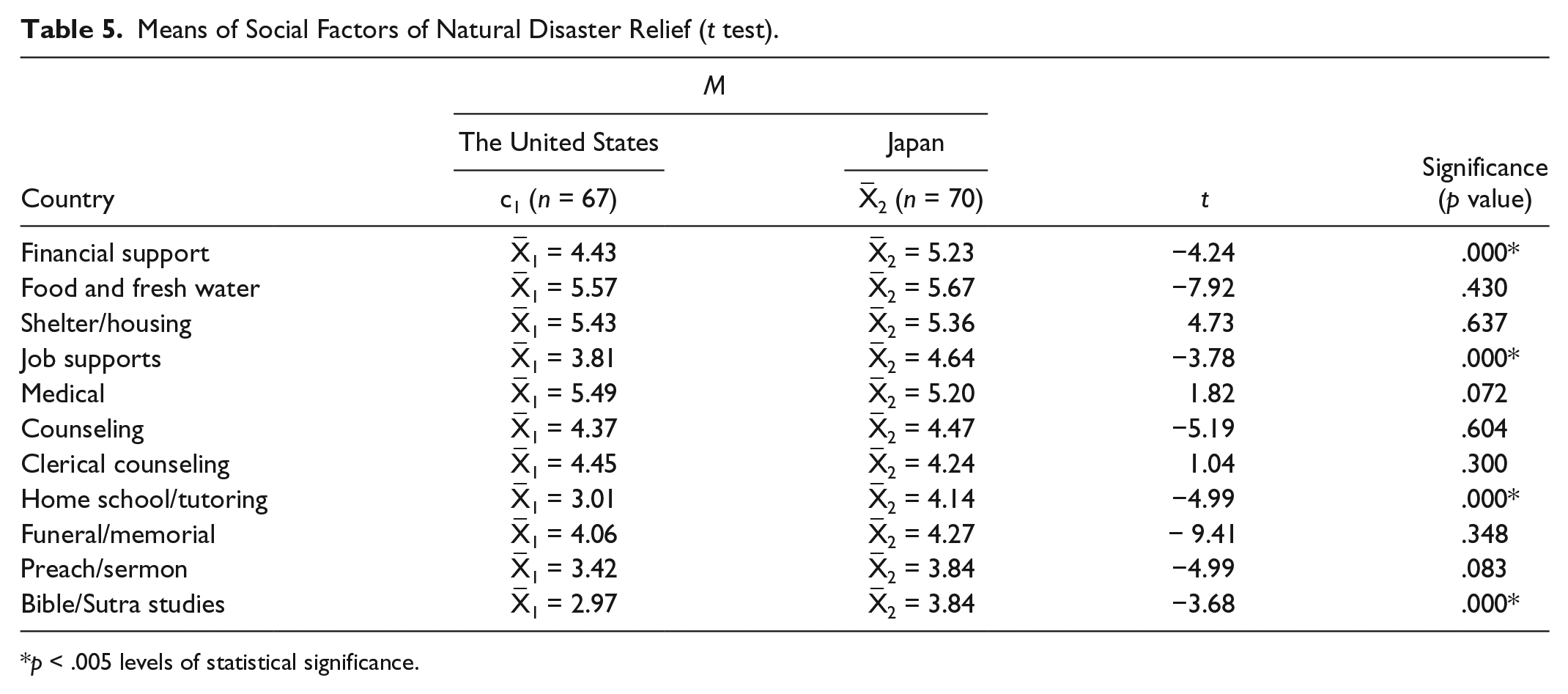
The first question focused on the religious leaders’ awareness of social issues that were important for natural disaster relief, asking, “How important do you think each of these factors is in contributing to natural disaster relief in America?” Please rank “1 (Lowest)” to “6 (Highest)” by circling the numbers. For example, (a) financial supports, (b) food and water, . . . (f) counseling. The investigators used a t-test for analyzing data to compare U.S. and Japanese clergy. Table 5 shows a significant difference in the means of social factors in natural disaster relief.
Means of Social Factors of Natural Disaster Relief (t test).
p < .005 levels of statistical significance.
Concerning financial issues, Japanese clerics had a tendency to think financial support contributes more to natural disaster relief than clerics in the United States. The respective means of American and Japanese clergy were as follows: the United States = 4.43 (SD = 1.17) and Japan = 5.23 (SD = 1.02) with a t score of −4.24 and p value of .000. This finding indicated that Japanese clerics thought that financial supports were a more crucial factor contributing to natural disaster relief than U.S. clerics. Economic difficulties might be the same in both countries, but the physiological and psychological impacts might be heavier in Japan than in the United States. The researchers theorized that after the Mega Earthquake, Japanese religious leaders might see that intangible support could be limited, and they thought tangible and financial support would be more important.
More Japanese clerics thought that job supports were important than American clerics. The mean of the American and Japanese clergy was: the United States = 3.81 (SD = 1.26) and Japan = 4.64 (SD = 1.33). The t score is −3.78 and p value was .000. This result might be related to high unemployment rates among Japanese elders (Hirono, 2013). According to the Statistics Bureau of Japan (2005), the percentage of the population 65 years old and older was 20.1 in Japan, and that in the United States was 12.4. Although the aging issue was a problem in both countries, political and social support systems were different. In the United States, older adults could find a job more easily than in Japan, because the legal retirement age was 60 years in Japan and 65 in the United States (Statistics Bureau of Japan, 2005).
The researchers could not find a statistically significant difference between American and Japanese clergy for the medical support question; however, they still found a substantial difference between the two countries. More American clergy thought that medical supports were more important than Japanese clergy. The means of the American and Japanese clergy were as follows: the United States = 5.49 (SD = .927) and Japan = 5.20 (SD = .957). The t score was 1.82, and the p value was .072. This result might be related to different medical insurance systems in both countries. Japan had a central public insurance system run by the Japanese government. On the contrary, the American insurance system was run mainly by private companies. Although Medicare and Medicaid were run by the U.S. Federal and state governments, the newly introduced Patient Protection and Affordable Care Act (PPACA or ACA) was run by private insurance companies (Lipp & Troy, 2012).
The researchers found a significant difference in the importance of homeschool or tutoring between the U.S. and Japanese clergy. More Japanese clergy thought that homeschool and tutoring were important than American clergy. The means of the American and Japanese clergy were as follows: the United States = 3.01 (SD = 1.39) and Japan = 4.14 (SD = 1.25) with a t score of −4.99 and p value of .000. Against this background, many Fukushima Buddhist monks considered children’s radiation exposure and the need of homeschool and tutoring because many school zones have so-called “radiation hot spots” that showed high radiation values (Inagaki, 2013).
Both in American Christian and in Japanese Buddhist communities, Bible (Christian) and Sutra studies are pivotal. The result related to the importance of Bible and Sutra studies was unexpected. The researchers thought that Christian clergy focused more on Bible study; however, the results indicated that more Japanese monks thought that Bible or Sutra study was more important than Christian clergy did. The means of the American and Japanese clergy were as follows: the United States = 2.97 (SD = 1.61) and Japan = 3.84 (SD = 1.11). The t score was −3.68 with a p value of .000.
Analysis of Open-Ended Questions
The researchers analyzed the themes of open-ended questions by using MaxQda Software. He also counted the keywords and themes. Furthermore, he tried to address the questions, “Why did the clergy think a particular intervention might be helpful?” and “What are important factors for religion and natural disaster relief?”
Action Versus Listening
First, the researchers asked the reason why clergy thought “natural disaster relief” was an obligation. In the United States, the five most common reasons were as follows: (a) ethical duty (n = 45), (b) personal belief (n = 38), (c) following God’s will (n = 34), (d) (Christ’s) mercy (n = 15), and (e) to offer hope (n = 7). Japanese clergy also answered the question by using similar keywords: (a) ethical duty (n = 45), (b) try to just listen to what they say (n = 19), (c) following the Buddha’s teaching (n = 18), (d) (Buddhist) mercy (n = 14), (e) seeking truth together (n = 6), and (f) personal belief (n = 5). As was evident above, the themes and keywords in both countries were very similar; however, Japanese clergy focused more on “listening” and “teaching,” while American clergy focused more on “God’s will” and hope. In other words, Japanese Buddhist monks stressed staying together and listening to what survivors say, while American clergy emphasized providing hope. We cannot say which attitude is superior or inferior, but we can say that evidence shows a cultural difference between the two religious communities.
Second, the researchers asked, “If you mention natural disasters during Mass/Bible study/congregational worship, what do you say?” American clergy’s typical answers were as follows: (a) We ask people to pray and give money to people who were victims of natural disasters (n = 11), (b) God’s will is to love one another (n = 8), (c) They are random acts of nature we cannot control them (n = 7), and (d) I try to avoid saying, “It’s God’s will.” God does not inflict pain and suffering on His people—if He did, He would be cruel and I would not serve Him (n = 5). In sum, multiple American clergy mentioned, “God’s will is to love.”
The researchers also asked the same question to the Japanese clergy, and they said (a) We would give thanks to Mother Nature. We cannot control Mother Nature because we are a part of her (n = 16); (b) We have a 100% chance of dying, and we don’t know how we will die. You would be ready to accept your death (n = 14); (c) Just carefully listen to what the victims say (n = 8); (d) Every day is a new day and precious. We would not waste the precious day (n = 2); (e) Don’t look back to your past, but go forward with hope (n = 2). The keywords, 100% chance of mortality and careful listening, are important concepts among both Christians and Buddhists. In short, both communities might seek the same goal: “maintaining hope for the future”; however, their approaches are different, and we also found cultural differences: action (Christian) versus listening (Buddhist).
Comfort and Hope Versus Just Pray
Third, the researchers posed the following question to American and Japanese clergy: “What do you say to families who have lost a family member to a natural disaster?” The typical American Christian answers are as follows: (a) It is not “God’s will,” people need comfort—not explanation (n = 13); (b) I prefer to listen while they talk (n = 6); and (c) words of comfort from God’s words of hope (n = 5). The keywords here are hope and comfort. Those keywords might boost victims’ residual power and can perhaps prevent survivors from developing PTSD.
Japanese clergy’s typical opinions were as follows: (a) I prefer to listen while they talk (n = 14); (b) We pray for them and seek to help in every way we can (n = 12); (c) Don’t focus on the negative. Keep their loved one’s memory alive in their heart, and share with them my personal loss (n = 7); and (d) It depends on each victim’s situation. I cannot generalize what I will say (n = 5). “Listening to what they say” and “Seeking help” are key themes in the Japanese Buddhist community.
Conclusion
The investigators’ hypotheses were as follows: (1) More Christian than Buddhist clergy think that natural disaster relief is their obligation, (2) Christian clergies more actively join natural disaster relief efforts than Japanese clergies, and (3) There are role differences related to natural disaster relief efforts in Japanese and American religious communities. Although the research sample was small, the investigators found a tendency of our hypotheses (1 and 2). Furthermore, there are the following role differences in Japanese and American religious communities.
The investigators also found some cultural differences between the two religious communities: (a) More American Christian clergies thought that natural disaster relief efforts are their obligation; more American clergies also thought that counseling with pastors can help natural disaster victims. (b) American clergies focus more on “comfort,” “reducing pain,” and hope, while Japanese clergies focus more on “listening” and “praying” when they have a chance to talk with family members who lost their loved ones.
Although there are differences in the ways that these words are expressed, both religious communities showed their sympathy to family members who lost their loved ones. Both countries’ clergy said (a) I prefer to listen while they talk, (b) We pray for them and seek to help in every way we can, and (c) Don’t focus on the negative. Keep their loved one’s memory alive in their heart.
Clergies need to collaborate among themselves and with other professionals for natural disaster relief efforts. Collaborative efforts between mental health professionals and clergy might be also needed. As the investigators mentioned earlier, it might be true that misunderstanding and mistrust exist between clergy and mental health professionals (Bland, 2005; Bledsoe et al., 2013). For mental health professionals, the role of clergy is overlooked. Clergies are essential for natural disaster relief because they are often the initial contact, and through their roles of listeners and voices of hope, they can become “gatekeepers” in preventing natural-disaster-related PTSD. For the clergy’s side, they would be educated specifically to take nonjudgmental and sympathetic attitudes toward the families of natural disaster victims. Clergies also need more resources, time, and training if they are to maximize their potential in providing postdisorder relief.
Limitations
First, the sample number (about 140) is small. Second, the researchers focused only on two groups: American Christians and Japanese Buddhists. Furthermore, only 20 females participated. Although there are multiple limitations, the investigators found several significant differences between the two religious communities. Thus, further research is needed.
Footnotes
Appendix
Declaration of Conflicting Interests
The author(s) declared no potential conflicts of interest with respect to the research, authorship, and/or publication of this article.
Funding
The author(s) received no financial support for the research, authorship, and/or publication of this article.