



Abstract
This study investigates the impact of digital innovativeness on esports fan identification and engagement by integrating innovation diffusion theory and the psychological continuum model (PCM). Drawing on survey data from 347 Taiwanese esports fans, we employed partial least squares structural equation modeling (PLS-SEM) to test the proposed relationships. Results indicate that digital innovativeness significantly enhances value co-creation experiences, fan knowledge, and fan identification. Among these, fan identification is the strongest predictor of engagement behaviors. Value co-creation experiences do not directly lead to engagement, but mediate through identification. The effect of innovativeness on identification is more pronounced in the early PCM stages (awareness and attraction) than in later stages (attachment and allegiance). These findings contribute to esports marketing literature by clarifying the causal pathways between digital innovativeness and fan engagement, and by emphasizing the strategic value of targeting early-stage fans through innovative approaches to strengthen identification and cultivate enduring digital fandom.
Plain Language Summary
This study looks at how digital innovation influences the way esports fans feel connected to their favorite games and how actively they participate in the esports community. Esports refers to competitive video gaming, which has become a major part of global entertainment. As the esports world continues to grow online, understanding how fans engage is important for both marketers and event organizers. We surveyed 347 esports fans in Taiwan and analyzed their responses using advanced statistical methods. Our goal was to find out whether people who are more open to digital innovations, like new apps, platforms, or tech features, are more likely to become dedicated esports fans and participate more in the community. We found that digital innovativeness helps fans gain knowledge, feel part of the esports culture, and enjoy shared experiences (such as chatting during live streams or customizing avatars). However, simply having these experiences doesn’t directly make fans more engaged. Instead, it’s the sense of identity “how much they see themselves as fans” that leads to stronger engagement behaviors like watching events, sharing content, or buying merchandise. Interestingly, we also found that digital innovation has the biggest impact on fans who are just starting to get interested in esports. This means that early-stage fans are especially responsive to innovative digital features, which can help turn casual interest into deeper loyalty. Overall, our research suggests that esports brands and marketers should focus on creating innovative, interactive experiences, especially for newcomers, to help them build a stronger connection with the community and become more involved fans.
Keywords
Introduction
In recent years, esports have evolved from a niche subculture into a mainstream global phenomenon, fueled by the rapid convergence of advanced technologies, competitive gaming, and digitally connected communities (Hamari & Sjöblom, 2017). This transformation has established esports as a multi-billion-dollar industry which reshapes how individuals interact with sports and entertainment (Chang et al., 2023; Huang et al., 2023). As the industry matures, fans have shifted from passive spectators to active participants who engage in content creation, digital interaction, and community-driven value co-creation (Behnam et al., 2023). However, research has yet to fully capture the complexity of these evolving fan behaviors in highly interactive and digitalized settings (Rogers et al., 2022; Pizzo et al., 2018). Much of the existing literature treats esports fans as a homogeneous group, thereby neglecting the psychological diversity and segmented engagement patterns that define the broader fan ecosystem (Huang et al., 2023). This oversight limits scholars’ and practitioners’ ability to devise targeted strategies that account for varying levels of psychological involvement and openness to innovation (Jang, Byon, Pecoraro, et al., 2021; Oh et al., 2025; Sjöblom et al., 2020). Given the continuous emergence of novel platforms, formats, and fan experiences, understanding how fans co-create value and attach with the team is essential.
The psychological continuum model (PCM) provides a foundational framework for understanding the progression of fan engagement, particularly within sport and entertainment contexts (Funk & James, 2001). It conceptualizes fan involvement as a dynamic psychological journey through four hierarchical stages of awareness, attraction, attachment, and allegiance (Funk & James, 2001, 2006; McDonald et al., 2023; Oh et al., 2025). Each stage reflects increasing psychological commitment, shaped by individual, psychological, and social influence (Funk & James, 2006; Inoue et al., 2017). In esports, where digital interactivity and global connectivity redefine traditional fandom, PCM is especially relevant for capturing the spectrum of fan behaviors, such as fan innovativeness, fan knowledge, and fan identification (Behnam et al., 2020). Despite widespread research interest in PCM applications (Funk, 2019), the model remains underutilized in esports research. Esports fan engagement mechanisms diverge from traditional sport due to digital immersion and participatory culture (Wang et al., 2025).
To capture the technological dimension of esports engagement, innovation diffusion theory (IDT) offers a valuable complement. IDT explains how individuals adopt and integrate innovations over time, emphasizing factors such as perceived novelty, compatibility, and complexity (Rogers et al., 2014). In this manner, achieving this transformation requires individuals to break existing habits and perceive these products, ideas, or behaviors as innovative, which depends on their personal characteristics and social environment (Rogers et al., 2014; Venkatesh et al., 2003). In the esports context, this process is particularly complex as fans continually adapt to emerging platforms, interactive technologies, and evolving engagement formats that challenge traditional engagement models. Therefore, the integration of PCM with IDT addresses a crucial gap in understanding modern fans by simultaneously considering psychological engagement and innovation adoption processes. This fusion enables a more holistic understanding of how fans progress along the engagement continuum while simultaneously embracing new technologies, platforms, and experiences within esports. By combining these frameworks, we can better explain how digital innovativeness influences fan development across different PCM stages, providing insights into the dynamic interplay between innovation adoption and psychological commitment in the esports era.
As esports continues to converge with technology and entertainment, understanding how immersive experiences drive value co-creation is essential for advancing both theory and practice (Jung et al., 2024, Kunz et al., 2022). While this study focuses on Taiwanese esports fans, regional cultural and market dynamics may shape their innovativeness, identification, and engagement. Taiwan’s esports ecosystem, which is characterized by mobile-first consumption, localized platforms, and strong community orientation, may differ considerably from Western markets, where cross-platform branding and commercial sponsorships play a larger role (Jung et al., 2024; Wang et al., 2025). Acknowledging these differences highlights the need for cross-cultural validation and supports a broader interpretation of the findings in a global context. Correspondingly, this study investigates how esports fans progress from awareness and attraction to attachment and allegiance, and how these stages relate to their value co-creation experience. By integrating PCM and IDT, the research offers a dual-lens framework that captures the interplay between psychological commitment and innovation adoption. Two research questions guide this inquiry: (1) How does the value co-creation experience differ across varying stages of psychological involvement among esports fans? (2) What role does innovation adoption play in shaping these value co-creation experiences?
Literature Review and Hypotheses Development
The PCM offers a robust framework for conceptualizing fan engagement as a dynamic and hierarchical process (Funk & James, 2001). The progressive stages of awareness, attraction, attachment, and allegiance reflect qualitatively distinct psychological states, influenced by both individual dispositions and social contexts (Inoue et al., 2017; McDonald et al., 2023; Oh et al., 2025). While PCM has been widely applied in traditional sport settings to explain the evolution from passive interest to loyal fandom (Doyle et al., 2013; Kunkel et al., 2022; Inoue et al., 2017), its application to esports remains limited despite the medium’s distinct characteristics. Esports fans engage within highly digital, interactive, and globally distributed ecosystems, which challenge assumptions embedded in conventional sport fandom models (Ko et al., 2023). Unlike traditional spectatorship, esports fan behavior often unfolds across real-time streaming platforms, social media channels, and participatory communities such as Discord and Twitch, where boundaries between content consumption and co-creation are blurred (Sjöblom et al., 2020). These affordances demand a recalibration of PCM’s assumptions to account for digitally mediated engagement, such as fan innovativeness, platform fluency, and online identification (Behnam et al., 2020; Huang et al., 2023). The current study addresses this gap by adapting PCM to the esports context and providing lens to examine how fans transition from initial exposure to sustained commitment in a rapidly evolving and innovation-driven domain.
IDT offers a complementary framework for understanding how innovations are adopted and diffused within social systems (Rogers et al., 2014; Wani & Ali, 2015). The theory delineates the innovation adoption process through sequential stages and classifies adopters into categories based on their openness to innovation (Tsai & Tiwasing, 2021; Wani & Ali, 2015). IDT has been widely applied across domains such as communication, healthcare, and technology management to explain individual and collective adoption behaviors (Mamasioulas et al., 2020; Tsai & Tiwasing, 2021). However, its use in fan studies, particularly within esports, remains underexplored despite the sector’s dependence on rapid technological advancements. Esports fans frequently encounter emerging formats, such as VR-integrated games, blockchain-based fan tokens, and AI-enhanced broadcasts, that require constant adaptation and active decision-making. In this context, IDT provides a valuable lens for understanding not only how fans adopt innovations, but also how they co-shape innovation trajectories through participatory behaviors such as content creation, modding, and community interaction (Jang & Byon, 2020).
While the integration of PCM and IDT offers a complementary approach, its explanatory power is context dependent. Specifically, PCM–IDT framework is most suitable for digital-first and high-interaction esports fan environments are central to their experience (Murray et al., 2022). In contrast, its applicability may be limited in traditional sports fandoms, where fan engagement often relies more on in-person attendance, long-standing rituals, and passive media consumption (Oh et al., 2025). In esports contexts, the role of technological innovation and digitally mediated co-creation is comparatively marginal, which may diminish the relevance of the IDT dimension and necessitate alternative models of fan behavior (Wang et al., 2025). These insights highlight the importance of critically adapting the PCM–IDT framework to the esports context, where the nature of fan engagement and the role of digital technologies may diverge from traditional assumptions embedded in the model.
Innovativeness refers to an individual’s willingness and capacity to adopt novel ideas, technologies, or practices (Kim et al., 2017), often characterized by openness to change and proactive engagement with emerging trends (Behnam et al., 2020). Within the context of esports fandom, innovativeness manifests through fans’ early adoption of new platforms, immersive technologies, and participatory behaviors (Kim & Kim, 2020; Yen et al., 2020). Value co-creation, defined as the interactive process through which consumers and organizations jointly produce value (Verleye, 2015; Vargo et al., 2023), is particularly salient in esports, where fan contributions often shape the development of community norms, and brand narratives (Giachino et al., 2023). Innovativeness enhances this process by fostering a sense of agency, personalization, and ownership over the fan experience (Kim & Kim, 2020; Murray et al., 2022; Yen et al., 2020). However, the strength of this relationship may be contingent upon factors such as digital literacy, role clarity, and perceived benefits of engagement (Kim et al., 2017). Fans high in innovativeness are more likely to perceive and seize co-creation opportunities, which unique insights and feedback that contribute to the ongoing evolution of esports culture and fan-brand relationships (Kim & Kim, 2020; Murray et al., 2022).
Value co-creation experience, grounded in the service-dominant (S-D) logic framework, emphasizes the collaborative role of consumers and producers in generating value through reciprocal interactions during product and service use (Vargo, 2021; Vargo et al., 2023). Rather than viewing value as embedded solely in firm offerings, S-D logic posits that value emerges through active consumer engagement, where customers function as co-creators rather than passive recipients (Ordanini & Parasuraman, 2011; Verleye, 2015). Esports platforms fundamentally transform value co-creation from traditional sports contexts. Specifically, value co-creation materializes through esports fan participation in community events, content creation, feedback loops, and social engagement within digital ecosystems (Wang & Chiu, 2023). A key antecedent to this process is innovativeness, or the willingness to adopt and experiment with new ideas, technologies, or practices (Ambika et al., 2023; Behnam et al., 2023). Individuals high in innovativeness are more inclined to engage proactively in value co-creation, leveraging emerging platforms and offering novel insights that enrich collaborative outcomes (Verleye, 2015; Wang & Chiu, 2023). Innovativeness and early adopters, in particular, drive this process by contributing creative inputs that shape the evolution of esports experiences. However, the influence of innovativeness is not uniform; it can be moderated by contextual factors such as technological readiness, connectivity, and perceived co-creation benefits (Verleye, 2015). Thus, innovativeness plays a critical role in enhancing the co-creation process by fostering deeper engagement and value realization for both fans and industry stakeholders. Based on these insights, we propose the following hypothesis.
Fan identification refers to the psychological attachment and sense of belonging individuals develop toward a sports team or organization, characterized by emotional investment, loyalty, and alignment with the team's identity and values (Fink et al., 2009; Lock & Heere, 2017; Naylor et al., 2017; Wu et al., 2012). In the context of esports, where fandom is often mediated through digital platforms, innovativeness may play a crucial role in shaping fan identification. Fans with high levels of innovativeness are more inclined to adopt emerging technologies and engage with novel forms of interaction, such as virtual watch parties, interactive streaming, and gamified fan platforms, that can enhance their experiential connection with teams (Behnam et al., 2023; Inoue et al., 2017; Wu et al., 2012). This active and tech-savvy engagement fosters deeper emotional ties and reinforces fan identity through immersive and personalized experiences (Behnam et al., 2023; Lock & Heere, 2017). Exposure to innovative team-driven initiatives—such as non-fungible tokens, digital collectibles, or augmented reality events—can generate excitement and satisfaction, further strengthening identification (Carlson et al., 2009). However, the relationship between innovativeness and fan identification may vary across individuals depending on motivations, preferences, and perceived value of innovation (Behnam et al., 2020; Inoue et al., 2017). Understanding these nuances is especially relevant in esports, where fan engagement spans a wide spectrum of psychological and behavioral profiles. As such, exploring how innovativeness contributes to fan identification provide valuable insight into evolving dynamics of fandom in digital sport ecosystems. Based on these considerations, we propose the following hypothesis.
Fan knowledge refers to the information, expertise, and understanding that fans develop about a team, organization, or sport, encompassing elements such as team history, player performance, game strategies, and broader industry dynamics (Behnam et al., 2020; Jang, Byon, Baker, et al., 2021). While traditional sports knowledge relies primarily on mass media and historical records, esports knowledge is derived from real-time data, live broadcasts, and community-generated insights (Qian & Seifried, 2023; Wang et al., 2023). In the esports context, where digital platforms facilitate rapid knowledge exchange, fan knowledge emerges as both a personal resource and a collective asset. From a S-D logic perspective, knowledge is not static but evolves through interactive learning, experience sharing, and co-creation processes between fans and organizations (Vargo et al., 2023). Innovativeness plays a critical role in shaping fan knowledge by influencing how fans seek, acquire, and disseminate information (Behnam et al., 2023; Wang et al., 2023). Highly innovative fans are more likely to explore emerging technologies and engage with diverse content formats, such as live streams, podcasts, analytics dashboards, and participate in digital communities where knowledge is exchanged (Qian & Seifried, 2023). This behavior fosters both individual learning and the development of collective fan intelligence. Innovative fans also contribute to knowledge-sharing ecosystems by offering insights, initiating discussions and curating content that enrich the broader knowledge base and enhance fan engagement (Wang et al., 2023). However, the extent of this influence may depend on psychological factors such as identification, involvement, and perceived value of informational engagement (Kim et al., 2017; Wang & Chiu, 2023). Thus, innovativeness acts as a catalyst for expanding and circulating fan knowledge within esports environments. Based on this rationale, we propose the following hypothesis.
Sports fan consumption behaviors are categorized into domains of game attendance, media engagement, and licensed merchandize purchases (Kim et al., 2011). Game attendance represents both a symbolic and economic expression of fandom. It contributes significantly to team revenue through ticket sales and enhancing the live event atmosphere, which can influence both fan experience and player performance (Natke & Thomas, 2019). Consistent attendance reflects strong psychological commitment and loyalty to a team. Media engagement, including watching broadcasts, following social media accounts, and interacting with digital content, has become increasingly central to fan behavior, particularly in the esports domain where online platforms dominate. Social media, in particular, enables fans to access real-time updates, engage in dialogue, and build community around their favorite teams (Haugh & Watkins, 2016). Licensed merchandize consumption serves as a visible expression of identification, allowing fans to demonstrate allegiance and distinguish themselves within the fandom (Y. K. Kim et al., 2011; Kim & Ko, 2019). These behaviors are not only central to fan engagement but also reflect varying degrees of psychological involvement. To understand the antecedents of these behavioral outcomes within the esports context, this study examines how value co-creation experience, fan identification, and fan knowledge influence these key behaviors through distinct theoretical mechanisms (see Figure 1).

Proposed structural model and research hypothesize.
From a S-D logic perspective, value co-creation experiences emphasize the collaborative role of consumers in generating value through interactive and personalized engagement (Vargo, 2021; Vargo et al., 2023). In sports contexts, when fans participate in co-creation activities with organizations, such as content creation, feedback provision, or community building, these experiences foster psychological ownership and emotional attachment (Behnam et al., 2023; Kolyperas et al., 2018). The participatory nature of value co-creation enhances fans’ sense of agency and personal investment, which subsequently translates into increased behavioral engagement (Nadeem et al., 2025). In the esports environment, where digital interactivity is paramount, co-creation experiences through streaming platforms, social media engagement, and community participation directly motivate fans to attend events, consume media content, and purchase merchandize as expressions of their enhanced connection. Based on these insights, we propose the following hypothesis.
Building upon the PCM framework, fan identification serves as a central driver of behavioral outcomes (Behnam et al., 2020). Social identity theory further explains how individuals construct their self-concept through belonging to specific social groups and how this sense of belonging influences their attitudes and behaviors (Hogg, 2016). In the esports context, strong fan identification triggers self-categorization processes, wherein fans internalize team success as personal success, thereby generating powerful motivations for supportive behaviors. This identification encompasses cognitive, affective, and evaluative dimensions that collectively shape behavioral intentions (Fink et al., 2009). Moreover, identification reduces perceived participation costs and enhances the stability of behavioral intentions by creating emotional bonds that transcend situational factors (Lock & Heere, 2017). Based on these theoretical foundations, we propose the following hypothesis.
Social learning theory posits that individuals primarily learn through observation, imitation, and modeling of others’ behaviors, with knowledge serving as a cognitive foundation for behavioral regulation (Bandura, 1977). In the context of individual behavior, knowledge functions as both a facilitator and motivator of engagement by reducing uncertainty and increasing behavioral self-efficacy (Bandura, 1977). Specifically, knowledgeable fans are better equipped to appreciate the nuances of esports competition, thereby increasing their confidence and competence in various consumption behaviors (Wang et al., 2023). Based on these considerations, we propose the following hypothesis.
The stages of PCM reflects a distinct psychological state, shaped by both individual and social factors (Funk & James, 2001; Inoue et al., 2017). This framework is instrumental in understanding the dynamic nature of fan involvement, particularly in esports, where engagement spans from casual participation to deep emotional commitment (Giachino et al., 2023; Kunkel et al., 2022). The model accommodates key constructs such as innovativeness, fan knowledge, and identification (Behnam et al., 2020; Kim et al., 2017; Rietz & Hallmann, 2022). Given the digitally mediated and interactive nature of esports, recognizing these varying psychological states is crucial. Accordingly, we propose that fans’ psychological involvement moderates the effects of innovativeness on value co-creation, fan identification, and fan knowledge, as illustrated in Figure 1.
Methods
Sample and Procedure
Data were collected using a purposive sampling strategy facilitated by the Chinese Taipei Esports Association, which provided access to official fan communities of professional esports teams. The association coordinated with team representatives to distribute the survey to registered fan club members during an appropriate timeframe. Eligible participants were required to be verified members of professional esports team fan groups, ensuring the authenticity of their engagement. A total of 347 valid responses were collected between October 20, 2024 and January 5, 2025. Prior to participation, ethical approval was obtained from the National Taiwan University Research Ethics Committee (Ref. No.: REC-202311ES021). All participants provided informed consent after reviewing a detailed statement outlining the study’s purpose, confidentiality protocols, and voluntary nature. To minimize respondent fatigue, the survey was designed to take 10 to 20 min and included features allowing participants to pause and resume at their convenience. Participants were also informed of their right to withdraw at any time without penalty.
To ensure data integrity and respondent attentiveness, the survey incorporated two attention-check items, following established best practices in online research (Becker et al., 2023). Two screening questions were administered at the outset to verify eligibility: (1) “Are you currently supporting a professional esports team?” and (2) “How long have you been a registered member of the esports team you support?” Only respondents who affirmed both criteria proceeded to the full questionnaire. Of the 353 initial respondents, 6 were excluded due to incomplete data, yielding a final sample of 347 valid cases. The sample was predominantly male (63.1%, n = 219), with females comprising 34.1% (n = 128). Participants ranged in age from 18 to 68 years (mean = 29.48). Most held a bachelor’s degree (72.6%, n = 252), followed by postgraduate degrees (17.3%, n = 60). Nearly half (47.0%, n = 163) had supported their esports teams for over 8 years, indicating a high level of fan longevity and domain familiarity.
Measures
All survey measures were adapted from validated scales in the sport consumer behavior literature and modified to suit the specific context of esports fandom in Taiwan. To ensure both cultural and contextual appropriateness, the adaptation process involved a panel of experts, comprising two professionals from the Chinese Taipei Esports Association and three academic researchers in sports management. This rigorous review ensured linguistic clarity and conceptual equivalence between the original English items and the adapted Chinese version. A back-translation procedure, following Esposito (2001), was employed to minimize semantic discrepancies and enhance translation validity. In addition to the core constructs, the survey collected demographic information, including gender, age, living arrangement, education level, marital status, employment status, health condition, income sources, types of esports played, and recent esports event attendance.
Innovativeness was assessed with a six-item scale (Kim et al., 2017), originally designed to capture user engagement with sports mobile applications. Example statement included: In general, I am the first in my circle of friends to know the latest esports games. Value co-creation experience was measured using a 20-item Chinese scale based on Verleye’s (2015) framework (Wang et al., 2025). This scale comprised of hedonic experience (e.g., It was a nice experience), cognitive experience (e.g., It allows me to keep up with new ideas and innovations alongside my esport support team), social/personal experience (e.g., I meet others with whom I share similar interests), and pragmatic/economic experience (e.g., I had control over the quality). Fan identification was measured using a 9-item scale, encompassing cognitive (e.g., I know a lot of information about X esports team), evaluation (e.g., I am a typical fan of X esports team), and affective (e.g., I feel happy to be a fan of X esports team) components (Behnam et al., 2023). Fan knowledge was assessed using an esport adapted version of 15-item sport fan knowledge scale (Behnam et al., 2020), comprising knowledge from fans (e.g., My club [esport support team] asks customers about its current service quality), knowledge about the team (e.g., My club [esport support team] demonstrates an understanding of its customer’s background), and knowledge for fans (e.g., My club [esport support team] provides information about new services for customers). Esports fan behaviors were measured on a 9-item scale (Kim et al., 2011). Example statements included: I intend to attend the Team Name’s game(s) (game attendance); I will watch or listen to the Team Name’s game(s) through the media, for example, TV, Internet, Radio, etc. (media consumption); and I am likely to purchase Team Name’s licensed merchandize in the future (merchandize consumption).
To assess fans’ psychological engagement with esports, we operationalized the PCM as a self-report categorical variable, reflecting four distinct stages of fan development (Funk & James, 2001). These stages represent a progression from minimal awareness to deep psychological commitment: Awareness, where individuals recognize the existence of esports or specific teams but have not yet formed preferences; Attraction, characterized by the emergence of a favorite team or game, often influenced by social-psychological and demographic factors; Attachment, where individuals develop a meaningful psychological connection to the esports object (e.g., a favored team); and Allegiance, denoting strong loyalty and sustained behavioral commitment. The measure demonstrated robust internal consistency among respondents, with Cronbach’s alpha values ranging from .82 to .91 across stages (see Table 1).
Construct Reliability and Convergent Validity Assessment for the Full Sample and Subgroups.

Note.λ = item loading; CA = Cronbach’s alpha; CR = composite reliability; The bold entries represent AVE = average variance extracted; *The deleted items.
Data Analysis
Construct reliability and validity were evaluated through item loadings (λ), Cronbach’s alpha (α), CR, and variance inflation factor (VIF). Reliability was established with λ, α, and CR values exceeding the threshold of .70, while all VIF values fell below 3.3 indicated no concerns with multicollinearity (Hair et al., 2022). Convergent validity was confirmed when the AVE for each construct exceeded .50. Discriminant validity was assessed using both the Fornell–Larcker criterion and the Heterotrait–Monotrait (HTMT) ratio. Discriminant validity was supported where the square root of each construct’s AVE exceeded its inter-construct correlations, and all HTMT values were below the conservative threshold of .85 (Hair & Alamer, 2022).
The structural model was analyzed using partial least squares structural equation modeling (PLS-SEM) in SmartPLS 4.1 (Ringle et al., 2022). This approach was selected for its capacity to accommodate complex hierarchical models involving both lower- and higher-order reflective constructs, as was the case in the present study with 60 observed indicators and a continuum (Hair & Alamer, 2022). Reflective indicators were estimated using Mode A, consistent with practices for reflective measurement models (Becker et al., 2023). To test the structural relationships, a bootstrapping procedure with 5,000 resamples was conducted to evaluate the statistical significance of the hypothesized paths. Effect sizes (f2) were also calculated to assess the magnitude of the significant relationships. A research objective involved assessing group differences across the PCM stages, which was addressed through multigroup analysis (MGA) in SmartPLS 4.1. Prior to conducting MGA, measurement invariance of composite models (MICOM) was applied to ensure that constructs were interpreted equivalently across PCM groups (Henseler et al., 2016). To mitigate the risk of Type I error arising from multiple comparisons (n = 6), a Bonferroni correction was applied, adjusting the significance threshold from .05 to .00833. This adjusted α was subsequently used in the permutation-based MGA to assess between-group differences.
Results
Measurement Model Assessment
As presented in Table 1, the majority of item loadings exceeded the recommended threshold of .50. However, three items within the fan knowledge construct (FKFR-2, FKAC-6, FKAC-7) demonstrated insufficient loadings and were subsequently removed from the model. Following their removal, all first-order constructs achieved acceptable levels of internal consistency and convergent validity, as evidenced by Cronbach’s α, CR, and AVE values exceeding recommended benchmarks. Psychometric properties of the second-order constructs were further assessed, both in the full sample and within each PCM group. While the AVE for fan identification in the allegiance group fell marginally below the .50 threshold, all remaining constructs demonstrated strong convergent validity and internal consistency.
Table 2 presents evidence of discriminant validity for all constructs and PCM groups. The lower triangle of the matrix reports the HTMT ratios, while the upper triangle displays the results of the Fornell–Larcker criterion. Both methods supported discriminant validity across the model. An exception was observed in the allegiance group, where the HTMT value between team identification and fan behavior slightly exceeded the recommended threshold of .90. For all other construct pairs, discriminant validity was established, with HTMT values remaining below .85 and the square roots of AVEs exceeding inter-construct correlations.
Discriminant Validity Assessment Using the Fornell–Larcker Criterion and the Heterotrait–Monotrait Ratio for the Full Sample and Subgroups.

Note. Diagonal (bold) = sqrt(AVE).
Structural Model
Table 3 presents empirical support for several hypothesized relationships. Innovativeness demonstrated a significant (p < .001) positive medium effect on fan co-creation experience (β = .451; f2 = .255), fan identification (β = .471; f2 = .285), and knowledge (β = .428; f2 = .224), thereby supporting H1 to H3. Fan identification positively influenced fan behavior (β = .596; f2 = .329), confirming H5. However, the effects of fan co-creation experience and fan knowledge were not significant (p > .05), leading to the rejection of H4 and H6.
Structural Model Results and Hypotheses Testing.

Note.***p < .001.
Multigroup Analysis
Respondents were segmented into four groups based on their position along the PCM of awareness (n = 86), attraction (n = 119), attachment (n = 78), and allegiance (n = 64). The three-step MICOM procedure was applied to assess the comparability of constructs across groups. Configural invariance was confirmed, as all groups shared identical model specifications and estimation procedures. As shown in Table 4, partial measurement invariance was established for the majority of group comparisons. However, invariance was not achieved for the comparison between the awareness and allegiance groups, therefore, MGA was not conducted for this pair.
Measurement Invariance Assessment Across Subgroups.
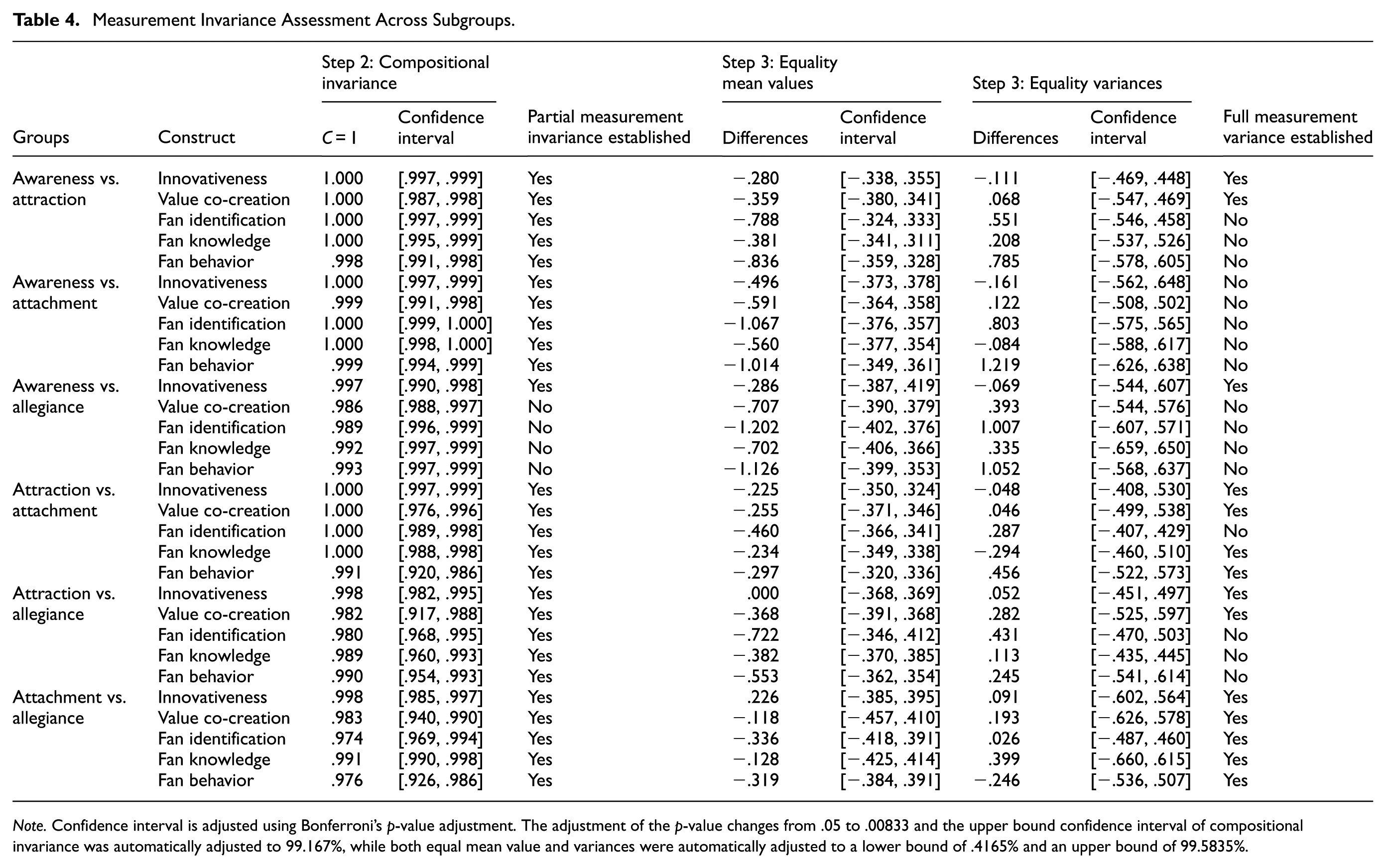
Note. Confidence interval is adjusted using Bonferroni’s p-value adjustment. The adjustment of the p-value changes from .05 to .00833 and the upper bound confidence interval of compositional invariance was automatically adjusted to 99.167%, while both equal mean value and variances were automatically adjusted to a lower bound of .4165% and an upper bound of 99.5835%.
As presented in Table 5, significant group differences emerged via permutation-based multigroup analysis (p < .05). Differences were observed between the awareness and attraction groups (Δβ = .305) and between the attachment and allegiance groups (Δβ = .531). Table 6 further details these relationships. The path from innovativeness to fan identification was statistically significant in both the awareness (β = .712) and attraction (β = .407) groups. The relationship remained significant in the attachment group (β = .572, t = 6.048) but was non-significant in the allegiance group.
Multigroup Analysis of Structural Path Differences Across Subgroups.

Note. Confidence interval is adjusted using Bonferroni’s p-value adjustment. The adjustment of the p-value changes from .05 to .00833. *p < .05.
Structural Model Assessment Across Psychological Continuum Model Stages.

Discussion
This study sets out to examine how digital innovativeness shapes esports fan identification and engagement, with a particular focus on the process across different stages of psychological involvement, as conceptualized by PCM and IDT (Funk & James, 2001; Oh et al., 2025; Wani & Ali, 2015). By integrating both theoretical frameworks, the study advances a dual-lens perspective that captures the evolving interplay between fans' openness to innovation and their psychological connection to esports teams. This approach addresses a critical gap in the literature, where fan engagement is often treated as homogeneous and static, despite the dynamic and segmented nature of digital fandom. The findings highlight the central role of innovativeness in driving fan identification, particularly in earlier PCM stages, thereby offering a more nuanced understanding of how fans evolve from peripheral awareness to deep loyalty. In doing so, this research not only contributes to the theoretical refinement of PCM and IDT in digitally mediated sport contexts but also provides actionable insights for practitioners seeking to design targeted engagement strategies that align with fans’ psychological readiness and innovation orientation (Behnam et al., 2023; Vargo et al., 2023).
The results underscore the pivotal role of fan innovativeness as a foundational antecedent to psychological engagement in esports, particularly through its strong influence on fan identification and fan knowledge. Among the examined variables, fan identification emerged as the most consistent and potent predictor of behavioral engagement, reaffirming its centrality in the development of enduring fan–team relationships (Naylor et al., 2017; Wu et al., 2012). In contrast, the direct effects of value co-creation experiences and fan knowledge on behavior were not significant. This aligns with recent studies indicating that engagement in co-creation or knowledge-sharing activities alone may not produce behavioral loyalty unless reinforced by affective bonds and identity alignment (Jang & Byon, 2020). It is plausible that fan identification acts as a critical mediator, translating cognitive and participatory engagement into behavioral outcomes, especially in digital-first environments where psychological commitment may serve as a filter for action.
The lack of direct effects may reflect contextual moderators, such as fandom intensity, platform type, or individual motivation (e.g., competitive vs. casual orientation), which can shape how value co-creation and knowledge expression translate into observable behaviors (Qian & Seifried, 2023). For example, highly identified fans may be more likely to convert co-creation into purchase behaviors or advocacy, whereas low-identified fans may engage for hedonic or exploratory reasons without behavioral follow-through. These findings reflect the complex and layered nature of esports fandom, where digital fluency, psychological readiness, and platform interactivity jointly shape fan trajectories (Behnam et al., 2023; Wang et al., 2023). These findings suggest the value of testing more complex models in future research. Specifically, mediated or moderated pathways could clarify how co-creation and fan knowledge indirectly shape behavior through psychological attachment, thus validating identification’s role as a central mechanism within innovation-driven fan engagement.
Findings from the multigroup analysis reveal critical heterogeneity in the psychological mechanisms driving fan engagement across distinct stages of the PCM, which underscore the strategic importance of fan segmentation in esports marketing and community development (Jang, Byon, Pecoraro, & Tsuji, 2021). The influence of innovativeness on fan identification was strongest among fans in the awareness and attraction stages and significantly attenuated in the allegiance stage. This pattern suggests that innovative digital stimuli are most effective during the formative phases of fan development, when psychological commitment is still emerging and malleable (Funk & James, 2001; McDonald et al., 2023). For practitioners, these findings advocate for a differentiated engagement approach, wherein organizations deploy novel, immersive, and gamified experiences to capture the attention of early-stage fans and facilitate their progression along the engagement continuum. Conversely, fans in later stages may respond more favorably to relational and identity-affirming experiences that reinforce existing loyalties rather than stimulate novelty-seeking. By aligning innovation strategies with fans’ psychological readiness, esports organizations can more effectively nurture sustained identification and behavioral loyalty over time (Kim & Kim, 2020; Sjöblom et al., 2020).
Theoretical Implications
This study advances theoretical understanding in sport management and digital consumer behavior by integrating IDT with the PCM to examine esports fan engagement within a digitally immersive and innovation-driven context. While PCM has traditionally been applied to analog sport settings (Funk & James, 2001; Inoue et al., 2017), this research extends its conceptual utility by demonstrating how psychological connection and innovation receptivity interact dynamically across stages of fan development (Ko et al., 2023). Specifically, the study reveals that fan innovativeness significantly enhances identification and knowledge acquisition (Behnam et al., 2023; Kim et al., 2017), particularly in early PCM stages, thereby positioning innovativeness as a critical psychological antecedent in the esports ecosystem (McDonald et al., 2023; Oh et al., 2025). These findings refine PCM by illustrating that fan engagement is not only hierarchical but also contingent on individual traits such as openness to innovation. The non-significant direct effects of value co-creation and fan knowledge on behavioral outcomes challenge assumptions in service-dominant logic and suggest that identification may serve a mediating function, particularly in digital fandoms characterized by high interactivity and low physical co-presence (Funk & James, 2001; Kunkel et al., 2022). This nuanced understanding supports a multidimensional and stage-sensitive view of engagement (Vargo et al., 2023; Verleye, 2015); wherein psychological and behavioral processes unfold along both vertical (PCM) and lateral (IDT) axes. By reconciling these frameworks, the study contributes to the theorization of esports fandom as a fluid, innovation-responsive, and psychologically stratified phenomenon, thereby offering a more sophisticated model for analyzing consumer engagement in digitally mediated sport contexts.
Practical Implications
The findings of this study offer clear and actionable implications for esports organizations seeking to strengthen fan engagement in an increasingly digital and innovation-driven environment. Most notably, the strong influence of fan innovativeness on identification suggests that organizations should actively cultivate an innovation-oriented fan culture. This can be operationalized through the deployment of emerging technologies, such as augmented reality (AR), virtual reality, and blockchain-enabled platforms, to create immersive, interactive, and personalized experiences that appeal to digitally fluent fans (Kim & Kim, 2020; Huang et al., 2023). For example, AR applications that allow fans to engage with virtual avatars of players during live broadcasts can enhance experiential value and facilitate emotional connection. The differential effects of innovativeness across PCM stages call for a segmented engagement strategy. Fans in the early stages may respond best to onboarding content, gamified tutorials, and introductory fan challenges, whereas more psychologically committed fans may be more engaged through co-creation initiatives, such as fan-led content design, modding, or collaborative storytelling (Qian & Seifried, 2023). Given that fan identification is the most robust predictor of behavioral engagement, organizations should further invest in strategies that foster belonging and identity formation, including community-driven platforms, exclusive loyalty programs, and team-branded digital assets (Carlson et al., 2009; Kim et al., 2011). By aligning technological innovation with fans’ psychological readiness, esports stakeholders can cultivate sustainable engagement ecosystems, deepen loyalty, and differentiate themselves in an increasingly competitive digital entertainment landscape (Funk & James, 2001; Oh et al., 2025; Qian & Seifried, 2023; Sjöblom et al., 2020).
Limitations and Suggestions for Future Research
Despite its theoretical and practical contributions, this study is not without limitations. The research was conducted within the context of Taiwan’s esports industry, which may constrain the generalizability of the findings to regions with distinct cultural, technological, and market dynamics (Baker, 2021). Future research should replicate and extend this framework in diverse esports ecosystems, such as North America, Europe, and Asia, to test for cross-cultural validity. While the study focused on innovativeness, fan identification, and fan knowledge, it did not account for individual-level moderators, such as gender, genre preferences (e.g., first-person shooter or multiplayer online battle arena), or engagement style (competitive or casual), which may influence value co-creation and psychological connection (Chang et al., 2023; Rogers et al., 2022). Incorporating these variables could yield a more granular understanding of fan segmentation. The exclusive reliance on self-reported survey data introduces potential biases, including social desirability and recall error (Becker et al., 2023; Hauser & Schwarz, 2016). Future studies should consider integrating behavioral data from digital platforms, such as streaming analytics, social media engagement, and in-game interactions, to enhance measurement validity. Emerging technologies such as AI-driven fan analytics, virtual influencers, or metaverse-based fan communities could also be explored to interact with innovativeness and fan identification within the dual-theory framework, thereby extending its relevance to next-generation digital fandoms. Addressing these limitations will not only strengthen the robustness of future models but also deepen insights into the real-time dynamics of esports fan engagement and value co-creation.
Footnotes

Ethical Considerations
This study was approved by National Taiwan University Research Ethics Committee (NTU-REC, Reference number: REC-202311ES021).
Funding
The authors disclosed receipt of the following financial support for the research, authorship, and/or publication of this article: This work was supported by the National Science and Technology Council, Taiwan (award number: NSTC 113-2410-H-032-063-MY2).
Declaration of Conflicting Interests
The authors declared no potential conflicts of interest with respect to the research, authorship, and/or publication of this article.
Data Availability Statement
The datasets analyzed during the current study are available from the corresponding author upon reasonable request.