




Abstract
Although a sizable number of studies have gathered information from college students regarding their varying degrees of support for capital punishment, few have explored the underlying rationales behind these students’ death penalty support or opposition. In addition, although criminal justice majors have frequently been used as study participants, little research has sought to explore if law enforcement majors are different in manners for supporting or opposing capital punishment than other criminal justice majors. In the current study, a survey designed to measure reasons for support or opposition to capital punishment was administered to a convenience sample of 135 criminal justice and law enforcement majors at a mid-size Midwestern university. The results indicated that law enforcement majors were not significantly different from criminal justice majors on measures of support or opposition to capital punishment. There were, however, some notable differences found related to the academic standing of the students.
Keywords
Introduction
The death penalty is one of the most controversial subjects in America today. Although the practice remains legal in 36 states and the District of Columbia, it has nevertheless stirred passionate and heated debate among both proponents and abolitionists. There have also been notable changes in regard to the circumstances that the death penalty may be imposed in the United States, as the practice was once again deemed to be constitutional following the 1976 Supreme Court decision in Gregg v. Georgia. Three notable changes regarding the death penalty in America since that time are that it is no longer allowed to be imposed as punishment on criminals who are mentally retarded (because of the 2002 Supreme Court decision in Atkins v. Virginia), that it is no longer allowed to be imposed as punishment on criminals who were below the age of 18 at the time of the crime (because of the 2005 Supreme Court decision in Roper v. Simmons), and that it is no longer allowed to be imposed as punishment on criminals if the underlying crime did not result in the victim’s death (because of the 2008 Supreme Court decision in Kennedy v. Louisiana).
Numerous opinion polls have revealed that a majority of Americans have supported the death penalty for more than 40 years. However, the results from a 2013 Gallup poll revealed the lowest support for the death penalty since 1972 (Jones, 2013). Furthermore, as discussed in the literature review, a body of evidence from research has begun to develop over the past 40 years, which has provided information regarding varying degrees of support certain groups of people have had for capital punishment, with White persons, males, Republicans, and less educated individuals generally expressing greater support for the death penalty than non-White persons, females, Democrats, Independents, and highly educated individuals (Borg, 1997; Britt, 1998; Cochran & Chamlin, 2006; Dotson & Carter, 2012; Halim & Stiles, 2001; Soss, Langbein, & Metelko, 2003; Unnever & Cullen, 2006; Vidmar & Ellsworth, 1974; Whitehead & Blankenship, 2000). A number of these studies have used college student populations, including several that have compared the opinions of criminal justice majors and non-criminal justice majors (Farnworth, Longmire, & West, 1998; Lambert et al., 2008; Robbers, 2004; Schadt & DeLisi, 2007). Additional research has looked at the underlying reasons persons have had for either supporting or opposing capital punishment (Bohm, 1987; Ellsworth & Gross, 1994; Ellsworth & Ross, 1983; Zeisel & Gallup, 1989). Little research, however, has looked at the similarities and differences in underlying reasons specific groups of individuals have had for either supporting or opposing the death penalty and none to date has explored whether or not law enforcement students differ in reasons for supporting or opposing the death penalty from other criminal justice majors.
Although studies often group criminal justice students and law enforcement students as belonging to the same population, there are some important differences between the two groups. One difference relates to the different academic requirements for each respective major. Although both criminal justice and law enforcement majors must complete several of the same classes as part of their degree requirement, there are a number of classes required for only one of the majors. In addition, law enforcement students interested in becoming licensed peace officers may be required to complete a law enforcement skills practicum during their final year in school. A second difference between the two majors relates to the career aspirations of each following the completion of their education. Whereas the law enforcement major is designed for students interested in becoming licensed peace officers, the criminal justice major is designed for students interested in a broader range of careers in the criminal justice system, including juvenile justice, parole, probation, courts, and corrections. Third, although there are similarities in the beliefs of the two majors, some studies have found that there exist important differences in the attitudes and opinions of law enforcement students compared with other criminal justice students, with students majoring in law enforcement or anticipating a career in law enforcement displaying higher ethical standards (Bjerregaard & Lord, 2004), more punitive beliefs (Courtright & Mackey, 2004), and more sensitivity to issues surrounding domestic violence (McMullan, Carlan, & Nored, 2010) than other criminal justice students.
Understanding whether or not differences exist between the two majors in relation to the reasons that each group has for supporting or opposing capital punishment is important for several reasons. One of these is due to the fact that the death penalty is the ultimate punishment. As Whitehead, Blankenship, and Wright (1999) point out, “Given the literal life and death nature of capital punishment, it is important to continue research on this topic” (p. 250). A second reason is that these differences may have important policy implications. Understanding if differences exist between the two majors has both theoretical and practical implications that are important for those who support and oppose the death penalty as well as for scholars, teachers, and other social scientists. In addition, some professors who teach classes in criminal justice and law enforcement are interested in better understanding how these two groups of students are similar to and different from each other.
Literature Review
Although public opinion surveys have provided insight into the level of support people have had for the death penalty, beginning in the 1970s, the focus of research shifted and attention was being given to try to help better understand the individual characteristics of those who strongly support the death penalty, those who support it under certain circumstances, and those who are opposed to the death penalty. The first areas of this research focused on the personal characteristics of people and how these characteristics were related to varying levels of support for the death penalty.
Two of the strongest individual-level characteristics related to death penalty support have been race and gender. Research studies have consistently revealed that White persons have higher levels of support for the death penalty than non-White persons (Baker, Lambert, & Jenkins, 2005; Britt, 1998; Cochran & Chamlin, 2006; Dotson & Carter, 2012; Ellsworth & Gross, 1994; Lambert, Clarke, Tucker-Gail, & Hogan, 2009; Unnever & Cullen, 2007b; Vidmar & Ellsworth, 1974; Young, 1991; Zeisel & Gallup, 1989). There have been some studies that suggest that the higher levels of death penalty support among White persons may partly be explained by White racism (Barkan & Cohn, 1994; Soss et al., 2003; Unnever & Cullen, 2007a). Another consistent finding is that males are more supportive of the death penalty than females (Barkan & Cohn, 1994; Borg, 1997; Britt, 1998; Dotson & Carter, 2012; Ellsworth & Gross, 1994; Lambert et al., 2009; Vidmar & Ellsworth, 1974; Whitehead & Blankenship, 2000; Zeisel & Gallup, 1989). Unlike race and gender, the findings related to death penalty support and age have been mixed, with some research reporting that older people tend to be more supportive of the death penalty (Vidmar & Ellsworth, 1974), other research finding that younger people tend to be more supportive of the death penalty (Borg, 1997), and additional research finding that age was not related to death penalty support (Robbers, 2004).
Political affiliation has also been found to be related to death penalty support as those who have identified themselves as Republicans have shown higher support for the death penalty than either Democrats or Independents (Britt, 1998; Lambert et al., 2009; Zeisel & Gallup, 1989). Research studies have further generally found an inverse relationship between the importance that religion plays in an individual’s life (religious saliency) and support for the death penalty (Bader, Desmond, Mencken, & Johnson, 2010; Britt, 1998; Lambert et al., 2009; Unnever & Cullen, 2006).
Population-based studies have also revealed that level of education has generally been inversely related to death penalty support, as those with higher levels of education typically are less supportive of the death penalty (Barkan & Cohn, 1994; Borg, 1997; Britt, 1998; Halim & Stiles, 2001; Vidmar & Ellsworth, 1974; Young, 1991). Studies involving college students, however, have reported mixed findings related to whether or not one’s level of support for the death penalty is affected by how far along in college one is. Although studies by Robbers (2004) and Lambert et al. (2009) found that year in college was not significantly related to death penalty support in studies of college students, Farnworth et al. (1998) found that seniors were less supportive of capital punishment than freshmen, and Pasupuleti, Lambert, and Cluse-Tolar (2005) reported that upper level social work students expressed a greater degree of opposition to the death penalty than lower level social work students.
A specific characteristic that some studies involving college students have looked at is whether their choice of major is related to their support or opposition toward the death penalty (Farnworth et al., 1998; Lambert et al., 2008; Pasupuleti et al., 2005; Robbers, 2004; Schadt & DeLisi, 2007). As criminologists have conducted many of the studies that have looked at death penalty support among college students, these studies have frequently compared the support of those majoring in criminal justice with those majoring in fields other than criminal justice. The findings have been mixed with some studies reporting greater support for the death penalty among criminal justice majors compared with non-criminal justice majors (Farnworth et al., 1998; Lambert et al., 2008) and other studies reporting no difference between criminal justice majors and non-criminal justice majors (Robbers, 2004; Schadt & DeLisi, 2007). Outside of criminal justice majors, in a study that compared the death penalty opinions of 172 social work majors with 234 majors from other fields, Pasupuleti et al. (2005) found that social work majors were significantly less supportive of the death penalty than non-social work majors. Although research that has looked at individuals’ personal characteristics found that these characteristics are related to various levels of support for or opposition against capital punishment, these characteristics are unable to explain the underlying reasons for the variations.
Research has revealed several common reasons that people provide for supporting the death penalty and for opposing the death penalty. Commonly given reasons to support the death penalty include deterrence, retribution, law and order, incapacitation, and cost (Bohm, 1987; Ellsworth & Gross, 1994; Ellsworth & Ross, 1983; Zeisel & Gallup, 1989). Reasons given in opposition of the death penalty include that it is immoral, that it is wrong to respond to violence with violence, that it is unfairly applied, and that innocent people may have been executed (Ellsworth & Gross, 1994; Ellsworth & Ross, 1983; Zeisel & Gallup, 1989).
Retribution is perhaps the most common reason that people give as a reason for supporting the death penalty (Bohm, 1987; Ellsworth & Gross, 1994; Whitehead & Blankenship, 2000; Zeisel & Gallup, 1989). There are two different concepts of retribution that relate to supporting capital punishment: retribution as “just deserts” and retribution as revenge (Finckenauer, 1988). Under the “just deserts” concept lies the idea that the punishment for an offender should be proportionate to the harm caused by his or her criminal act. As such, those who support the death penalty under the “just deserts” concept of retribution believe that it is the appropriate punishment for those convicted of murder because the crime involved deliberately ending the life of another (Bohm, 1987; Zeisel & Gallup, 1989). Under the revenge concept, retribution is frequently an emotional response that is tied to the pain and anger experienced by those who were affected by the murder. Those who support the death penalty under this concept frequently believe that the execution will help relieve the suffering for those affected by the murder.
Another frequent reason people support the death penalty is based on the idea that executing murderers deters other persons from committing similar crimes in the future (Ellsworth & Ross, 1983; Whitehead & Blankenship, 2000; Zeisel & Gallup, 1989). People who support the death penalty for this reason believe that execution is a more effective deterrent than life imprisonment (Ellsworth & Gross, 1994).
Others who support death penalty do so because they believe that the punishment is necessary to maintain law and order in society. This is tied to the ideology of using state violence and punishment as a means of exerting social control (Rankin, 1979). The ideology that the death penalty helps society to have order is tied to the instrumentalist perspective. “The argument underlying this hypothesis is that citizens who fear crime or see it as an important social problem and who believe that crime would be lessened by harsher punishments will support harsher punishments” (Tyler & Weber, 1982, p. 22).
Incapacitation is another reason given by some to justify support for the death penalty (Ellsworth & Gross, 1994; Zeisel & Gallup, 1989). There is a belief among some that murderers will kill again if they are not executed (Whitehead & Blankenship, 2000), and under the incapacitation argument, murderers who are executed will not be able to do so. Another reason people support the death penalty under the incapacitation ideology is due to the perception many have that people who are sentenced to life imprisonment do not end up spending the remainder of their life in prison (Ellsworth & Gross, 1994; Ellsworth & Ross, 1983). Related to this, some research studies have found that the number of those who stated that they are in favor of the death penalty decreases when they were offered the option of life without any chance of parole (Whitehead & Blankenship, 2000).
A fifth commonly given reason for supporting death penalty relates to cost (Bohm, 1987; Ellsworth & Gross, 1994; Zeisel & Gallup, 1989). A common perception that people have is that it costs less to execute a person than to keep that person incarcerated for the rest of his or her life (Ellsworth & Ross, 1983; Lambert & Clarke, 2004). Although research studies have found that executions actually cost more than life imprisonment (Cook & Slawson, 1993; Roman, Chalfin, Sundquist, Knight, & Darmenov, 2008; Spangenberg & Walsh, 1989), studies also show that many people are not aware of this fact (Ellsworth & Ross, 1983; Lambert & Clarke, 2004).
One of the most prevalent reasons why people are opposed to capital punishments relates to the issue of morality. These people view it as immoral or wrong for the state to kill someone (Ellsworth & Gross, 1994; Ellsworth & Ross, 1983; Zeisel & Gallup, 1989). A second reason why people are opposed to the death penalty has to do with the possibility that an innocent person may end up being executed (Ellsworth & Ross, 1983; Zeisel & Gallup, 1989). This is becoming a salient argument as more people who are being sent to death row are subsequently released because of doubts about their guilt (Harmon, 2001; Radelet & Bedau, 1998). Since 1973, there have been more than 155 people who have been exonerated and released from death row (Death Penalty Information Center, 2015). A third common reason that people state why executions need to be abolished is because of its unfair application and disproportionate impact on minorities (Radelet & Pierce, 1985; Sorenson & Wallace, 1999) and the poor (Bright, 1994; Ellsworth & Ross, 1983). Although deterrence has been cited as a reason to support the death penalty, some who oppose the death penalty believe that executions do not deter murders but rather believe that executions have a brutalization effect that may result in an increase in the level of violence and rates of homicide (Bowers & Pierce, 1980; Vandiver, Giacopassi, & Gathje, 2002). Finally, as with support for the death penalty, opposition can also be due to emotional reasons. People who are opposed to executions sometimes state that they are saddened when people are executed and are opposed for this reason (Ellsworth & Ross, 1983).
As research has found that there are different reasons why people are in support of capital punishment or in opposition to capital punishment, some studies have begun to look at how these differences vary among different groups. In a study that analyzed different reasons for supporting or opposing the death penalty based on race, Baker et al. (2005) reported that African American students had significantly lower levels of agreement with eight of nine statements that reflected reasons to support the death penalty and significantly higher levels of agreement with seven statements that reflected reasons to oppose the death penalty than White students. The reasons to support the death penalty included statements related to deterrence, retribution, law and order, and incapacitation, and the reasons to oppose the death penalty included statements related to morality, unfair application, the brutalization effect, mercy, and innocence. When multivariate models were run controlling for race, gender, age, and academic standing, African American students remained significantly less supportive than White students on four of the nine statements for supporting the death penalty and significantly more supportive than White students on six of the seven statements for opposing the death penalty.
In a second study that analyzed different reasons for supporting or opposing the death penalty based on gender, Lambert et al. (2009) reported that female students had significantly lower levels of agreement than male students for five statements that measured support for the death penalty based on retribution, for three statements that measured support for the death penalty based on deterrence, and for two of three statements that measured support for the death penalty based on incapacitation. The female students were further found to have higher levels of agreement than male students for four statements that measured opposition to the death penalty based on issues of morality, for two statements that the death penalty was unfairly administered, and for statements that the death penalty led to increased violence in society and that an innocent person had likely been executed. When multivariate models were run controlling for gender, age, race, educational level, political affiliation, religious salience, and religious frequency, female students remained significantly less supportive than male students on multiple item indices related to supporting the death penalty for retribution, deterrence, and incapacitation purposes and significantly more supportive than male students on multiple item indices related to opposing the death penalty based on issues of morality and unfair administration and on single item measures opposing the death penalty due to brutalization and innocence.
In a third study that analyzed differences for supporting or opposing the death penalty based on whether a student was a social work major or was majoring in some other discipline, Pasupuleti et al. (2005) reported that social work majors had significantly lower levels of agreement than other majors with six of nine statements that measured support for the death penalty based on deterrence, retribution, law and order, incapacitation, and cost and significantly higher levels of agreement with five statements that measured opposition to the death penalty based on morality, unfair application, brutalization, mercy, and innocence. When multivariate models were run controlling for college major, gender, race, education level, and age, social work majors continued to have significantly lower levels of agreement than other majors with five of the nine statements that measured support for the death penalty and significantly higher levels of agreement than other majors with two of the five statements that measured opposition to the death penalty.
Research Questions
The following research study will expand on the works of Baker et al. (2005), Lambert et al. (2009), and Pasupuleti et al. (2005) by exploring if there are significant differences between criminal justice majors and law enforcement majors related to their levels of agreement with statements related to supporting the death penalty based on retribution, deterrence, law and order, incapacitation, and cost and their levels of agreement with statements related to opposing the death penalty based on morality, innocence, unfair application, brutalization, and emotional opposition. The study will further explore if level of education has a significant impact on levels of agreement with these statements.
Method
Participants
The data for this study are drawn from a survey of college students at a mid-size Midwestern urban university, with a total enrollment of 11,000 students. A non-random, convenience sample was utilized, involving students from eight criminal justice classes in the Spring Semester of 2014. All the students who participated in the study were majoring in either criminal justice or law enforcement. The class sizes ranged from 21 to 32 students, and all were criminal justice classes, required for both criminal justice and law enforcement majors. The students were asked to take part in the study by voluntarily completing the survey administered during the second week of classes in Spring 2014. To prevent double participation, students in each of the classes were asked not to participate in the survey if they had done so in a previous class. Although the students were informed that they were not required to participate in the study and that not participating would not affect their grade, all those who were asked to participate did so.
Dependent Variables—Reasons for Supporting or Opposing the Death Penalty
To measure participants’ attitudes toward capital punishment, the students were given a series of 15 statements that had been used as part of a previous study that looked at reasons for supporting and opposing capital punishment (Lambert, Clarke, & Lambert, 2004) and were asked to indicate how much they agreed or disagreed with the statement using a five-item Likert-type response scale (1 = strongly disagree, 2 = disagree, 3 = undecided, 4 = agree, 5 = strongly agree). Eight of the statements were designed to measure levels of agreement with reasons to support the death penalty based on the ideologies of retribution, deterrence, law and order, incapacitation, and cost. Seven of the statements were designed to measure levels of agreement with reasons to oppose the death penalty based on the ideologies of morality, innocence, unfair application, brutalization, and emotional opposition. The specific statements asked are listed in Table 2.
Independent Variables
There were a total of eight survey questions, which measured fear of personal victimization, religious saliency, college level, race, gender, political affiliation, age, and major, that were originally intended to serve as the independent variables in this study. To measure fear of personal victimization, a five-item Likert-type scale question was included in the survey asking respondents “How often do you fear being a victim of a violent crime?” with 1 representing not at all, 2 representing once a month, 3 representing 2 to 3 times a month, 4 representing once a week, and 5 representing more than once a week. The question “To what extent has religion played a role in your life?” was also included as a measure of religious saliency using a four-item Likert-type scale with 1 representing not at all, 2 representing not much, 3 representing a fair amount, and 4 representing a great deal.
College level was measured by asking respondents to state their college rank (1 = freshman, 2 = sophomore, 3 = junior, 4 = senior). Race was a binary coded variable with 0 representing non-White students and 1 representing White students. Gender was a binary coded variable with 0 representing male and 1 representing female. Political affiliation was measured by asking respondents to select from one of four possible political affiliations (1 for Democrat, 2 for Republican, 3 for Independent, 4 for Other). The measure was collapsed into a binary coded variable to identify whether or not the participant identified him or herself as a Republican (with 0 representing Republican and 1 representing non-Republican). Age was measured in years. Major was a binary coded variable with 0 representing criminal justice major and 1 representing law enforcement major.
In total, 135 students completed the survey. Answers were provided to every survey item, with the exception of age, by more than 90% of the participants. Because slightly more than one third of the participants failed to answer the survey item regarding age, this variable was not used in the subsequent analysis. For the remaining survey items with missing data for these variables, the mean values of these variables were substituted for the missing values.
Regarding college level, 6.06% of the students were freshmen, 13.64% were sophomores, 51.52% were juniors, and 28.79% were seniors. In terms of race, 60.31% of the participants reported that they were White persons, and 39.69% reported that they were non-White persons. In terms of gender, 53.03% of the participants reported that they were female, and 46.97% reported that they were male. In terms of political orientation, 37.69% of the participants identified themselves as being Democrats, 26.15% identified themselves as being Republicans, 16.92% identified themselves as being Independents, and 19.23% identified themselves as being “Other,” regarding their political affiliation. The ages of 88 of the participants were provided, with a range from 18 to 55 years old. The age variable had four medians as 10 of the participants reported being 21 years old, 10 reported being 23 years old, 10 reported being 24 years old, and 10 reported being 25 years old. The mean age was 26.97, with a standard deviation of 7.74. Finally, 69.64% of the participants identified themselves as being criminal justice majors, and 30.37% identified themselves as being law enforcement majors. The demographics, excluding age, are summarized in Table 1.
Characteristics of Respondents for Demographic Variables.

Findings
Reasons for Supporting or Opposing Capital Punishment by Major
The first analysis involved examining the survey responses to see if there were significant differences in reasons for supporting or opposing the death penalty comparing students who were criminal justice majors and students who were law enforcement majors. The percentage of responses for the eight statements that represent reasons for supporting the death penalty and the seven statements that represent reasons for opposing the death penalty for the entire sample, for criminal justice majors and for law enforcement majors, are presented in Table 2. Although many of the differences were small, in general, criminal justice majors expressed somewhat lower levels of agreement with most of the statements for supporting the death penalty and somewhat greater levels of agreement with the statements for opposing the death penalty.
Frequency Responses for Reasons for Supporting or Opposing Capital Punishment for Entire Group, CJ Majors, and LE Majors.

Note. CJ = criminal justice; LE = law enforcement; SD = strongly disagree; D = disagree; U = undecided; A = agree; SA = strongly agree.
Because the variables regarding level of agreement with statements measuring either support for or opposition to capital punishments used a five-item Likert-type scale, ordered logistic regression models were used to see whether criminal justice majors differed significantly on reasons for supporting and reasons for opposing the death penalty. The results for these tests are presented in Table 3. What they show is that although criminal justice majors were somewhat lower in their levels of agreement with statements for supporting the death penalty and somewhat higher in the levels of agreement with statements for opposing the death penalty, there was only one statistically significant difference between the majors. This finding was that criminal justice majors were more in agreement with the statement “When society executes an individual for a violent crime, it is responding to violence with violence” than law enforcement majors (z = −2.29, p < .05). This provided evidence that criminal justice majors were significantly more likely to agree with a statement related to opposing the death penalty on the basis that capital punishment is immoral than law enforcement students. There were not significant differences between majors related to agreement with statements for opposing the death penalty based on the ideologies of innocence, unfair application, brutalization, and emotional opposition. There were also no differences between majors on any of the statement for supporting the death penalty.
Differences in Reasons for Supporting or Opposing Capital Punishment by College Major.

Note. CJ = criminal justice; LE = law enforcement.
p < .05. **p < .01.
Reasons for Supporting or Opposing Capital Punishment by College Level
The next analysis involved examining the survey responses to see if year in school was significantly associated with reasons to support the death penalty or with reasons to oppose the death penalty. The percentage of responses for the eight statements that represent reasons for supporting the death penalty and the seven statements that represent reasons for opposing the death penalty are presented in Table 4 according to year in college for the 132 respondents who answered the survey question regarding year in school. These items were fairly consistent in showing that upper level students (juniors and seniors) had lower levels of agreement than lower level students (freshmen and sophomores) regarding statements in support of the death penalty. Looked at individually, both juniors and seniors had lower levels of agreement than both freshmen and sophomores for all but one of the statements in support of the death penalty. There was not, however, a similarly clearly evident trend regarding level of agreement, comparing upper level and lower level students regarding statements in opposition to the death penalty. Of the seven statements in opposition to death penalty, there was only one where both juniors and seniors showed a higher level of agreement compared with both freshmen and sophomores.
Frequency Responses for Reasons for Supporting or Opposing Capital Punishment for Freshmen, Sophomores, Juniors, and Seniors.

Note. SD = strongly disagree; D = disagree; U = undecided; A = agree; SA = strongly agree.
To test for significance, ordered logistic regression models were run for each of the 15 reasons to support or oppose the death penalty along with the participants’ year in college (see Table 5). These models revealed significant, inverse relationships between year in school and level of agreement with three of the statements that have been used to support the death penalty. These findings were that students were significantly less likely to believe that “Crime is one of the most serious social problems facing society today” (z = −3.34, p < .01), that “The death penalty is a more effective deterrent than life imprisonment” (z = −2.70, p < .01), and that “We need capital punishment to provide law and order in society” (z = −2.64, p < .01) the farther along they had progressed in college. Thus, as students were further along with their education, they were less likely to be in agreement with statements related to supporting the death penalty under the belief that capital punishment helps promote law and order and that the death penalty helps deter certain crimes. Year in school was not found to be significantly related to agreement with statements for supporting the death penalty based on the ideologies of cost, retribution, or incapacitation. There was also one significant relationship between year in college and opposition to the death penalty. This difference was that students were significantly more likely to believe that “When society executes an individual for a violent crime, it is responding to violence with violence” (z = 2.65, p < .01) the farther along they had progressed in college. This revealed that as students were further along with their education, they were more likely to be in agreement with a statement related to opposing the death penalty on the basis that capital punishment is immoral. Year in school was not found to be significantly related to agreement with statements for opposing the death penalty based on the ideologies of innocence, unfair application, brutalization, and emotional opposition.
Differences in Reasons for Supporting or Opposing Capital Punishment by Year in College.
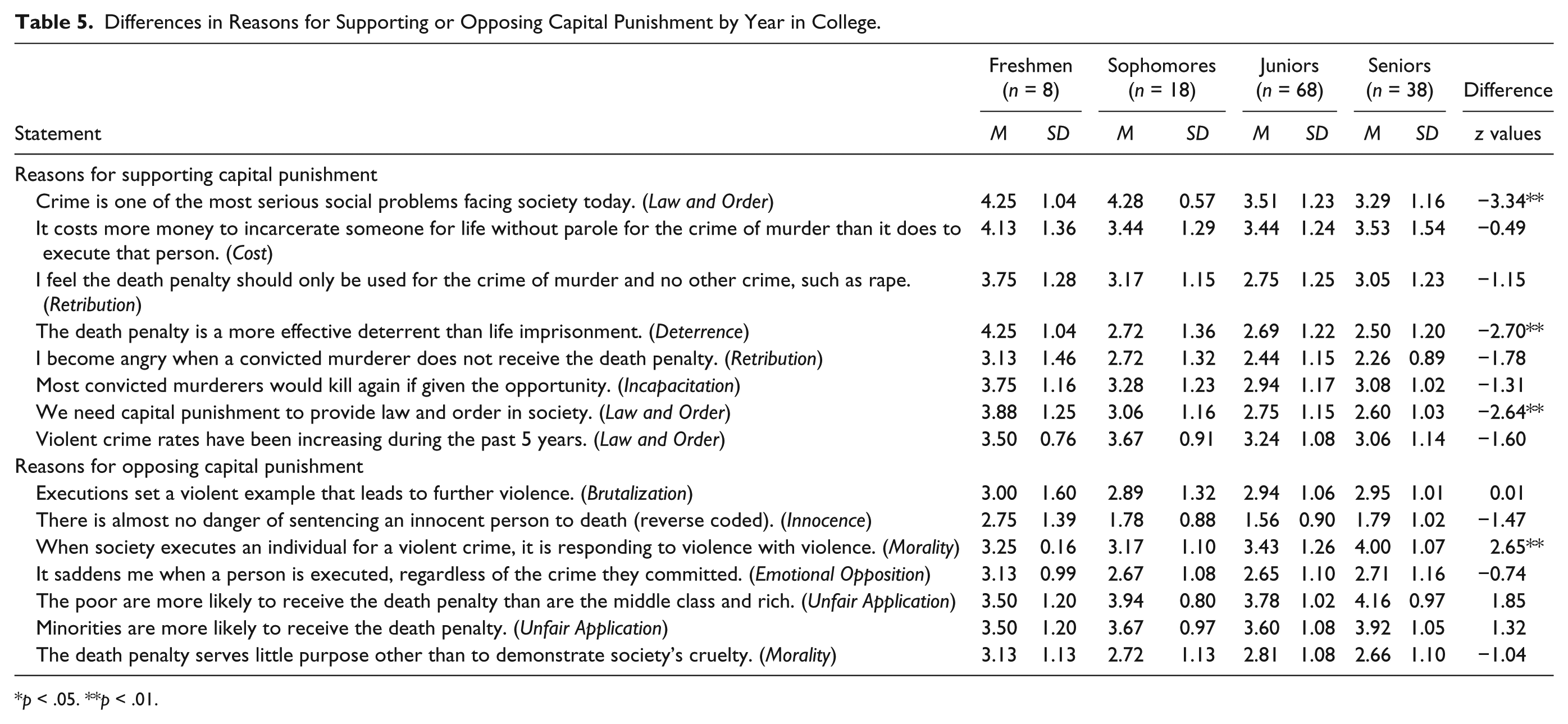
p < .05. **p < .01.
As the bivariate regressions had revealed a significant relationship between year in school and levels of agreement with three statements related to support for the death penalty and had further revealed a significant relationship between year in school and levels of agreement with one of the statements related to opposition to the death penalty, ordered logistic regression models were run with gender, race, political affiliation, religious saliency, personal fear of victimization, college major, and year in school as the independent variables. Separate models were run for each of the four statements that had previously produced statistically significant findings. What these models revealed was that even after controlling for gender, race, political affiliation, religious saliency, personal fear of victimization, and college major, all four of the variables that were related to year in school remained statistically significant. What the multivariate model also revealed, however, was that college major was no longer significantly related to level of agreement with the statement opposing the death penalty based on the ideology that the death penalty is immoral (see Table 6).
Multivariate Ordered Logistic Regression Results for Reasons for Supporting or Opposing the Death Penalty as a Dependent Variable.

p < .05. **p < .01.
Discussion
The results of the exploratory study did not provide evidence that there exist differences in levels of agreement with statements related to support or opposition of the death penalty when comparing law enforcement majors with other criminal justice majors. There was, however, found to be a significant relationship between level of education and the levels of agreement students had for three statements regarding death penalty support and for one statement regarding death penalty opposition. More specifically, students who were further along with their education were significantly less likely to agree with the statements that “Crime is one of the most serious social problems facing society today,” that “The death penalty is a more effective deterrent than life imprisonment,” and that “We need capital punishment to provide law and order in society.” Students who were further along with their education were also significantly more likely to agree with the statement “When society executes an individual for a violent crime, it is responding to violence with violence.” Although the survey did not specifically inquire whether the students were in favor of or opposed to the death penalty, and therefore, it cannot be stated whether upper class students were less supportive of the death penalty than lower class students; the findings do nevertheless show that year in college did have a significant influence on opinions about two statements regarding law and order, along with one statement about deterrence and one statement about morality.
These significant differences of opinion suggest that the college education that these students had achieved provided them with information and material, which may have influenced some of their perceptions about criminal justice issues. This increased information may have helped students have a better understanding that identifying crime as one of the most serious problems neglects to take into consideration the other social problems that are frequently associated with and may lead to involvement in crime. Some factors that have been identified as possible pathways to crime include unemployment, poverty and homelessness (Belknap, 2007; Chesney-Lind & Pasko, 2004; Greenfeld & Snell, 1999; Hughes, Wilson, & Beck 2001), and suffering sexual or physical abuse as a child (Harlow, 1999; Widom, 1995) along with drug addiction and alcohol abuse (Karberg & James, 2005; Mumola, 1999). Some scholars have further pointed out that for some offenders, their abuse of drugs or alcohol starts out as a way to cope with victimization experiences they suffered as children (Inciardi, Lockwood, & Pottieger, 1993; Miller, 1986). More fully understanding the relationships between other social problems and crime may explain why students with more years of education were less likely to view crime in terms being one of the most serious social problems facing society today. Their opinions about crime being a serious social problem may have further been influenced by their exposure to published reports that have shown that both violent and non-violent crime rates in America have been on the decline for more than a decade (Federal Bureau of Investigation, 2014a, 2014b).
Additional years in school may have allowed upper level students to complete upper level classes with specific components that deal with both crime prevention and capital punishment. The involvement in these classes may have helped the students better understand why many research studies have not found evidence that the death penalty deters crime (cf. Decker & Kohfeld, 1990; Radelet & Akers, 1996; Radelet & Lacock, 2009). These classes may have further helped these students understand that there are other factors outside of capital punishment necessary for law and order to exist in a society. The opinion about law and order may have also been influenced by the fact that the state where the students in this study were working toward their degree does not have the death penalty. Their education may have also had an effect on how the students saw execution in terms of being an act of violence by the state as opposed to being an act of justice for the victim.
The current study is not without limitations. First, given that the subjects came from a convenience sample of criminal justice and law enforcement majors from one university, the results may not be generalizable to other populations. Second, as the university was located in a state without the death penalty, it is impossible to tell whether the findings would be similar in a state with the death penalty. Third, the relatively small sample size meant that the statistical power was low. Thus, it is possible that there would have been more significant differences based on either major or year in school had a larger sample been used. Fourth, given that the study did not include a specific survey question asking the degree to which the students were in favor of or are opposed to the death penalty makes it difficult to compare this study’s findings with others that looked at support for and opposition against the death penalty. Fifth, there were several variables that prior research has found may influence perceptions about the death penalty that were not included in the survey used for this study. These variables include marital status (Bohm, 2003), social class (Unnever & Cullen, 2007b), political conservatism (Cochran, Boots, & Chamlin, 2006; Stack, 2000), religious affiliation (Britt, 1998; Grasmick, Cochran, Bursik, & Kimpel, 1993), and attribution styles (Cochran et al., 2006).
Given that this is the first research study to explore if there existed differences in reasons for supporting and opposing the death penalty between criminal justice and law enforcement students, it would be beneficial to replicate this study. Future research could include a larger sample of students drawn from multiple universities. To better understand the differences and similarities that exist between majors, it would help if the sample included students from one or more states that authorize the death penalty as a form of punishment along with students from one or more states that do not allow capital punishment. Future research could also explore the extent to which increased knowledge about specific criminal justice facts is associated with higher levels of education to better understand the extent to which increased knowledge about specific facts influences reasons for supporting and opposing capital punishment.
Conclusion
In an earlier study that looked at if majoring in criminal justice had a significant impact on the perceptions of criminal justice majors as compared with students who majored in other programs of studies, Tsoudis (2000) found support to the hypotheses that criminal justice majors would be less likely to support harsh punishments, would be more likely to support criminal rights, would be more in favor of equitable treatment of criminal defendants regardless of race, and would be more in favor of treating juvenile offenders differently than adult offenders. In explaining the findings, she stated that criminal justice education appeared to be an effective way to influence the development of the criminal justice system by providing criminal justice students with factual information, which they were then able to use to counter inaccurate perceptions about crime and criminal justice that came from the media.
Although the current study was not a replication of that done by Tsoudis (2000), the findings of this study provide similar evidence. Although the current study did not ask participants about whether or to what degree they were in favor of or opposed to capital punishment, the findings do nevertheless show that upper level students were more informed about certain criminal justice issues that prior research has found may affect death penalty support (Lambert et al., 2004). As such, it would be safe to say that the evidence presented indicates that the death penalty beliefs of criminal justice and law enforcement students who are farther along in their studies are more likely to be “informed beliefs,” formed with a better understanding about some important facts about the death penalty, when compared with the death penalty beliefs of those with less education.
Footnotes
Declaration of Conflicting Interests
The author(s) declared no potential conflicts of interest with respect to the research, authorship, and/or publication of this article.
Funding
The author(s) received no financial support for the research and/or authorship of this article.