




Abstract
Social capital and its dimensions are highly interrelated, and the outcome of social capital provides entrepreneurs with resources and knowledge that are not available in the first place. The objective of this study is to examine the effect of relational and cognitive social capital on structural social capital and the effect of structural social capital on the performance of micro-enterprises owned and managed by women in Peninsular Malaysia. This study uses a cross-sectional approach, and quantitative data are collected through structured interviews. It was found that cognitive social capital has a significant positive effect on structural social capital, and structural social capital has a significant positive effect on micro-enterprise performance. It was found that relational social capital has a positive but insignificant effect on structural social capital. Therefore, women entrepreneurs should emphasize on making the communication process easier and on ensuring that their business values, norms, interpretation, and meaning are shared and communicated to relevant parties to improve network ties and to build a dense network, which is essential in providing access to resources and knowledge. This, in return, is expected to improve the micro-enterprise performance in Malaysia.
Introduction
The term social capital indicates the resources that are available from and through personal and business networks. These personal and business networks generate resources, such as business opportunities, information, financial capital, ideas, leads, emotional support, trust, cooperation, and even goodwill. The term social in the social capital context explains the resources belonging to an individual, but they lay in the network of relationships (Baker, 2010). Bourdieu, an influential French sociologist, defined social capital as the sum of resources, actual or virtual, that are available to individuals or a group derived from strong network relationships built by mutual acquaintance and recognition (Gauntlett, 2011). Robert Putnam (2002) detailed that communities with a high level of civic engagement and social interaction have better means of governance, democracy, and economy. The World Bank defines social capital as “the groups, networks, norms, and trust that people have available to them for productive purposes” (Grootaert, Narayan, Jones, & Woolcock, 2003; p. 3).
Moving beyond individualism, the resources generated by social capital are very beneficial and improve personal and business success. At the individual level, networks help to land a job. Not all individuals secure jobs through “formal” methods such as advertisement and headhunters. The practice of finding a job through networking is promoted by counselors and outplacement consultants, and people tend to land a better paying job, which is satisfying, and they stay longer at these jobs. The people with better networks are reported to have better pay and tend to be promoted faster (Baker, 2010). At the firm level, social capital helps in securing venture capital as the formal and informal social network provides not only access to information on current investment objects but also opportunities to increase their willingness to invest (Alexy, Block, Sandner, & Wal, 2012). As noted in Small Business Administration (2009), a significant proportion of the new businesses and start-ups acquire financing through social networks of investors and capital seekers, such as friends, colleagues, and acquaintances. At the same time, social capital is linked to advertising based on word-of-mouth marketing where this method has a better effect when personal recommendation and referrals lead to actual purchase decisions. Social capital is found crucial to potential entrepreneurs who wish to embark on a start-up. The act of meeting other entrepreneurs and building good social capital is important for starting entrepreneurial activities. For potential entrepreneurs, joining business incubators and entrepreneurial support network is necessary to promote and strengthen entrepreneurship (Neira, Portela, Cancelo, & Calvo, 2013). Neira et al. (2013) also noted the importance of social trust on entrepreneurs as it could improve entrepreneurial intention among the potential entrepreneurs.
The Malaysian government has been serious in developing entrepreneurs in the country, through the Center for Instructor and Advanced Skills Training. The entrepreneurs are given skills and entrepreneur development trainings so that they will be able to improve and grab opportunities from the job market. For business start-ups, a total of RM65 million was given to the Small Entrepreneur Fund to promote a sustainable economy. To strengthen and promote small and medium enterprises (SMEs), a SME Shariah-compliant financing fund of RM2 billion was allocated, and disbursed through 13 Islamic banks throughout the nation.
Many studies have proven that social capital has a relationship with economic development and standard of living (Svendsen, 2003). Grootaert (1998) suggested that social capital is the missing link in economic development. Social capital is known to bring in benefits such as reducing transaction cost, reducing systematic risk, and boosting investment. This was the case when Percoco (2012) tested this hypothesis in Italian cities. It is noted that a correlation between entrepreneurship and social capital exists; although this cannot be generalized, it is applicable to the Italian scenario.
The groundbreaking contribution to the literature of social capital and growth height during the 1990s is from the book titled Making Democracy Work by Putnam, Leonardi, and Nanetti (1993). In this book, the authors found a positive and significant correlation between economic performance and social capital where the latter is measured by indicators such as the number of voluntary organizations, the number of newspaper readers, voter turnout at polls, and civic retardants. Following that, Helliwell and Putnam (1999) used the same indicators of social capital to show that there is a positive impact in the long run on economic growth in the Italian provinces.
Based on the importance of entrepreneurship that contributes to the economy and development of a country, research focusing on why a business fails to take off or does not sustain based on factors such as access to finance is well established. Apart from that, the difference between men and women in starting and building a business is another area of focus in entrepreneurship (Buttner & Rosen, 1998). However, research focusing on women-owned businesses and the factors that affect them are still minimal (Hanafi, 2012).
Policymakers and scholars started to accept that social capital is valid and relevant in adding value to communities and people. Thus, policymakers are finding ways to utilize the positive vibe of social capital to benefit communities and individuals in the economic sense. However, the gap remains as there is not much knowledge explaining social capital and its impact on entrepreneurship (Gailey, 2010).
Apart from that, research by Tsai and Ghoshal (1998) and Casson and Della Giusta (2007) have repeatedly discussed the importance of networks in promoting entrepreneurship, but there is not much literature concerning the contribution of networks linked to business sustainability (Tsai & Ghoshal, 1998). Even if there are studies on entrepreneurship and network, it is limited to a single industry (Schilling & Phelps, 2007) and the manufacturing industry is the most favored (Y. Park, Shin, & Kim, 2010). Among few studies focused across the industry, Saha and Banerjee (2015) used a quasi-experimental design where they compared the impact of social capital on small enterprise performance in West Bengal, India. Findings of their study reported a significant positive effect of formal networks on the performance of small enterprises in India.
Social capital researches are full of limitation in developing countries. Generally, “memberships in formal associations” are used to measure social capital. Krishna (2008) argued that membership in formal association requires time and cost, which keeps entrepreneurs away, and suggested including informal associations and groups as a measure in developing countries. Even though there are useful social capital studies carried out in developing countries, it is just among Microfinance Institutions’ (MFIs) clients measuring trust, reciprocity, and social cohesion (Ahlin & Townsend, 2007).
Contradicting research findings are common in social capital and entrepreneurial performance studies. Park and Luo (2001) and Anderson, Forgren, and Holm (2002) showed that there are significant positive relationships between social capital and entrepreneurial performance; however, Rowley, Behrens, and Krackhardt (2000) found no significant positive relationship between social capital and entrepreneurial performance. The situation remains the same with little consensus concerning social capital and entrepreneurial performance (Stuart & Sorenson, 2007).
Social capital and its three dimensions are inseparable in the world of entrepreneurship. Daily business activities and processes are embedded within network relationships. Prior studies focused on individual effects of social capital dimensions or as a whole on firm performance and neglected to study the interrelations among the dimensions. This study explains how the three dimensions of social capital, namely, relational, cognitive, and structural interact, and how it eventually affects micro-enterprise performance. This study is in line with the suggestion of Nahapiet and Ghoshal (1998) who pointed out that the dimensions of social capitals are highly interrelated, and is focused on the relationship between relational and cognitive social capital on structural social capital and micro-enterprise performance.
Women entrepreneurs’ contribution to the Malaysian economic development is substantial, but they own just 19.7% (Department of Statistics, 2011) of the total number of SMEs in Malaysia. At the same time, social capital is proven to affect enterprise performance by providing resources that would not be available outside network relationships. These resources are important, and to be utilized, especially by existing and future women entrepreneurs to increase their enterprise performance that will be a greater contribution to the economic development. To achieve this, it is important for women entrepreneurs to understand how social capital and its dimensions affect enterprise performance. According to Nahapiet and Ghoshal (1998), social capital is divided into three dimensions, namely, structural, relational, and cognitive. Based on this fact, the study intends to explore the influence of relational and cognitive dimensions of social capital toward the structural dimension of social capital and micro-enterprise performance.
Women Entrepreneurship in Malaysia
Over the recent decades, there has been a significant increase in the number of women entrepreneurs throughout the world (Heilbrunn, 2004). This phenomenon is backed by behavior of individuals, and social and economic factors, including early life experience, stages of career, personal background, family background, growth environment, social networks, self-confidence, and social pressures, all of which strongly motivate women to become entrepreneurs (Gadar & Yunus, 2009).
In Malaysia, the participation of women in economic activities goes back to the year 1970, where in Peninsular Malaysia, 18% of the female labor force were classified as “own-account workers,” whereas 2.3% were classified as employers, and 13% were labeled as “working proprietors of wholesale and retail trade.” This clearly shows that many women were involved and showed a keen interest in self-employment (O’Brien, 1983). As noted in the recent survey by the Department of Statistics, Malaysia, a significant proportion of women were actively engaged in entrepreneurial activities and owned 19.7% of the total Malaysian SMEs (Department of Statistics, 2011). A total of 91.7% of them were involved in the services sector and a small portion of 6.9% were in manufacturing, and the balance of 1.4% were active in mining, agricultural, and construction sectors (Department of Statistics, 2011). This shows the active participation of women in entrepreneurship considering 99 percent of enterprises in Malaysia were SMEs and contributed 31% to the national gross domestic product (GDP). Apart from that, women entrepreneurship is acknowledged as the main contributor to employment and innovation creation, and their participation in economic activities matched up with ownership and control of productive assets speeds up development process, and reduces poverty and inequalities while improving the overall well-being of children (Lee, 2014).
In Malaysia, a micro-enterprise is defined as a business establishment with a sales turnover of less than RM300,000 or less than five full-time employees. In Malaysia, micro-enterprise establishments make up 77% of the total SME establishments. In the service sector, 79.6% of the total establishments are micro-enterprises. In the agricultural sector, 56.3% of the total establishments are micro-enterprises. However, the proportion of micro-enterprises is relatively smaller in the mining and quarrying sectors (19.1%) compared with small enterprises that account for 42.1% of the total establishments. In terms of contribution to the economy, micro-establishments account for RM93.6 billion or 18.5% of the national GDP. The highest contribution of the micro-enterprise is from the service sector amounting to RM87.7 billion or 93.7% of total contribution by micro-establishments. Looking into employment capability, micro-enterprises in Malaysia employed 1.3 million workers or about three workers per micro-enterprise (Department of Statistics, 2011).
Literature Review
The concept of social capital revolves around the effect and consequences of human interactions and connectedness, and how it is related to individuals and social structure (Tzanakis, 2013). Social capital was even found in the disadvantaged African American community in the early 1990s. It was found that they used both traditional and nontraditional social capital to promote economic outcomes (Cook, 2011). In the case of women entrepreneurs, formal social capital has been proven to bring in more benefits in the sense of growth resources, such as financial resources, when compared with informal social capital (Kickul, Gundry, & Sampson, 2007). It was found that training in production/operations and planning together with formal social capital was present among women entrepreneurs with high growth resources.
Recently, more academicians have recognized and agreed upon the benefits of social capital. Carey, Lawson, and Krause (2011) found a significant benefit derived from the relationship between the buyer and the supplier of a company. Based on a sample of 163 respondents, relational social capital mediated the link between cognitive and structural dimension of social capital with performance that was measured as innovation. In the Chinese life insurance industry, social capital was proven to have a strong relationship with objective sales performance. Chen, Zhang, and Fey (2011) found that when human resource practices did not improve performance, social capital came in as a moderator to push individual performance among 984 participants from China. In the less developed regions of the United Kingdom, the government was involved in providing entrepreneurship scholarship. When the study by Jayawarna, Jones, and Macpherson (2011) was conducted to examine how nascent entrepreneurs performed, it was found that bootstrapping helped and social capital played a significant role in securing bootstrapped resources.
Cognitive Social Capital
The cognitive dimension refers to resources that provide shared representations, interpretations, and systems of meaning among parties (Nahapiet & Ghoshal, 1998). This dimension, the least studied of the three, encompasses shared meanings and shared interpretations between parties in a relationship. The cognitive dimension captures the concepts of shared norms, systems of meanings and values, and, as such, the cognitive dimension can be expected to directly affect the development of social capital and the development of relationships.
Nahapiet and Ghoshal (1998) suggested that cognitive capital is embodied in the shared visions and collective goals of organizational partners and encapsulated by shared perceptions, expectations, and interpretations. Relationships developed with shared norms and values can be expected to be stronger (Moran, 2005). Weick (1995) asserted that when there is congruence on goals and values and when interpretations are shared by and across organizational partners, the cognitive capital becomes ongoing, cumulatively supportive, and self-reinforcing. The cognitive dimension reflects the concept that separate networks or communities develop unique terms, acronyms, interpretations of numbers, and concepts.
Relational Social Capital
The relational dimension concerns the kind of personal relationships people have developed with each other through a history of interactions (Nahapiet & Ghoshal, 1998). This dimension encompasses the characteristics and qualities of individual relationships. Therefore, issues such as shared history, trust, respect, and friendship are important. The relational dimension is associated with the “qualities,” good or bad, of ongoing relationships. The relational dimension encompasses the character and qualities of the connection between individuals. This is often characterized through trust and cooperation and the identification that a particular individual has within a network of relationships.
An example of how the relational dimension may come into play can be seen when comparing the interactions between separate individuals who may have the same positions in a network of relationships (say a buyer and a supplier). Depending on the history of bonds and trustworthiness between the two individuals, the action and dynamics of the interactions will be very different than between the same two people without the relational ties. The interaction between the individual actors is highly influenced by the relationship and history of exchanges between the particular individuals. This article views the relational dimension concept as the asset created and leveraged through distinct (specific person-to-person) relationships that have their own unique relational history.
Structural Social Capital
The structural dimension concerns the properties of the social system and of the network of relations as a whole (Nahapiet & Ghoshal, 1998). This dimension has been explored in depth, strongly influenced by the work of Burt (1992), and deals with whom you reach and how you reach them. The structural dimension encompasses network components and facets, such as the presence or absence of ties between parties, the configuration of a network, such as the hierarchy within an organization, and concepts, such as the denseness of relationships, structural holes in networks, the presence or absence of network ties between different people, formal and/or informal (such as appropriable networks) network configuration, and the density and connectivity of a network.
According to Burt (1992), actors on opposite sides of structural holes operate in different information circles, and thus, there is value in spanning these separate information circles. Combining information from these separate, nonredundant information flows, then, offers the potential for innovation and the generation of new intellectual capital. We suggest here that these properties in and of themselves cannot generate social capital; rather, these ties facilitate social capital only when they work in conjunction with the relational and cognitive dimensions. Structural ties alone cannot bridge separate information flows effectively, for, as Burt (1995) asserted, closure between two networks requires more than just structural ties; bridging also requires attributes such as facilitating trust, collaborative alignment, and shared interpretations.
Social Capital and Performance
Nahapiet and Ghoshal (1998) studied the interactions among the three detailed dimensions of social capital and suggested that even when these dimensions are separated analytically, they still have elements that are highly interrelated. Consequently, relational and cognitive social capital should affect structural capital, and the interrelations among the three dimensions are dynamic. Empirical evidence provided by Carey et al. (2011) who examined the relationships among relational, structural, and cognitive dimensions of social capital indicates that cognitive capital influences the level of relational capital and structural capital enhances trust and reciprocity in relational capital. It was even found that relational capital mediates the relationship between cognitive capital and firm performance and relational capital partially mediates the influence of structural capital on firm performance in terms of buyer innovation improvements.
Even though the interrelations among the three dimensions of social capital is a great interest among various researchers, previous studies tend to focus on the effects of the dimension without looking into how the three dimensions interact (Li, Liao, & Yen, 2013). Li et al. (2013) investigated the association between structural capital and research impact, relational capital and research impact, relational capital and structural capital, cognitive capital and structural capital, and cognitive capital and relational capital. The study demonstrated that relational capital based on a trustworthy relationship improves structural capital, and cognitive capital measured based on team exploration with structural based on degree centrality is not significant, but team exploration with structural capital based on closeness and betweenness is significant. Looking at the impact of structural capital on research impact, betweenness centrality affects citation counts positively and at the same time, degree and clones centrality does not have a significant effect.
Research Methodology
This study used a cross-sectional design and collected quantitative data through a structured interview from registered women micro-entrepreneurs in Peninsular Malaysia. The sampling frame was based on the business directory of SME Corporation Malaysia’s registered members of National Association of Women Entrepreneurs. Based on the list of registered women entrepreneurs under the SME Corporation Malaysia, there are a total of 126,910 registered SMEs in Malaysia, owned by women entrepreneurs; among them, 111,571 are registered micro-enterprises. The micro-entrepreneurs were drawn from four different regions of Peninsular Malaysia, namely, the Northern, Central, Southern, and the East Coast Region. The Northern region is made up of Perlis, Kedah, Penang, and Perak. Kuala Lumpur and Selangor represent the Central Region. The Southern Region constitutes the states of Malacca and Johor whereas the East Coast Region is made up of Kelantan, Terengganu, and Pahang. This research adopted the stratified random sampling method to identify women entrepreneurs from the four regions. This sampling method ensures that all sections of the population are taken into consideration. Each region was considered as strata; from that, a simple random sampling method was used to select 500 women micro-entrepreneurs, where every micro-entrepreneur had an equal chance of being selected.
After retrieving the details of 500 women micro-entrepreneurs from a list of 111,571 women micro-entrepreneurs, this study confirmed their current status, size of enterprise (based on the total investment and number of full-time employment), and whether they fully own and manage their enterprise. Among the selected 500 micro-entrepreneurs, a total of 421 micro-entrepreneurs were selected based on their recent status (active, own, and manage) and size. Among them, only 4 women micro-entrepreneurs refused the request for an interview; therefore, complete data were collected from 417 women micro-entrepreneurs.
Research Instrument
A questionnaire was designed using simple and unbiased wordings whereby respondents could easily understand the questions and provide answers based on their own perception. Questions were adopted from earlier studies with minor modifications where needed. Details of each section, what it measured, and from where this study adopted the questions are presented below.
A 5-point Likert-type scale ranging from 1 (strongly disagree) to 5 (strongly agree) was used for the independent and dependent variables. Cognitive dimension is the ease of communication among various actors in a day-to-day business activity. This was derived through shared meaning, shared interpretation, shared values, and shared norms. This study used a combination of questions (from Carey et al., 2011) to measure shared meaning and interpretation, and shared values and norms, to represent micro-entrepreneurs’ cognitive social capital. The structural dimension is a combination of network ties and network density, which allows resources and knowledge exchange by interacting in a social network. The questions to measure micro-entrepreneurs’ network ties were adopted from Turner (2011), Mercy (2013), and Rochelle (2011), and for network density, all the measures were adopted from Elly (2010).
Finally, the relational dimension measured the type of personal relationships that people have built with each other through a chain of interactions. To measure the relational social capital, this study focused on the quality of relationship and the level of trust among key business players. Measures for “quality of business relationships” were adopted from Turner (2011), whereas measures for “trust among key business players” were adopted from Turner (2011) and Koh (2010). Finally, for micro-enterprise performance, this study focused on perceived financial indicators and all measures were adopted from Turner (2011) and Elly (2010).
Due to the exploratory nature of this study, this study used the variance-based structural equation modeling, that is, partial least squares (PLS) estimation with the primary objective of maximizing the explanation of variance in the structural equation model’s dependent constructs. This method was chosen because the component-based least square is a robust causal modeling technique. It allows for the estimation of measurements and path coefficients simultaneously. The findings of this analysis are reported as recommended by Hair, Ringle, and Sarstedt (2011) for PLS modeling. These include the (a) indicator reliability (e.g., standardized indicator loadings 0.70; in exploratory studies, loadings of 0.40 are acceptable), (b) internal consistency reliability (Cronbach’s alpha and composite reliability, both measures should exceed .70), (c) convergent validity (average variance extracted [AVE] ≥ 0.50), (d) discriminant validity (cross-loadings), (e) r2 (acceptable level depends on the research context), (f) effect size or f2 (0.02, 0.15, 0.35 for weak, moderate, strong effects), (g) path coefficient estimates, and (h) predictive relevance Q2 (Q2 > 0 is indicative of predictive relevance).
Summary of Findings
Micro-Entrepreneurs and Micro-Enterprise Characteristics
To examine the effect of cognitive and relational social capital on structural social capital and micro-enterprise performance, this study collected quantitative data from a total of 417 micro-entrepreneurs from Malaysia. Among them, the highest proportion of the women entrepreneurs was within the age group of 31 to 40 (47%) followed by the age group of 41 to 50 (25.2%). The lowest number of women entrepreneurs came from the age group of below 20 (0.5%). Out of the 417 respondents, 322 (77.2%) were married and 66 (15.8%) remained single; 16 (3.6%) of them were divorced and 13 (2.9%) were widowed.
As per their educational background, a total of 162 (38.8%) respondents have attended secondary school, followed by 151 (36.2%) of them having a Malaysian Higher School Certificate (Sijil Tinggi Persekolahan Malaysia - STPM) or diploma level education, 5 (1.2%) respondents have completed master’s degree, and only 6 (1.4%) micro-entrepreneurs never attended school. Majority of the respondents, 257 (61.6%), reported that they took all business decisions together with their spouses, whereas 132 (31.7%) of them were the principal decision makers. About 6 (1.4%) micro-entrepreneurs stated that other relatives were the principal decisions makers in their household. Among the micro-enterprises, the highest number of firms (168 or 40.3%) were involved in manufacturing activities, followed by retailing (131 or 31.4%), services (86 or 20.6%), and only 1 was involved in agricultural activity.
Validity and Reliably Analysis
Cronbach’s alpha explains the indicators’ intercorrelation that estimates the reliability of the indicators used. As presented in Table 2, Cronbach’s alphas for all items, that is, cognitive social capital, relational social capital, structural social capital, and micro-enterprise performance are more than .7 that means all the items are reliable. As for the composite reliability, the cutoff value is .7 (Hair et al., 2011), and all the items show a higher value than .8, representing reliable items. Based on Hair’s suggestion, AVE should be higher than 0.50, and as noted in Table 2, all the AVE values for constructs are higher than 0.50, which indicates acceptable convergent validity.
Characteristics of Entrepreneurs and Enterprises.

Note 1. STPM: Sijil Tinggi Persekolahan Malaysia (Malaysian Higher School Certificate)
Reliability Analysis.
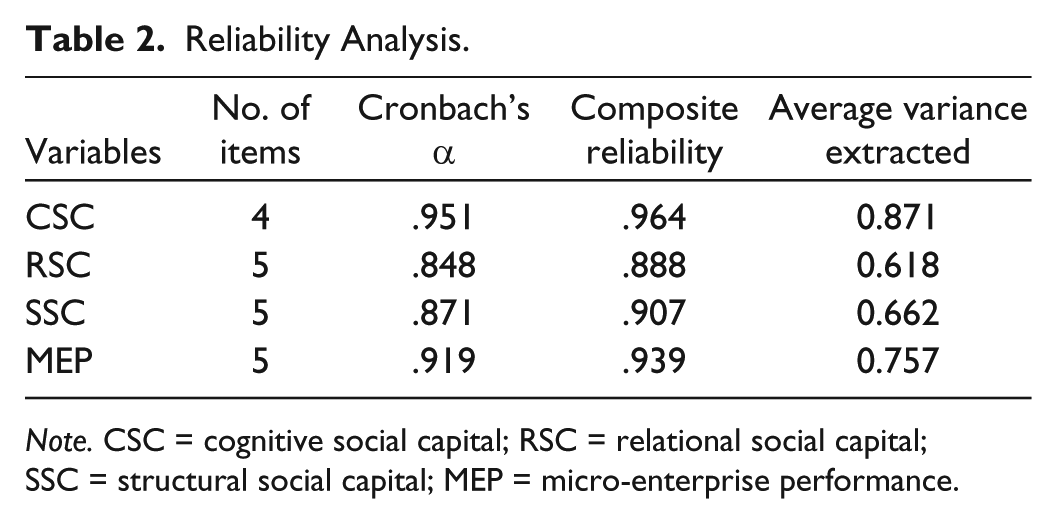
Note. CSC = cognitive social capital; RSC = relational social capital; SSC = structural social capital; MEP = micro-enterprise performance.
Indicators are checked for discriminant validity and considered as reliable when outer (component) loadings are higher than 0.7 and a construct’s loading should be higher than all of its cross-loadings. Component loading with value 0.5 is also acceptable if the AVE value is higher than 0.5. As in Table 3, all the indicator loadings are higher than 0.7, except for Structural Social Capital Items 4 and 5 but they are higher than 0.5, thus assumed reliable. Both the items with standardized loadings of less than 0.7 are kept for further analysis based on Chin’s (1998) work who suggested that indicators with a loading higher than 0.5 need not be dropped. Looking at the cross-loadings, all the indicators’ loadings are higher than the entire cross-loadings, confirming discriminant validity. For discriminant validity based on the Fornell–Larcker criterion, the AVE for each indicator should be higher than the construct’s highest squared correlation with another construct. Based on Table 3, all the constructs manage to meet the set criteria.
Outer Model Loadings and Cross-Loadings.

Note 1. CSC: Cognitive Social Capital; SSC: Structural Social Capital; RSC: Relational Social Capital; MEP = Micro-Enterprise Performance.
Note 2. Bold-italic values are indicators’ loadings
Structural Model
Assessment of the model is based on the ability to predict the endogenous constructs that is facilitated by coefficients of determination (r2), effect size (ƒ2), and cross-validated redundancy (Q2). The r2 that explains variance in two endogenous variables based on Table 4 is considered moderate. The moderate r2 value is regarded as acceptable as this study is designed to identify how cognitive social capital and relational social capital affect structural capital and how structural social capital affects micro-enterprise performance rather than to identify which key factors affect the micro-enterprise performance.
Path Coefficients.
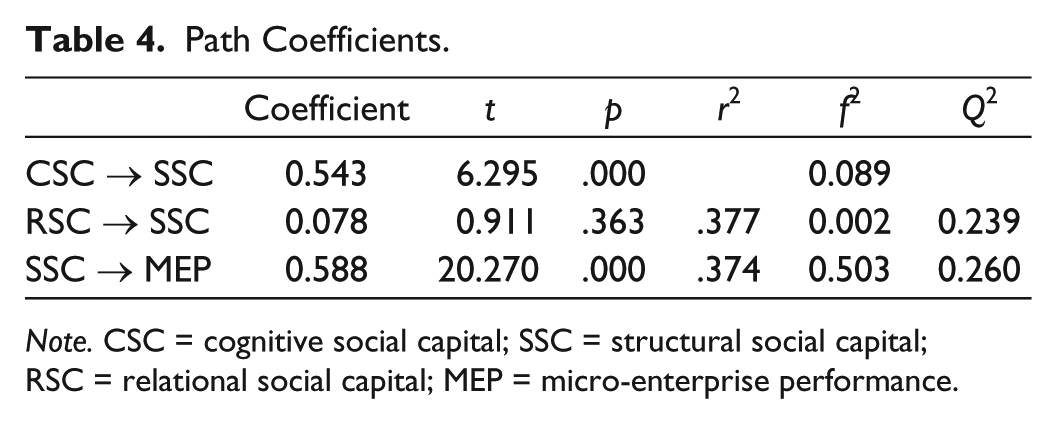
Note. CSC = cognitive social capital; SSC = structural social capital; RSC = relational social capital; MEP = micro-enterprise performance.
The path coefficient between cognitive social capital has a positive effect on structural social capital, and the effect is spastically significant at the chosen 5% level of significance. The coefficient for relational social capital and structural social capital is relatively lower and statistically not significant at the chosen 5% level of significance. The coefficient between structural social capital and micro-enterprise performance is the highest and statistically significant at the chosen 5% level of significance. Looking at the effect size (ƒ2) of cognitive social capital, it has a small effect on structural social capital. In contrast, structural social capital has a considerable large effect on micro-enterprise performance. The effect size of relational social capital on structural social capital is not significant. The predictive measure of Stone–Geisser’s Q2 is another assessment to assess the model’s predictive relevance. A Q2 value larger than zero indicates that the path model’s accuracy is acceptable, and based on Table 2, Q2 values are more than zero for structural social capital and micro-enterprise performance, indicating predictive relevance.
Conclusion
Social capital and its three dimensions are inseparable in the world of entrepreneurship. Daily business activities and processes are embedded within the network of relationships. Prior studies focused on individual effects of social capital dimensions or as a whole on firm performance and neglected to study the interrelations among the dimensions. This study explained how the three dimensions of social capital, namely, relational, cognitive, and structural interact, and how it eventually affects micro-enterprise performance. Findings of this study are in line with the suggestion of Nahapiet and Ghoshal (1998) who mentioned that the dimensions of social capitals are highly interrelated, and this study focused on the relationship between relational and cognitive on structural social capital and finally on micro-enterprise performance. The findings reported that cognitive social capital has a positive effect on structural social capital compared with relational that tends to have an insignificant effect. The structural social capital built from this configuration has a significant and large effect on micro-enterprise performance.
Shared interpretation, shared meaning, shared value, and shared norms go far compared with trust among key business players and the quality of relationship in building network ties and network density. The women entrepreneurs should therefore focus on creating a better system of communication between parties and work on a set of values and norms. These values and norms when communicated to relevant parties promise a better structural social capital, which is essential in providing access to resources and knowledge.
Footnotes
Declaration of Conflicting Interests
The author(s) declared no potential conflicts of interest with respect to the research, authorship, and/or publication of this article.
Funding
The author(s) disclosed receipt of the following financial support for the research, authorship, and/or publication of this article: This study was funded by Ministry of Education, Malaysia. Grant Title: Research Acculturation Grant Scheme (Grant Code: RAGS/2013/UMK /SS05/1) Project: Multi-Dimensional Perspective of Social Capital and the Development of Women Entrepreneurship in Malaysia. Total Grant: RM34200 (Ringgit Malaysia)