




Abstract
Despite the fact that vocational adolescents are in a disadvantaged position regarding their post-secondary high school routes, research has highlighted the resistant and innovative ways they set in motion so as to grapple with their estranging schooling experiences. Our article aims to contribute to this research area by focusing on how adolescents’ narration of their schooling frames their life planning. In particular, we explore a major finding of our research—namely, their defending of vocational training—by means of the notion of ambivalent biographical identity. We argue (a) that today’s adolescents do not openly reject vocational training, and they try to transform the unofficial skills and knowledge obtained in their cultures into official cultural capital capable of making them enter the job market and (b) that their life planning is tied up with a biographical identity formation through which they try to coherently reconcile their embodied cultures with the vocational qualifications they aspire to acquire.
Keywords
Introduction: Aims and Scope of the Research
Subcultural accounts of working-class youth have shown that school underachievement was not a problem for their identity construction. They could cultivate anti-school values and create oppositional cultures within which they could accrue social capital and forge a respectable adolescent identity simply because opportunity structures in the old days could assure them a safe and stable passage into working-class jobs (Hagan, 1997; Jackson, 2002; Kelly, 2009; Martino, 1994; Sullivan, 1989; Wexler, 1992; Willis, 1977). Despite the fact that they had to face educational exclusion and disrespect in their teen years, working-class adolescents’ identities were protected against this social exclusion due to the power of their resistant culture and to the fact that they could safely plan their transition into manual jobs (Clarke, Jefferson, & Roberts, 1975; Chu, Porche, & Tolman, 2005; Francis, 1999a; Mac an Ghaill, 1994; Swain, 2003; Thornton, 1995)
In the last 30 years, youth sociology researchers tend to subscribe a kind of paradigm shift regarding identity formation of working-class adolescents. Radical transformations in the job market are so overwhelming for working-class youth that direct transition into traditional manual jobs has been made an unattainable dream. Stemming from what has been called “risk-individualization thesis,” the dominant argument that youth scholars seem to subscribe holds that, even if social inequalities remain intact and pervasive as in the old days, working-class adolescents are forced to reflect upon their post high school options in individual terms and to become the authors of their narratives all by themselves, without resorting to class ties or to oppositional cultures (Andres & Wyn, 2010; Beck & Beck-Gernsheim, 2002; Bennett, 2000; Biggart & Walther, 2006; Du Bois-Reymond, 1998)
In the remaining of the article, we aim at forging an argument on how vocational adolescents of our days shape their self-narratives and take decisions on their life transitions by focusing on the interplay of social class and biographical contexts within which these decisions are made. Two basic assumptions frame our line of reasoning. First, how adolescents reconstruct their biographical life events is not structurally determined, but it is something that takes place in specific life-world contexts which have to be thoroughly analyzed should one wish to understand when and to what extent agency or structure prevails in his or her life transitions, and second, how they narrate their turning points and construct their biographical identities seems to be a crucial factor regarding the framing of their life decisions.
Literature Review and Research Questions
Research on how self-formation of working-class adolescents affects their life transitions shows that in our days, they are exposed to an array of vocational and training options which make them be more reflective about their post-secondary routes. However, it is a kind of reflexivity of which the dynamic is extremely forged by and through social forces. Research conclusions could be summed up as following: (a) decision making should not be seen as grounded on a rational planning but on what is called pragmatistic rationality, meaning that it is not the psychological or developmental tasks that guide adolescents’ decisions but it is the context-specific, practical and partial character of their everyday life that shapes the criteria for their post-secondary transitions (Hodkinson & Sparkes, 1997; Hodkinson, Sparkes, & Hodkinsin, 1996; Irwin, 1995); (b) working-class adolescents’ agency is bounded by the restricted cultural capital of their parents who are not able to contribute to their planning and by the limited opportunity structure that the local job markets offer them and which tie them up with their geographical location (Bynner & Roberts, 1991; Evans, 2002; Southerton, 2002); (c) they are more prone to trust not the official or “cold” knowledge of school authorities but the informal and “hot” knowledge of their social networks (Ball & Vincent, 1998; Horvat, Weininger, & Lareau, 2003; Leonard, 2005); and (d) working-class origin of adolescents should not be seen as an independent variable that determines life transition but that it is the decisive role of schooling experiences that mediates their job aspirations (Ball, Davies, David, & Reay, 2002; Lucey & Reay, 2000; McLeod & Yates, 2006).
Despite its contribution to how vocational adolescents make decisions regarding their job careers, the above-mentioned research presents some gaps, which we believe deserve thorough discussion. First of all, in some cases, explanations seem to resort to a kind of habitus determinism, as it is either negative schooling experiences which make vocational adolescents have poor job aspirations (Sletten, 2011) or parents’ poor emotional capital which makes them believe in interpersonal information regarding their job options (Foskett & Hemsley-Brown, 1999; West & Ribbens, 1994). Second, despite the fact that vocational adolescents are called to become the authors of their narratives due to the multiple and risky options they face, proponents of “risk-individualization” thesis do not provide us with a clear theoretical proposition which could frame the end product of this self-narration. In other words, we are told half of the story—not how it ends in theoretical terms (Foskett & Hesketh, 1997). Finally, there is a tendency to approach vocational adolescents’ life decisions in disembodied terms, that is, as if their decision making is a discursive matter disconnected from their system of relevance (Francis, 1999b).
Our research comes to deal with these gaps by focusing on the cognitive, emotional, and embodied dimensions which frame working-class adolescents life planning and on how identity formation process is tied up with their schooling experiences and with their post-secondary routes. In particular, we are going to explore (a) the evaluations and representations these pupils hold in relation to their choice to pursue vocational schooling, (b) the vocabulary of motives (Mills, 1940) they use for constructing (and construing) their sense of self and others, and (c) the ways the above two parameters are inscribed in their life-world conditions and give shape to their post-secondary ambitions.
Theoretical Underpinnings of the Research
In framing the above questions, we adopted two core ideas from Bourdieu’s theory of habitus and from research on narrative identity. According to Bourdieu and some commentators (Bourdieu, 1990; Crossley, 2001), the sense of self is shaped through one’s involvement into what his or her life-world considers as valuable and practically relevant. Social interaction and familiarization of the actor with the classifications and typifications of the group within which he or she grows up are the reasons why he or she comes to see some life options as self-evident and others as unthinkable. Actions are put in motion by means of actor’s embodied habituation with what his or her social situation enables him or her to do or not (Crossley, 2006; Csordas, 1990; Hewitt, 2003; Jackson, 1983; Throop & Murphy, 2002; Waquant, 2014).
Although habitus can effectively tap the taken-for-grantedness of actor’s everyday life and the social grounding of his or her orientations, biographical identity is a term used to capture the narrative ways he or she implements to meaningfully analyze how his or her past life-world experiences are connected with present self-conceptions (Bruner, 1991; Maines, 1993; Riessman, 2008; Somers, 1994). It is not only through narratives that actors cohere biographical life events but also they claim an identity related to how they became what they are and to how they want to be conceived by others (Spector-Mersel, 2011). Actors, by looking back at what they have been through and looking forward to what they aspire to be, produce narratives through which they can coherently cope with their psychologically painful life experiences by drawing upon the stock of knowledge of the social worlds of which these narratives are a part of (Fischer-Rosenthal, 2000; McAdams, 2008, 2011).
Methodological Considerations
Sampling Choices
Our sample strategy was designed according to the logic of “maximum variation purposeful sampling” (Miles & Huberman, 1994), that is, we recruited vocational adolescents taking into account, besides social class origin, the location of the school and the social attributes of adolescents’ neighborhood so as to compare data drawn from vocational adolescents who have different socializing experiences. The goal of our research design was twofold. In particular, we wanted to present a quantitative picture of how vocational adolescents evaluate their option to enroll in vocational school after the completion of junior high school. In addition, we aimed at digging into how local knowledge of vocational adolescents’ life-world shapes the subjective orientations regarding their post-secondary ambitions. To reach these goals, we implemented two research instruments, questionnaire and interviews. The questionnaire enabled us to get a complete picture on an aggregate level both of how vocational adolescents value their schooling and of the socio-demographic composition of vocational schools. Interviews were used to get deeper understanding of the social micro-process through which vocational adolescents make sense of themselves and on how this cultural grounding of their self-construction affects their post-secondary life decisions. Thus, as a consequence of the above-mentioned sample strategy, we delivered questionnaires to 145 eighteen-year-old adolescents attending their last year in three vocational schools in a big city of Western Greece. Schools are located in different areas (one in the center of the city, one in suburban location, and one in a working-class area), and we carried out 50 narrative interviews with 22 girls and 28 boys of the same sample. All the names we present are fictional.
Data Collection
Given the qualitative orientation of the research, the main data collection research technique was what Wengraf (2001) and relevant scholars term biographical-narrative interview. According to this way of conducting interviews, the aim is to tap the meaningful thematic fields of the actor that support his or her narrative renderings and how these fields are correlated to the life-world relevancies upon which they draw. Priority is given to make informants use accounts containing narratives imbued by personal experiences and not to talk solely in an argumentative or descriptive manner about social issues (Riessman, 2002; Rosenthal, 2004; Rubin & Rubin, 1995). Given that not all adolescents are in a position to produce extempore narratives (McLean, Pasupathi, & Pals, 2007), we made up an interview guide which we divided into four discussion axis related to (a) their schooling experiences, (b) their family habitus, (c) their leisure activities, and (d) to what C. Taylor (1988) has called “strong evaluations” (p. 310), that is, the moral boundaries that make up their value orientations. Some of the interview questions we included in each of these axis were the following: what were your experiences from high school all these years? What are you planning to do after high school? What are your parents’ dreams of you? How was it for you to grow up in this neighborhood? How do you spend your free time? What things or experiences are you proud of? How do you imagine yourself in 5 years’ time?
It should be noted that according to this type of interviewing, what interviewees say is not to be taken to represent directly the outer world. The interviewer does not aim at discovering whether what informants talk about corresponds to what is happening outside the interview context. Instead, by treating what informant say as accounts, we tried to investigate the sense-making work through which participants engage in explaining, attributing, justifying, describing, and otherwise finding possible sense or orderliness in the various events, people, places, and courses of action they talk about (Bertaux, 1980; Roulston, 2010).
In parallel with narrative interviews, we delivered questionnaires to adolescents aimed at highlighting, in quantitative terms, the reasons they give for attending vocational school, the level of satisfaction they experience from this type of school, and the job they aspire to obtain. The reason why we used questionnaires was that we wanted to bring to the fore possible connections between their answers in the questionnaire and the thematic fields we tapped from their narrative accounts. In combining data obtained from questionnaire and interviews, we aimed not at validating our findings but mostly at providing complementary points of view of the same phenomenon, namely, the role of self-formation on how vocational adolescents take life decisions (for a similar usage of combining interviews and questionnaire on life transitions, see Kelle, 2001).
Data Analysis
In analyzing our interview data, we emphasized the Glaserian version of the Grounded Theory (Charmaz, 2002; Glaser, 1992, 1998, 2002), taking into account some of the principles of narrative analysis (e.g., Riessman, 2002; Rosenthal, 1993; Spector-Mersel, 2011). In particular, we implemented a four-step process in dealing with the transcripted interviews: (a) we sketched the portraits for each of the informants so as to tap the sequential order of their biographical life events, (b) we coded in vivo their accounts from the above-mentioned discussion axis and we wrote down in diagrammatic form the sum of categories that emerged from each participant so as to obtain an overall view of these categories, (c) we compared the categories and we tried to bring to the fore the informants’ main concern (or core category) which permeated the thematic field, and (d) in a more conceptual refining, we highlighted how their main concerns were related to the identities they claimed as they were articulated by means of the strong evaluations regarding who they are and how they want to be perceived by others.
Issues of Trustworthiness of the Research
Reliability and validity are issues which are dealt with in different terms in qualitative research in comparison with traditional quantitative approaches, simply because of the intentional character of social action (Healy & Perry, 2000; Maxwell, 1992; Seale, 1999). However, this does not mean that qualitative researchers remain blind to such issues. Having as an epistemological point of departure conceptions of social world stemming from critical realism (Bhaskar, 1989; Sayer, 2000), we consider validity to be a term related to the question how sure can one be as to the truth of what informants say in the interviews. We have no reason to believe that adolescents of the study intend to lie in the interview or that they come to participate in it with an intention to deceive the interviewer. Quite the contrary, in treating what they say as accounts, what we aspire to understand is adolescents’ point of view on how they narrate their past, present, and future lives and the version of the world they construct, given the structural frames that exist in their lives (on narrative interviews validity, see Elliot, 2006). Our goal was to understand why adolescents produced these specific narrative versions of the world and not others. In addition, it has been shown that the more one commits himself or herself in narrating his or her life, the more close the content of his or her narration is in what “actually happened.” Finally, we checked what adolescents were saying by prompting them to give accounts of the same experience (e.g., leisure time practices) in various narrative moments of the interview.
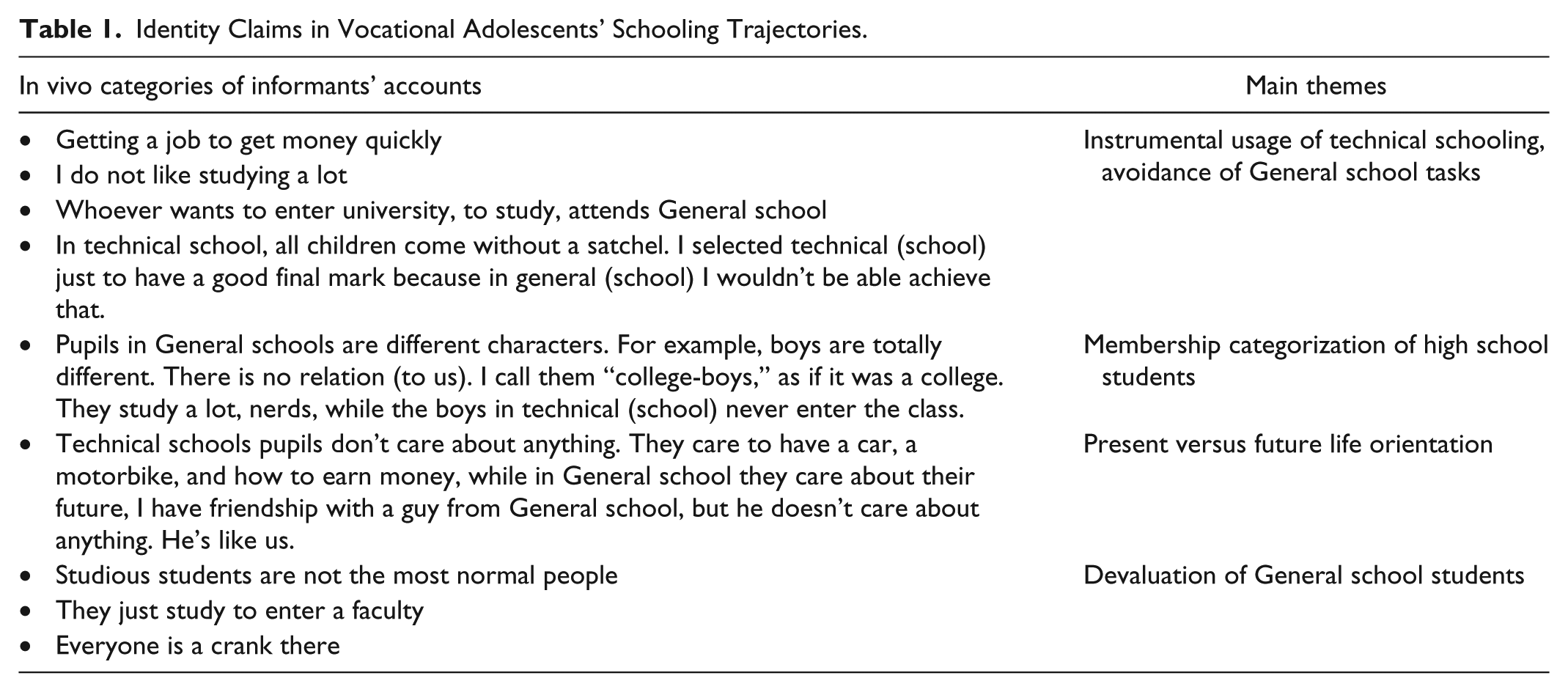
With regard to whether the conclusions we have reached are accidentally produced, we tried to triangulate our data in the following way: (a) data obtained from the questionnaire were in the same direction with what adolescents talked about in the interviews, namely, that they defend and positively value vocational schools, (b) we collected life stories from adolescents who reside in different geographical locations, and we saw that it does not affect their stance against vocational schools, and (c) due to the differentiated sampling of our data, we were able to compare responses of adolescents who have opted for various vocational specialties (e.g., hairdressers, car mechanics, or cooks). It was through this threefold crosschecking process that we were able to be more confident with regard to why vocational adolescents defend their option to pursue vocational training. According to this line of methodological reasoning, how theory is implemented in data processing affects our knowledge claims as far as generalizability is concerned. In our research, habitus theory and narrative identity approach were implemented neither to provide us with deductively produced hypotheses which were going to be tested against our findings nor as a means for operationalizing central terms of the research. By contrast, these theories were used as sensitized concepts through which we were able to put questions to our data, to order them, and to transform the emic words of the informants into an epic argument the researcher sets up (for reasons of clarity, we provide Tables 1 and 2 containing the in vivo categories and the main themes of the interview data. Habitus theory and biographical identity enabled us to transform these themes into theoretical argument.). Hence, what we claim is not generalizability assured by statistical procedures related to individuals who present the same socio-demographic variables, but a theoretical proposition containing concepts which could explain processes that take place within contexts similar to our own and could provide us with interpretations as to how vocational adolescents’ habitus formation sets in motion specific biographical planning and aspirations (e.g., Gobo, 2004; Payne & Williams, 2005).
Identity Claims in Vocational Adolescents’ Schooling Trajectories.
Embodied Cultures in Adolescents’ Everyday Lives.

Vocational Education in Greece: An Overview
Only two countries in Europe in the 19th century, Germany and France, placed special emphasis on technical and vocational education and established the relevant institutions. However, technical schools in these founding countries have not been particularly valued, which is somewhat surprising because of the fact that such schools were needed for the “less talented students,” and were considered synonymous with professional training (Prost, 1968, pp. 303-305; Ringer, 2003). Highly influenced by what was happening in German- and French-speaking countries, Greek educators acclaimed, especially after 1870, the need to establish an extensive network of technical and vocational education too. In contrast to their aspirations, however, the results of this initiative were poor, for until the early 1960s; the number of children in technical junior high schools and high schools did not exceed 10% of the total number of children of this age group (15-18). Thanks to the admonitions of International organizations, particularly the Organization for Co-operation and Development (OCDE) and the World Bank; the percentage of children attending secondary technical schools would reach 25% of the above-mentioned age group during the mid-1970s. After a spectacular rise in 2002, mainly due to the strict tests applied in general high school, this percentage increased to 41.39% of the total of students of this age group, and now stands at around 30%.
To give an overall view, at present, about 80% of students of the given age group attend secondary post-compulsory education. More specifically, according to statistics from the Ministry of Education and the Greek National Statistical Service—during the school year 2002-2003—218,747 students attended general high school (58.61%) and 154,464 (41.39%) a technical one. (By way of contrast, during the school year 2008-2009, the corresponding numbers increased to 245,314 (69.4%) for the former and fell to 108,010 (30.6%) for the latter.)
Apart from the respective differences in attendance between the two types of schools over the 6-year period shown by these statistics, it is worth mentioning that there were slightly more girls than boys in general high school, but in technical secondary education, the number of boys remained constant at about twice that of the girls. More specifically, during the school year 2008-2009, the number of girls in general high school was 130,764 out of a total of 245,314 students (53.2%), whereas in technical schools, girls made up only 37,461 out of 108,010 overall (34.7%).
Despite some differences, there is no doubt that the vast majority of children who focus on technical education come from the neediest (both financially and culturally speaking) social groups. This fact was confirmed in our sample too, as in a relevant question regarding parents’ profession, the fathers’ professions that prevailed were that of a farmer (19%), laborer (22.5%), driver (6.3%), car mechanic (5%), unemployed (3%), shop owner (11%), private sector employer/employee (also self-employed; 5%), and other related professions. As for their mothers’ professions, 62% responded with domestic services, private sector (as above; 18%), maid (2%), nurse (4.5%), and public servant (6.2%).
Defending Vocational Schooling
The first question we posed to students concerned the degree of satisfaction they felt in their school by asking them whether they had a good time in vocational school, using the measurement scale of “no,” “moderate,” “good,” and “very good.” We considered “no” and “moderate” to express more openly the negative stance against this question and “good” and “very good” the positive. A total of 73.5% of students answered “good” and “very good,” while 26.5% were not so satisfied with their experience.
The reasons for their attendance was the second question we posed, and the answers we provided were (a) “because attendance in TS is easier,” (b) “because my attendance in vocational school helps me to accomplish my professional goals,” (c) “because I could not cope with general high school,” (d) “because my friends are in vocational school,” and (e) “because of other reasons.” In comparison with the adolescents who answered (a) and (c), what was surprising was the fact that 67.6% of students chose the second answer, believing that they had more or less made a choice scheduled on the basis of plans made in an earlier time. Answers (d) and (e) gathered 13.2% each, while those who chose “other reasons” did not actually clarify their answer.
The fact that students expressed a conscious choice as far as their motivation to attend vocational school is concerned is further supported by the manner in which they answered the next question: “Which school do you consider better: the general high school or TS?” A total of 78% of students answered in favor of vocational school, obviously in an effort to defend technical high school and the career opportunities offered in attending it. This is further related to the answers they gave to the next three questions. The fourth and the fifth question asked students to evaluate the career prospects of their friends attending general high schools, while the sixth asked if they thought that vocational school provided them with the skills needed for their professional career. Sixty-five percent of vocational students believe that children attending General high school will find themselves in a worse position in comparison with themselves in regard to their career success, and that better professional prospects awaited children of technical high school (75%), providing them with the necessary skills to do so (87%).
All in all, our findings conclude that students of technical-vocational education generally consider themselves satisfied with their studies. They posit as a key motivation or reason for their choice, their professional prospects, and they place themselves in a privileged position compared with general high school graduates. When asked to identify the profession they want to practice in the future, they referred to the professions of car mechanic (19.6%), refrigerant technician (13%), and electrician (11 7%). However, 17 of them (33%) gave no answer as they were undecided.
The high percentage of those who gave no answer should not be explained simply in terms of class culture but also in relation to the extent in which the interaction networks of these students are capable of providing them with enough social capital to invest in working-class jobs or in related prospects. From the analyses of the questionnaires, it could be argued that vocational students’ views on how they face their career prospects are permeated by the following characteristics:
They consider themselves as being satisfied with their attendance, and they present as a basic motivation for their choice, the help technical education offers them in finding employment in post-adolescent years.
This incentive seems to give them reasons to construct narratives of themselves within which they represent their identities as superior in comparison with the students of general high school, believing that the latter will find themselves at a later disadvantage in the job market.
If we stick to the last two findings, one could approach them via the rational-choice model: Pupils invest in school after having calculated the costs and the likely profits of their efforts, meaning that children from poor backgrounds do not invest in school as much as pupils attending general high schools because the benefits related to them are not worth pursuing. This consideration, however, cannot explain a key finding of the questionnaires, that is, the contrast observed between the effort to support their choice to attend vocational school and the fact that one out of three pupils seemed to be unable to answer the question regarding the profession he or she wants to practice in the future. In addition, the question still remains as to what extent the fact that they value and defend vocational school is related to the way their self-formation is shaped. In other words, what the questionnaire does not highlight concerns whether their option in pursuing working-class jobs via vocational schooling has been planned in rational terms in their junior high school years or it is the end product of their effort to coherently reconstruct their past, present, and future self. In the next sections, we aim at shedding light to this question.
Identity Claims in Vocational Adolescents’ Schooling Trajectories
In coding our interview data, one permanent theme that permeated adolescents’ answers was that vocational school comes to be crystallized as post-junior high school option in connection with what Gubrium and Holstein (1995) called “local culture” (p. 50), that is, locally promoted and biographically sedimented ways and interpretive resources for making sense of their lives. One of our interviewees, Maria, for instance, raised in an extended family in a village, has excluded the choice of attending university from her options, despite succeeding in national exams, believing that this does not constitute a worthwhile investment from a career point of view. Discussing her plans about the future, the biased enthusiasm of the researcher for “undergraduate student life,” which intrudes unconsciously in our interaction, is contradicted by Maria in the blatant and matter-of-fact way she defends and promotes her career prospects:
Extract 1:
How did you do in your national exams?
I succeeded as an agriculturist in plant production Department
So are you going to start your undergraduate career now?
I don’t know. I don’t think I will go.
Why so?
What for? Just to have a certificate that I graduated from Higher Technical Education? There are no jobs. To go there for five years and then for two more looking for a job?
And what are you thinking of doing?
I’m thinking of getting a job to get money quickly or become a hairdresser . . . Our financial status isn’t that good to go to study in one other town but, okay, I have also applied to the police force for a position as a special guard.
Insofar as she has been helping her father in the farming of their land since she was a child, and to the extent that she knows that growing crops will not enable her to establish a career (not because it is a man’s world, but because “you are left with nothing, you end up in debt”), Maria experiences her relation with time in terms of pressure. For Maria, higher technical education constitutes neither a means of attaining upward social mobility nor a form of investment in which she will obtain prestige, issues that do not seem to have crossed her mind as she has already decided not to attend the faculty she has succeeded in the national exams. Her motives and her goals are combined in such a way that she grounds her educational choices not on a positively formulated job perspective but rather on the avoidance of a future negative situation (unemployment).
If this is the case, however, why did she choose to attend technical senior high school as she does not consider it as a means for realizing job aspirations? The answer could lie in what Schutz (1973) called a “system of relevances” (p. 229), that is, in her motivational statements through which her world comes to be seen as taken for granted and within which the major and minor issues that make up her life are specified. Discussing the reasons, Maria invokes to attend vocational school; she enunciates a range of typifications which allow her to put an order to her school experience and to privilege her self-determination:
Extract 2:
And why did you choose Technical and not General [high school]?
Because I do not like studying a lot. Because I knew that General [high school] includes courses such as Ancient Greek and Mathematics; courses I couldn’t handle. Only in the first grade of the technical high school are we taught the same courses with General [school] with the exception of Ancient Greek. Then in the second grade I was able to select the classes of my section, easy classes, and a lot of laboratory courses . . . In general, [school] in my opinion, whoever wants to enter university, to study, attends this kind of school, while in the technical one all children come [to school] without a satchel. I selected technical [school] just to have a good final mark because in general [school] I wouldn’t be able achieve that. I do not have the patience to study, while in technical school I would just study for the classes I was examined in. It’s not that I don’t want to study. It’s that I am unable to focus on studying for hours.
It is evident that Maria places herself in the “non-studious” category of students, not so much in the sense that she chooses not to study, but mainly because of her mood and a lack of patience. This self-typification does not seem to be a source of shame or embarrassment against someone (i.e., the researcher) who is presented as an exponent of the values of the school institution. Rather, it is something that it may be indicative of the fact that the categorization of students into “studious” and “non-studious” is so obvious to her that she does not consider it threatening to the way she presents herself. It has a clearly practical value for her, functioning as a way not so much to make a post-secondary school decision, but rather to deal with her schooling trajectory and to make a choice as to whether to attend general or vocational school after junior high school. The “studious”/“non-studious” classification allows her to attribute motives to the members of these two groups in relation to post-junior high school choices, for the former go to general high school to “enter a faculty in Higher Technical Education or a university” while the latter choose to attend vocational school to “get a good final mark.”
Furthermore, the self-positionings students of technical school produce to interpret their choice to attend vocational school are also a source that permits them to biographically thematize their identity claims. Those students who defend their choice do so not only to highlight the social significance of technical education but also to protect the interpretation and the categorization of themselves as “non-studious.” They achieve this through the way they understand their relation to the general high school students. When we asked them their opinion about general high school students, we got the following answers:
Extract 3:
They are different characters. For example, boys are totally different. There is no relation [to us]. I call them “college-boys,” as if it was a college. They study a lot, nerds, while the boys in technical [school] never enter the class. They never attend classes. Students project a cunning image of themselves. No lesson can be taught, there is a mess. Even teachers are different between the two [kinds of] schools. Let’s say that in technical schools they are friends with the teachers. They talk to them in singular. Only the headmaster was a bit strict. (Eva, 17)
Extract 4:
Well, General school has many differences with the Technical because I have a friend who attends General . . . That is to say children are very different . . . That is, in our school they don’t care about anything.
What do you mean?
That they care to have a car, a motorbike and how to earn money, while in General school they care about their future, too.
Do you have friends from General [school]?
Yes. I connect with a guy, but he doesn’t care about anything. He’s like us.
That is to say there is a distinction between the guys coming from General and Technical [schools] . . .
I believe there is no relation at all. No relation . . . No relation with these guys. (Jim, 17, emphasis added)
Extract 5:
Studious students are not the most normal people, it’s kind of like a college there; they’re not the most normal people. It’s quite obvious. Basically, I believe that over there most of them live in a fantasy world. They just study to enter a faculty. I know that because I attended first class in General [school] but I quit as I didn’t study. Everyone is a crank there. I used to try to fit in, but they didn’t pay attention to me, and I said that it was not worth being with them and I left. (Alex, 17)
It is obvious from the above passages that for technical education students, the sense of difference is experienced in emotionally strained and gendered terms. Masculinity and the undermining of official school values (“No lesson can be taught, there is a mess,” Extract 3) function as a basis for a gendered standardization and classification of students (“They study a lot,” Extract 3), and as evidence of the separate and potentially superior behavior of vocational school students. The emphasis given to masculinity serves as a resource to morally legitimize the mode of action of those who fall into the category of such students who can state, “It’s not that I don’t want to study. It’s that I am unable to . . . ” The identity that technical education students claim refers to the fact that they are “non-studious,” and that attendance in technical school is grounded on all those practices through which “mess” is performed and money is earned.
For our speakers, their sense of self is formed by what they exclude and evaluate negatively, such as to be “studious,” “college-boys,” “nerds,” and “crank” (Extract 5), properties they think are suited to general high schools students. By means of this classificatory evaluation, pupils in vocational schooling not only make motivational statements about two types of different school contexts but claim to valorize their belonging in vocational education in relation to pupils of General high schools as well. The emotionally charged character of these relational self-understandings is tied up with the unequal social value that is attributed to vocational and general education in Greece. Thus, to the extent that pupils in vocational education seem to defend an institution devoid of what Bourdieu would have called “symbolic capital” (Bourdieu, 1984, pp. 466-480), they come to forge a sense of connectedness based on their trying to deflect official classifications that defines them as being “less talented.” Knowing that they have in common a present with no future (in contradistinction to General school pupils who share a future with no present), pupils in vocational education attempt to define as valuable both the institution they live in and, even more so, their way of being-in-the-world. But what this being-in-the-world actually consists of and how are their identity claims embodied in actual practices? Through what experiences and feelings is their cultural world constructed and deemed worthy of respect? And, finally, to what extent does this cultural world function as a reserve within which their sense of manliness is to be sustained?
Embodied Cultures in Adolescents’ Everyday Lives
The identity pupils in vocational education claim by dint of the vocabularies of motives they draw upon is not a cognitive matter or something that happens within their head but rather a constitutive aspect of their life-world experiences. What we want to argue is that adolescents’ identity claims are not a psychological mechanism deployed in their cognitive processes, but instead that it emerges in the collectively organized and meaningful practices they engage in in their everyday life interactions. The par excellence practice where one can see the emergent nature of vocational adolescents’ identity is motorcycle driving. The range of meanings they develop in motorcycle driving and the values that permeate it are revealing of their collective attempt to make sense of themselves and to forge their career plans. Motorbike is not just a means of transport but a symbol of sociability and a sign of embodied skillfulness. Take Jim, for example,
Extract 6:
Where did you use to go in the afternoons?
We used to gather in the square or go for a ride with our motorcycles.
And what did you use to do in the square?
We used to discuss things and sometimes to play over there . . . To play? Basically we used to make a fuss so that the police come and chase us. You know, to laugh.
And did the police used to come?
Yeah listen to me, listen to me . . . Another time a police officer came and we had hidden the motorbikes and okay . . . The police officer left. Then we created trouble again and the police car arrived and . . .
When you say trouble, what did you do namely?
We went here and there by motorbike . . . “Accelerations” . . .
And what time did you use to do that?
At night. Half past eleven, twelve o’ clock. Something like that. Basically, it’s nice like this. I like living this way.
In the above passage, our speaker does not describe something he has seen but in his narration valorizes something he has experienced. Dimitris likes challenging authorities “for fun” and as a way of living, because through this ritualized provocation he builds, proves, and strengthens his relationship with his friends as it provides him with opportunities for testing his capacity in effectively handling motorbikes. The use he makes of the motorbike means that it is a necessary and significant symbol of their cultural toolkit and a cultural object in which they collectively attribute meaning and value and obtain access to their social practices. The street and the square are experienced by the adolescents of our sample as social places for displaying their capacity in driving motorbikes. Doing “accelerations” is a collectively orchestrated ritual that bonds together those who participate in it as the shared knowledge of doing so functions as a sign of membership of their social group. Risk taking in driving motorbikes (usually without a license) is something they have learned to face from their childhood years, while all the potential failures encountered (tumbles, injuries, and accidents) constitute primary stages for successful and skillful driving in the future:
Extract 7:
And what intrigues you in the whole situation?
For me it’s the experience . . . Well, those who do drag races didn’t start right away on a 1000cc motorbike, my man. They used to race with small motorbikes here and there, on 650cc motorbikes and stuff, and then they ride these [1000cc motorbikes]. They do not ride them right away. They start when they are young.
And how did you learn?
I used to watch the others and I did it. And I decided to do it. What’s the big deal? Well, in order to learn this you should tumble twice or three times, that’s for sure (Andrew, 17)
Excitement for these students means their involvement in the possibility of failure as its surpassing of this is indicative of their moral strength and provides an opportunity to display “character” to their friends. Learning to handle a motorbike and its concomitant risks is a process inscribed in body movements. Their body, through mimicry, comes to be adjusted in patterned ways to all the practical exigencies of a specific kind of driving which necessitates total control of all the parts of the motorbike. Students in our interviews liked to narrate stories full of incidents indicating the high risk of motorbike driving and of the embodied skillfulness which is demanded in overcoming it. Only in such practical testing does one come to understand how to move and use one’s body when driving the motorbike; that is, how to position one’s body upon it so that one can have the mastery of the correct speed, height, or twist of the body when driving dangerously:
Extract 8:
Yes, you know why this is difficult, eh? Basically, on powerful motorbikes they do not do that because the moment you shift gear and you have the hand here the steering wheel can twist and the motorbike might drive on one wheel . . . I watched a motorbike in a drag race and a car appeared and hit the rider. Well, he was not hurt but you should have seen the way he fell off . . . (Tom, 18)
Extract 9:
Well, I don’t know how to handle it with the foot very well, because to go straight forward you use the foot, then you “play” with the brake, brake-throttle, brake-throttle . . . Did you use to ride a bike [in such a way on one wheel]?
Yes. yes. I used to do it.
Using the brake, right?
Yes. yes.
So, as you pressed the pedal you motivate the pedal and the brake. Move the pedal and brake. That’s it, but you also have to find the torque to raise it.
And aren’t you afraid?
Look, my best friend has never fallen off, and he rides it straightforwardly, a motorbike without gears, while with a more powerful motorbike it’s different. You know something? With the bigger motorbike? The first time I made a shift from first to second [gear], I opened the legs . . . unconsciously . . . You don’t say the foot goes there and press the pedal off the brake. That’s it, you have to learn this. (Mike, 17)
Learning to drive in the street presupposes that the driver has gradually learned to coordinate his body movements in accordance to how the motorbike is moving so that he has reached a point where his body can unconsciously adjust on its own “unconsciously,” without needing “to say that the foot goes there and press the pedal off the brake.” One can easily see that driving entails the discipline of the body and the following of “rules” that are intuitively assimilated, without it being necessary to attain knowledge explicitly formulated and learned. This pre-reflective and bodily knowledge valorized by those vocational education pupils interviewed functions as a source of accumulating symbolic capital within the peer group. Practical mastery of a motorbike in risky driving situations is experienced as a personal exploit capable of creating feelings of pride in those who publicly exhibit the strength to face the challenge, insofar as overcoming danger entails a combination of body-movement patterning with improvisation.
It can be seen then that the students of our sample have learned in practice to face this embodied skillfulness as a kind of personal and improvised accomplishment in relation to forming a hierarchy of status among them. Furthermore, the rules and the principles of this kind of visual learning and of practical imitation, thanks to which this embodied know-how in motorbike driving is developed, are nowhere explicitly formulated, and yet are formed collectively by the members of the group. This is a kind of knowledge forged both through practice and experience (in riding on one wheel, in acceleration, in drag racing, etc.) and tested in risky circumstances. Its principles are transferred though word of mouth, and only by those who have themselves been initiated, thus creating the feeling that they are indeed special.
Conclusion
While previous years research on vocational adolescent identity formation posits that the core element of its evolvement revolves around adolescent disavowal for vocational school qualifications, our findings highlight that adolescents of our days do not seem to reject the profits these qualifications could assure them. In particular, today’s adolescents seem to make sense of themselves in forging biographical identities by which they try to reconcile two contrasting life-world experiences: on one hand, they ground their self-positionings in reversing official school culture classifications by promoting the embodied skills they acquire in their out-of-school interactions and by valorizing “street knowledge,” and on the other hand, they have to construct life plans based on the qualifications the vocational school provides.
We consider this finding to be in line with A. Taylor’s (2005) argument that it is the evolvement of social self in school life that gives shape to vocational adolescents’ decision making. What we have shown is that the crucial and core element of this evolvement concerns the extent to which agency affects vocational adolescents’ habitus formation. More specifically, we noted that in trying to reconcile these contrasting urgencies, adolescents’ habitus is shaped not only in an unconscious and practical way but it is through its reflexive involvement in forging narrative identities combining experiences from their street culture with the prospects entailed in vocational school that habitus is formed. In other words, vocational adolescents’ habitus is constructed in reflexive terms through narrative self-understandings that make them capable to align their working-class lives with the new prospects the vocational schools promises. Within this context, vocational adolescents try to make a socially devaluated institution, that is, technical schools, into a place where proper admission is dependent on the extent to which one accepts the criteria of vocational identity membership they try to impose. Through such practices as if and when they will bring a satchel, if and how many absences will be noted down, if they go to school by motorcycle, and whether they question a teacher’s authority and undermine the official school values that usually prevail in general high schools, vocational adolescents try to make technical education into something that belongs to them, by controlling the ebb and flow of its daily school life and by claiming that this is their way to “define the situation” of what schooling means.
Insofar as they cannot turn their backs to the job careers which are based on these qualifications because of the credentialization of job market, adolescents of our days come to shape their identity claims in navigating between these two contrasting demands. Defending vocational school is their way to narratively cohere both the practical logic of their habitus shaped in street-knowledge exigencies and the skills qualified in their passage from vocational training. As the jobs they aspire to cannot be taken without the vocational training they go through in their teen years, today’s adolescents cannot rely only on careers provided by “street corner society” connections.
Despite the fact that other researchers have pointed out the role of the informal networks in assuring successful passages into work life, what they have missed concerns that working-class social networks are not as much weak and incapable as these researchers believe (see, for example, Walther, Stauber, & Pohl, 2005). In contrast, one should not downplay the social capital they acquire through the networks they forge in their local cultures. To the extent that they make job decisions related either to their father’s job or to their embodied cultures, adolescents through their vocational training try to make the unofficial skills acquired in these cultures into educational qualifications. For instance, buying a motorbike, exchanging it with another one, the care they invest in fixing it, to paint it, to change its engine and improve it, the drag races they do, and the bets they lay, are all indicative of the process through which it is possible for these adolescents to plan their job-related careers. It is exactly their immersion into the motorbike culture that which provides them with an intersubjective stock of knowledge upon which they draw for constructing their life decisions and possible selves. In other words, in case that an adolescent raised in this life-world locality chooses to become a car mechanic, for example, he has to follow the path of vocational training in order to transform the embodied skills he acquired in this social world into qualifications which will enable him exchange them with a working-class job career. This finding is more close to relevant research which has shown how working-class adolescents transform their local knowledge into cultural capital which enables them to navigate in job market (Bottrell, 2009; France, Bottrell, & Haddon, 2013).
In a more theoretical vein, it is our contention that by combining the concept of habitus with how identity is biographically thematized can youth sociologists explain why working-class adolescents of our era seem to be in a situation of permanent disjunction that permeates their life stories. As other writers have claimed (Adams, 2006; Sweetman, 2003), the disjunction is born out of the fact that their aspirations to follow a normal biography containing job security and settled life are at odds with the flexible and risky options opened up for them by the vocational training. Raised in the contexts of this disjunction, vocational adolescents become familiarized with a reflexive habitus which makes them feel that decision making is a stressful and burdened social action because they do not control the criteria of entrance into manual jobs. Thus, reflexivity is turned into biographical ambivalence that feeds an identity formation process through which working-class adolescents come to be aware of the frustration entailed in the gap between aspirations and access to resources. Only by unraveling the ebb and flow of the social embeddedness within which decision making of vocational adolescents’ biographical planning is shaped can policy makers produce forms of guidance adjusted to their practical needs and values.
Footnotes
Declaration of Conflicting Interests
The author(s) declared no potential conflicts of interest with respect to the research, authorship, and/or publication of this article.
Funding
The author(s) received no financial support for the research and/or authorship of this article.