




Abstract
This study was undertaken to examine the differences in school funding perceptions between Alabama school superintendents and legislators. The overarching purpose was to determine areas of agreement and disagreement so that intermediaries working with both of these groups can help public policy makers make the best education funding decisions through the legislative process.
Keywords
It was hypothesized that there would be differences between legislators and superintendents across four constructs: Equity and Adequacy, Personal Values, Political Ideology, and Social Influence. Several demographic variables were evaluated. While the study did not yield as many differences as expected, it is conclusive that important differences do exist; the results are important because school funding decision makers must find common ground to equitably and adequately fund education for every child.
Introduction
School finance is not a new problem in the United States nor is it a new problem in the state of Alabama. It has been in existence and evolving since the beginning of public education. During the 2004 democratic presidential primaries, Senator John Edwards struck a chord with voters and educators when he spoke of “two Americas: one for the wealthy and privileged, another for those not so lucky” (Bartolomeo, 2004).
Likewise, since the beginning of the school finance debate, researchers have found spending differences between tax-wealthy school districts and those poorer districts with limited tax capacity. Students and schools may be shortchanged in the quality of education because of the lack of financial resources. In a study of New York City schools, Bartolomeo (2004) analyzed the inequities teachers and students experienced due to the funding divide. Bartolomeo found that poorer districts in New York had higher turnover, fewer textbooks, more unsafe conditions and older buildings when compared with their wealthier counterparts elsewhere in the state. Class sizes in the poor districts were 30 to 35 compared with the wealthier districts’ class sizes of 15 to 25. The results of this study provided evidence that a strong tax base resulted in more funding, afforded better programs, higher quality textbooks and more manageable class sizes.
A similar study found that the majority of students who are classified as having the greatest needs and a higher cost to educate tend to live in poor districts (Moran, 1999). These costly students more often than not reside in property-poor districts; this creates a greater obstacle for district leaders to generate sufficient local taxes to meet their educational needs.
School finance in Alabama presents problems similar to those in other parts of the country. Many believe that current funding issues in the education system are rife with inequity and the lack of equal opportunity for students from different socioeconomic classes (Crawford, 2004). Moran (1999) attributed the lack of opportunities to the differences in funds collected by the individual school districts. These problems, while not new, remain unsolved.
In Alabama, the budgeting process is spelled out in state law. Specific taxes are designated to the Education Trust Fund, which funds education in the state. These are primarily sales tax and income tax, which both fluctuate with the state’s economy. When the economy is growing, there tends to be additional revenue. When the economy slows down, the Education Trust Fund has a hard time meeting existing financial obligations.
The Alabama Education Trust Fund provides the financial resources that support the legislatively approved minimum educational programs for each district and each student throughout the state. Any additional program offered by a district that is above and beyond what the state mandates is a result of the expenditure of local tax dollars. Some districts have the potential to generate greater amounts of local taxes; therefore, they can offer enriched learning opportunities over tax poorer districts.
Local school districts have very limited authority to impose additional taxes for educational purposes without first gaining full support of the Alabama Legislature. Statewide legislation only allows county commissions to levy limited county and district school taxes. If a district wishes to exceed that amount, they must secure a three-fifths vote of the House and Senate delegation to have a proposed constitutional amendment placed on a ballot for a statewide vote, and then a majority of state voters is required for its passage. As a result, funding for education in Alabama relies heavily on legislators and local superintendents who work with legislators to determine funding priorities. The decision-making process of these groups of individuals is influenced by internal and external factors that affect their belief systems. This study investigates how these belief systems influence the decisions of legislators and superintendents.
Literature Review
Funding
The politics of school funding tend to blend philosophical, social, and economic differences into a structure recognized as “free public schools.” It is impossible to separate education funding from resources. The level of funding drives not only the quantity but also the quality of resources available to create public educational opportunities.
The success or failure of schools is strongly connected to the financial support made available to them through the levying of taxes and the allocation of revenues (Harvey, 1989). In this regard, major legal decisions have occurred in Alabama affecting the educational funding throughout the state. To understand where the state is today, it is important to know where it was in past years.
Historical Events in Alabama That Held Funding Implications
Three major legal decisions that affected education funding in Alabama have all centered on the state’s right to define what is appropriate legislative support of school funding.
The 1950s were an extremely volatile time in Alabama history. In an attempt to avoid desegregation of public schools, the Alabama Legislature amended the 1901 Constitution in 1956 (Harvey, 2000). This amendment has served as the basis upon which the State of Alabama provides funding for schools based on its available revenue. It also eliminates any obligation to the needs or quality of those educational opportunities (Harvey, 2000).
Since the 1950s, proration of educational funding has been a major factor in the history of Alabama. Proration in the Education Trust Fund has been declared 17 times since 1950; 15 times it continued until the end of the fiscal year, an average of once every 3.66 years.
The second legal factor that continues to influence legislation and policy decisions in Alabama was the 1973 ruling by the U.S. Supreme Court on the case of San Antonio v. Rodriquez, where the court ruled that public schooling was not a right guaranteed under the United States Constitution (Schrag, 2004). This ruling essentially assigned obligations for any kind of an education to the states, where it remains today.
The third and most significant legal factor that transformed the state funding scheme from what was known as “The Minimum Program,” prior to 1995, to the current funding scheme known as “The Foundation Program” was Alabama Coalition for Equity v. Hunt (1993). In an effort to more clearly define the state’s obligation to provide equitable and adequate educational opportunities, 33 school systems sued the State of Alabama in Ace v. Hunt (1993). This court action resulted in the creation of a declaration in which the judge stated, “that education is a fundamental right under the Alabama Constitution.” This ruling forced the legislature to adopt a different method of distributing state funds (Ward & Sauser, 1997).
The final disposition of this case was never completed to the extent of defining and implementing a funding scheme based on a set of defined outcomes, as many similar cases in other states were able to accomplish. Instead, it ended in 2002. While considering a totally unrelated educational matter, the Alabama Supreme Court ruled that it was not the court’s responsibility to insure equity and adequacy of the schools in Alabama. According to the Court, that responsibility rests in the authority of the Alabama legislature ( Siegelman v. Alabama Association of School Boards, 2001). This ruling established the legal precedent that legislators control the funding of public schools.
The major outcome of these three cases was that the legal responsibility for school funding rests with the states. States have a responsibility to provide equitable education for all citizens, and legislators control the allocation of funds for schools. Thus, legislators are the key to school funding equity in the state.
The Evolution of Adequacy
Historically, states have focused on how to allocate funding across school districts. Calculating revenues and how they are distributed to school districts are complicated issues and difficult to understand. Recently, the focus has changed from equity to adequacy and over the past 30 years, state courts have played a significant role in shaping education finance policy. Legal challenges to finance formulas have been brought in 45 of the 50 states (Smith & Pettersen, 2002).
Many of the early cases centered on “equity.” Equity was defined as funding every child throughout the state in an equal manner (Smith & Pettersen, 2002). Alabama changed its funding distribution method in 1995 to accomplish this type of equity. Known as the “Foundation Program,” the funding scheme dictated the distribution of state dollars equitably on a per pupil or per teacher basis to every district in the state (Whitney, 1998).
In a report released by Public Affairs Research Council of Alabama (PARCA), Williams (2006) reported that a foundation program tries to do three things:
Define the components of an adequate K-12 education and the cost of providing them to ensure that every student, no matter where he or she lives, has an adequate educational opportunity.
Encourage an appropriate level of local tax support for every public school system to promote local ownership and to recognize the benefits of good schools to the community.
Distribute state funds in a way that meets these objectives so that everyone pays a fair share of the burden of supporting high-quality public schools throughout the state.
Alabama’s Foundation Program was established to combine both state and local funds to support the standard educational program defined by state laws. These resources are made available to every local school system, in the following way: First, the resources necessary for the standard program are calculated. In Alabama, these are defined in terms of numbers of teachers and other professionals, plus amounts for their salaries and fringe benefits, five types of classroom instructional support and other operating expenses. These components are then summed to determine the allocation to each school system for the cost of the foundation program. Second, a minimum level of local tax support is required for every school system. The idea is that the local community should pay a fair share of the cost of the foundation program. In Alabama, every school system must contribute 10 mills of local property tax support to the foundation program. This produces more local funds per student in some school systems than in others, primarily because property uses and values vary across the state. Third, the local share is subtracted from the defined cost of the foundation program. The remainder is paid by the state. The subtraction is larger for school systems in communities that have the ability to raise large sums locally. This means that the state pays a smaller share of the cost of the foundation program for such “wealthy” systems, and a larger share of the cost where local taxing capacity is low. The subtraction therefore helps to ensure that the foundation program is affordable in every community across the state (Williams, 2006).
PARCA’s report (Williams, 2006) on Alabama’s Foundation Program validated the benefits of this method of funding schools. Prior to the adoption of the Foundation Program, the state distributed its funds to school systems with very little consideration of local tax capacity.
The Budgeting Process
In the budgeting process, the State of Alabama requires that the state superintendent develop a budget proposal for consideration for the State Board of Education. Once adopted, the budget is submitted to the Governor, who then makes it part of the budget proposal that is presented for approval to the Alabama Legislature. The legislature can approve it in whole, or they may choose to modify various segments of the proposal.
The budgeting process has become increasingly complex. As states attempt to establish some form of equity in school funding, many factors complicate the process. Differences in local tax capacity continue to allow some school districts to provide more services than others. The addition of standards and a means of measuring whether a district has met those educational standards have heightened the awareness of a need for adequacy. The connection of standards to funding further adds to the complexity of the budgeting process.
State’s Role and Components of an Adequate Funding Scheme
In the past, states have allocated funds across school districts, each of which has different tax bases, in a manner to achieve some level of parity. States have paid far less attention to the results each district has produced (Hunter, 2004).
In a review of literature on school finance, Theobald (2000) listed the following three goals for any proposed change to a state’s education finance system: (a) education finance systems should facilitate a substantially higher level of achievement for all students, while using resources in a cost-effective manner; (b) education finance systems should facilitate efforts to break the nexus between student background characteristics and student achievement; and (c) education finance systems should generate revenues in a fair and efficient manner. In many states, the responsibility has been placed on legislators to determine performance goals and establish funding accordingly. Alabama has yet to embrace that obligation.
Models for Adequate Spending Levels
Since the 1983 publication of A Nation at Risk (Education Commission of the States, 1983), there has been a growing recognition by policy analysts, policy makers, and the courts that an equal distribution of resources will not close the achievement gaps among ethnic and socioeconomic groups. This is particularly true if the amount of resources distributed equitably is not sufficient to provide the instructional resources required to eliminate those gaps. Thus, consideration of equity issues increasingly has been approached from the perspective of adequacy (King, Swanson, & Sweetland, 2005). Other researchers have elaborated by blending sufficiency with desired outcomes in defining adequate financing as sufficient resources to provide students with the opportunity to achieve adequately defined levels of knowledge and skills (Guthrie & Rothstien, 2001).
There are four primary models used to determine adequate educational spending levels, including the Professional Judgment Model, the Successful Schools Model, the Advanced Statistical Model, and the Evidence-Based Approach Model (King et al., 2005). These four models can provide policy makers options for considerations that utilize measurable means to better address a true understanding of adequate resources.
The Professional Judgment Model brings a group of educators together to define the components needed to establish a prototype school that, in their opinion, will have enough resources to enable a specified percentage of students to meet established standards (King et al., 2005). The cost of those resources is then estimated to ascertain an adequate level of funding. The professional judgment model is the only method that has been fully implemented by a state. Wyoming conducted a study using this method and, as a result, the legislature approved a plan that cost US$6,050 per student each year (Odden, 2003). The main advantage of this approach is that spending levels for adequacy can be estimated in the absence of a sophisticated student assessment system. It is easy to explain to the public, and the resulting estimates are based on the judgments of professional educators with experience in educating students.
The Successful Schools Model looks at all schools in the state and identifies the ones that are meeting the state-approved standards. The amount of money these schools are spending becomes the adequate funding level for the state (Picus & Blair, 2004). However, flaws have been identified in this model. For example, the model bases its recommendations on only a few educational standards and fails to account for many of the other important functions of a good education (Picus & Blair, 2004). According to Odden (2003), because atypical districts are usually eliminated when using this approach, the result is often based on average-sized nonmetropolitan districts that are demographically homogeneous and spend below the state average. The successful school district approach does not specify a way to make adjustments for characteristics of individual districts, leading to potential disagreements over how to meet the needs of many students, especially those with high needs.
The Advanced Statistical Model represents the most technically complex model. This approach attempts to estimate how much money would be needed to attain a certain level of student performance, while controlling for the characteristics of the district and its students. A number of important insights about relationships between inputs and outputs may be gleaned from cost function analyses. Many of these insights can be used to inform policy and help determine the magnitude of adjustments for students and district characteristics (Picus & Blair, 2004). Proponents believe that with enough information on education expenditures and student characteristics, statistical techniques can determine the funding needed to meet education standards (Smith & Pettersen, 2002). The primary concern with this model is its complexity; lawmakers and the public in general are very suspicious of complex models and may mistrust the final calculations (Picus & Blair, 2004).
The final method used to determine “adequate” funding is the evidence-based approach. This model relies on current educational research to identify resources needed for a prototypical school to meet the state’s student performance standards (Picus & Blair, 2004). Once identified, those specifications are subject to the “professional judgment” of officials in the state to validate the research-based recommendations. These costs are then estimated and applied to actual schools in the state. One drawback is the fact that research-based models will not always work in absolutely every situation (Picus, 2000).
Spending for Improvement in Student Achievement
In considering the aforementioned funding models, many states, including Alabama, have yet to make the change to funding with an emphasis on student performance. Most states who adopted formulas similar to the foundation program formula used in Alabama have failed to recognize that the amount of money needed to educate students in one district may not be the amount needed to educate other students in a different district (Reschovsky & Imazeki, 2000). Alabama, however, has invested in three programs designed to improve student achievement in three critical areas. These include the Alabama Reading Initiative (ARI), the Alabama Math, Science, and Technology Initiative (AMSTI) and the Alabama Connecting Classrooms Educators and Students Statewide (ACCESS) in advanced secondary classes.
Now that states have set ambitious performance goals for their students and the federal No Child Left Behind Act of 2001 has demanded that all children achieve those standards in reading and mathematics by 2013-2014, the push is to link education spending to academic results (Olson, 2005). While Alabama has yet to define a true meaning of an “adequate” education, it has chosen to direct specific allocations focused on improving the academic results of students. In 1998, the state launched a study of 16 schools participating in the ARI using US$1.5 million dollars from corporate donations to fund the project. The initiative was targeted to strengthen reading instruction in the early grades, continuously expanding all students’ reading power and comprehension, and intervening effectively with struggling readers.
AMSTI provides three basic services to schools in an effort to boost hands-on learning experiences in math and science. Central to its success is a strong recurring professional development model that involves all teachers in Grades K-8 with extensive professional development training. In addition, teachers are supported throughout the year with prepackaged manipulative kits that allow each class to engage in hands-on learning experiences.
The ACCESS represents a statewide initiative that focused on bringing true equity in instructional opportunities to all Alabama high school students. It provides a blended approach of online and interactive learning experiences through a statewide distance learning effort. When fully implemented, all 440 Alabama high schools will be connected; each will have the have the ability to offer students more rigorous and advanced learning opportunities. This initiative began in 2006 with 24 pilot sites and an appropriation of US$10 million dollars, and has been granted increased state funding each year to its current level of US$25 million dollars for FY2009 (Alabama Department of Education Legislative Budget Request, FY 2008-2009).
These efforts have served to focus resources on improving student learning and have produced significant academic gains statewide. The National Assessment of Educational Progress (NAEP), which was released in September 2007, showed Alabama public schools made more improvement in fourth-grade reading than any other state in the nation. The NAEP report showed a significant gain of eight points in fourth-grade reading for Alabama students—almost triple the national average in gains. In 2005, the scaled score was 208, and in 2007 it increased to 216. Today, Alabama is only four scale score points away from the national average (220) in fourth-grade reading (The Nation’s Report Card: NAEP, http://nces.ed.gov/nationsreportcard).
In addition, NAEP data show Alabama posted gains in fourth-grade mathematics and in eighth-grade mathematics. In 2005, fourth graders in Alabama scored 225 points, and in 2007 the score rose to 229. While the national average improved by two points, Alabama’s score showed a four-point gain. The percentage of students who performed at or above the NAEP proficiency level was 26% in 2007, up from 21% in 2005. Alabama’s eighth graders improved NAEP mathematics score from 262 in 2005 to 266 in 2007 (The Nation’s Report Card: NAEP, http://nces.ed.gov/nationsreportcard). These focused appropriations have begun to move Alabama up in the nationally ranked means of measuring student achievement.
This study looks at four constructs of educational funding perspectives: (a) equity and adequacy, (b) personal values, (c) political ideology, and (d) social influence. It is important to understand how such perspectives are formed.
The Formation of Attitudes and Opinions
Behavioral studies in the field of politics have long recognized the need for a thorough understanding of the fields of psychology, sociology, and anthropology. These disciplines often present an array of competing positions but their synthesis offers a basis to more accurately examine attitude research (George, 1958). Specifically, how does attitude affect the general disposition of a superintendent or legislator to take action in a certain way?
George (1958) stated that the notion that political man is a purposive being, engaged in instrumental behavior and exercising reason in attempting to choose his course of action wisely is, of course, a traditional and highly respected idea in political science. This notion, has long served as the basis for interpreting and accounting for political action by means of the so-called “rational hypothesis.” (p. 21)
Karl Popper has chosen to interpret political action by means of the rational hypothesis, the “logic-of-the-situation” type of explanation (Popper, 1952). Those individuals choosing to “act” are assumed to choose among alternative courses of action based on their assessment of logic of the situation that they are confronting. For example, if an inner city school is labeled as a failing school, a legislator may perceive it is a result of poor teaching and a lack of proper administration. However, the school may have far more challenges than other schools, in that there may be many more socioeconomic barriers preventing the school from succeeding.
One study (George, 1958) claimed that “one takes account of the actual and programmed use of these three functions—‘object appraisal,’ ‘social adjustment,’ and ‘externalization’” (p. 21). All of these factors apply motivational forces in forming opinions. Likewise, “reality testing,” “reward and punishment,” and “ego defense” are three additional motivational contexts of attitudes (Saruoff & Katz, 1954). Researchers have validated that no single factor forms opinions or shapes attitudes.
Social Influences
The process of opinion change is greatly affected by social influence. In a study on opinion change by Kelman (1961), he identified processes of social influences that guide all opinion changes: compliance, identification, and internalization.
Compliance can be said to occur when an individual accepts influence from another person or from a group because he hopes to achieve favorable reaction from the other. He may be interested in attaining certain specific rewards or avoiding certain specific punishments that the influencing agent controls (Kelman, 1961). For example, he stated that “some individuals may compulsively try to say the expected thing in all situations and please everyone with whom they come in contact out of a disproportionate need for favorable responses from others” (Kelman, 1961, p. 62). The individual learns to say or do the expected thing in special situations, regardless of their private beliefs.
The second social influence that guides the development of opinions is identification. Identification can be said to occur when an individual adopts behavior derived from another person or a group because this behavior is associated with a satisfying, self-defining relationship with a given person or group. It contributes to a person’s self image. In accepting influence through identification, an individual has a way of establishing or maintaining the desired relationship to the other party. Opinions formed through identification may take all or part of the role of the influencing agent. He or she defines their role in terms of the role of the other (Kelman, 1961). An example of this may include political party affiliation or caucus membership. An individual’s opinion is influenced by a desire to maintain affiliation with the group and often embraces the opinion of the group whole heartedly to maintain acceptance.
The third social influence that affects opinion formation of an individual is that of internalization. It is said to occur when an individual accepts influence because the induced behavior is congruent with his own value system. The individual adopts it because he finds it useful for the solution of a problem or because it is congenial to his own orientation or that is demanded by his own values (Kelman, 1961).
Compliance, identification, and internalization are, in effect, tools needed to influence or internalize change.
Core Beliefs and Values
An individual’s core beliefs and values represent the basic fiber of an individual as he or she enters the arena on the first day of political interaction. To some extent, policies and actions are often judged right or wrong because of their implications for deeply held values (Rokeach, 1973). A set of widely shared beliefs, values, and norms concerning the relationship of citizens to their government and to one another in matters affecting public affairs is often recognized as political culture (McCloskey & Zaller, 1984).
Three widely shared beliefs that tend to define the core values of an individual are (a) a belief in equal opportunity, (b) support for economic individualism, and (c) support for the free enterprise system (Devine, 1972). All three of these are major components of what Devine identified as the basis of American public opinion and have been argued to be central to the way in which people in the United States think about politics.
Economic individualism, the belief which people should get ahead because of their own hard work, is a core element in accounts of American values and beliefs. Some of the earliest European settlers brought with them a commitment to the work ethic already entrenched in industrialized Britain (Feagin, 1975). Evidence of a widespread belief in the work ethic is still apparent in opinion surveys today.
The companion belief to work ethic is equality of opportunity. Despite obvious discrimination against minorities and women, the United States was the first nation to acknowledge that formal equality is a right of all people (Lipset, 1979). Americans have interpreted equality as formal or political equality rather than equality of results. Its value was meant to be interpreted in terms of advancement rather than as an asset in itself.
The third belief that serves as a core value is that of the strong support to the free enterprise system. The free enterprise system can be seen as the economic side of the individualistic social system. Support for the free enterprise system has typically been accompanied by a distrust of big government (Lipset, 1979). The support for capitalism and free enterprise forms one of the basic elements of the American political culture.
Core beliefs are not uniformly distributed within the public or in the ideals of politicians or superintendents. To the extent that differences exist, these beliefs can account for variations in policy preferences, political evaluations, and candidate preference (Feldman, 1988). Take for example the belief in equal opportunity for all. To one legislator that may be interpreted as the need to propose policy language that has very little restrictions on government interference, while another legislator may interpret equal opportunity for all to include nondiscriminatory language in any proposed legislation.
Political Ideology
Being aware of the current “Political Ideology” is very important. All legislators hold personal views, beliefs, and values. They often move away from them to vote, according to the views and beliefs of their constituents. Legislators may bow to threats or enticements and vote against their own values, especially in highly publicized issues. In fact, researchers have raised doubts about the importance of personal ideological orientations of an individual legislator when it comes to roll-call voting (Clausen, 1973).
Transparency in voting produces strong incentives for legislators to adhere to constituency preferences (and ignore their own) on all but the most trivial or obscure bills. Voters seem to evaluate incumbents largely on the basis of simple name recognition, personal trustworthiness, and providing legislative grants and service as ombudsmen in the bewildering bureaucracy. Few voters demand that representatives unswervingly follow constituency in all their roll-call votes. The result is that for a vast majority of the votes, “a congressman can do as he wishes” (Fenno, 1977, p. 911).
In most sessions, legislators confront a few highly publicized, controversial issues; their private policy views may matter little. When confronted with issues similar to these, an elected official may resort to ideology as a means to define his or her position. The use of political ideology as a matter of “position” on a given issue is defined as a set of general attitudes about the proper role of government in the allocation of values in society; it contains a general evaluation of the status quo of wealth and power, and a general orientation toward the extent and nature of any changes that government should pursue. This definition partakes of questions usually associated with the “liberal/conservative or a Republican/Democrat” continuum in politics (Entman, 1989).
Oftentimes, legislators choose to adopt the ideology of the majority of their constituents on a particular issue as a matter of pursuing the pathway of least resistance and as the safest path that minimizes any criticism that they may receive as a result of the position they take. Conservative legislators most often represent more affluent suburbs and rural areas; in contrast, liberal legislators tend to represent predominantly urban areas which stand to benefit from the programs usually supported as a means of improving social factors that benefit the masses (Entman, 1989).
Being cognizant of an individual’s political ideology is important when approaching legislative changes. One’s political ideology can also serve to assist in addressing measures that attempt to diminish public education’s position. It is this political ideology that many legislators wear as a protective shield, and it allows their actions to be viewed based on a defined group and not that of an individual.
Gender Differences
Today, 32 out of 132 superintendents in Alabama are female, and 18 legislators are female out of a total of 140 legislators in the state. Women now have an established presence in an arena traditionally dominated by men. Many believe that women will focus their time and efforts on policy development issues that are more important to women as a group, which will change the way these issues are conceptualized, debated and legislated to produce substantive policy outcomes that serve women better than similar outcomes designed by men (Thomas, 1994).
Numerous studies of women legislators find that they focus on issues that follow from their status as women and their socialization as part of this distinct group. Sanbonmatsu (2002) found that female legislators have defined distinct positions nationally as they relate to reproductive rights. Tolbert and Steuernagel (2001) noted that female legislators have shaped national policy on health care issues as they relate to all women and children. Both studies validate that the overarching allegiance to and support of the effects of policy development occur with all women, in general, rather than a party allegiance to Democrats or Republicans.
Other issues that women have successfully influenced involve their traditional social roles as mothers and caregivers, such as, policies about child protection, or those related to these traditional social roles, such as education and health care (Thomas, 1994). Women try to change policies in these areas primarily through agenda-setting activities in the legislature, where they have the most leeway to be policy leaders in their areas of interest (Tamerius, 1995). Women introduce, sponsor, and cosponsor more legislation in these areas. Women legislators may have similar policy priorities and interests to each other and different policy priorities from men, but the specific alternatives to solving these policy problems may not be the same. Instead, the policy alternatives women favor are often “filtered through their own differences as a female” (Carroll, 2002).
Female legislators see themselves as representatives of women (Mansbridge, 1999). Mansbridge (1999) identifies this type of representation as “surrogate representation” in that women are able to act on behalf of women as a constituency beyond district or political boundaries, particularly because of the marginalized place of their social group in the political past.
The biggest differences in men and women’s political opinions tends to focus on policy priorities, in that women are more interested in policies dealing with families, children, and women’s rights as well as policies related to other areas, such as education, health care, and welfare. They tend to be more supportive of government activism and regulation, more compassionate toward low-income and minority groups, less supportive of the use of force and in some cases, more socially conservative than men (Thomas, 1994).
Group Affiliation and Choice Shift
Understanding the attitudes and opinions of a specific gender or an individual legislator is only part of the puzzle. One must realize the influence of group dynamics and how they are intertwined in fostering opinion change. Friedkin (1999) stated that the study of choice shift and group polarization is a prominent line of work for social psychologists. It examines the effect of group memberships on individual attitudes. A choice shift is said to occur when, after a group’s interaction on an issue, the mean final opinion of group members differs from the members’ initial opinion. Group polarization is said to occur when the choice shift is in the same direction as the mean initial opinion (e.g., if on some issue, the initial attitude of the average member is positive, then the subsequent attitude of the average member will be more positive).
Choice shifts can arise simply from inequalities in the relative influence of persons in a group interaction. A choice shift is the product of a group’s social structure in which certain members have more influence than others during the opinion formation process (Berger, Fisek, Hamit, Robert, & Zelditch, 1977).
An examination of these dynamics and the other factors reviewed from the literature are key to understanding how an individual is influenced by his or her affiliation with multiple groups. These groups include, but are not limited to, party affiliation, caucus membership, regional and demographic affiliation, and constituent obligations. Understanding group dynamics provides a better theoretical understanding of those groups in which social structures affect individual and group outcomes.
The knowledge gained from this review informed the construction of the data collection instrument used in this study.
Data and Method
This study utilized an ex post facto research design to analyze perceptual differences between two groups (superintendents and legislators). The dependent variables included opinions relative to school funding in four categories: equity and adequacy, personal values, political ideology, and social influence. These constructs were evaluated within several demographic independent variables: gender, ethnicity, education level, population of representative districts, and average household income of the districts.
The participants consisted of two groups: 140 elected members of the State of Alabama legislature (comprising 105 members of the House of Representatives and 35 members of the Alabama State Senate) and 132 local school superintendents (39 of whom served as elected superintendents and 93 having been appointed by their respective boards). All were included to maximize the sample size.
Because of the uniqueness of this study, the researcher developed the data collection instrument—a self-administered, Likert-type scale questionnaire, School Funding Factors Survey (available upon request). Specific items targeted perceptual beliefs relative to the four constructs: equity and adequacy, personal values, political ideology, and social influence. Five demographic variables were also assessed on each participant: gender, ethnicity, education level, population of representative districts, and average household income of the districts represented by the two groups. Cronbach’s alpha internal consistency reliability coefficients were computed on the survey and all subscales.
Content validity of the instrument was established through a two-stage process. First, survey items were extracted from the existing literature on the subject and a thorough review was conducted by experts in the field of higher education. Second, the instrument was reviewed for content validity by a panel of experts consisting of three legislators, and three superintendents. After receiving input from these experts, final edits to the instrument were completed and it was approved for use by the university Institutional Review Board.
The survey instrument was sent to each legislator and superintendent in the State of Alabama. The survey included a cover letter that provided the participant with an overview of the study; in addition to assuring anonymity, it contained information about who to contact with questions regarding their rights as participants. Each potential respondent was contacted by fax to inform them that they would be receiving a survey regarding state finance of education. A link to the online survey was subsequently emailed to each superintendent; a hard copy of the questionnaire was mailed to each legislator (along with a stamped, self-addressed envelope). The superintendent participants had the option to either link directly to the survey, submit their responses online or download a hard copy of the survey and fax or mail their responses. The legislative participants had the option to complete the hard copy and either mail or fax their responses to the researcher. To maximize response rates, differences in data collection procedures were implemented after consultation with legislative and state education staff.
An array of descriptive statistics was computed on all variables. The analyses comparing the legislator and superintendent perspectives on school funding issues along the four constructs was conducted using two-tailed independent groups Student’s t tests. Comparison of the superintendent and legislator groups on demographics variables was conducted with a Pearson’s chi-square test of independence. All statistical analyses were conducted at the 0.05 level of statistical significance using the SPSS statistical software package.
Results
Cronbach’s alpha internal consistency reliability coefficients for the School Funding Factors Survey and its subscales are provided in Table 1. These reliability coefficients were deemed acceptable for a user-designed instrument. Increasing the number of items per subscale, however, may have improved the reliability.
Reliability Statistics for Survey Constructs.

Before analysis, the data were examined for overall accuracy. This included checks for missing data elements, duplication of records, sufficient frequency counts in each level of variable to support the chi-square test of independence (categories were collapsed where necessary), and deletion of unusable records. Generally, records were eliminated from the data for missing demographic data elements or duplication of the entire record. Furthermore, records were eliminated from analysis if small counts could cause spurious results in later analyses or potentially threaten the anonymity of the respondent; for example, the single informant who was self-reported as “Native American/Alaskan Indian.” Four subscale scores and a total score were generated from the survey items. First, the subscale score for equity and adequacy was formed by summing the first 15 items of the survey; this score could range from a low of 15 to a high of 75. Second, the subscale score for personal values was formed by summing items 16 through 20; this score could range from a low of 5 to a high of 25. Third, the subscale score for political ideology was formed by summing items 21 through 28; this score could range from a low of 8 to a high of 40. Fourth, the subscale score for social influence was formed by summing items 29 through 33; this score could range from a low of 5 to a high of 25. Finally, an overall scale score for funding factors was formed by summing all School Funding Factors Survey items; this score could range from a low of 33 to a high of 165.
The basic demographic analysis is displayed in Table 2. Among respondents approximately 40% were legislators, and 60% were school superintendents.
Demographic Variables by Legislator and Superintendent.

Responses to highest education level were recoded into five hierarchical levels. A majority of respondents, 77.5%, fell into one of three categories with very nearly equal percentages. The largest percentage of respondents were at the level of “post-master’s (no doctorate)” at 26.5%, followed closely by those responding at the level of “doctorate” with 27.2%, and those claiming “master’s degree” following closely at 23.8% of the sample. Recoding the variable district population resulted in two categories with three times more respondents identifying their district population as “less than 50,000.” The variable average income showed 45.0% of the respondents at the middle level of “US$30,000-US$60,000.”
The difference in subscale and total scale means between legislators and superintendents are given in Table 3. In particular, the difference in means on the construct Equity and Adequacy was found to be statistically significant (p < .05). The data show a difference between legislators and superintendents on the factor of equity and adequacy on the order of 0.4 standard deviation, a moderate effect (Cohen, 1988), with legislators scoring, on average, 2.14 points higher than superintendents on this scale. This score indicates greater disagreement by the legislators than disagreement by the superintendents.
Legislator Versus Superintendent Mean on Subscales and Total Scale (n = 151).

Note: Means compared with two-independent groups t test.
p < .05.
All categorical variables were investigated for differences on the demographic variables using the chi-square test of independence. The results of these tests are found in Table 4.
Legislators’ and Superintendents’ Relationship With External Demographic Factors (n = 151).

p < .05.
Statistically significant differences (p < .05) between legislators and superintendents were found on education level, district population and average income with superintendents exhibiting higher educational attainment, representing smaller population bases, and bringing home smaller paychecks than legislators (see Table 2).
Further analysis involved comparing legislator and superintendent mean responses to each survey item using a student’s independent samples t test. Because 33 simultaneous t tests were performed on the data, the Bonferroni correction was applied. To control for experiment-wise Type I error, the significance level required to ensure a true 0.05 level of significance was 0.05/33 = 0.0015. On 12 of the items, mean differences were found to be statistically significant (p < .05). Eight of these items (6, 7, 10, 11, 12, 13, 14 and 15) were used in generating the construct of equity and adequacy. Those 8 items represented 53.3% of the subscale’s score. Two additional items (19 and 20) were subsumed into the construct of personal values and contributed 40% of the subscale score. One item (23) was included in the construct of political ideology and contributed 12.5% of the subscale’s score. One final item (29) was a component in the construct of social influences and represented 20% of the subscales score. The means, standard deviations, differences between group means, by item, are reported in Table 5.
Survey Items With Statistically Significant Mean Differences Between Legislators and Superintendents.
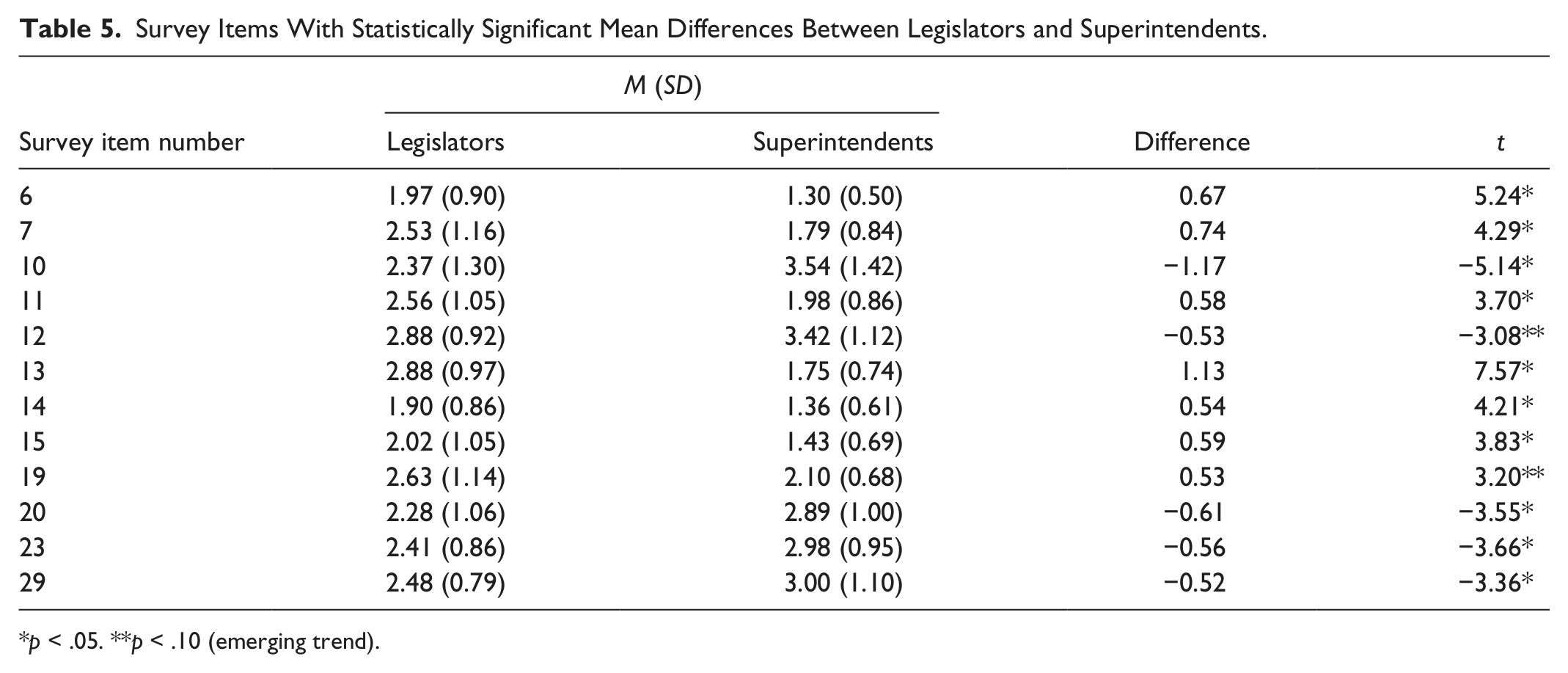
p < .05. **p < .10 (emerging trend).
Superintendents outscored legislators on items: 10, 12, 20, 23, and 29. Note that a larger scaled value indicates less agreement with the survey item statement. The complete text of the survey is available from the authors upon request.
Conclusion and Implications
The purpose of this study was to examine factors influencing the thoughts and perceptions of statewide policy makers engaged in the process of funding schools. Alabama has 140 legislators and 132 school superintendents. They collectively represent a very diverse group of constituents as well as personal backgrounds and experiences. In addition, they vary in their level of understanding of the political process and their understanding of quality school programs. Superintendents and legislators must gain a clearer understanding of each other’s thinking to develop effective strategies for establishing a consensus for change. Identifying differences and similarities between superintendents and legislators can provide directives for future consensus initiatives relative to securing and deploying additional resources. The outcomes of this study should be useful to both groups as they gain an enhanced understanding of each other’s perspectives related to school funding.
Evidence was found to conclude there is a difference between legislators and superintendents on the factor of equity and adequacy; furthermore, the typical legislator scored 2.14 points higher than superintendents on this factor. The mean factor scores on Equity and Adequacy are actually weighted averages based on eight survey items. Of these eight items, superintendents outscored legislators on only two of the factor items. In addition, of these two factors only one factor difference was statistically significant and the other factor difference indicated an emerging trend toward significance. The two survey items are number 10 and 12.
Survey item 10 states, “Districts should be required to contribute a local match in an amount greater than 10 mills in order to receive state funds.” The median response for legislators was agreement, but the median response for superintendents was disagreement. Efforts could be made to inform legislators that most states require a local match much higher than 10 mills required in Alabama. This low threshold results in a funding model that is primarily dependent on state appropriations. An increase in local match would provide more stable funding for the districts and take some of the pressure off the legislators to meet the needs for providing adequate state funds. This represents an opportunity to build consensus and capitalize upon a win-win outcome for both groups.
Survey item 12 states, “State implemented achievement tests are the best in assessing the performance of a school district.” The median response among legislators was neutrality, while the median response among superintendents was disagreement. The difference between the two groups shows that there is a predisposed tendency to view school success by multiple factors, especially on the part of superintendents. Some of these factors may include parental satisfaction, extracurricular accomplishments, teamwork, behavior and attendance, using subject measurement factors other than norm-referenced tests, and a variety of other measures that contribute to a person’s success in life and contributions to society. Superintendents’ disagreement with achievement tests as the best means of measuring success may be based on their experience that all students cannot be fairly measured by the same factors. Instead, multiple measures may be employed to ensure schools are educating the total child regardless of their background. A better understanding and agreement between legislators and superintendents about what children should learn to be successful, productive citizens is a cogent starting point to begin the discussion.
Nationally, there exists a large gap between spending in tax-wealthy and those poorer districts that are limited in tax capacity. This disparity presents a problem in that educational funding is limited in poorer areas, thereby often contributing to fewer resources and personnel for some students, depending upon where they reside. As decisions regarding the parity of spending are made at the state level, where legislators and superintendents engage in discussion through committees and other fact-gathering endeavors, the study of perceptions is critical to the creation of final policies that impact school funding issues. Although the current body of research on school funding is abundant, there is a paucity of research in the area of differences in perceptions of school superintendents and legislators as it relates to school funding policy decisions. Thus, this study seeks to make a contribution to the body of literature on the topic. Policy intermediaries are individuals who work with sometimes disparate groups to help them find points of agreement so that policies can be developed to improve the “public good” or “public welfare.” The quality of those policies is directly influenced by the information that legislators and superintendents receive. The findings of this study clearly point out that it is incumbent upon these intermediaries to locate, distill, and share in understandable and succinct units of information that are usable by the groups directly responsible for creating and legislating educational funding policies. The practical outcomes of this study that intermediaries may use to improve policy development processes and products are that they should:
Identify key policy issues well in advance that are well documented and data based;
Keep key policy issues to a minimum, avoiding information saturation;
Frame policy issues clearly and succinctly without using excessive educational or legislative jargon.
Understand that both legislators and educators need a shared definition of what constitutes “adequacy.” (The data suggest that viewpoints are disparate on this definition; adequacy is associated with the responsibility to ensure an education that is standards based. Historically, education has been focused on an “equitable” education, that is, funding based on distribution of funds rather than funding for achievement of standards. This is a new definition that is not understood or shared by all factions of policy makers.)
Supply research around key policy issues that is timely, provides an historical context, and is accurate.
Provide all decision makers and their immediate support staff involved in the issue with the same high-quality information.
Note the make-up of the various committees charged with creating and dispensing policies; identify gender, ethnicity, educational levels, and constituent information (socioeconomic levels, population densities).
Recognize the historical influence in respective chambers/districts (not part of study, but considered important in retrospect). This is important because these key leaders, whether legislative or educational, hold influence over their counterparts, who tend to support them and their viewpoints regardless of their personal affiliations. Therefore, it would be worthwhile in the development of policy to test and/or pique the interest of these key leaders when policy issues of importance to educational funding are on the docket for review and action.
Footnotes
Declaration of Conflicting Interests
The authors declared no potential conflicts of interest with respect to the research, authorship, and/or publication of this article.
Funding
The authors received no financial support for the research and/or authorship of this article.
Author Biographies