




Abstract
This study examines how a practice-based unit informs undergraduates’ understandings of the dynamics of teaching and learning in a multicultural society, and how these intersect with equity in U.S. classrooms. Citizens’ nuanced understanding of teaching and learning is increasingly important for their engagement with U.S. schools. Practice-based opportunities can allow students to “see” the complexity of teaching and to challenge assumptions about teaching and learning, which are central to preparing an informed citizenry. Findings further suggest that a single course is not sufficient to expand undergraduate students’ understanding of the role of diversity in social life. More concentrated and ongoing efforts may be needed to make racial, ethnic, economic, and cultural differences salient to students, especially those who have attended largely homogeneous school contexts such as the students in this study.
Keywords
This study examines how a practice-based unit informs undergraduates’ understandings of the dynamics of teaching and learning in a multicultural society, and how these intersect with equity in U.S. classrooms. Citizens’ nuanced understanding of the processes of teaching and learning, as well as their understanding of who schools have served, and how, is increasingly important for their engagement with U.S. schools, especially given transformative economic and demographic changes in the United States.
Information about teachers and the K-12 student population in the United States highlights a growing demographic mismatch between U.S. students and teachers: Students of color will soon outnumber White students (Bureau, 2004; National Center for Education Statistics, 2015), but the demographic distribution of both U.S. teachers and teacher candidates remains largely unchanged, with the large majority of teachers being White, middle-class women (Feistritzer, 2011; Juárez & Hayes, 2015; Ludwig, Kirshstein, Sidana, Ardila-Rey, & Bae, 2010). This lack of diversity within the teaching force—where “the future teachers are White, the teacher educators are White, the teachers are White” (Juárez & Hayes, 2015, p. 321)—contrasts with the growing diversity in the population of children enrolled in schools. This has been a central research consideration as scholars have studied the “continued under-preparation of teachers” (Juárez & Hayes, 2015, p. 318), and searched for ways to support the learning of effective ways to teach across difference; for example, Milner and Laughter write that “teachers report their relative under-preparedness to work with children living around and below the poverty line,” and, even more, that “these same teachers’ concerns—most of whom are White—about teaching children who live in poverty pale in comparison to their concerns about teaching Black and Brown students” (Milner & Laughter, 2013, p. 342).
In this study, we explore how practice-based opportunities can allow undergraduate students to “see” the complexity of teaching and to challenge assumptions about teaching and learning, which we argue are central to preparing an informed citizenry in a multicultural society. 1
This type of preparation is especially needed as the educational requirements of an information-based economy grow and the school choice movement increasingly positions parents as critical consumers of educational opportunity (see, for example, Olson- Beal & Hendry, 2012).
Countering Prevalent Assumptions About the Simplicity of Teaching
Teaching is often considered a straightforward and easy enterprise requiring little special skill beyond having “a knack with children and keep[ing] them reasonably attentive and enthusiastic about learning” (Stevenson & Stigler, 1992, p. 157). Assumptions about the ease of teaching are broadly shared—Feiman-Nemser and Remillard note the prevalence of “common sense theories” such as “‘Anyone can teach,’ ‘If you know your subject, you can teach it,’ ‘Teachers are born not made . . . ’” (Feiman-Nemser & Remillard, 1995, p. 1). As historian Carl Kaestle notes, Americans from everyday citizens to congressional leaders believe the notion that “Everybody’s been to fourth grade, so everybody knows what good teaching is” (Kaestle, 1992, p. 27). Even some prospective teachers believe teaching will be easy, only to quickly find that it is much more difficult than originally imagined (Darling-Hammond, 2010).
Dan Lortie wrote that future teachers’ and citizens’ lengthy “apprenticeship of observation” in U.S. schools constrains their ability to analyze, learn about, and conceptualize teaching and learning in new ways (Lortie, 1975). Lortie wrote, “the average student has spent 13,000 hours in direct contact with classrooms by the time he graduates from high school” (Lortie, 1975, p. 61). A key problem, according to Lortie, is that students’ observations of teachers and teaching is not systematic or deliberative; instead, it “is intuitive and imitative rather than explicit and analytical; it is based on individual personalities rather than pedagogical principles” (Lortie, 1975, p. 62). What students “see” or “know” about teaching is not the complexity of pedagogical knowledge, teachers’ assessment of student learning and adaptation of their practice, and the fluid and multiple dilemmas of teaching that arise over time and across content (Lampert, 1985). This study is in direct response to this problem, and seeks to disrupt these normative views of teaching developed over the lengthy apprenticeship of observation.
Lortie’s argument is strongly related to what Tyack and Tobin referred to as the enduring “grammar of schooling,” which provides consistent rules and structures to schooling (Tyack & Tobin, 1994). This grammar is conservative—it encourages students, teachers, and citizens to expect what they have experienced in schools; thus, it limits the potential for change, reform, and learning. Teachers, policy makers, and citizens believe that they “know” how to teach because of their experiences in schools. But this is particularly problematic for issues of diversity; students and teachers expect others to learn as they have, to interact with content in the same way, and to understand as they have. This familiarity with schools, then, can complicate the ability to understand and analyze the many ways in which diverse members of our society experience schools in the United States. Building upon these arguments about the grammar of schooling and the apprenticeship of observation, we investigate how observation, analysis, and teaching enable undergraduate students to examine and question assumptions about teaching and learning, and how these prepare undergraduates to critically consider teaching in increasingly multicultural schools.
Preparing citizens requires disrupting common conceptions of teaching and learning as universal processes, which remain insensitive to the way that language, culture, and social location shape expectations, actions, and perception in the classroom (Irvine, 1990). Researchers focused on the promise of multicultural education advocate for the development of reflective practitioners. Preparation for multicultural schools and communities necessitates being “watchful,” experiencing the dilemmas of teaching firsthand, and carefully examining those experiences (Zeichner & Liston, 2013, p. xii). Reflective practitioners use observational, empirical, and analytic abilities to examine teaching and adapt to the diverse understandings that surface in multicultural learning communities (Chisholm, 1994; Irvine, 1990; Sharma, 2011). Central to a dispositional preparation for diverse schools is an appreciation for and acceptance of “both individual and cultural interpretations of reality and recognition of cultural and personal thinking and learning preferences” (Chisholm, 1994, p. 50). Furthermore, the complexities of diverse spaces are not just personal, but structural, requiring recognition that schools are “socio-political contexts that are not neutral but are based on relations of power and privilege” (Zeichner et al., 1998, p. 166).
Understanding Teaching as Intricate Professional Practice
Scholars of teaching have argued that though teaching might be viewed as “natural” work that one might be “born” to do, that it is anything but. Ball and Forzani, for example, describe the “unnatural and intricate nature of instructional practice.” Even more, they write that “Despite the common view of good teaching as something that is mostly learned through experience, our argument rests on a conception of teaching as unnatural work” (Ball & Forzani, 2009, p. 498). Ball and Forzani—and others—have noted a number of ways in which teaching is unnatural work. For example, they write, consider the role of questions . . . In everyday life, people ask one another questions to which they do not know the answers. Teachers, on the other hand, must ask questions all the time to which they do know the answers: what is the number that lies between 1.5 and 1.6? . . . (Ball & Forzani, 2009, p. 499)
It is largely from this view of competent teaching as highly skilled, professional work that the field of teacher education has increasingly come to consider grounding the work of learning to teach in what has been called practice-based teacher education. Building out of the view that “making the transition to becoming a professional requires learning to do things that are not common in daily life and that most competent adults cannot do well” (Ball & Forzani, 2009, p. 499), scholars have encouraged the revision of teacher preparation, so that it can be more wholly focused on practice, where “practice makes practice” (Britzman, 2012; McDonald et al., 2014). The value of practice derives from thrusting the student into complex, real-time dilemmas in a way that other forms of preparation do not.
In light of the widely held belief in the ease of teaching in the United States and persistent inattention to the rich and complex possibilities of diverse classrooms, we designed a study aimed at surfacing undergraduate students’ assumptions about teaching and learning in a multicultural democracy. We reasoned that as citizens, voters, and potential future parents, these students have a substantial stake in the maintenance and improvement of the United States’s public education system. 2 We hypothesized the following:
In turn, this capacity for analysis might enable insights critical for civic participation in schooling such as understanding more deeply what goes into teaching students with diverse strengths and experiences. Furthermore, all citizens, not just intending teachers, need more than a surface understanding of the dynamics of teaching and learning, given the increasingly pivotal role of education as preparation for an increasingly information-based economy.
We argue that citizens who are knowledgeable about, even connoisseurs of, teaching, are a critical component needed to improve our current system of education. If we are to change broadly held conceptions of teaching as simple or easy work that is innate and prepare citizens to make effective choices about education, then citizens need to know more about the mechanisms of teaching and learning than they might learn solely through their individual experiences in schools. Citizens’ participation has been viewed as integral to public schooling from the founding of the Common Schools in the early 1800s (Mann, 1846) through contemporary discussions of educational reform (Chubb & Moe, 1990). We pick up these long-held views, and argue that citizens’ nuanced understanding of teaching and learning is increasingly important for their engagement with U.S. schools. Thus, we ask: How do observation, analysis, and teaching enable undergraduate students to examine and question assumptions about teaching and learning?
We conclude this article with a consideration of the following question: What do the findings suggest about ways to prepare undergraduates to critically consider teaching in increasingly multicultural schools?
Method and Design
In this study, we examine the questions and tensions that arise when undergraduate students analyze and examine firsthand experiences learning, observing, and teaching. We use constant comparative analysis (CCA; Glaser & Strauss, 1967) to examine students’ analysis of a three-part unit—the Teaching and Learning: Historical Investigation (TLHI). Positioned as learners, observers of another’s learning, and teachers of the same unit, the students drafted, rewrote, and submitted a final paper on the nature of teaching and learning. These papers offer a window into how students grappled with a “backstage” pass to the intellectual work of teaching and the diverse way that students learn (Grossman, 1991).
Theoretical Framework
This study draws on the work of theorists such as Dewey (Dewey, 1899/1980, 1902/2001, 1904/1965, 1913, 1916) and Piaget (Piaget, 1970). In addition, we draw upon the work of Vygotski and other social constructivist theorists, who emphasize the students’ capacity to draw on existing knowledge and experience when encountering new information. Furthermore, social constructivism assumes that problem solving in the context of an authentic task allows students to engage in an ongoing process of revising understandings and comprehending anew as students co-construct understandings in collaborative, social contexts (Vygotski & Cole, 1978). Thus, the design of the TLHI unit deliberately positioned students to engage in a moment of teaching practice from three different vantage points, working collaboratively with others throughout, while engaging in ongoing written reflection as a way to surface and inform assumptions about the nature of teaching and learning in contexts characterized by diversity.
Participants
Participants in this study were enrolled in a school of education course devoted to examining schooling in a multicultural society. Sixty-one undergraduate students participated in this study and 73 participated in the course. Eighty-five percent of the study sample identified as White; 8% identified as African American, 5% as Asian American, and 2% as Arab American. The sample consisted mainly of students who attended suburban (77%) and public high schools (85%) prior to enrolling in the university. Students in this sample characterized their high school settings as serving a relatively homogeneous population of students in terms of race, ethnicity, or economic status. Only 21% of the sample characterized the student population of their high schools as “diverse” or “very diverse.” Finally, 15% of the students declared education as their major at the time of the study. However, slightly more than half the students indicated they were interested in teaching in some capacity (55%).
Course
The unit under study took place at a large public Midwestern university in the United States in an undergraduate class that fulfills the university’s race and ethnicity requirement. In this course, students investigated three questions:
What are the purposes of schooling, and for whom?
How do schools work, and for whom?
What is involved in improving schools?
Across this set of questions, instructors and students attended to school’s competing goals of assimilation and diversity, opportunity and competition. The course was designed to help students wrestle with the multiple aims and conceptions of schooling in a multicultural society (i.e., schools as a social and economic equalizer; Mann, cited in Cremin, 1957) or schools as a place centrally concerned with the learning of academic content (Bestor, 1953). A central and unifying theme of the course was the evolving, complicated, and often problematic ways that differences have been understood and experienced in U.S. schools. As such, the course traces the history of schooling from the anti-Catholic Bible Riots to the ongoing saga of segregated schools to the movement for multilingual rights. Students were supported to develop a perspective that is at once historically rooted, based on knowledge of teaching practice, and attentive to current educational policy.
The instructor cultivated this perspective through three successive units in the course. The first unit traced the foundations of public education in the United States with particular attention to ongoing responses to differences in the schooling system (i.e., the advent of tracking). The second unit focused on developing an understanding of the practices of teaching and learning, moving from a macrolevel understanding of schooling to a more microlevel analysis of interactions in the classroom. The third unit asked students to apply their developing knowledge of educational history and teaching practice to current policy debates, and to articulate a stance on a critical issue facing today’s schools.
The teaching and learning unit
In an effort to develop students’ understanding of teaching practice, students participated in a unit of study devoted to teaching and learning. This section of the course incorporated readings, lectures, videos of teaching, small group discussions, and the TLHI. In total, students spent 8 weeks reading, viewing, analyzing, and teaching during a deliberately scaffolded investigation of the interactive dynamics of teaching and learning. The 8-week unit culminated with a final paper that asked students to develop a set of evidence-based claims about the nature of teaching and learning in U.S. classrooms.
TLHI
Embedded within this 8-week teaching and learning unit, students participate in the TLHI, a three-part unit designed by the lead author to help students critically analyze teaching and learning by holding the unit of study constant. 3 The unit was designed so that the students could engage in a singular unit of learning as students, observers, and teachers. The content of the TLHI was purposefully constructed so that it could be used by students and teachers across age levels and could be solved in multiple ways. The TLHI consisted of a study of the internment of Japanese Americans during WWII. Twelve primary source documents that consisted of images and quotations offered a range of perspectives on the internment of Japanese Americans in the United States. The document set included a copy of executive order 9066, the presidential executive order that led to the relocation of Japanese Americans; a map of the internment camps in the United States; and photographs and quotes drawn from newspapers, interned Japanese Americans, and servicemen stationed at Pearl Harbor.
This piece of U.S. history was chosen purposefully because most students have only modest knowledge about this moment in history. Of six key U.S. history textbooks, none covers this more than briefly (see, for example, Appleby, Brinkley, & McPherson, 2003; Boyer, 2003; Bragdon, McCutchen, & Ritchie, 1997; Cayton, Perry, Reed, & Winkler, 2003; Danzer, Klor de Alva, Krieger, Wilson, & Woloch, 2003; Nash, 2002). Furthermore, Japanese internment forefronts a key assertion of the course: Individuals of different social positions experience and respond to events differently. So too, students interpret and respond to the same information differently, which is part of the dynamics of teaching and learning that this unit aimed to highlight for students unaccustomed to critically examining not only their own learning, but the learning of others.
Student as learner
The TLHI began by asking students to answer two questions: (a) What is history? (b) How do you do history? Next, students examined an image of the USS Arizona, one of the ships sunk during Pearl Harbor, in flames and the video testimony of Akiko Kurose, a Japanese American, reflecting on her experience as a child the day after the attack on Pearl Harbor and her parents’ and teachers’ fear of reprisals and racism (“Densho Visual History Collection,” 2011). Then, the instructor introduced students to a graphic organizer designed to elicit and to record ongoing thinking, and explained the purpose of each section. As a final preparatory measure, the instructor modeled how to use the graphic organizer using the map of internment camps in the United States. Next, students were asked to respond to the questions:
What are two likely stories—arguments or theses—that these documents tell? Use evidence from the documents to support your evolving historical inquiry.
What are some key questions that you can compose? Again, use evidence from the documents to support your questions.
Now that you have begun this study, what other documents would you need to deepen and enrich your story?
Each student chose at least three documents to analyze, and used the graphic organizer to record their observations and developing theories. After completing their own graphic organizer, students compared arguments in small groups. Finally, some students shared their theses during a whole class discussion.
Student as observer
After experiencing the TLHI as students, the undergraduates observed the instructor teach the TLHI to a middle school student recruited from a local public school. The instructor used the same resources—the graphic organizer, primary source documents, and content-based questions, but the middle school student learned the TLHI in a one-on-one context. When the undergraduate students completed the TLHI, they alternately worked independently, in small groups, and as a whole class. This teaching session was recorded and posted on a shared site so that students could watch and study the episode, using it as a text for the analysis of teaching and learning.
Student as teacher
In the final stage of the teaching and learning unit, each student selected an individual from outside the class to experience the TLHI. These individuals ranged from elementary school students to fellow college students to parents and grandparents. The undergraduate students had access to an additional 12 documents and other resources for their own research on the internment of Japanese Americans. A class was devoted to helping students prepare for their teaching session. In this class, undergraduates worked with peers and instructors to select documents for their teaching session, generate possible questions to guide their teaching, and complete a planning guide that asked students preparatory questions. Students prepared for and taught the TLHI, collecting artifacts from their teaching such as notes used in preparation, their student’s graphic organizer, video or audio recording of the teaching session, and/or transcriptions of the teaching sessions. Students used evidence collected as a student, observer, and teacher as the foundation for their culminating paper on teaching and learning.
Data Sources
The teaching and learning unit culminated with a final paper that asked students to describe their experience as both a student and a teacher of the TLHI as well as make three to five assertions about “learning and teaching and about how these are affected by a host of different factors” in the environment.
Analytic Approach
TLHI paper analysis
We employed CCA (Glaser & Strauss, 1967) to examine collegiate students’ thinking about teaching and learning. CCA consists of a three-stage coding process in which researchers compare data with one another to further refine labels and establish relationships between data. In the open-coding stage, each member of the research team read and reread a single student’s paper. We read and open coded a full two thirds of the data together, discussing possible codes, relationships between codes, and resolving overlaps between our tentative labels. Our coding process was guided by our interest in our main research questions. Once we developed a shared understanding of the key codes, we divided the 61 papers among the three research analysts on the team. We coded the papers with 17 initial codes developed through the open-coding process. Throughout the coding process, we discussed ongoing analysis, challenging and refining each other’s interpretations to increase the validity of our findings.
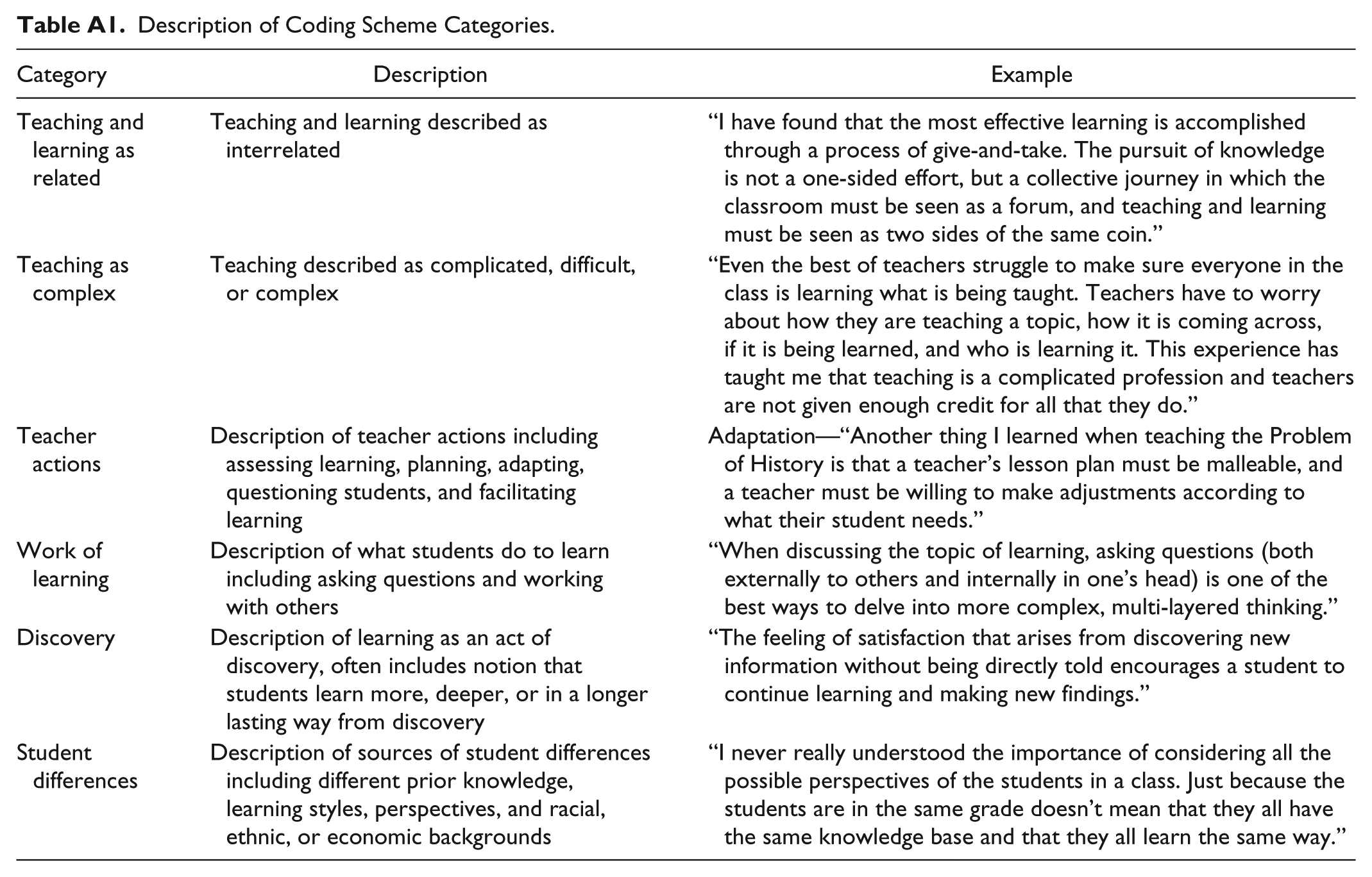
In the second stage of analysis—axial coding—we used group discussion, memos, and more intensive analysis of individual categories to establish properties of codes and expand or collapse codes as needed. We collapsed our initial set of labels into six codes—teacher actions (such as planning, assessing, and adapting), differences, work of learning, discovery, teaching and learning as related, and teaching as complex. Next, we divided the six categories among the data analysts and looked within each category for common patterns and potential nuances in the data. For example, within the category of differences, students characterized learners as bringing different learning styles, different prior knowledge, different perspectives, and different racial, ethnic, cultural, or economic backgrounds to the work of the learning. Furthermore, the students suggest these differences can serve as a challenge, a source of strength, or simply a factor that teachers must attend to in the classroom. This second level of analysis helped flesh out the categories, highlighting interactions between the concepts. For example, in the category of student discovery, students claim that discovering information on their own improves the quality of learning, but they also describe the teacher’s role in “allowing” such learning to take place as exemplified in this quote: It is sometimes an effective strategy to let your students figure things out for themselves instead of just giving them the answer. In order to help students understand why something is true instead of just how to find the answer, it is important to let them work through the problems themselves and with other classmates before the teacher jumps in to give them the answer. By doing this, the students will be able to reason through why certain answers are right or wrong.
In this way, student discovery is not just about what students do, but what teachers do as well. Throughout this stage of analysis, members of the research team wrote weekly memos, discussed ongoing analysis, and tested and corroborated developing theories. Table A1 briefly overviews the main categories in the data.
Finally, in the selective coding stage, we revisited the data looking for confirming and contradicting evidence of our developing hypotheses. We used this process to consistently challenge the theories developed through the coding process. Each team member created a key linkage chart to show the relationships between central codes in the data. We used the charts to generate tentative assertions. All three initial assertions situated teacher actions and student discovery as two potential core categories of the data, around which the other codes relate. After finding a high level of agreement among the three analysts’ assertions, we discussed and refined our thinking to create a provisional assertion.
To further corroborate our coding, we presented a subset of our data to seven colleagues with experience in qualitative methods and research interests centered on the learning of prospective teachers. We asked these collaborators to open code a subset of exemplars drawn from four of the six main categories from our data. We also solicited feedback about any exemplars that did not seem to belong in the same category as other data. All seven respondents largely substantiated our coding scheme with the exception of minor differences in choices of language. For example, two respondents suggested the label “constructivist learning” in lieu of “student discovery.” We chose to maintain the label “discovery” because it reflected the students’ own language in describing a facet of learning.
Results
The TLHI created an opportunity for students to examine their understanding of teaching and learning. Our findings indicate that students in this study saw teaching and learning as highly related. They wrote that teaching is deliberate, interactive work that not only involves a good deal of planning but also requires flexibility, in the moment decision making, and the ability to simultaneously meet a multitude of student needs. For these undergraduates, a fundamental tension of teaching and learning arises from the interactive nature of teaching. Because teaching is complex interactional work, it requires knowledge about the student, planning, and adaptation—all new insights for individuals who had experienced classrooms as students, but not as teachers. What students bring to the work of learning—prior knowledge, learning styles, perspectives, and racial, ethnic, or economic backgrounds—is of tremendous consequence for what teachers do, and for what students learn.
Below we consider (a) TLHI students’ understanding of teaching and learning as highly related, interactive work; (b) the importance they placed on student differences in background and perspective; (c) their understanding of teachers’ work as planning and adapting instruction to meet student needs; and (d) TLHI students’ notion of students’ learning, which they described as a dynamic process of “discovery.” The sum of these understandings is that teaching is interactional, sophisticated work. For example, one student wrote, Teaching and learning are complex processes, which students and teachers actively engage in every time they enter a classroom. On the surface, the goal of teaching seems obvious—to educate the students. However, a lot more careful planning and intricate evaluation of situations are involved when it comes to educating a group of students.
The TLHI students found that though teaching might appear, on the “surface” to be straightforward, it is actually complex work involving detailed planning and ongoing assessment of multiple “situations” related to student learning. In this respect, the TLHI helped students see beyond simplistic views of teaching to the planning, assessing, decision making, and adapting that makes classroom learning possible.
Teaching and Learning as Interactive Work
The students in this study saw the student and the teacher as both actively contributing to learning outcomes. More than 40% of the TLHI students saw teachers and students in a kind of partnership that operates as “a two-way street.” As one student noted, I have found that the most effective learning is accomplished through a process of give-and-take. The pursuit of knowledge is not a one-sided effort, but a collective journey in which the classroom must be seen as a forum, and teaching and learning must be seen as two sides of the same coin.
For students in this study, teachers and students work together closely in what another student described as a “complicated relationship that connects them.” This relationship is important because what teachers and students do in the classroom depends on one another. In a representative comment, one TLHI student noted, “Through the investigation of teaching and learning, I have been able to understand the importance of the relationship between teachers and students, and how each of their roles is directly affected by one another.”
Our students’ understanding of teaching and learning hinged on the insight that teaching and learning are highly interactive works. For example, students saw teaching as dependent upon students’ engagement, and wrote that teachers’ reliance on students increases the complexity of the iterative enterprise: Teachers have a tough job—they are responsible for fostering the learning and success of others and therefore must be able to challenge students, be cognizant of student struggles and bias tendencies, and be able to alter their teaching to increase student learning.
They saw teachers as “responsible” not only for their own work, such as planning, but also for the actions of others—what students do with the opportunities and resources teachers provide.
Student Differences
The majority of these students (59%) were surprised to learn that not everyone learns like they do, in classes like they did. For example, one student wrote, “Since every student approaches learning with his or her own perspective and experiences, every student comes to understand knowledge differently.” This suggests an important breakdown in assumptions about schooling. As another student commented, “I was originally under the impression that there was always an easier way to learn something, and that that was the best way for everyone. But after observing my peers this was easily not the case.” Instead, TLHI students realized that students learn differently. Because students learn differently, teachers must know their students to meet their needs. On this, one student wrote, “It is also important for teachers to know how their students learn, or at least to acknowledge that different students learn in different ways.”
Teachers need to understand not only a student’s learning style but also what students know, and what they bring to their work in classrooms. This point reflects a growing understanding of the importance of knowing students to be receptive to their learning. This view was represented in students’ writing. Students asserted that the social and motivational aspects of learning are defining aspects of successful classrooms. Forty-five percent of the TLHI students asserted that teachers need to know them, relate to them, and make learning experiences meaningful and relevant to their lives. To this end, one student wrote, It is important to give learning a purpose and a meaning while teaching so that your students are motivated to learn. If students believe that they have no reason to be learning the information that you’re teaching them, then they will most likely not pay attention or will not have any interest in the lesson at all.
For these students, learners not only interpret information differently based on their background and experiences, but they are motivated and engaged by teachers who know them and connect content to their lives.
Expanding on this point, just more than a quarter of our students (26%) acknowledged that a student’s racial, ethnic, economic, or cultural background was an important determinant in student engagement and learning in the classroom. In a representative comment, one student wrote, “When the pedagogical content is culturally relevant to the students, they will optimally learn.” For this subset of TLHI students, what students know and bring to their classroom work is, in part, shaped by their social, economic, or cultural backgrounds, particularly in terms of the extent to which instruction is relevant to their everyday lives. Notably, despite the emphasis of the course on multiculturalism and the centrality of different social positions in shaping understanding in the TLHI unit of history, relatively few students noticed how social, economic, and cultural positioning might inform learning.
A subset of students (25%) found that differences in perspective, understanding, and background help students to learn. As students experienced the TLHI as students, this portion of students wrote about the benefit of differences in classrooms. For example, one student wrote, “Some of my classmates have commented that hearing the diverse opinions of other students helps them to add new knowledge to what they already know.” Another recalled, Very quickly my partner and I established we had very different political viewpoints. We disagreed about a few interpretations and our stories reflected very different concerns with the Japanese internment. Reflecting on this, I realize the many benefits that come with a diverse classroom—diverse in terms of not only backgrounds, but also in cultures and in this particular example, viewpoints.
Although student differences pose challenges for teachers’ practice, they can enrich student learning when teachers position students to work with one another. In this way, TLHI students saw how students could be resources for one another’s learning.
The Role of the Teacher: Planning and Adapting
Students experienced and wrote about “difference” in two contexts: the impact difference has on students’ learning and on teacher’s actions. One student wrote, “Every student comes to class with a unique learning style and perspective, and, it is the teacher’s mission to teach the same information to every student despite those discrepancies.” For these students, difference seemed to be a natural part of a classroom environment, and teachers must adapt to an array of understandings, viewpoints, strengths, weaknesses, and needs. Although these students acknowledged that teacher actions in response to student difference often contributed to the difficulty and complexity of teaching, they saw how teachers react to difference is a vital component of effective instruction. For the TLHI students, teachers respond to student differences by preparing “for variability,” “identify[ing] the learners’ strengths and weaknesses,” “mak[ing] the schoolwork fit each student’s style of learning,” and “explain[ing] different concepts in different ways.” One student wrote, “Each student has a unique type of learning style as well as different cultural backgrounds; therefore teachers must be flexible to match the needs of their students.” TLHI students not only viewed difference as a challenge to teachers but also argued that difference should inform and even determine a teacher’s pedagogical choices and behavior. Students wrote that teachers should constantly adapt to student understandings and differences.
Seeing teaching and learning as highly interactive, students felt teachers needed to be able to “expect the unexpected” and engage in detailed planning as well as in-the-moment adjustments. For instance, one student wrote, The teacher needs to be prepared for the unexpected, the lesson plan may not go the way that they exactly planned, or the students may ask questions that the teacher doesn’t expect or cover in the lesson plan. It is important for the teacher to be able to answer these questions or change the lesson plan on the fly; otherwise the class won’t run as smoothly.
For these students, teachers need to demonstrate a kind of nimbleness, flexibly altering plans in the moment. Although the students recognized the value of planning, they noted, “While a teacher can plan out a lesson, they cannot plan their students’ reactions, forcing teachers to deal with reactions as they come.” As such, students wrote that teachers must both plan for the unexpected by preparing in an organized way and be able to alter their lesson plan fluidly, in the moment. Although students saw adapting to students as a challenging but indispensable aspect of teaching, they also recognized the benefits that stem from the interactive nature of teaching and learning. One student wrote, I learned to be prepared for things to possibly go in directions you don’t expect. Obviously it is still important to keep the goals in mind, but sometimes the most profound learning can be a complete surprise even to the teacher.
TLHI students wrote that teachers’ practice should be responsive and iterative, and that they need to adapt their work precisely because of the interactional nature of teaching and learning. They asserted that teachers adapt to the unexpected by “over-preparing,” organizing, preparing for unexpected questions and preparing for the unforeseen. For example, one student wrote, Another large segment of what I learned is to prepare oneself for the unforeseen. While this is a metaphor, the premise remains unchanged when you apply it to the instruction of a child; they can ask surprising questions and construct strange truths of their own. A teacher must strive to allow his or her lesson plan to not be diminished by an unknown question, but strengthened by the want of students to explore a concept further.
The TLHI students wrote that the highly interactive nature of teacher necessitates that teachers plan for the unexpected in advance of teaching, and that they adapt their practice while teaching to accommodate their students’ needs and learning goals.
Interestingly, the TLHI unit occasioned students’ understanding of the differences that students bring to the classroom and how those differences bring about diverse responses to learning opportunities in the classroom. For the TLHI students, diverse and unexpected understandings require a nimble teacher, capable of adapting instruction according to in-the-moment interactions in the classroom. This conception of classroom learning derives, at least in part, from the fact that the TLHI unit did not help the students, in this study, see how individual students wrestle with learning challenges in patterned ways, which help teachers anticipate common problems and misconceptions during planning and classroom instruction. Consequently, as first-time instructors, the TLHI students could not see how some student responses might cease to be “unexpected” after increased teaching experience.
The Role of Student Discovery
Just above 60% of students wrote of the importance of student discovery. Students asserted that teacher adaptation and student discovery are highly related—that is, teachers must adapt to “let” students discover: For teaching, I found that in order to be able to make sure that a student gets as much as he or she can out of a lesson a teacher must be able to adapt to different situations, and that allowing students to work things out on their own, with only giving leading questions when needed, can be a great tool while teaching them because instead of spitting back out what they were just told, the students form their own ideas.
Because teaching and learning are carried out in interaction with others, teachers must continuously be responsive to what students bring to their work. One student described this relationship by writing, “Everyone brings a different perspective to the classroom and it is important to cultivate that by letting their own ideas grow.”
Teachers are also, in this view, dependent upon students as much as students are dependent upon teachers. Thus, “discovery” is not only what students do to learn but also what teachers enable. Describing how teachers enable student discovery, one student wrote, I began to think about the value of the “Ah-Ha” moment. Like the very first video we watched in class and the debate over if six was odd or even, the teacher took the back seat and allowed self-discovery to occur. (Mathematics Teaching and Learning to Teach, 2010)
A second student described teachers’ work by saying, “Teachers must help without doing.” For the TLHI students, the work of teaching involves letting students do the work—analyzing, questioning, and discussing information. Teachers enable student work by providing resources and adapting to student understandings, but they cannot learn for students.
According to our students, self-discovery is important because it makes learning more “memorable,” it enables students to “learn deeply,” and it is “motivating.” One student wrote, “In learning, a student’s direct discovery, or the process of finding knowledge and information for oneself, creates a more memorable and effective experience because these connections are being made inside the student’s head.” Emphasizing the value of such learning, our students contrasted insights that their learners discovered on their own with information that is “regurgitated” or “spitting back out what they [learners] were just told.” For the TLHI students, student discovery created conceptual understanding, which they recognized as more valuable than more superficial demonstrations of learning such as memorization.
Students wrote that adaptive teaching and self-discovery can lead to sophisticated learning. For example, one student wrote, “by fostering an environment of student self-discovery, teachers of students of all grade-levels are capable of eliciting high-level, analytical theory building.” But, they ascertained that enacting adaptive teaching and engaged “discovery” is challenging work. For example, one student wrote, It is extremely important but difficult for educators not to simply tell students what they want to know. While it may seem easier, this is a disservice to students because it inhibits them from formulating their own, unbiased ideas. It is both a challenge for the student to come up with conclusions on their own and a challenge for the teacher to let students come to conclusions on their own. But this challenge ultimately pays off.
TLHI students concluded that teaching is challenging work that necessitates time, skill, and effective teaching practices. They also found that negotiating these challenges “pays off” by positioning students to come to their own conclusions.
The Complexity of Teaching and Learning
The TLHI students saw students as taking up or using the resources and opportunities that teachers make available. They wrote that students must engage with content and each other if they are to learn. According a prominent role to individual student differences, students noted that teaching is challenging precisely because classrooms consist of a multiplicity of individuals. In a representative statement, one student wrote, “trying to understand my single learner in teaching Japanese internment and cater to her needs was difficult enough, even while it lacked the complexities of a larger classroom that is more typical of the American education system.” Students wrote that classrooms are comprised of individual students who understand and take up work with their teachers and content in differential ways: “As a teacher next year, I am likely to be charged with negotiating students of all different backgrounds, aptitudes, abilities, and work ethic.” Because effective instruction necessitates adaptive teaching practice, individual student differences challenge teachers’ work. One student wrote, Having students with varied learning styles and differing interpretations of information poses a challenge because the teacher must find a balance between teaching styles so that all students have a chance to learn in a way that suits them and how they interpret the information.
Schooling in a democratic, multicultural society necessitates this careful balancing between the individual and the group; “finding that balance” contributes to the complexity of teaching.
A key theme that emerged from the data has to do with the complexity of teaching; nearly three quarters of our students wrote about the complexity of the work of teaching. Students wrote that the interactional nature of teaching makes it a fundamentally complex endeavor. One student asserted, I used to view teaching as a simple task with few issues until I began researching only to find how many issues and dilemmas teachers are faced with on a daily basis—from large scale issues such as time management within the classroom to smaller scale issues, which need to be dealt with in the moment like not knowing the correct answer to a question.
Students wrote that teaching is complex because teachers need to continually weigh the efficacy of different teacher moves, because teachers are dependent upon student work for learning outcomes, and because student differences significantly affect how and what students learn and understand. Students wrote that the in-the-moment work of teaching makes managing this work particularly complex: “when teaching, teachers need to be alert the whole time and they need to make decisions every minute.”
A subset of students—nearly a third—wrote that prior to their systematic study of the practices of teaching and learning, they had not seen teaching as complex: I have come to appreciate the complexity and richness behind both the process of teaching and of learning. Before this, I viewed teaching as an easy task, and learning as a simple undertaking done in one way, with nothing from the past having an effect. However, I now realize how truly wrong I was in both of these views.
These students reported that they revised their views of teaching. They wrote that this unit helped them to perceive and appreciate aspects of the work of teaching that had been invisible when they were students themselves. As one student noted, “I honestly went in to the experience thinking that it would be easy because I have been attending class and watching how professors have taught throughout my entire life.” For this subset of students, their lengthy experience in schools as students led them to see teaching as relatively simple work that they were prepared to do.
In this way, students challenged the previously held views of teaching and learning. The invisible became visible, as one student wrote, Simply sitting back and watching Professor Author teach Sean and even while she was teaching our own class the lesson, I was unable to fully grasp how much preparation teaching a lesson well, really takes, and this was until I had to begin to try to teach the lesson myself. I think that there is a lot of outside work that a teacher must do to make the lesson a success that the learner often does not see or may even overlook. Most importantly, though, I think that it is this preparation work that really makes a lesson a success or a failure.
Similarly, another student wrote, “after being a student for so many years, having the opportunity to teach allowed me to understand the difficulty that is teaching.” Thus, studying teaching in the TLHI disrupted students’ views of the cognitive and professional demands of teaching.
Discussion
In 1893, J. M. Rice decried the paucity of citizens’ “intelligent interest” in schools: In the large majority of instances the people take absolutely no active interest in their schools. I do not here refer to that form of interest which manifests itself on the part of the citizens of most localities in a certain pride in their own particular schools, which they consider the best in the country, but which pride is founded neither on a knowledge of what is going on in other schools, or even in their own schools, nor upon the slightest knowledge of the science of education; but I refer to an intelligent interest, an interest sufficiently deep to lead one to follow closely the actions of the board of education, the superintendent, and the teachers, and to seek some knowledge of the scientific development of children. If but one parent in a hundred would be interested to this extent, I believe that most of our flagrant educational evils would disappear. (Rice, 1893, p. 10)
To Rice, citizens’ knowledge about teaching and learning would be so powerful as to eliminate the “educational evils” of his day. The research we report here takes up these very points. We argue that recent educational reforms overlook a critical component needed to improve our current system of education—citizens who are knowledgeable about, even connoisseurs of, teaching. Such a connoisseurship rests on two central understandings: teaching (a) is intricate professional practice and (b) is informed by diversity in multicultural democracies.
To date, scholars have written about practice-based professional teacher education, and how “making practice the core of teachers’ professional preparation” is critical for addressing the “common views of teaching as idiosyncratic and independently creative” (Ball & Forzani, 2009, p. 497). We extend scholars’ interest in practice-based education, as we design and research a practice-based unit and study its use in an undergraduate course with students who are interested in education, but do not necessarily plan to pursue a degree in education. This is critical, for many scholars have argued that teachers face a “dilemma” as they “carry out their work in the face of students who, guided by years of memories, filter and interpret teacher education coursework according to their preconceived beliefs about how to teach” (Balli, 2014, p. 105), an obstacle to preparing all undergraduate students to reenvision schooling as a preparation for citizenship.
We investigated the following questions: How do observation, analysis, and teaching experience enable undergraduate students to examine and question assumptions about teaching and learning? What does this suggest about ways to prepare undergraduates to critically consider teaching in increasingly multicultural schools? Leveraging the power of practice-based experience, students engaged in a three-part study, which positioned them as students, observers, and teachers of a unit on Japanese internment. The TLHI worked as a scaffold for generating insights about the nature of teaching and learning not typically available to students, because students had access not only to their own learning but also to points of comparison made possible by examining the learning of others. In structure and content, the TLHI aimed to disrupt common conceptions about the ease of teaching as well as restricted and homogenizing conceptions of learning preferences and processes.
In terms of students’ developing understanding of teaching as intricate professional practice, we report that students engaged in nuanced ways of thinking about teaching and learning. Specifically, these undergraduates argued that students bring important differences to the classroom, that what teachers do depends on students and their developing understanding and sense making, that teaching consists of planning and adapting in the moment, and that teaching is complex interactional work. Each of these represents an increasing connoisseurship of teaching developed by engaging in the instructional planning, decision making, assessment and other practices that are normally hidden from the view of students (Grossman, 1991). Even more, this cuts against the view of teaching as “natural,” and instead, privileges the view of “teaching as a highly skilled practice, one that requires close training (Ball & Forzani, 2009, p. 508). As Rice wrote two centuries ago, without knowledge about and understanding of the work of the teaching, ordinary citizens’ abilities to make important decisions—as voters, citizens, and parents—are constrained.
Limitations
The TLHI offers a promising beginning for how to prepare undergraduate students for a lifetime of engagement with public schooling. Recent reforms assume that individuals have the necessary knowledge to make choices about schooling simply because as Kaestle notes, “Everybody’s been to fourth grade” (Kaestle, 1992, p. 27). As research into everyday citizens’ “apprenticeship of observation” in schools suggests, simply experiencing teaching as students offers a shallow preparation for understanding the complexity of teaching and learning. The TLHI made this complexity more transparent for the TLHI students in this study. However, this study represents only one particular context. We need to know more about how other individuals in other contexts might take up such a “backstage” pass to teaching (Grossman, 1991). By inviting a larger and more diverse number of citizens to analyze the complex, iterative interactions that occur in teaching and learning, the value of initiating citizens into the complexity of teaching can be better understood.
Evidence from this study suggests that the TLHI offers something on which to build. Even over a short period, TLHI students demonstrated insight into teaching and learning that went beyond what one might conclude from everyday experience. The TLHI was designed to plant seeds—new insights and ways of thinking—that would continue to grow. Long-term study is needed to determine to what extent this type of engagement influences future thinking and decision making about education. Although it is clear that recent reform efforts overlook enhancing the knowledge of everyday citizens, further study is needed to determine the extent to which units such as the TLHI substantively address this need over the long term.
Implications
This study’s findings are important for efforts to enrich the practices and pedagogy of postsecondary education. As citizens who will make important decisions about schooling, all undergraduates need to understand the complex interactional work of teaching and learning, not just intending teachers. At the start of this article, we asked the following: What do the findings suggest about ways to prepare undergraduates to critically consider teaching in increasingly multicultural schools? In part, this study illuminates how practice-based opportunities can allow individuals to “see” the complexity of teaching and to challenge assumptions about teaching and learning. We assert that a fundamental means to do this is to position students to critically analyze teaching from multiple perspectives. Feiman-Nemser and Remillard wrote that “deeply rooted . . . views of teaching and learning are unlikely to change unless alternative experiences challenge their validity” (Feiman-Nemser & Remillard, 1995, p. 9). This unit provided students the opportunity to challenge existing views and “discover” for themselves the complexity of teaching. This discovery is important because as U.S. schooling shifts toward a system in which citizens are consumers, parents are increasingly required to make informed choices between possible school placements for their children. Postsecondary education needs to play a role in preparing citizens for this kind of civic engagement.
Our research shows that this firsthand investigation of teaching and learning enabled undergraduates to understand that teaching is a profoundly multifaceted practice. Students’ emerging understanding of teaching allowed them to better understand how it is that education plays out in a multicultural society. Enabling students to see that “we all learn differently” is important because it facilitates citizens’ abilities to understand the multiple and complex demands of teaching in an increasingly diverse society. It also highlights the benefits derived from working closely with others with diverse backgrounds and experiences. Schooling in a democratic, multicultural society necessitates a careful balancing between the individual and the group. Teaching can be challenging precisely because classrooms consist of a multiplicity of individuals, but it can be rewarding for teachers and students as well because both teachers and students learn from the insights of others.
Although the students in this study recognized that students bring differences to the classroom, which shape their understanding and necessitate a responsive teacher, the majority of TLHI students did not see these differences as arising from diverse experiences or perspectives shaped by racial, ethnic, economic, or cultural backgrounds. The course in which the TLHI took place focused on schooling as a socially shaped enterprise through which society negotiated tensions over social, economic, and cultural differences. The tensions charted in the course ranged from the earliest years of public schools (i.e., sectarian violence between Catholics and Protestants over the reading of the Lord’s Prayer) up to more present-day concerns such as the struggle for bilingual resources in schools, powerfully dramatized by the student-led protests in Crystal City, Texas, in the early 1970s (Mondale & Patton, 2001). Yet, TLHI students, in their analysis of teaching and learning, did not attribute the unique perspectives of students that they saw as so pivotal to learning to the social, economic, and cultural differences that shape students’ experiences and perspectives. Instead, they made more general claims about the nature of each individual’s unique life experience and perspective.
Furthermore, the TLHI unit foregrounded the disparate perspectives of citizens who occupied different social positions with regard to Japanese internment, showing how the same event can be experienced and interpreted in vastly different ways by individuals in a diverse society. The varied interpretations of events were reflected not only in the documents provided for study but also in the TLHI students’ developing theories that derived from analysis of these documents. Despite this heavy emphasis on the ways that race, ethnicity, economic status, and cultural background inform and shape individuals’ opportunities for learning and experience of those opportunities, the TLHI unit made the role of social, economic, and cultural backgrounds in learning transparent for some, but not all the students in this study. This finding suggests that a single course is not sufficient to expand undergraduate students’ understanding of the role of diversity in social life. As detailed here, the demographics of the course under study reflect the lack of diversity in the teaching force, as 85% of the study sample identify as White.
We reflect again here on the demographics of the study, and the difficulty of changing minds around issues of diversity, and of the broad scholarship on White fragility (DiAngelo, 2011; Matias, 2016). More concentrated and ongoing efforts may be needed to make racial, ethnic, economic, and cultural differences salient to students, especially those who have attended largely homogeneous school contexts such as the students in this study. Indeed, this finding echoes calls for preparation for multicultural communities to not reside in single classes, but to permeate the curriculum in postsecondary settings (Gay, 2002; Ladson-Billings, 1995a; Ladson-Billings, 1995b; Sharma, 2011; Zeichner et al., 1998); doing this, DiAngelo (2011) writes would break the modal experience, whereby “many white people have never been given direct or complex information about racism before, and often cannot explicitly see, feel or understand it” (p. 67).
The students in this study recognized a multiplicity of differences in the classroom, but were unable to see the patterned ways that students respond to particular content and learning arrangements. Consequently, the TLHI students imagined classrooms in which teachers were left to respond in the moment to unknown and unpredictable challenges. In this way, the TLHI unit enabled students to see the complex demands of teaching, but offered less access to the ways that experienced teachers learn to grapple with these challenges over time. The inability of students to see patterns in students’ responses suggests the need for complementary experiences that provide the opportunity for students to see common responses and perspectives as well as differences in the classroom.
Participation in the TLHI led students to write that they could “see” teaching and learning as they had not seen before. As we, as a nation, continue to invest substantial resources to improving schools, “seeing” the complexity of teaching practice is important for the construction and support of policies, which will support what researchers have called “ambitious” (Lampert, 2005; Lampert & Graziani, 2009), “adventurous” (Cohen, 1988), or “reform-minded” teaching—teaching that encourages students to ask, explain, and problem solve, and that positions all students as capable of learning sophisticated, challenging academic content (Feiman-Nemser, 2001). Such teaching is possible when it is understood, valued, and protected from calls to diminish intellectual engagement for a focus solely on basic skills. Recognizing that learning is a process of intellectual “discovery” is a seemingly simple insight, which supports teaching that positions students as capable, critical thinkers, rather than passive consumers of information. Preparing all undergraduate students to understand and appreciate the complexity of teaching in increasingly diverse schooling contexts offers an important way to protect and advance ambitious teaching, a core resource for democratic societies.
Footnotes
Appendix
Description of Coding Scheme Categories.
| Category | Description | Example |
|---|---|---|
| Teaching and learning as related | Teaching and learning described as interrelated | “I have found that the most effective learning is accomplished through a process of give-and-take. The pursuit of knowledge is not a one-sided effort, but a collective journey in which the classroom must be seen as a forum, and teaching and learning must be seen as two sides of the same coin.” |
| Teaching as complex | Teaching described as complicated, difficult, or complex | “Even the best of teachers struggle to make sure everyone in the class is learning what is being taught. Teachers have to worry about how they are teaching a topic, how it is coming across, if it is being learned, and who is learning it. This experience has taught me that teaching is a complicated profession and teachers are not given enough credit for all that they do.” |
| Teacher actions | Description of teacher actions including assessing learning, planning, adapting, questioning students, and facilitating learning | Adaptation—“Another thing I learned when teaching the Problem of History is that a teacher’s lesson plan must be malleable, and a teacher must be willing to make adjustments according to what their student needs.” |
| Work of learning | Description of what students do to learn including asking questions and working with others | “When discussing the topic of learning, asking questions (both externally to others and internally in one’s head) is one of the best ways to delve into more complex, multi-layered thinking.” |
| Discovery | Description of learning as an act of discovery, often includes notion that students learn more, deeper, or in a longer lasting way from discovery | “The feeling of satisfaction that arises from discovering new information without being directly told encourages a student to continue learning and making new findings.” |
| Student differences | Description of sources of student differences including different prior knowledge, learning styles, perspectives, and racial, ethnic, or economic backgrounds | “I never really understood the importance of considering all the possible perspectives of the students in a class. Just because the students are in the same grade doesn’t mean that they all have the same knowledge base and that they all learn the same way.” |
Acknowledgements
Publication of this article in an open access journal was funded by the Portland State University Library’s Open Access Fund.
Declaration of Conflicting Interests
The author(s) declared no potential conflicts of interest with respect to the research, authorship, and/or publication of this article.
Funding
The author(s) disclosed receipt of the following financial support for the research, authorship, and/or publication of this article: The authors are grateful for generous suport from the University of Michigan. Publication of this article in an open access journal was funded by the Portland State University Library’s Open Access Fund.