




Abstract
This study aims at understanding entrepreneurial relations between Pakistani and Western entrepreneurs. It emphasizes the concept of national culture and tries to determine how Pakistani entrepreneurs are able to manage relations with their foreign clients in an economic downturn. The qualitative study consists of interviews conducted with various entrepreneurs of Pakistan. Political instability emerged as a major trial that most entrepreneurs faced, which in turn lead to reluctance, reliability, and trust issues among foreign investors. Despite cultural differences and economic challenges, Pakistani entrepreneurs are willing to work hard to maintain their relationships with foreign entrepreneurs.
Introduction
Globalization has allowed Western entrepreneurs to explore ample opportunities and markets in third-world countries. This exploration of projects and deals has not been a smooth journey due to the challenges of understanding cultural needs and behaviors of people in these countries (Ghauri, 1983). Establishing effective and strong relationships is necessary to create a sustainable entrepreneurial environment, and therefore requires a lot of effort from the stakeholders.
Culture plays an important role in forming of relations and networks, and it also has an impact on the basic network model, which includes the actors, the activities, and transformation of resources, as well as the atmosphere where this takes place and the interactions involved (Fletcher, 2004). Different cultures value relationships differently, which subsequently leads to variations across cultures in terms of establishment, development, and maintenance of relationships. It is argued that Europeans have a more cooperative attitude, North Americans emphasize on power and conflict, while Asians are more connected in terms of relationships (Abosag, Tynan, & Lewis, 2002). In terms of Asia, Western entrepreneurs wishing to enter a new market like Pakistan would be confronted with an unknown cultural environment that could have a bearing on how to set up a business relationship (Rammal, 2005).
Gaffeo and Santoro (2009) argue that the possibility of firms to thrive in a competitive environment is largely based on macroeconomic risks, and these risks have an effect of 25% (Sharpe, 1981) to 75% (Schankerman, 2002). Pakistan, a developing nation, has recently been struck by an economic recession due to political instability and natural disasters. According to Aqeeludin (2010), Pakistan was considered a land of opportunities and was not only viewed as attractive by global investors but also achieved the status of being one of the fastest growing economies in Asia (Khan, 2009). With the advent of global recession, the scenario started to change and led the country to lose out on foreign investment due to rising costs for doing business. According to Ministry of Finance Pakistan (2008), Pakistan’s economy faced a difficult phase during the fiscal year 2007-2008. It was a time of political instability, unstable law and order, supply shocks, inflation, low demand, and turmoil in the international financial market. “These factors created a perilous environment for economic growth. Furthermore, a weak institutional base and the inability of successive governments to undertake long-term and broad-based reforms and policies have made sustained economic growth difficult” (Ali, 2009, p. 107).
This work aims to understand the relationship between Pakistani and foreign entrepreneurs from a Pakistani entrepreneur’s perspective. It does so by investigating whether macroeconomic factors influence the culture of an economy. In addition, this study analyzes the impact of national culture on business relations.
The article unfolds as follows. First, we give an overview of the literature focusing on macroeconomic factors and national cultural dimensions of Hofstede and Schwartz, leading to key propositions and development of a conceptual model. Next, we present the methodology and data analysis followed by the findings. After a discussion section, the article is rounded up with limitations and directions for future research.
Literature Review
Ritter, Wilkinson, and Johnston (2004) suggest that firms tend to develop certain relationships with various types of firms and other types of organizations when carrying out business activities. It is said that major relationships of a company to its various actors such as suppliers, customers, and other third parties are “connected” to one another. What happens if one relationship affects the interaction between others (Blankenburg & Johanson, 1990)? Hakansson (1987) describes a firm’s relationships as one of the most valuable resource that a company possesses. They are a source of direct benefit in terms of the various functions they perform, and the resources they offer to help create and provide access to knowledge and markets. They also provide indirect benefits because they grant access to other relations, organizations, resources, and competencies (Hakansson & Snehota, 1995; Walter, Ritter, & Gemünden, 2001). Therefore, it is essential to be able to manage business relationships and business networks. However, effectively doing so appears to be a difficult issue, given that an estimated 60% of partnerships fail (Spekman, Isabella, & MacAvoy, 1999). In international business, the relationship is more complicated due to factors such as language barriers and cultural differences, which may prevent or complicate long-term relationships (Friman, Garling, Millet, Mattsson, & Johnston, 2002). The factors that make up the business environment create a challenging atmosphere for the business because they are quite often not in control of the business owner (Hiriyappa, 2008). These environmental factors that are sometimes unstable include economic, financial, legal, political, and sociocultural issues, largely called macroeconomic factors. Consistent with Klapper, Amit, Guillén, and Quesada (2007), business environment is explained as the absolute strength of the governing environment that is essential for a business to grow. This description expands to starting a business, licensing, hiring workers, getting credit, doing business at cross border level, protecting the interests of investors, property registration, tax payments, ending a business, and making contracts. Hiriyappa (2008) also argues that the business environment has a huge influence on entrepreneurship within any given country. It tends to create good collaboration and interdependent relations in the way businesses are conducted. Under the environmental approach, entrepreneurship is viewed as a response to certain environmental conditions that can help or hinder its success by the nature of climate they establish (Lee & Peterson, 2000). Based on the above, the following proposition can be formulated:
Culture is an important issue discussed in entrepreneurship. It is the binding factor that hinders a business activity if interpreted with error. For any debate of entrepreneurship, “culture” is imperative because it determines the attitudes of individuals towards the initiation of entrepreneurship (Vernon-Wortzel & Wortzel, 1997). Culture is a multifaceted construct that has been studied at different levels and contexts giving varied definitions, conceptualizations, and dimensions as implemented in various studies (Straub, Loch, Evaristo, Karahanna, & Srite, 2002). There has been a significant amount of research on the influence of cultural factors on individual and organizational behavior (Denison & Mishra, 1995). Furthermore, Ye, Hu and Li (2008) claim that cultural analysis falls into two categories: national and international. This study examines culture at a national level.
Studies by Ouchi and Jaeger (1978) and Tayeb (1988) explain variations of culture between different societies. Based on this notion, George and Jones (1996) came up with the concept of “National Culture.” According to them, “a national culture is the particular set of economic, political and social values that exist in a particular nation. Invariably the national culture seems to characterize the way people live and work” (Aluko, 2003, p. 169). At the national level, cross-culture studies have found that national culture impacts how managers interpret and respond to strategic issues (Schneider & Meyer, 1991), individual work value of managers (Ralston, Holt, Terpstra, & Kai-Cheng, 1997), competitive strategy formulation (Schneider, 1989), management practices (Newman & Nollen, 1996), new product development (Nakata and Sivakumar, 1996), and user technology acceptance (Srite & Karahanna, 2006)" (Ye et al., 2008, pp. 4-5). It is suggested by Deusen and Muller (2006) that several comparative studies have been done to show national differences in individuals’ values (England, 1975; Hofstede, 1998, 2001; Schwartz, 1994), which has had an effect on business activity. According to Drogendijk and Slangen (2006), international business has used the concept of national culture extensively. The academic literature regarding the effects of culture on business relations at cross border level has revolved around a few cultural frameworks. These include the work of Hofstede and Schwartz. Although these frameworks have been criticized by scholars, foreign entry mode studies still rely on them, because not much progress has been made in developing any other reliable or concrete alternatives (Drogendijk & Slangen, 2006).
The theory of Hofstede (1980) was established when Hofstede surveyed data on work-related values between 1967 and 1973 for more than 117,000 IBM workers working in 40 different countries. Through his research, he found four statistically independent dimensions that explained the inter-country variation response to his survey question. These dimensions were labeled Power distance, Uncertainty avoidance, Individualism, and Masculinity (Drogendijk & Slangen, 2006). According to Hofstede (1994), there are five dimensions of culture, where the fifth is called Long-term Orientation (Chinese Culture Connection, 1987; Hofstede, 1980, 1983, 1986, 1991; Hofstede & Bond, 1984, 1988).
Schwartz’s theory attempts to cover the limitations of Hofstede’s theory. In 1992, Schwartz based his research on a set of 56 individual values that were recognized across cultures that covered all value dimensions that explained different inter-country cultural variations. After examining which values were equal in nature, the number was reduced to 45 (Drogendijk & Slangen, 2006). Subsequently, his result produced seven dimensions along which national culture differed. These are labeled conservatism, intellectual autonomy, affective economy, hierarchy, egalitarian commitment, mastery, and harmony (Schwartz, 1994, 1999). Both theories have one objective and that is to determine national culture of an economy. As suggested by Ng, Lee, and Soutar (2007), Hofstede and Schwartz attempted to identify certain dimensions that were used to compare cultures. Hofstede (1980) derived his framework empirically, whereas Schwartz developed his framework theoretically. Although Schwartz (1994) argued that his dimensions were different than Hofstede’s dimensions, he also claimed that his framework included Hofstede’s dimensions. Furthermore, he reports that Hofstede’s individualism score was positively correlated with his affective autonomy, intellectual autonomy, and egalitarian dimensions whereas negatively correlated with conservatism and hierarchy. Moreover, Hofstede’s uncertainty avoidance was positively correlated with harmony, and Hofstede’s masculinity score was positively correlated with Mastery (Ng et al., 2007). However, Schwartz does not relate his dimensions to two of Hofstede’s dimensions: Power Distance and Long-term Orientation. Table 1 shows a combination of Hofstede Theory and Schwartz Theory based on the assumptions suggested by the literature.
Combination of Hofstede and Schwartz Dimensions.
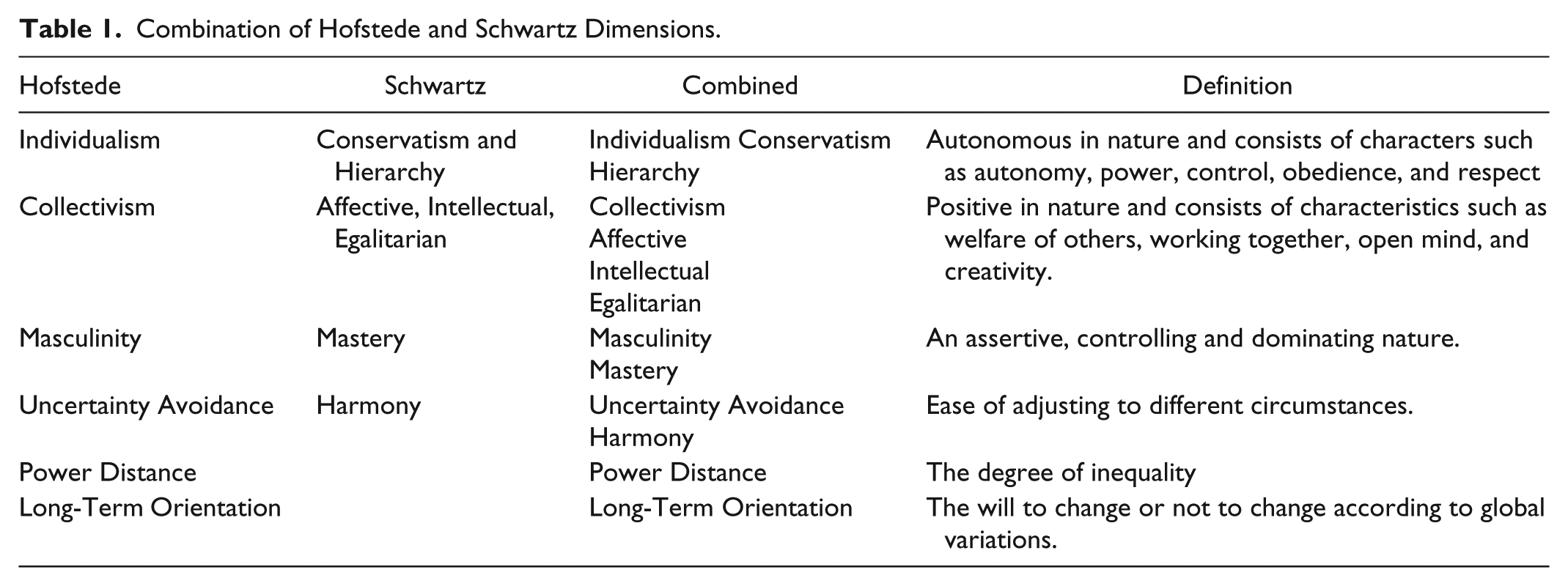
Although the table shows some overlap in the cultural dimensions, it was suggested by Steenkamp (2001) that Schwartz’s value included elements of culture which were not captured by Hofstede’s value. He identified four dimensions when comparing the work of Hofstede and Schwartz. He termed them autonomy versus collectivism, egalitarian versus hierarchy, mastery versus nurturance, and uncertainty avoidance. According to the factor analysis by the author between Hofstede (1980) and Schwartz (1994) dimensions, there were four factors identified out of which three were related to both Hofstede and Schwartz’s dimensions. Although there was one factor that is egalitarianism versus hierarchy, which only consisted of Schwartz’s dimensions.
The first dimension Autonomy is a combination of the Hofstede dimension Individualism and Schwartz dimension Conservatism and Hierarchy, which describes the national culture of a country. All three dimensions have one objective and that is to act as individuals rather than as a group. The emphasis of the culture is to maintain status quo, power, and control, and have roles that give the authority to distribute resources unequally (Hofstede, 1980; Schwartz, 1999). According to Abzari and Safari (2006), the Western entrepreneur is individualistic in nature that rejects the common view and emphasizes their own unique views, hence suggesting that the autonomy dimension is most directly associated with Western entrepreneur’s ideals.
Collectivism is combined with the three dimensions of Schwartz: Affective, Intellectual, and Egalitarian. A collectivist culture is more social in nature with its objective to work in groups, and it tends to promote the freedom to pursue one’s own ideas and their affective desires (Schwartz, 1999). According to Russell (2004), Collectivist societies are less likely to reward individual entrepreneurial efforts, and fewer individuals are likely to aspire to the role of entrepreneur. Consequently, the level of entrepreneurial activity is likely to be reduced in these contexts.
The third dimension combines the dimension of Hofstede’s Masculinity and Schwartz’s Mastery. These define a culture that is assertive and controlling and has a dominating nature. This culture has a high need for achievement, and in these societies, the material success achieved through successful entrepreneurial ventures is valued and entrepreneurs who attain such success are recognized and esteemed (Abzari & Safari, 2006). Conversely, in less assertive cultures, achievement motivation, at least in the material sense, is relatively weak, and success is defined in terms of pleasant human relationships. Hence, it is assumed that individuals belonging to an assertive culture will be able to attract more entrepreneurial activities as compared to less assertive cultures.
Adjustment is derived from the combination of Hofstede's dimension Uncertainity Avoidance and Schwartz's dimension Harmony. It defines how the culture of a country is in ease with adjusting to different circumstances. Highly uncertain economies tend to shy away from changes or risks. According to Hofstede, such organizations are not likely to be a source of innovative ideas that would create entrepreneurial opportunities. The combination of risk avoidance, low tolerance for ambiguity, and resistance to change that characterizes high uncertainty avoidance regions is likely to reduce the number of individuals who step forward to initiate entrepreneurial ventures. Moreover, the entrepreneurial activity that does emerge from this social context is likely to be directed towards more predictable, stable businesses and away from risky innovative ventures (Russell, 2004).
Power distance is one of the dimensions of Hofstede that defines the level of inequality that prevails in a society. Countries that have a higher power distance are more likely to experience social inequality and access to educational systems and economic resources may be restricted to a priviliged few. Moreover, those who do not have access to these resources may not be accepted into entrepreneurial roles or, if they assume such roles, their activities may be devalued or considered illegitimate (Abzari & Safari, 2006). However, low power distance societies have social mobility allowing them the ease to access to entrepreneurial resources, which enables them to generate a higher level of entrepreneurial activity (Russell, 2004).
Long-term orientation is where the culture of a society has the will to change or not to change according to global variations. Values associated with long-term orientation are thrift and perseverance; values associated with short-term orientation are respect for tradition, fulfilling social obligations, and protecting one’s “face” (Hofstede, 1994). According to Hofstede (1991), “long-term orientation refers to a positive, dynamic, and future oriented culture linked with four positive Confucian values: persistence (perseverance), ordering relationships by status and observing this order, thrift and having a sense of shame. Short-term orientation on the other hand has a negative, constant, traditional and past orientated culture is connected with four negative Confucian values: ‘personal steadiness and stability’; ‘protecting your face’; ‘respect for tradition’; and ‘reciprocation of greetings, favors and gifts’” (Fang, 2003, p. 348). The author further mentions these countries such as Pakistan, Nigeria, Philippines, Canada, United Kingdom, United States, New Zealand, Zimbabwe, and Germany have short term– orientated cultures, whereas countries such as Japan, Thailand, China, Hong Kong, Taiwan and Singapore are more long term–orientated.
The conceptual model being investigated is summarized in Figure 1.

Conceptual model.
Research Method
The research methodology chosen for this study was focused on a qualitative and exploratory approach because it required extraction of detailed data. A case study method was adopted, which consisted of five main components that made up the research design. This included the study’s question, the propositions, unit of analysis, linking of data to the propositions, and interpreting the findings. The propositions have been mentioned earlier in this article, and the emphasis has been on the relationship between foreign and Pakistani entrepreneurs, hence the unit of analysis will be each individual who is an entrepreneur. This article focuses on multiple case studies because a multiple or collective case study will allow the researcher to analyze within each setting and across each setting (Baxter & Jack, 2008).
The purpose was to identify a range of entrepreneurs dealing with foreign entrepreneurs so as to give a clear and concise answer to the intended research question. The standard criteria, based on the literature review, chosen to distinguish the cases are as follows:
Degree of relationship with foreign entrepreneurs.
Belief in Effects of Macroeconomic Instability affecting businesses and relations.
Data Sample
The sample consisted of 11 Pakistani entrepreneurs and three managers who worked for entrepreneurial organizations. Although it is mentioned that the focus was on entrepreneurs, due to shortage of time and availability of participants, the sample was limited. The first criteria for dividing the entrepreneurs was based on how experienced they were in the field of entrepreneurship. These entrepreneurs were categorized as Case 1 (C1). This was observed by considering the length of time they were involved in the business and the long-term relations (between 10 and 15 years) they had secured with international entrepreneurs.
The second category involved experienced and young individuals who have been in the market for a shorter period of time (between 5 and 10 years) and have been able to maintain relations with international entrepreneurs in this short period of time. These entrepreneurs were categorized as Case 2 (C2). This included experienced individuals as well as young individuals who have mature relations with foreign partners.
The third category Case 3 (C3) were of individuals who were young entrepreneurs who have entered the market and had some experience (less than 5 years) with foreign partners.
The fourth and last category Case 4 (C4) was based on entrants with limited (1 year or less) or no experience with international partners. Figure 2 below depicts the classification.

Multiple case study with embedded unit of analysis.
Data Collection
One of the most important sources of case study information is the interview. The interview of the entrepreneurs (or/and managers) appeared to be guided conversations rather than structured queries as suggested by Yin (2003). Interviews were conducted via Skype where the conversations were recorded with the permission of the interviewee. The aim of the interview questions was to understand the relation of Pakistani entrepreneurs with foreign entrepreneurs. Each question was associated with the working propositions mentioned in the literature review.
Linking of Questions With Working Propositions
Table 2 below shows the linkage between the interview questions and the working propositions. The questions were synced with the propositions so that the research questions were justified based on the working propositions.
Relating Questions With Propositions.

Note. Asterisk indicates the association between interview questions and working propositions. The grey area shows that there were no associations. WP = working proposition.
Data Analysis
After transcribing, each interview was analyzed to identify the relevant information required to answer the research question. Systematic coding of the data was carried out using a thematic analysis approach, which involved searching for themes that emerge as being important to the description of the phenomenon being researched (Daly, Kellehear, & Gliksman, 1997). The process involved the identification of themes through “careful readings and re-reading of data” (Rice & Ezzy, 1999). The themes that emerged during the coding were Decision making, Family orientation/Team work, Leadership style, Risky investment, Respect, Long-term commitments, Reliability/Trust, Political and electricity issues, and Educated employees.
Using NVivo software, the transcripts were transferred to the software where the data were coded. The codes developed were entered as nodes, and the appropriate data with respect to the classified nodes were matched accordingly. During coding, any new themes that emerged were given a separate code. While coding, care was taken to systematically make connections with the intended propositions.
Findings
In this article, the objective was to identify whether or not macroeconomic factors influence the culture of an economy, and how this in turn may cause an effect on national culture affecting business relations either in a positive or negative way. The case analysis guided by propositions yielded interesting findings, which are individually discussed in detail.
Macroeconomic Instability
Starting from the first proposition, C1 and C3 entrepreneurs and/or managers believed that the macroeconomic instability in the economy had less negative impact on their business as well as on their relationships with foreign entrepreneurs. They believed that as entrepreneurs, they had to deal with the situation whether it was good or bad. In the case of Pakistan, economic situation has always remained an issue, and these entrepreneurs had been able to withstand the situation. As suggested by the entrepreneurs from C1 and C3, I won’t go too far to saying that it has effected but it has but not to a great extent. This company has much distribution channels and it is a huge company so I would say that regardless the condition there has been no adverse effects. (C3)
However, C2 entrepreneurs believed that the macroeconomic instability in Pakistan had affected their businesses, which in turn had caused some negative setbacks in their relations with foreign entrepreneurs. However, they also mentioned that although the problems were there, they as entrepreneurs had to still manage their businesses and try their best to keep their relations positive. As suggested by entrepreneurs from C2, Electricity, gas and customs are some of the other problems being faced since these are all corrupt departments which don’t allow Pakistan to develop. Now the situation of Pakistan is terrible even when I’m going to my customer I’m considered as a terrorist and they do have this look in their eyes which makes me feel that way. But to do business you need to be strong, you should have a target that I have to do this thing. (C2)
C4 consisted of individuals who had none or minimal experience (less than 1 year) with foreign entrepreneurs and also believed that the macroeconomic instability in Pakistan had negatively affected businesses and those businesses that had relations with foreign clients. There was only one young entrepreneur working in the national market, whereas the other two were managers who represented this case. Regarding the macroeconomic instability, the young entrepreneur responded by presenting the problems that had risen due to the political instability that lead to problems in the business environment. The two managers also believed that inconsistent policies caused negative effects on business culture. However, it should be noted that these managers had less exposure to the international market as well as national market in terms of having business relations. Moreover, due to lack of any entrepreneurial experience they were unable to provide many statements from their own personal experience. As suggested by the entrepreneur in this case, In Pakistan, working as an entrepreneur is difficult today as compare to the time when I started. This is because the political situation in Pakistan is dire as there is a clash between state institutions like the judiciary and the executive. This coupled up with corruption, bad governance and the failure of the state to handle the security situation and uphold the rule of law in strategic geographical areas like Karachi has led to great insecurity, a loss of confidence amongst the public and thus political instability. This political instability has also adversely affected the business environment. (C4)
The following are the dimensions of Hofstede and Schwartz combined together, which were discussed earlier in the literature review (refer to Table 1). An emergent theme was associated with each dimension to have clarity in terms of how the participants were categorized based on their responses. The objective was to analyze the national culture of the entrepreneurs in Pakistan and to understand how these dimensions were able to determine the business activities that took place at national and cross border levels.
Autonomy
The emergent theme associated with Autonomy was decision making based on the participant’s responses.
C1 entrepreneurs showed a more domineering attitude when it came to decision making. They believed that as CEOs, it was ultimately their responsibility to make the final decisions regarding the business activities. Hence, it can be determined that they had higher degree of individualism in them because they believed in status quo and power by making the absolute decisions in the organization. Such entrepreneurs are believed to have a lesser negative impact on their relations with foreign entrepreneurs because they coincide with the ways the Western entrepreneur works as argued by Abzari and Safari (2006).
I have actually the sales and production department under me the rest is looked by the management. For the procurement and purchase function, that I handle myself as well as the finance division. Mostly in marketing and sales the people tend to make the decisions but obviously I have to look over. The final decision is mine and I own it. (C1)
C2 participants, however, believed in decision making to be done mutually with others in the organization rather than being individualistic and being the only one making the final decision. They responded by mentioning how it was important to involve others in decision making because you work together as one unit and you take along everyone with you. It can be said that in this case, collectivism was high as compared to individualism. According to the combined theory of Schwartz and Hofstede in the literature review, these entrepreneurs possess the characteristic of having a culture that is positive in nature with characteristics such as welfare of others, working together, open mind, and creativity.
I am not only the one who decides really. Yes, you always need someday to sign things off and at this point of time it could be me there are two other people who are now at very senior positions in the company they manage it. (C2)
The response of the participants for C3 was twofold. When it came to decision making, they responded by saying that there were some decisions which they took by themsleves without having any discussion with the staff. While on some occasions, decisions were made by discussing them with the staff members. It can be said that these individuals had a mix of being individualistic and collectivist at the same time.
Sometimes Yes! But mostly it’ll be a team discussion. I tend to involve others and make sure it’s an interactive communication style and that decisions are made accordingly. (C3)
C4 participants also showed a higher degree of autonomy in terms of decision making similar to C1. The entrepreneur commented that he was highly involved in decision making, and he managed the tasks himself. This showed signs of having a high individualistic characteristic. The managers also had to make the final decisions, and they had to follow the rule of the CEOs who passed down the final decision. Hence, the organization showed decision style to be very autocratic in nature, which showed individualism: Well a lot has to pass through me, it’s fair to let the people I have put in charge of certain duties, perform them. It’s all about specialization but at the end of the day, I have to make the final decision. (C4)
Collectivism
The emergent theme associated with collectivism was based on the number of participants having and believing in family businesses.
C1 entrepreneurs believed in having stronger family businesses because according to them, such kind of business leads to higher productivity and more trust. Pakistani entrepreneurs are more collectivist in terms of keeping family businesses as it has a higher level of loyalty, trust, as well as the nature to protect their loved ones.
Because our family pitches us to make it successful. When I started this business, my father was in the Government and I asked him to take his retirement and join this business and he joined in. when my brothers grew up, they did their BAs and MBAs, I requested them to join the company. So the more family members get involved you get trust, you get your top management better. (C1)
C2 and C3 respondents had mixed views regarding the concept of family businesses. In C2, some of them believed that having family businesses was productive, but they also stressed how it was important to keep some form of distance in the way management was held so as to avoid any sort of clashes.
Initially it wasn’t but now you can say it is a family based business. We do business with XYZ which is owned by my nephew but ABC and XYZ both are separate companies working together. It is better that in the beginning they separate the business so that everybody has their own separate entity. My company has no link with XYZ and XYZ has no link with me. What we are doing is of no concern with XYZ. And this is the separation where there is no question of fight. (C2)
In C3, one of the respondents mentioned that his business was purely his own with no family involvement; hence, he had a low level of collectivism. However, the other respondents explained that the businesses were family-owned, and they believed that in Pakistan, having family businesses was the norm.
No—it’s purely established by my own. No one in my family is well aware of Web designing and development. I have a flare since my working days that one day if I ever get a chance and my monthly expenses allow me I’ll definitely go for it. (C3) Yes it is basically managed by family members but it has a lot of other professionals as well. I think that a very handsome chunk in Pakistan is family based because it’s more like a part of culture. (C3)
Assertiveness
The emergent theme that was associated with this dimension was based on how the entrepreneurs dealt with decision making in terms of the leadership style they adopted.
Being individualistic and having a hierarchical organization, C1 respondents believed in having decision-making power in their own hands rather than making group decisions.
I think its autocratic reason since technology wise the students who have applied in this company are my students. So I have to guide them I have to take them along and they look up to me for guidance and technology help. And for that they respect me and I respect them too. I usually get my own way in many issues. (C1)
C2, C3, and C4 had similar views regarding the leadership style adopted by them. These respondents believed in having a friendly atmosphere and a devolved leadership style. Management such as this considers maintaining pleasant relations with others rather than adopting a style where autonomy, power, and mastery are dominant features.
If you want to develop any company you should come as an employee not as a boss. We are the backbone of the workers. You have to be friendly with them, if you want to get work from them you have to work with them. You should of course keep an eye on them on what they are doing but always maintain a friendly atmosphere. (C2)
Adjustment
The emergent theme under adjustment was related with investments. Investments are essential for the growth of a business, and an entrepreneur is defined as one that is willing to take risky investments.
In C1 when it came to adjustment, it was reported that the entrepreneurs were particular about taking risks. Two of them believed in taking calculated risks while the third believed that taking risks was essential in anyway. Based on the responses of the entrepreneurs, it could be assumed that these individuals lay in the spectrum of being risk averse but, at the same time, had less initiation to go toward highly ambiguous opportunities.
Risky investments are risky if you have not done your home-work well. If you do your home-work well then it is not risky at all and businessmen are not gamblers so you do not take risks which can take you anywhere you always take calculated and step by step risks and you always have a contingency plan in your pocket. If something goes wrong then what would you do. So risk is something you mitigate all the time. (C1)
In C2, three out of the four entrepreneurs agreed to take part in investing in risky opportunities. All three responded that investment was essential for their business even if it was risky, and they had also invested in new business opportunities both at national and international levels. Only one entrepreneur was reluctant in taking risks, because he believed that it is better to stay safe rather than play with the fire. He said that although he had many opportunities, he avoided them.
Yes I think since we keep on scanning the horizon for other opportunities and right now renewable energies and energy is the area we are venturing into besides the manufacturing, aviation and vocational training. So the new area we are going into is energy area which is definitely a good business area for Pakistan. (C2) You always think and decide whether it is profitable enough for you and whether you should proceed. I never go in risk. I had many opportunities but I cannot do this thing. (C2)
C3 and C4 also responded positively commenting that they would definitely be willing to take any risky investments that came along.
Yes 100%. Firstly, coming to Pakistan was a risky decision even though things were better but still it wasn’t that good but yes the company takes an initiative when requires. (C3) Yes our organization is willing to invest when an opportunity arrives. But it’s on national level at the moment due to limited capital. But in my opinion if an Entrepreneur is seeking for an opportunity in an unfavorable scenario, then it’s also expected to give more profit in the long run, as he/she is taking more risk. (C4)
Power Distance
The emergent themes relevant to this dimension were the combination of the leadership style and decision making made by the entrepreneurs.
Power distance is high for C1 individuals because they believed in power and had differentiated themselves as owners and had a hierarchical approach. In addition, in high power distance organizations, less powerful subordinates tend to be “submissive” and primarily concerned with preserving their position within a rigid hierarchy Sometimes options are created and if options are created then you as the leader or the CEO of the company or CO . . . so ultimately you decide which option you will pick. The bus stops here! (C1)
C2 entrepreneurs had low assertiveness and high collectivism, which meant that power distance within these organizations was low.
Yes at times I do have to be strict when the makers mess up the order or do not deliver the products on time but mostly I prefer to have a friendly atmosphere. (C2)
The level of power distance was low for C3 respondents as well because they believed in equality, maintained friendly relations, and had no specific hierarchy. They believed in having pleasant relations in the organization, hence reducing the level of inequality.
One word “friendly”—treat them equally, listen to them properly and pay them happily. (C3)
In C4, power distance was higher for the entrepreneur and for one of the manager, but for the other manager, it was lower because they did not have a hierarchical structure.
As I belong to the Executive, so in my organization I make the decisions personally. As far as my mutual partnership in paper industry is concerned, we both partners make decisions collectively. (C4)
Long-Term Orientation
The last proposition dealt with long-term orientation, and the emergent theme associated with this was long-term relations.
All cases responded positively with regard to having long-term relations with their foreign counterparts. C1 and C2 respondents claimed that they had kept in contact with their clients and had maintained a certain level of trust and confidence, and they were also positive that relations would grow in the future.
Yes, you should always be in touch with your customers. I have had and still have relationship with partners for the past 25 years even though I visit them rarely we still do business together. They prefer long term relations. There has to be confidence and trust between the seller and buyer to have a successful relationship. (C2)
C3 respondents also believed in long-term orientation, they all responded positively although it had been a short period of time since they had been able to develop strong ties with their clients.
As stated so far it’s wonderful. Earlier I was working with Cushman and Wakefield as a Marketing Manager—Asia Pacific and since they closed their operation in Karachi back in 2010 they retain me from Karachi office for one year and when I established my own firm they became my client and now we are having a great working relationship—they still take me as a part of their own company. It’s all because of your own personal goodwill and sincerity towards work and people involved at other end. (C3)
Because C4 respondents had no significant relations with foreign clients, the long-term orientation was low from that side, but nationally, they were confident in their commitments and had been able to have maintained positive relations. It can be assumed that if these organizations tend to extend in the international market, they will be able to maintain long-term relations and hence have a higher long-term orientation.
Currently my business is acting nationally, and it’s able to deliver what it commits from its suppliers and buyers. For relations with foreign entrepreneurs, I require more capital. (C4)
Reluctance, Reliability, and Credibility
An interesting development was the finding of an emergent theme unrelated to the working propositions and that was of reluctance felt by new international participants willing to work with Pakistani entrepreneurs. Two of the respondents in C1 claimed that the problem they actually faced was convincing new partners to come and work with them, and for that, they needed to convince them to be able to create new partners.
However, new ones are reluctant to come in but once they come in, then they stay. (C1) Before 9/11 situation was comfortable my customers used to come and go and meet and we used to sit together and we knew each other’s problems. They used to come over here and see and discuss the problems but nowadays as they are reluctant to come to our country that makes a big difference. (C1)
As for C2 respondents, reluctance, credibility, and reliability were one of the emergent themes that were identified. Apart from one respondent, the rest of the entrepreneurs described that due to the political and economic situation in Pakistan, the question of reliability, credibility, and reluctance had risen. They mentioned that the customers (existing and new) had doubts on whether they should rely on them and whether or not they will be able to provide the services on time. These effects have caused the entrepreneurs to deal with their customers with extra caution and to make sure they are able to convince their customers that they can provide them the services they expect.
So I see in Pakistan although the political situation has messed things up for a lot of businesses. We are having problems naturally if you really want to ask about the problems its credibility the reliability factor has come in question. Whenever you sit in front of somebody who is from Britain, from Scotland or Germany the first thing they will ask is will your business sustain? Considering you’re based in Pakistan. Do you know what will happen next politically in terms of your economy and all that? So that has given a big hindrance for us as Pakistanis working and to work outside. Yeah but we try. (C2)
C3 respondents, however, had a differing view as compared with C1 and C2 respondents. In terms of reluctance, one of the owners and managers responded that they did not believe that there was reluctance from the foreign clients. One of the respondents mentioned that if you are honest, then there should be no question of reluctance. Similarly, one of the managers responded that he believed that there is positivity, and the foreigners will be willing to invest no matter what the situation is.
No, actually I would disagree to that, because they actually now trust us more. For example they recently, you know we had some discussion with this company. The company name is V and they are actually planning to move their whole development section to Pakistan. So I think they really trust us and if you are honest and if you are hardworking you can make your own image and you can really impress people and they can trust you. (C3) I believe that there will be a positive relation and the prospects are pretty good. Once the foreigners come and see for themselves they will realize it is profitable to invest. (C3)
As for C4, one of the managers suggested that the negative effects did cause reluctance, but much of it had been exaggerated to a greater extent, which suggests that it may be high or it may be low depending on the circumstances.
I believe it has in every business because media is strong and whatever is being portrayed is being believed by everyone. For example if in some far off city there is a bomb blast it doesn’t affect us much, yes it is a part of Pakistan, but the media tends to exaggerate it and portrays a rather messed up picture of the whole situation. The trust element does become shakier and there is reluctance. It does affect but not that much. (C4)
Discussion
It was seen that Pakistani entrepreneurs did face problems due to macroeconomic instability, to be more precise, political instability and a shortage of electricity. This in turn led to reluctance, reliability, and trust issues from foreign entrepreneurs to invest in Pakistan. Welter and Smallbone (2006) argue that trust results in reduced transaction costs and encourages cooperation between entities that may otherwise find this mutually advantageous exchange too costly or risky. This is specifically relevant in places where third-party enforcement such as the state and its constituent legal and regulatory institutions are weak or uncertain (Arrow, 1974). A basic belief in a counterpart’s honesty is an “important lubricant” for a social and economic system. Hence, in this study, Pakistani entrepreneurs had to convince foreign entrepreneurs to work with them and invest, which was not the case some years back. The established notion of trust as an inhibitor of risk and uncertainty in complex entrepreneurial situations is clearly evident (Höhmann & Malieva, 2005) in the case of Pakistani entrepreneurs.
Pakistani entrepreneurs tend to be more collective in nature although there was some element of individualistic behavior involved. They tend to maintain their relations with foreign entrepreneurs by understanding their position and working methods and try to maintain a balanced relationship by being individualistic as well as collectivist at the same time. This collective approach of Pakistani entrepreneurs draws attention towards a closer examination of team entrepreneurship (Khan, Breitenecker, & Schwarz, 2014, 2015; Knapp, Breitenecker, & Khan, 2015) in the future.
Organizations in Pakistan have a higher tendency of being assertive in nature because they had a hierarchical structure and most of the organizations used a top down approach when dealing with their employees. However, based on the analysis, some are assertive whereas some are less assertive, which may be due to the fact that every entrepreneur had a different stance as to how he or she perceived the system.
It was interesting to see that majority of Pakistani entrepreneurs were willing to take risks when a new opportunity arrived, whether it was national or international. Although the entrepreneur faced ambiguity due to the economic situation of Pakistan, being an entrepreneur, he or she believed that taking risks was essential and necessary to grow because the market had become very competitive.
Contrary to expectation was the level of long-term orientation that prevailed in Pakistani entrepreneurs. All participants were mostly satisfied because they had maintained relations with their partners for such a long time and were also willing to invest in new opportunities in the hope to grow. Despite the economic issues, Pakistani entrepreneurs had been able to maintain strong bonds with their international partners, and that proved that they had a flair for maintaining long-term relations.
Limitations and Future Direction
The study faced the first limitation of being one-sided as it interviewed only Pakistani entrepreneurs. It would have given a wider perspective and a deeper analysis if foreign entrepreneurs could have been included in the case study. The study was mostly male-orientated, which led to the second limitation of gender-specific perceptions. Only one female participant could be interviewed who was a manager and therefore may not be entirely representative of a female entrepreneurial viewpoint. Future work could gain deeper insights by specifically sampling female entrepreneurs and investigate the culture-related aspects from their point of view. The third limitation was that the interviews were conducted via Skype, which meant less face-to-face interaction and difficulty in observing participant reactions. Moreover, some participants were enthusiastic to give answers and gave more descriptive ones, whereas some chose to provide brief responses. The fourth limitation was that the sample was not a whole representative of the entrepreneurs in Pakistan. By including various entrepreneurs from different industries, a wider audience could be included and the study could provide more interesting insights.
Conclusion
It can be said based on the results that various factors discussed in this article had affected Pakistani businesses and relations to some extent. Political instability had been a prevailing problem since the advent of Pakistan, and entrepreneurs had come to deal with it by relying on themselves, but the adverse effects are that it had led to skepticism in the mind of the foreign entrepreneur. It had become hard for Pakistani entrepreneurs to convince their partners due to the ongoing issues in Pakistan. The national culture adopted by Pakistan may have helped develop these relationships. Pakistan is a collectivist society, so they believe in making long-lasting ties. By being less assertive, they have been able to mix elements of individualism and collectivism, thereby making it more convenient for foreign entrepreneurs. Moreover, being open to adjustment and forming long-term ties have helped these entrepreneurs to combat the negative effects prevailing in Pakistan as well.
Footnotes
Declaration of Conflicting Interests
The author(s) declared no potential conflicts of interest with respect to the research, authorship, and/or publication of this article.
Funding
The author(s) disclosed receipt of the following financial support for the research, authorship, and/or publication of this article: The open access publication fee for this article was funded by Libera Università di Bolzano-Bozen, Italy.