




Abstract
Built environment research has long been interested in understanding the complexities of transitional spaces by investigating their hosted interactions. One approach used in efforts of this kind is actor-network theory (ANT), which conceptualizes built spaces as networks of relations that allow for certain interactions but not others. Previous studies have not considered the full variety of such interactions, having either addressed such multiplicity generically or focused on particular interactions related to a specific activity. Filling this gap, this article utilizes an ANT-inspired ethnographic approach to unpack the spatial diversity of a Jordanian university’s corridor space by mapping the various interactions therein. The findings present the relational dynamics within the various networks created and show how they have diversifying effects on the very shaping of the corridor. Ultimately, this article suggests a more nuanced conceptualization of transitional spaces through a better understanding of the multitude of interactions, offering designers a tool to create distinctive spaces that serve different user needs.
Introduction
In this article, we use an actor-network theory (ANT) perspective to develop an understanding of how built spaces are shaped by the way their users interact within them. This relationality of space has been discussed in previous ANT-studies with an emphasis on user activities and the physicality of space (Kärrholm, 2007; Yaneva, 2010, 2013, 2017). However, only very few of these studies have considered the full variety of interactions that actually take place in the spaces they analyzed and hence presented only limited evidence of the co-creation of built spaces (Sharif, 2016, 2020). While some addressed the generic variety of user–space interactions, highlighting the multiplicity of spaces, specific spatial productions resulting from such multiplicity were not tackled (Kim, 2017). Other studies focused on a particular set of interactions connected with a specific type of activity, which limited the view of resulting spatial productions (Kärrholm, 2007). This article addresses this gap by presenting and analyzing a much wider range of interactions.
To take a step back, space studies deal with the processes through which spatiality is produced or constructed (Foucault, 1991; Lefebvre, 1991), and built spaces are primarily considered as both socio-spatial achievements (Dean, 2017; Gutman, 2010; Jones, 2011; Pinch, 2008) and settings for interactions (Allen & Henn, 2007; Goffman, 1959, 1963; Sudnow, 1972; van Marrewijk & Yanow, 2010). More specifically, built space studies emphasize how buildings reflect the complexities of our societies and explore the significant impact their design has on our daily lives. This is consistent with ANT’s focus on built spaces that are produced through a complex set of networks which allow for various interactions to take place (Gieryn, 2002; Yaneva, 2013, 2017). These networks consist of specific relational patterns that are produced between different actors involved (both human and non-human). In other words, ANT conceptualizes built spaces as generated equally through the interaction between the human, social activity of users, and the purely physical aspects of space. The resulting realities are lived and interpreted differently, which shapes our future ideas of both buildings and interactions.
This article is based on ethnographic research in the main transitional space of a university department in Amman, Jordan. ANT is used as the conceptual lens to interpret the built spaces through user interactions that take place in the built environment. We provide a nuanced understanding of the ability of space to encompass various relational patterns, as demonstrated by the breadth of user activities within the physical space. Ultimately, we present a novel approach of conceptualizing the performance of space, allowing us to manage and design spaces differently. A better understanding of the diversity of spaces through the variety of their interactions should inspire designers to create more distinctive spaces that effectively cater for the ever-changing needs of their users.
Theory
Many theories of built spaces focus on the complex processes and dynamics that occur within them. For example, Lefebvre (1991) refers to perceived, conceived, and lived spaces as modes of production that are all dialectical processes through which society and space are co-produced. Foucault (1991) emphasized that space constructs, controls, and produces society which in turn constructs, controls, and produces space. In his view, society and space (re-)produce each other over time. From this perspective, built spaces are to be understood as a co-production of their users’ behaviors and the physical structures that outwardly define them (Dean, 2017; Gutman, 2010; Jones, 2011; Pinch, 2008) and through the interactions they host (Allen & Henn, 2007; Goffman, 1959, 1963; van Marrewijk & Yanow, 2010). Gutman (2010, p. 155) argues that “a building cannot be conceived apart from the human activities it serves to facilitate and encourage.” Pinch (2008) shares the same view when highlighting the necessity of studying both people and things to see how interactions between them occur and what the outcomes are. Studies addressing built spaces and the interactions that shape them include work on apartment building lobbies (Bearman, 2005), trading room offices (Stark, 2009), laboratories (Owen-Smith, 2013), engineering offices (Allen, 1977), corridors (Hurdley, 2010; Iedema et al., 2010), doors (D’Hoop, 2018), schools and dormitories (Heilweil, 1973; Minami & Tanaka, 1995), business centers (Perrée et al., 2018) as well as coffee machine and photocopier rooms (Fayard & Weeks, 2007). Despite this apparent multitude, the detailed exploration of buildings remains an “underdeveloped field of enquiry” (Jones, 2011) in terms of understanding their variety of hosted interactions.
ANT, which originated in the mid-1980s and was developed by Latour (1986), Callon (1992), and Law (1992), hold similar views on the complexity of space (Kärrholm, 2007; Murdoch, 2006) and give much attention to built space in particular (Gieryn, 2002; Yaneva, 2013, 2017). However, as mentioned above, ANT differs from other approaches in its quest to comprehend the socio-technical world through a network perspective that produces relational effects among human and non-human actors (Akrich, 1992; Akrich & Latour, 1992; Latour, 1992). In contrast to studies exploring spaces in which the social and physical aspects are considered strictly separate (Dean, 2017; D’Hoop, 2018; Goffman, 1959, 1963; Hurdley, 2010; Pinch, 2008), ANT-based studies view the social/physical or human/non-human relational dynamics as constitutive of space (Callon, 1991; Latour, 1986; Law, 2002). In fact, ANT is different from other relational approaches in that it does not consider any reality outside these relational effects (Harman, 2009).
Building on Latour (1986), ANT scholars have maintained that everything happening throughout the initial shaping of space as well as any later changes need to be understood by observing its so-called “prescribed” networks and their “translation,” wherever they may lead (Callon, 1991; Latour, 1986; Law, 2002). The term “prescribed” here refers to the initial creation of the design network in question and so is contingent on how designers conceive of or envision a device, a machine, or a design for its eventual use (Akrich, 1992; Akrich & Latour, 1992). To put it differently, a network’s prescription is the construction of a space through forming relations between the designers, the material aspects of the design in question, and the interaction between both to shape a specific intention of space (Yaneva, 2010). The term “translation,” in turn, is a description of how the network is shaped and reshaped later on and of how its relations are kept/built or changed/cut as a result of the interaction between the user with the material aspects of the space to shape it differently according to their needs and preferences. (Callon, 1991; Latour, 1987). In ANT terms, this shaping or reshaping of spatial networks is the relational “effect” produced through the collaborative achievement between the social contributors and the material aspects of a space, wherein objects “act” in equal measure to the human users (Latour, 2010). For any construction to take place, non-human entities must play a major role. In that sense, “spaces emerge as socio-material relations . . . arranged into orders and hierarchies” and “continually change shape and form within differing sets of relations” (Murdoch 1998, pp. 358–359). Although translations can continuously change from one type of relation to another, they are considered stabilized when certain relations are repeated in enduring and recurring forms, producing similar and consistent effects (Law, 2002; Law & Singleton, 2005). Therefore, the conceptualization of built space becomes inherently connected to those changes in relations that translate and stabilize new interactions (Kärrholm, 2007; Murdoch, 2006).
Previous ANT-based studies have reflected on built spaces and their interactions within university buildings (see Gieryn, 2002; Yaneva, 2009). Others have focused on a variety of interactions, for example, in the complex networks of actors in laboratory atria (Yaneva, 2010), the relational effects in an exhibition place (Sharif, 2020), or the socio-material relations in a nursing home (Driessen, 2019). However, while these ANT-inspired studies of spaces approached the co-creation of built spaces with an emphasis on interaction, they did so with only limited awareness of the full extent to which these interactions vary.
To address this gap, in this article we use an ANT approach to investigate built space complexity by unpacking the different interactions demonstrated by users inhabiting a built environment. The focus of our study is to understand the shaping of built spaces through the various interactions hosted therein. Furthermore, the variety of possible interactions found will be explored with keen attention to the ways of inhabitations that are stimulated and offered by the built environment as an internal space as opposed to external space. In other words, the focus lies on the relational patterns evident in user activities and the physicality of space that translate and stabilize different interactions. To illustrate this, we use the empirical example of the main transitional space located in the extension of a Jordanian university department. We examine the emerging spatial diversity of this space through the multiple and variant interactions that take place there. As we will see, space is a product of renegotiation shaped by each new or modified network of interactions. Consequently, it is forged with different relations and new stabilized translations or, in Latour’s (1996, p. 372) words, “into a world which has not yet been so neatly charted.”
Materials and Methods
The case study at hand is the main transitional space, a corridor (Figure 1), located at one of the buildings hosting the engineering departments, situated on the western part of a Jordanian university campus. The building is composed of four floors. The first floor is for general facilities, the second for the civil engineering department, and the third and fourth are for the architecture engineering department. The building includes three entrances on different floors, with the main entrance situated at the north-west of the ground floor. This case study is focused on the fourth floor, which was introduced as an expansion of the department of architecture engineering that used to occupy the third floor only. It was used daily by around 300 users, at the time of the study, comprising faculty members, administrators, and architectural students from different year groups. The corridor follows the L-shape design of all the other floors of the building while being different in its specific components as it hosts a number of student studios that include, in some instances, supervisor rooms. The floor also hosts a computer laboratory with a supervisor room, single, double, triple staff rooms, and separate toilets for students and staff. The corridor connects to and is accessible by main and service staircases.

The physical layout of the case study (the corridor).
Generally speaking, corridors are particularly intriguing spaces because they are typically seen as a “backstage” (Goffman, 1959), a “fill-in” or an “add-on” (Iedema et al., 2010). While in traditional research corridors might be appreciated as places that provide chances for brief encounters and chit-chat, the true diversity of the interactions they host is often overlooked.
During a semi-structured interview, an expansion’s assistant designer explained that the corridor was designed to host the growing number of students and staff and allow for their free movement and group activities. Hence, it was shaped to facilitate relations among students, staff, and material aspects of space to promote specific interactions. A closer look into how the corridor is being used reveals how it is reshaped through the recreation of relational patterns demonstrated by user activities and the physicality of space which translate and stabilize different types of interactions (Law, 2002; Law & Singleton, 2005; Yaneva, 2010). The built space is co-constructed through processes where people communicate, socialize, and interact within the physical environment.
The fieldwork for this study used an ANT-inspired ethnographic approach (Kärrholm, 2007; Sharif, 2019; Yaneva, 2013) and was completed between October 2017 and February 2019. ANT-inspired ethnography seeks to follow the actors and relations, unpacking their traces and effects (Kärrholm, 2007; Sharif, 2019; Yaneva, 2013). It is described by Fenwick et al. (2015, p. 122) as choosing “a site and just sit in it for a while or wander about in it, watching, listening, thinking, perhaps talking with people in the site until something of interest emerges.” Tracers, according to Fenwick et al. (2015, p. 122), refer to “an object (tool, idea, text, etc.) that appears to move and organize activity throughout the site.”
The fieldwork was preceded by desk research covering the architectural design of the faculty building and its extension. It included 38 pilot interviews (5–15 minutes each) and 20 extensive participant observations (1–2 hours each) of the extension to understand the interactions, the users, and the physical elements in and around which the interactions occurred. We took notes and photos and drew sketches continually to document these interactions. Since we were one of the corridor users, there were very few constraints on accessibility and communication. We rendered users anonymous with the help of pseudonyms and by blurring their photos, and verbal consent was sought before any statement or photo was taken.
The relations between students, staff, and the material aspects of the corridor we observed were in a state of continuous change between multiple and unsettled entities. Capturing the shaping/reshaping of spatial networks through these “articulated moments” (Massey, 2005) represented a challenge on its own. We therefore followed those sustained relations demonstrated by user activities and the physicality of space which translated into space interactions and hence represented moments of stability (Law, 2002; Law & Singleton, 2005; Yaneva, 2010). We achieved this by focusing on the recurring and enduring events as well as the contingent but stabilized practices that typically remain unseen and unheard beneath the buzzing repetition. In essence, we examined representative events in depth in favor of exploring a larger number of shallow samples.
For the thematic analysis of the outcomes, we used a qualitative data analysis software (NVivo 10) to identify relevant codes and emerging themes. We recognized various interactions created within the space and assigned them different types of translated interactions networks: casual, unavoidable, intrusive, informative, recreational, cooperative, disruptive, and celebrative. In what follows, we provide a closer look into each of these networks and their effects in diversifying the shaping of the space.
Results and Discussion
We found a large number of ways through which the corridor is shaped by the emerging types of interaction it hosts. It is initially shaped by a certain set of networks and then reshaped by each translation of these networks that stabilizes into different interactions.
Casual Interactions
To take the most common example first, the corridor networks can be translated to stabilize “casual interactions,” when students and staff meet each other without a specific pre-determined purpose both within and outside of class times. While performing their various activities, modes of anticipation and contingency are developed depending on whom or what they might encounter (Hurdley, 2010). This allows them to develop fleeting contacts as well as long-lasting relationships (Festinger et al., 1950). It is important to mention that the physicality of the corridor with its bounded space (Dean, 2017; Hurdley, 2010) contributes to this by bringing people closely together. Since the corridor is the only available route for students and staff to reach their studios and offices, it creates a functional proximity in addition to the physical proximity already established therein. Students and staff lose or, as ANT would describe, cut these proximity relations (Sharif, 2016) as soon as they enter their studios and offices.
Typically, students spend time in the corridor before and after, but also during studio classes when taking short breaks. As students and staff move from one place to another in the corridor; wait for classes or their turn to enter supervisor offices; or perform other activities while sitting, standing, and leaning using the corridor walls, doors, and floors, they encounter many individuals. The recurring, everyday routine of these encounters generates familiarity between students and staff over time. This creates acquaintanceship, whereby two individuals can personally identify each other and acknowledge that a state of mutual information exists (Festinger et al., 1950; Goffman, 1963). Students share greetings, nods, and smiles as signs of “social recognition” (Goffman, 1963). This recognition helps people in the corridor identify strangers easily. It also helps students identify each other’s belongings, making them comfortable with temporarily leaving them on the floor or hung on doors and locker handles in the corridor (Figure 2). This reflects different types of relations, stronger and weaker ones (see also Sharif, 2020), created between the human actors (students, staff, and even strangers) and the non-human actors (objects, belongings, and the physical aspects of the enclosed corridor; Yaneva, 2010). As the actors become more engaged with each other and their surroundings, their relations grow stronger.

Student belongings left in the corridor.
As students pass by, wait, or perform different activities throughout their day, they form an event of encounter that can be joined by others through various modes: A focused mode occurs when people engage with and sustain their concentration on the activity at hand, typically by taking their turn to talk. A partially focused mode entails people attending an activity without necessarily engaging with it, while an unfocused mode occurs when people get some information from an activity by glancing at it as they pass by (Goffman, 1963; Sudnow, 1972). The unfocused mode can also occur when people engage with the space in its entirety and become indirectly aware of specific activities. For example, when Rami, a second-year student, stands beside the studio door waiting for his class to begin, other classmates join; some stand next to him while others stand nearby, instantly engaging in different conversations (focused mode). Their interaction attracts other students and staff who either join the conversations briefly (partly focused) or simply pass by with a quick glance while being engaged with other activities such as talking to another friend, reading a book, or talking on the phone (unfocused; Figure 3). All of these interactions occur within the relations created between human actors (students, friends) and non-human actors (books, phones, and physical aspects of the bounded corridor), and so when relations are cut with the surrounding studios and offices. These interactions are suspended when the studio door opens, allowing students to move beyond the corridor space.

Casual interaction.
Unavoidable Interactions
In addition to the translations along the corridor that stabilize such “casual interaction,” the corridor networks can be translated to stabilize “unavoidable” and, in some cases, “undesirable” interactions. Some students and staff prefer to conduct activities within the corridor without encountering other people. However, those present in or around the corridor are obliged to maintain some readiness for potential face-to-face engagements. Traveling through or simply being in the corridor without encountering acquaintances or diversions is almost impossible (Owen-Smith, 2013). These potential meetings can cause anxiety, anticipation, hesitation, and delay while passing by, waiting, or performing activities (Hurdley, 2010), which in turn can cause disturbance and a felt need to restrict communication. These observations are indicative of how the students and staff try to cut relations with others and possibly with the corridor space, but they simply cannot. The physical boundedness, enclosure, and centrality of the place somehow impose unwanted encounters, particularly when there simply are no alternative routes to reach the stairs, studios, or offices. Furthermore, the openable doors and translucent windows diminish possible boundaries between the corridor and its surrounding spaces.
Ismail, for example, is a third-year student who prefers spending most of his time in the corridor rather than using other floors and outdoor spaces. Hence, he can hence hardly avoid being caught eventually by his studio instructor and is forced to explain his week-long absence. During our interview with him, Ismael indicates that students prefer to withdraw from any involvement with their supervisors by using books or tablets as partial shields to cover their faces, by turning around, or by rushing to the stairs or into one of the open studios (Figure 4).

Unavoidable interaction.
Within a physically bounded space, students assume they can stop passing people to initiate, or even oblige them to enrol in, face-to-face encounters for the purpose of a brief chat or to ask a quick question. For example, Khawla, a staff member, complains that during the journey of less than 50 steps from her office to the studio, many students stand in her way to ask questions, request extensions, etc., when she simply cannot attend to such matters. She indicates that supervisors try to avoid contacts by looking at their watches or mobile phones and just generally by avoiding eye contact with students. Khawla may even stay in her office to avoid the unwelcome contact of the corridor. In this way, the human actors in the corridor (students and staff) try to cut relations with each other by building relations with non-human actors (tablets and watches; Yaneva, 2010). With the built relations with the non-human actors of the corridor (walls, doors, and floors) that create a physically bounded space this becomes harder, which results in some cases to cutting relations with the corridor itself.
Another form of unavoidable interaction occurs when students and staff accidentally discover the presence and activities of each other. Even in situations when the students do not encounter people in the corridor, they can still sense their presence in the studios and offices from a distance, for example, through light and shadows visible from within the rooms, or if students can overhear other parties through the partly opened doors. Conversely, staff in their studios and offices can sense the presence of people in the corridor with a quick glance or when hearing indeterminate noises outside. In other words, people who are not participants in any particular engagement are still able to gain information about other participants and activities. Some staff are very aware that their presence can be perceived in such indirect ways, and many regret this lack of privacy. For this reason they keep their studios and office doors shut frequently, or even locked in order to set boundaries and restrict communication. Similarly, students who are aware that they might be noticed feel that they are under indirect yet continuous surveillance, which they try to avoid. In this way, undesirable relations are built between students in the corridor and staff inside studios and offices in addition to the relations being built intentionally with other humans and non-humans in their respective spaces. This is due to the built relations with corridor physical aspects (non-human actors such as translucent windows and partly opened doors) that students and staff shut, thereby cutting these created relations.
Intrusive Interactions
Beyond the translations along the corridor that stabilize “casual” or “unavoidable” interactions, corridor networks can be translated to stabilize “intrusive” or interfering interactions. These occur when students and staff pass through the adjacent spaces of the studios and offices with little restriction. Continual intrusion distracts people from engaging in their own activities and disrupts their attempts to withhold attention from matters occurring outside their engagement. These observations are indicative of how students and staff try to cut relations between people inside studios and offices, and those outside in the corridor. This is made more difficult by door handles that are operated from both sides, allowing free and continual opening and closing. Moreover, the thin walls allow sound transmission, adding noise to the list of intrusions. Although some staff and students try to set boundaries to disallow or restrict communication and participation, some may still be physically possible across the boundary.
For example, Hadeer, a staff member whose office is located in the middle of the corridor directly opposite the main staircase, complains that she cannot complete her work tasks due to continuous interruptions as people can easily open her office door from the outside whenever they want (Figure 5). Similarly, Bushra, another staff member who gives classes in the studios at the end of the corridor, mentions that it is annoying when students talk behind the studio door as the noise can be heard through the thin walls and the voids around the door. It is also annoying for her when students are able to open the door from the outside repeatedly to check if the room is free. Yusra, a fifth-year student who reserves a studio with her colleagues to complete their projects, complains that they cannot concentrate due to the continual entry of students who think that the studio is open for all. Shams, another fifth-year student, recounts an occasion when a door handle was damaged, preventing the door from shutting. She says it was impossible to concentrate on her homework because of the constant noise and access of students from the corridor. The flow of physical elements exacerbates this type of intrusive interaction in other ways, too, for example, when students and staff complain about stools left in the corridor, taken from studios and never returned. Other students and staff are frustrated by unreturned tools that are taken from studios or offices. In such cases, students and staff try to cut relations between people and objects (Yaneva, 2010) inside studios and offices and those in the corridor, but are unsuccessful because of the physical aspects of the corridor that allow the continuous flow of people and objects through its doors and walls.

Intrusive interaction.
Despite these examples of undesired intrusion of people and objects from and to the corridor, we also realized that in some cases this flow is actually desired. For example, the students at times use a stool or a person to hold the door open to facilitate people entry, or to aid the transfer of objects from inside a studio. While relations are cut in some situations to avoid undesirable intrusion, they are built in others between the people in the corridor and people and objects (Yaneva, 2010) in studios and offices where the flow becomes desirable. This is challenged by those physical aspects of the corridor that do not easily allow such continuous flow.
Informative Interactions
The corridor networks can be translated to stabilize “informative interaction” when students share their knowledge and insights in either informal or pre-arranged ways (Hurdley, 2010; Iedema et al., 2010) while also initiating conversations and engaging in different focus arenas within the ongoing activities. These observations are indicative of how students actively strive to build these relations between one another and with the corridor: While the physicality of walls and doors, for example, allows for the attaching of signs, advertisements, and posters and so invites the exchange of informal knowledge, the lack of dedicated seating furniture restricts other forms of information sharing (Figure 6).

Informative interaction.
Students, staff, and visitors continually interact to exchange informal knowledge, ask for directions, enquire about advertisements and announcements they see on the wall, or chat about class and term times, opinions on subject matters, exam procedures, and so on. Some may use these types of enquiries to gain specific knowledge or simply initiate conversations (Iedema et al., 2010). These kinds of activities show how information is transmitted through the social and material worlds when they interact with each other, stimulating further interactions down the line. People’s openness to engaging in these interactions and the physicality of walls, doors, and other means to hang signs, advertisements, and posters are major contributors to building these relations. Information can be transferred between social and material actors in various ways. For example, a pile of paper accumulated around a garbage bin indicates a conclusion of an event or ceremony; a gathering of study groups tends to imply an approaching exam, and so on. Here, relations are built between students themselves and between students and other objects (Kärrholm, 2007), such as signs, piles of paper, etc., while they also build relations with the corridor itself.
In other scenarios, the students exchange information through arranged groups that collaborate in solving problems, completing assignments, and preparing for exams while attracting other students. This creates a form of “mutual accessibility” (Goffman, 1963) between people with similar interests. Although there is an available studio for students to work on such activities, they tend to prefer to engage in them along the corridor which gives the potential of meeting other students who can contribute to the ongoing activities. For example, Khaled, a third-year student leans on the wall while Mahmoud, his classmate, sits on the floor to connect his laptop to the nearest power socket to finish their assignment. Their mutual classmate, Haytham, later joins them to complete his own task, all while the three of them are observed by Hamdan, another fellow student. Students also form groups at the classroom door right before the start, or after the conclusion, of an exam to compare answers. In these types of information exchange, students are engaged in different focus arenas allowing them to gain knowledge through various means. Here, several types of relations are built, ranging from stronger (featuring direct student engagement) to weaker engagement (with students watching) between students and staff (as they also engage with other people and objects; Sharif, 2016). This happens while they build relations with the corridor, which results in cutting relations with less preferable spaces, such as the studios. However, the physicality of the corridor is restrictive due to the lack of shelves and tables, which forces students to build these relations by leaning on walls or sitting on the floor if they were unable to borrow stools from surrounding studios.
Recreational Interactions
Corridor networks can be translated to stabilize into “recreational interaction,” an important type of interaction that occurs when students exhibit entertaining and playful activities that can also be referred to as “time-passing” activities (Goffman 1963, p. 44). These are usually performed to combat boredom as students wait for friends or for classes to start. They may also be associated with anxiety and anticipation as students wait for their exams to begin or for supervisors to allow them to enter their offices. Such activities might be disrupted by other activities, obliging the participants to put a premature end to their time-passing. They may also be interrupted or suspended by the passage of a supervisor along the corridor or a complaint from others with ongoing classes. Our observations suggest that the students use the corridor walls or doors together with their belongings to perform these activities and so create relations with each other and the corridor.
For example, when Bilal, a first-year student, quietly stands in the corridor holding a pencil case while awaiting an examination session to start, he playfully and somewhat unconsciously throws his pencil case up in the air and catches it. One of his friends approaches, swiftly snatches the pencil case and throws it back at him. They engage other students in this game of catch, some of them taking part, others just watching from the side-line. When Bilal’s class begins, he suddenly abandons the activity, leaving other students to continue and talk about the event. In another example, Asaad, a fourth-year student known for his beautiful voice, decides to break the silence of his study group by humming a tune. He is joined by two of his friends, Ayman, who gently taps the surface of his laptop, and Ghayad, who knocks on the nearby wall to mimic a drumming sound. A cheerful, playful daytime moment brings a smile to the faces of the people who join or pass by, until they are interrupted by a supervisor who breaks the scene up because she cannot concentrate in her class. The social and physical interactions that produce these activities can be manifested in different ways when students build relations between themselves and external objects (Kärrholm, 2007), such as their belongings and the corridor’s physical aspects (e.g., walls and doors) to make them appear. These relations are maintained until the studio door opens or a supervisor passes by, which results in cutting these relations.
Cooperative Interactions
The corridor networks can be translated to stabilize “cooperative interaction” when the students try to provide for their drinks and food, necessary tools, and support independently from external facilities (i.e., facilities outside of the corridor), thereby further strengthening the relations between them (Figure 7). Our observations illustrate how the students build and reinforce relations among themselves and the corridor by requesting corridor facilities and storage areas while cutting their relations with the outside world. This change in the relations results in an extreme case of translation (see also Callon, 1992; Law, 2002), producing a self-sufficient, separate world.
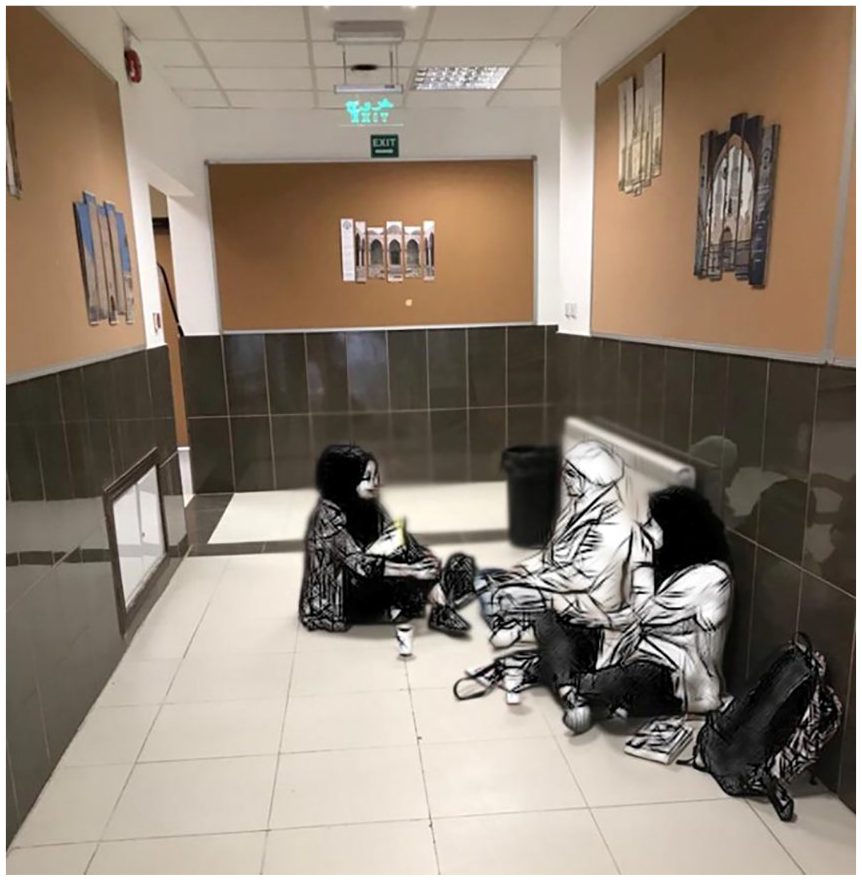
Cooperative interaction.
As it is undesirable for students to leave the corridor, which hosts most of their daily activities, they collaborate by sharing food. In fact, the students try to reinforce their self-sufficiency within the corridor area by requesting the installation of a vending machine and an additional water cooler from the university’s administration. They also request extra lockers to store their belongings and tools, which they are in the habit of sharing among themselves. In this way, students strive to build these relations with the corridor by enhancing its physical potential to serve their needs.
Another form of collaborative interaction happens when students organize events together. Event preparations engage many students in diverse tasks such as hanging posters, sourcing additional pinboards, preparing food tables, and arranging seating zones. Some students enrol in these activities even if they are not part of the event by merit of their past experience in such preparations, while others refuse to participate even if they are taking part in the event. Similarly, there are cases when a supervisor asks students for help in clearing his/her office or with transferring posters and models from one place to another. These activities not only require focus of attention, but also complete engagement in the activity, although some students might still be disengaged due to their lack of interest. In these situations, some students build various forms of relations, from stronger to weaker, between themselves and other objects such as posters and models. This happens as they build relations with the physical aspects of space, mainly to serve specific needs for students and staff, although other students completely cut these relations.
Disruptive Interactions
Yet another way the corridor networks can be translated to stabilize is into “disruptive interaction” when the students engage in activities that may interrupt or annoy other groups. These activities are likely to induce anxiety and feelings of guilt among the disruptors, which drive them to hide or escape. Our observations show how, on such occasions, students quickly cut their relations with others and, eventually, with the corridor itself. The physicality of the corridor may provide a few zones for hiding such disruptive activities; at the same time, the physicality of the space as bounded and narrow can render some ordinary interactions disruptive.
Generally, students prefer to remain in the corridor even when the activities they perform might be perceived as disruptive. Some of these activities include smoking, which students are inclined to do in the corridor far away from staff offices, while at the same time being prepared to escape if they are caught by a passing supervisor. Other disruptive activities include spilling food or littering and pranking inquisitive visitors with false directions and information, from which students try to escape by moving to another corner of the corridor or by completely leaving it. Here, students try to cut relations with each other and with staff. However, because of the physicality of the corridor, which lacks hiding zones, disruptive people are always exposed to others, which in some cases results in cutting relations with the corridor itself.
When students do perform disruptive activities, such as smoking at the end of the corridor, they assume they will not be easily caught because the area is far away from staff offices, where excessive light coming in from the windows makes it difficult for the viewers to notice what exactly they are doing. This zone is also open to the emergency staircase from where students can escape before they are caught. Hence, this area acts as a partial shield (Goffman, 1963) that creates a blind spot for forbidden activities (Hurdley, 2010). The students’ bathrooms are further shielding places due to their separation from the ones dedicated for staff. Other shields have the useful attribute of being portable; for example, the use of a book to cover a cigarette. In such cases, students try to cut relations with each other and with the staff while striving to keep relations with the corridor by relating to specific zones and objects therein (Yaneva, 2010). It may be only under these relatively protected conditions that some individuals feel safe in manifesting certain inappropriate behaviors. A number of students, however, mention that some supervisors intentionally patrol these areas as suspected locations for misbehavior.
Other disruptive activities occur when people move in big groups carrying large models, or when groups sit in the middle of the corridor disrupting the movement and activities of others. These activities do not require people to hide, shield, or disappear. Usually, a simple excuse or apology is sufficient, as it is commonly accepted that such inconveniences and cutting relations are mainly due to the physical attributes of the enclosed and narrow space, which masks these activities as situationally disruptive (Figure 8).

Disruptive interactions.
Celebrative Interactions
Lastly, the corridor networks can be translated to stabilize “celebrative interaction” when students and staff exhibit and celebrate their partly or fully completed projects. These activities draw the attention of different participants and sometimes engage people in ways that do not permit them to perform other activities at the same time. Our observations show how, on such occasions, students build various relations with each other, with staff, with other participants from inside and outside the department as well as with the corridor (Figure 9). However, the physicality of the corridor restricts this because of the limited area of the wall and the confined space, which can cause extreme levels of disruption. This specific case shows how the arrangement of relations can simply collapse and transform into unexpected translations, illustrating how translations are fundamentally precarious (see also Callon, 1992; Law, 2002).

Celebrative interaction.
For example, as architecture design students conclude their midterm projects or final juries, the instructors ask them to hang their work on the pinboards and walls along the corridor to celebrate their outcomes. Instructors invite other staff, students, and possibly friends from other departments who can engage with comments. These events manifest an “involvement contour” orienting all of its encounters in a specific direction by not only generating a world for its participants but by carrying them deep into it (Goffman, 1963, p. 174). For example, as Hiba and Shams, two second-year students, casually pass through the corridor on their way to see their supervisor during one of these events, they forget about their meeting and instead find themselves drawn unintentionally into the event. In this way, relations are built between students, staff, friends, and even other people who are present in the corridor space more or less unintentionally. This happens as these people try to build relations with other objects (Yaneva, 2020), pinboards, and hung projects as well as the walls and space of the corridor.
Although such celebrative events are usually a pleasant affair, issues can arise that showcase the interplay between the instable character of translations in this corridor space (see also Callon, 1992; Law, 2002). Hadi, a fifth-year student, complains that the use of scotch tape to hang the drawings results in poor adhesion and requires them to be constantly monitored; accordingly, the students ask for additional hanging boards to mount their project drawings using pins. The use of these additional pinboards maximizes the use of hanging space, but they are still not sufficient. Staff members Ala’a and Hanan complain that the corridor space is also not large enough for these celebrations, especially when they include students’ families and guests. As a result, Ala’a decides to have her students’ jury inside the studio, but there is still insufficient space and the students are isolated from the celebrations in the corridor. Consequently, they extend the exhibition of student works to parts of the corridor and ask the students who are finished with their discussions to remove their work and allow other students to hang theirs or split the juries to separate days so that the facilities can accommodate all the events. The students who want to enjoy a continuous and joint celebration with their colleagues become disappointed by these developments. In this way, students and staff try to build relations between themselves, other objects (Yaneva, 2020), and the corridor, but they are limited in building these relations as the corridor with its physical limitations in walls, space, and other material aspects restricts them. These restrictions become unmanageable for larger events, which evidently the corridor is unable to host.
Summary
Our observations show that a wide variety of interactions can be manifested in the space of the corridor, well beyond our initial expectations. While the built space demonstrates specific prescriptions through its initial sets of anticipated relations, it can stabilize different forms of translations manifested through changes in relations (Law, 2002; Law & Singleton, 2005; Yaneva, 2010). For example, in casual, informative, cooperative, and celebrative interactions, students and staff strive to build relations with each other and with the corridor space to produce specific effects. By contrast, in unavoidable, intrusive, and destructive interactions they try to cut relations between each other and sometimes with the space. The physicality of space and its elements can allow or restrict relations and contribute to their building or ending (Yaneva, 2010). In casual interactions, the boundedness of the space helps students create relations with each other while in unavoidable interactions this boundedness becomes problematic, preventing students and staff from cutting undesired relations. Similarly, in casual interaction, a closed door allows interactions by emphasizing the boundedness of the area; while in intrusive interactions it disallows the flow through interference. In these translations, social and material actors are enrolled in different relations to produce specific stabilized effects. In a casual interaction, the student is an actor who meets other people, while in an informative interaction he/she is an actor seeking and providing knowledge. Similarly, in a casual interaction, the wall acts as a facilitating boundary, whereas in an unavoidable interaction it is an undesirable one. In intrusive interaction the wall transmits unwanted sounds, and in celebrative and informative interaction it acts as an element for hanging posters and advertisements.
Conclusion
Multiple ANT-related studies unpack the complexity of spaces by conceptualizing them as networks of interaction (Driessen, 2019; Gieryn, 2002; Sharif, 2020; Yaneva, 2017). In this article we extend this complexity by attempting to understand the spatial ability to hold different and variable networks of interaction that shape the space differently each time. This can be demonstrated by taking a closer look into the variety and continuity of translations, whereby (i) translations can enrol various actors in different relations to stabilize the same effects. An informative interaction can involve students building relations with a poster hung on a wall or students building relations with each other to revise for an exam. It can also involve students building relations with each other and the wall by leaning on it to discuss an assignment. All these translations stabilize the same type of interaction, but they are arranged differently each time and, with this, the space itself is also reshaped differently each time. (ii) Translations may change various actor enrolments in relations to stabilize similar or different effects. A student can cut a relation with people doing homework to build a relation with a different group. The stabilized interaction, in this case, remains informative, albeit with some change in relations. Another student can build relations with a group of people who are studying for their exam. As he finds people smoking in the corridor, he might cut his relations with the first group and build relations with the other. As a result, the stabilized interaction is translated from informative to disruptive. A supervisor passing through the corridor in a bid to cut his relations with the surroundings might be interested in briefly joining a conversing group. By doing so, the stabilized interaction is translated from unavoidable to casual. Material aspects follow these different changes as they transform the interactions from one mode to another. This demonstrates that translation can stabilize similar or different effects with changes in actors and relations. Therefore, the shaping of space can be seen as more diverse as it holds different interactions that are arranged differently each time.
Corridors are underestimated when they are described as a mere passage or a place that encourages interaction. Such descriptions undermine a corridor’s potential for providing chances for encounters, learning, collaborating, celebrating, and even disrupting, and ignore how these modes transform from one shape to another. The corridor is not only a place that supports the main activities occurring in studios or offices—in fact, it includes activities that are even more important. The paper provided typologies for corridors as places for casual, unavoidable, intrusive, informative, recreational, cooperative, disruptive, and celebrative interactions. This is not an attempt to categorize interactions happening in corridors comprehensively, but a way to show the variety of corridor productions that result from interactions happening in them.
If designers were to take these findings into consideration and tried to comprehend these various actors and relations, they will extend their view enormously by including the varying and unstable connections that all these actors have to each other. The case of the corridor shows how an inability to properly connect users and the physical elements surrounding them leads to less satisfied users. If user–space relations are crafted with a flexibility that permits changes, we can expect distinctive spaces that effectively host the ever-changing needs of their users. As designers are concerned with fulfilling user demands in space through the shaping of its physical elements, they need to give more consideration to these actors and their connections in order to make them more open, flexible, and adaptable for different and unexpected translations (see also Gutman, 2010). In other words, designers need to enhance connection possibilities in order to produce socially accepted outcomes, and more innovative spaces that offer physical elements that stimulate interactions and innovations. Changeable furniture such as foldable benches could offer options to sit when needed whilst at the same time providing the flexibility of standing and walking in case sitting was not the desired option. Light, extendable pinboards can provide more space for hanging projects when needed. Various sizes of modular lockers can provide more options for storing different types of objects. Movable partitions within and between the corridor and adjacent areas can provide a better potential spread and distribution within and beyond the corridor area.
While this investigation deliberately provides one particular contribution of one single, distinct space and its translations, this may also prove to be a limitation since unpacking of different spaces would possibly provide different outcomes, resulting in less standardized design practice recommendations. This paves the way for future research to expand the empirical results of this study and explore the shaping of different spaces through their interactions, with the ultimate intention of providing recommendations to design spaces and their physical elements in alignment with different uses.
Footnotes
Declaration of Conflicting Interests
The author declared no potential conflicts of interest with respect to the research, authorship, and/or publication of this article.
Funding
The author received no financial support for the research, authorship, and/or publication of this article.
Availability of Data and Material
The datasets used and/or analyzed during the current study are available from the corresponding author on a reasonable request.
