




Abstract
Writing is recognized as a vital skill in education and the workplace; students in the United States finishing K-12 schooling are expected to be competent writers. Yet, the Nation’s Report Card found that U.S. high school graduates coming into the workforce are particularly deficient in writing skills. Teachers serve as a crucial link in the move to improve literacy skills of K-12 students; however, teachers themselves are underprepared to be writers and writing teachers. Therefore, there is an urgent need to improve teachers’ writing skills and skills of teaching writing to improve K-12 students’ writing skills in the United States. This qualitative study examined the process-based writing project experienced by 22 practicing teachers through their reflective practices in a graduate capstone class. In particular, this study explored the challenges the teachers faced and the lessons they learned through the recursive phases of writing: planning, drafting, revising, editing, conferring, and publishing. The triangulation of the researchers’ field notes, teachers’ daily reflections, and informal interviews between the instructor and the teachers indicated that the challenges the teachers faced and the lesson they learned through the process-based writing project were phase specific. On the completion of the writing project, the participating teachers (a) developed a deep understanding of process-based writing; (b) learned new skills of planning, drafting, revising, editing, and sharing; and (c) were more confident as writers themselves and as writing teachers for their students.
Introduction
Writing is recognized as a vital skill in education and the workplace; students in the United States finishing K-12 schooling are expected to be competent writers (Bromley, 2011; Genlott & Grönlund, 2013; Hansen & Wills, 2014; K. Harris, Graham, Friedlander, Laud, & Dougherty, 2013; Salahu-Din, Persky, & Miller, 2008). However, George Leef (2013), an educational columnist, commented that young American students graduate from high school with “pathetic abilities” in crucial areas: reading and writing. Tyre (2012), when discussing the consequence of American students not knowing how to write, stated that “when students don’t learn how to articulate ideas, their options erode—and our whole society is worse off for it” (para. 1).
Teachers serve as a crucial link in the move to improve literacy skills of K-12 students; however, teachers themselves are underprepared to be writers and writing teachers (Bentham, Sinnes, & Gjøtterud, 2014; Chukwu, 2014; Darling-Hammond, 1997). Leef (2013) commented that one of the key reasons why high school graduates could not write well was that many of their teachers were not very good themselves. For example, in a case study of three California colleges’ education programs, Hochstetler (2007) found that first, most teachers were not taught how to write in K-12 schools nor in the university; second, they were not taught how to teach writing in teacher preparation nor in professional development; and, third, the materials they were provided with to teach writing when they did enter the profession were, at best, only peripherally related to writing, and writing instruction.
The need for improving the effectiveness of writing teachers is underscored by a recent evaluation conducted by the National Assessment of Educational Progress (NAEP), which indicated that only 24% of the students in Grades 8 and 12 in the United States could write at a proficient level (National Center for Education Statistics [NCES], 2012). According to The Nation’s Report Card: Writing 2011 (NCES, 2012), students performing at this level need to clearly demonstrate the ability to accomplish the communicative purpose of their writing. Nevertheless, the remaining three quarters of the students performed at basic or below basic levels.
As faculty members in an education graduate program at a large Midwest 4-year public university, we set as one of our goals to prepare graduate students who were practicing K-12 teachers for the professional challenges ahead. In particular, we believe it is important for practicing teachers to develop a deep understanding of the writing process with first-hand experience and confidence in their abilities to write, and teach writing. To do this, we constructed a process-based writers’ workshop model for a research writing project in a capstone course to find out the challenges the practicing teachers would face and the lessons they would learn, which may shed some light on how to improve the effectiveness of writing teachers for K-12 students.
Process-based writing approach has been utilized in postsecondary writing programs (J. Harris, 1996; K. Harris et al., 2013; Miller, 1993; Woo, Chu, & Li, 2013; Yuknis, 2014) for more than three decades. While Ken Macrorie (1985) outlined the practices of process-based writing pedagogy 30 years ago, Lannon’s book on the writing process approach has reached the 11th edition in 2012 (Lannon, 2012). The key components of process-based writing include students engaging in cycle of activities, starting from brainstorming to outlining, from peer-reviewing to editing and publishing. They write with real purposes for real audiences, and the project could last a period of time (Barnhisel, Stoddard, & Gorman, 2012; Graham & Perin, 2007).
The purpose of this qualitative study was to examine the process-based writing experienced by 22 practicing K-12 teachers through their reflective practices in completing a research writing project in a graduate capstone class. In particular, this study explored the challenges the teachers faced and the lessons they learned through the recursive stages of writing: planning, drafting, revising, editing, and publishing.
Review of Literature
Process-Based Approach to Writing
The International Reading Association (2009), the National Writing Project (2014), and the National Association for the Education of Young Children (NAEYC; 2013) all endorsed the process-based writing approach for learning how to write. Solley (2000) gave a historical perspective on the teaching of writing when writing was taught in school as a product, not a process. Teaching of the process-based writing began in the early 1970s when Emig (1971) began studying the writing process of high school students. Calkins, Ehrenworth, and Lehman (2012) extended the writing process model into the writers’ workshop model by adding conferring and publishing to the process.
The process-based writing approach requires students to produce a paper in several phases, each phase receiving significant instructor and/or peer intervention. Although phases of process-based approach vary (Ferris & Hedgcock, 2013), it could include pre-writing activities, first draft, revising, editing, conferring, revising subsequent drafts, and pub-lishing. The phases are recursive (Artunduaga, 2013; Kolb, Longest, & Jensen, 2013; Koutsoftas & Gray, 2013) in that for each phase writers receive feedback—suggestions on how to improve and how to better achieve the goals of the assignment.
Among the advantages of process-based writing approach is that it fosters writing competency in students that is transferrable not only between courses but also within a wide variety of writing situations. Process-based writing can make it easier for learners to import the skills and practices they have learned into new contexts (Guy, 2009).
Furthermore, Street and Stang (2008) found that 79% of the teachers who participated in a semester-long process-based writing course reported that they felt more prepared to teach writing, had an increased understanding of writing, were more confident writers themselves, felt better prepared and more comfortable giving guidance and feedback, and had an increased ability to assign and grade writing assignments.
Genre-Based Approach to Writing
Genre, according to The Bedford Glossary of Critical and Literacy Terms (Murfin & Ray, 2003), is “the classification of literacy works on the basis of their content, form, or technique” (p. 189). For centuries, works have been grouped according to a number of classificatory schemes and dis-tinctions, such as prose/poem, fiction/drama, and comedy/tragedy. Recently, genres have been categorized based on the purposes of writing. Derewianka (1990) identified six main school types according to their primary social purposes: (a) narratives: tell a story, usually to entertain; (b) recount: tell what happened; (c) information reports: provide factual information; (d) instruction: tell the listeners or readers what to do; (e) explanation: explain why or how something happens; and (f) expository texts: present or argue a viewpoint. The Common Core State Standards (National Governors Association Center for Best Practices & Council of Chief State School Officers, 2010) grouped different genres into three major types of writing, namely, argumentative writing—to persuade, informational writing—to inform, and narrative writing—to convey experience.
Genre-based approach to writing goes hand in hand with process-based approach and has become a prevalent topic in textbooks for teaching writing to advance the Common Core State Standards (e.g., Fredricksen, Wilhelm, & Smith, 2012; Smith, Wilhelm, & Fredricksen, 2012; Wilhelm, Smith, & Fredricksen, 2012). The aforementioned authors have published a series of textbooks on narrative, informational, and argumentative writing, introducing many genre-specific strategies. K-12 teachers have also adopted genre-based writing approach (Ramos, 2014). Ramos (2014) described how English as a second language (ESL) and content area teachers can use the genre-based Reading to Learning approach to support adolescent English learners (ELs) in learning to write in an academic way. Kohnen (2013) and Donovan and Smolkin (2011) reported successful teaching experiences in applying genre-specific strategies with student writing; while Kohnen focused on informational writing in high school science, Donovan and Smolkin focused on elementary-level informational writing.
Regardless of the different approaches to teaching writing and different ways to categorize genres, there are common principles all effective writing teachers need to follow to help their students develop beliefs about the nature of writing. Drawing from the theory and practice of teaching genre, Duke, Caughlan, Juzwi, and Martin (2012) have identified five guiding principles to teach genre-based writing, which echo the process-based writing approach described in the previous section:
Design compelling, communicatively meaningful environment.
Provide exposure and experience.
Explicitly teach genre features.
Explicitly teach genre-specific or genre-sensitive strategies.
Offer ongoing coaching and feedback
Feedback From Writing Instructors
Feedback from writing instructors, as a key component in the process-based approach to writing, plays an important role in improving student’s writing (Feuerherm, 2011; Gulley, 2012). Past research tends to survey student perceptions of the feedback from the instructors and action taken in response to such feedback (McMartin-Miller, 2014; Stellmack, Keenan, Sandidge, Sippl, & Konheim-Kalkstein, 2012). However, how writing instructors think of the right way to provide feedback and how they actually provide feedback had seldom been described. Dana Ferris (2010, 2014) and Ferris, Brown, Liu, and Stine (2011) recently conducted a series of research studies on the topic, which received the attention of both researchers and writing instructors.
One revealing result from Ferris’s (2014) study was that there was variation across the instructors and discontinuity between their self-reported feedback principles and their actual practice. Specifically, while writing instructors were being interviewed, they described their response principles of providing multiple-draft responses, indicating students would receive one or multiple-time feedback from the instructors. But further examination revealed that most of the feedback for the preliminary drafts was from fellow students via in-class peer reviews. The format of such peer reviews was often rubric handouts or feedback forms; seldom was there a special training session to prepare students for the peer review. Another finding of practice discontinuity was that when assessing the importance of teacher–student conferences, all instructors agreed on its importance and effectiveness, but in practice, many instructors reported that they did not have enough time to run such conferences and only met with the students who visited them during office hours.
The recommendations by Ferris (2010, 2014) and Ferris et al. (2011) concur with those by Montgomery and Baker (2007) that while most writing teachers recognized the practice of providing feedback on both local and global issues throughout the writing process, they should concentrate on global issues on first drafts and local issues on subsequent drafts. The writing instructors in the study actually gave far more feedback on grammar and mechanics on student papers than they reported in their survey. Such an approach does not follow the recommendations for balanced feedback on global and local issues, depending on the needs of each students, text, and task (Diab, 2011; Ferris, 2014; Glenn & Goldthwaite, 2013; Lee, 2008, 2011, 2014).
Peer Revising and Editing
MacArthur (2013) defined peer revising and editing as a common feature of writing process classrooms and it was often recommended as a way of providing student writers with an audience of readers to respond to their writing, identify strengths and weaknesses, and recommend improvement.
Graham and Perin’s (2007) milestone meta-analysis of writing instruction for adolescent students reported, among others, on the effects of peer assistance as a strategy of scaffolding students’ writing controlled against students who wrote alone. The seven effect sizes for peers working together to plan, draft, and/or revise their compositions were positive. Collective arrangements where students worked together to help each other with one or more aspects of the process writing had a strong and positive impact on writing quality.
To enhance the effectiveness of peer assistance, it was suggested that peer revision be integrated with instruction in evaluation and revision (Philippakos, 2012). Specifically, when students were given a rubric for evaluating their classmates’ writing and shown how to apply it to evaluate strong and weak papers and make suggestions, the peer evaluation was more effective and meanwhile the student reviewers also improved the quality of their own writing.
Stellmack et al. (2012) described the traditional approach of review–revise–resubmit procedure. In this approach, instructors tell the students what is wrong with the paper, and students revise according to the instructions from the instructor. Stellmack et al. challenged the effectiveness of this approach by stating that any improvement in the grades after the review–revise–resubmit procedure might only be an indication that “a student has successfully responded to the feedback of the grader and has satisfied the grader to some extent in revising the paper” (p. 244). Their research results show that when blinded, graders who were not provided the original feedback often perceived less improvement across drafts and frequently perceived no change or a decrement in writing quality across drafts.
Some recent studies attempted to look into the nature of the feedback during peer revision. Guasch, Espasa, Alvarez, and Kirschner (2013) reported on what type of feedback best improves the quality of peer revision and editing in an environment based on asynchronous written communication. Their results revealed that epistemic feedback and suggestive feedback best improved the quality of revision performance.
The Benefits of Teachers as Writers
Teachers as writers are endorsed in numerous research studies (Kaiser, 2013; Olthouse, 2012; Randles, 2012). The argument is that in perusing their own writing lives, teachers will inform and enhance their writing pedagogy (Dawson, 2009; Gallavan, Bowles, & Young, 2007; Whitney et al., 2012). As Penny Kittle (2008) pointed out, “I now believe you really can’t teach writing well unless you write yourself” (p. 7). There are many books and articles targeting teachers and teacher educators, claiming that teachers who write know writing strategies better, have stronger ability to empathize with student writers, and have valuable understandings about writing (Calkins et al., 2012; Kittle, 2008; Pytash, 2013).
Much of this literature on teacher-writers emphasized pedagogical methods which teachers can make use of in their own writing processes, experiences, and products in the classroom. Dierking and Fox (2013) examined how contacting with other professionals in intensive week-long sessions as well as mentoring from the professional development coach affected the practicing teachers’ concept of themselves as writers, as well as how this attitudinal change affected their classrooms and students.
Many researchers looked at preservice teachers to assess their understanding as writers (e.g., Hall & Grisham-Brown, 2011; Zimmerman, Morgan, & Kidder-Brown, 2014). They found that preservice teachers did not enjoy writing, had a difficult time visualizing themselves as being effective writing teachers, and lacked confidence as writers and future teachers of writing. Pytash (2013) reported in her research results that initially the science preservice teachers did not have knowledge of specific instructional approaches to teach writing. Through her instruction, the science preservice teachers engaged in critical and analytical reading and writing, which enhanced their knowledge of how to write and how to teach writing.
Washburn, Matesha, and Binks (2011) reported that preservice teachers often entered English language arts teacher preparation courses with fears of writing and teaching writing due to neutral or bad experiences as K-12 students. Stockinger (2007) provided extensive modeling of writing through a semester-long methods course involving authentic writing experiences, peer group discussions, extensive opportunities for reflection, and a 30-hr field component in a local elementary school wherein participants worked with small groups of elementary-student writers. Stockinger reported in the research how preservice students developed positive, clear images of themselves as writing teachers.
Morgan (2010) also reported that preservice teachers have a strong sense of themselves as writers along the good–bad writing dichotomy. Her preservice teachers, at the end of the writing methods class, identified four instructional strategies: (a) reading like a writer, (b) having similar writing experiences in class as their future students, (c) writing regularly in a topic of their choice, and (d) designing writing mini-lessons.
While the process approach to writing instruction is one of the most popular methods for teaching writing, most of the research studies were conducted at K-12 school settings and for preservice teachers (Graham & Sandmel, 2011; Morgan, 2010). There have been research studies at the graduate-level course on technical writings for a statistics course (see K. M. Collins, Onwuegbuzie, & Jiao, 2014), and on how to enhance the writing in a qualitative research course (see Sallee, Hallett, & Tierney, 2011). However, studies examining how the process approach to writing instruction is taught at the graduate-level educational course are scarce. This study explored the challenges the 22 practicing teachers faced and the lessons they learned through the recursive phases of writing: planning, drafting, revising, editing, conferring, and publishing in a graduate capstone class.
Research Methodology
Participants
The 22 participants in this study were matriculated graduate students in a master of arts in education program in a 4-year public university in the Midwest region of the United States. Ten of these students were elementary school teachers, 10 were middle school teachers, and 2 were high school teachers. The classroom experience of the teachers ranged from 4 to 19 years. There were 19 females and 3 males. Their ages ranged from 26 to 52 years.
All participants were native English speakers; none of them were bilingual, and a few had learned Spanish in secondary school. As for research writing, all of them had written many papers for graduate-level courses for their master’s degree. However, all the writing emphasized the end-product, with handing in the paper at the end of the semester as normal practice. Seldom was there any multiple-draft experience in the graduate courses. When being informed of this research writing project, they were all unsure of how exactly the process-based writing would unfold.
Course Description
This course, titled Master of Arts Capstone Seminar is one of the last courses of the master’s degree in education. The course prepares students for a 4-hr long comprehensive examination on multiple K-12 educational topics called the Capstone Examination. This course specifically requires students to have an in-depth study of a topic developed with input from the student’s master’s degree advisor, and approved by the instructor of the course. It must reflect the results of a substantial review of the literature obtained through the research methodologies the student has learned during the master’s program, and the tools to which the student has been introduced during the Capstone Seminar course. The final paper must be a synthesis of the work from the student review of the literature and relevant course work. This culminating research project should not only illustrate the abilities of the individual student to collect and report information on a topic of special interest and relevance to classroom teachers but also reflect plans for specific applications to classroom practices.
This course was normally conducted in a seminar format, preparing students to conduct research on a specific educational topic. Usually, students engaged the research individually, and at the end of the course, they shared the research findings with classmates. This traditional product-based method brought plenty of pressure on students; a majority of students felt as if they were fighting an individual war, with no connection and communication with their fellow classmates, nor a sense of belonging to a learning community. As a result, students struggled and produced low-quality research papers. The outcome of such methods was unsatisfactory both to faculty members and students. A call for change was both necessary and urgent.
The instructor of this course decided to approach the writing project with new strategies based on her own teaching experience and an extensive literature review on process-based writing, teachers-as-writers, and benefits of peer revision and editing. The key strategies adopted included (a) helping students gain their identity as writers and the ownership of the writings, (b) engaging research in a process-based approach rather than product-based approach, and (c) building a learning community in peer mentoring, revising, and editing.
The instructor believed that such strategies, when properly implemented, would have long-term positive effects on these practicing teachers (Guasch et al., 2013; Kaiser, 2013; Kittle, 2008; Olthouse, 2012). The strategies, meanwhile, would make teachers feel more confident in their abilities to write, and therefore, teach writing. This research writing project was completed during a 6-week summer course where students wrote a 20-page, double-spaced synthesis of literature review. The process-based writers’ workshop model followed the five phases.
Phase I: Topics and Questions—Generating Ideas
Phase II: Sources and Syntheses—Building Knowledge
Phase III: Putting It Together—Drafting
Phase IV: Revising and Editing—Peer Mentoring
Phase V: Finalizing and Sharing—Publishing
To help the participating teachers see how the process-based writing approach moved from phase to phase, we used the concept of advanced organizers by Ausubel (1963, 2000) to design a flow chart (Figure 1) to show the phases used in this writing project.
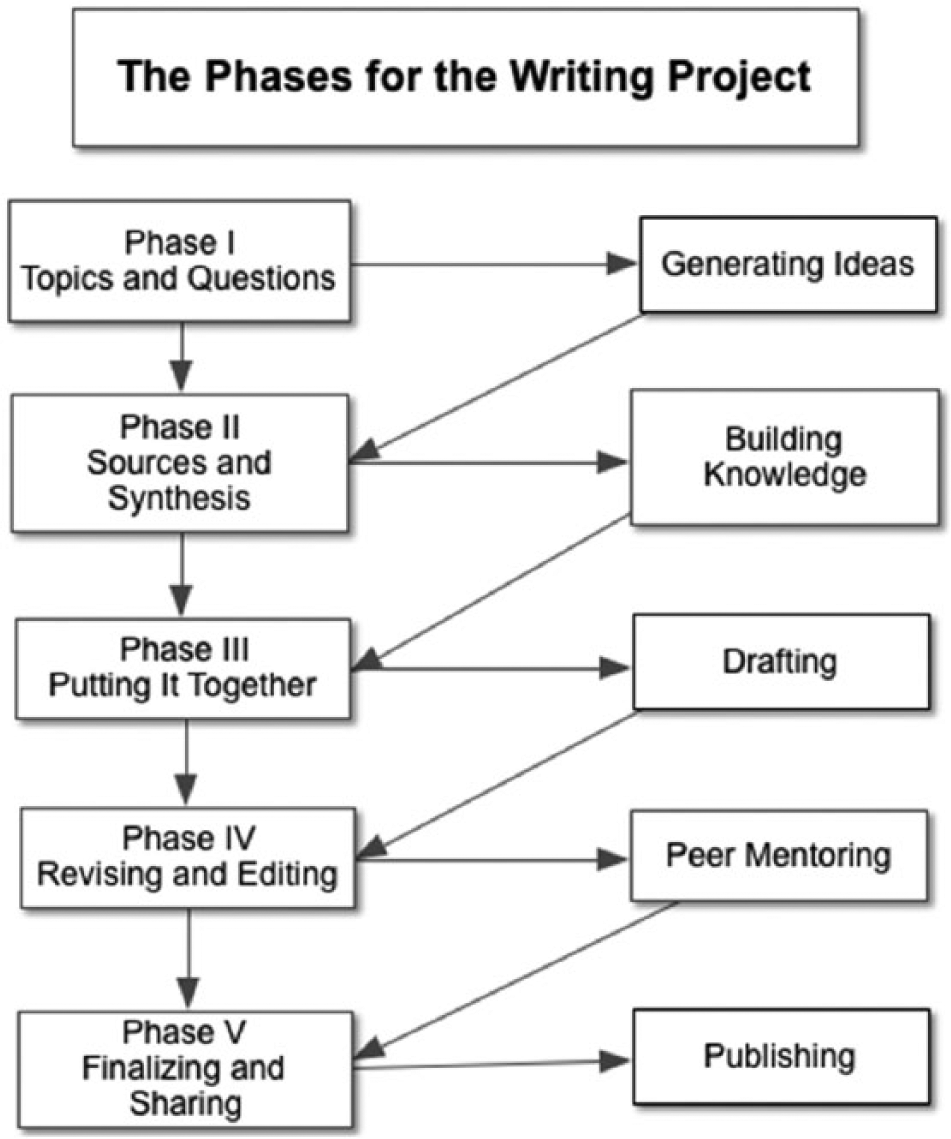
Flow chart representing phases used in the writing project.
These phases in the flow chart may appear linear; however, they are actually recursive (Artunduaga, 2013; Kolb et al., 2013; Koutsoftas & Gray, 2013). When we observe a writing process in action, we will find that rehearsing, drafting, and revising occur again and again during the whole writing process. When the writer is drafting, one continues to discover, recall, and revise. Therefore, writing is a tremendously complex process involving recursive application of a wide range of thinking skills, linguistic abilities, and knowledge base.
Data Collection and Analysis
The purpose of this study was to examine the challenges the 22 graduate students faced and the lessons they learned through their reflective practices in a graduate capstone class. Multiple sources of data were collected and analyzed and they include (a) instructor’s field notes derived from observation and informal interviews between the instructor and the students before, during, and after class; (b) graduate students’ daily reflections; and (c) all capstone research project-related written assignments including outlines, drafts, and final versions of the paper.
For the purpose of data collection, nine written assignments and nine daily reflections were designed based on the phases of the process-based writing approach. Each student submitted the assignments listed below. All assignments were in written format and were required to be submitted to the course Blackboard, and later were all exported and archived in the first author’s personal computer for coding and recoding:
Draft capstone research question and reflection sheet
Ten journal articles and reflection sheet
Annotated bibliography of the articles and reflection sheet
Ten journal article synthesis charts and reflection sheet
Research topic outline and reflection sheet
First draft and reflection sheet
Second draft and reflection sheet
Third draft and reflection sheet
Final research report and reflection sheet
(see Appendix A for a sample assignment and reflection sheet).
The first author of this article was the instructor of the course, and acted as a participant of all class activities. She collected the data via participant observation (field notes, informal interview before, during, and after class). Participant observation is a routinely used method in qualitative research (Fraenkel, Wallen, & Hyun, 2014).
The informal interviews by the first author before, during, and after class were written down as field notes. Some were written down on the spots, some were written down immediately after the interviews, and some were written down after the day’s class was over. All notes were individually and chronologically recorded in accordance with the phases of the process-based writing approach.
To ensure reliability and validity of the instructor’s field notes, triangulation and member checking techniques for qualitative research studies were utilized (Fraenkel et al., 2014). Triangulation refers to the use of different data sources, time periods, and data collection methods that result in similar findings (McMillan & Wergin, 2009). We collected graduate students’ daily reflections, their written assignments, and the instructor’s field notes based on observation and informal interviews before, during, and after class, and it was found that the field notes corroborated the data derived from the analysis of the graduate students’ daily reflections and their written assignments.
The second technique utilized to ensure reliability and validity is member checking, which refers to the practice of submitting researchers’ field notes to the participants to verify whether their perspectives have been recorded accurately (McMillan & Wergin, 2009). After all field notes were individually and chronologically recorded, they were sent back to respective participants for accuracy check. The participating teachers were invited to make notes on the printouts if they found any discrepancies. All discrepancies were rectified before the data coding and recoding process began.
A grounded theory approach was used in this data analysis (Glaser & Strauss, 1967). The aim of grounded theory is to generate or discover a theory (Charmaz, 2014). Grounded theory is defined as “the discovery of theory from data systematically obtained from social research” (Bryant & Charmaz, 2007). We believed that the grounded theory approach was a good fit for two reasons. The first reason is that the essence of the grounded theory is that it takes an inductive pathway to the phenomenon of the study (Stern & Porr, 2011)—we did not have any pre-determined positions to prove or disprove about what and how students might respond cognitively and emotionally to the process-based approach to the writing project. The second reason is that as data collection progressed, we were able to detect patterns and discern meanings from the student subjective experience by using the main analysis techniques of the grounded theory: open coding and recoding, and repeated constant comparisons. The triangulation of graduate students’ daily reflections, their written assignments, and the instructor’s field notes based on observation and informational interview before, during, and after class was used to strengthen the credibility and validity of the findings.
Because grounded theory emerges as a result of data analysis, the triangulated data were cast onto a matrix that followed initial coding and recoding (Tracy, 2013). The authors of this article adopted an inductive stance and strived to derive meanings from the data (Creswell, 2012; Hennink, Hutter, & Bailey, 2010). After several rounds of initial coding and recoding, we found several themes within the data. Each author independently coded the data using those themes. To establish inter-rater reliability, we compared our coding. To address any differences in coding, we re-analyzed the data together, shared our thoughts, and resolved all differences, thus establishing agreement in coding for themes. When we began to map out the findings, they showed a close parallel with the phases of writing processes; so it was agreed on by the authors that the best way to present the findings was to follow the process-based writing phases and embed the themes that emerged from the analyses within each phase.
When describing validity and reliability in qualitative research, the term “rigor” is often used instead (Lincoln & Guba, 1985). As stated by Thomas and Magilvy (2011), “rigor are ways to establish trust or confidence in the findings or results of a research study” (p. 151). The model of trustworthiness of qualitative research proposed by Lincoln and Guba (1985) addressed four components of trust-worthiness that were relevant to qualitative research: (a) truth-value (credibility), (b) applicability (transferability), (c) consistency (dependability), and (d) neutrality (confirmability). We used this model to emphasize the rigor of data collection and analysis.
To establish credibility, we reviewed the researcher’s field notes derived from observation and informal interviews before, during, and after class; student reflections; and the many writing drafts by students to look for similarities and patterns within and across study participants. To establish transferability, we provided detailed descriptions of the demographics of the participants of the study, the questions asked for student reflection, and steps taken by the course instructor for each phase of the writing processes. All these endeavors make it possible for researchers with similar interests to use the information to further examine this important topic in different populations. To establish dependability, we provided detailed descriptions of data collection procedures, and had both authors participate in the analysis process. When there were discrepancies in the results of analysis, we reviewed the data and the coding and recoding details to reach a consensus. The last component of the model is confirmability, which, according to Thomas and Magilvy (2011), will occur when credibility, transferability, and dependability have been established. One key part of confirmability is to have the researchers of the study reflect on how their own preconceptions might affect the research and do the best to lessen the possible impact. We made a conscious effort to follow, rather than lead, the direction of the reflection by asking the participants to clarify the points they were making both in interviews and written reflection. Great attention was paid to the rigor of the research, and the model of trustworthiness recommended by Lincoln and Guba (1985) was followed from the conceptualization through the completion of the research.
Research Findings
In the following sections of the article, we present the findings based on the five phases of the process-based workshop model.
Phase I: Topics and Questions—Generating Ideas
During Phase I of the process-based writers’ workshop, the teachers in the class chose a topic and wrote a capstone question to study for the rest of the semester. The process used to assist teachers in choosing and writing a capstone question was instructor modeling and student brainstorming. The instructor used key words “Critical Literacy” as an example to start the modeling process by answering questions on four key areas in the following organizer (Figure 2).

Graphic organizer with four key areas.
At the end of Phase I, all students had chosen a topic and written on specific areas of their interest. Some of the topics included,
Integrated Curriculum in Middle School
A Comparison of Full-Day Versus Half-Day Kindergarten
Single Gender Schools
Best Middle-Level Science Practices
Peer-Led Literature Discussion Groups
Equity in the Mathematics Classroom: Ensuring All Students Succeed
Here is an example of a capstone question following the graphic organizer by a student: My Topic: Using Dynamic Indicators of Basic Early Literacy Skills (DIBELS) as an Assessment of Early Literacy Skills In this era of No Child Left Behind, educators are looking for assessment tools to evaluate the early literacy skills of their young students. Many schools are employing the DIBELS program as a measure of students’ growth and achievement. What are the components of the DIBELS assessment program? What are the reliability and validity of the DIBELS measurement tools? What challenges do classroom teachers face to implement the use of DIBELS? How can teachers effectively use DIBELS’ results to support early literacy skill development? (Sheila)
When reflecting on the most difficult part of writing a capstone question, the teachers’ reflections fall into three themes. They are (a) how to find a topic that was not too narrow, yet not too broad; (b) how to put thoughts into words; and (c) how to write an informative lead sentence despite lack of prior knowledge.
In this initial phase of the process-based writing workshop, they learned that (a) reviewing the literature was a necessary part of finding a research topic; (b) writing a capstone question required multiple layers of thinking; and (c) creating a topic included (i) defining the topic, (ii) looking at prior research, (iii) dealing with problems associated with the topic, and (iv) making the scope of the capstone question manageable. Here are some thoughts expressed through the reflection journals of the students and informal interviews with the first author.
On the Effectiveness of Using the Graphic Organizer:
I learned that writing a capstone question was not as difficult as I thought it would be as long as I followed the graphic organizer given in class along with the class examples. The professor’s modeling and visual aids helped me see how I could find my topic of interest and replicate the format shown to produce my own capstone question. (Dana) I was fearful of not being able to organize my thoughts for this paper. Being introduced to the flowchart and the prompts helped me immensely as it began to make sense how I can structure the paper. (Cheryl)
On the Uncertainty of the Topic:
It’s okay to tweak it if you’ve started your research and realize that it’s taking you in a slightly different direction than you initially planned on going. (Angela) Will my capstone question stay the same or will it change as I perform more research? I am not yet sure if I will be able to find enough information to answer the questions I have created. (Sarah)
On Connecting With Their Own Teaching:
Strategies provided by the professor can be easily applied to my students in my own teaching. I see a parallel between the difficulty of my own topic searching and that of my high school students in finding topics for their research. (Michelle) I liked the process the professor used in helping me find a research topic. I will employ similar strategies in supporting my students to choose their research topics. (Ben)
Based on the process-based approach of writing, we believed teachers’ concerns at Phase I were natural and mostly resulted from a lack of prior knowledge of the topic. We emphasized the process-based writing model and tried to reassure the teachers that the writing was recursive and nothing was final at this early phase. We used the analogy of writing being like planting a seed and the seed (topic) will develop through its life stages. It was well accepted by most of the teachers. Teachers’ reflections indicated that the graphic organizer we provided proved to be an effective tool that helped students sort their ideas and finalize a research topic.
Phase II: Sources and Syntheses—Building Knowledge
There are two components in this phase. For the first component, teachers were requested to conduct an online library search to find 10 journal articles related to their topic. All articles needed to be from refereed journals, no older than 8 years except 1 or 2 classic articles, and had at least eight pages as most feature articles in journals are about 6,000 to 7,000 words and about eight or more pages. Those requirements were to guarantee the journal articles were current and of high quality.
To assist teachers in identifying 10 research articles, we accompanied them to the university computer lab, and modeled using electronic educational databases such as Education Full Text (EBSCO) and the Education Resources Information Center (ERIC). The instructor’s sample research topic Critical Literacy: A Critical Component in Literacy Development was used as the example for conducting educational database search. The instructor demonstrated how to use these two educational databases and record the reference information. The instructor also showed students a variety of ways of using different combinations of key words for conducting online search and showed that a simple change in the search term, such as the order of search terms, could lead to major changes in the search result. Teachers were able to look thoroughly into their individual topics and were amazed at the amount of information available. For instance, the term “critical literacy” in EBSCO resulted in 2,514 entries. They were all able to locate 10 or more articles and write annotated bibliographies of the 10 articles to submit and share with classmates. This online library database search enhanced teachers’ ability to conduct independent research—a key skill toward becoming a researcher (Helms & Whitesell, 2013).
When reflecting on the most difficult part of writing for this phase, the teachers’ reflections fall into three themes: (a) coming up with the search terms that would yield the best results, (b) locating quality research articles that met the page and year requirements, and (c) deciding which of the many articles to read. They learned that (a) when doing searches, it was best to start broad and narrow down from there, and (b) it was helpful to look at the related searches that the search engine suggested based on the original search.
On the Experience of Finding Research Articles:
The most difficult part of finding 10 research articles was coming up with the search terms that would yield the best results. I started out with “integrated curriculum” and that brought more than one thousand hits. I then narrowed it down with “middle school” but that made the focus too narrow. I then thought to look at the related terms that were on the bottom of the detailed records and that helped the search a lot. I have learned that when searching it is best to start broad and then narrow down from there. (Kendra) I would like to find out if the Dynamic Indicators of Basic Early Literacy Skills (DIBELS) is used only in the United States or if it is used in other countries. I would also like to see how my school compares to the national average in achievement rates on the DIBELS measures, but that may have to wait until after this paper is complete. (Sheila) I have created my capstone question that I am trying to answer and not all of the articles on my topic were directly related to my questions. It was difficult to meet the criteria for choosing journal articles. Sometimes it may have been a good article but it did not have enough pages nor current publishing dates. It was also difficult to find articles that were directly related to my specific topic. I need to experiment with more and different terms. (Ben)
At the end of this component of Phase II, we felt that teachers were on the right track for the writing project. We noticed that many quality journal articles were located, and teachers had made good progress in knowledge building for their respective topics. The annotated bibliography helped them use more standard terms for their topics. We also noticed some modifications of topics by some teachers. Individual conferences were conducted with teachers to assist them in developing a clear focus of their topics.
The second component of this phase was to synthesize the articles. This was a significant step of the research writing project based on the process-based writers’ workshop model. Bloom’s (1956) taxonomy defined information synthesis as the process of combining elements or parts to form a pattern or structure not clearly there or seen before. Students often confuse synthesis with summary (Megwalu, 2013). Whereas a summary involves condensation of ideas or information to highlight main ideas (J. Collins, 2012), synthesis involves examining, reducing, breaking down, and assimilating information to see emerging points of view (Megwalu, 2013).
To assist students in synthesizing research, we designed an Inquiry Chart (I-Chart; Table 1), which consists of four columns/questions: (a) definition/dimensions/principles, (b) research support/evidence/effects, (c) challenges/needs/issues, and (d) solutions/strategies/applications. The I-Chart was based on the research by Assaf, Ash, Saunders, and Johnson (2011), Buehl (2013), and Hoffman (1992). With the I-Chart, students became more independent and the search became an inquiry process.
Inquiry Chart.

As in Phase I, we modeled and guided the strategies in the class first and then let teachers do the charts on their own. See Appendix B for a sample I-Chart.
With one I-Chart for each journal article, we laid a solid foundation for our teachers to use multiple sources that provided a variety of information for their writing. We found that the three most difficult parts of creating inquiry charts for the teachers were (a) condensing all the articles into a few key points so that the charts did not become overwhelming, (b) organizing relevant articles with other focus that did not fit the I-Chart well, and (c) technical challenges of reading through research articles that were full of charts, graphs, and statistics. They learned that creating a research synthesis chart was a great way to organize information in a research project and showed enthusiasm for implementing such a tool in their teaching.
On Connecting With Their Own Teaching:
I learned a great way to organize information in a research project. It is important to read through articles with focus on what you are looking for. When you know the purpose and main topics of research, it would be easy to put information into categories on a chart. This is definitely something that I could use with my middle school students. I have used a chart for research in the past with my students but it really just had two columns: source and information. I think it would be great to divide the chart into more specific columns to categorize the information. (Leanne) I also found it difficult to put notes down instead of just highlighting articles for future use. This is something that I have asked my students to do during a research project, so I have a much more appreciation for the work they were involved in now. I think it will be helpful in the actual writing process of the paper, but it took a couple of articles before I was to put notes down with ease. (Kendra)
At the end of this phase, we experienced much more positive feedback from the class with teachers making major progress in their writing of the capstone paper; more importantly, they seemed to become more patient and resilient. We saw and heard less complaints and observed more readiness by teachers to dig deeper into the topics; some teachers added more articles to their collection than required. I-Chart played a key role in helping teachers succeed with the synthesizing component. At this point, the pre-writing was complete and we felt the process-based writing so far was successful; teachers made significant progress both as writers and in their perception toward writing. The big picture of the process writing began to sink in and the teachers were ready to move on to the next phase.
Phase III: Putting It Together—Drafting
Using synthesized information from I-Charts to write the first draft is a critical phase in completing a quality capstone research writing project. To assist teachers with the first draft, we paid great attention to the process that teachers were recommended to follow. An effective way to organize information in the I-Charts was to create a bare-bone roadmap outline that reflected the synthesized information. This bare-bone roadmap outline was different from the preliminary brainstorm-based one in Phase I of the writing process (Yeh, Lo, & Huang, 2011); the I-Chart-based outline is a roadmap that is rich in information, rooted in the research conducted in earlier writing phases, and will provide a solid foundation for a quality first draft.
With the 10 I-Chart syntheses based on 10 journal articles, teachers created a roadmap outline such as the following:
Topic: Critical Literacy: A Critical Component in Literacy Development
I. Introduction to Critical Literacy
II. Critical Literacy: Definitions, Dimensions, and Principles
III. The Need for Critical Literacy in the Classroom
IV. Challenges to Incorporating Critical Literacy for Teachers
V. Strategies for Teaching Critical Literacy
VI. Conclusion
Based on this process, teachers learned that each outline needed to reflect the nature of the particular topics they were working on, but there might be some common components that appeared in most of the outlines, such as Introduction, Implications, and Conclusions. With further discussion and analysis of the bare-bone outline and information from the I-Chart, a more detailed, full-version outline was created (see Appendix C).
When reflecting on the most difficult part of writing for this phase, the teachers’ reflections fall into three themes. They are (a) resisting the urge to spend too much time on details such as wording, paragraphing, and referencing; (b) being overwhelmed with the full version outline; and (c) finding it a challenge to write a decent first draft, using the synthesized I-Charts. They learned that (a) their research still had gaps and they would need to keep reading and searching for more articles and books to fill in the gaps, (b) an effective way to write the first draft was to write one section at a time following the full-version outline, and (c) the full-version outline could still be revised to meet the overall objectives better.
One problem some teachers ran into is, due to various reasons, they had not completed the I-Charts for their 10 journal articles from the previous phase. Therefore, they felt that the time should be spent on getting more research done rather than working on the first draft.
On Jumping Around the Phases of Writing:
My biggest challenge with this assignment is seeing the value in it. I would never choose to write a first draft before my research is anywhere near done. I feel as though my time could have been spent much better by focusing on doing more reading instead of putting my notes from one form into another. I bet that I have not had enough time to process all the information I have gathered yet to make a coherent, well-thought-out first draft. Tardiness is my worst enemy now. (Adam)
On Connecting With Their Own Teaching:
With my students we often talk about the writing process. Many students struggle to get their initial ideas down because of their perfectionist tendency. We talk about how a first draft does not need to be perfect and I model for them the process; however, when it comes to my own work, I am occasionally guilty of not practicing what I preach. Writing the first draft helped to reinforce for me the fact that writing is a process. It is often only through the process of writing that you can discover what you want to say and how you want to say it. (Sonia)
What we learned from these reflections is that we must emphasize the importance of the timeline. All assignments designed for each phase of the writing process must be completed on time. We need to make it very clear to future students that any delayed completion of assignments for each phase will inevitably jeopardize the next phase’s assignments and therefore affect the writing project negatively.
Phase IV: Revising and Editing—Peer Mentoring
To assist teachers with their second draft, we first had them share it in their groups, and then had the group members provide suggestions using the stars and wishes method. Stars and wishes is a strategy used in K-12 classrooms to enhance peer feedback where students identify two positive aspects of the work of a peer and then express a wish about what the peer might do to improve the work (Davies, Cameron, Politano, & Gregory, 1992). We revisited the concept of learning community during this phase (MacPhail, Patton, Parker, & Tannehill, 2014). Although peer discussion and feedback were routine activities, the revision and editing phase called for a higher sense of community learning. We set up the revision format as a self-selected two-person team. To ensure the peer mentoring responsibility was fulfilled, checklists were created for team members to follow and all feedback from team members were recorded and evaluated. More importantly, a series of short training sessions were run to prepare the teachers to ensure quality peer evaluation (Ferris, 2014). The stars and wishes strategy was welcomed by all teachers even though they knew the strategy was commonly used for younger students. The non-threatening nature of the strategy worked well with adult learners, too.
Then, we did two mini lessons: (a) how to organize the research paper and (b) how to use transitional paragraphs, sentences, and words. Another round of intensive peer revision and editing followed. Finally, we sent teachers to work on their third draft.
When reflecting on the most difficult part of writing for this phase, the teachers’ reflections fall into three themes. They are (a) putting the ideas together and attempting to make it flow using translational words, (b) struggling with the whole notion of “research writing” in general, and (c) staying on topic. They understood that they had made considerable progress, but still had a long way to go; and they needed to go back and reread some of the sources to find some additional information even though it was already the second draft.
On the Importance of Revising and Editing:
When I finished writing the first draft I was feeling really good about myself. Little did I know, it wasn’t that great. When I read back through it to revise and edit for my second draft, I found a lot of confusing parts and sections that needed to be reorganized. I found it helpful to do this editing and revising on a hard copy rather than on the computer screen. I think that the activity we did in class with regard to organizing sentences and paragraphs along with the mini-lesson on transition words was very helpful. I thought of it a lot while reading through my first draft. (Leanne)
On APA Style and Paraphrasing:
When citing in the text a source that has six authors, do I list them all out as I do in the references? It seems like that is a lot to put in the paper. If you use a book that has a forward written by another author, how do you cite it? (Adam) I understand the benefit of using so many references especially for a research paper. It was also difficult at times to paraphrase a reference. They stated it so well that it was difficult to come up with other wordings. (Ben) I have learned that having many references will help solidify the points that I am trying to make in my paper. When more than one reference has a similar idea it makes the point stronger. (Adam)
On Connecting With Their Own Teaching:
At the beginning of this phase, to say I disliked revising and editing is an understatement. Upon completion, the result of two revised drafts was shocking, in a positive way—I saw the immense improvement in my latest draft. The improvement from the first draft stage to the next persuaded me to accept the significance of revising and editing. I have been wondering on how I can teach these skills to my students. They will benefit tremendously if they master the skills. (Ben)
To assist teachers with their third draft, we first organized peer editing and revision. Then, we did a mini-lesson on the APA style. Teachers found that the three most difficult parts of writing the third draft were (a) motivating themselves to sit down and read through the draft to make revisions, (b) verifying the reference pages, and (c) making sure that they had everything for completing the draft. They learned that having a peer read their paper and offer suggestions was very helpful, and that it was OK that they were still gathering information for the research part of the paper with the third draft.
On the Benefits of Peer Revising and Editing:
Through the peer editing, I learned more about the use of transitions. Dana pointed out that she knew what I was trying to say, but there wasn’t always a clear change in my words. She was definitely right. As I read her notes and suggestions, I could see that I abruptly ended and abruptly started without transitioning. The transitions make the paper easy to read and definitely help with the flow of the material. (Sandy)
What we learned from the reflection by the teachers and our observation is that there was a major switch in their concern. It was no longer about their topics; it became more about the technicality and mechanics of the writing. The focus was now on APA reference styles, transitional words, and filling in the gaps. We felt this was a natural development of understanding of writing; they were ready to move on to the next phase—publishing.
Phase V: Finalizing and Sharing—Publishing
Publishing is the last phase in the writing process. Publishing carries different meanings. In a K-12 writing project, it could be a printout and posting on the classroom walls or a printed paper brought home to parents. It could also be a digital publication where the writings by students are published on the class website or a digital newsletter. As a capstone project, teachers were required to have their final paper spiral bound and handed in to their instructor for filing. However, the key activity in this phase is sharing. Sharing completes the cycle of process-based writing.
When reflecting on the most difficult part of the final phase of writing, the teachers’ reflections fall into two themes. They are (a) finding it difficult to let go, because that was the point of no return; they tended to double, triple, and quadruple check that everything was in the proper order and (b) realizing that the paper would never be perfect even with more drafts and revisions. They learned that (a) a project of this magnitude did not have to be overwhelming if you broke it down to sections and (b) they began to see the benefits of peer revising and editing, proving that writing was social and took the whole village.
On Mechanical Issues:
The most difficult part of finalizing the report was again carefully reading it all the way through checking for grammar mistakes, consistent APA format, and content flow. For example, I ended up changing the look of my section headlines because they didn’t match APA format. (Dana) I felt the most difficult part to finalizing my report involved making sure everything was perfect. I found myself reading the paper several times and checking for one thing at a time. First, I would check to make sure all my sources were marked correctly; the next time I was checking all the spaces. (Sara) The most challenging part of finalizing my paper was making sure that I had all the topics covered that I wanted to cover. When I did my third draft, there were some pieces of information that I hadn’t included that I felt needed to be in the paper, but I was unsure of where to put them. The peer revision and editing was great. My partner read and discussed my paper and helped me determine where I could put the extra information since she had a very fresh eye. It was very helpful to have the class as a learning community. I should follow this practice in my own teaching. (Kendra)
On Understanding of the Writing Processes:
I have learned that writing a research paper to this extent is a very time consuming task. I really enjoyed breaking this major assignment up into several small assignments. It really helped me to stay on task and manage my time better. (Holly) I learned that a project this big doesn’t have to be overwhelming. I struggle with planning and tend to procrastinate. I liked the way you broke down the process so I didn’t have the opportunity to procrastinate. It took the planning out of my hands which was nice. (Angela)
On Connecting With Their Own Teaching:
The questions I have are more about myself as a learner and a teacher rather than about the writing process or final project. This experience has caused me to think a lot about the struggling writers I teach each year. (Andrea) I can really see the whole picture of process-based writing approach now. I appreciate its functionality. I will try this writing instruction approach with my fifth graders. I expect my students to become better writers once they learn all the skills from the process-based approach to writing. (Angela)
At the conclusion of the process-based writers’ workshop, teachers’ perception of writing changed toward being positive, both as a writer and teacher. Their reflections clearly indicated that they had developed a much better understanding of the writing process. They became much more tolerant of the ambiguity in writing because they knew that even with pre-planning and pre-writing, there would be uncertainty and only the process would take care of the problems. One of the most rewarding benefits is that teachers reflected on how they began to understand the struggles their own students were having, and they were more confident in providing the students help.
Discussion and Recommendations
Quantitative research in literature on process-based writing approaches tends to report positive or negative findings in a relatively linear manner, as many such research studies were reported in the meta-analysis by Graham and Perin (2007), and individual studies reported by Street and Stang (2008, 2009). We have found that the challenges faced and lessons learned by our practicing teachers are phase-specific. Findings from this qualitative research show more detailed and in-depth descriptions of what happened to teachers in their learning and reflection in different phases of the writing process. This rich nuance is different from the quantitative results. The challenges and solutions are unique for each phase, and best presented as phase-specific findings.
Specifically, while teachers were faced with difficulties throughout the process of writing, the foci of difficulties changed with different phases. Therefore, different strategies were necessary for instructors to provide assistance and solve problems. For instance, a major obstacle at the beginning of the writing project was that the majority of participating teachers (a) felt that they were not confident as writers, let alone as effective writing teachers, (b) did not have a sound understanding of the process-based writing approaches, (c) had little or no personal experience in writing research papers using the process-based writing model, and (d) realized that their teacher education programs and professional development targeted mainly the subject areas of reading but not writing. An effective approach was to create a user-friendly learning community where the participants could express their concerns and be encouraged to get their feet wet by embracing the process-based writing approach.
After accepting the process-based writing approach as a new way of learning to write, the participating teachers immediately ran into difficulty finding topics for their research as required in Phase I: Topics and Questions—Generate Ideas. The cause behind the difficulty was the lack of knowledge on different educational topics. To some extent, it had less to do with writing abilities than subject and content knowledge. The solution varied with different students in locating topics. Personal needs and concerns tend to be good starting points. One such example is the issue of literacy assessment that had bothered one student for over a year. With some discussion in a small group of classmates and some guidance from the instructor, she developed this concern into a research topic with many possible aspects for investigation. Another effective way to generate writing topics was to bring to class a textbook of educational issues like the one written by James Noll (2014), Taking Sides: Clashing Views on Educational Issues. The book listed more than 23 critical educational issues ranging from learning theories and standardized tests to merit pay for teachers. The issues expanded teachers’ visions and were valuable in helping them choose one or two to work on; moreover, the issues in the book activated students’ thinking processes and the students further developed their own topics. Another useful resource book used was Issues and Trends in Literacy Education by Robinson and McKenna (2011).
In contrast, the major obstacles faced during Phase II: Sources and Syntheses—Building Knowledge involved finding quality journal articles; the solution was to use a different search database and various combinations of key words and terms—more a technical issue than academic. The second part of Phase II is on synthesizing the journal articles, a key component of the process-based writing in building participant’s knowledge. The strategy was to let the teachers see the learning objectives of synthesizing information mirroring the writing tasks of the Common Core State Standards—writing from multiple sources. Participants’ reflections became positive and enthusiastic, indicating a feeling of strong connection between the writing task at hand and their own teaching of writing in K-12 classrooms.
When the teachers were writing the draft in Phase III: Putting It Together, the strategy was to model how the synthesized information in I-Charts could be transferred into an overall, detailed outline (Appendix C). A well-written detailed outline performed as a roadmap, leading them from Point A to Point B. However, incomplete I-charts for this phase will inevitably jeopardize the next phase’s assignments and therefore affect the writing project negatively.
When revising and editing in Phase IV: Revising and Editing: Peer Mentoring, teachers learned to trust their learning community because they saw the value of the psychological support and expertise support. Their reflections provided strong evidence that when they benefited from their peer revision and editing, they tended to contribute more and take the peer revision and editing more seriously.
When the teachers reached Phase V: Finalizing and Sharing, their mindset was very different from the early phases. They were more relaxed, more tolerant, and more positive toward revisions. They understood that their paper was not perfect and that there were areas for improvement—a concept that might have disturbed some teachers if mentioned at the first phase. The participating teachers (a) developed a deep understanding of the process-based writing approach; (b) learned new skills of planning, drafting, revising, editing, and sharing; (c) were more confident as writers themselves and as writing teachers for their students; and (d) planned to use writing process-based approach in their own teaching.
The process-based writing workshop approach successfully provided the teachers with first-hand experience that writing was recursive and that revision and editing did not just happen at the end of the first draft. In the second and third phases, when teachers began to dig deep into their topics, they found some dead ends and some new roads and directions they did not see in the first two phases. Their reflections clearly indicate their deepening understanding of the ongoing revision process and they became comfortable refocusing their research topics. Two of the teachers even restarted with completely new topics and did so with a high level of confidence and efficiency.
Research writing is underemphasized in both undergraduate and graduate-level teacher education courses. Teachers are underprepared to be writers and writing teachers, particularly in research writing and teaching. To ensure that K-12 teachers are competent to teach future generations, teacher education programs need to provide courses for graduate students not only for learning how to teach writing but experiencing writing themselves (Kaiser, 2013; Olthouse, 2012; Randles, 2012). They need to personally experience the struggles and the lessons learned (Kittle, 2008). In these courses, we need to provide opportunities where graduate students are actively involved in planning, drafting, revising, editing, and sharing as their own students will be doing. Only then can we expect our graduate students to be confident research writers themselves and competent teachers of research writing for their students. Their reflections in different phases indicate that they saw many detailed connections between their learning experiences in the course and the struggle their students have in learning writing. The participating teachers expressed strong desire and intent on how they would apply the different strategies to their own teaching, emphasizing the strategies of writing based on the information from sources to meet the Common Core State Standards for writing.
The following recommendations are for both the writing instructors and students for academic research paper writing using the process-based approach:
Every graduate-level education course should have a writing component, either a position paper, synthesis paper, or research paper, so that in-service teachers can experience what their students are experiencing.
The writing instruction needs to be both process and genre based. Graduate-level education courses should provide a conducive environment where the in-service teachers are actively involved in the writing process to inform, to persuade, and to convey experience as required by the Common Core State Standards for K-12 students.
In-service teachers should experience planning, gathering and synthesizing sources, drafting, revising, editing, and publishing to have a deep understanding of the writing process.
Teacher education professors should model each phase of the writing process as teachers will do in their K-12 classrooms so that practicing teachers will learn to handle challenges related to different writing phases.
Teacher education professors should encourage in-service teachers to write for their school district professional development, for their professional organization conferences, or for professional journals with authentic audiences, purposes, and tasks instead of writing for professors only.
Finally, there are two levels of caveats associated with the recommendations. The first level is related to the nature of the research methods and the number of participants for the study. The findings and recommendations are based on the interpretation of the qualitative data collected by the authors of the study, and the study involved a relatively small number of participants. The second level is that despite the effectiveness of the process-based writing approach described in this study, the sample in this study represented a group of native English speakers with a U.S. educational background. They are not representative of their counterparts in other countries in terms of their preparedness and performance. Therefore, cautions are called for when considering the recommendations of the present study.
Footnotes
Appendix A
Appendix B
A Sample Inquiry Chart.
| Capstone question: Critical literacy—A critical component in literacy development |
||||
|---|---|---|---|---|
| What is critical literacy? | Why is critical literacy important? | What are the challenges? | What are the solutions? | |
| Article 1: | p. 5 | p. 6 | p. 8 | p. 8 |
| Luke, L. (2012). Critical literacy: Foundational notes. Theory Into Practice, 51, 4-11. | The term critical literacy refers to use of the technologies of print and other media of communication to analyze, critique, and transform the norms, rule systems, and practices governing the social fields of everyday life. | It is a key element of education against cultural exclusion and marginalization with a commitment to the inclusion of working class, cultural and linguistic minorities, indigenous learners, and others marginalized on the basis of gender, sexuality, or other forms of difference. | Although Freirian models provide a pedagogical approach and a political stance, they lack specificity on how teachers and students can engage with the complex structures of texts, both traditional and multimodal. | Enable teachers and students to focus on how words, grammar, and discourse choices shape a version of material, natural, and sociopolitical worlds.Enable a critical engagement with the question of where texts are used, by whom, and in whose interests. |

Appendix C
Declaration of Conflicting Interests
The author(s) declared no potential conflicts of interest with respect to the research, authorship, and/or publication of this article.
Funding
The author(s) received no financial support for the research and/or authorship of this article.