




Abstract
As part of the requirements for the award of degrees in higher education institutions, students at undergraduate and postgraduate levels normally carry out research, which they report in the form of dissertations or theses. The research journey commences with the selection of a research topic and the preparation of a proposal on the selected topic. Experience has shown that students tend to encounter difficulties in writing research proposals for their supervisors because they do not fully comprehend what constitutes a research proposal. The purpose of this article is to take students through a step-by-step process of writing good research proposals by discussing the essential ingredients of a good research proposal. Thus, it is not a didactic piece—the aim is to guide students in research proposal writing. In discussing these ingredients, relevant examples are provided where necessary for ease of understanding. It is expected that on reading this article, students should be able to: (a) demonstrate knowledge and understanding of what research is all about and its challenging nature; (b) display an enlarged comprehension of research gap(s), problem or question(s), aim, objectives, and hypotheses as well as their distinguishing characteristics; (c) demonstrate a good understanding of the relevant elements to be considered in the constituent sections of a good research proposal; and (d) comprehend the elements of a research proposal that should feature in the final written dissertation or thesis.
Introduction
Students pursuing studies in academic institutions (particularly, universities) both at the undergraduate and postgraduate levels are required to conduct an independent piece of research and present in the form of a dissertation or thesis as part of the requirements for awarding academic degrees. It is expedient at this stage to explain what research means and its types because that provides a context for the ensuing discourse. Research is a careful, systematic, and patient investigation in some field of knowledge, undertaken to establish facts or principles; it is a structured inquiry that utilizes an acceptable scientific methodology to collect, analyze, and interpret information to solve problems or answer questions and to create new knowledge that is generally applicable (Burns, 1997; Grinnell, 1993; Kumar, 2011). Similarly, according to Research Assessment Exercise (2005), research is an original and systematic inquiry or investigation into a subject to gain knowledge and understanding of a phenomenon. Research can, therefore, simply be described as a journey embarked upon that leads to the discovery of new knowledge or revision of facts, theories, and applications. Thus, any research conducted must make an original contribution to the existing body of knowledge in the relevant discipline.
There are two main types of research, which are scientific/academic research and research that is more or less carried out by people in their daily lives, known as common sense research. In distinguishing between these two types of research, Lundberg (1942) explains that nearly all people in the course of their daily lives may systematically observe, classify, and interpret data, which is a form of research. For instance, a potential purchaser of a particular model of a car may systematically investigate about the performance of the car before finally making a decision to purchase it and this constitutes research. Lundberg, however, observes that this type of research is different from scientific research because of the degree of formality, rigorousness, verifiability, and general validity of the latter. The essential features of academic research are that it should, as far as possible, be controlled, rigorous, valid and verifiable, empirical, critical (Kumar, 2011), reliable, systematic, arguable, and challengeable.
Regarding the concept of control, in real life, many factors can affect an outcome and, therefore, in exploring the causality in relation to, for example, two variables, it is important that the study is set up in a manner that minimizes the effects of other factors affecting the relationship (Kumar, 2011). This, Kumar notes, can be achieved to a large extent in the physical sciences because most of the research is conducted in a laboratory setting. He, however, opines that in the social sciences, it can be extremely difficult to control external factors as the research is carried out on issues relating to human beings living in a society where such controls are impossible and it will, thus, be necessary to quantify their impact. It appears, Kumar assumes, that such impacts can always be quantified. However, it might not be possible in all cases and even where they can be quantified, an issue that may arise will relate to the appropriate technique to be used and these constitute some of the challenges in the research process.
In terms of the rigorousness of academic research, scrupulousness on the part of the research is required to ensure the procedures followed to address problems or find answers to questions are relevant, appropriate, and justified (Kumar, 2011; Lundberg, 1942). These authors observe that the degree of rigor will vary markedly between the physical and social sciences. The concept of validity and verifiability implies that the conclusions, which are made based on the research findings, should be correct and can be verified by the researcher and others (Kumar, 2011). Validity is about the study’s success at measuring or investigating what the researcher sets out to measure or investigate (internal validity) and the extent to which the research findings can be applied to new settings (external validity) (Bell & Bryman, 2011; Bryman, 2012; Bryman & Cramer, 2005; Creswell, 2003, 2009; Curtis & Curtis, 2011; Lincoln & Guba, 2000; Szafram, 2012). Albeit other types of validity exist, it suffices that only internal and external validity is mentioned because the object is to briefly define the concept.
Reliability refers to the extent to which a test or any measuring procedure yields the same results on repeated trials (Bell & Bryman, 2011; Bryman, 2012; Creswell, 2003, 2009; Creswell & Miller, 2000; Curtis & Curtis, 2011; Farrell, 2011; Krippendorff, 2013; Lincoln & Guba, 2000). It is, therefore, about consistency. It is when research procedures or tools used by different researchers yield consistent measurements that researchers are able to satisfactorily draw conclusions, formulate theories, or make claims about the generalizability of their research findings (Creswell, 2003, 2009). Thus, the importance of reliability in academic research cannot be over-emphasized as it determines the validity of research findings. In terms of empirical issues, any conclusions drawn should be based on hard evidence collected from real-life experiences or observations (Kumar, 2011). It, however, needs to be noted that in conducting academic research, not all data will be based on real-life experiences or observations as there can be desktop research, which is considered later. Regarding critical issues, critical scrutiny of the procedures or methods used is crucial to a research inquiry; that is, the process and procedures adopted must be able to withstand critical scrutiny (Kumar, 2011).
Academic research is also systematic, arguable, and challengeable. This is because what is to be addressed or investigated [that is, the research problem or question(s)] must, first of all, be established based on the research gap(s) identified in the relevant literature. Second, how the research problem or question(s) are to be addressed has to be determined. Third, data will be collected, presented, and analyzed using appropriate data analysis tools and the research findings discussed. Finally, conclusions and appropriate recommendations will be made. Thus, conducting research is a systematic process that involves the realization of milestones and deliverables. As aptly observed by Kumar (2011), the procedures adopted to undertake an investigation follow a certain logical sequence and, therefore, the different steps cannot be taken in a haphazard manner—some procedures must follow others. Timescales and resources for research are normally tight. Any research to be conducted will be time-bound and, thus, the researcher has no infinite time, neither has he got limitless resources for the research; these constitute challenges that are normally referred to as research limitations or constraints. Other research challenges that might be encountered in the research process include issues relating to the particular research methodology used and accessibility to data. It is, thus, very important to comprehend these research challenges and to acknowledge them in the research process.
There are two main forms of academic research based on the sources of data. The first one is desktop research, which is any research conducted where the source of data is solely published and unpublished materials; that is, the research relies heavily on secondary data. Examples will include information from books, journal articles, published and unpublished dissertations and theses, reports, databases, newspapers, and magazines. The second one is empirical research where data are gathered via direct experience, observation, experimentation, interviews, and questionnaires—this type of research, therefore, uses mainly primary data. It is possible to conduct academic research, which is an amalgam of the two and, therefore, they are not watertight closed boxes.
The preoccupation of this article is academic research since it is that type of research that students in universities are normally required to conduct and report in a dissertation or thesis form. The research journey normally commences with the selection of a research topic from a subject or an area of interest and the preparation of a research proposal on the selected topic. A research proposal clarifies the thoughts of the researcher. Furthermore, it aids him to organize his ideas into a coherent statement of research intent regarding what is to be investigated, how it will be investigated, and the significance/importance of what is to be investigated. It also offers him an opportunity to convince an assessor or any other reader that the proposed research can be conducted within a given time frame and resources.
The purpose of this article is to discuss the essential ingredients of a good research proposal. The experience of the authors in teaching research methodology and supervising students at both undergraduate and postgraduate levels shows that students tend to find it difficult understanding the essential ingredients of a research proposal and for that matter, find it difficult to write good research proposals. Thus, there is the need to explain such ingredients in more detail and to provide relevant examples where necessary for ease of comprehension. The article is, therefore, not a didactic piece—rather, the purpose is to guide students in research proposal writing. These ingredients are research topic, research background and gap(s), research aim and objectives, research methodology, research significance/importance, research program, and references, which are treated in that order. Elements of the research proposal that are supposed to feature in the final written dissertation or thesis are also considered before the article is concluded.
Research Topic
As indicated above, the research proposal is prepared on a selected research topic but the topic will emanate from an area of interest. An area of interest could, for instance, be real estate management or construction management. Such broad subject areas will form the basis of a preliminary exploration to be carried out about the subject by reading the relevant literature. The preliminary reading enables the potential researcher to familiarize himself with the subject area and to help him gain a sense of its scope and complexity. Once some background knowledge is gained, the next stage is to narrow the subject area by formulating a topic that can be thoroughly investigated within a given period of time. At the topic formulation stage, the potential researcher should be able to articulate at least a tentative topic for the research to be conducted. Selecting a topic via this route can serve as a motivator and driver for the research. Topics that seem interesting and perhaps meet the career aspirations of the student can be identified and pursued. In using this route, it may be helpful to confer with colleagues and lecturers in terms of what one intends to pursue for their input. Admittedly, selecting a topic through this route takes a lot of time.
Regarding, particularly, undergraduate and master’s dissertations there is another route for selecting a research topic. This is where students fashion their topics based on the research interests of particular lecturers; indeed, a list of topics from lecturers based on their research interests may be available for the students to choose from. One advantage with this route is that the student is able to settle on a topic within a shorter period of time in comparison with the first one above. The other advantage is that in the supervision process, the lecturer will be in a much better position to offer expert advice providing the student who has chosen one of the topics of a particular lecturer is allocated to that lecturer to supervise. This significantly enhances the quality of supervision and ultimately contributes in enhancing student satisfaction and experience. However, the latter advantage cannot be achieved if the student is not finally allocated to the lecturer whose topic has been chosen by the student and this happens in some cases in universities. The experience of the authors in coordinating dissertations also shows that this route to selecting research topics can be problematic in some cases, especially, when the student is facing difficulties in the course of conducting the research; they tend to use the fact that the topics were given to them by their lecturers as an alibi for their problems.
Whichever route is used to select a topic, it is very important to seriously consider the availability of relevant data and its accessibility for the research in the decision making process. Table 1 provides examples of good and bad research topics.
Examples of Good and Bad Research Topics.

Note. REIT = real estate investment trust.
Research Background
Various terms are used to describe the research background or background to research section, for example, “broad discussion” (Holt, 1998), “rationale” (Hart, 2001; Naoum, 2013), “purpose” (Naoum, 2006), and “introduction.” Research is conducted to address an existing problem or question(s), which has not been addressed before and, therefore, irrespective of the terminology that is used to describe the section, it provides a context for the research, by identifying the research problem or research question(s), which requires a kind of mini literature review. Thus, the terminology used to describe the section does not actually matter. A literature review is a “systematic, explicit, and reproducible method of identifying, evaluating, and synthesising the existing body of completed and recorded work produced by researchers, scholars, and practitioners” (Fink, 2005, cited in Booth, Papaioannou, & Sutton, 2012, pp. 2-3). In other words, it is a process of searching and describing or critically analyzing any secondary data that relate to a particular subject, field, discipline, or topic. Thus, a literature review is simply about making references to the works of other people either in a descriptive or critical and analytical manner. It is a process and there are two types: descriptive literature review and critical and analytical literature review.
Based on what literature review means, it is inappropriate to use “literature review” as a title or heading of a section in a research proposal or a chapter in a dissertation or thesis albeit it is commonly used that way. For instance, Naoum (2013) has used it as a section heading in a sample research proposal. In writing a research proposal, dissertation, or thesis, elements of literature review can be found in any section or chapter once references are cited in that section or chapter even if it is a single reference that is cited. Under the research background section of a research proposal, for example, a mini literature review will be conducted, but the section is titled “research background” and not “literature review.” Similarly, in the research methodology chapter of a research proposal, dissertation, or thesis, references will be cited but the chapter will not be titled “literature review.” It will be appropriately titled, “research methodology.” Also in MPhil and PhD theses, a chapter on a theoretical framework for the study is an imperative but the chapter will be titled “theoretical framework” although it will be a literature review. Indeed, in the empirical data presentation, analysis, and discussion chapter(s) of a dissertation or thesis, there can be elements of literature review; for example, a researcher may establish a finding and compare it with previous findings and in this instance, the reference(s) for the previous findings will be cited. Therefore, it does not make any sense to title a particular section or chapter “literature review”; rather, an appropriate title or heading that captures the contents of the section or chapter should be used.
A literature review serves various purposes, which have been identified by Kumar (2011) and Booth et al. (2012) as follows: It (a) provides a theoretical background for the research, (b) broadens the researcher’s knowledge base and brings clarity and focus to the research problem, (c) helps to establish the nexus between what is proposed to be researched and what has already been studied, (d) improves research methodology, and (e) enables the researcher to show how his findings contribute to the existing body of knowledge and, therefore, helps to contextualize the research findings. Purposes (b) and (c) are of more relevance here—the rationale for a literature review under the research background section is to establish the links between what has already been researched and what is proposed to be researched, thereby, broadening the researcher’s knowledge base as well as to bring more clarity and focus to the research problem or research question(s).
The term mini literature review is used in the present context to differentiate it from the main analytical and critical literature review that will be presented in the final dissertation or thesis. The mini literature review provides an overview of the key literature sources from which the ultimate main research will draw. Thus, it is the mini literature review that will finally be expanded when the dissertation or thesis is being written. Research background is the heartbeat of a research proposal and the researcher needs to demonstrate his knowledge of the relevant literature both past and present by clearly articulating what other researchers have done in relation to the topic to be investigated, what they have found, and what aspects have not been researched, known as research gap(s).
Thus, a clear line between previous studies that have been carried out and the research to be undertaken must be shown. In short, the proposed research should be the point of departure from the existing knowledge; that is, what the proposed research will do that is different from what has been done before must be demonstrated. The overarching aim of the research background section is, therefore, to establish research gap(s), which will then form the basis of the research problem or question(s) to be addressed. Research gap(s) may take two main forms as follows.
A Situation Where No Research Has Been Conducted in Relation to the Topic Under Consideration
Where this situation is established via the mini literature review, it will form the basis of the research problem or question(s). This may easily apply to the physical sciences. However, in the social sciences, it may be difficult (although not impossible) for it to apply as invariably; a form of research would have been conducted in relation to a topic. However, where it is possible to establish that research has never been conducted in relation to a particular topic under consideration, it will form the research gap.
A Situation Where Research Has Been Conducted Into a Topic Under Consideration but to a Certain Extent or From a Particular Perspective
It is this situation that normally applies in the social sciences. Under this broad form of research gap, different sub-research gaps can be encountered including those discussed below.
Historical
The research gap can be historical where research has been conducted on a topic a long time ago with no other research conducted on the topic since then. The same topic could be researched today as it is possible that with the effluxion of time, the conditions that existed at the time of the original investigation into the topic might have changed.
Where a topic has been researched from the perspective of a particular discipline
For example, a topic could have been investigated by a planner but has never been considered by an economist and, thus, it can be investigated by the economist from the perspective of economics. Because these researchers will have different subject backgrounds, they will be wearing different lenses and, therefore, will investigate the topic from different perspectives in accordance with their training.
Where a topic has been researched in relation to a particular geographical location
Regarding this situation, a topic could have, for instance, been investigated using Holland as a case study but research has never been conducted into that topic using Italy as a case study—this will, therefore, constitute a research gap. It could even apply to the same country where research would have been carried out on a particular issue using a particular city or town as a case study and the same research could be conducted using a different city or town within the same country. Albeit it will be the same topic that is being investigated, the conditions in the different countries or different parts of the same country will be different, which will influence the research.
Comparing issues
A fourth form of research gap will relate to comparing issues. Thus, from the literature to be reviewed, it will be possible to discover that research has never been conducted on a topic already investigated on a comparative basis and this will be a research gap. This form of research gap could, for example, relate to geographical locations where research has never been carried out on a topic on a comparative basis using different geographical locations.
Where a topic has two or more dimensions but research has only been conducted in relation to one or some of them
For instance, an issue such as constraints of accessibility to formal capital for investment will have demand and supply side constraints. It is, therefore, possible that although a lot of research would have been conducted on this issue, all the studies might have concentrated on, for example, the demand side in various countries with no research that has looked at the supply side constraints. This will, thus, constitute a research gap.
When the mini literature review is being carried out, it is the above forms of research gaps that one needs to be searching. Once the research gap(s) are established, an appropriate research problem can be formulated. The research problem formulation is a very critical stage in the research process. As Kerlinger (1986) aptly and succinctly puts it, “If one wants to solve a problem, one must generally know what the problem is. It can be said that a large part of the problem lies in knowing what one is trying to do” (p. 17). The researcher needs to have a clear idea regarding what he wants to find out about and not what he thinks he must find (Kumar, 2011). However, what the prospective researcher wants to find about should not have been investigated in the existing literature. An issue or phenomenon becomes a research problem because it exists and has not been researched (or some aspects of it have not been researched) before. Consequently, the mere fact that an issue or phenomenon exists does not make it a research problem—for the issue to become a research problem, the potential researcher needs to demonstrate that the phenomenon has not been investigated or some aspects of it have not been investigated in the existing literature. Thus, for all intents and purposes, the research problem is simply, a re-articulation of the research gap(s), which can alternatively be stated by posing relevant research question(s) that have to be answered. The research problem or research question(s) will in turn form the basis of the research aim and objectives for investigation.
It is important to end the research background section with a statement of the research problem or research question(s). The research problem or research question(s) can also be stated in a sub-section of its own. Indeed, the whole research background section need not be presented in a monolithic manner. It can have sub-sections with appropriate headings as required. It is possible to identify two or more problems or questions from the mini literature review. However, when this scenario arises but the researcher wishes to concentrate on some of the research problems or questions, the research scope or boundary needs to be defined or clearly stated to show, which of them will be addressed in the research. Due to the fact that a form of literature has to be reviewed, relevant references must be cited in this section. Therefore, personal unsubstantiated statements cannot be the basis of research gap(s) and for that matter, research problem or research question(s).
Research Aim and Objectives
The experience of the authors bespeaks that some students tend to have difficulties differentiating between research aim and objectives. A research aim is basically a purpose statement that defines the trajectory or route and destination of research. It is simply a catchy re-statement of the research topic and, thus, when the research topic has been appropriately phrased and very clear, it is easy to state the research aim. The research aim is meant to address the research problem or question(s). It needs to be clearly stated in one to three sentences and only one research aim is needed even at the master’s and PhD levels because as earlier indicated, a research aim is catchy re-statement of the research topic and the researcher will be dealing with only one research topic.
The realization of the research aim will, however, require the pursuit of individual measurable objectives, which should also be clearly stated. Thus, research objectives are a translation of the aim into operational statements and tell the reader how the overall research aim will be realized or achieved. In the statement of research objectives, specificity and unambiguity are important; that is, the objectives need to be specific and should be stated in an unambiguous manner. In addition, research objectives need to be realistic and it should be possible to investigate them within a specified period of time because, as already noted supra, research will have to be carried out within a given time frame. The research objectives should leave the reader in no doubt as to what the proposed research precisely seeks to investigate.
Research objectives could be stated in bullet points or numbered and typically between three and five objectives will suffice even at the PhD level. Research aim and objectives are appropriately phrased using verbs such as “to investigate,” “to examine,” “to evaluate,” “to assess,” “to determine,” “to develop,” “to measure,” “to explore,” and so on. Such verbs are used to show that the research is “do-able” (Farrell, 2011) and will be critical and analytical in nature rather than descriptive. Examples are shown in Table 2.
Relationship Between Research Topic, Aim, and Objectives.
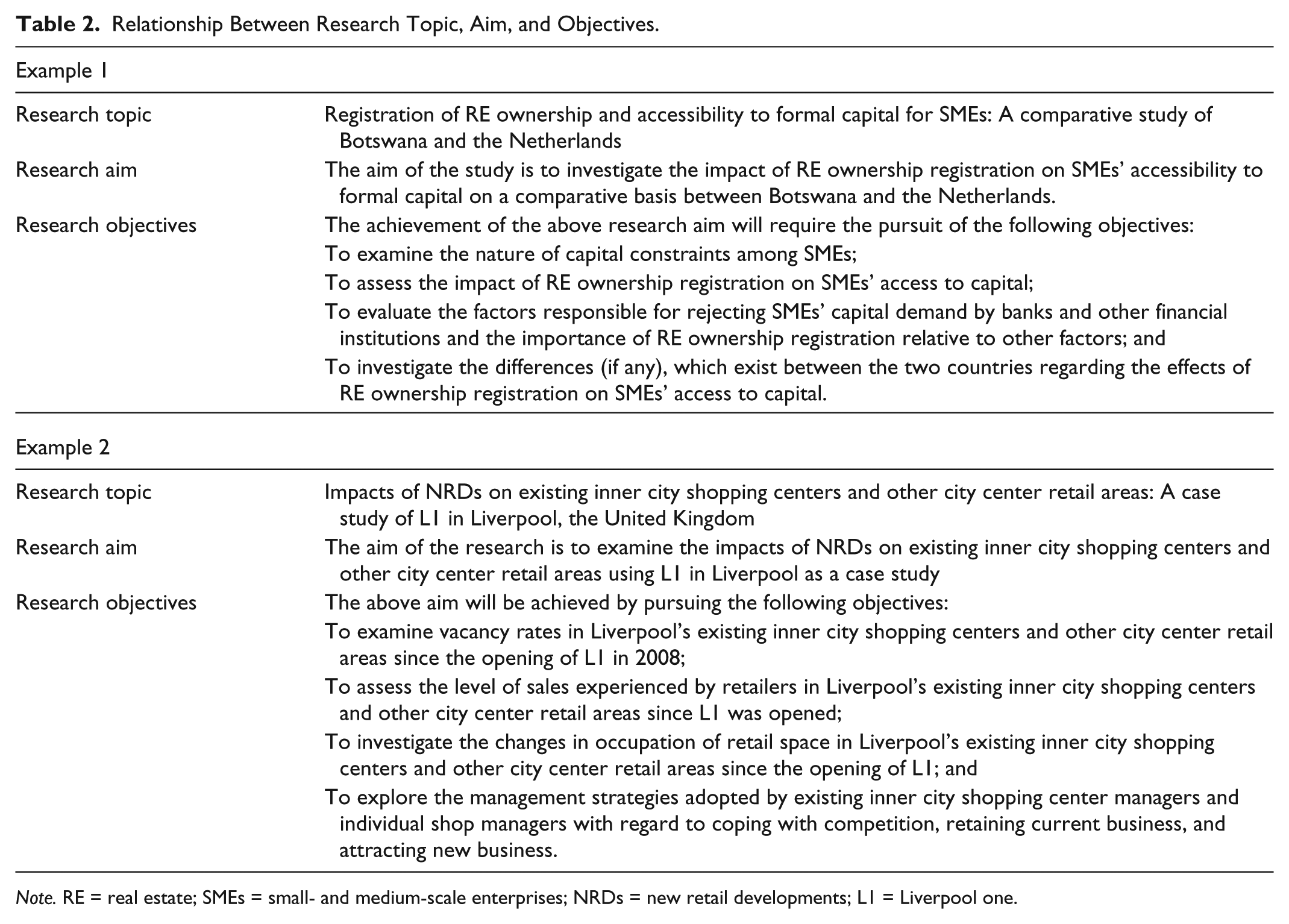
Note. RE = real estate; SMEs = small- and medium-scale enterprises; NRDs = new retail developments; L1 = Liverpool one.
It is not uncommon to see statements such as the following: “to gain knowledge and understanding or to understand . . .” (see, for example, Farrell, 2011) and “to make recommendations” as statements of research objectives. However, such statements cannot be research objectives. Regarding the first phrase, the overarching purpose of conducting research is to gain knowledge and understanding of a phenomenon or to understand a phenomenon or issue but that knowledge and understanding is gained after research objectives have been investigated and it is those objectives that need to be formulated and stated. Similarly, in terms of the second phrase, recommendations are made after research objectives have been investigated and based on the research findings. Thus, recommendations are an end product of investigating objectives. When research is conducted and reported, recommendations will be made any way and so it is needless to tell the reader the obvious.
It is also not uncommon to see research objectives and hypotheses (hypothesis for singular) stated in dissertations or theses, and indeed, authors such as Farrell (2011) and Naoum (2013) create the impression that research objectives and hypotheses need to be stated in a research proposal. This, however, is problematic. A hypothesis has been defined by Kinnear and Gray (1994, 2008) as a provisional supposition that a variable has a causal effect on another variable. It is a suggested explanation for a group of facts or phenomenon either accepted as a basis for further verification or accepted as likely to be true (Holt, 1998). Fellows and Liu (2008) also define it as a statement, conjecture, speculation, or an educative guess, which is a reasonable suggestion of a causal relationship between two variables.
Based on the above definitions, a hypothesis can be described as a testable proposition about the relationship that exists between two or more variables, concepts, or events. A null hypothesis means there is no relationship between the variables, concepts, or events. It is a research objective that is re-phrased as a research hypothesis and vice versa. For example, an objective such as “to examine the impact of price on demand for goods and services” (which can also be phrased as “to investigate the extent to which price affects the demand for goods and services”) could be re-phrased into a hypothesis such as “price affects the demand for goods and services” or “price is a determinant of demand for goods and services.” Thus, once research objectives are stated, it is not necessary to state hypotheses or when hypotheses are stated, it is needless to state research objectives; stating the two will be tautological. Research objectives or hypotheses serve the same purpose. Normally, research objectives are investigated while hypotheses are tested but the process of investigating research objectives or testing hypotheses is the same and the end results are also the same.
Statement of research objectives or hypotheses (but not both) in a research proposal and for that matter, in a dissertation or thesis is a sine qua non. This is because the research objectives or hypotheses drive or determine the rest of what is to be done. The chapters on: (a) critical and analytical review of the main literature (an expansion of the mini literature review in the research proposal) including the development of an appropriate theoretical framework (for MPhil and PhD theses); (b) research methodology; (c) data presentation, analysis, and discussion; and (d) summary of research findings or conclusions, limitations, and recommendations will all be based on the research objectives or hypotheses. For example, a discussion of the research methodology including the design of research instrument for data collection must be linked to the research objectives or hypotheses and the research objectives or hypotheses will form the themes in data presentation, analysis, and discussion. Furthermore, in the summary of research findings or conclusions, limitations, and recommendations chapter, the summary of research findings will be linked to the research objectives or hypotheses to establish the extent to which the objectives or hypotheses have been investigated or tested. It is, therefore, inconceivable for a dissertation or theses not to have research objectives or hypotheses.
Thus, in summary, first of all, the research problem or research question(s) are to be identified and stated based on the research gap(s) established in the mini literature review. Second, to address the research problem or questions(s), a research aim is formulated. Finally, to realize the research aim, specific, unambiguous, measurable, achievable, realistic, and time-bound (SUMART) individual objectives are formulated to be investigated or alternatively, hypotheses are formulated to be tested. This order of activities is illustrated diagrammatically in Figure 1.

Order of activities.
The order of research problem or question(s), aim, and objectives has been considered by Naoum (2013). However, Naoum’s order is problematic as he appears to be putting the cart before the horse, particularly, where he places research questions as follows: research aim; research objectives; and key research questions. Naoum’s order of activities suggests that it is the research questions that address research objectives, when it is the other way round. As noted earlier, research is conducted to address a particular research problem or questions. Thus, the research problem or question(s) must first of all be established at the outset based on the research gap(s) and when this is done, the research aim and objectives or hypotheses will then be formulated to address the research problem or questions(s). Therefore, research objectives or hypotheses are investigated or tested to achieve the research aim and once the research aim is realized or achieved, it implies the research problem or question(s) would have been addressed and for that matter, the research gap(s) would have also been filled. Consequently, diagrammatically, the arrows in Figure 1 will be reversed from the base as follows in Figure 2.

Addressing research problem or question(s)
Research Methodology
The research aim and objectives or hypotheses that are based on the research problem or question(s) considered above will tell the reader what exactly the researcher intends or wants to investigate. This section offers the researcher the opportunity to explain how the research will be carried out. Thus, research methodology (also known as research approach) is the strategy of investigation, which is about the whole dissertation or thesis from the beginning to the end including how the research objectives have been founded from the research problem, how the literature review has been carried out, pilot studies, data collection, analytical methods, and the process of developing findings and conclusions (Farrell, 2011). It is, therefore, a gamut of various issues that are: (a) strategies of inquiry; (b) theoretical/secondary and primary data collection; (c) sampling issues; (d) construction of research instrument for primary data collection (design of questionnaires and interview schedules or guides), data collection procedures (research methods), ethics, and pilot studies; (e) data presentation, analysis, and discussion; and (f) validation of research findings. In this section, the elements of research methodology are treated at a theoretical level first to provide an appropriate context before a consideration of what needs to be incorporated in the research methodology section in a research proposal.
In the social sciences, there are three research methodologies that can be used to conduct academic research. These are: (a) quantitative research methodology, also known as the traditional, positivist, or empiricist research approach; (b) qualitative research methodology, which is variously referred to as the constructivist, naturalistic, interpretative, postpositivist, or postmodern perspective approach; and (c) mix methodologies and the other terminologies for it are multi-methodology and pragmatic approach—it is an amalgam of quantitative and qualitative research methodologies in one study. The distinguishing features of quantitative and qualitative research methodologies are provided in Table 3.
Characteristics of Quantitative and Qualitative Research Methodologies.

Source. Compiled from Bryman (1998); Locke, Spirduso, and Silverman (2000); Mertens (2003); Bell (2005); Creswell (2003, 2009, 2013); O’Leary (2013); Charmaz (2014); and Flick (2014).
Research methodology is considered by some authors to be the same as research design whereas others treat research design as a sub-set of research methodology. Kumar (2011), for example, defines a research design as a plan, structure, and strategy of investigation so conceived as to obtain answers to research problems or questions. Thus, he considers research methodology to be the same as research design where he differentiates between qualitative and quantitative research designs (also see, for example, Kerlinger, 1986, and Creswell, 2009, 2013). However, the explanation of research design by authors such as Thyer (1993), Selltiz et al. (1962), Bell and Bryman (2011), and Bryman (2012) shows that it is a sub-set of research methodology. Bryman (2012), for instance, defines it as the framework for collecting data and analysis—the focus here is only data collection and analysis. Albeit the literature is ambivalent regarding the distinction between research methodology and research design, the authors of this article are of the opinion that they are the same and can be used interchangeably.
Regarding research paradigm and methodology, there is a difference between them. A research paradigm is a collection of assumptions and beliefs that guide the path of conducting research and interpreting findings (Koshy, Koshy, & Waterman, 2010). Thus, it can be described as a matrix of theoretical mind-sets that underpin a research methodology or approach. For example, an assumption in the quantitative research methodology is that knowledge (epistemology) is real and exists (ontology) there in the world that can be objectively and quantitatively measured and that is an element of a research paradigm in the quantitative research methodology. Epistemological and ontological issues are treated later. In terms of the qualitative research methodology, the assumption is that knowledge is real and exists there in the world that can be subjectively and qualitatively measured and that is also an element of a research paradigm in the qualitative research methodology.
Strategies of Inquiry
Various types exist in quantitative, qualitative, and mixed methodologies, which have been considered by authors such as Clandinin and Connelly (2000), Babbie (2000), Creswell (2003, 2007, 2009, 2013), Bell and Bryman (2011), Farrell (2011), Grbich (2013), Naoum (2013), Urquhart (2013), and Coghlan and Brannick (2014), and summarized as follows.
Surveys
A survey is a system of gathering information and includes cross-sectional and longitudinal studies that use mostly questionnaires, interviews, and observation for data collection. In a cross-sectional survey, all the data on relevant variables are collected at the same time or within a relatively short time frame. It, therefore, provides a snapshot of the variables included in the investigation at one particular point in time. However, in longitudinal surveys, data are collected over long periods of time. Measurements are taken on each variable over two or more distinct time periods. This permits the measurement of change in variables over time.
Experiments
The basic intent of an experiment is to test the impact of a treatment or an intervention on an outcome (the effect—dependent variable), while controlling all other factors (the determinants or causes—independent variables) that might influence that outcome. Experimental strategies are normally used in the physical sciences where the experiments are laboratory-based. However, they can be used in the social sciences—when they are used in the social sciences, the experiment is field-based.
Ethnography
This is where the researcher studies an intact cultural group in a natural setting over a prolonged period of time by collecting primarily observational data. The research process is flexible and typically evolves contextually in response to the lived realities encountered in the field setting.
Grounded theory
In grounded theory, the researcher attempts to derive a theory of a process, action, behavior, or interaction grounded in the views of participants in the study. This process involves multiple stages of data collection and the refinement and interrelationship of categories of information.
Case study
It is an in-depth systematic investigation of a phenomenon (which can be a program, an event, an activity, a process, a geographical location, one or more individuals, etc.) by a researcher. The cases are bounded by time and activity and researchers collect detailed information using a variety of data collection procedures over a sustained period of time.
Phenomenology
It is the study of everyday life. In phenomenological studies, the investigator identifies the “essence” of human experiences concerning a phenomenon as described by participants in a study. Comprehending the “lived experiences” marks phenomenology as a philosophy as well as an approach and the procedure involves studying a small number of subjects or participants via extensive and prolonged engagement to develop patterns and relationships of meaning. In this process, the researcher “brackets” his experiences to understand those of the participants in the study.
Narrative research
It is a form of inquiry in which the researcher studies the lives of individuals and asks one or more individuals to provide stories about their lives. The information is then re-told or re-storied by the researcher into a narrative chronology.
Action research
Action research, variously known as participatory action research, community-based study, co-operative inquiry, action science, problem-solving research, and action learning, is the study of a social situation carried out by those involved in that situation to improve both their practice and the quality of their understanding of the situation. Practitioners, industrialists, and students from the professional backgrounds normally adopt this strategy of inquiry by identifying a problem in the course of their work and to investigate it in order to propose changes that will improve an existing situation.
Sequential procedure
In a sequential procedure, the researcher seeks to elaborate on or expand the findings of one research methodology with another research methodology. This may involve beginning with a qualitative research methodology for exploratory purposes and following up with a quantitative research methodology. When the researcher begins with qualitative research methodology followed by quantitative research methodology, it is termed a sequential exploratory strategy. Here, priority is given to the qualitative aspect of the study. The findings of the two phases are then integrated during the interpretation phase. The purpose of this strategy is to use quantitative data and results to assist in interpreting qualitative findings.
Alternatively, the study may begin with a quantitative research approach followed by the collection and analysis of qualitative data. Priority is typically given to the quantitative data and the two research methodologies are integrated during the interpretation phase of the study. This procedure is termed a sequential explanatory strategy. The purpose of a sequential explanatory strategy typically is to use qualitative results to assist in explaining and interpreting the findings of a primarily quantitative study. It is better suited for explaining relationships. It can be, especially, useful when unexpected results arise from a quantitative study. In this case, the qualitative data collection that follows can be used to examine these surprising results in more detail.
Concurrent procedure
Unlike a sequential procedure above where the researcher begins with one methodology and follows with another in stages, in a concurrent procedure, the investigator converges quantitative and qualitative data to provide a comprehensive analysis of the research problem. In this design, the investigator collects both quantitative and qualitative data at the same time during the data collection stage and then integrates the information in the analysis and interpretation of the overall results. The researcher may nest one form of data within another and this is called a concurrent nested strategy. Given less priority, a quantitative research methodology is embedded or nested within a prominent qualitative research methodology or the vice versa. This nesting may mean that the embedded research methodology addresses a different issue than the dominant research methodology or seeks information from different levels. The data collected from the two research methodologies are mixed during the analysis phase of the project.
The concurrent nested strategy is often used so that the researcher can gain broader perspectives as a result of using two approaches rather than using only one research methodology. For example, a primarily qualitative research design could embed some quantitative data to enrich the description of the sample participants.
Transformative procedure
In this procedure, the researcher uses a theoretical lens as an overarching perspective within a research design that contains both quantitative and qualitative data. The theoretical perspective can be based on, for instance, ideologies such as advocacy. Within this lens could be a data collection method that involves a sequential or concurrent strategy. The perspective is reflected in the research problem or research question(s).
Reflection on strategies of inquiry
Sequential, concurrent, and transformative procedures are strategies of inquiry in the multi-methodology. However, in terms of the other strategies, as Farrell (2011) aptly notes, they “are not closed boxes” (p. 77) and can, therefore, fit into quantitative or qualitative studies. For example, surveys and case studies can be strategies in both quantitative and qualitative research. Sometimes, surveys or case studies are referred to as research methodology. However, from the preceding discourse, they are not research methodologies by themselves—they are rather strategies of inquiry within research methodologies.
In making a decision as to the methodology to use and subsequently, the strategy of inquiry to adopt, researchers need to consider their philosophical stance regarding epistemological and ontological issues (Koshy et al., 2010). Epistemology is the theory of knowledge and it presents a view and justification for what can be regarded as knowledge; that is, what can be known and the criteria that knowledge must satisfy to be called knowledge rather than beliefs (Blaikie, 1993). What people say, how what they say is interpreted, and what they do are all important regarding, for example, an action researcher for knowledge creation (Koshy et al., 2010). Ontology, is about the theory of being and its mandate is the development of strategies that can illuminate the components of people’s social reality; that is, about what exists, what it looks like, the units that make it up, and how these units interact with each other (Blaikie, 1993). For instance, within action research, researchers would consider this reality as socially constructed and not external and independent and the stories they tell will be based on subjective accounts from the people who live within their environment—thus, the methods of data collection they use will be consistent with their ontological stance (Koshy et al., 2010).
Types of Data and Research Methods
As earlier indicated, there are two main types of data that can be used in the above three research methodologies. These are: (a) secondary data, which refers to any published and unpublished material (e.g., materials from books, journals, newspapers, reports, magazines, undergraduate and postgraduate dissertations or theses, online materials, databases, video and audio recordings, photographs, films, and computer-based programs)—thus, a literature review is part of secondary data collection; and (b) primary data—it is “first hand” information gathered via procedures such as observation, interviews, questionnaires, and direct experiences. The questionnaires (normally used in quantitative studies) can be administered via mail/post, fax, Internet (web-based or email), or face-to-face whereas interviews (often used in qualitative studies) can be conducted face-to-face, over the phone, or using a voice-over-IP service such as Skype.
Interviews can be unstructured, semi-structured, or structured, and the difference between them has been explained by authors such as Abdulai (2010) and Naoum (2013) as follows. Unstructured interviews (also called intensive, informal, or in-depth interviews) are like journalistic interviews with a guide prepared on the areas or issues one intends to ask questions about. There are, therefore, no specific questions or specific order. The wording and sequence of questions to be asked depend on the answers the respondent gives to an initial question. It is assumed that the respondents have particular experiences or are knowledgeable about some subjects on which they can elaborate. The respondents are, thus, referred to as key informants and purposively chosen. Semi-structured interviews are more formal in comparison with unstructured interviews in that specific questions are asked although they are not asked in any specific order and normally, no interview schedule is used. Regarding structured interviews, an interview schedule is prepared where questions are presented in the same order and with the same wording to all the respondents. Interviews can be conducted on one-to-one or focus group basis. Focus groups/group interviews are open discussions between members of a group and the researcher.
It is the preceding data collection procedures that are often referred to as research methods. The questionnaires and interview schedules or guides prepared are known as the research instrument for primary data collection.
Sampling Issues
In the collection of primary data, a sample population (sample size) is normally selected from the target total population (sampling frame) and surveyed. In using questionnaires as the research instrument and, particularly, where they are administered via the Internet or post, one way to determine the sample size is to distribute the questionnaires to all members of the sampling frame or a pre-determined sub-population of the sampling frame. The number of completed questionnaires that are returned constitutes the response rate and that becomes the sample size. However, in geographical locations where the Internet or postal system is not well developed, this technique of determining the sample size may be difficult, if not impossible, to implement.
In the light of the above problem, other methods that can be explored are probability and non-probability sampling techniques. The other name for probability sampling is random sampling. Random sampling generally incorporates some type of systematic selection procedure to ensure that each unit or element in the sampling frame has an equal chance of being selected. The use of random sampling is based on an implicit assumption that a sampling frame can be established. Thus, where it is not possible to determine the sampling frame or an adequate sampling fame does not exist, random sampling cannot be used. Examples of random sampling are simple random sampling, systematic sampling, stratified sampling, and cluster sampling, which have been extensively covered in the works of authors such as Morse (1994) and Lincoln and Guba (2000).
Non-probability sampling focuses on volunteer potential subjects, easily available potential subjects, or those who just happen to be present when the research is carried out. There is no any systematic selection procedure. Non-random samples are mostly used in qualitative studies, pilot studies, and market research, consulting with experts or in circumstances where adequate sampling frames are unavailable (Lincoln & Guba, 2000; Morse, 1994). Accidental, volunteer, quota, purposive, and snowball sampling techniques are examples of non-random sampling, which are also well treated by the above authors.
Design of Research Instrument for Primary Data Collection and Pilot Studies
In designing a research instrument, it is important to note that questions are asked to solicit information that will enable the investigation of research objectives (or testing of hypotheses). There is, therefore, the need for the research instrument to be explicitly linked to research objectives. When a question is being constructed, it is critical to ask oneself how the response to that question will help in investigating a particular research objective or part of it. Indeed, it might be useful to sectionalize the whole research instrument thematically based on the research objectives in order to ensure that most, if not all, of the information that is needed to address the objectives is obtained.
A pilot study is described by Bell (1996, cited in Naoum, 2013) as getting the bugs out of the research instrument so that subjects in the main study will not experience difficulties in completing it and for a preliminary analysis to be carried out to determine whether or not the wording and format of questions will present difficulties when the main data are collected and analyzed. It, therefore, provides a trial run that involves testing the wording of questions, identifying ambiguous questions, testing the data collection method, and measuring the effectiveness of standard invitation to respondents (Naoum, 2013). At the MPhil and PhD levels, a pilot study can be carried out although this might not be possible for undergraduate dissertations due to time constraints.
Ethical Issues
In conducting research (laboratory-based or field-based), there is the need to normally ensure people are not harmed physically or emotionally and that is what ethical considerations are about. The researcher has a responsibility to ensure that research participants are protected (O’Leary, 2013). Apart from not doing harm, there is also the need to be truthful to the process (Coghlan & Brannick, 2014). Curtis and Curtis (2011) observe that the most important aspect of an ethically appropriate research is voluntary informed consent. In terms of recruiting participants, Curtis and Curtis explain the following: voluntary as the notion of free will; informed as referring to the provision of enough information about what will be asked of them; and consent as the formal process, which they affirm that they have been provided with all the information they require and are agreeing to take part out of their own free will. The process of gaining informed consent includes the provision of a participant with information sheet (PIS), which contains all the information the participant needs to make an informed decision about participation (Curtis & Curtis, 2011; O’Leary, 2013). However, before data collection commences, ethical approval will have to be obtained from the researcher’s institution.
Data Analysis and Validation of Research Findings
After gathering the relevant data for the research, it has to be presented, analyzed, and discussed. A starting point is normally to clean, transcribe (if recordings were done during the data collection stage), and to code the data in an appropriate statistical package such as STATA or SPSS (quantitative studies) or qualitative data analysis software package such as NVivo (qualitative studies) for analysis. Content analysis can be carried out where appropriate. It is a tool used to determine the presence of certain words or concepts within texts or sets of texts by quantifying and analyzing the presence, meanings, and relationships of such words and concepts (Palmquist, Carley, & Dale, 1997). There are two types, which are conceptual and relational analyses.
At an advanced level such as MPhil and doctoral studies, it is important to validate research findings albeit this is not normally required at the undergraduate or MSc levels. Two common procedures that are used to validate findings are explained as follows. One procedure is triangulation where two or more techniques are used in the investigation of a phenomenon to enhance confidence in the ultimate findings. For example, the research methodologies, including data collection procedures, data sources, and survey participants can be triangulated to validate the findings. The second procedure is to withhold a percentage of the data collected that is then presented and analyzed later and compared with the initial findings. This procedure, however, appears problematic as it is actually a continuation of data presentation, analysis, and discussion and not research validation in the real sense because it is the same data set that is used, just that the data are analyzed at a different time.
What to Include in the Research Methodology Section
Under the research methodology section, a detailed treatment of all the research methodological issues is not needed since it will be considered in the research methodology chapter during the write-up stage of the dissertation or thesis. What is required in this section is for the researcher to laconically demonstrate awareness of the research methodology process in the social sciences in a logical manner. Thus, any consideration of the theoretical issues should be as brief as possible by concentrating on the important and salient issues that will inform how the research will be conducted. The research methodologies available in the social sciences should be briefly explained and a justification provided for the choice of a particular methodology.
The selection of a research methodology needs to be explicitly linked to the research objectives or hypotheses. Therefore, there is the need to explain clearly how each of the research objectives will be investigated. If it is one research methodology that will be adopted to investigate all the stated research objectives, then the linkage will be obvious and does not need an explanation. However, where the multi-methodology will be adopted, there has to be an explanation regarding which research methodology will be used to address which of the research objectives. For instance, if there are four stated research objectives, the quantitative research methodology might be used to investigate two of the research objectives whereas the qualitative research methodology may be used to investigate the remaining research objectives, and this needs to be explained and justified. Following on, the strategy of inquiry, research methods, and research instrument to be used, how the survey participants will be selected, and how the data to be collected will be analyzed should be explicated. If a pilot study will be carried out, it should be indicated. Also, it should be indicated that ethical issues will be considered and that before the primary data collection process begins, ethical approval will be obtained. Finally, it will be necessary to state that the first part of the research methodology will consist of a critical review of the relevant literature in order to, among other things, identify the appropriate theoretical framework for the research and to help in designing the rest of the research methodology. Research methodology can be likened to the “foundation” of a building in construction and, therefore, needs to be robust; if it is weak, the research will also be weak.
Research Significance/Importance
The importance of the research must be considered by justifying the need for the research. This will require some reference to be made to the research gap(s), problem, or question(s), and an explanation of how the proposed research will contribute to existing body of knowledge (novelty) as well as explaining how the outcomes of the research are likely to benefit the following stakeholders where applicable: (a) academia, (b) individuals and communities, (c) industry and commerce, and (d) policymakers nationally and internationally.
Research Program
As earlier indicated, time and resources regarding, particularly, pecuniary legacy for the conduct of any research are normally limited. Thus, there is the need for a research program. It indicates the principal or milestone activities to be carried out and the time line for such activities. The research program will be used by the supervisor to monitor the progress made by the student once the research commences so that any issues can be identified and addressed. The research program can be indicated in a tabular form or diagrammatically, for example, in the form of a Gantt chart and it can be embedded in the research program section or added as an appendix.
References
In the above sections, relevant references will have been cited in-text where necessary in accordance with a particular referencing style. It is in this section that the full references will be provided in accordance with the same referencing style used for the in-text citations. The references should be listed in an alphabetical order. Sources from which one can draw information are varied as alluded to above. However, it is not advisable to rely heavily on websites as they are often not considered a good source of materials. Thus, websites should be used sparingly. The most highly regarded sources of materials are academic journals (including online journals) and research monographs, followed by text books. Quantity, quality, and currency of references are of importance here.
There can also be a bibliography section, which should be titled “Bibliography” after the references section. The dictionary definition does not differentiate between references and bibliography. However, in academic writings, there is a difference between the two albeit some authors use them interchangeably perhaps based on the dictionary definition. As Farrell (2011) explains, references are everything cited in the dissertation. Thus, references that are specifically cited in-text will be fully listed under references. However, Farrell describes bibliography as everything that has been read or browsed, which is relevant to the subject area but has not been cited. It is, therefore, any material that is consulted to help shape the ideas of the researcher but has not been used in a manner to warrant in-text citation. For example, if a student consults somebody’s dissertation or thesis to gain ideas regarding how to appropriately phrase a research topic, the student cannot cite that person in stating his research topic in his dissertation or thesis. However, to acknowledge that person, the full reference to that dissertation or thesis will be listed under bibliography. Similarly, references that may be relevant to the research but have not been used in a manner to warrant in-text citation will be listed under bibliography for further reading.
Research Proposal Components That Are Supposed to Feature in the Final Thesis or Dissertation
Based on experience, some students, especially, at the undergraduate and master’s levels, reproduce all the contents of the research proposal in the introductory chapter of the dissertation, which is inappropriate. The introductory chapter is named “Chapter One” and its title is “Introduction.” The main relevant sections in this chapter are: (a) research background; (b) research aim and objectives; (c) research methodology; (d) summary of main research findings, limitations, and recommendations; (e) research significance/importance; and (f) structure/organization of dissertation. The introductory chapter serves a dual purpose by first, setting the appropriate scene for the research conducted and second, encapsulating what was researched and why it had to be researched, how it was researched, what was found, limitations, and the way forward or recommendations; that is, it provides a snapshot of the research that has been conducted. Sections of the research proposal that should appear in the dissertation or thesis are the “research background,” “research aim and objectives,” “research methodology,” and “research significance/importance,” of course, with appropriate amendments where necessary because the main literature review would have been carried out and the whole research conducted. The contents of the research methodology section in this chapter are supposed to be very laconic as there will be a chapter devoted to it in the dissertation or thesis.
Conclusion
This article has considered the essential elements of a good proposal for both undergraduate and postgraduate students in the social sciences and it is hoped that the students would find it intellectually stimulating and insightful.
Although a theoretical framework, which is about the relevant theory or theories that underpin a particular study, is an imperative at a more advanced level such as MPhil or PhD, it has not been considered above. This is because settling on a relevant underpinning theory or theories is difficult, takes time, and will not normally crystallize at the research proposal writing stage until the main literature has been critically reviewed following the commencement of the research. Thus, what is required at the mini literature review stage is for the prospective researcher to bear in mind that a theoretical framework has to be ultimately developed if it is an MPhil or doctoral research.
Footnotes
Declaration of Conflicting Interests
The author(s) declared no potential conflicts of interest with respect to the research, authorship, and/or publication of this article.
Funding
The author(s) received no financial support for the research and/or authorship of this article.