




Abstract
The present study investigates Taiwanese researchers’ perceptions, problems, and strategies of trying to get published in English in the field of English teaching. This discipline presents an interesting case for publishing, as in Taiwan, this group of researchers is highly expected to use English as a medium in writing for research. Through semi-structured in-depth interviews with 21 researchers, the findings show that regarding the role of English, all participants regarded it as an indispensable tool in their academic careers. They valued the significance of English journals and were keen to promote their ideas in the international market by using English as the medium. Most researchers reported that they had writing problems. However, if they were well-prepared, they would not be trapped into them. Except for language use, researchers were confident in their research topic. Because of Greater China’s rapid growth, people may want to know more about it. They also reported different strategies to solve problems in English publication. Implications of this study are discussed and concluded.
Introduction
With the expansion of the higher education worldwide in the past few decades, to meet the requirements for international competitiveness has become an important issue. Consequently, many governments, policy makers, university teachers, and researchers have devoted a great deal of resources and energies to look for ways in boosting university research to rank higher in the world university league tables (Mok & Wei, 2008). Competitive funding and university rankings are greatly emphasized, and research outcomes need to be internationalized.
In academia, academic achievement is highly associated with publications (Nicholls, 2005). University rankings, public funding, and prestige are generally intertwined with the number of research articles published in some journals and their following citations by researchers (M. Anderson, Ronning, De Vries, & Martinson, 2007). The ideology of publish or perish, which denotes the value of publication, has greatly influenced academia in Taiwan (e.g., Chu, 2009; Mok, 2016). Thus, researchers in Taiwan are under increasing pressure to have their work published in international journals. Most important of all, the main reason behind the pursuit of world-class universities and global university ranking is that the more publication in international journals, the more resources and social prestige universities will obtain.
In the past, although there are many reports in English writing for scholarly publication research in different disciplines (e.g., Aitchison, Catterall, Ross, & Burgin, 2012; Bardi, 2015; Buckingham, 2014; Cho, 2004; Curry & Lillis, 2014; Ge, 2015; Gea-Valor, Rey-Rocha, & Moreno, 2014; Ho, 2017; Huang, 2010, 2011, 2014, 2017; Li, 2006a, 2006b, 2007, 2014, 2016a, 2016b; Li & Flowerdew, 2007, 2009; Li & Hu, 2017; Luo, 2015; Martín, Rey-Rocha, Burgess, & Moreno, 2014; Muresan & Pérez-Llantada, 2014; Pérez-Llantada, Plo, & Ferguson, 2011), to date there is a lack of understanding on researchers working in the field of English teaching. The motivation for this study comes from the largely unexplored field in English teaching. Unexplored issues include how researchers in the field of English teaching perceive the issues and problems of writing for scholarly publication along with the factors contributing to successful publication in English. The present study, being exploratory in nature, aimed to address these gaps in the literature.
This article starts by providing a literature review on three major areas of research concerning writing for scholarly publication in English: the hegemony of English, the domain loss of national languages, and the dilemma about publishing in local versus international journals. Then, I outline and describe some important issues in the research design, including the procedures of data collection and analysis. Next, results related to researchers’ perceptions of publishing in English, problems of publishing in English, and factors contributing to successful publication in English are reported and discussed. Finally, the article concludes with implications and future directions for researching writing for scholarly publication in English.
Literature Review
Concept of Hegemony and Domain Loss
Under the influence of globalization, English has almost become “the main lingua franca for research networking and scientific communication across different cultural contexts and different languages” (Pérez-Llantada, 2012, p. 2). As the culture-independent nature of research may lead to researchers’ preference for using one common language, relying too much on one language may cause researchers’ negative attitudes toward their national languages and limit their use of these languages in writing for scholarly publication.
Undeniably, the portrait painted above has to be qualified. Researchers all over the world, no matter the field where they are, face many challenges to get their work published internationally (Ferguson, 2007; Flowerdew, 2013; Luo & Hyland, 2016; McKinley & Rose, 2018). They usually have to struggle and negotiate various aspects of writing research papers in English (Curry & Lillis, 2013; McKinley & Rose, 2018; Uzuner, 2008). Most importantly, they have to “bring their discourse into line with Anglo-Saxon norms” (Bennett, 2010, p. 193). For example, in his study, Ferguson (2007) addressed the impacts of hegemony of English, which are (a) global diglossia and domain loss as English may relegate other languages to a minor role and (b) the inequality of scientific communication between English-speaking researchers and non-English-speaking researchers who may be disadvantaged particularly when they submit their research work in reputed international journals. He concludes that “the risk of domain loss is very real, but that recent language planning interventions may help avert the danger” (p. 7) and that English language may be an obstacle but not really a big disadvantage in scholarly publication. At least, it is a disadvantage that can still be ameliorated.
The concept of hegemony and domain loss is also closely related to Canagarajah’s (2002) critiques on scholarly publishing practices, in which he outlines the existing inequalities between center and periphery researchers regarding their access to academic knowledge production and academic knowledge dissemination. He further relates such inequalities to the greater politico-economic inequalities which are constructed, legitimized, and reproduced under capitalist imperialism.
Specifically, in terms of writing for scholarly publication, he argues that the dominance of English as an international language of scientific communication and scholarly publishing results directly in the ideological hegemony of the West and marginalization of the knowledge of Third World countries. This poses challenges for researchers from the periphery, such as Asia, Africa, and Latin America in getting their work into center journals and books. Periphery researchers may encounter many difficulties in bringing their research to light. In view of this, Canagarajah asks real changes to be made in scholarly publication. For instance, he suggests that periphery researchers should continue questioning knowledge constructed by the center. The uncritical acceptance of dominance of the English language could have negative impacts on researchers from different origins, and center journals should democratize participation, especially if they claim to be international journals.
Despite the fact that it is impossible to entirely avoid outside influence, language awareness should be raised among researchers (Gunnarsson, 2001; Hanauer, Sheridan, & Englander, 2019). Publication in English indeed has its merits but also has various problems, including disadvantages for inadequate language proficiency and lack of understanding of different cultures. In addition, in terms of national identity, a nation may be afraid of being colonized by the English language and its culture (Fischer, 2008). The conclusion suggested here is that linguistic Englishization in writing for scholarly publication is a complex process, and there exist important driving forces, such as reputation, visibility, internationality, pressure to publish, and high impact factor due to the hegemony of English.
Researchers need to strive for overcoming English language hindrances and obstacles to get their work published in international journals. As Flowerdew (2013) suggested, the hegemony of English in scholarly publication has become pervasive worldwide. Researchers in different regions should be encouraged to voice their publication problems.
Problems of Writing in English Publication for Non-Native Researchers
Jaroongkhongdach, Todd, Keyuravong, and Hall (2012), based on Uzuner’s (2008) review, identify eight problems for researchers from different countries and disciplines to get published in the international journals as follows:
lack of time
lack of resources or funds
lack of connections with the academic community in core countries
bias against scholars from peripheral countries
parochialism
problems with language
problems with the literature review and discussion sections of research articles
problems with research methodology
The problems stated above offer insights into the complexities that second language (L2) researchers encounter in their attempts to get their works published internationally. International publication could be considered an immense challenge to L2 researchers. It is also important to note that the problems identified by Jaroongkhongdach et al. (2012) and Uzuner (2008) should not be regarded as problems only specific to L2 researchers in response to the demands of writing for scholarly publication. Some of these problems may also be experienced by researchers from English-speaking countries, particularly among those who are at the early stage of their research careers.
In addition to these problems, more importantly, Jaroongkhongdach et al. (2012) pointed out that some practically oriented research does not easily get published in the international journals because of its context-specific nature and thus cannot contribute much to knowledge in the field. “There therefore appears to be a conflict between the internal practically-oriented motivations to conduct research and the external pressure to publish” (Jaroongkhongdach et al., 2012, p. 202).
Another major problem is related to researchers’ knowledge construction restrained by their own culture that may play a role for non-native speakers to get published in international journals. Jaroongkhongdach et al. (2012) argued that for people in Anglophone countries, knowledge is to be challenged. However, in other countries such as Thailand, knowledge should be respected and this may lead Thai researchers to make little critical comments on literature.
These problems of writing in English publication for non-native researchers may lead them to struggle in publishing international or local journals. For example, Flowerdew and Li (2009) examined 20 Chinese researchers from humanities and social science disciplines to identify how and to what extent they used English and Chinese in publishing local and international publications. The finding indicates that although the importance of English as an international language was acknowledged, participants’ limited English proficiency was seen as the major barrier in publishing in English. In addition, many participants did not find particularly necessary to publish in English. Resistance was found to publishing in English. The reasons behind include assessment criteria encouraging publication in Chinese, the fact that Chinese and international (Anglo-American) academia belong to separate discourse communities, a desire to avoid pandering to “orientalist” discourses, and resistance towards the “internationalizing” implications of the government policy. (p. 8)
It is noted that although from the literature we have already known a lot about the problems of publishing in English, it remains unclear about how teachers particularly in the field of English teaching cope with problems of publishing in English and whether they still have such problems, as they are usually required to get their works published in English and English is normally a default language for them to use in academic writing.
The Need for Non-Native English Researchers in Publication
To solve these problems, non-native researchers are reported to employ strategies and resources that facilitate the scholarly publication process (e.g., Cargill & O’Connor, 2006; Curry & Lillis, 2010; Jaroongkhongdach et al., 2012).
For example, from the institutional aspect, Cargill and O’Connor (2006) described collaborating-colleague workshops to develop Chinese researchers’ skills for publishing in English. The workshops include four features: task-based approach (e.g., a draft that can be brought and revised in the workshop), genre pedagogy (e.g., introduction of academic writing structures such as Introduction, Method, Results, and Discussion), referee criteria for reference (e.g., a set of criteria that is presented), and discourse strategies for expressing researchers’ intended meaning (e.g., passive voice and verb tense in different sections).
From the national aspect, Jaroongkhongdach et al. (2012) indicated that to increase the number of scholarly publications in international journals, Thailand adopted some strategic plans, such as the establishment of the National Research Fund, the Royal Golden Jubilee Program, and the Office for National Education Standards Quality Assurance.
As suggested by Lillis and Curry (2010), such participation is considered essential in English publishing regardless of language proficiency and academic writing experience. What researchers need is not only how to design their research but also how to present their research in an acceptable standard of English. It involves not only research skills but also language and writing skills.
Since 2006, the Ministry of Education in Taiwan has initiated a number of policies to augment academic excellence and boost international visibility in universities. For example, the government has forged a link between research evaluation outcomes and funding allocation in the “five-year 50 billion” plan such as “Aim for the Top University Project,” aiming to select and fund potential universities toward top universities in the future.
Specifically, the number of publications appearing in A&HCI (Arts & Humanities Citation Index), SCI (Science Citation Index), and SSCI (Social Sciences Citation Index) has been adopted as one of the main criteria for government funding, research project approval, job seeking and promotion, and global university ranking (Kao & Pao, 2009). Research performance is thus much focused on the number of papers published in peer-reviewed journals and their associated journal impact factors (Tien, 2007). The overall objective of the “five-year 50 billion” plan is to make Taiwanese universities enter the top 100 world universities and become premium international research institutions in higher education.
Continued attention needs to be given to the problems of writing for scholarly publication in English if researchers in Taiwan hope to contribute and disseminate their knowledge in the global world. Although Taiwanese researchers have received some attention, most notably in the studies conducted by (Ho, 2017) and Huang (2010, 2011, 2014, 2017), researchers in the field of English teaching have not been the focus.
There were other studies conducted in different countries showing an increasing need of international publishing, but still they were also mainly in hard sciences (Aitchison et al., 2012; Cho, 2004; Li, 2006a, 2006b, 2007, 2016a, 2016b; Li & Flowerdew, 2007; Luo, 2015; Martín et al., 2014; Pérez-Llantada et al., 2011), except comparatively few studies in soft sciences (Bardi, 2015; Ge, 2015; Gea-Valor et al., 2014; Li, 2014; Li & Flowerdew, 2009; Li & Hu, 2017; Muresan & Pérez-Llantada, 2014) or in both hard and soft sciences (Buckingham, 2014; Curry & Lillis, 2014). Nonetheless, it should be noted that the research area falling within either hard sciences or soft sciences may vary a lot. Even the sub-disciplines in soft sciences could be heterogeneous. Most previous studies, except case study, did not take this important factor into consideration. For example, in the Li and Flowerdew (2009) study, although their 15 participants were all under the category of humanities and social sciences, they were from social sciences, linguistics, translation studies, musicology, comparative literature, applied linguistics, history, English literature, and education. A synthesis of these previous empirical studies in writing for scholarly publication in English is shown in Table 1.
Previous Empirical Studies in Writing for Scholarly Publication in English.

The above prior studies indeed have enhanced our understanding of the complexity of researchers’ endeavors in writing for scholarly publication. However, none of these studies centered on exploring academic publishing activities in the field of English teaching. English especially plays an important part for these researchers as they are normally required to write and get published in English. In addition, as English is a major international language of research, there is a need to explore issues of writing for scholarly publication in English for non-native researchers, particularly those who are mainly using English to write and publish their work. Unlike other fields of study, English is generally regarded as a default language for researchers in the field of English teaching. It would be interesting to explore what concerns and problems they may encounter when they write for scholarly publication.
Specifically, drawing on interviews with Taiwanese scholars, who remain a relatively little researched academic community compared with many others, the objective of this study is twofold: first, to explore perceptions of publishing in English by Taiwanese scholars in the field of English teaching, along with the problems when publishing in English, and second, to identify factors contributing to successful publication in English. The overall aim is to better understand how these scholars cope with the challenge of disseminating research in English with a view to formulating realistic and appropriate ways to support them in academic English writing. This article is a contribution to an expanding literature on the challenges non-Anglophone scholars confront in disseminating their research in English, the major language of international communication. The present study seeks to answer the following research questions:
Research Method
Participants
Via looking through the university official websites of Taiwanese researchers in the field of English teaching from five research-oriented universities, I sent emails to 25 researchers who have published at least one article written in English-medium journals or books. Twenty-one researchers returned responses, yielding a response rate of 84%. Researchers’ participation was entirely voluntary and anonymity was ensured. The investigation consisted of in-depth semi-structured individual interviews with 21 researchers. As English is a foreign language in Taiwan, at university, the study of English teaching is generally in the department of English or foreign languages and literature. The department aims to prepare students to be teachers of English or foreign languages in elementary schools, junior and senior high schools, and universities, and to enter other professions that need a good command of English or foreign languages.
Table 2 summarizes the researchers’ profiles. It shows that about half of them were associate professors, while the other half were full and assistant professors. It also shows that half of them earned their highest degree in Taiwan, while the other half were in the United States or the United Kingdom. All of them had experiences of publishing their papers in local and international journals. Those who were able to and/or likely to publish papers in international journals tended to have been educated abroad, for example, in the United States or in the United Kingdom. Compared with assistant professors, associate and full professors were more productive in publications. This suggests that their success in publishing papers played an important role in their career development. In addition, based on seniority of the researchers, there are two clearly defined groups: relative novices with 7 or fewer years teaching (and presumably research) experience and senior scholars with 10+ years experience. In view of this, the present study includes both junior and senior researchers.
Participants.

Advantages for Taiwanese Researchers to Publish Internationally.

Disadvantages for Taiwanese Researchers to Publish Internationally.

Role of English Perceived by Researchers.

Strengths in Writing English Papers.

Weaknesses in Writing English Papers.

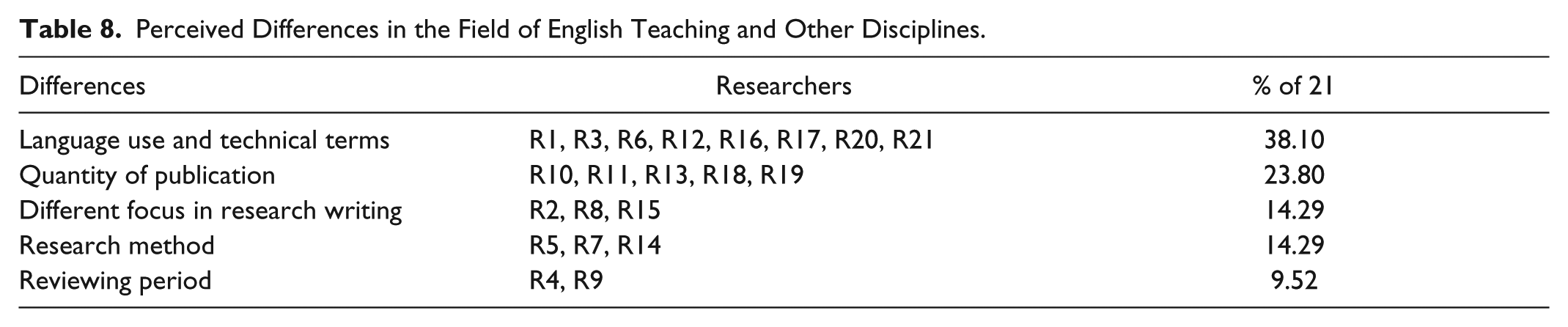
Perceived Differences in the Field of English Teaching and Other Disciplines.
Sections of a Research Paper That Researchers Find Problematic and Other Aspects of the Publication Process Before Review.

Sections of a Research Paper That Researchers Find Problematic and Other Aspects of the Publication Process After Review.

Factors Contributing to Successful Publication in English.

Data Collection
The interviews were designed to understand researchers’ perceptions of writing for scholarly publication in English in Taiwan. Specifically, the purpose of the interviews sought to discover what issues and problems that researchers in the field of English teaching faced and how they handled them. I arrived at the interview questions by asking 247 researchers in the field of English teaching to fill out an online questionnaire (179 researchers responded; response rate: 72.5%) and by consulting Flowerdew’s interview questions (2007, 2009), which served as a basic guide to the data collection. The format of interviews, as specified in Supplemental Appendix 1, consisted of four parts.
Questions 1 to 6, related to the first principal research question, focused on researchers’ perceptions of publishing in English in general, such as advantages and disadvantages for Taiwanese researchers to publish their English papers in the global world, role of English perceived by researchers, strengths and weaknesses in writing English papers, and perceived differences in the field of English teaching and other disciplines. Questions 7 to 10, related to the second principal research question, focused on academic writing difficulties encountered by researchers in language, content development, organization, structure, and writing different sections in a research paper. Questions 11 to 13, related to the third principal research question, involved researchers’ strategies for success in publishing in English. It is noted that some questions are overlapped, such as “Do you have any strategies that can make your English papers better?” and “What are your strategies for success in publishing in English?” Similar questions were asked in different ways. This is due to the consideration of collecting more data and gaining more in-depth response. In case researchers did not answer adequately, another similar question could help them rethink and approach the question from another angle and perspective.
The interviews approximately lasted for 1 hr. All interviews were carried out in Chinese by my research assistant and I, recorded digitally, and then transcribed verbatim. Selected excerpts considered closely relevant to answering research questions were later translated into English. The translated excerpts were checked for accuracy by an experienced English educator. As shown in the interview data, the use of Chinese enabled the researchers to express themselves freely and correctly. Although each researcher demonstrated a story of his or her experience of writing for scholarly publication in English, these stories, from different perspectives, informed these researchers’ perceptions of writing for scholarly publication in English in the field of English teaching in higher education in Taiwan over the course of time.
Data Analysis
The nature of qualitative data makes it difficult, if not impossible, for the person doing the analysis to separate himself or herself from the data. In this study, I, however, tried to maintain objectivity and avoid bias with qualitative data analysis, including having participants review transcribed interview document to see whether interpretations were representative of their beliefs, and having an additional person (research assistant) to code the data to ensure consistency between my interpretation and that of the other.
To illustrate, to make the study credible and rigorous, two different techniques were achieved using participation review and consistency check. First, participation review was achieved by presenting researchers’ voices under each theme and by providing detailed description of each of the cases. Triangulation will be used consistently with research assistant and me in general. Each of the researchers interviewed were asked to review the transcribed interviews to add, delete, or amend any statements made. The transcribed interview documents were then emailed to each researcher and requested an email response with any comments included in their interview document. To make sure validity and reliability (Merriam, 2002), member checks were used by sending interpretations back to researchers by email or via hardcopy to ensure that they are accurate. In this return email, each researcher was asked to give consent that the information provided in the transcribed interview document was accurate and aligned with their views and opinions. In addition, the research assistant and I conducted a consistency check. A necessary ethical practice was the analysis being faithful to the data collected, accurately reflecting the researchers’ explanations. The study aimed to take their explanations from an open-minded perspective and analyze the data systematically.
The data analysis focused on locating common threads and themes while listening to the audio recordings and then transcribing the relevant sections/phrases. In the interview data analysis, the research assistant and I followed the procedures of analytic induction (Goetz & LeCompte, 1984) and constant comparison (Miles & Huberman, 1994). Miles and Huberman (1994) stated that qualitative data analysis consists of “three concurrent flows of activity: data reduction, data display, and conclusion drawing/verification” (p. 10).
Specifically, the research assistant and I were involved in the analysis of the data, which was a continuous process in search of possible themes for different sections. After a practice coding session and each coder (researcher/research assistant) had completed his or her individual coding independently, we came together to discuss the appropriate themes and defend data points. We reduced and condensed data, and thereby began to seek meaning, as the study continued throughout data collection. To illustrate, based on a grounded-theory approach (Strauss & Corbin, 2008), the procedure involved looking for possible themes for sections of the interview protocol, and more deeply for new possible themes in this recursive process. In other words, the research assistant and I reviewed data for possible themes for sections of the interview protocol, including defining sets of relationships, developing possible themes, continually examining more data for examples of similar or recurring themes, and refining themes to build a picture and tell a story to describe what happened. Well-designed qualitative data analysis should be systematic, aiming for “saturation” of data, which involves analyzing data in an iterative process until no new information arises and provides a degree of insight into complex phenomenon. Data analysis ceased when there was no new theme.
In addition, comparisons were made among all the themes for sections of the interview protocol according to different researchers’ perceptions and checked whether there was agreement about the themes. Inter-rater percent agreement between the research assistant and I was 95.2%. The research assistant and I read the data sources repeatedly and intersubjectively against each other so as to arrive at a documented report. The measure of intra-rater reliability was reached as the research assistant and I coded the same data subset again about 2 weeks after the inter-rater reliability measure was reached. Intra-rater percent agreements were 98.7% and 99.1%, respectively. These results show that inter and intra-rater agreement were satisfactory.
The major themes in this study are as follows: (a) researchers’ perceptions of publishing in English in general, including advantages and disadvantages for Taiwanese researchers to publish internationally, role of English perceived by researchers, strengths and weaknesses in writing English papers, and perceived differences in the field of English teaching and other disciplines; (b) problems of publishing in English; and (c) factors contributing to successful publication in English. The results are mainly presented in the form of qualitative comments by the participants. When the data in an interview are reported, they are indicated by the pseudonym of the interviewee (e.g., R15).
Results
Researchers’ Perceptions of Publishing in English
An initial question concerns why participants should publish in English. Most researchers could find more advantages than disadvantages. For example, 21 out of 23 researchers stressed the visibility of Taiwanese researchers in the world—a strong backup to get promotion. Foreigners would know more about Taiwanese or Chinese perspectives, and researchers who could publish in international journals would get more credits than in local ones. It is noted that two researchers with local PhDs (R1 and R2) indicated that the ability to conduct research is the major advantage for Taiwanese researchers mainly due to their solid research training during doctoral studies in Taiwan.
When it comes to disadvantages, although nearly half of the researchers stated that there is no disadvantage for Taiwanese researchers to publish internationally, there are still some disadvantages indicated by other researchers. For instance, seven researchers pointed out the problems of language use. Interestingly, these researchers with more than 13 years of teaching experiences tended to regard that although the contents of research writing are critical, the importance of language use still cannot be neglected. R14 mentioned the decrease in the number of papers submitted in local journals in Taiwan. R15 cared about the validity of the papers submitted to foreign countries as the procedures would take much longer than the local journals. Other concerns also include whether different research topics or theory development would fit in an international context.
Second, regarding the role of English, all researchers considered it an indispensable tool in their academic careers. For example, R15 indicated her experience of using English extensively since graduate school, including reading and writing materials, paper, thesis, and even doing presentations. Thus, English was internalized in her repertoire. She said, “I did not really think about this question due to frequent use of English since graduate school. So when I talk about the importance of English, it is already internalized in my language use.” She further pointed out that she is so accustomed to using English that it has become unproblematic for her. Researchers from not only English department but also non-English department should be familiar with English to keep up with the latest trends in their discipline because materials are mostly in English. R17 gave another example. She mentioned that the trend had been changing throughout the decade—the revival of English as a medium of writing promoted by Taiwan Ministry of Education and National Science Council. This may reflect that first, the exposure of English plays a crucial role in writing for scholarly publication in English and second, that in Taiwan, English has already become an important tool for internationalization in the era of globalization and is more or less endorsed by the Taiwanese government.
On the issue of publishing in local/international journals and on the language choices, in response to the current situation of the non-Anglophone scholars and the pressures on scholars to publish in English, Chinese as a language of research publication is in fact one of the most robust competitors with English. Chinese is surely now a viable alternative also for Taiwanese scholars. However, for instance, R11 stated the dilemma that researchers are facing. She said, If you want to gain reputation within Taiwan, you have to publish in Chinese. People would know more about you if you disseminate your ideas in the first language. On the other hand, if you want to get promotion, you ought to publish in English, as English counts more than Chinese. In academia, journals published in English are generally well respected, especially those which are international journals.
Interestingly, she further indicated, Why I want to get published in English is not because of this language, but because of its value of getting my work to be visible and internationally recognized. It is through publishing in international indexed journals that drive my choice of English over Chinese. In addition, English is almost a default language in my field. Nonetheless, this choice has resulted in my minimal use of Chinese in writing for scholarly publication.
The result is to some extent in line with Rey-Rocha and Martín-Sempere’s (1999) and Salager-Meyer’s (2014) studies, suggesting that both English and local languages offer options for publication, but one or the other depends on the specific purpose and research field.
In addition, in Taiwan, whether to publish in English or in Chinese, in fact, may depend on the researcher’s preference and discipline. For instance, R20 said, Sometimes I’d like my article to be read by colleagues whose command of English might not be so good. Then I publish in Chinese. Sometimes I find it hard to create Chinese terms for linguistic phenomena that have mostly been dealt with in English language publications. Then I choose English as the language of publication. This may also happen in other fields such as medicine and engineering.
This shows that to have a wider appeal in Taiwan and educate Taiwanese, publishing in Chinese is one of the important strategies.
Moreover, all researchers concurred that they were restricted and expected to use English to publish their papers. However, it is noted that two researchers (R16 and R19) perceived English as a mere tool of promotion, with no other functions. For example, R16 stated that people from Taiwan were interested in the research conducted in Chinese, but not otherwise. R19 also said, “English is just a tool which is only used for promotion.” In such sense, English journals, in R16’s and R19’s perceptions, were just a waste unless they were submitted abroad.
As a final remark, it is noted that senior researchers (with more than 13 years of teaching experiences) tended to regard English as an instrument of conveying ideas to the international world and understanding different international research, while junior researchers were inclined to consider English to be part of the knowledge and skills in writing and only for the purpose of promotion.
Third, commenting on their strengths and weaknesses in writing English papers, most participants focused mainly on language proficiency, while others mentioned about various features. Specifically, for strengths, more than half of the researchers stated none. Seven researchers replied the originality of ideas, which is the ability to come up with fresh or novel thoughts. Two researchers were talented in theory integration, whereas one researcher was good at textual analysis.
For weaknesses, 16 researchers indicated weaknesses on language use and proficiency as English was their L2. R12 considered herself not hardworking enough to read materials, and R18’s weakness would be procrastination, which relates to her personal habit. These two researchers apparently blamed themselves for their failure to write and publish in English. They considered themselves having few strengths when preparing a manuscript for publication in English. When asked about when publishing in Chinese, they also mentioned that they had the similar problem. It seems this is not because of language, but more importantly, because of their personal habits.
Finally, participants commented widely on the differences between publishing in different academic disciplines. For instance, eight researchers found that the language proficiency and difficulty were much higher in the field of English teaching. R12 said, “The language in natural sciences is much easier. These researchers are only required to write smooth English. However, researchers in the field of English teaching are required to use different rhetorical techniques.” This brings out an important issue of publishing experiences for English as an additional language (EAL) researchers, namely, the greater demands regarding literacy and literary skills placed on researchers writing in the humanities. In addition, the other main difference is about quantity of publication. Five researchers agreed with the slow publication speed in the field of English teaching. It is noted that these researchers with 13 or fewer years of teaching experiences regarded that research output is indeed important. Nevertheless, due to different natures between hard and soft sciences, researchers in soft sciences are generally less productive in comparison with those in hard sciences. For instance, R10 said, “One of my friends, a teacher in the Department of Physics, can publish 4 papers in a year, while I can only publish one per year.” Another example given by R11 is as follows: I might have to spend 1-2 years or even more years conducting a research, particularly if it is a longitudinal research. Also, in terms of the length of the paper, the paper in my field tends to be longer because it is more discursive than other fields. In the field of English teaching, the paper requirement is usually around 8000-9000 words, but it would be fewer in natural sciences.
Moreover, R13 said, “Researchers in natural sciences often cooperate with others and work as a team, but researchers in the field of English teaching tend to work individually. Naturally researchers in natural sciences could publish more papers.” In view of this, for researchers in soft sciences, it would be unfair to compete for tenure and promotion on the basis of the same criteria applied to researchers in hard sciences. Other than differences in language use and quantity of publication, researchers’ perceived differences in the field of English teaching and other disciplines include different focus in research writing, research method, and reviewing period.
Problems of Publishing in English
Regarding problems in publishing in English, before review, seven participants remarked rather surprisingly, stating that they did not have any major personal problem in writing papers, while 14 researchers had difficulty in language, content development, and organization. They considered writing English papers part of their research process. If they were well-prepared, they would not be trapped in the problems. For example, they might have difficulty in language because of the target readers. R15 said that she has to think of the Anglophone readers before writing her paper. She needs to pay close attention to the tone and the way that she writes. R10 gave her explanation as follows: “Compared with Chinese writing, English writing tends to be more precise and reader-oriented. When writing in English, I am more self-conscious and self-censoring my own work, fearing that it is written like a Chinese translation.” Moreover, some participants (R2, R13) find it difficult in content development because its content should be convincing and logical, which would be the most difficult part for them. Other problems are about discourse organization, including how to write a good introduction, literature review, discussion, or conclusion.
After review, nearly half of the researchers in this study claimed that there would be no problem for Taiwanese researchers to get their papers published in English journals, while the other half said the main obstacles would be the divergence of reviewers’ comments and reviewers’ hostility. For those who stated the major obstacles, for instance, R16 explained one of her experiences that she was accepted by one reviewer, but the other one rejected her word choice with emotional comment. The reviewer challenged her vocabulary and sentence structure. On the contrary, R21 pointed out that good content would make the paper publishable. If problems arose, the main reason would be from the reviewers. Interestingly, it is noted that before review, only one senior researcher indicated having no problem. However, after review, six senior researchers (with 13 years of teaching experiences and more) stated so. This could be due to the reasons that senior researchers tended to be cautious and foresaw that some problems might arise before review.
Factors Contributing to Successful Publication in English
To improve their writing in English, more than half of the researchers espoused the importance of reading, including reviewing and revising the manuscript after a period and reading more paper, because reading would help them with their organization skill and word diction by comparing and contrasting the style and the organization of different journals. More specifically, eight researchers focused on repetitious amendment such as checking all the details to amend the unclear ideas and arguments so as to get published. Six researchers promoted the idea of extensive and intensive reading, such as developing their ideas by abundant reading and then sorting out all theme-related resources. In addition, four researchers found peers or native speakers for assistance, and three researchers relied on dictionary and grammar books.
It noted that in terms of proofreading by peers or native speakers, researchers with local and foreign PhDs had different strategies. Those with foreign PhDs (R8, R17) tended to have native English speaking peers in their own fields who they had known when they studied in the United Kingdom or United States to help proofread their papers. On the contrary, those with local PhDs (R3, R6) generally sought assistance from native English speakers who are more linguistically proficient and regularly provide editing service in Taiwan. While some researchers who did their PhDs in the United Kingdom or United States reported turning to their native English-speaking colleagues in similar fields for editorial assistance, native English-speaking “peer editors” usually may not be locally accessible for those with local PhDs in Taiwan.
Discussion
Hegemony and Englishization
First, in line with some other studies in Europe (e.g., L. Anderson, 2013; Bocanegra-Valle, 2013), the results of the present study show an irreversible hegemony of English in writing for scholarly publication and the indifference of educational authorities against it. It is also noted that more publication in English results in less publication in national language. This may cause domain loss in scientific publication and a negligence of the national language (Gunnarsson, 2001). The policy that privileges English-medium publishing can be negative for the local language in the development of its academic registers. It can lead to less research being disseminated in local society (Lillis & Curry, 2010).
Moreover, in terms of how globalization affects scientific knowledge production in national and university policies in Taiwan, the results show that the impact of globalization on higher education policy may cause tensions for both nation and individual researchers. Although some researchers may prefer to work in other languages, nonetheless, the use of English as the medium of scholarly exchange is strongly felt in the Taiwanese context. Specifically, despite the impact of national research policy and its shift toward encouraging researchers to publish in English journals and ensuring that their knowledge is globally accessible, it shows Taiwanese researchers’ dilemma and decision making in response to internationalization, particularly in choosing to get published in English or Chinese. On the contrary, it can also be argued that Taiwanese researchers benefit from the viewpoints gained from English journals, and bi-directionally societies worldwide could reap the benefits of scholarship from Taiwanese researchers as well with a view to communicating the results of their research to the international academic community.
Problems of Writing in English Publication for Non-Native Researchers
In the interview data, most researchers reported that they had problems in language use when writing English research papers. This finding is consistent with that of some previous studies (Flowerdew & Li, 2009; Hanauer et al., 2019; Huang, 2010, 2017; Luo & Hyland, 2016; Uzuner, 2008). Non-native researchers’ limited English proficiency is a disadvantageous factor in scholarly publication. Their problems in language use may further limit them to publish academic papers in international journals.
Another researchers’ major language problem tends to be socio-pragmatic, such as how to address readership appropriately in the hope of being accepted by the readers in the English world. Moreover, some researchers in this study reported that they had problems in different sections of a research paper, which is to some extent in line with Uzuner’s (2008) review, indicating “the stylistic differences arising from the mismatches between the discursive traditions and cultural values of multilingual scholars and those of the English-based core disciplinary communities” (p. 256). However, interestingly, particularly in the field of English teaching, four of them found it difficult in writing literature review. Unlike other disciplines, this is likely due to the need in the field of English teaching placing a heavy emphasis on synthesizing and integrating different and a large amount of sources to carve out a research space providing a compelling rationale for the research.
It should be noted that one of the problems mentioned by researchers in the present study but not documented in literature is logic in writing. Two researchers in this study pointed out that they had problems in making logical arguments no matter what language was used. In this regard, some non-native researchers’ problems of writing in English publication are related to language itself, while other problems are related to writing skills, such as logical reasoning in academic writing.
In addition, researchers in this study reported their problems in the review process, which is important but was largely neglected in previous studies (e.g., Flowerdew & Li, 2009; Luo & Hyland, 2016; Uzuner, 2008). About half of the researchers in the present study found divergence of reviewers’ comments very problematic after receiving reviewers’ comments probably because they may not be able to make satisfactory revisions. This finding suggests the role of reviewers in English publication for researchers and how their comments are sometimes problematic to non-native researchers. In fact, diverging reviewer comments could pose a challenge for all prospective researchers, regardless of their language background.
Strategies Used by Non-Native English Researchers in Publication
Third, researchers in the study reported different strategies to solve problems in English publication. These strategies include “review and revise the manuscript after a period,” “read more paper,” “proofread by peers or native speakers,” and “check grammar or academic writing reference books.” As suggested by Curry and Lillis (2010), two types of resources help researchers in their English publication, including (a) linguistic or rhetoric aspect and (b) material, financial, and social aspect. It seems that researchers in the field of English teaching mainly used more strategies related to the first linguistic aspect to deal with their L2 problems. For example, they checked grammar or academic books or made self-revision after a period of time. However, strategies related to the second type were seldom mentioned by these researchers, except manuscripts proofread by peers or native speakers.
In addition, unlike Huang’s (2010) in Taiwan and Ge’s (2015) studies in Mainland China, showing that researchers were reluctant to address their writing problems or mostly played a passive role rather than an active one in international publications, researchers in the present study tried to use different strategies to improve their English language when writing for publication. One possible explanation for this difference is that researchers in Huang’s (2010) study were mainly from natural sciences and were more concerned about experimental results than language itself, as “English plays only a secondary role in scientific research” (p. 33). As for Ge’s (2015) study, participants belonged to the fields of humanities and social sciences (including archeology, economics, and sociology) and “English writing and publishing is still far from being the institutionalized practice in these disciplinary areas” (p. 59). By contrast, researchers in the present study came from English teaching and English is generally a default language required by the department. Therefore, a good command of language use in academic writing is essential for them.
Moreover, in addition to reading academic texts within their field, direct attention to mastering English language may help researchers achieve the standards required in English for Research Publication Purposes. For researchers in EAL countries such as Taiwan turning to local native English editors who in spite of being unfamiliar with specific disciplinary knowledge are willing to work “closely with [writers] to shape their desired meanings” could potentially be one of the solutions (Luo & Hyland, 2016, p. 48). This point becomes even more pertinent when considering that peers in academics could offer more comprehensive, constructive, and professional comments than native English speakers who mainly focus on language use in general. Peer comments could be helpful and increase a researcher’s outputs, especially if the peer is familiar with the nuanced publication culture of the given academic field.
Potential Obstacles to and Benefits of Publishing Research Related to Greater China
Finally, as indicated by the participants in the present study, the main obstacle in writing English papers is language use and the main benefit of it is values of publishing research related to Greater China. Although most of them regard language use as the main obstacle, they seek to find ways to compensate their own weaknesses and are keen to promote their ideas in the international market by using English as the medium, as English is indispensable to make their work visible internationally. Also, unlike other humanities disciplines “such as history, literary and cultural studies and even linguistics—which represent sites of potential resistance to the implicit privileging of publication in English” (Burgess, 2017, p. 15), because participants in this study are from English teaching, they are used to this language instrument and English has become part of their linguistic repertoire in writing for scholarly publication.
In addition, despite the fact that only a small number of participants indicated the practicality of English writing—promotion—it is still worthwhile to mention it. It is likely not English language itself but the value which is accumulated through publishing in international journals for researchers to get promoted that leads to the choice of English over Chinese or other languages. Nonetheless, except for language use, they were confident in their research topic. As reported by them, because of Greater China’s rapid growth, people may want to know more about it. In view of this, they can conduct research based on issues related to this region, which could be the major advantage in disseminating their research.
Conclusion
To conclude, the study investigated perceptions of English publication by Taiwanese researchers in the field of English teaching. The results showed that these researchers reported some problems in English publication. In line with reports from several other studies (e.g., Flowerdew & Li, 2009; Huang, 2010, 2017; Uzuner, 2008), the main problem for these researchers in the present study is language use in English writing. Unlike other studies (e.g., Flowerdew & Li, 2009; Luo & Hyland, 2016; Uzuner, 2008), participants in this study mentioned problems in the review process, including reviewers’ divergent comments and possible hostility to the author(s). To solve these problems, these participants adopted strategies in English publication, including strategies related to both linguistic aspect and social aspect. In addition, these researchers in the present study clearly pinpointed that they were in a more disadvantaged position than an advantaged position in the global world when compared with native researchers; the main disadvantage was language use in English publication. Generally speaking, these non-native researchers were aware of their problems, weaknesses, strengths, and possible solutions to their problems.
In light of the findings, language use is the focal point. The study, therefore, provides two implications. First, non-native researchers are encouraged to improve their language use in academic writing as language use was considered by these researchers as the main problem and disadvantage in academic writing. Second, researchers in the present study seldom had workshops or courses to improve their English publication, it is therefore suggested that university or research institutions should hold workshops or courses regularly to help researchers’ academic writing skills and increase opportunities for network participation.
In terms of further research, as researchers encounter different kinds of difficulties, some of them can be pinpointed. For example, the scope and requirements for publication in different journals are dissimilar. How these scope and requirements affect researchers’ incentives and ways in preparing for publication can be analyzed. Moreover, the publication process is also an interesting topic to explore because it causes a lot of troubles for researchers, such as the divergence of reviewers’ comments. Furthermore, researchers may encounter difficulties before and after peer review, which is also a worthwhile topic to be investigated. In addition to professional editing services, researchers may seek input from colleagues who can play an important role in shaping the final product. As such, when preparing manuscripts for publication, researchers may potentially engage with literacy brokers (i.e., academic brokers and language brokers) who influence the texts in content and language use. Further understanding these and hitherto benefits and input from literacy brokers remains an area open for more investigation regarding their roles in shaping writing for scholarly publication research.
In addition, it is noted that despite the fact that participants in this study do not mention how technology use influences their writing for scholarly publication, past research (e.g., Reynolds, 2013; Reynolds & Anderson, 2015) has shown that several online language tools such as IWiLL2.0 and online text chat have been created for academic purposes. More research would be beneficial to explore to what extent do technological devices enhance students’ academic English writing skills as well as what teachers’ and students’ perceptions are in the use of such technological devices.
Similarly, although participants in this study do not indicate how collocations/chunks influence their writing for scholarly publication, the uses of collocation and chunk in academic writing have been emphasized in past research (e.g., Frankenberg-Garcia, 2014, 2018; Frankenberg-Garcia, Lew, Roberts, Rees, & Sharma, 2019) and are therefore worth further exploration. For instance, due to the consideration of the wide range of collocational choices available for researchers to choose from, how lexicographic resources such as in corpora could effectively facilitate them for comprehension and production in academic writing, and cater their needs to maximize the potential use remains an important issue.
Last but not least, while the present study extends the extant literature on writing for scholarly publication in Taiwan, the major limitation is that each teacher was interviewed only once. Future research may extend this study by using multiple interviews to explore researchers’ perceptions of publishing in English in their professional development over time.
Supplemental Material
Appendix_1 – Supplemental material for Writing for Scholarly Publication in English for Taiwanese Researchers in the Field of English Teaching
Supplemental material, Appendix_1 for Writing for Scholarly Publication in English for Taiwanese Researchers in the Field of English Teaching by Shih-Chieh Chien in SAGE Open
Footnotes
Declaration of Conflicting Interests
The author(s) declared no potential conflicts of interest with respect to the research, authorship, and/or publication of this article.
Funding
The author(s) disclosed receipt of the following financial support for the research, authorship, and/or publication of this article: The study was funded and regulated by the Ministry of Science and Technology, Taiwan (formerly National Science Council, Taiwan; NSC 101-2410-H-038-005).

Supplemental Material
Supplemental material for this article is available online.
Author Biography
References
Supplementary Material
Please find the following supplemental material available below.
For Open Access articles published under a Creative Commons License, all supplemental material carries the same license as the article it is associated with.
For non-Open Access articles published, all supplemental material carries a non-exclusive license, and permission requests for re-use of supplemental material or any part of supplemental material shall be sent directly to the copyright owner as specified in the copyright notice associated with the article.
