




Abstract
The integration of environmental policies with political support for action on these policies is of prime significance for mobilization and progression of improving indoor environments. However, state licensing agencies and local county ordinances for child care centers do not universally follow these policies and standards. As a result, most early childhood educational programs operate without proper indoor environments. Indoor air quality, temperature, ventilation, daylighting, and acoustics are crucial factors for educational settings in early childhood education. This study documents the physical environment in early childhood education centers in three counties in Maryland. Results indicate that building performance and indoor air quality standards vary according to the socioeconomic status of children who attend early childhood programs, and environmental factors correlate with educational achievement (as measured by kindergarten readiness scores).
Keywords
The integration of environmental policies with political support for action on these policies is of prime significance for mobilization and improving indoor environments. However, state licensing agencies and local county ordinances for child care centers do not universally follow these policies. Ordinances for new construction (e.g., requiring temperature controls in new hotels) may be changing gradually, but retrofitting older buildings is not always required. As a result, most early childhood educational programs operate without proper indoor environments as defined by the U.S. Green Building Council (USGBC; 2008), even though the negative consequences of doing so are clear. Improving building design, operation, and maintenance are the first steps toward achieving safe indoor environmental quality (IEQ) and satisfying occupants. Indoor air quality, temperature, ventilation, daylighting, and acoustics are crucial characteristics of early childhood educational settings. Lack of control of these characteristics not only leads to health problems but also affects children’s learning and behavior.
Environmental quality also affects the future productivity of the work force. The effects of IEQ on adults and school-age children all over the world are well documented (Almeida & de Freitas, 2014; Babayiğit et al., 2014; Clausen et al., 2011; Frontczak et al., 2012; Jepsen, 2001; Santamouris et al., 2014; Sarbu & Sebarchievici, 2013; Turunen et al., 2014; Zhang et al., 2013). Scant research focuses on the connections between environment and early learning. Some researchers theorize that the environment affects brain development and learning during preschool years, a time when the brain undergoes intensive growth. Inequitable distribution of ecologically sound learning environments could contribute significantly to social justice issues in educational communities (Noble, Tottenham, & Casey, 2005).
This article documents a statistical sample of early childhood facilities in three counties in the Eastern Shore of Maryland and their level of compliance with indoor environmental policies. The three-county area chosen for this study is semi-rural with two small cities and many towns and villages. Worcester County includes Ocean City and two adjacent small towns, which are fairly affluent. The remainder of Worcester County has many high-poverty areas. Somerset County has the lowest per capita income in Maryland. Socioeconomic status (SES) in Wicomico County varies.
This article focuses on IEQ, so the survey focuses on buildings’ ability to provide healthy indoor environments. We theorized that thermal comfort, better indoor air quality and ventilation, improved acoustics, and better lighting in preschools would improve kindergarten readiness scores. The results indicate that building performance and indoor air quality are low in early education facilities. This is an interdisciplinary research project that examines young children’s interactions with their physical environment (indoor air quality, temperature, ventilation, daylighting, and acoustics), a topic that has not received enough attention from other researchers.
To define terms, child care or early care and education usually refers to care for and education of children while their parents or guardians are working or attending school. It usually serves children from 6 weeks of age until they enter public school, but children up to 12 years of age may attend before and after elementary school. Child care services are usually the responsibility of the parent to choose, and the child care is paid for by the child’s parents, guardians, or—for families that qualify—the state subsidy program. Beginning teachers are required to have at least 90 clock-hours of training in child development and curricula plus 24 clock-hours per year of continued education (Child Care Centers, 2014). Maryland is gradually implementing a credential program where teachers of early care and education will be required to have a 2- or a 4-year degree (Child Care Centers, 2014).
Project Head Start provides care and education to children from the age of three until kindergarten in families whose incomes are below the federal guidelines for poverty. The program was sponsored by Lyndon Johnson in 1965 as part of his war on poverty, and the federal government has continued to fund Head Start. Head Start aims to ensure that children from families with lower SES have the same chance to succeed educationally as children from families with higher SES. Children attend Head Start for the education provided, and the parents are not required to work or go to school during the time that their children are at Head Start. Hours of education vary according to location, and some Head Start programs offer before- and after-care funded by other sources, but using the same buildings and faculty. The federal government contracts agencies to provide services under the Head Start program. Ten percent of children enrolled in Head Start have a documented disability (Office of Head Start, n.d.). Teachers in Head Start are required to have either a 2-year degree or a 4-year degree in early childhood education or a related field.
Public pre-kindergarten programs are care and education programs provided by public school systems. These programs are usually designed to serve the children who have more perceived needs, such as those who may be at risk for developmental delays. Teachers in these programs are certified in early childhood education. Parents are not required to work or attend school during the time their children are in the program.
Teachers in all three settings must use concepts and skills set forth in curricula approved by the Maryland State Department of Education. Children learn language, pre-reading and reading skills, pre-writing and writing skills, mathematics, science, social studies, social and emotional skills, fine and gross motor skills, and self-help skills.
Early care and education begins the education process, and early childhood professionals must meet standards for developmentally appropriate practices (National Association for the Education of Young Children, 2009). However, the physical buildings of each program may be quite different. In 1992, the USGBC was established to promote green building and environmental sustainability. More specifically, there are six focus areas: sustainable sites, energy and atmosphere, water efficiency, materials and resources, IEQ, and innovation in design and operation. Although all of these areas are important for design and construction, this article focuses on IEQ in early childhood facilities.
Literature Review
Green Building
Leadership in Energy and Environmental Design (LEED) is a green-building certification program that recognizes best-in-class building strategies and practices (USGBC, n.d.). Research on IEQ in preschool programs focuses on LEED-certified preschool buildings. Pennsylvania State University’s Child Care Center is a building that qualifies for platinum LEED certification, the highest possible certification. The university claims children are delighted with the building (Ruskin, 2013); however, Ruskin (2013) did not include research on children’s ability to learn in the building compared with other buildings. Other articles focus on environmental education. For example, Wilson, R (2014) in her study, taught children to love the outdoors. Other research focuses on components of preschool environments, such as learning centers in classrooms and playground equipment (Miller, Tichota, & White, 2014). Some studies focus on the human environment, such as parents’ SES and the lack of early environmental education (Davis, 2009). There are some studies that investigate how children learn in the natural environment, for example, at schools where children spend the majority of their day exploring the outdoors (Borradaile, 2006).
Early care and education programs are changing because of the federal Preschool for All initiative (U.S. Department of Education, 2014). Many in the education community have realized that there are not enough adequate physical spaces for preschoolers. Public schools are seeking to expand; in the meantime, they are holding preschool classes in child care centers partly because of space constraints and partly because they want to increase the quality of early care and education programs.
Physical buildings’ design and construction could impact the learning and behavior of preschool children (Turunen et al., 2014) during a time of intense brain development which builds the foundation for their future education (Heckman, 2012).
With sustainability in mind, architects have started thinking about design and construction differently. Architects are starting to design buildings so that they can utilize the following: passive solar heating, daylighting, active solar energy, and photovoltaic panels that produce on-site electricity (reducing energy loads for heating). Key factors for the quality of indoor environments include the following: the volume of air in a classroom, air exchange rates, window size, window position in relation to the sun, window shades, floor area, floor materials’ heat absorption, and sound control (American Society of Heating, Refrigerating, and Air-Conditioning Engineers [ASHRAE], 2010a).
Kindergarten Readiness Scores
Kindergarten readiness refers to children’s readiness to learn the concepts and practice the skills necessary for kindergarten success. Kindergarten teachers give students a readiness test during their first month of kindergarten to generate kindergarten readiness scores according to the Maryland State Department of Education. The deadline ensures that teachers find students’ learning deficits early, so teachers can intervene as soon as possible. The Maryland Department of Education tabulates results and compares them county by county.
Teacher Requirements
Teachers in child care programs must meet required educational levels that vary according to state and county. Continuing education requirements are imposed, as well. (Because regulations may vary from state to state, education requirements for teachers in child care may be found at the Department of Education or the Department of Human Services in each state.) Maryland requires teachers in Head Start to have either an associate’s or a bachelor’s degree in child development, early childhood education, special education, or a related field, such as human ecology. Human ecology covers the study of humans in their natural, social, and built environments, and it includes studying child development (Bubolz & Sontag, 1993). These teachers earn low wages considering education requirements, continued training requirements (24 clock-hours per year), and work requirements (such as keeping detailed documentation about children’s progress). Their mean hourly wage is just US$9.61 (Bureau of Labor Statistics, 2013). According to Hershbein and Kearney (2014), early childhood teachers have the lowest lifetime earnings for those with a college degree. Many children spend 8 to 9 hr per day in child care centers, and, during that time, they are expected to be learning. Many families receive subsidies for their children to attend child-center programs so that parents can work or attend school.
Benefits of Child Care
Children who attend quality early childhood programs are more likely to stay in school and more likely to earn higher incomes than those who do not. Each dollar invested in preschool programs yields a seven dollar return (Karoly, Kilburn, & Cannon, 2005). The High Scope Perry Preschool study found that “adults at age 40 who had the preschool program had higher earnings, were more likely to hold a job, had committed fewer crimes, and were more likely to have graduated from high school than adults who did not have preschool” (Schweinhart et al., 2005, p. 1).
Availability of Child Care
Parents may choose early care and education centers based on location, available seats, and affordability. There are some available seats in public preschool programs provided by school districts for 4-year-old children. There are also some available seats in privately owned child care centers. Project Head Start has available seats if parents’ income qualifies. There are some available seats in family child care homes, and some parents may need to rely on kith and kin. Parents may not be aware of the differences in kindergarten readiness scores for children who attended each of these different kinds of child care. Also, there are limited options for affordable child care in convenient locations in the study area, so parents may take what they can get rather than what they prefer for their children. Head Start centers, the school district’s preschools, and child care centers are generally either accredited or working on accreditation, which should ensure programs’ quality (Maryland State Department of Education, 2014a). High-quality child care is known to make a difference in the outcomes for children (Heckman, 2012).
Kindergarten readiness scores varied between child care programs administered by school districts, Project Head Start, and private organizations, so the researchers were curious about other factors that may influence the scores. Kith-and-kin care and family child care programs were quite diverse in terms of buildings, teacher preparation, and size, so they were not included in the study.
Study Area
The three-county area of Maryland where this research was conducted contains semi-rural, isolated communities. The poverty rate for families in the three counties was 11% in Worcester County, 16.2% in Wicomico County, and 20.4% in Somerset (U.S. Census Bureau, 2012). There are a limited number of child care centers, Head Start centers, and early learning programs administered by the public school system. The elementary schools were mostly constructed in the early 1970s and feature open-classroom floor plans and have since added partitions between the different age groups of children. Their walls are cinder block, and the floors are concrete covered with vinyl tile. Classrooms generally have doors that exit to the outside and provide fresh air intermittently. Windows, when present, are small but do provide some light. Most of the light comes from overhead florescent lights. Sound is muffled by fiberboard or cork bulletin boards and suspended acoustic-tile ceilings. Older and louder school-age children can increase sound levels.
At the time of this survey, the children with prior care at the public pre-K programs in the three counties had lower kindergarten readiness scores compared with children attending private child care settings in the same three counties. The children chosen for the public pre-kindergarten programs were those with the highest perceived needs, and many of the children had documented disabilities. The curriculum focused on learning sound-symbol correlation and memorizing arithmetic, and there was very little emphasis on hands-on learning through play. The public pre-kindergarten programs are either half a day or a full day.
Two of the technical high schools had part-day programs for preschoolers. Children attended part of the day, and high school students, supervised by a high school teacher, provided the educational program. These part-day public school preschools were not included in the survey because they are half-day programs, not licensed as child care facilities, and under different regulations. The half-day programs are like a laboratory setting for high school students taking courses in child care.
Environmental Factors
This study explored various environmental factors that may affect learning for pre-K children who attend private child care and Head Start centers.
Thermal comfort
Teachers and children are affected by their perception of overall IEQ, including thermal comfort. A thermally comfortable environment supports green building design and positively affects children’s learning and behavior. Both humidity and temperature affect comfort. High humidity is not only uncomfortable but also a potential source of mold. Humidity lower than 25% to 30% can cause breathing passages to become uncomfortably dry and make children more susceptible to viral infections, such as the common cold (Millman, 2015). Individual temperature control may improve productivity because individuals are most productive at different temperatures (Nicol & Humphreys, 2002). ASHRAE has recommendations for indoor operating temperatures that meet most of the needs of children and teachers (ASHRAE, 2010b). Maryland regulations state that a room may be used for child care only if it “A. Has natural or mechanical ventilation that provides adequate exchange of air to protect a child’s health and comfort; B. Is free of moisture and dampness; and C. Has a temperature at floor level of not less than 65°F [18.3°C]” (Child Care Centers, 2014, §13A.16-.04.06). Air conditioning systems must be designed for adequate air flow to prevent complaints about stuffiness and drafts. Systems must also provide sufficient amounts of clean air to maintain oxygen at an acceptable level and dilute contaminants generated within occupied spaces. Air should be reasonably free of dust, and spaces should be free of odors and other pollutants that may be hazardous or objectionable (ASHRAE, 2010b).
Indoor air quality and ventilation
There is a correlation between children’s and teacher’s dissatisfaction with indoor air quality and children’s learning and behavior (Wyon, 2004). Creating a healthy interior space requires fresh outside air to be brought into the building to dilute potentially toxic components of indoor air. These toxic components include carbon dioxide from respiration, carbon monoxide from incomplete combustion of fuel used in heaters, and volatile organic compounds (VOC) that off-gas from building materials. Indoor air quality is usually controlled through ventilation, air filtration, removal of smell-causing substances, and low-VOC furniture and carpeting. According to the American National Standards Institute (ANSI) and ASHRAE, ventilation requires a significant quantity of outside air, and outside air must be heated or cooled to mix with indoor air (ANSI/ASHRAE, 2010).
Lighting
Research shows that natural lighting can improve the health and productivity of children and teachers (Çakır, 2010; Loftness, Hartkopf, Gurtekin, Hansen, & Hitchcock, 2003; Plympton, Conway, & Epstein, 2000; Warren, 2013). Using daylight for illumination is one of the hallmarks of high-performing buildings. In addition to supplying no-cost lighting, natural light has been shown to improve physical well-being and provide psychological benefits. In the late 1990s in California, Pacific Gas and Electric Company conducted the first comprehensive scientific studies on benefits of daylighting in two types of buildings, retail stores and schools. The studies found that daylighting in stores increased sales per square foot of retail space by 30% to 50%, and students’ learning rates increased 20% to 26% in classrooms with daylight (Heschong, 2002). Florescent lighting may have detrimental effects on learning and behavior because florescent light does not emit the same wavelengths as natural light (Çakır, 2010; Heschong, 2002). In addition, florescent lighting can be hazardous because shattering florescent bulbs releases a small amount of mercury vapor, which can be hazardous over time (Johnson, 2008).
Sustainable education buildings can use large energy-efficient windows to allow sunlight to pass through while nearly eliminating heat exchange. These buildings may also have skylights with appropriate shading or diffusion controls. Trees that are planted adjacent to windows, especially larger windows facing south or east, mitigate the sun’s heat during summer. (Other shading devices, such as awnings, are also beneficial.) The compass direction of windows matters due to the earth’s 23.5° tilt, seasonal changes in day length, and the latitude of classrooms. In the northern hemisphere, south-facing windows collect the most light and heat, and north-facing windows collect the least. East-facing windows collect early sunlight; due to earth’s spin, west-facing windows collect sunlight after noon. The amount of sunlight and the variability of the spectrum of light and heat collected depend on the size of roof overhangs. Other factors include weather, the season, and proximity of deciduous and evergreen trees to the windows (Newell & Newell, 2010). Trees reduce ambient heat via evapotranspiration and “intercepting the sunlight before it warms the building” (National Council of Architectural Registration Boards [NCARB], 1991, p. 19). Furthermore, trees can serve as a windbreak and reduce heating needs (Akbari, Pomerantz, & Taha, 2001).
Acoustics
Sound and vibration are important contributors to the comfort and health of children and teachers. Research has shown noise to affect people’s productivity and performance (Waye et al., 2002). Beyond productivity, relatively low levels of indoor noise, such as normal conversations at 60 to 65 decibels (dB), can adversely affect people’s well-being. Exposure to noise over 90 dB for 8 hr can damage hearing (Sight and Hearing Association, n.d.). Background sound and reverberation significantly impact speech intelligibility, which is necessary in productive learning environments. A complete description of noise criteria in learning environments is in the ASHRAE handbook HVAC Applications (ASHRAE, 2007).
In classrooms, the primary noise-control solutions are increasing wall insulation, adding other sound-absorbing surfaces (such as cork or fiberboard bulletin boards), using acoustical ceiling tiles, upgrading windows, and properly sealing the building envelope while ensuring ventilation systems provide fresh air. These improvements provide quieter learning environments by blocking outside noise. They also improve the efficiency of air conditioning systems and save energy. Noise from mechanical and electrical systems also needs to be controlled.
Method
Employees at 33 child care and Head Start centers in Worcester, Somerset, and Wicomico counties in Maryland were surveyed. A child care center is a single- or multiple-classroom building managed by a director, who might also serve as a teacher. Head Start centers are managed by a director in coordination with central administration. Family child care centers in private homes serve eight or fewer children and were excluded because residential building codes differ from public building codes (Maryland State Department of Education, n.d.). Data on environmental factors at public school buildings were not recorded because preschool classrooms do not have separate environmental controls from the remainder of the school building.
Because the first 5 years of a child’s life sets the stage for all later learning (Gully, 2013), child care and Head Start centers were chosen for this pilot research project.
Responses to survey questions were given point values with a lower number being least desirable and the highest number being the most desirable.
This research project implemented a survey via telephone. Survey participants were spokespeople (directors or teachers) for child care and Head Start centers. The survey contained the following questions:
When was your building constructed?
What type of building do you have? For example, is it a pre-fabricated building, a prior church, prior school building, or prior home?
For what purpose was your building constructed? Is there any known previous history?
Are the windows operable? Do your windows provide enough natural light so that you can function without artificial light? Can the children see outside through the windows?
What is the noise level of the children as they play, learn, and interact? When you speak to the children, can you hear what they are saying in response to questions during the time they are participating in the classroom’s learning centers?
How are the walls in your classroom constructed? Dry wall/sheet rock? Lathe and plaster? How many bulletin boards do you have, and are the bulletin boards constructed of fiberboard, cork, or paper?
Do you have suspended ceiling panels?
Do the windows face east, southeast, south, west, or southwest?
Do you have outside shade trees adjacent to the windows?
Is your center located near a busy highway or other source of loud noise?
Does your building become too hot or too cold for comfort?
How are the floors in the classroom constructed and covered? Carpet, area rugs, hardwood, laminate, tile, or linoleum? What is under the floor covering? Concrete or wood?
Survey takers recorded responses from the telephone survey by taking copious notes as well as eliciting additional information from the directors and teachers to clarify information that was initially unclear.
One researcher visited the child care and Head Start centers and observed classrooms when children were present. The researcher observed the noise levels of the classrooms and the construction materials of walls, floors, ceilings, and windows as well as lichen growth and outside shade. The research team obtained approval from the University of Maryland Eastern Shore’s Internal Review Board before undertaking this research.
Researchers obtained kindergarten readiness scores from data published by the Maryland State Department of Education (Maryland State Department of Education, 2014b). Kindergarten readiness scores are calculated by Maryland’s Department of Education using kindergarten teachers’ student assessments and using the Work Sampling System developed by Pearson Publishing Company. The scores are widely used in the State of Maryland and are accessible from their website. The groupings include children who have developmental disabilities and who are becoming multilingual. The assessment is in English, not students’ native languages.
Results
Some public schools were in somewhat poor condition. Some cinder block walls had cracks, and most windows were single pane. The schools were built around 1970, and they had fairly similar construction. Many public school classrooms had an open-classroom design with well-placed walls, few classroom doors, concrete floors with tiles and area rugs, cinder block walls, noise-absorbing bulletin boards, acoustical ceiling panels, and florescent lights. In general, air conditioners and heaters functioned and maintained adequate temperatures. The buildings were specifically designed for children’s use. The average age of a child care center building was 37 years. The newest child care center was built in 2010. The oldest child care center was built in 1930. The average age of a Head Start building was 43 years. The newest Head Start center was built in 1970. The oldest Head Start center was built in 1923.
Data on 33 centers (both child care and Head Start centers) out of a possible 52 centers yield statistically significant results. The child care and Head Start centers included in the 33-center sample were fairly evenly distributed between cities and towns. The results show average scores within low- and high-SES groups. The high-SES group (high SES) consists of 27 child care centers (3,248 children) where most children’s families were above the federal poverty level. The low-SES group (low SES) consists of six Head Start centers (474 children) where all the children’s families lived below the poverty level.
Thermal Comfort
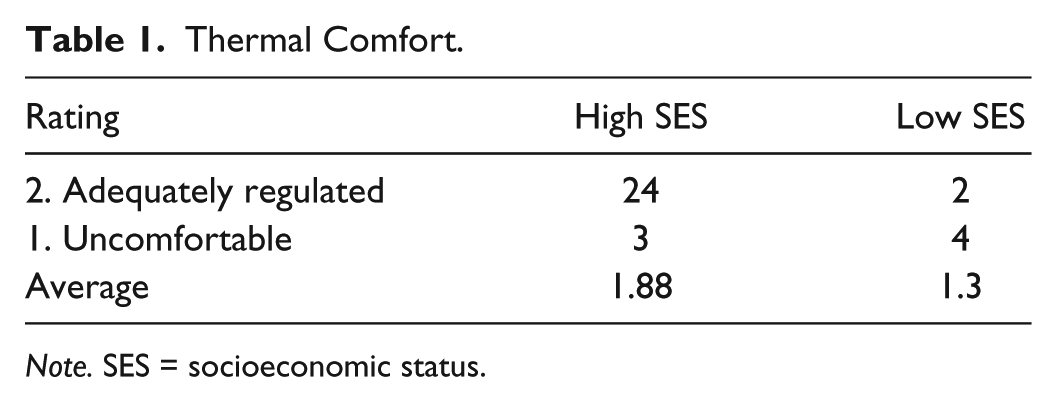
Temperature in child care centers is the most adequately regulated component. Head Start and child care centers that had difficulty with heating and cooling tended to be in older buildings that were originally intended for other purposes. The most significant problems were in a Head Start building that was located in a decommissioned school building. In this building, inside temperatures were too warm in the summer and too cold in the winter. A child care center had a wall of unshaded windows, so the indoor temperature was far too high. All of the child care centers and Head Start centers had air conditioning in the summer, and air conditioners were adequately maintained. The child care and Head Start center directors and teachers usually did not know how old the air conditioning systems were unless they had been replaced recently. The scale for thermal comfort had 2 points with 1 being uncomfortable and 2 being adequately regulated. Table 1 presents results.
Thermal Comfort.
Note. SES = socioeconomic status.
Lighting
There was no difference in the lighting among any of the child care or Head Start centers; they all had florescent lighting, and they did not make use of natural light.
Windows and Indoor Air Quality
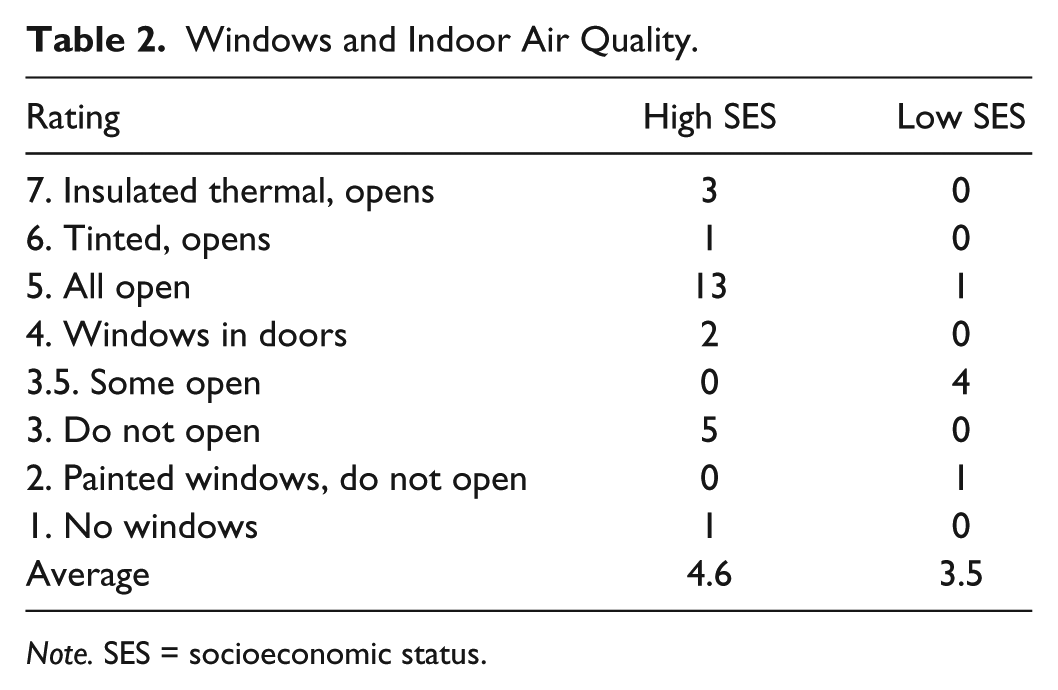
Ratings on the scale for windows in classrooms follow (1) no windows, (2) painted over windows, (3) windows not opening, (3.5) some of the windows opening, (4) windows in doors, (5) all windows opening, (6) windows opening and tinted, and (7) insulated thermal windows. Most of the child care centers and Head Start centers had windows in classrooms. Indoor air quality and ventilation were better in centers with windows that could be opened to allow fresh air in. Eight of the Head Start and child care centers had windows in several classrooms that were unable to be opened because the building was designed for another purpose or the windows were no longer operable. In an additional three child care and Head Start centers, some of the classrooms had windows that opened, and some did not. The center that had the most non-functioning windows was the Head Start center in the decommissioned school building. One child care center was in an old gymnasium with very high windows that could have been opened but were not because it was too inconvenient. Another child care center was in a church that had a wall of windows that were not designed to open, and heat accumulated when the sun shone through them. The windows in some child care centers were located in the doors that were kept locked for safety. The remainder of the centers had windows that allowed for intermittent fresh air. In every classroom in one particular high-SES child care center, there were new, insulated windows that opened. One Head Start center had screen doors in addition to regular doors. In one child care center that was originally a horse barn, air quality deteriorated when ceiling tiles were disturbed because dust from leftover horsehair and dander would drift into the classroom. All but one center used pest control services, which may use child-safe traps or sprays. Licensing regulates cleaning in all the child care and Head Start centers, and, in this researcher’s opinion, staff worked diligently to keep the centers clean and free from unwanted odors. Table 2 presents results.
Windows and Indoor Air Quality.
Note. SES = socioeconomic status.
Windows Providing Outside Views
Child care and Head Start centers varied a great deal as to whether the children had an outside view. Outside views provide children the opportunity to watch the sky, rest their eyes, or just let their thoughts wander. Ratings on the scale for windows providing views follow (1) no outside view; (1.5) some classrooms in the child care or Head Start center have windows with an outside view, and some do not; (3) windows are covered with blinds the entire day, which obscures any outside view; and (3) children can see outside most of the day. Table 3 presents results.
Windows Providing Outside Views.

Note. SES = socioeconomic status.
Shade Trees
Ratings on the scale for shade trees follow (1) no shade, (2) partial shade, and (3) enough shade. In general, centers were built so that the front of the building faced the road rather than the direction that would take advantage of sunlight. Trees were planted based on where there was space rather than on where they could best provide shade. Parking lot size and playground space likely contributed to whether buildings had adequate shade. At least one center had no trees, bushes, flowers, or grass near the building, and its playground was covered in recycled rubber, which served as padding. Table 4 presents results.
Shade Trees.

Note. SES = socioeconomic status.
Acoustics
The State of Maryland requires 35 ft2 (3.25 m2) of classroom floor per child, and small classrooms at capacity were fairly loud at times. In some of the older child care and Head Start centers, noise carried through the halls when classroom doors were open, and, in some Head Start centers, noise carried through the walls due to a lack of proper sound insulation. Most ceilings were suspended with acoustical panels, and most walls were drywall. Two child care centers had carpet on the walls to help with acoustics. Many classrooms had both tile and carpet flooring. One private child care center and several Head Start centers were in pre-fabricated buildings, and the sound of people walking carried to other areas because of structural vibration. A few Head Start centers had noisy terminal fans in their Heating, ventilation, and air conditioning (HVAC) systems. Paper bulletin boards (which do not muffle sound like cork and fiberboard bulletin boards) were more popular in Head Start centers. Ratings on the scale for acoustics follow (1) very noisy both in the classroom and throughout the building, (2) noise contained in the classroom, (3) some echoing but otherwise fairly quiet, and (4) mostly quiet. Table 5 presents results.
Acoustics.

Note. SES = socioeconomic status.
Outside Noise
Low noise levels outdoors are fairly common in the semi-rural communities in the study area. However, some areas are noisier than others. Considerable outside noise affected four of the classrooms in a child care center near a hospital and a fire station. The portion of this center that was designed as a bomb shelter was not affected. Most of the child care and Head Start centers were far enough away from four-lane highways to avoid traffic noise, or they were on two-lane roads with minimal traffic. The noise of children playing on playgrounds can be louder than nearby highways according to a California State Highway Department employee who did environmental impact studies on future highways in southern California in the 1970s (R. Satterlee, personal communication, November 18, 1973). All of the centers experienced constant, low-decibel background noise from high-flying airplanes and occasionally louder noise from low-flying airplanes, helicopters, or trains. Ratings on the scale for outdoor noise follow (1) noisy, (2) some noise, (3) low noise. Table 6 presents results.
Outside Noise.

Note. SES = socioeconomic status.
Outdoor Air Quality
In general, outdoor air quality was high. Lichen growth on most trees indicates that the air is clean (Showman, 1975). At times, pesticides from nearby fields would get into the air. (Low-flying airplanes dispersed some weed- and insect-control chemicals.) During some seasons, the pollen and leaf-mold levels were quite high and caused problems for asthmatic children. To document outdoor air quality, samples need to be taken at different times of day and during different seasons because wind, weather, time of day, and season affect air quality and because pollutants come from a variety of sources (e.g., automobile exhaust, particulates from vehicle brakes, and methane from chicken manure). However, sampling at different times of day and in different seasons was beyond the scope of this project.
Flooring
Floor materials varied among the centers. The floors in centers in more affluent areas were a combination of carpet and an easily cleaned material, such as vinyl tile. Other centers had vinyl tiles, linoleum over concrete, or wood flooring with area rugs to define play spaces. Staff cleaned floors frequently in all centers, and floors in some of the older centers were worn from such frequent cleaning. Carpet thickness varied as some had padding and some did not. Centers in pre-fabricated buildings with wood flooring tended to be noisier than centers with carpet and linoleum over concrete. Walking on wood floors is more comfortable and safer in case of falls, but concrete underlayments are quieter. Flooring varied significantly across several dimensions (e.g., carpeting thickness, flooring materials, and the ratio of bare floor to carpet). Also, flooring varied more by classroom than by center. Individual scores were not calculated because researchers were unable to obtain accurate measurements for the ratio of bare floor to carpet.
School Readiness Scores
Overall, the county with the highest income level had the highest kindergarten readiness scores (Maryland State Department of Education, 2014b). The state-published scores for the three counties were combined to obtain a statistically significant number and to maintain centers’ confidentiality. Children who attended private preschool programs, family child care homes, and informal care were excluded.
Of kindergartners in the three counties who attended child care, Head Start, or public pre-K programs, 88.7% scored “fully ready.” Table 7 provides a visual comparison of kindergarten readiness scores.
Kindergarten Readiness Scores in the Study Area Compared With Scores in the Whole State of Maryland in 2014.
Synthesis
Kindergarten readiness scores indicate that children in the study area who attended Head Start scored a standard deviation below children in Maryland overall. In the study area, kindergartners who attended child care centers had higher scores than kindergartners who attended public pre-kindergarten; kindergartners who attended public pre-kindergarten had higher scores than kindergartners who attended Head Start centers.
All of the environmental factors previously mentioned impact all of the children, but parents of higher SES enrolled their children in centers that protected them from many of the negative environmental factors. These centers tended to have intermittent fresh air and better acoustics. The buildings were newer and more specifically designed for children; however, all centers complied with child care regulations for buildings (Maryland State Department of Education, n.d.).
The children from families of lower SES tended to be more adversely impacted by noise pollution and decaying buildings. The centers were often in very old, pre-fabricated buildings. Noise from walking on the wooden floors reverberated throughout the buildings, and noise easily traveled between adjacent classrooms. The noise volume might not be as important as the emotional content of the noise; a child crying would be more disconcerting than playing or singing children. Worn indoor and outdoor carpets often covered approximately half of each classroom floor with linoleum tiles covering the other half. The classrooms were small, and the classrooms were at maximum capacity. Windows, when present, rarely opened, and they were usually single-pane windows rather than double-pane, insulated windows. The classrooms tended to be warmer in summer and cooler in winter.
Centers tended to be located near residential areas for parents’ convenience. Head Start provides bus transportation for children and requires that bus rides take less than 1 hr. By necessity, Head Start centers are located near population centers wherever building sites can be found. Schools that have been declared unsuitable for school-age children are often used as child care or Head Start centers. One center was in a former private school, and another center was a former public high school. Many of the centers were housed in buildings that were originally intended for child care, although two of the centers were located in buildings originally constructed to stable horses. Another center was in a former warehouse. One center began in a very old school building, which was later declared unsafe and demolished. The center relocated to another decommissioned school, which closed in fall 2014 due to flood damage from a hurricane. The data for this center were collected from the building that was flooded in 2014. The center has since relocated to a church that is also a child care center. The town in which this center was originally located is in an area where many families of lower SES live due to the collapse of the blue crab and oyster industries. A new center is under construction at the time of writing. Pre-fabricated buildings that house several other Head Start and child care centers passed licensing inspection; however, they seemed flimsy, and some had minimal insulation.
Children in informal care and family child care settings, particularly those who lived in counties with higher levels of poverty, scored lower on the kindergarten readiness assessments. Children who attended private pre-kindergarten programs had higher scores (Maryland State Department of Education, 2014b). Environmental quality of family-care homes was excluded for the following reasons: (a) the education level of many caretakers was unknown, (b) their locations were difficult to determine, and (c) sites varied too much to adequately characterize from a small sample. The authors visited many such sites and found that they varied significantly. The sites varied widely in terms of building structure, sound barriers, and light. The centers may occupy settings as diverse as a living room, a remodeled garage, or a converted porch. The building structures could be trailers, ranch homes, or Victorian homes or built in other architectural styles.
Discussion
Although most of the surveyed centers were, in this researcher’s opinion, struggling to comply with the minimum standards for building quality and IEQ, centers in the high-SES group were better able to protect children from many negative environmental factors than centers in the low-SES group. In other words, the socioeconomic level of each community is a determinant factor in children’s health and the quality of their education. These findings are limited by the fact that other factors than the physical environment contribute to readiness scores. Finally, this article contributes to literature by documenting and evaluating the indoor space and environmental quality of early childhood educational facilities in the study area.
The rising cost of building maintenance and energy and tightening school budgets exert more pressure on administrators who are attempting to improve their programs by either building new facilities as inexpensively as possible or by renovating existing ones. An important topic for future research is policy recommendations for creating physical environments that improve learning outcomes under these budget constraints.
Footnotes
Declaration of Conflicting Interests
The author(s) declared no potential conflicts of interest with respect to the research, authorship, and/or publication of this article.
Funding
The author(s) received no financial support for the research and/or authorship of this article.