




Abstract
In this article, we discuss the communicative functions of hashtags during a period of major social protests in Brazil. Drawing from a theoretical background of the use of Twitter and hashtags in protests and the functions of language, we extracted a sample of 46,090 hashtags from 2,321,249 tweets related to Brazilian protests in June 2013. We analyzed the hashtags through content analysis, focusing on functions, and co-occurrences. We also qualitatively analyzed a group of 500 most retweeted tweets to understand the users’ tagging behavior. Our results show how users appropriate tags to accomplish different effects on the narrative of the protests.
Introduction
During June 2013, Brazil was swept by one of the biggest wave of protests since the end of the dictatorship period in 1984 (Singer, 2013). These protests started as manifestations against the rise of the bus fare in Porto Alegre and Sao Paulo, organized by the Passe Livre (Free Fare) Movement (Saad-Filho, 2013). They were, however, sparse until June 13, when they gained momentum due to reports of police brutality in Sao Paulo. These reports, which showed injured protesters and journalists, triggered a substantial increase in media coverage. The images of this police brutality quickly spread through social media, leading to new and larger protests. 1 On June 14 and 20, more than 2 million people gathered in the streets of more than 200 cities in Brazil, around several demands such as the end of corruption, the suspension of FIFA’s Confederation and the World Cup, better public transportation system, and the end of law projects (Saad-Filho, 2013; Singer, 2013).
During these protests, social media and specially Twitter played a key role by allowing protesters to organize and spread their own narratives. Twitter also provided a platform to mobilize other users from different locations through hashtags (Bastos, Recuero, & Zago, 2014), helping spread the word from the people on the streets to social media audiences and often back again to the streets. However, Twitter’s role in the mobilization of the people and the spread of the protests in the country is still unclear. In this article, we aim to investigate a part of this role, focusing on the narratives created and changed by the usage of hashtags during the events. We aim to explore the roles played by different Twitter hashtags and their combination. Our objectives are directed to understand (a) the types and communicative functions of the hashtags used during the protests, (b) how co-occurrences of hashtags depict different meanings and functions, and (c) the tagging behavior of users as the events unfolded. To address these objectives, we collected more than 2 million tweets related to the protests using a set of 35 hashtags and keywords connected to the Brazilian protests. The data were analyzed using a combination of quantitative and qualitative methods, from content analysis to qualitative observation, as we will further explain.
Theoretical Background
Several works have discussed the role of social media in helping organizing protest movements and reporting protests around the world. Some researchers have shown that social media provides new ways of social organization and allows for new forms of protesting activity (Castells, 2012; Malini & Antoun, 2013), particularly because social media lacks traditional mediators (Gutierrez, 2013) and enables new forms of participation (Penney & Dadas, 2014), creating “new” decentralized and emergent movements (Castells, 2012). Toret (2012) argued that such movements have hybrid characteristics that turn personal issues into collective political processes, aggregating different political motivations into large social movements, which is similar to what happened in Brazil, where demands were not clear and the reasons why people were in the street were plural (Saad-Filho, 2013).
Segerberg and Bennett (2011) argued that globalization is partially responsible for these characteristics of what they called “personalization of collective action.” For the authors, social movements became more individualistic in nature, where people engage themselves in causes related to their own lifestyles, personalizing politics. This phenomena is directly connected to the choice of communication strategies (such as Twitter) and the decentralized nature of contemporary protests (Castells, 2012), as well as the stronger role of personal networks in these events (Segerberg & Bennett, 2011). These characteristics are also related to the reduced presence and role of conventional political organizations (parties, unions, etc.) because digital communication platforms play this part (Segerberg & Bennett, 2012).
The role of social media as an alternative source of information, acting in a peer-to-peer basis in mobilizing users, was also explored. Tufekci and Wilson (2012) interviewed protesters in Egypt and showed that Facebook and social media provided an alternative source of information for people under the authoritarian regime in the country, along with the means to organize themselves, thus allowing these ideas to spread. Similarly, Storck (2011) argued that social media provided alternative press and awareness for people in Egypt and contributed with political mobilization. Social media thus allows discourses that are not shown in traditional media to arise and spread, mobilizing users around these different topics, creating and spreading new and multiple narratives (Poor, 2005).
Twitter and Protests
There is a growing literature about the role Twitter is playing in these new protests around the world. Some authors (Shapiro, 2012) refer to them as “Twitter Revolutions,” arguing they were in several ways triggered by Twitter users through Twitter. The tool enables user to participate in different ways, both by creating and spreading information directly to other users. Penney and Dadas (2014) discussed Occupy protests and explored these roles, arguing that the platform allows for (a) facilitating protests off-line, (b) live online coverage, (c) spread of information and hyperlinks, (d) expressing different opinions about the events, (e) getting involved in debates about the protests, (f) connecting with other activists, and (g) facilitating online actions. Gleason (2013) studied the Occupy movement and the different opportunities Twitter creates for participation as well, particularly through hashtags. The author explored how the content created and shared by users help them learn about the movement, explaining the particular affordances in Twitter, such as multimodal content and real time search, for example, may be connected to the user’s participation.
Researchers also examined the process of recruitment through social media. Gonzalez-Bailon, Borge-Holthoefer, Rivero, and Moreno (2011) examined how people were influenced in Twitter during the mobilizations in Spain in 2011 and found that there are different topological position for early protesters and influencers that trigger the information cascades. Lotan et al. (2011) analyzed the information flows during Tunisian and Egyptian Revolutions created by different actors and showed how Twitter not only amplifies their voices but also allows the narratives to be co-constructed. Twitter has also played a role in creating more localized narratives and has amplified the voices of those protesting on-site (Bastos et al., 2014; Croeser & Highfield, 2014).
The literature also includes research focusing on the role of hashtags during political turmoil. Vallina-Rodriguez et al. (2012) discussed the “Indignados” movement in Spain. The authors partially credit the rapid spread of the protests in Spain to Twitter and the use of hashtags. Segerberg and Bennett (2011) explained these “revolutions” have different ecologies and illustrate their argument with the analysis of two different hashtags showing the different “protests” they depict. Beyond connecting the narratives, however, the literature has not explored systematically the roles different types of hashtags play during political events. In the next section, we will briefly cover previous research about general tagging behavior and hashtags in particular.
Hashtags and Tagging Behavior
Hashtags are keywords or brief sentences posted on Twitter preceded by the “#” sign. They are used to contextually mark Twitter’s conversations around a certain topic (boyd, Golder, & Lotan, 2010). However, their appropriation by Twitter users also suggests other contexts and functions. Because Twitter falls into the definition of a “social tagging system” (Marlow, Naaman, boyd, & Davis, 2006), it allows users to participate in creating and sharing a particular resource through tags. These resources can be multiple because their meaning is socially constructed. Therefore, hashtags have several functions beyond marking context.
Huang, Thornton, and Efthimiadis (2010) studied tags in Twitter and Delicious and classified them as organizational and conversational types. While the first one focuses on organizing resources, the second is focused on conversation, the tag itself carrying an important part of the message. According to the authors, this second group is more prevalent in Twitter’s tagging behavior. Further work provides even more ideas on the tagging behavior in Twitter. Page (2012) discussed hashtags as visibility mechanisms, not just contextual markers. Recuero, Amaral, and Monteiro (2012) showed that fans use tags to publicly support their idols and gain visibility. Finally, Diaz-Aviles, Siehndel, and Naini (2011) argued that tagging behavior in Twitter is more related to filtering and directing content to specific audiences, where the tag itself is part of the message. Thus, hashtags have an important role in creating visibility for a message and also, can be the message themselves, not only marking context but also changing and adding content to the tweet.
In the previous section, we reviewed the literature on protest movements organized through social media and how the latter, specially Twitter, arguably influences events on the ground. The role hashtags play in these events and how tagging behavior works is, however, less studied. Bastos, Raimundo, and Travitzki (2013) claimed some hashtags in protests have different roles such as “pamphleteering,” which relates directly to the visibility characteristic discussed by previous authors also adding a layer of mobilization to the tag (similarly to what Vallina-Rodriguez et al., 2012, argued). Barash and Kelly (2012) discussed the different roles of political hashtags and showed that different semantic tags were used in different ways by Twitter communities in Russia, having thus different dynamics. However, none of these works focused on hashtags from a linguistic and communicative point of view, discussing how their functions may help understand their usage. These works shed light into the role of hashtags during political protests. However, to the best of our knowledge, no systematic attempt to categorize the different communicative roles played by hashtags has been presented. In the following section of this study, we discuss these roles in detail by relying on theories of language.
Functions of Language
Roman Jakobson (1960) is a central reference in the Prague Linguistic Circle. He created a model of the communication process that ties together both communication and linguistic functions. The model is a classic work in linguistics and has been deployed in a range of disciplines. Although it is criticized by many authors (Shapiro, 2012), the model provides a starting point to discuss how hashtags create meaning and how their different functions influence tagging behavior online.
Jakobson’s (1960) model of the functions of language is built upon six elements that are necessary for every communication to occur. Every communication between two actors needs (a) context, (b) sender, (c) receiver, (d) contact, (e) common code, and (f) message (Figure 1). Each of these elements may have a preeminent role on the process, and each communication may have a different function. Thus, there are six key functions to the language: the referential function (where the context is the focus of the interaction), the emotive or “expressive” function (where the focus is on the sender and what he or she wants to express), the conative function (where the focus is on the receiver and the action the sender wants him or her to take), the phatic function (focusing on the contact/channel aiming at understanding whether the channel works), the metalingual function (which focuses on the code used), and finally, the poetic function (which focuses on the message itself). These functions help the analyst to understand what is important in each message and how the message is conveyed. To Jakobson, a single act of communication may have several functions, albeit one is typically more preeminent.

Jakobson’s model.
In social media context, Radovanovic and Ragnedda (2012) discussed the phatic function related to the need to communicate and to keep in touch with other people in Facebook and Twitter posts. In this work, they classified types of phatic posts, showing how users constantly use this type of information to check whether others are there and whether they are visible. Miller (2008) also discussed the importance of this function in online media in general. However, literature focusing on these functions on Twitter is still forthcoming.
Jakobson’s model is appropriate for the purposes of this study because it pays particular attention to language in mediated environments and addresses the role played by the channel as a fundamental part of the communication process. Social media is a channel and language has to be negotiated so users can make sense and appropriate the medium for their own purposes. Contentious communication is no exception to this. Jakobson’s model also helps us to unveil how hashtags may play a bigger role than simply being a contextual (boyd et al., 2010) or an organizational and conversational function. When used for activism and political participation, hashtags may assume different roles and have different communication functions to help users make sense and influence others in times of turbulence.
Method
During the Brazilian protests of June 2013, we monitored and collected a data set of 2,321,249 tweets related to the events. The period of data collection comprehends June 13 to 20, which was the most active period of the protests (Bastos et al., 2014; Singer, 2013). The original data set used in this article was thus created through the archival of 35 keywords and hashtags related to the protests using the open-source platform yourTwapperKeeper (2012). Data collection also relied on keywords used by protesters and observers, such as “protest” and “protests,” “manifestation” and “manifestations,” and so on (see the appendix). Relevant keywords were subsequently added to the corpus as new entries to the open-source platform yourTwapperKeeper. A more detailed account of the procedures used for data collection is provided elsewhere (Bastos et al., 2014).
As previously discussed in the article, our primary objective is to describe the role hashtags played during the protests in Brazil. This objective is divided into three specific goals: (a) to understand the types and functions of hashtags used during the protests, (b) to examine how co-occurrences of hashtags depict different meanings and functions, and (c) to describe tagging behavior of users during the protests. To discuss these objectives, we first describe the data collected and rely on content analysis to classify the functions of hashtags and their co-occurrences (Krippendorff, 2013). To this end, we subsampled the data and applied a qualitative coding procedure to the 500 most retweeted tweets in the data set that identified tagging behavior within co-occurrences of the categories of hashtags. The sample size was defined according to the possibilities of human coding and aimed at providing an overview of the context where hashtags were used.
Data
In the original database of 2,321,249 tweets, 56.3% (1,306,847) of them did not contain any hashtag. There were 567,623 (24.5%) with one hashtag and 19.2% (446,779) with two or more hashtags. The distribution of hashtags per tweet is shown in Table 1. The total number of occurrences of hashtags in the database was 1,868,427, and the total number of unique hashtags was 77,074.
Distribution of Hashtags per Tweet in the Data Set.

From the original set of tweets, we selected a subset covering the 1,040 most frequent hashtags (the ones that appeared more in the total number of unique tweets) which accounted for 85% of the total of unique occurrences (Figure 2) with a total occurrence of 1,605,816. These hashtags were manually categorized by two independent coders based on their linguistic and communicative perceived functions according to Jakobson’s (1960) model using Content Analysis (Krippendorff, 2013). Content Analysis is a method for textual analysis based on classification and codification of elements and parts of texts, often described as “quantitative,” “objective,” and “systematic” (Neuendorf, 2002, p. 1). 2 Jakobson argued that a single message may have all functions present. For analytical purposes, thus, Hébert (2011) explained the analyst needs to establish a hierarchy between the functions by “identifying the dominant function” (p. 1). Our criteria were based on the question, “What is the purpose of this message?” which coders applied by consulting the usage of each tag in the tweets from the data set. We thus qualitatively consulted at least 10 tweets per tag to get a better understanding of their usage. To check for reliability of the classification between the coders, we used Krippendorff’s alpha, which was .76 (Krippendorff, 2013) with a reliability of 82.3%, which is considered good.

Cumulative distribution function of total number of hashtags in the database.
In addition, as we can see in Table 1, there are many tweets with more than one hashtag. To better explore hashtag functions, we also analyzed co-occurrences of hashtags. For this second part of the analysis, we extracted a random sample of 45,000 tweets from the total number of tweets with two or more hashtags (446,776). The sample includes 46,090 unique pairs of different hashtags and a total of 118,906 co-occurrences (Figure 3). Of these co-occurrences, 1,270 were used at least 10 times and are responsible for 47% of all co-occurrences. The few hashtags appearing in this subset that were not categorized in the previous analysis were coded using the same methodology.
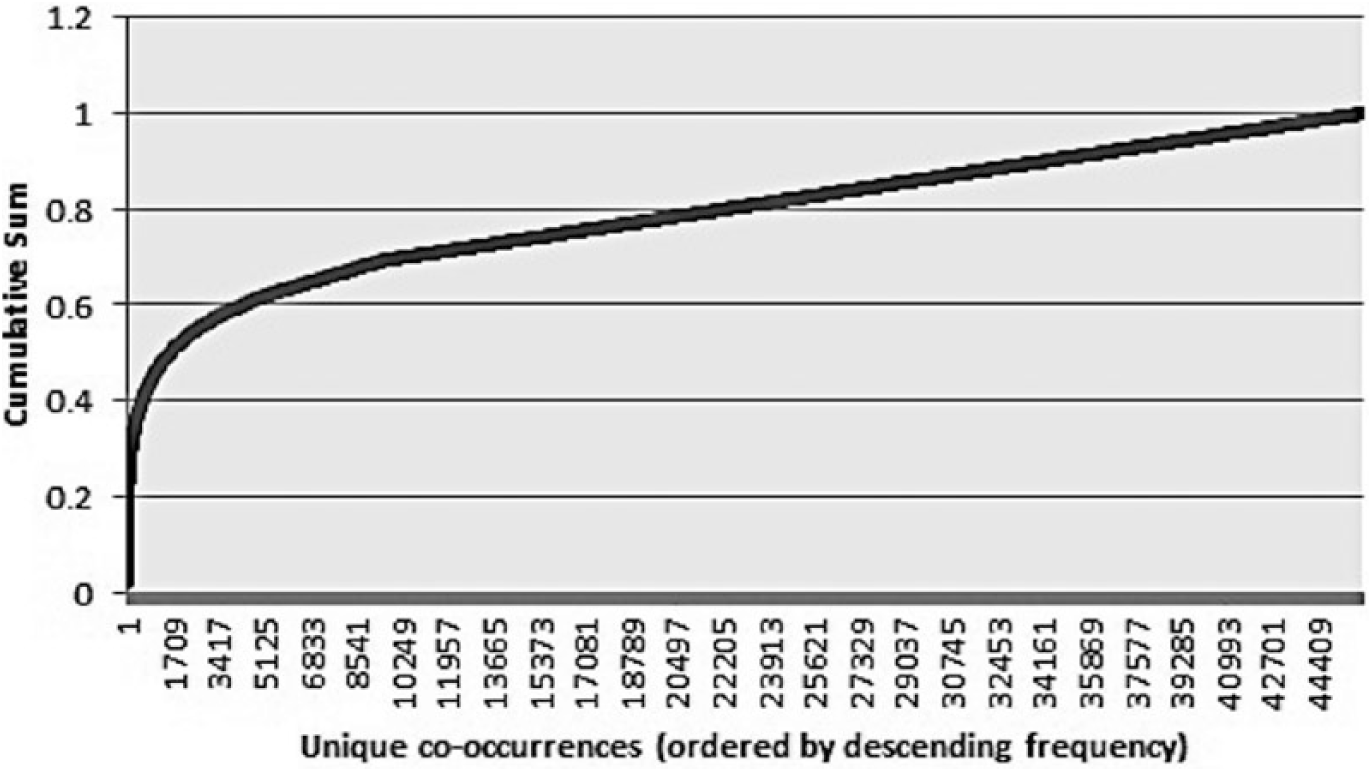
Cumulative sum of co-occurrences of hashtags.
Finally, we also analyzed qualitatively the 500 most retweeted tweets that used hashtags from the original data set, with a total of 278 hashtags co-occurrences. We analyzed the tweets focusing on the (a) meaning of the messages and (b) general context of the tweet through a case study (Creswell, 2006), aiming to provide more context to the quantitative analysis. This group of tweets was the base for the discussion of users’ retweeting behavior and will provide the examples we will further use in this article. Tweets were anonymized. All the tweets we analyzed in this work were originally composed in Brazilian Portuguese 3 and translated to English for the purposes of this report. As native Portuguese speakers, we translated every hashtag and tweet aiming at keeping the original meaning and context. Thus, tweets such as “#cometothestreet Fight for a fairer Brazil #changebrazil” were originally “#vemprarua Lute por um Brasil mais justo #changebrazil.” We kept the words that were originally in English and translated the remainder from Brazilian Portuguese into English.
Analysis
Types of Hashtags
We classified the hashtags according to their function on Jakobson’s (1960) proposal of language functions. In this section, we present the analysis focused on hashtags that presented agreement between coders during the classification process.
We classified as
Finally, we also found
There were also incomplete hashtags, hashtags from other protests, and hashtags not at all associated with the protests (frequently from spammers). We discarded these data because our main focus in this article is to discuss protests happening in Brazil (see Table 2).
Number of Hashtags and Occurrences per Type.

The proposed classification, once validated, was further applied to the second step that we detail next. In cases where a hashtag performed more than one function, we classified them under the strongest one (Jakobson, 1960). (Table 3 shows the total number of occurrences and unique occurrences of hashtags in each category.) The frequency of these different hashtags shows that the tags had more than a contextual function during the protests. On average, each unique hashtag occurs from a few hundred times to thousands of times, showing that hashtags are often co-opted by users. Conative hashtags were by far the most frequent category by total number of occurrences, followed by Referential and Emotive. Unique occurrences show a similar pattern, but it can be seen that Referential tags are more diverse than the other categories, showing the importance of adding a localization context to the tweets. Emotive tags were also used, showing tags as forms of sharing an opinion. The presence of these functions may help understand Twitter as a public sphere for voicing one’s opinion, for mobilization, and for debate.
Occurrences of Hashtags Pairs for Each Category.

Note. CC = conative-conative; CR = conative-referential; RR = referential-referential; CE = conative-emotive; CM = conative-metalingual; RE = referential-emotive; EE = emotive-emotive; RM = referential-metalingual; MM = metalingual-metalingual; EM = emotive-metalingual.
Co-Occurrences of Hashtags and Tagging Behavior
We observed that hashtags often occurred together on the same tweet. Thus, we classified the co-occurrences of hashtags by combining each hashtag’s function. We chose to classify the co-occurrences in pairs as most tweets include less than three tags (Table 1). Based on these results, we created the notation: referential-referential (RR), referential-emotive (RE), conative-referential (CR), conative-emotive (CE), conative-metalingual (CM), metalingual-metalingual (MM), emotive-metalingual (EM), and referential-metalingual (RM). Table 4 summarizes the categorized data. In this section, we will present each type of co-occurrence and further discuss the user tagging behavior of each through qualitative examples obtained in the data set. Examples for this discussion were provided by the qualitative analysis.
Co-Occurrences of Hashtags Among the Most Retweeted Tweets.

Note. CR = conative-referential; RR = referential-referential; CC = conative-conative; RE = referential-emotive; RM = referential-metalingual; CM = conative-metalingual.
Group
The third group is the
The
The
The
The
The
By observing the unique co-occurrences, it is possible to see that we now have CR as the most frequent category, followed by CC and RR. This is due to the number of different hashtags used to localize the protests and the importance to localize the narratives among several protests that occurred at the same time. Context was always changing and the most popular hashtags are fairly similar (e.g., hashtags following the method of protest+city). However, conative hashtags are less varied. The most popular tags remained being used throughout the entire period of analysis.
Co-Occurrences in Most Retweets and Tagging Behavior
Finally, we qualitatively analyzed hashtag co-occurrences among the 500 most retweeted tweets. In this data set, we found 203 tweets with more than one hashtag, with a total of 307 co-occurrences (some tweets had more than two tags). These co-occurrences were further analyzed and are discussed in this section (see Table 4). Even though there were more than two tags in some tweets, we analyzed tweets by co-occurrences of two by two categories as the previous analysis.
The most retweeted tweets were specially focused on the live narrative of the protests, frequently by protesters themselves, celebrities, and the media. Both referential and conative hashtags were the most used types, followed by metalingual (mostly media signatures) and emotive. The most retweeted tweet with co-occurrences was from a media outlet, “TerraAoVivo” (TerraLive), and said, “Manifestants sit down in Berrini (a street in Sao Paulo). Police also sits down and is applauded. [link] #Terralive #protestsp” (765 retweets). Hashtags in this tweet have different functions. The first one is a metalingual tag, a media signature. The second one localizes the event the tweet is covering (context). While the signature adds credibility to the information (it is from the live coverage of a media outlet), the second one adds context. Live tweeting is also an important evidence of how Twitter allowed users to create and share their own narratives of the protests, using hashtags to personalize them (as Segerberg & Bennett, 2011, 2012, discussed).
Hashtags co-occurrences were very similar to what we described before, in the larger data set. The majority of co-occurrences was within CR group (123 co-occurrences), such as “RT @userH It started! They are shooting people with rubber bullets in Rio [link to a media transmission] #cometothestreets #protestrj.” As we pointed before, conative tags were used as motivation tags to inspire other users to go out. Thus, these tweets were often comments from people who seemed to be watching the manifestation and from people from the streets. Examples are “RT @userX The police is throwing bombs from helicopters! Is this a war? #protestbh #cometothestreets” (this tweet was sent by a group covering the manifestations live) and “RT @userR Riot police attacked the protesters and threw bombs even inside the Sao Cristovao station [metro]! #protestrj #changebrazil.” This usage also points to the idea of personalization of collective action that Segerberg and Bennett (2011) discussed. As Twitter allows users to create personalized narratives to their own contexts where the protests are happening, the role of the tool seems to be increased as a key player in the organization and diffusion of the events. This enables users to create and share their own vision about the events (Poor, 2005).
The second most preeminent category was RR (80 co-occurrences). This category seemed to be populated by tweets from users in the streets live tweeting the event. For example, “RT @userR You won’t believe, but right now there are no political [parties] flags in the manifestation! We expelled the PSTU [a Brazilian party]! #protestsp #protestbr.” This tweet was sent by a tech celebrity in Brazil who was live tweeting the protest (several of his tweets are among the most retweeted). Another example is “RT @userT Police confiscating cell phones and cameras from protesters for no reason in Rio de Janeiro #protesrj #brazilprotests.” This tweet was sent by a group who was also live tweeting the protests in Rio de Janeiro. Some of the co-occurrences in this category were redundant (two hashtags that described the same event—for example, #protestrj and #rj both refer to Rio de Janeiro and were used to localize the narrative). This may be due to the fact that users wanted to ensure that the audience following different tags would be able to receive their message or because users wanted to relate different protests in the same narrative. As protests in major cities were given more attention by the media and the audience, this strategy may have been used to make smaller protests more visible (Poor, 2005).
Category CC had 35 co-occurrences and was used among different tweets. For example, some people used these tags together with several other types of tags, probably in an attempt to add visibility to their tweet, such as “RT @userI And thou will see that a son of thine doesn’t flee from battle! #protestsp #cometothestreets #thegiantwokeup #freefare [link].” Some others used the tags to narrate the protests from the streets such as “RT @userH Police is throwing bombs from inside the palace [the police headquarters] #cometothestreets #changebrazil #protestsp.” We understand the difference found in this category to be related to how users focus on mobilizing other users at the same localization. Therefore, we believe both mobilization and localization of the narratives play an important role in this type of message, as pointed by Penney and Dadas (2014).
Category RE was next with 28 co-occurrences. Emotive tags, however, were not among the most used; they were present because of tweets with more than two tags. An example is “RT @userZ #allrevolutionsstartwithasparkle #downwithglobonetworkthepeoplearenotstupid #wakeupbrazil #thegianthaswakeup #protestsp #protestrj [link].” The same goes to the CE category, which has 16 occurrences due to tweets similar to the example.
Category RM mostly had media tweets; the metalingual hashtag was used both as a signature (RT @UOLNews It went down! The fare in Sao Paulo has decreased to 3 reals! [link] #protestsp #uolnews) and, sometimes, to describe the link in the tweet (RT @userK #live streaming from Largo do Batata [the place where protesters met in Sao Paolo]! #protestsp). This category was fairly present (23 co-occurrences) because among the most retweeted tweets, there were several from the media.
Categories MM and CM were not present in the data set. We believe these categories were not present in this data set simply because of the role Twitter played during the protests.
Thus, co-occurrences of hashtags seem to be related to (a) the personalization of the messages narrating the protests, specially focusing on the mobilization and the narration of the events in each place where they occurred; and (b) strategies to relate different protests, maybe to gain visibility or even to create a more unified narrative. This may indicate the hybrid nature of these events and how Twitter enables users to coordinate and act in different locations at the same time. This is especially important in a country so huge as Brazil.
Discussion
In this article, we focused on exploring and discussing the functions of hashtags during the protests of June in Brazil. We examined the frequency of hashtags types and their co-occurrences and the tagging behavior of user. We found that during the protests, Twitter hashtags performed several communicative functions that were not only focused on context, as boyd et al. (2010) previously indicated as the main function for hashtags. Sometimes, the main function seemed to localize the tweet or to mobilize the audience toward the protests. By creating a complex ecosystem of tags, users change the original meaning adding different layers of functions, often overlapped between each other. Thus, different types of hashtags performed specific functions that changed the original meaning of the message, by adding layers of opinion, calls for mobilization, or assigning meanings unrelated to the original message (see Table 5).
Functions of Hashtags During Protests.

The majority of hashtags used had both a conative function aimed at motivating and mobilizing users and a referential one aimed to localize the event (the CR category). This may be expected because these tags worked as pamphlets similarly to what Bastos et al. (2013) previously reported. However, the co-occurrence of conative tags with referential ones is something new. Probably because there were many protests occurring in several places at the same time (Bastos et al., 2014; Singer, 2013), this co-occurrence seem to be a way to focus the narrative and mobilize specific audiences within Brazil. Also, conative hashtags tend to co-occur with other conative hashtags, highlighting the mobilizing role of Twitter and acting as a vector to persuading more people to protest as pointed out by Vallina-Rodriguez et al. (2012).
Another category greatly used was the referential hashtags. Although they refer to context, the most used ones refer to particular contexts, often localized ones. Thus, their role was not only to provide context but also to allow users to access information related to a particular context. This is a more organizational function in the sense discussed by Huang et al. (2010). Referential hashtags also played a very important role in live coverage of the events (one of Twitter’s functions in protests, according to Penney & Dadas, 2014, by organizing the narrative toward different cities and audiences). Among the most retweeted tweets, referential tags were always present, helping to contextualize the tweets (often sent live from the site of the protests). When used with conative tags, the pair works as a pamphlet and mobilize specific areas. Because of these characteristics, referential tags were also important for live tweeting the events and amplifying the voice of protesters (Bastos et al., 2014; Croeser & Highfield, 2014). Referential tags could, thus, create separate streams of conversation to each protest happening in each state of city and help organize the information stream of local events (as we observed through the usage of the tags #Protest+city). Combined with other types of tags, referential hashtags could add the mobilization layer (when combined with conative tags), add the opinions and the demands layer (when combined with emotive tags), or simply add signatures or descriptions of the content (through the metalingual tags) both to people at home and in the streets.
Emotive hashtags were mostly about demands. It is important to notice that because these demands were showed through tags, they could gain visibility and support among other protesters in other parts of the country (Page, 2012) by the adoption or not of the tag. However, when used with other types of hashtags, such as conative, they acquire new functions, such as motivation and pamphleteering. So a tag such as “#dilmaout” put together with a “#cometothestreet” urges people not just to protest but to protest against Brazilian President Dilma Rousseff in a more broad context (not only in a localized protest). On the contrary when used with referential tags, emotive tags would tie the demand or the opinion to a local context, often creating a specific demand to a protest in a certain locality.
The functions Twitter provides protesters (Penney & Dadas, 2014) cannot happen all at the same time. For Twitter to work as a communication tool, users need to find a way to organize the flow of messages. Those two categories (referential and conative) were by far the most used, mostly because of the functions they create during an event like a protest. While referential tags organize the flow, conative tags keep people engaged and mobilized. Emotive tags showed support and added demands and critics to the conversation.
Finally, metalingual hashtags were mostly used to characterize the information posted (conveying the code) such as #instagram to indicate part of the information was in the site or to indicate the link posted was a video (#video). Other function was to “sign” the message, identifying the content provider. Media often used this function. When metalingual hashtags were used with others, they usually retained their function but added a narrative focus (when used with referential tags) or a mobilization one (when used with conative tags).
Among the most retweeted tweets, we saw a similar pattern, with an emphasis to the categories CR (the most preeminent), RR, and a large number of RM. The RR category was mostly used by live users narrating the protests in an attempt to localize the events. The CR category was used by different users both to localize and to mobilize others to protest. Finally, the RM category was present mostly due to the presence of tweets from the media, which were largely retweeted. These results reinforce the categories from the other data sets.
A summary of these findings is shown in Table 6.
Summary of Findings.

Note. CC = conative-conative; CR = conative-referential; RR = referential-referential; CE = conative-emotive; RE = referential-emotive; EE = emotive-emotive; CM = conative-metalingual; RM = referential-metalingual; MM = metalingual-metalingual.
This usage of hashtags also adds a layer of personalization to each tweet related to the protests, helping users to create personalized actions, as argued by Segerberg and Bennett (2011). The usage of these hashtags analyzed through Jakobson’s model also provides some insights on how people personalized their messages and the nature of collective action during the protests in Brazil. The larger number of CR and RR is evidence to the localization and mobilization as strategies for protests to happen in different cities and the role Twitter plays as an organization platform, which may have allowed the protests in Brazil to happen in the decentralized way they did (similarly to what Segerberg & Bennett, 2012, argued). Through analyzing the functions of hashtags, we may have a glimpse on the hybrid nature of these events and how social media provides a platform for personalized communication.
Conclusion
This study provided a detailed analysis about how hashtags present different meanings to tweets in political contexts. We showed that during the protests in Brazil, Twitter hashtags had several communicative functions. Using a frequency, co-occurrence, and interpretative analysis of tweets published during June 2013, we explored and discussed how different hashtags had different functions that added to or changed the meaning of tweets.
To this end, we proposed a classification of hashtags based on Jakobson’s (1960) functions of communication and analyzed how users appropriate hashtags for political activism and participation. Based on this classification, we found that conative tags, which focused on mobilizing users, were the most frequent in the tweets. Referential tags, which referred to the different contexts of protest activity, such as cities where the events took place, were less common but more diverse.
We also identified that the largest amount of unique co-occurrences were between conative hashtags (which aimed at mobilizing users) and referential hashtags (which aimed at localizing the narrative). Brazil is a very large country, and there were several protests occurring at the same time; thus, hashtags were used to align different protests and connect them through this organizational narrative. Referential hashtags were important to the live coverage of the events. Conative hashtags were central to the narrative of the events not only because of their pamphleteering function but also because they tied together different local protests. CC co-occurrences were the majority of co-occurrences, thus highlighting how users mobilized each other through Twitter. CR co-occurrences show that this was also performed locally. Other types of hashtags were less frequent but also added information about demands and opinions. Hashtags were also often used to change the meaning of other tags or to add/reinforce demands and opinions.
The classification proposed and the results reported in this study shed light on the affordances of Twitter platform and how users create and share meaning during political protests. The usage of hashtags is an important form of political activism and mobilization through different audiences and narratives. By understanding how users rely on these markers as part of their message, we can understand the role Twitter plays in instances of political unrest and the strategies users create to spread their message. In this sense, Jakobson’s model provides an important contribution to understanding the function of the markers, which as shown in this study, are not simply contextual or narrative.
A caveat of this study is that the localization of the sample (Brazil) may have particularities related to how Twitter is used by the local user base. Nevertheless, the classification proposed may be informative for other studies focusing on political protests or other communication settings. Types and roles of hashtags may vary in different countries and languages, and these aspects can be further assessed in future studies.
Footnotes
Appendix
List of Twitter Hashtags and Keywords Associated With the Vinegar Protests.
| Vinegar | Tweets | |
|---|---|---|
| 1 | acordabrasil | 68,581 |
| 2 | brazilianspring | 358 |
| 3 | catraca_livre | 1,512 |
| 4 | catracalivre | 1,515 |
| 5 | changebrazil | 285,385 |
| 6 | chupadilma | 28,200 |
| 7 | contraoaumento | 7,167 |
| 8 | mudabrasil | 103,614 |
| 9 | obrasilacordou | 12,411 |
| 10 | ogiganteacordou | 181,511 |
| 11 | passe_livre | 41,810 |
| 12 | passelivre | 37,942 |
| 13 | primaverabrasileira | 4,460 |
| 14 | protesto | 2,210,304 |
| 15 | protestobh | 41,651 |
| 16 | protestobr | 30,683 |
| 17 | protestoce | 10,698 |
| 18 | protestoemvitoria | 1,899 |
| 19 | protestopelotas | 1,572 |
| 20 | protestopoa | 18,044 |
| 21 | protestorj | 114,557 |
| 22 | protestosp | 133,260 |
| 23 | revogaoaumento | 2,243 |
| 24 | saladuprising | 839 |
| 25 | sp13j | 6,366 |
| 26 | sp17j | 953 |
| 27 | tarifa | 455,756 |
| 28 | tarifa_zero | 3,767 |
| 29 | tarifazero | 2,166 |
| 30 | todarevolucaocomeca | 2,219 |
| 31 | todosjuntosporumbr | 3,578 |
| 32 | vdevinagre | 1,776 |
| 33 | vemprarua | 534,936 |
| 34 | verasqueumfilhoteu | 603,876 |
| 35 | vforvinegar | 179 |

Declaration of Conflicting Interests
The author(s) declared no potential conflicts of interest with respect to the research, authorship, and/or publication of this article.
Funding
The author(s) disclosed receipt of the following financial support for the research and/or authorship of this article: CNPq grant (408650/2013-3).