




Abstract
The study of social cognition involves the attribution of states of mind to humans, as well as, quite recently, to nonhuman creatures, like God. Some studies support the role of social cognition in religious beliefs, whereas others ascribe religious beliefs to an ontological knowledge bias. The present study compares these distinct approaches in 37 catholic children aged 4 to 10 years, who were administered an adapted version of the unexpected content task assessing false beliefs of different agents: a human, a dog, a robot, and God. The children were also administered an intentionality understanding task, a component of mentalization abilities, and an interview on ontological knowledge assessing emotions, intentions, imagination, and epistemic knowledge. In line with previous research, the results showed that children did not attribute false beliefs to God as they did to the human and to other nonhuman agents. Importantly, while false-belief attribution to the human was associated with the children’s ability to attribute mental states (intentionality understanding), false-belief attribution to God was related to children’s ontological knowledge. We conclude that, contrary to false-belief attribution to the human and to other nonhuman agents, children’s understanding of God’s mind is largely a function of ontological knowledge about God, rather than of children’s social cognitive functions.
Keywords
Introduction
The interest in studying the development of beliefs about God’s mind has been increasingly growing in the past decades (see, for example, Corriveau, Chen, & Harris, 2015; Heiphetz, Lane, Waytz, & Young, 2016, 2018; Heiphetz, Spelke, Harris, & Banaji, 2014), becoming a significant aspect of the cognitive science of religion (Brelsford, 2005), at which psychology, theology, education, and philosophy converge. Recent studies (Nyhof & Johnson, 2017; Richert, Saide, Lesage, & Shaman, 2017) have investigated the development of children’s conception of God’s mind and have found similarities across cultures and religious backgrounds. For example, Nyhof and Johnson (2017) showed that, regardless of religious background, children as young as 3 to 4 years hold comparable ideas of God, attributing to God special mental properties. Children then continue to learn about differences between God and humans, in line with their religious traditions. In the Christian catholic tradition, from very early in life, children are told about the existence of an extraordinary entity, God, that is conceived as all-powerful, all-knowing, and omnipresent because of his transcendental and immaterial nature. However, when referring to God as an entity with an intentionality, own thoughts, and will, God is also anthropomorphically described. With the present research, we aimed at deepening our knowledge about the development of children’s understanding of God’s mind by putting particular focus on attribution of false beliefs, and by specifically comparing two distinct theoretical approaches: the mentalization hypothesis, and the ontological confusion hypothesis.
The human capability to mentalize, also defined as “Theory of Mind” (ToM), has been studied for 40 years as a socio-cognitive function that enables individuals to think about others’ mental states, such as thoughts, intentions, motivations, desires, and emotions underlying behavior (Tomasello, 1999; see also, Frith & Frith, 1999). Through the attribution of states of mind, humans can predict and eventually manipulate others’ thoughts and actions (for a review, see Waytz, Gray, Epley, & Wegner, 2010). Children develop this ability during their early years of life and, specifically, they start recognizing that others have thoughts that can be different from their own at about 4 to 6 years of age and to acknowledge that these thoughts can be false (Wimmer & Perner, 1983). Only recently has the focus of studies of social cognition moved to the individuals’ ability to think about mental states of nonhuman creatures, such as animals, inanimate things, paranormal entities, and God (Gervais, 2013; Wigger et al., 2013; see also Giménez-Dasí, Guerrero, & Harris, 2005; Harris & Koenig, 2006; Wellman, 2017). As a matter of fact, people consistently use mental states to explain both human and nonhuman actions (Waytz, Gray et al., 2010). Supporting the mentalization hypothesis in false-beliefs attribution to the Divine, several contributions (Barrett, Richert, & Driesenga, 2001; Giménez-Dasì et al., 2005; Jack, Friedman, Boyatzis, & Taylor, 2016; Lane, Wellman, & Evans, 2012; Shaman, Saide, Lesage, & Richert, 2016; Wigger, Paxson, & Ryan, 2013) hence mantain that the development of the ability to mentalize may also lay at the basis of children’s attribution of beliefs to God. This approach, which links religious thinking to the human cognitive system (Barrett, 2012; Bloom, 2009), has been termed “theory of religious mind” (Wigger, 2016).
Children’s culture is populated by living and nonliving characters, which hold specific intrinsic properties that categorically define them (e.g., a dog is an animal with species-specific characteristics; a robot is built with metal). However, because of the way these charachters are proposed to children (e.g., dogs can talk; a robot can have a soul), they are susceptible of categorical trespassing. In this respect, and challenging the mentalization hypothesis, Lindeman, Svedholm-Häkkinen, and Lipsanen (2015) investigated how ontological confusions in core knowledge may predict religious and nonreligious paranormal attribution of beliefs in adult individuals. The term “core knowledge” refers to a set of ontological knowledge “that children learn universally roughly at the same age and mainly without instruction, and it is characterized as the backbone of our conceptual system, engendering, shaping, and constraining other conceptual understandings” (Lindeman et al., 2015, p. 65). Ontological confusion is a set of bias in knowledge about psychological, biological, and physical phenomena that would be possibly caused by categorical trespassing. When thinking of attribution of beliefs to different nonhuman entities, for example, human tendency to anthropomorphize both living and nonliving things could conceivably determine the confusion between psychological properties, which are human-specific. Comparing the ontological confusion hypothesis with the mentalization explanation to supernatural and religious beliefs, Lindeman and colleagues assessed mentalizing in adults using measures that were mainly related to empathic abilities, which are thought to lay the ground for the moral intuitions associated with religious reasoning (Boyer, 2003). The results of their study (see also Kiessling & Perner, 2014) suggest that ontological confusion, and not mentalizing, plays a decisive role as a predictor of beliefs in adults (see also, Astington, 1991; Moore & Frye, 1991). In particular, it was shown that core ontological confusions are tied up with both religious and nonreligious paranormal beliefs, as well as with beliefs in supernatural purpose, extending earlier findings (e.g., Barber, 2014; Svedholm & Lindeman, 2013) that show that the confusions predict religious and nonreligious paranormal beliefs better than mentalizng bias.
In the present study, we extended the ontological confusion idea to children’s understanding of God’s mind by comparing the mentalization hypothesis and the ontological confusion hypothesis in the attribution of FB to living and nonliving entities. Defending the mentalization hypothesis in false beliefs (FB) attribution to God, 4- to 10-year old Italian Christian catholic children were administered an intentionality understanding (IU) task (Astington, 1998), which can be regarded as a significant cognitive component of ToM abilities (Astington, 1991). It consists of asking children several questions with respect to intentionality attribution to a child depicted in a series of short stories. The ontological confusion hypothesis was assessed by evaluating children’s attribution of mental properties to different entities on the basis of specific ontological dimensions. In particular, we used an ad hoc version of a structured interview taken from Martini, Gonzalez, and Wiese (2016), in which children were asked to judge whether each entity held specific mental properties, namely, emotions, intentions, imagination, and epistemic knowledge. To be able to compare the mentalization and the ontological confusion hypotheses, children were required to have developed at least a first-order ToM, that is, children must have acquired a first-order recursive thinking that emerges at approximately 4 to 6 years of age (Corballis, 2007). Our sample was therefore divided into two age groups on the basis of the expected level of mentalization competencies (4-6 years; 7-10 years), with the younger children having supposedly acquired a first-order ToM and the older children having acquired more sophisticated mentalizing abilities that develop at about age 7 years (Astington, 1998; Hollebrandse, van Hout, & Hendriks, 2014; Itakura, Okanda, & Moriguchi, 2008; Wellman, 2017; Wellman, Cross, & Watson, 2001).
To assess FB attribution to different entities, we used the unexpected contents task (Perner, Leekam, & Wimmer, 1987), which is one of the most frequently used in studies about attribution of FB (Barrett et al., 2001; Giménez-Dasì et al., 2005; Lane, Wellman, & Evans, 2010; Lane et al., 2012; Shaman et al., 2016; Wigger et al., 2013). It consists of showing children a box, the content of which is cued by its label, and asking the children what they think there is inside it; when the box is opened and the children find out that the content is not what they had expected, they are asked what another child, unaware of the actual content, could think there is inside the box. Appropriately responding to the task means recognizing that the other child has an FB, and it indicates that the subject has acquired some mentalization abilities. Barrett et al. (2001) were the first to propose an adaptation of the FB task that included different agents: a parent, some animals (a bear, an ant, a snake, an elephant), an inanimate thing (e.g., a tree), and God. Further contributions have also included other animals, such as apes, monkeys, cats, dogs; inanimate things, such as rocks and dolls; and supernatural creatures, such as imaginary friends, superheroes, ghosts, and whispers (e.g., Knight, Sousa, Barrett, & Atran, 2004; Lane et al., 2010, 2012; Makris & Pnevmatikos, 2007; Wigger et al., 2013). In the present study, children were asked to attribute FB and mental states to God, a human agent (a child), a nonhuman living agent (a dog), and a nonhuman nonliving agent (a robot). The robot, in particular, has never been used in any of the studies cited above, although like animals that are typically anthropomorphized in fairy tells—such as dogs (e.g., Hight, 2017)—the robot is indeed a significant candidate for the attribution of human-like mental states. It is not by chance that robots have been increasingly studied, particularly with adults, as socially competent partners (e.g., Boucenna, Anzalone, Tilmont, Cohen, & Chetouani, 2014; Breazeal, 2003; Kanda, Hirano, Eaton, & Ishiguro, 2004) that hold human-like features (Kiesler, Powers, Fussell, & Torrey, 2008). Mind is in the eye of the perceiver, although characteristics of the entity being perceived also influence mind perception (Waytz, Gray et al., 2010). Entities that act unpredictably, for instance, recall the behavior of independent entities (Bering, 2002) and seem more mindful than entities that behave predictably (Waytz, Morewedge, et al., 2010). In line with this view, living nonhuman agents should be considered as more mindful than nonliving agents, although most recent studies (e.g., Lazzeri, Mazzei, Cominelli, Cisternino, & De Rossi, 2018) increasingly confirm evidence suggesting that humans tend to treat also nonliving entities, such as robots, as agents with some mentalizing abilities (for a review, see Marchetti, Manzi, Itakura, & Massaro, 2018). In this respect, it has been shown that even children aged 5 to 16 years tend to ascribe cognitive, behavioral, and especially affective characteristics to robots, assigning to them many animistic abilities (Piaget, 1951) which are more apparent in younger than older children (Beran, Ramirez-Serrano, Kuzyk, Fior, & Nugent, 2011; see also Melson et al., 2005; Weiss, Wurhofer, & Tscheligi, 2009).
The aim this study was therefore to assess what model (mentalization vs. ontological confusions) best predicts FB attribution to God with respect to other living and nonliving entities. Children aged about 4 years have previously been shown to be able to respond correctly to the FB task when assessing humans’ FB (Perner et al., 1987; Wimmer & Perner, 1983). With respect to God, in line with previous work (Barrett et al., 2001), we hypothesized that children, independent of age, would not ascribe FB to God, as opposed to what they would predictably do with respect to the dog and also to the robot. Additionally, and critically, on the basis of the results obtained with adults in Lindeman et al. (2015), we hypothesized that children’s attribution of FB to God—regarded as a supernatural entity—would be based on an ontological knowledge (OntKnow) bias, thus supporting the ontological confusion theory.
Materials and Methods
Participants
Thirty-seven Italian children (21 males; mean age = 7.03 years, SD = 1.90) were recruited in a catholic summer camp for children of a parish in the north of Italy. Recruitment was made by means of flyers addressed to parents by the Sunday school teacher. For the past 12 months, the children were exposed to the same religious education instructional material, all children being part of the same church. The sample was dichotomized into two age groups: 4 to 6 years (n = 19; 10 males; mean age = 5.37 years, SD = 0.56), and 7 to 10 years (n = 18; 11 males; mean age = 8.79 years, SD = 1.01), with the underlying assumption that these age groups would differ in terms of ToM competence, as introduced above. The caregivers were informed of the aim and procedure of the study and provided a written consent for their children’s participation in the study. The children were not reported by teachers or parents for learning and/or socio-relational difficulties.
Materials and Procedure
The children were tested in a quiet dedicated space. Each session was individual and lasted about 25 min. Administrations were carried out by a single researcher. The session started with the administration of the IU task (Astington, 1998), which was followed by the administration of a recognition test and an ad hoc OntKnow questionnaire that was drawn from the questionnaire described in Martini et al. (2016). In the recognition test, four cards depicting different agents—a child (a boy or a girl, in accordance with the participant’s gender), a dog, a robot, and God—were shown to the participants for recognition (see Figure 1). Although in the catholic tradition it is well known that God is disembodied, God is nevertheless typically pictorially represented with a human form; to facilitate the children’s recognition of God, we opted for an image of God used in the Sunday school. In the event that the child showed difficulties in recognizing the depicted character, the researcher stimulated the child with verbal cues, making sure that all children had the same basic knowledge of all presented characters. Once satisfied with the child’s recognition of the characters, the researcher invited him or her to answer eight ad hoc questions aimed at assessing the child’s OntKnow about each agent: Two questions addressed emotions; two questions, intentions; two questions, imagination; and two questions, epistemic knowledge (see Table 1 for a specification of the questions). Correct responses were scored 1, whereas incorrect responses were scored 0, for a total maximum score of 8 and scores ranging from 0 to 2 for each domain.
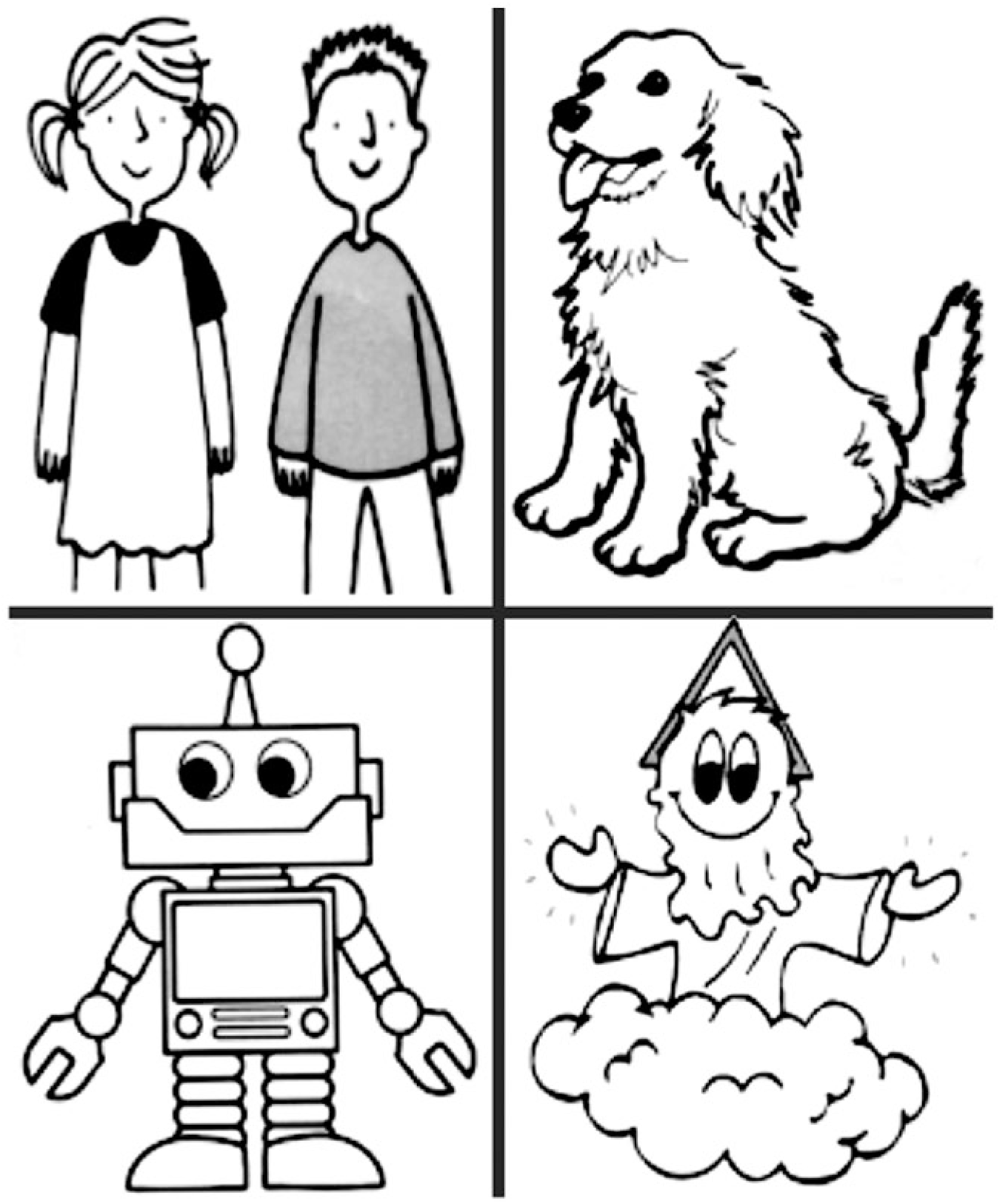
Stimuli used in the recognition test: Female or male child (top left) according to the participant’s gender, dog (top right), robot (bottom left), and God (bottom right).
Questions on Ontological Knowledge Attribution.

Finally, the unexpected contents task was used to assess the FB task. In this study, an adapted version of the FB task was used (Barrett et al., 2001), which included different characters (agents). The children were always presented with the image of the child first (a most plausible situation), whereas the presentation order of the other agents was randomized across children. In the FB task, the child (participant) was initially shown a box of crayons and asked what he or she thought the content of the box was (crayons). When the researcher opened the box, the child found out that the box was full of candies instead. After closing the box, the researcher started telling the story—while showing the corresponding image/character—when another child (or a dog, a robot, or God) suddenly entered the room. The test question consisted of asking the child what he or she thought that the other agent (the child, the dog, the robot, or God) would believe was inside the box. If the child responded crayons, he or she passed the FB test and scored 1; if the child responded candies, he or she failed the FB test and scored 0. A final control question was then asked to the child requesting him or her to indicate the actual content of the box (candies).
Statistical Analysis
The statistical analysis was performed with SPSS version 22.0. The IU task was assessed correlating (Pearson’s r) performance on the IU task and age (months). An independent t test was then carried out to compare differences in IU performance between the two age groups. Differences in performance on the FB and the OntKnow tasks were assessed, independently, as a function of agency and age group through a repeated measures general linear model (GLM). Finally, to support the mentalization versus the OntKnow hypotheses introduced above, correlations analyses were carried out between FB and IU performance, as well as between FB and OntKnow performance. To better clarify the effect of IU and OntKnow performance on FB attribution from a developmental perspective, four regression analyses (one for each agent) were carried out with performance at the FB task as the dependent variable, and age group, IU performance, and OntKnow as predictors entered, hierarchically, in three steps.
All of the continuous variables were normally distributed with skewness between −1 and 1. The homogeneity of variance was checked for all parametric tests, and eventual corrections are reported.
Results
Intentionality Task
The intentionality task was used to evaluate children’s mentalistic competencies as a function of age group. Generally, the children performed well at the intentionality task, with performance significantly increasing with age, as shown by the positive correlation found between scores at the task and age (months) (Pearson’s r = .43, r2 = .17, p < .01).
The inspection of the distribution of scores as a function of age showed that for children up to 6 years, the distribution was quite sparse, with scores ranging from 3 to 8, whereas all children older than 7 years were at ceiling (range: 7-8), highlighting a net cut-off between age groups. This distinction was further supported by an independent t test, comparing scores between the two age groups, which showed a significant difference between scores obtained from the younger children (4-6 years: M = 6.17, SE = 0.44) and the older ones (7-10 years: M = 7.72, SE = 0.11; t(35) = 3.44, p < .001).
OntKnow
To assess differences in children’s attribution of OntKnow to the different story characters (child, dog, robot, and God), a repeated measures GLM analysis was carried out, with four levels of agency (child, dog, robot, God) and four levels of OntKnow (emotions, intentions, imagination, epistemic) as the within-subject factors, and age group (two levels) as the between-subject factor. The Greenhouse–Geisser correction was used for violations of Mauchly’s Test of Sphericity (p < .05). The results showed a main effect of agency, F(3, 105) = 39.73, p < .001,
In general, the factor that most accounted for the explained variance in the model was agency (53%), indicating that OntKnow scores substantially differed with respect to the agent. In particular, post hoc analyses (Bonferroni-corrected) evaluating the main effect of agency showed significantly higher OntKnow scores for the child (M = 1.86, SE = 0.03) compared with all other agents (p < .0001) and the lowest OntKnow scores for the robot (M = 0.86, SE = 0.11), which were significantly different from the child (Mdiff = 1, SE = 0.12, p < .001), God (Mdiff = 0.79, SE = 0.13, p < .001), and the dog (Mdiff = 0.66, SE = 0.11, p < .001). The significant interaction found between agency and age group stemmed primarily from older children’s lower OntKnow attribution to the robot compared with the younger group (Mdiff = 0.83, SE = 0.23, p < .001; see Figure 2).

Graph showing the mean scores of ontological knowledge as a function of type (emotion, intention, imagination, epistemic) and agency (child—blue line; dog—red line; robot—green line; God—purple line).
With respect to the main effect of OntKnow, post hoc analyses showed that intentions received higher scores compared with both epistemic knowledge (Mdiff = 0.21, SE = 0.04, p < .001) and imagination (Mdiff = 0.23, SE = 0.06, p < .001). The interaction between OntKnow and age group showed that the main effect of OntKnow was mainly determined by the younger children’s higher scores—with respect to the older age group—on both epistemic knowledge (Mdiff = 0.22, SE = 0.08, p < .05) and imagination (Mdiff = 0.43, SE = 0.08, p < .001).
Finally, the critical interaction effect observed between OntKnow and agency revealed that God received intermediate scores in almost all tested dimensions (emotions, intentions, and imagination), except for epistemic knowledge, for which God received higher ratings compared with both the robot and the dog (p < .01), but, crucially, not compared with the child (p>.05). As expected, the child received higher scores in almost all dimensions compared with the other agents, except for epistemic knowledge, for which—as just described—God received the highest ratings. The interaction between OntKnow and agency is represented in Figure 3; statistical details are reported in Table 2.

Graph showing the mean scores of ontological knowledge as a function of agency (child, dog, robot, God) and age group (4-6 years—blue line; 7-10 years—red line).
Pairwise Comparisons of Ontological Knowledge Attribution Scores (Emotion, Intention, Imagination, Epistemic) to the Story Characters (Agency).

Adjustment for multiple comparisons: Bonferroni.
The mean difference is significant at p = .01.
Bold values that are significant at the different significance levels (indicated in the notes).
FB Attribution
With this analysis, we compared FB scores among agents (child, dog, robot, and God) as a function of age group (4-6 years, 7-10 years). A repeated measures GLM analysis, with four levels of agency as the within-subject factor and two levels of age group as the between-subject factor, showed a main effect of agency, F(3,105) = 8.64, p < .0001,

False-belief attribution mean scores as a function of agency (child, dog, robot, God).
Correlations
Comparing the mentalization hypothesis with the ontological confusion hypothesis to explain FB attribution to God, the scores on the FB task were correlated both with scores obtained from the IU task and with scores obtained from the OntKnow task (Table 3).
Pearson’s r Correlations and Effect Sizes (r2) Between (a) the Scores on the False-Belief Attribution Task and the Scores Obtained From the Intentionality Understanding Task and (b) the Scores on the False-Belief Attribution Task and the Scores Obtained From the Ontological Knowledge (OntKnow) Attribution Task as a Function of Agency (Child, Dog, Robot, God).

Note. OntKnow = ontological knowledge.
Correlation is significant at the .05 level (two-tailed). **Correlation is significant at the .01 level (two-tailed).
Bold values that are significant at the different significance levels (indicated in the notes).
In general, correlations comparing FB and IU performance showed a significant positive relationship between IU and FB attribution to the child (r2 = .48), the dog (r2 = .11), and the robot (r2 = .34), but not to God (p > .05). Crucially, God was the only agent for whom we found a significant positive intercorrelation between FB attribution scores and OntKnow attribution (r2 = .12). That is, the greater the attribution of OntKnow to God, the greater the attribution of FB to God, which means the more God is anthropomorphized, the more he loses his extraordinary attributions.
Regression Analyses
Regression analyses were carried out by introducing age group as a predicting variable on FB performance (dependent variable), alongside IU performance and OntKnow. These predictors were entered, hierarchically, in three steps: Model 1: age; Model 2: age, IU; Model 3: age, IU, OntKnow. Each regression reflected scores for each agent: (a) child, (b) God, (c) robot, and (d) dog. The statistical details are summarized in Table 4:
(a) Evaluating attribution of FB to the child ((a) in Table 4), the results showed that all three models were statistically significant, Model 1: F(1, 36) = 7.75, p < .001, R2 = .18,
(b) The regression analysis evaluating attribution of FB to God ((b) in Table 4) showed that none of the three models were statistically significant, Model 1: F(1, 36) = 0.39, p > .05, R2 = .01,
(c) The regression analysis evaluating attribution of FB to the robot ((c) in Table 4) showed that only Models 2 and 3 were statistically significant, Model 1: F(1, 36) = 1.38, p > .05, R2 = .04,
(d) Finally, assessing attribution of FB to the dog ((d) in Table 4), the results showed that none of the three models was statistically significant, Model 1: F(1, 36) = 0.24, p > .05, R2 = .01,
Regression Analysis of Variables Predicting Performance at the False-Belief Task (N = 34) for (a) the Child, (b) the Dog, (c) the Robot, and (d) God.

Note. IU= intentionality understanding; OntKnow =ontological knowledge.
p < .05. **p < .01. ***p < .001.
Bold values that are significant at the different significance levels (indicated in the notes).
Discussion
The study of children’s attribution of beliefs to nonhuman creatures is a rapidly growing field of investigation (Barrett et al., 2001; Gervais, 2013; Harris & Koenig, 2006; Knight et al., 2004; Lane et al., 2010, 2012; Makris & Pnevmatikos, 2007; Wellman, 2017; Wigger et al., 2013). To contribute to clarifying the attribution of FB to God during development, we compared the mentalization against the ontological confusion hypotheses in a sample of 4- to 10-year old Christian catholic children. The mentalization hypothesis was assessed by evaluating the predictive effect of IU (a ToM component; Astington, 1991, 1998) on children’s performance at an FB task, whereas the ontological confusion hypothesis was assessed by evaluating the predictive effect of attribution of OntKnow to different agents on children’s performance at the FB task. FB attribution to God was assessed through an adapted version of the unexpected content task taken from Barrett et al. (2001), and it included FB attribution to other living and nonliving, human and nonhuman entities, namely, a child, a dog, and a robot. On the basis of mentalization abilities, the children of this study were divided in two age groups. The results of the IU task supported differences in intention understanding between the two age groups and confirmed that older children have higher mental attribution abilities with respect to the younger ones (see Astington, 1991; Baron-Cohen, 1997; Phillips, Baron-Cohen, & Rutter, 1998). This result substantiates our experimental idea to assess FB attribution to different agents also as a function of children’s ability to attribute intentions, which is considered a meaningful aspect of ToM development (Astington, 1998).
The results on the OntKnow interview showed that God received lower scores, compared with the child, on almost all tested dimensions (emotion, intention, and imagination), except for epistemic knowledge. As a matter of fact, God received a similar score to the child on epistemic knowledge, which was substantially higher compared with the other nonhuman agents (the dog and the robot). The differences found between God and the child in most ontological dimensions (emotions, intentions, and imagination) reflect the fundamental assumption that God is different from the human. At the same time, sharing the capacity to think and decide between God and the child suggests that God must know everything. This was also shown in Nyhof and Johnson (2017), who found that, independent of religious background, young children tend to attribute supernatural knowledge to God. The concept of God’s mind as all-knowing is well captured in this study by the discrepancy found between the results on epistemic knowledge and FB attribution to God and the child: While ascribing to God human-like epistemic competencies, that is, the capacity to think and decide, children also implicitly considered God’s mind—and not the human’s mind—as infallible, as indicated by all children’s FB attribution to the child, and not to God. This result is in line with the current literature (Barrett et al., 2001; Knight et al., 2004; Lane et al., 2010, 2012; Makris & Pnevmatikos, 2007; Wigger et al., 2013), suggesting that children of about 4 to 5 years of age tend to regard God’s mind as extraordinary, extraordinary defined, in the child’s mind, as the attribution of omniscient knowledge. This interpretation is strongly supported by the significant intercorrelation that we found specifically for God, and not for the other agents, between OntKnow and FB attribution, which suggests that the less God has FB (i.e., he knows the correct content of the box), the more God is regarded as a divine creature. That is, the less the children try to relate God and the human on the ontological level, the more God acquires his characteristic omniscience.
The relationship between the attribution of an FB and mental states to God and the human can be better understood if also considering the relationship between the human and other nonhuman entities, namely, the dog and the robot. Similarities observed between OntKnow attribution to the child and the dog (a living nonhuman animal) specifically with respect to emotions and intentions would generally support findings that show the aptitude of humans to attribute emotions and intentions also to animals by virtue of their living status (Urquiza-Haas & Kotrschal, 2015). This would be particularly true for children, who are often told about anthropomorphic animals in fairytales (Hight, 2017). Importantly, differences found in the attribution of FB between the child and the dog may stem from children’s ascription of some physical properties specifically pertaining to the dog, as indicated by the spontaneous comments of the children after the FB task: The dog could have known the actual content of the box because dogs have a very high developed sense of smell and could have sensed the candies inside the box. This likely interpretation is reinforced by the fact that children attributed lower epistemic knowledge to the dog compared with both the child and God. Comparing the results about God, the child, and the dog, these data overall show that both God and the dog are somehow regarded as special, but in different ways. The dog shares features with the child that are linked to its social nature and purpose (i.e., intentionality and emotions), whereas God shares a key feature with the child, namely, epistemic knowledge, which relates God’s mind to His distinctive all-knowing ability.
The peculiarity of God’s mind in children’s view is further supported by data obtained for the robot. The results on the OntKnow interview showed that children, independent of age, attributed to the robot lower scores on all ontological dimensions compared with the other agents (see also, Di Dio et al., 2018). This finding is consistent with the intrinsic nature of the robot with respect to all other agents in this study, namely, inanimate versus animate, and in line with evidence showing that children tend to consider the robot as a nonliving thing, especially when knowing that the entity is controlled remotely (Somanader, Saylor, & Levin, 2011). Nevertheless, our data showed that younger children tended to anthropomorphize the robot more than the older group, as shown by these children’s higher attribution of mental properties to the robot than the older children. This result is consistent with young children’s propensity to overattribute psychological capabilities to nonhuman inanimate agents (Wigger, 2016) and is very much in line with the animism phenomenon (Piaget, 1929, 1936, 1951). According to this phenomenon, children younger than 6 years old tend to attribute consciousness to objects, namely, the capability to feel and perceive and to consider “alive” also the things that are inanimate for the adult, if these objects serve a function or are used to reach a goal. In other words, young children would tend to attribute a living soul to inanimate objects while being aware that these entities are nonliving (Beran et al., 2011; Katayama, Katayama, Kitazaki, & Itakura, 2010; Turkle, 2004). In this light, the result regarding FB attribution to the robot is even more interesting: Independent of age, in fact, all children attributed an FB to the robot as they did to the child. This is in line with the current literature showing that individuals tend to behave similarly with the human and the robot, often attributing to the robot an FB (e.g., Nishio et al., 2012; Sandoval, Brandstetter, Obaid, & Bartneck, 2016; Terada & Takeuchi, 2017; see also Manzi et al., 2017; for a review, see Marchetti et al., 2018). However, also based on the age-related differences in OntKnow described above for the robot, the underlying reasons for an FB attribution to the robot may be slightly different for the two age groups: Older children’s FB attribution to the robot may be due to the fact the robot is, contrarily to God and the child, an entity with low psychological, and in particular, epistemic competencies. Its mind is therefore limited in nature. For younger children, FB attribution to the robot may be in fact due to their anthropomorphizing tendency, suggesting that young children are keen to think of the robot’s mind like the human’s mind, which is strikingly different from God’s mind that is not subject to FB.
As a whole, the above comparisons highlight some peculiarities of God with respect to humans and the other nonhuman living and nonliving entities. However, central to this study are the psychological mechanisms that lead children to attribute FB and specific mental qualities to the different agents. In this respect, the correlation and regression analyses carried out between IU task and the FB task, and between the attribution of OntKnow and FB revealed to be quite enlightening, preliminarily clarifying the weight of the mentalization versus the OntKnow hypotheses on children’s reasoning about these entities’ mind. The results of the correlation analyses indicated that the lack of attribution of FB to God in the unexpected content task was significantly related to OntKnow, as clearly shown by the significant intercorrelation found specifically for God (and not for the other entities) between OntKnow and FB attribution. On the contrary, attribution of FB to the child, the dog, and the robot—but not to God—was related to IU, namely, to the child’s mental attribution abilities. Congruently, the results from the regression analyses showed that only IU significantly predicted attribution of FB to the child, the dog, and the robot—but not to God. In addition, age played a significant role in predicting FB attribution only for the child, strengthening the view that attribution of FB relates to the development of mentalization abilities. On the contrary, and crucially, only OntKnow significantly predicted FB attribution to God. This was independent of age.
In the cognitive science of religion, most theoretical approaches include the presence of supernatural, and, more precisely, of superhuman agents (for review, see Franek, 2014). While supporting this view, with particular emphasis on attribution of epistemic knowledge to God, the main issue we addressed in this study was to understand how individuals think of these supernatural agents, and specifically of the Catholics’ God. From a cognitive perspective, drawing inferences about God is argued to require the same mental attribution mechanisms that make it possible for us to understand other people’s thoughts and feelings (Purzycki, 2013; Pyysiäinen & Hauser, 2010; Richert & Smith, 2010). Our data show that this mechanism plausibly applies to children’s understanding of the child’s, the dog’s, and the robot’s minds, the mental abilities of which were most likely assessed through mentalization processes. On the contrary, children’s mental representation of God’s mind was better described in OntKnow terms, which characterizes, from very early in age (Carey, 1985; Spelke & Kinzler, 2007; Wellman & Gelman, 1998), the pillar of our conceptual system (Lindeman et al., 2015), also shaping, according to our data, knowledge about God. Our findings in fact showed that OntKnow is more informative in explaining attribution of belief to the Divine with respect to ToM in children, and that children regard God as an entity that is not subject to the same constraints of informational access like, on the contrary, is the human mind. God’s great epistemic knowledge most likely reflects the catholic conception of God as a knowledgeable being, in that “he knows everything”; all the same, God is conceived as a divine creature, whose mind is perfect in the sense that it is above the human states of mind—the “curse of knowledge.” This is likely possible because of God’s immaterial nature and coherence of substance—and not function—that distinguish God from other entities.
It is important to note that the results of this study call for consideration of the nature of the OntKnow interview used in this study, which is mainly focused on the assessment of attribution of states of mind that characterize the human being. Our results on the nonhuman agents have to be interpreted—therefore—in light of the unknown capabilities of these agents’ mind: The Divine’s mind is unknown by definition, whereas the contents of an animal’s mind may be inferred, although it is surely not part of the human knowledge (see, for example, Buccino et al., 2004), as—on the contrary—can be the content of the mind of a robot, which is a men’s creation.
Concluding Remarks and Limitations of the Study
Our results confirm previous literature showing that God is regarded differently from other agents and extend previous findings by directly comparing, for the first time, the mentalization hypothesis and the ontological confusion idea in children’s attribution of mental properties to extraordinary creatures. On the whole, our findings suggest that children have a conception of God as an entity with a mind. Nevertheless, children attribute to God’s mind different psychological proprieties than the human mind, namely, a mind with great epistemic psychological abilities, but with a lower propensity to feel emotions, have intentions, and to imagine than humans. Also, contrary to FB attribution to humans, children’s tendency to not attribute FB to God may be regarded as a phenomenon possibly related to the child’s OntKnow about God’s mind rather than to the child’s mental attribution abilities, so as claimed by the cognitive theorists of religion. The latter consideration prompts further research aimed at a better diversification of questions in the OntKnow interview, which would need to specifically explore God’s characteristics so as to highlight God’s specificities also, and mostly, with respect to the epistemic state. In addition, it would be also important to include in the OntKnow interview the evaluation of the physical properties of the different entities to be able to better interpret results on FB attribution tasks.
A limitation of this study was the rather small sample size. Although considered overall sufficient to obtain results of an acceptable power, a greater sample size would be required to better capture age-related differences that may have possibly remained latent in this study. Futhermore, the 37 children were recruited from one northern Italian parish and cannot thus be regarded as cross-culturally representative. This is generally true for studies about the cognitive science of religion that often address WEIRD (Western, Educated, Industrialized, Rich, and Democratic) samples. In addition, it is important to stress that several factors may affect children’s understanding of God, including the family religious background and practice. These could be also addressed in future related research to better outline children’s reasoning about God.
Finally, to fully grasp the specificity of the extraordinary quality of God’s mind, this should be compared also with other intangible, disembodied entities, such as spirits and ghosts. To this end, further ToM tasks would be required to confirm our findings on the relationship between the mentalization and the ontological confusions hypotheses and children’s conception of God’s mind.
Footnotes
Authors’ Note
Cinzia Di Dio and Sara Isernia contributed equally to this work
Declaration of Conflicting Interests
The author(s) declared no potential conflicts of interest with respect to the research, authorship, and/or publication of this article.
Funding
The author(s) disclosed receipt of the following financial support for the research, authorship, and/or publication of this article: Università Cattolica del Sacro Cuore contributed to the publication of this research.
