




Abstract
Subclinical autism-related traits have been shown in the general population to be independently related to both social anxiety and sensory sensitivity. The present study examined the relationship between autistic traits as measured by the Autism Quotient (AQ) and its relationship to social anxiety and tactile sensation abnormalities. One hundred and seventy-three female university students completed the AQ, the Liebowitz Social Anxiety Scale (LSAS), and the touch subscale of the Adult/Adolescent Sensory Profile. Results revealed that the relationship between social anxiety and tactile sensation abnormalities to be fully mediated by the level of autistic traits. Of the two subscales forming the LSAS (anxiety and avoidance), the avoidance score related more strongly to tactile sensation abnormalities and was again found to be moderated by the AQ.
Extreme levels of anxiety are often experienced in social situations partially because we have a desire to make a positive impression and fear people will evaluate our behavior negatively (Mansell & Clark, 1999). These situations often lead individuals who are more socially anxious—those who show a marked and persistent fear of social situations—to avoid them. Although the definite causes of social anxiety are unknown, many prominent models of social anxiety (e.g., Clark & Wells, 1995) suggest that the way we process information in our environment, such as overly attending to threatening social cues, contributes to the emergence and maintenance of the disorder. Therefore, our responses to sensory stimuli such as impairments in detection, modulation, or interpretation of stimuli may be one contributory factor to social anxiety (Green & Ben-Sasson, 2010).
Integral to anxiety in social situations is contact with others, as touch forms an important part of social interaction. While appropriate touch can be calming, inappropriate touch can be anxiety provoking. Touch can also cause anxiety because it responds to social rules and conventions, often based on social protocols that change depending on the situation and the people present (Jourard, 1966). Individuals with higher levels of anxiety have been shown to report more anxiety to a variety of social situations involving touch. They also respond to touch with markedly greater increases in self-reported anxiety, self-consciousness, and embarrassment (Wilhelm, Kochar, Roth, & Gross, 2001).
The way sensory information is processed has long been linked to social anxiety, as our senses allow us to interpret stimuli and to respond accordingly to the environmental demands (Jerome & Liss, 2005). Importantly, people have different thresholds for perceiving, responding to, and becoming overwhelmed by sensations, which are reflected in individuals’ lifestyles, moods, and temperaments (Dunn, 2001). Individuals who are more socially anxious are thought to be innately more sensitive to sensory information (Hofmann & Bitran, 2007). Increased levels of anxiety contribute to sensory over-responsiveness (hyper-sensitive), as arousal increases one’s awareness of our surroundings and heightens the likeliness of responding to aversive stimuli (Green & Ben-Sasson, 2010).
While social anxiety has been linked to heightened sensory sensitivity, particularly within the tactile domain, this relationship is thought to be most extreme in individuals with higher levels of both social anxiety and sensory behaviors. One such group is those with Autism Spectrum Disorders (ASD), and it has been reported that social anxiety is one of the most common clinical concerns in people with ASD. For example, Williamson, Craig, and Slinger (2008) reported that individuals with ASD perceive themselves as being socially incompetent, and received more negative feedback and less peer approval. This awareness of social difficulties and sense of aloneness may contribute to social anxiety evidenced in ASD (Kuusikko et al., 2008). However, others have argued that overwhelming sensory input leads to withdrawal and anxiety associated with social situations (Jones, Quigney, & Huws, 2003).
Unusual sensory experiences are a key feature in individuals with ASD and are currently considered part of the diagnosis criteria for ASD (American Psychiatric Association, 2013). They are consistently reported as showing an atypical sensory profile (hypo-responsiveness, hyper-responsiveness, and seeking behavior) across all sensory modalities, including vision, hearing, and touch. However, it is responses to tactile stimuli, which are one of the most commonly reported sensory features described by parents of children with ASD (Tomcheck & Dunn, 2007). For example, tactile defensiveness, such as being unable to tolerate a well-meaning hug or pat on the back, and/or hyper-sensitivity to tactile stimuli, such as texture food rejections, are among the red flag signs of a child having an ASD, even before social impairments are observed (Baranek, David, Poe, Stone, & Watson, 2006; Martínez-Sanchis, Bernal, Costa, & Gadea, 2014).
This unusually acute tactile sensation abnormalities or the inability to modulate tactile input has been shown to impede social behavior that involves interpersonal touch (Grandin, 1992; Wilhelm et al., 2001). Moreover, several studies have shown aberrant responsiveness to touch to be related to social impairments in both children and adults with ASD. Foss-Feig, Heacock, and Cascio (2012) found a relationship between hypo-responsiveness to touch and social impairments in children with ASD, whereas Hilton et al. (2010) found hyper-responsiveness to have more of a marked effect. A more recent study addressing a large group of adults with ASD, found hyper-responsiveness to touch to mediate social impairments (Lundqvist, 2015). Although research has suggested a relationship between social impairments and tactile sensation abnormalities in ASD, a gap in literature exists addressing this relationship in the general population. This is important because a range of characteristics found in ASD have also been found to be continuously distributed within the general population, often referred to as the Broader Autism Phenotype (BAP; Wainer, Ingersoll, & Hopwood, 2011). The BAP is then thought to reflect an underlying continuous dimension of autistic traits with those reaching the criteria for a clinical diagnosis regarded as having the more extreme scores on this continuum. Therefore, some behaviors commonly associated with ASD are thought to be present in various degrees in the general population. These behaviors include reduced gaze reciprocity, restricted and repetitive behaviors, and, importantly in the current context, sensory sensitivity (Lai et al., 2012).
In recognition of ASD symptoms following a continuous distribution, two recent studies have attempted to address whether sensory symptoms can also be associated with ASD traits. Robertson and Simmons (2012) assessed sensory sensitivities in the BAP in several modalities (including auditory, tactile, and olfactory) and reported that higher levels of autistic traits were associated with higher levels of sensory behaviors across each of these domains. More recently, Horder, Wilson, Mendez, and Murphy (2014) have replicated these findings in a larger scale study, showing a linear relationship between autistic traits and sensory scores. Furthermore, they were able to replicate this relationship across three different measures of sensory behaviors.
A gap also exists in the autism literature addressing how the disorder and its traits affect females, with research heavily biased around the male brain theory (Baron-Cohen & Hammer, 1997); suggesting autism is predominantly a male disorder as the deficits it typifies are extreme versions of traits most commonly associated with males. Despite the greater emphasis on male, rather than female ASD symptomatology, performance in the social-cognitive domain has been found to be equally impaired in males and females with ASD. For example, in a group of high-functioning autistic individuals, females were found to display less autistic-like behavior during interpersonal interaction, but nevertheless reported more autistic traits and sensory issues (Lai et al., 2012). These findings suggest that socio-cognition is a hallmark of the autism disorder and that social-cognitive deficits may be particularly important in differentiating those on the autism continuum. Therefore, it is important to explore the relationship between social anxiety and touch in females, as most literature reports that women in general show higher levels of anxiety than men, have more concerns about contact with others, and interpret being touched by others differently than men (McLean & Anderson, 2009).
The aims of the current study were twofold: First, the study aimed to replicate previous findings showing a relationship between aberrant tactile responses and social impairments. More specifically, we were to examine whether those with higher tactile sensation abnormalities would show higher levels of social anxiety. We refer to tactile sensation abnormalities as higher levels of unusual tactile responses including both, under and over reactiveness. Both behaviors were included to establish a relationship between any abnormal reactions to tactile stimuli, as individuals with ASD often show a mixed pattern of hyper- and hypo-sensitivity, and both types of behavior in the tactile domain have been linked to social problems in ASD (Foss-Feig et al., 2012; Lundqvist, 2015). A second aim was to explore the relationship between social anxiety and tactile sensation abnormalities in the general population with varying levels of autistic traits. Previous studies have highlighted a linear relationship between sensory scores and levels of autistic traits (Horder et al., 2014). Therefore, it was hypothesized that those with higher autistic traits would not only show high levels of social anxiety, but the relationship between social anxiety and tactile sensation abnormalities would be stronger in individuals displaying more autistic traits. In addition, it was expected that the levels of autistic traits would moderate the relationship between anxiety levels and tactile sensation abnormalities.
Method
Participants
One hundred and seventy-three female undergraduate students from different disciplines at the University of Birmingham participated voluntarily in the study. The age range was between 18 and 38 years old (M = 20.31, SD = 1.92).
Materials
The Autism Quotient (AQ) questionnaire (Baron-Cohen, Wheelwright, Skinner, Martin, & Clubley, 2001) is a 50-item self-report questionnaire assessing levels of autistic traits in adults with normal intelligence. The AQ questionnaire is widely used and has good validity and reliability. Participants rated their behaviors in five different areas (attention switching, attention to detail, communication, imagination, and social skills) on a 4-point scale, with a maximum score of 50, with higher numbers indicating higher levels of autistic traits. The Touch Processing subscale of the Adult/Adolescent Sensory Profile (AASP; Brown & Dunn, 2002), is a subscale that contains 13 items measuring the frequency of responses to various sensory experiences in a scale from 1 (almost never) to 5 (almost always). Higher scores indicate that individuals display more unusual responses to tactile stimuli, both under- and over-responsiveness. The AASP reliably measures the responses to everyday sensory stimuli, with a maximum score of 75. The Liebowitz Social Anxiety Scale–Self-Report (LSAS-SR; Liebowitz, 1987) assesses two components of social anxiety, namely avoidance and anxiety. It contains 13 social and 11 performance situations that are rated on 4-point scales from 0 (none and/or never) to 3 (severe and/or usually). The LSAS-SR scale is widely used as a self-report as well as in clinical settings, with good reliability and validity scores, with a maximum score of 144 for the combined scales.
Procedure
All the materials and procedures were checked and approved by the ethics panel at the University of Birmingham, UK. All participants were tested individually. Each participant was presented with information about the measures in the study and requested for written consent. After providing consent, each participant was presented with the three questionnaires in counterbalanced order to answer at their own time. When the participant finished, he or she was thanked and debriefed about the aims of the study.
Results
Preliminary Analysis
AQ
The scores of the AQ were added following the scoring procedure of the scale to create one score per participant.
Tactile sensation abnormalities
The items of the Touch Processing scale were added to create one single score following the scoring procedure of the AASP manual (Brown & Dunn, 2002), with higher numbers indicating more abnormal sensitivity to touch.
Anxiety and avoidance scores
The LSAS-SR scale is formed by two subscales, one on anxiety and the other one on avoidance. The scores of each of the subscales were added following the scales scoring procedure, creating one score of each subscale, that were correlated at r(171) = .82, p < .001. Despite the high correlation between these subscales, we decided to explore whether the two subscales had independent associations with the other variables by entering them separately in subsequent analyses. The combined scores of the anxiety and avoidance subscales were added to obtain one combined anxiety score. The correlation between the variables and their descriptive statistics are in Table 1.
Mean, Standard Deviation, Minimum, Maximum, and Pearson Correlation Coefficients.
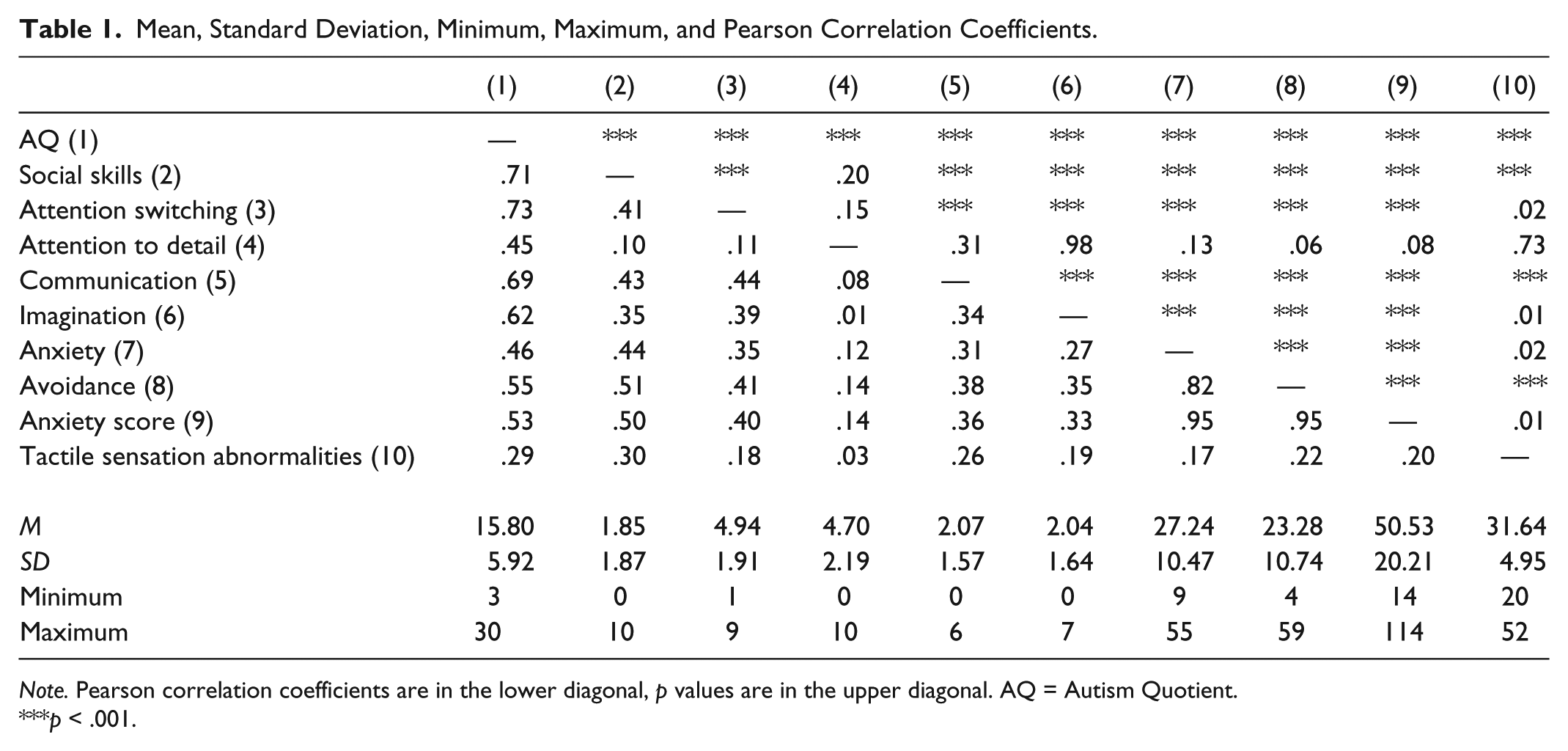
Note. Pearson correlation coefficients are in the lower diagonal, p values are in the upper diagonal. AQ = Autism Quotient.
p < .001.
Mediation Analyses
Multiple linear regressions were used to explore the moderating role of the levels of autistic traits on the relationship between anxiety and tactile sensation abnormalities scores. A three-step mediational analysis showed that the relationship between the combined anxiety score and tactile sensation abnormalities was significant (β = .21, R2 = .04, t = 2.74, p < .01), so that higher levels of anxiety predicted higher levels of tactile sensation abnormalities. Results also showed that the combined anxiety score significantly predicted levels of autistic traits (β = .53, R2 = .28, t = 8.21, p < .001). Finally, using the combined anxiety and the levels of autistic traits as simultaneous predictors of tactile sensation abnormalities, the effect of autistic traits remained significant (β = .25, R2 = .09, t = 2.90, p < .01), whereas the effect of the combined anxiety was no longer significant (β = .07, R2 = .09, t = .83, p = .41). A significant Sobel test, Z = 2.74, p < .01, suggested that the relationship between combined anxiety and tactile sensation abnormalities was fully mediated by the level of autistic traits. These findings were confirmed using a bootstrapping method with 5,000 resamples and 95% confidence intervals (Hayes, 2013). Results showed that the confidence interval did not include 0, confirming a full mediation effect. Importantly, the alternative model using tactile sensation abnormalities as a mediator of the anxiety–autistic traits relationship did not show a mediational effect.
Relationship Between Autistic Traits, Anxiety, and Avoidance
Of the two subscales forming the LSAS, the avoidance scale was correlated to tactile sensation abnormalities more strongly than the anxiety scale (see Table 1). As there were significant differences between both scales despite their high correlation, their individual effects were analyzed as predictors of tactile sensation abnormalities and autistic traits. The initial relationship between the scales of anxiety and avoidance independently predicting tactile sensation abnormalities resulted significant (β = .17, R2 = .03, t = 2.28, p < .05; and β = .22, R2 = .05, t = 2.92, p < .01; for anxiety and avoidance, respectively). To explore the relationship between these variables, a model in which the level of autistic traits mediating the independent contribution of anxiety and avoidance was performed using a bootstrapping method with 5,000 resamples and 95% confidence intervals (Figure 1). Results confirmed that avoidance was a significant predictor of the level of autistic traits (β = .54, R2 = .31, t = 4.88, p < .001); but anxiety was not (β = .02, R2 = .31, t = .16, p = .87). Once more, only the levels of autistic traits significantly predicted tactile sensation abnormalities (β = .24, R2 = .09, t = 2.75, p < .01). The 95% confidence interval of the avoidance scale did not contain 0 [.02, .13] but the intervals of anxiety did [−.03, .03], and the test of homogeneity of regression resulted not significant, F(2, 167) = .49, p = .61. This pattern is consistent with a model in which the levels of autistic traits fully mediate the relationship between avoidance and tactile sensation abnormalities.

Mediational model of anxiety, avoidance, and autistic traits on tactile sensitivity abnormalities.
Multiple linear regression was used to explore the relationship between the anxiety and avoidance scales and the five subscales of the AQ, using anxiety and avoidance scores to predict each of the subscales of the AQ. Results revealed that avoidance was the main predictor for all the subscales of the AQ (Table 2), confirming that although the scores of the subscales are significantly correlated, they still have an independent predictive value.
Mean and Standard Deviations of the AQ Subscales and Standard Regression Coefficients of Anxiety and Avoidance Predicting AQ.

p < .01. ***p < .001.
Discussion
The present study investigated the relationship between social anxiety, autistic traits, and tactile sensation abnormalities in a group of female university students. The results support previous findings showing that those individuals with higher social anxiety display more abnormal sensory responses (Wilhelm et al., 2001). This relationship was explored further looking at autistic traits, showing that the relationship between social anxiety and tactile sensation abnormalities was mediated by the level of autistic traits. Moreover, it was the avoidance of social situations rather than the anxiety levels that were more strongly associated with tactile sensation abnormalities.
Sensory-processing sensitivity, as an individual trait, is thought to manifest itself in the form of avoidance of overstimulation and has been found to be a particular risk factor for social anxiety (Hofmann & Bitran, 2007). Importantly, it suggests those who are socially anxious are predisposed to process information from the environment differently, and tactile stimuli may be one domain in which they are particularly vulnerable (Craske, 2003). Furthermore, underlying traits linked to ASD appear to make this relationship much stronger.
Sensory abnormalities are a core feature of ASD and currently are considered as part of the diagnose criteria for the condition. However, although atypical sensory processing in those with an ASD have been well documented in the literature, far fewer studies have addressed abnormal responses to touch within clinical and non-clinical samples. This is surprising given that abnormal response to tactile stimuli is reported to be one of the most common sensory problems reported by parents (Tomcheck & Dunn, 2007) and because of its association with social impairments (Foss-Feig et al., 2012; Hilton et al., 2010). The current results not only replicate previous findings showing an important relationship between sensory abnormalities and autistic traits (Horder et al., 2014; Robertson & Simmons, 2012) but also show that this relationships may exists in individual sensory domains, in the case of our findings, the tactile domain. The relationship also occurs in those individuals that typically may be considered to be on the mildest end of the spectrum, namely a non-clinical sample of females.
This study highlights that autistic traits mediate the relationship between social anxiety and the way in which sensory stimuli is processed. Those who were both, higher in autistic traits and social anxiety, showed more abnormal responses to tactile stimuli. It remains a possibility that sensory sensitivity is innately characteristic of both conditions and may be important in highlighting those with either of these disorders (Green & Ben-Sasson, 2010).
Although these results suggest that social anxiety and autistic traits impact upon tactile sensation abnormalities, it is unclear whether the same effect would be observed in other sensory domains, as sensory behaviors often interact (Baranek, 1999; Brown & Dunn, 2002). Future studies need to address this interaction and reveal the unique contribution of tactile sensation abnormalities to social anxiety. In addition, we referred to tactile sensation abnormalities as higher levels of unusual tactile responses, and this included both under and over reactiveness. Both behaviors were included to establish a relationship between any abnormal reactions to tactile stimuli, as individuals with ASD often show a mixed pattern of hyper- and hypo-sensitivity. In non-clinical samples, social anxiety has predominantly been associated with hyper-sensitivity, and research should explore whether it is specifically hyper-sensitivity to touch, which defines social anxiety in both those with an ASD and those with high levels of autistic traits. Finally, it is important to compare this relationship in both male and female samples. Our findings show that the relationship between social anxiety and tactile stimuli to be stronger with increasing levels of autistic traits, and therefore this relationship maybe even stronger using a male sample.
To the best of our knowledge, this is one of the first studies to establish the links between unusual responses to touch and social anxiety with autistic traits. Previous studies have shown that unusual responses to tactile stimuli to relate to social impairments (Foss-Feig et al., 2012; Lundqvist, 2015). Our findings have extended this relationship to anxiety in social situations. Future studies may need to control for anxiety levels in general to identify whether this relationship is specific to social anxiety.
In summary, the current results show a relationship exists between social anxiety and aberrant responses to tactile stimuli and that this relationship is moderated by the level of autistic traits. Given that unusual responses to tactile stimuli are among the first signs of an ASD and often occur before social impairments (Martínez-Sanchis et al., 2014), treatments involving tactile stimuli may act as an early social intervention. Our findings also highlight the importance of considering modality specific approach to sensory behaviors in understanding how different sensory modalities link to specific autistic-like behaviors.
Footnotes
Declaration of Conflicting Interests
The author(s) declared no potential conflicts of interest with respect to the research, authorship, and/or publication of this article.
Funding
The author(s) received no financial support for the research and/or authorship of this article.