




Abstract
Self-compassion and grit are each positively associated with adaptive characteristics, and negatively associated with psychological distress. Limited research exists on the relationship between grit and self-compassion, and there is a paucity of research on the impact of grit on social anxiety. Undergraduate participants (N = 184) completed online measures of grit, self-compassion, well-being, and psychological distress. They also recalled a recent social situation in which they felt judged and reported state levels of self-compassion. As hypothesized, grit (specifically the perseverance subscale) was related to greater state self-compassion regarding the social judgment situation participants recalled. Further, there was support for self-compassion as a mediator of the relationship between grit and state anxiety. However, how self-compassionate participants reported being in their social stressor was best predicted by trait self-compassion and state anxiety. Finally, the type of social judgment situation mattered: participants were less self-compassionate when they recalled performance situations compared to social interaction situations. Findings suggest continued research on how grit and self-compassion may influence one another over time in the context of social judgment.
Self-compassion and grit are constructs that are related to indices of well-being (Hill et al., 2016; Li et al., 2018; Neff, 2003; Neff et al., 2007; Odou & Brinker, 2015); however, there is a paucity of research on the relationship between self-compassion and grit. In the context of social anxiety, self-compassion has been shown to have positive benefits (Arch et al., 2013; Harwood & Kocovski, 2017; Leary et al., 2007; Stevenson et al., 2019), but there is little research on the impact of grit on social anxiety specifically. The primary aim of the present study was to examine the relationship between self-compassion and grit, and to evaluate the potential benefits of being self-compassionate and gritty when faced with a social judgment situation.
Self-compassion consists of three components: self-kindness, common humanity, and mindfulness (Neff, 2003). Self-kindness entails taking a kind and understanding approach to oneself, instead of being judgmental and self-critical. Common humanity involves seeing one’s experiences as part of the larger human experience, instead of seeing them as separate and isolating from everyone else. Mindfulness emphasizes being aware of one’s painful thoughts and feelings, but not over-identifying with them (Neff, 2003). Recent research has distinguished between self-compassion as a trait, namely the general tendency to respond in a self-compassionate manner, and state self-compassion, a transient state that can be induced through self-compassion exercises and interventions (Blackie & Kocovski, 2018; Neff et al., 2019; Odou & Brinker, 2015).
Self-compassion has been linked with increasing adaptive psychological functioning, and lower levels of distress. In an experimental study, participants who went through a self-compassion induction following a negative mood induction showed greater increases in positive affect, compared with a distraction condition (Odou & Brinker, 2015). Self-compassion has been linked to other characteristics such as happiness, reflective and affective wisdom, curiosity, exploration and optimism, and lower levels of depression, social comparison, public self-consciousness, anger, and the need for cognitive closure (Neff, 2003; Neff et al., 2007). Finally, the benefits of self-compassion have also been examined in the context of social anxiety. Self-compassion training via meditation led to decreased physiological and subjective distress responses in a speech task (Arch et al., 2013). Written self-compassion induction exercises have also been helpful for reducing anxiety (Harwood & Kocovski, 2017), and a brief online self-compassion intervention led to significant decreases in social anxiety (Stevenson et al., 2019). Self-compassion may allow socially anxious individuals to view themselves from a more balanced perspective, instead of the self-critical lens that is characteristic of those with elevated levels of social anxiety (Leary et al., 2007).
Self-compassion and grit may complement one another; those who are gritty and able to overcome obstacles may also be more self-compassionate when faced with these hardships. Grit is defined as perseverance and passion for long-term goals (Duckworth et al., 2007). Grit entails working toward challenges and maintaining effort and interest in goals despite failures and adversity that may arise. Early research found that grit predicted success for Ivy League undergraduates, higher grade point averages, retention in two classes of the United States Military Academy, and ranking in a national spelling bee (Duckworth et al., 2007). More recently, grit has been examined in relation to mental health outcomes in clinical and non-clinical samples and similar to self-compassion, it has been linked to increased well-being, positive affect, and purpose commitment (Hill et al., 2016; Li et al., 2018). In an experimental study, effort-related autonomic nervous system activity was assessed during a self-paced effort task (Silvia et al., 2013). Those who scored higher on the perseverance subscale of grit showed stronger autonomic activation, demonstrating that gritty individuals persevere more during difficult tasks. Grit has also been related to lower levels of negative affect, distress, and depression (Musumari et al., 2018; Sharkey et al., 2018; Singh & Jha, 2008).
Several studies have recently examined the relationship between grit and anxiety in health anxiety, test anxiety, and generalized anxiety disorder contexts (Musumari et al., 2018; Sharkey et al., 2018; Sheridan et al., 2015; Sturman & Zappala-Piemme, 2017). These studies support a relationship between grit and reduced anxiety, but grit has yet to be examined in the context of social anxiety. In social evaluative situations, being gritty may help individuals persevere through feelings of discomfort and cognitions about negative evaluation, ultimately leading to reduced anxiety. It is important to examine grit in different contexts in light of recent research demonstrating that grit levels vary as a function of situational context (Cormier et al., 2019).
Social anxiety is described as an intense fear of social situations where one may be negatively evaluated by others (American Psychiatric Association [APA], 2013). Social anxiety can arise in social interactions, performance situations, and observations by others (APA, 2013). These varying situation types can have important implications for understanding differences in the etiology, age at onset, and physiological and treatment responses in socially anxious individuals, with research suggesting that those endorsing performance anxiety present with unique features that differ from other types of social anxiety (Peyre et al., 2016). A distinction can also be made between trait and state social anxiety, with trait anxiety representing relatively stable individual differences in anxiety proneness and state anxiety indicating a transitory feeling of tension and apprehension that fluctuates and varies in intensity (Spielberger et al., 1983).
To our knowledge, no studies have examined the impact of grit on state self-compassion, and there is only one study that explored the relationship between grit and trait self-compassion (Booker & Perlin, 2020). Contrary to their hypotheses, grit was not significantly correlated with self-compassion, but the subscales were not examined. Given past literature showing that the grit perseverance of effort subscale is more strongly correlated with certain outcomes than the consistency of interests subscale (Bowman et al., 2015; Datu et al., 2016; Disabato et al., 2018; Silvia et al., 2013), more research is warranted examining the subscales separately. Past research has explored the relationship between the grit subscales and mindfulness, a construct closely related to self-compassion (Cavazos Vela et al., 2018; Li et al., 2018; Raphiphatthana et al., 2018). Raphiphatthana et al. (2018) found that the grit perseverance subscale predicted non-reacting, a facet of mindfulness, supporting that by being gritty, individuals can persevere through obstacles with less negative and self-critical feelings. A similar relationship may exist with self-compassion, namely that grit (specifically perseverance) may lead to greater self-compassion in the face of failure. Though mindfulness and self-compassion may relate similarly to grit, research supports their distinction as separate constructs that facilitate and enhance each other (Baer et al., 2012; Bluth & Blanton, 2014). Whereas mindfulness focuses on present moment awareness and responding to thoughts and feelings without judgment in any context, self-compassion focuses on balanced awareness in the context of failure and suffering (Bluth & Blanton, 2014).
Present Study
The purpose of the present study was to examine grit and self-compassion as psychological resources used during times of social judgment. Whereas grit emphasizes persevering in the face of adversity, self-compassion focuses on treating oneself with compassion when failures occur. Given their conceptual overlap, we explored the relationship between the two. We also examined their association with other psychological outcomes to gain a further understanding of how these constructs relate to other indices of well-being. Lastly, to examine grit’s potential to serve as a protective resource in the context of social judgment, we explored whether grit predicted state self-compassion in response to a social judgment situation. Participants completed a writing task where they recalled a difficult social situation in which they felt judged and then reported levels of state self-compassion and state anxiety. It was hypothesized that grit would be positively associated with state and trait self-compassion, but that the perseverance of effort subscale would be more strongly correlated with self-compassion than the consistency of interests subscale. Further, it was hypothesized that both grit and self-compassion would correlate with mental health outcomes consistent with relevant past research and theory (i.e., positive correlations with well-being, mindfulness, self-esteem, and negative correlations with social anxiety and depression). Given the evidence for the relationships between anxiety, mindfulness, and self-compassion (Baer et al., 2012; Bluth & Blanton, 2014; Harwood & Kocovski, 2017; Stevenson et al., 2019), it was hypothesized that trait self-compassion, mindfulness, and state anxiety would predict state self-compassion in response to social judgment. Grit was examined as an additional predictor of state self-compassion given recent work supporting the connection between grit and mindfulness (Raphiphatthana et al., 2018). Additionally, given that gritty individuals may be less prone to anxiety because of their propensity to experience failure in a positive way (Musumari et al., 2018), it was hypothesized that state self-compassion would mediate the relationship between grit and anxiety. Lastly, the type of social judgment situation was examined in an exploratory manner.
Method
Participants
Participants were 184 undergraduate students (76% female) compensated with course credit. Participants ranged in age from 18 to 22 years (M = 20.95, SD = 9.03) and self-reported their race/ethnicity as follows: White (65.2%), Asian (10.9%), African-Canadian (7.6%), Middle Eastern (5.4%), First Nations (1.1%), and other (9.8%). There were no inclusion criteria for the present study. Thirteen participants failed more than two out of four attention checks and were removed from the initial dataset (N = 197).
Materials
The Self-Compassion Scale (SCS; Neff, 2003) is a 26-item scale that consists of six subscales: self-kindness, self-judgment, common humanity, isolation, mindfulness, and over-identification. A sample item is “When I’m feeling down I tend to obsess and fixate on everything that’s wrong.” Research supports the factor structure, strong concurrent validity, convergent validity, discriminant validity, and test-retest reliability (Neff, 2003). To assess state self-compassion, a modified version of the self-compassion scale was used. Blackie and Kocovski (2018) adapted the original self-compassion scale to create a state version of the self-compassion scale (SCS-S). A sample item is “I became consumed by feelings of inadequacy.” They reported very strong internal consistency, but less research exists on the state modification of the scale. Items for both versions of the scale are rated on a five-point scale ranging from 1 to 5, with higher scores on the scale representing higher levels of self-compassion. Research supports using the scale to examine six subscale scores or a total score (Neff, 2003; Neff et al., 2019). The 12-item Grit (Duckworth et al., 2007) scale consists of two subscales: consistency of interests, and perseverance of effort, referring to the tendency to maintain the same goals over time and the tendency to work hard in the face of setbacks, respectively. The scale demonstrated strong reliability across six studies, and factor analyses support a two-factor model for the scale (Duckworth et al., 2007). A sample item is “Setbacks don’t discourage me.” Items are rated on a five-point Likert scale ranging from 1 to 5, with higher scores representing higher levels of grit.
There were several measures of well-being and related constructs. The 18-item Psychological Well-Being (PWB; Ryff & Keyes, 1995) scale was used. A sample item is “I like most parts of my personality,” and items were rated on a six-point scale ranging from 1 to 6. The scale measures six aspects of psychological well-being: autonomy, environmental mastery, personal growth, self-acceptance, purpose in life, and positive relationships. A total well-being score is commonly reported. The scale has demonstrated strong internal reliability, convergent validity, and test-retest reliability, and confirmatory factor analyses provided support for a 6-factor model (Ryff & Keyes, 1995). The 14-item Freiburg Mindfulness Inventory (FMI) measures mindfulness among participants with or without meditation experience (Walach et al., 2006). A sample item is “I pay attention to what’s behind my actions,” and principal component analysis suggested one common factor (Walach et al., 2006). The scale has demonstrated strong internal consistency, convergent validity, and construct validity. Items are rated on a four-point scale ranging from 1 to 4, with higher scores representing higher levels of mindfulness (Walach et al., 2006). The Single-Item Self-Esteem Scale (SISE; Robins et al., 2001) was used. The SISE measures levels of global self-esteem and serves as a useful substitute for the Rosenberg Self-Esteem Scale (RSE; Rosenberg, 1965). The SISE and the RSE had almost identical correlations with a wide range of criterion measures. The single item asked participants to rate on a 1 to 7 scale their agreement with the statement “I have high self-esteem,” with higher scales representing higher levels of self-esteem. The test-retest reliability of the measure was very good (Robins et al., 2001). There were several measures of psychological distress. Social anxiety was measured using the Social Phobia Inventory (SPIN; Connor et al., 2000). The 17-item scale measures fear of social events and negative evaluation, avoidance of social situations, and physiological discomfort. A sample item is “Being criticized scares me a lot,” and items are rated on a five-point Likert scale ranging from 0 to 4, with higher scores representing higher social anxiety. The scale has demonstrated good test-retest reliability, internal consistency, and convergent and divergent validity (Connor et al., 2000). State anxiety was measured using the Subjective Units of Distress Scale (SUDS; Wolpe, 1969), a one-item measure. Participants were asked to record their distress level on a scale from 0 to 100, with higher scores representing higher distress. Lastly, depression was measured using the Single-Item Depression Scale (Lefèvre et al., 2011). The single-item scale measures depression on a 0 to 3 scale, and participants were asked to indicate the extent to which the item “During the past week, I felt depressed” applied to them. It has demonstrated predictive validity with longer measures of depression, as well as a close association with symptom severity (Lefèvre et al., 2011; Radloff, 1977).
Social Judgment Task
Participants were asked to complete an open-ended writing task in which they brought to mind a social situation in which they felt judged (Blackie & Kocovski, 2018). They were asked to describe the situation they brought to mind, when it occurred, who they were with, their relationship with the person/people whom they felt were judging them, and what they were worried about. Participants then completed several items assessing how well they were able to remember the situation, how anxious they were during the situation, and how important the situation was to them. Items were rated on a five-point scale, ranging from “not at all” to extremely” (Blackie & Kocovski, 2018).
Procedure
The study was completed online through the university’s psychological research website. Following informed consent, participants completed baseline questionnaires (trait self-compassion, grit, social anxiety, psychological well-being, mindfulness, self-esteem, SUDS, and depression). Participants then completed the social judgment writing task as described above, followed by a second SUDS rating, the state self-compassion scale, and a mood booster.
Data Analysis
Data were analyzed using SPSS version 24 (IBM Corp, 2016). Pearson correlations were conducted to assess zero-order correlations between all variables of interest for the first two hypotheses. Linear hierarchical regression was used to explore the third hypothesis (predictors of self-compassionate responding in response to the social stressor). To test the mediating effect of state self-compassion in the relationship between grit and anxiety, SPSS PROCESS Macro (model 4, Hayes 2017) was used with bootstrapping (5000 samples). State anxiety (SUDS) was entered as the dependent variable (Y), grit perseverance of effort was entered as the independent variable (X), and state self-compassion was entered as the mediating variable (M).
Results
Scale Descriptives and Recalled Social Judgment Situation
Descriptive statistics for all scales can be found in Table 1. Alphas ranged from good to excellent. One participant did not complete the state self-compassion scale (but completed all other measures) and was excluded from analyses pertaining to state self-compassion.
Descriptive Statistics for all Measures.

For the recalled social situation, participants reported close to “very much” for how well they were able to remember it (M = 3.83, SD = 0.93) and for the level of anxiety they experienced (M = 3.70, SD = 1.09). Their rating for how important the situation was to them was “moderate” (M = 3.09, SD = 1.20). To examine whether recalling the social judgment situation induced anxiety, a paired sample t-test was conducted. Distress (SUDS) was significantly higher after the social situation was recalled (M = 58.66, SD = 25.67) than before (M = 47.58, SD = 25.60), t(181) = −6.05, p < .001, Cohen’s d = 0.45. Most participants recalled either a social interaction (n = 94) or a performance situation (i.e., mostly presentations; n = 77), but a small number (n = 10) wrote about a situation in which they were observed by others (e.g., walking through a busy crowd).
Comparing Situation Types: Social Interaction vs. Performance
Given most participants reported either social interactions or presentations, only those two situation types were compared. First, situation types were compared on the questions assessing memory, anxiety, and importance. Participants rated importance significantly higher for performance situations (M = 3.34, SD = 1.07) compared to social interactions (M = 2.87, SD = 1.23), t(169) = 2.61, p = .01, Cohen’s d = 0.40, but did not differ on how well they were able to remember the situation or for how anxious they felt (ps > .55). A multivariate analysis of variance was conducted comparing situation types on the six facets of state self-compassion. State self-compassion was significantly higher for social interactions compared to performance situations, F(6,163) = 2.71, p = .016,
Correlations Between Grit, Self-Compassion, and Other Constructs
Consistent with hypotheses, grit was significantly related to both trait and state self-compassion, r = .28, p < .001 and r = .17, p = .02, respectively. Correlations between the subscales for grit and self-compassion appear in Table 2. The grit subscale consistency of efforts was found to be significantly correlated with only one self-compassion trait subscale (i.e., trait isolation). However, the perseverance of effort subscale was significantly correlated with all six trait self-compassion subscales, as well as the three positive subscales for state self-compassion.
Correlations Between Grit Subscales and Trait and State Self-Compassion Subscales.
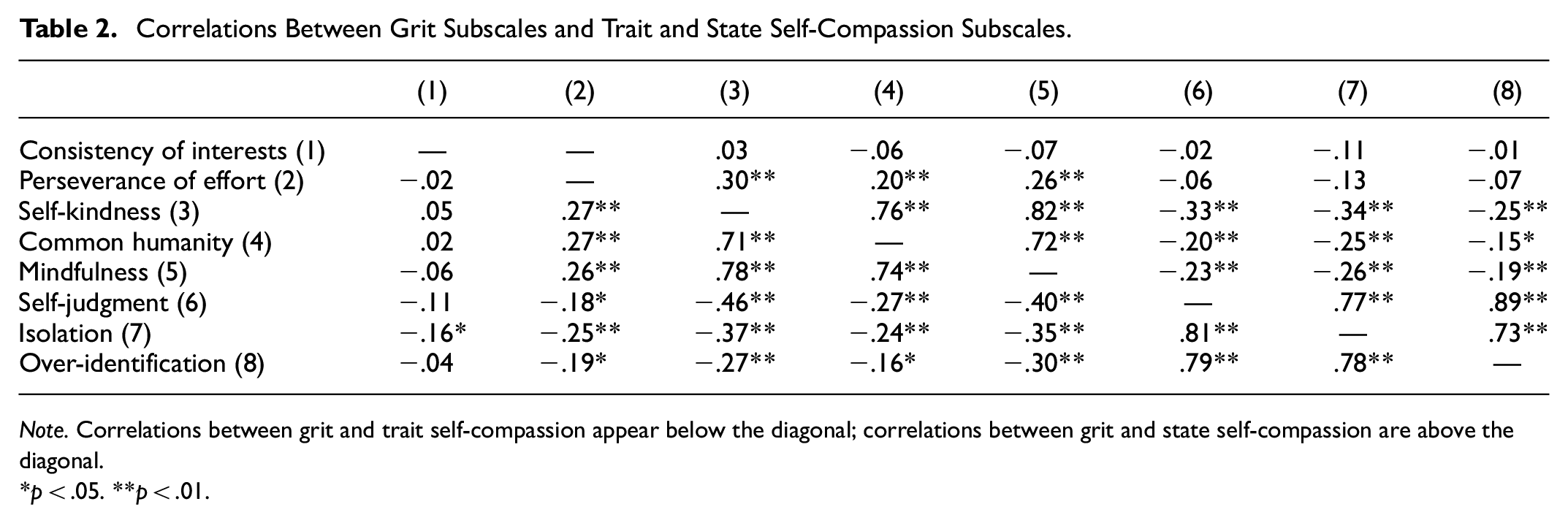
Note. Correlations between grit and trait self-compassion appear below the diagonal; correlations between grit and state self-compassion are above the diagonal.
p < .05. **p < .01.
As hypothesized, grit and self-compassion were both positively related to well-being, as well as the other positive mental health constructs (see Table 3). The perseverance of effort subscale for grit was significantly positively correlated with the other positive mental health measures, but the consistency of interest subscale for grit was not. Consistent with hypotheses, there were significant negative correlations between social anxiety and both trait and state self-compassion. Also as expected, there was a significant negative relationship between social anxiety and the grit total scale, as well as the perseverance, but not the consistency of interest subscale. A similar pattern was found for depression, but in this case, both grit subscales were found to be significantly negatively correlated with depression (see Table 3).
Correlations Between Grit and Self-Compassion and Other Measures.
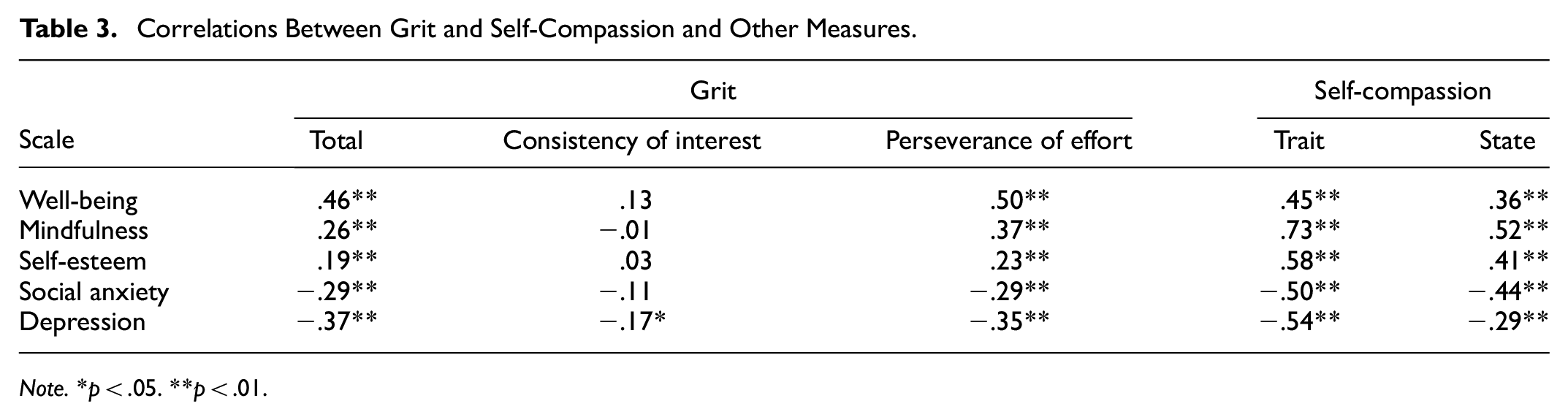
Note. *p < .05. **p < .01.
Predictors of State Self-Compassion for Social Judgment
To examine how grit and other factors influence how self-compassionate participants were in response to their social judgment situation, hierarchical regression was used. Given the differences based on situation type noted above, the models were first run separately for social interaction and performance situations, but the results were consistent across situation type, so only the analysis including all participants follows (see Table 4). Hypothesized trait variables were entered in step 1 (trait self-compassion, mindfulness, and grit). Step 2 consisted of the following state variables: state anxiety as hypothesized (anxiety during the event and SUDs after bringing the event to mind), as well as the rating of situation importance given differences found in previous analyses. Trait variables in step 1 accounted for 39.1% of the variance in state self-compassion and state variables in step 2 accounted for an additional 15.5% of the variance, FChange(3,176) = 21.32, p < .001. In the final model, trait self-compassion and state anxiety (anxiety during the event and SUDs) were the only significant predictors of state self-compassion accounting for 54.6% of the variance.
Hierarchical Regression Predicting State Self-Compassion for Social Judgment Situation.

Note. Step 1 accounted for 39% of the variance in state self-compassion; Step 2 accounted for additional 16%. SCS = Self-Compassion Scale; FMI = Freiburg Mindfulness Inventory; Anxiety = level of anxiety they experienced during the social situation; SUDS = rating of distress in the present moment as they thought about their social situation.
Self-Compassion as a Mediator of the Relationship between Grit and Anxiety
Hayes’ PROCESS model 4 (Hayes, 2017) was used to test state self-compassion as a mediator of the relationship between grit and anxiety. The grit perseverance subscale was used rather than the total score given perseverance is more relevant to anxiety than consistency of interests. The model was run twice, once for each measure of state anxiety as the outcome. The indirect effect was significant for both models; SUDS as the outcome is reported herein. As shown in Figure 1, grit-perseverance was a significant predictor of state self-compassion, t(180) = 3.03, p = .003, and state self-compassion was a significant predictor of state anxiety, t(179) = −8.06, p < .001. Finally, there was a significant indirect effect (−0.68), with grit-perseverance being associated with greater state self-compassion which was in turn associated with less state anxiety (95% bootstrap CI [−1.21, −0.24]). However, the direct effect (c = −0.76) was not significant, t(180) = 1.76, p = .08.

Self-compassion mediates the relationship between grit and anxiety.
Discussion
This is one of the first studies to examine the relationship between grit and self-compassion, and it did so in the context of social judgment. As hypothesized, grit was positively correlated with both trait and state self-compassion, albeit at a low to moderate level. Looking more specifically at the subscales, the perseverance of effort subscale correlated significantly with all of the trait self-compassion subscales and three of the state self-compassion subscales, but the consistency of interest subscale was only significantly related to the isolation subscale for trait self-compassion. These results are consistent with past research, which has found the two subscales for grit to correlate differently with other constructs (Bowman et al., 2015; Datu et al., 2016; Disabato et al., 2018; Silvia et al., 2013). In the present study, perhaps how people persevere, rather than how they maintain consistency in interests is more relevant to how they treat themselves in the face of failure (kindly vs. critically). Like self-compassion, perseverance is about how one responds to failure or setbacks. Maintaining consistent interests may have benefits such as allowing one to become proficient in an area of interest but may not be as relevant to how one responds to being judged by others.
Consistent with past research, self-compassion was negatively related to social anxiety (e.g., Arch et al., 2013; Harwood & Kocovski, 2017), but novel to the literature, grit was also negatively related to social anxiety, specifically the perseverance subscale. However, the strength of the relationship between perseverance and social anxiety was lower, suggesting that an absence of self-compassion may be more detrimental for social anxiety. Additionally, grit and self-compassion were both positively related to the other positive mental health constructs (psychological well-being, mindfulness, and self-esteem). These results are consistent with previous research findings on grit and self-compassion individually (Li et al., 2018; Neff et al., 2007; Odou & Brinker, 2015; Raphiphatthana et al., 2018; Singh & Jha, 2008). However, it is of benefit to compare these relationships within the same sample. Although trait self-compassion and grit showed a very similar correlation with well-being, it is not surprising that self-compassion, compared to grit, was more strongly related to mindfulness and self-esteem.
In the regression model predicting how self-compassionate participants were in response to their social judgment situation, contrary to hypotheses, only trait self-compassion and state anxiety were significant predictors in the final model, not grit. However, there was support for the mediation model: grit was associated with greater self-compassion which in turn was associated with less state anxiety. The cross-sectional nature of this study prohibits us from truly understanding how these constructs might work in tandem but we hypothesized that grittier individuals would be more self-compassionate in response to their social judgment situation, and therefore less anxious. Being both gritty and self-compassionate may allow individuals to deal with obstacles in an adaptive way, thus reducing the negative effects of failure. However, similar to research on mindfulness being associated with increased grit over time (Raphiphatthana et al., 2018), it may be that self-compassion allows people to become grittier over time. Given the conceptual overlap and relationships between self-compassion, mindfulness, and grit, further research is needed to parse apart the mechanisms underlying these relationships and their unique roles in fostering psychological resilience.
We also examined the type of social stressor that people brought to mind. The pattern of results in our regression models remained the same but the overall level of self-compassion differed. People reported less self-compassion if they recalled a performance situation compared to people who recalled a social interaction, but similar levels of state anxiety. Although there were differences on how important their situation was, with performance situations rated as more important than social interactions, state self-compassion remained significantly different across situation types when controlling for importance (and when controlling for trait social anxiety), and there were no differences in trait self-compassion levels. When examining the specific facets of state self-compassion, it was the mindfulness facet that differed significantly based on situation type. For presentations, people reported lower mindfulness than for social interactions. It is unclear why it was harder for people to have balanced awareness for presentations than social interactions. Although recognizing that these findings require replication, it may be especially important to help people view performance situations in a more compassionate manner.
With respect to practical implications, the present study builds on the growing evidence for the benefits of self-compassion for social anxiety (e.g., Arch et al., 2013; Harwood & Kocovski, 2017). In addition, given that grit and social anxiety are negatively related, future research could explore clinical implications of this finding. Grit has been found to vary depending on domain, with athletes showing higher levels of grit in the context of sports than school and life in general (Cormier et al., 2019). Future research can continue to examine the domain specificity of grit, and whether assessing grit in the context of social judgment may be fruitful.
An important limitation of the present study lies in its correlational nature, which precludes any causational conclusions from being made. Other variables not measured in the present study such as resilience, self-efficacy, and hope may influence the relationship between self-compassion and grit and are of interest for future research on the two constructs. Further, the present study only assessed self-compassion as a state, and not grit as a state, so we were unable to examine levels of state grit in response to the social judgment situation participants described. Future research should explore whether grit can be induced as a state and examine whether trait self-compassion predicts state levels of grit in response to social anxiety. Future research could also employ a longitudinal design examining self-compassion and grit over time to explore how these constructs may influence each other and whether there is the potential for a synergistic relationship between them. Finally, there are demographic limitations in that the sample was mostly female and 65% Caucasian, and that the study did not pre-screen participants for elevated levels of social anxiety or a clinical diagnosis of social anxiety disorder. Future research should replicate the study with a more diverse sample and extend the study with a clinical sample.
Overall, grit and self-compassion are both adaptive constructs that are associated with each other, with greater psychological well-being, and with lower psychological distress (social anxiety, depression). In the context of social judgment, although grit was correlated with state self-compassion, the only unique predictors of state self-compassion were trait self-compassion and state anxiety. In other words, how self-compassionate a person was during their social judgment situation depended most on how self-compassionate they generally were and how anxious they felt. However, there was evidence for an indirect effect of grit being associated with reduced anxiety through self-compassion. Additionally, less self-compassion was reported for presentations compared to social interactions. Future research can examine self-compassion and grit over time in the context of social or other stressors to determine how these constructs influence one another.
Footnotes
Declaration of Conflicting Interests
The author(s) declared no potential conflicts of interest with respect to the research, authorship, and/or publication of this article.
Funding
The author(s) disclosed receipt of the following financial support for the research, authorship, and/or publication of this article: The authors gratefully acknowledge this work was supported by the Social Sciences and Humanities Research Council of Canada (Grant 435-2018-0349) awarded to the second author.
Ethics
All procedures followed were in accordance with the ethical standards of the responsible committee on human experimentation (institutional and national) and with the Helsinki Declaration of 1975, as revised in 2000 (5).
Consent to Participate
Informed consent was obtained from all individual participants included in the study.
