




Abstract
Abstract writing presents problems to budding academics, especially in keeping to the generic structure and the requisite word counts by the various publishers. The article focuses on grammatical metaphor as a systemic resource for achieving proficiency in research abstract writing. Borrowing from Halliday and Matthiessen’s semantic domains beyond the clause and Halliday’s theorizing of the language of science, the article explores the various forms of transferences made possible by the grammar: from logical to experiential, from sequences to figures, elements and things, involving downgrading of linguistic units from higher semantic domains to lower ones. The resulting nominalization is seen as the single most powerful resource for effecting grammatical metaphor of the ideational type through its capacity for lexical packing. The article analyzes five randomly selected undergraduate research abstracts that exhibited an obvious lack of awareness of this systemic resource. By focusing on the sequences of figures from each abstract, comprising various numbers of clause nexuses, the article demonstrates how the judicious use of nominalization can simultaneously achieve word economy and information density, which are obvious marks of proficiency in this academic genre, and strongly recommends this grammatical strategy for students and budding academics.
Keywords
Introduction
Academic writing encompasses all writing tasks that are the product of research, investigation, or enquiry for the advancement of knowledge in academic or professional settings. In the educational institutions, this may be of two kinds: first, professional research writings that are the prerequisite for annual appraisals of academics who must publish or perish. The second is the student academic writings involving term papers, research projects, theses, and dissertations. All these require the writer to provide a condensed text encapsulating the major issues raised in the research report in the form of an abstract, following specified conventions and schematic structure for presenting such technical genre.
Because academic writing belongs to the category of writings characteristic of high literacy in science, technology, arts, social sciences, and other specialized disciplines, it is more abstract, more depersonalized, more consistently ideational in its orientation as it concentrates on objects of research procedures and findings. It follows a conventionalized format with specifications on the number of pages and length of report. It, therefore, requires a specialized pattern of information packaging and texture in ways which not only make for word economy but also retain the sophistication and erudite touch which mark it out as proficient academic discourse. One of the systemic strategies for achieving word economy and information density in academic writing has been suggested: grammatical metaphor of the ideational type (Halliday, 1985, 2004; Halliday & Matthiessen, 2004). Our concern in this article is to highlight the salutary effects of ideational metaphor, especially nominalization in achieving word economy and information density in the writing of research abstracts as a way of helping young academics especially undergraduate and graduate students who must write abstracts as part of their final research project reports or seminar presentations.
An abstract, according to Bhatia (1993), is a description or factual summary of the much longer research report. It is a synopsis meant to give the reader an exact and concise information on the full report. It contains information on the following aspects of the research that it describes: what the author did (purpose/objectives), how the author did it (methodology), what the author found (findings/results), and what the author concluded (conclusions). This format is regarded by Bhatia as the generic or the cognitive-move structure of a well-written abstract. A standard abstract in most academic journals and conference proceedings is usually specified between 200 and 250 words and in a few instances up to 300 and 350 words. Some applications for fellowships would even limit the applicants to as low as 100- to 150-word abstracts. These specifications demand the greatest economy in textual organization and information packaging.
Research abstracts have been a subject of study in the existing scholarship ranging from the focus on their schematic or cognitive-move structure (Bhatia, 1993) to how information is packaged to keep them concise and within the requisite word-count limits. Holtz (2009), in her corpus-based study of abstracts and research articles, was concerned with a qualitative and quantitative analysis of instances of nominalization as registers of scientific disciplines of computer science, linguistics, biology, and mechanical engineering. Her findings show that more nominalized style is prevalent in biology and mechanical engineering, less in computer science, and even less in linguistics. Kazemian, Behnam, and Ghafoori (2013) also studied the frequency of nominalization and the predominant process types in 10 authentic scientific texts drawn from magazines. They concluded that scientific discourse is a highly nominalized discourse and the prevalent process types are relational and material ones. These studies drew their theoretical models from Halliday’s (1985) systemic functional grammar (SFG) and grammatical metaphor as explicated in his book The Language of Science (2004). The major concern of these studies is identifying the occurrence of nominalization in various scientific and technical texts.
However, personal experience has shown that proficiency in exploiting grammatical metaphor which has been described as a theoretical model for scientific and technical discourse does not develop uniformly across all text users, and the research abstracts selected for this study are concrete examples. Halliday (2004) gave a seemingly universal parameter for the ontogenetic development of grammatical metaphor in the human adult user as a product of advancement in knowledge afforded by formal education. He contended that as the child encounters the language of science in school, he progresses from primary consciousness of his or her protolanguage to higher-order consciousness. This, he argued, brings about a concomitant progression from the more commonsense representation of reality to more complex and compact strategies of organizing and packaging information, grounded in metaphor. This generalization seems to be true for his particular subjects of study but may not readily apply in all instances, especially among English-language users in the outer and expanding circles such as Nigeria where English is a second language. This assertion becomes even less universally valid when one takes a cursory look at some abstracts, especially those written by undergraduates of Nnamdi Azikiwe University who are supposedly within the developmental ambit of literate or technical knowledge. These selected texts display some obvious lack of knowledge of the systemic resource of grammatical metaphor with the result that most of the abstracts studied are in the clausal commonsense mode of representation, the word counts exceeding standard specifications, yet lacking sufficient substance in terms of content. Normally, in this university, students are required to limit their abstracts to not more than 150 to 200 words, but most of them fall grossly below expectations in what an abstract should be, hence, the need for this study.
The questions that are posed here are as follows: How have the abstracts that are subjects of this study deviated from this semogenic power of the grammar? What alternative choices could have been made in the selected abstracts to bring them up to the level of literate and technical discourse using grammatical metaphor and what can be done to help these students write more nominalized abstracts? In the next section, we explore the theoretical bases for grammatical metaphor and how good mastery of this semantic domain explicated in the systemic functional model contributes to proficiency in academic writing, especially in the writing of research abstracts.
Theoretical Bases: SFG: Meaning-Making by Choice
Halliday’s SFG provides the theoretical bases for understanding grammatical metaphor. The basic underlying factor of SFG is meaning-making in the context. Meaning is said to be an interface between linguistic (lexicogrammatical) and extralinguistic (contextual) features (Halliday, 1973). Writers choose from the rich inventory or a network of paradigmatic options in the linguistic system (systemic) the particular meaning they require to perform various communicative functions in their lives (functional). This is the crux of this framework propounded by Halliday. Halliday categorized the choices open to a writer/speaker in two ways: the “potential” and the “actual” choices (Eggins, 2004, p. 20; Halliday, 1978, p. 40).
The “potential” consists of the totality of meaningful choices open to the language user to convey simultaneously three meaning potentials which Halliday referred to as “metafunctions.” These include—the ideational (representing human experience as content), the interpersonal (enacting human relationships), and the textual metafunctions (how text is created and how it relates to itself—cohesion—and to the context of use—coherence). The ideational metafunction is further stratified into experiential and logical metafunctions, the former constructing the world of experience and social reality and the latter constructing the tactical and logico-semantic relations that help text generation and creation.
Our focus in this framework is the ideational metafunction and the construction of grammatical metaphor of the ideational type. As earlier mentioned, this ideational metafunction has two distinct strata: the experiential and the logical metafunctions. Whereas the experiential metafunction enables a writer to recreate linguistically the world of experience, the logical metafunction helps the text writer to produce a coherent text by exploiting the dependency and interdependency relations (taxis) in the formation of expansion and projection relations (logico-semantic relations) made possible in the grammar by the notion of the clause complex and circumstantial elements. These two semantic domains enable text producers to choose either the nominal or the clausal style in their speech or writing.
Whereas the nominal style is located in the system of transitivity, the clausal style operates at the level of the clause complex. The clause complex is one of the resources of the logical relations existing among textual sequences. According to Halliday and Matthiessen (2004), this systemic resource operates above the clause rank and “is related to the clause in terms of logical complexing rather than in terms of experiential constituency” (p. 369). A clause complex is the grammatical combination of two or more clauses by either parataxis or hypotaxis, the former being a logical relation of interdependency between two or more clauses of equal rank, and the latter a dependency relation of two or more unequal clauses. These relations, in traditional terms, would be equated to relations of coordination and subordination, respectively. Each pair of clauses related by taxis or interdependency is referred to as a “clause nexus” (Halliday & Matthiessen, 2004, p. 375). The paratactic and hypotactic nexuses consist of primary and secondary clauses. In the paratactic nexus, the primary clause is the initiating clause while the secondary clause is the continuing clause which either elaborates on the primary clause, extends or enhances its meaning by adding more information or embellishing the primary clause. Similarly, the primary clause in the hypotactic nexus is the dominant clause whereas the secondary is the dependent clause also related by elaboration, extension or enhancement.
In text creation, such as in the writing of abstracts where information density and lexical economy is essential, there is need to manage these tactic and logico-semantic relations in ways that would downgrade the tactical relations of clause sequences of expansion or projection into lower grammatical ranks in the system of transitivity to enable more compact information packing in the nominal groups. According to Halliday and Matthiessen (2004), In the creation of text, we choose between augmenting a clause “internally” by means of a circumstantial element and augmenting it “externally” by means of another clause in a complex. The decision depends on many factors, but the basic consideration has to do with how much textual, interpersonal and experiential semiotic “weight” is to be assigned to the unit. (p. 369)
The present work concerns itself with the internal augmentation of the clause involving downgrading of sequences of figures in a clause nexus to figures comprising single clauses or to elements comprising nominal groups. Halliday and Matthiessen (2004) described this augmentation as a structural realization, a more compact grammatical integration in the realization of expansion and projection; these logical relations are, thus, construed as embedded constituents of nominal groups. This nominal mode of information packaging has been recommended by Halliday (2004) for the written form of the language of science, a more specialized and sophisticated style for presenting scientific, technical (and we might add, academic) discourse, as opposed to the more dispersed external augmentation using the resources of the clause complex, described as the clausal mode, a cohesive sequence of interdependent clauses in nexuses of expansion or projection associated with commonsense spoken discourse. In the next section, we explore the concept of grammatical metaphor with a particular emphasis on ideational metaphor and nominalization.
Grammatical Metaphor: Congruent Versus Metaphorical Realizations
Research interests in metaphor came into prominence with Lakoff and Johnson’s (1980) Metaphors We Live By. Metaphor is seen as ubiquitous in the representation of human experience and in the formation of mental models, schemata, and presuppositions of social groups. However, Lakoff and Johnson’s interests were focused on lexical metaphor in line with cognitive linguists and other schools. The notion of grammatical metaphor, however, was proposed by Halliday (1985, 2004; see also Simon-Vandenbergen, Taverniers, & Ravelli, 2003). Although grammatical metaphor differs in meaning and application to lexical/conceptual metaphor, both have one similar characteristic, both involve making a choice between a more straightforward and a more oblique realization of meaning; both involve transference or transportation of meaning from one domain of reference to the other (Bloor & Bloor, 2004; Jamshid, 2005). Whereas traditional lexical metaphor transfers a dominant quality/attribute of one thing onto another—that is, from the “source domain” to the “target domain” as in LOVE IS A JOURNEY (Lakoff, 1993)—grammatical metaphor transfers meaning from one grammatical status/class to another, for instance, from verb (process) to noun (participant). Whereas lexical metaphor is on one word/idea instead of another, grammatical metaphor involves one grammatical form instead of another (Asuncion, 2005; Matthiessen & Bateman, 1991; Simon-Vandenbergen et al., 2003).
Grammatical metaphor has been described as a rhetorical strategy for creating new modes of meaning (Halliday, 2004; Matthiessen & Bateman, 1991). Two types of grammatical metaphors are prominent in functional grammar, namely, ideational metaphor and interpersonal metaphor (Halliday & Matthiessen, 2004), although Jamshid (2005) gave some exemplifications of textual metaphor. Interpersonal metaphor creates new layers of meaning by “upgrading” modal assessment, which in its “congruent” form is realized as an adjunct of a proposition (for instance, “hopefully,” “regrettably,” etc.) to the rank of a whole clause, such that the interpersonal assessment becomes a proposition in its own right (for instance, “I hope,” “I regret”). However, ideational metaphor “downgrades” linguistic sequences, figures, and elements to a rank below. As mentioned earlier, our concern here is on ideational metaphor. Interpersonal metaphor is outside our scope. In this write-up, we shall explore in detail the concept of ideational metaphor, the grammatical strategies for its realization, and finally the application of ideational metaphor in academic writing with an emphasis on the writing of research abstracts.
Halliday and Matthiessen’s (2004) definition of ideational metaphor is as follows: . . . the general tendency of ideational metaphor is to “downgrade” the domain of grammatical realization of a semantic sequence, figure or element—from clause nexus to clause, from clause to group/phrase, and even from group or phrase to word . . . Such downgrading affects both the unit whose domain of realization is downgraded, and the units of which it is composed: the downgrading proceeds down the rank scale by a kind of “domino effect.” The downgrading may start with (i) a whole sequence of figures (ii) with a single figure, or (iii) with a single element within a figure. (p.646)
The terms congruent and non-congruent may be equated with the “commonsense” as opposed to the “metaphorical” realization of meaning. Congruent forms, also referred to as the “unmarked clause structure,” reflect the typical ways we construe experience using the resources of the lexicogrammar. Normally, the congruent/unmarked relationship between semantics and lexicogrammar is as follows (Halliday & Matthiessen, 2004, pp. 636-640, 646-654);
Nouns construe things/participants
Verbs construe events/processes
Adjectives construe qualities, properties/attributes/epithets
A group/phrase construes an element
A clause construes a figure
A clause nexus construes a sequence, etc.
However, in the metaphorical mode of realization, which includes ideational metaphor, also referred to as “the marked clause structure,” the following remappings may be evident:
A process realized by a verb may be coded as a participant—a noun/nominal group
An attribute/property realized by an adjective may be coded as a participant
An element realized by a group/phrase may be coded as a Thing in the nominal group
A figure realized by a clause may be coded as a nominal group/phrase
A sequence realized by a clause nexus may be coded as a single clause with all the lexical items packed in the nominal groups serving as subject or complement
Thus, in the metaphorical mode of the ideational type, there is a remapping that involves shifting the whole set of mappings “downwards”; a sequence is downgraded to a figure, a figure to an element, an element to a thing, and so on. A few examples will suffice.
⫼Because she had insisted on traveling ‖ she failed her examinations ‖ which resulted in her low cumulative average. ⫼ (2 clause nexuses) = ⫼Her insistence on traveling caused her failure and low cumulative average⫼. (2 clause nexuses reduced to a single clause, 1st hypotactic clause is reduced to a nominal group. The paratactic clause and the 2nd hypotactic clause are downgraded to a nominal group serving as Attribute).
⫼The only thing that showed ‖ that he was uncomfortable ‖ was that his fingers were trembling nervously ‖ as they were toying with the buttons of his overcoat. ⫼ (3 clause nexuses) = ⫼His only sign of discomfort was the nervous trembling of his fingers ‖ toying with the buttons of his overcoat⫼ (3 clause nexuses reduced to a clause nexus, “showed” (process) = “sign,” “uncomfortable” (attribute)—“discomfort” (entity/Thing).
⫼The corn crop failed ‖ and so labor became cheap⫼ = ⫼The failure of the corn crop made labor cheap.⫼ “Failed” (process-verb)—“failure” (participant-noun).
What we must note in the above examples is that the metaphorical mode of realization represents a shorter yet comprehensive variant of the congruent mode and these compressed modes of representation are made possible mainly by the resource of nominalization. Grammatical metaphor, thus, involves a movement from the clausal commonsense construction of experience to the nominal style; whereas the congruent, clausal style represents our everyday spoken form of the language, the nominal metaphorical style is more prevalent in the written form, a means of presenting the discourse of specialized academic disciplines of which research abstracts are a part.
Halliday (2004) also established a relationship between progression from congruent to metaphorical mode of writing and the human child’s language development from birth to adulthood in what he has termed “semiotic maturation” (p. 32). He summarized this ontogenetic language development as consisting of three critical stages: generalization, from child tongue to mother tongue, age 1 to 2; abstraction, from commonsense grammar to literate, age 4 to 7; and metaphor, from congruent to metaphorical, age 9 to 13. This progressive construction of knowledge from commonsense to literate to technical forms has been argued to be responsible for the increasing complexity of the internal structure of the nominal group, which becomes more lexically dense as the language user matures. The next section treats this grammatical strategy in more detail.
Nominalization: A Grammatical Strategy for Ideational Metaphor
One way of defining ideational metaphor is that it is created through the grammatical process of “nominalization” by which a verb or an adjective is converted to a noun. Halliday and Matthiessen (2004) confirmed this assertion in these words: Nominalization is the single most powerful resource for creating (ideational) grammatical metaphor. By this device, processes (congruently worded as verbs) and properties (congruently worded as adjectives) are reworded metaphorically as nouns; instead of functioning in the clause as Process or Attribute, they function as Thing in the nominal group. (p. 656)
Halliday (2004) argued that the grammatical system of a language is imbued with a powerful systemic potential to create meaning and also extensively explicated how the grammar acquires this potential to pack meanings in nominal groups. He attributed this semogenic power to the paradigmatic organization of the grammar as a system that enables text users to exploit the rich inventory of meaning potentials in making meaningful choices. Thus, ideational metaphor construes additional layers of meaning using the systemic resource of “nominalization.” It is an elevated type of grammar in metaphorical mode, associated with specialized discourses such as education, science and technology, bureaucracy, law, especially abstract writing as a subgenre of academic discourse. This nominal mode of expression which ontogenetically develops from the clausal, commonsense mode, has been described as “the cross-coupling of meanings between grammatical classes . . . the decoupling of qualities and processes from their congruent realization as adjectives and verbs, and recoupling both these meanings with nouns” (xvi).
Halliday and Matthiessen (2004) identified these forms of nominalization: verbal nominalization, for example, press = pressure, decided = decision; adjectival nominalization, for example, hot = heat; and clausal/logical relation nominalization, such as the following:
⫼it is impaired by alcohol⫼ = |alcohol impairment
⫼they allocate the entire revenue⫼ = |allocation of the entire revenue|
⫼they were able to reach the computer⫼ = |access to the computer|
⫼because people produce palm oil ‖ using their hands ‖ they do not keep it clean⫼ = ⫼the manual production of palm oil is the reason for its lack of hygiene. ⫼
The main function of nominalization is, therefore, to “objectify” processes and qualities (Jamshid, 2005), making them amenable to further grammatical operations. According to Jamshid, a characteristic of nominalization is that of “information density.” The brevity of expression achieved by nominalization is hard to achieve with more congruent clausal style. This means that more meanings can be packed into nouns (which has been described as “stable”) than into verbs (described as “transitory”), thereby opening up for the nominalized process more expressive possibilities as a result of the fact that more operations in terms of modification and embedding can be made on nouns than on verbs. This attribute of nominalization is expressed by Eggins (2004, pp. 95, 97) in these words: . . . it allows us to get away from the real world sequencing that goes with speaking where we relate sequences of actions in which we featured as actors. By nominalizing actions and logical relations, we can organize our text not in terms of ourselves but in terms of ideas, reasons, causes . . .by turning words and other parts of speech into nouns . . . we increase the possible content of our text, and thus increase it lexical density . . .
Take the following example given by Bloor and Bloor (2004), a sentence from a medical research abstract: The GDP counts contributed to intraoperative decision making in three patients . . . by localization of tumour not identified by inspection of palpation. (GDP = Gamma Detecting Probe; palpation = feeling with the hands, p.129)
In the above medical extract, the “agency” (i.e., human participants) is distanced from the data. If we try to render this in a more congruent form that involves human agency, we may come up with this variant as cited by Bloor and Bloor above.
Someone used a GDP and by using the figures which came up, surgeons could decide what to do while they were operating on three patients. They could do this because they could find precisely where a tumour was even though this had not been found out by palpating the patient’s bodies.
The first thing we note in these two versions is that the second is more verbose than the first (51 as against 21!), the first shows evidence of high literacy in the medical field than the second owing to the high prevalence of nominalization, and finally the second is less likely to be used by professionals in the medical field. To render a nominalized text in its congruent form involves a process referred to as “unpacking” (Halliday, 2004, pp. 24-48). In our textual data which are mostly congruent realizations, an attempt is made to provide nominalized versions of sequences in the selected abstracts to further buttress our argument in this write-up.
Methodology and Textual Data
Five research abstracts of undergraduate final projects in the Department of English Language and Literature, Nnamdi Azikiwe University, Awka, were randomly selected for the study. In each abstract, the sequences of figures in the information flow were numbered, as they were presented by the writers. We admit to a number of technical and grammatical errors in the presentation of the abstracts by the original writers but we do not concern ourselves with them except to point out the most obvious ones that may impede understanding in the present work. The aim is to find out whether the abstract writer was able to achieve to a reasonable extent and in a limited number of words the four cognitive structures that characterize the format of an abstract, namely, Purpose, Methodology, Findings, and Conclusions, and also to discover how information is packaged using the resource of ideational metaphor. An attempt is also made to provide a possible nominalized variant of the abstracts to illustrate how the transferences from the logical to the experiential metafunction and from verb (process) to noun (participant) help achieve brevity and information density in the abstracts. The sequences of figures in the abstracts are divided into clauses and groups using the key adapted from Halliday and Matthiessen (2004; see the appendix). The tables present only the tactical structures and the logico-semantic relations using the notations specified by the above authors. The original abstracts and the attempted nominalized variants can be read in the appendix.
Analysis
Samples of Logical to Experiential Remappings in the Abstracts
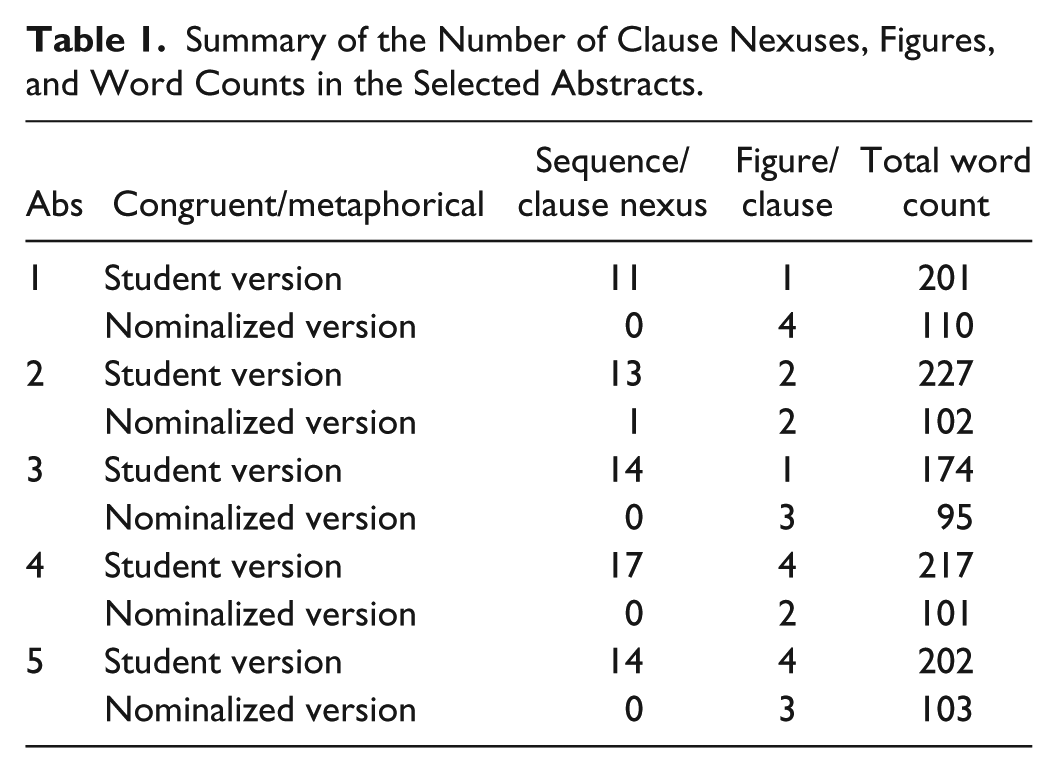
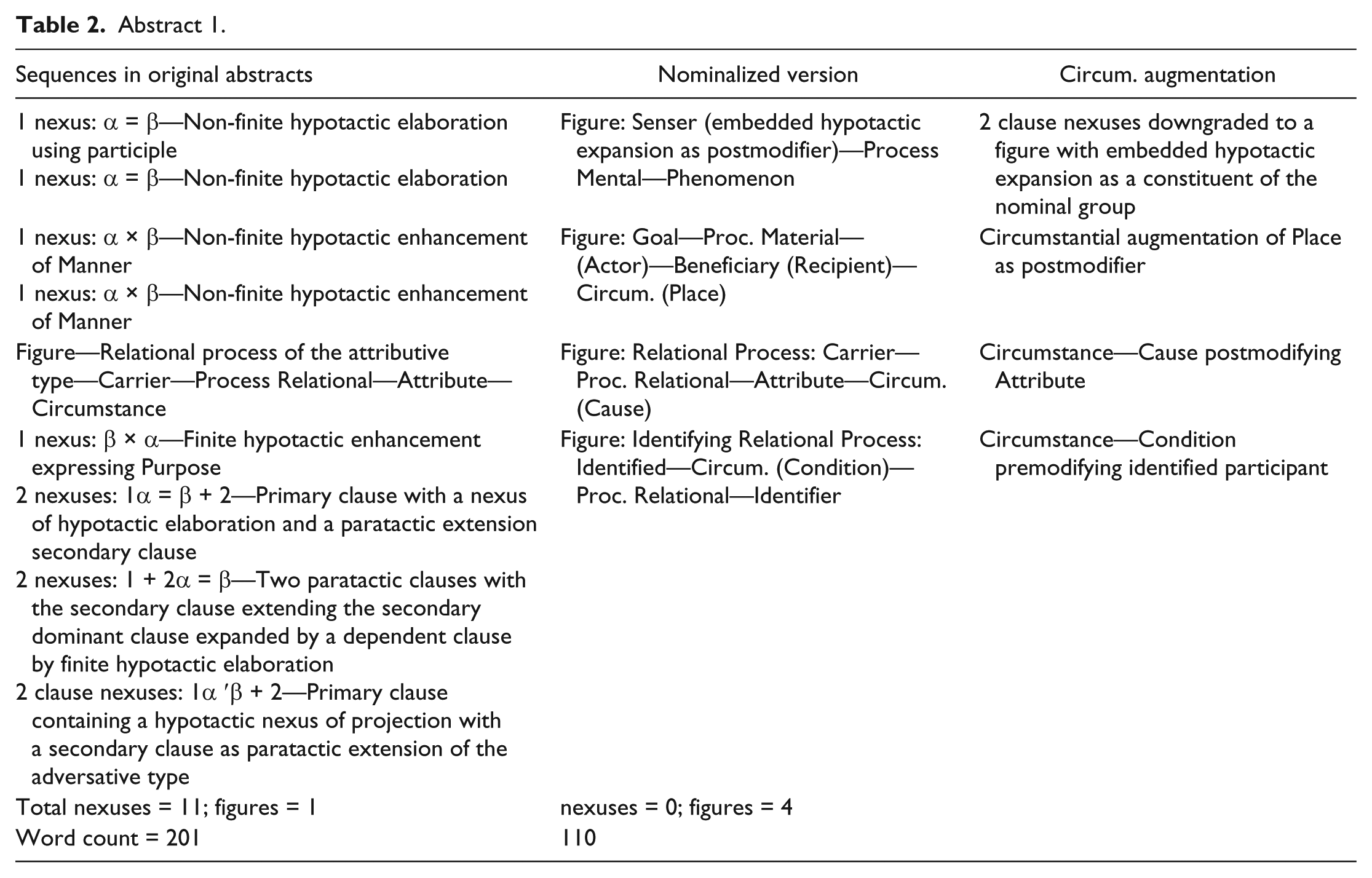
In Abstract 1, 11 clause nexuses comprising 6 paratactic and 5 hypotactic clauses plus a figure were downgraded to only four figures (clause simplexes, that is, single clauses) by augmenting the figure and the clause nexuses either circumstantially or by embedded expansions into nominal groups. This augmentation enables the grammar to transfer their semantic domain from the logical metafunction to experiential, thus locating them in the system of transitivity. This reduces the total word count from 201 to 110. It is also evident from the data that out of the four figures realized in the nominalized variant, two are relational processes, whereas the other two are material and mental process types.
The sequence of figures in Abstract 2, consisting of 13 clause nexuses and 2 figures, is reduced to 3 figures. For instance, the 4 hypotactic clauses (“‖with the aim of finding out ‖ how vocabulary is acquired ‖ developed ‖ and utilized . . .‖”) are realized as a nominal group, object of the preposition “on” (“on the acquisition, development and utilization of vocabulary . . .”). The material processes “acquired, developed and utilized” were objectified and assigned participant roles. In the same Abstract 2, the sequence of figures in Numbers 2 to 5 consisting of 5 clause nexuses and 1 figure was reduced to a figure with modifications and embedding packed in the nominal groups: “⫼Through a questionnaire and a class test of twenty five items, ‖administered to one hundred students . . ., ‖ the findings and observations revealed awareness of the subjects . . . ⫼.” These figures are also construed as relational processes.
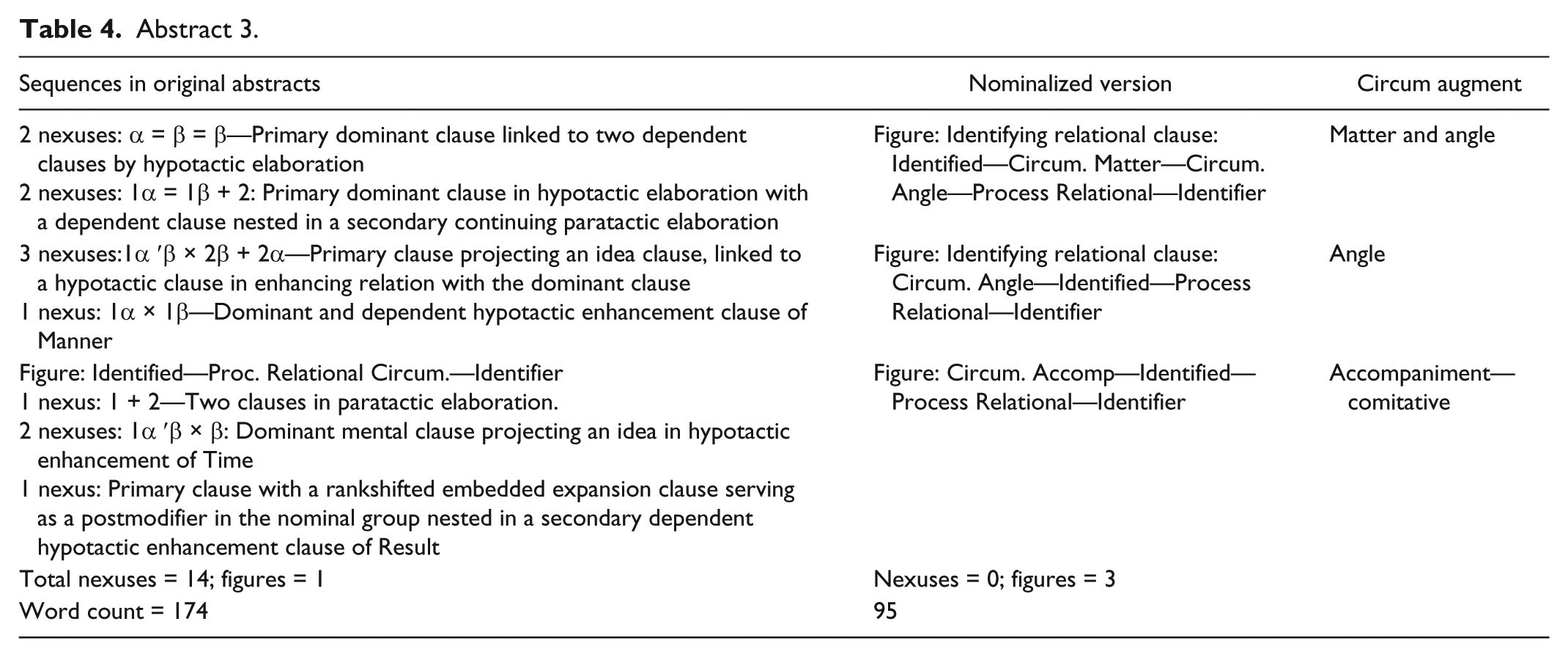
In Abstract 3, the first sequence of figures made up of three clause nexus, one paratactic and two hypotactic clauses, is rankshifted to nominal status as Subject of the primary clause in the nominalized variant. The clause nexus, made up of one paratactic and two hypotactic clauses, is realized as a single figure in one clause, the process “sets out to investigate” is realized as a participant, “an investigation” and as Head of the nominal group serving as Subject, while the primary and secondary clauses in the nexus serve as Postmodifier of the Head. The hypotactic finite elaboration in the nexus “while students engage in conversation” is downgraded to a nominal group “during students’ conversation” serving as a circumstantial element expressing Time. The three figures realized in the sequences analyzed in Abstract 3 also manifest as relational processes.
The same pattern of rankshifting and downgrading is evident in Abstract 4. Up to 17 clause nexuses and 4 figures are realigned by nominalization and realized as 1 clause nexus and 2 figures using circumstances of Time, Place, Manner, and Means as modifications of the Head of the nominal group so realized. For instance, “An investigation of the motivational effects of bilingualism on the learner . . .” is a nominal group serving as Subject in the metaphorical variant, but is an amalgam of four clauses and three clause nexuses. The object of the metaphorical variant “through a survey method, three hypotheses and a pre-tested seven-item questionnaire on a four-point rating scale . . .” is also a nominal group complex comprising three nominal groups linked by coordination. The two figures are realized as material and mental clauses, whereas only one clause nexus with a hypotactic enhancement is realized in the nominalized variant.
Abstract 5 follows the same pattern. Clause nexuses are realized as single clauses and nominal groups with finite or non-finite modifications by circumstantial elements and embedding. It is also seen that the nominalized variants, just as has been pointed out in the other attempted nominalized versions, are realized as a figure, with predominantly relational processes confirming Halliday’s assertion that the nominal style usually instantiates as a figure, with in most cases two complex nominal groups joined by a relational process of the type be.
Table 1 provides a summary of the effect of this downgrading on the selected abstracts. The word counts in the congruent clausal mode are considerably higher than in the metaphorical mode. In addition, the number of clause nexuses is drastically reduced while figures comprising mostly nominal groups serving as Subject, Complements, and Circumstances are higher in the metaphorical mode.
Summary of the Number of Clause Nexuses, Figures, and Word Counts in the Selected Abstracts.
Discussion
It is found that academic genres like abstracts require a unique textual organization and distancing from individual perspective, a compact and condensed form of discourse that packs information not as expansions and projections of clauses but as embedded constituents of nominal groups. The above analyses have attempted to highlight the various forms of transferences from one grammatical class to the other, that is, from Process (realized as a verb) and Quality (realized as an adjective) in the congruent forms written by students, to Participant (realized as a noun) in the attempted modified metaphorical variants. In the metaphorical mode, processes were converted to participants, sequences to figures represented as single clauses, and figures to elements represented as groups, particularly nominal groups. The attempted nominalized samples are provided to further illustrate the operation of grammatical metaphor.
Tables 2 to 6 provide the tactic structures of the original abstracts and the attempted modified ones that tried exploit ideational metaphor. The logical relations of clause complexing which consists of sequences of figures in the congruent mode were realigned by nominalization to become experiential components of figures and elements realized by single clauses (clause simplexes), nominal groups, and group complexes in the metaphorical variants. As grammatical metaphor presents as a figure, a characteristic of written technical discourse, each sentence is typically one clause, consisting of one or two nominal groups with a verbal group usually a relational process with a verb be or a material process (Halliday, 2004; Holtz, 2009).
Abstract 1.
Abstract 2.

Abstract 3.
Abstract 4.

Abstract 5.

It should be noted that in the metaphorical mode, the agency is distanced from the actions specified by the nominalized process, as in for instance, “The researcher found out that . . .” This is a clause nexus of projection (in the form of a report), downgraded to a nominal group as in “The findings . . .” with the agent “the researcher” omitted. This makes it possible to construe experiences in terms of actions, ideas, facts, and subject matter rather than in terms of processes. The configurational patterns of participant roles are lost or obscured when figures are realized as groups or phrases. This seeming disadvantage pointed out by Halliday and Matthiessen (2004) is not very crucial in our case because abstracts require depersonalized discourse where even the inclusion of agency may add to lexical overload.
Tables 2 to 6 also illustrate the nature of the downgrading achieved by recourse to nominalization and ideational metaphor. Because the nominal group lends itself easily to modifications using prepositional and adverbial phrases or attributive adjectives, it is empowered by the grammar with this unique characteristic of information packing. In Halliday and Matthiessen’s words, “the nominal group is the primary resource used by the grammar for packing in lexical items at high density” (p. 655). The veracity of this assertion is ascertained by the fact that in all the abstracts, the word counts were drastically reduced by using nominalization. Owing to increasing need for information density in writing as a result of the recent explosion in human knowledge, science and technology, coupled with the increasing sophistication in literacy index, there is equally a persistent need for a more formal, concise, and stylistic textual representation and packaging of meaning, which at the same time captures our communicative purposes.
Conclusion
From our data, it is seen that the nominalized metaphorical variants help the writer to achieve lexical economy, and at the same time pack as much information as required in the nominal groups which make the abstracts exhibit unique characteristics of prestige discourse. Nominalization, therefore, shows evidence of high literacy, a powerful and authoritative use of the English language that conforms to the generic and schematic structuring of research abstracts. Ideational metaphor, using nominalization, is therefore recommended to budding scholars, especially those in areas where English is a second language, who would want to make their research reports especially abstracts to be densely packaged, with low word counts and at the same time present an intellectually highly rated discourse.
To do this effectively, students should first learn the noun-derivational forms of verbs and adjectives, how processes and qualities are reconstrued as things and entities, the various forms of pre- and postmodifications that are possible in the headword of the nominal group, and how whole clauses can be rankshifted to become constituents of the nominal group through embedding. These are no mean tasks, and enormous responsibility lies on the shoulders of teachers to bring this knowledge to fruition. As the development of grammatical metaphor is a conscious design to create and control our discourse in more technical terms in line with the current explosion of scientific, technical, and other academic advancement, awareness is being created here for budding academics to strive toward this new way of reconstructing experience.
We do not by this recommendation castigate the use of the congruent mode entirely. After all, ideational metaphor is said to deny the grammar access to the significant potential of the tactic patterns of clause complexing (paratactic interdependency and hypotactic dependency), and the configurational patterns of participant roles are lost or obscured when figures are realized as groups and phrases (Halliday & Matthiessen, 2004). However, when word economy and information density are at stake, such as in the writing of abstracts, a writer should exploit the resources of ideational metaphor and nominalization to achieve his or her communicative purposes. As grammatical metaphor is literacy-oriented, it is believed that developing the ability to use this linguistic potential in our undergraduates and budding academics will place them on a path to successful academic career and excellence.
Footnotes
Appendix
Declaration of Conflicting Interests
The author declared no potential conflicts of interest with respect to the research, authorship, and/or publication of this article.
Funding
The author received no financial support for the research and/or authorship of this article.