




Abstract
The 1918 influenza pandemic has been blamed for as many as 50 million deaths worldwide. Like all major disasters, the full story of the pandemic includes smaller, less noted episodes that have not attracted historical attention. The story of the 1919 wave of the influenza pandemic in Bristol Bay Alaska is one such lost episode. It is an important story because the most accessible accounts—the Congressional Record and the Coast Guard Report—are inconsistent with reports made by employees, health care workers, and volunteers at the site of the disaster. Salmon fishing industry supervisors and medical officers recorded their efforts to save the region’s Native Alaskans in private company reports. The federal Bureau of Education physician retained wireless transmission, reports, and letters of events. The Coast Guard summarized its work in its Annual Report of 1920. The independent Bureau of Fisheries report to the Department of Commerce reveals the Coast Guard report at striking odds with others and reconciles only one account. This article explores the historical oversight, and attempts to tell the story of the 1919 wave of the pandemic which devastated the Native Alaskan population in this very remote place.
The 1918 Spanish influenza pandemic has been blamed for as many as 50 million deaths worldwide (Niall, Johnson, & Mueller, 2002) earning it the designation as the “greatest medical Holocaust in history” (Waring, 1971, p. 33) and “the mother of all pandemics” (Reid, Taubenberger, & Fanning, 2001, p. 81). Like all major disasters, the full story of the pandemic includes smaller, less noted episodes that have not attracted historical attention. The story of the 1919 influenza pandemic in Bristol Bay Alaska is one such lost episode. It is an important story because the most accessible accounts—the Congressional Record and the Coast Guard Report—are inconsistent with reports made on scene. This article is an attempt to remedy this historical oversight.
In the spring of 1919, the adult Native population in Bristol Bay was decimated by influenza (VanStone, 1967). The Native Alaskan population in the region at the time numbered approximately 1,000 people, living a subsistence lifestyle in barbaras or sod huts and traveling to fish camps in the spring. Weather conditions preclude travel in and out of the region from September to May, and the Native Alaskan population, with a few federal/territorial employees and salmon industry winter watchmen, were completely isolated from the outside world for 8 to 9 months each year. Because of its remoteness, the region had escaped the first wave of the 1918 pandemic. However, as the ice melted in 1919 and preparations for fishing season began, the dead, the dying, and the orphaned were discovered in appalling numbers.
Two major institutions recorded attempts to mitigate the disaster. The Coast Guard, reporting on its efforts in the 1920 Congressional Record (United States Senate, 1920) and its own Annual Report, was authorized and funded to respond (United States Coast Guard, 1920). The Alaska Packers Association (APA) responded incidental to preparations for the salmon fishing season, maintaining private company reports from several sites in the Bay. A startling contrast, however, exists between the reports of the rescue. The Bureau of Fisheries of the Department of Commerce, reporting independently on the fishery, reconciles only the APA reports, calling the Coast Guard efforts “the saddest repudiation of a benevolent intention” (Baker, 1919, p. 4).
Disease Control in “an American Colony”
In what Haycox refers to as “an American colony,” the U.S. government was responsible for the maintenance of Native Alaskans (Haycox, 2006, title). The Natives, however, were exceedingly vulnerable to disease, having suffered the devastation of their culture and society from colonial administrations beginning with the Russian Period and extending into statehood (Crosby, 1989; Haycox, 2006). Even so, industrial and governmental roles often overlapped in this under-resourced and harsh place. Bristol Bay is the largest sockeye salmon fishery in the world and the source of both Native subsistence and American commercial fishing interests. As part of the commercial enterprise, the APA (1919) provided physicians, nurses, and hospitals for Native employees and their families during the fishing season. The Coast Guard also performed its Annual Survey of the region in summer, providing incidental health care services. In the 1919 season, the Coast Guard was authorized and funded to care for and provision residents of the Alaska Territory during the influenza pandemic (United States Senate, 1920).
The Federal Bureau of Education educated and employed Native Alaskans through the Territorial School Service, and associated domesticated reindeer herds. Teachers initially provided limited health care services, but eventually the Bureau of Education hired nurses and doctors employed by the fish canneries in the same locations. Physicians, in particular, were often recruited as federal representatives, first as Bureau of Education Commissioners, and later with the Indian and Public Health Services. Kanakanak School in Bristol Bay—staffed by a former cannery physician and two Bureau of Education nurses—served first as the school, then the hospital, and, eventually, the orphanage during the 1919 pandemic (Bristol Bay Area Health Corporation, 2003).
By the time of the events described here, the United States had extensive experience with the pandemic. In 1918, U.S. Commissioners nominated deputies in Bristol Bay (French, 1918). Quarantine authorization was established and medical instructions distributed (see Figure 1; Lamb, 1918). Territorial Governor Riggs instituted shipping quarantines in mid-October (Riggs, 1919). Fortuitously, however, weather embargoed the ports, and the influenza raging in San Francisco and Seattle did not affect remote Southwest Alaska until 1919. With the spring ice break-up and resumption of shipping, the opportunity to prevent transmission was lost. Arriving in May for the 1919 fishing season, APA representatives found the influenza preceded them. The fast moving epidemic arrived from Unalaska, 500 nautical miles down the Aleutian Chain, in mid-May, and its lethal effects were apparent by the APA’s May 19th arrival.
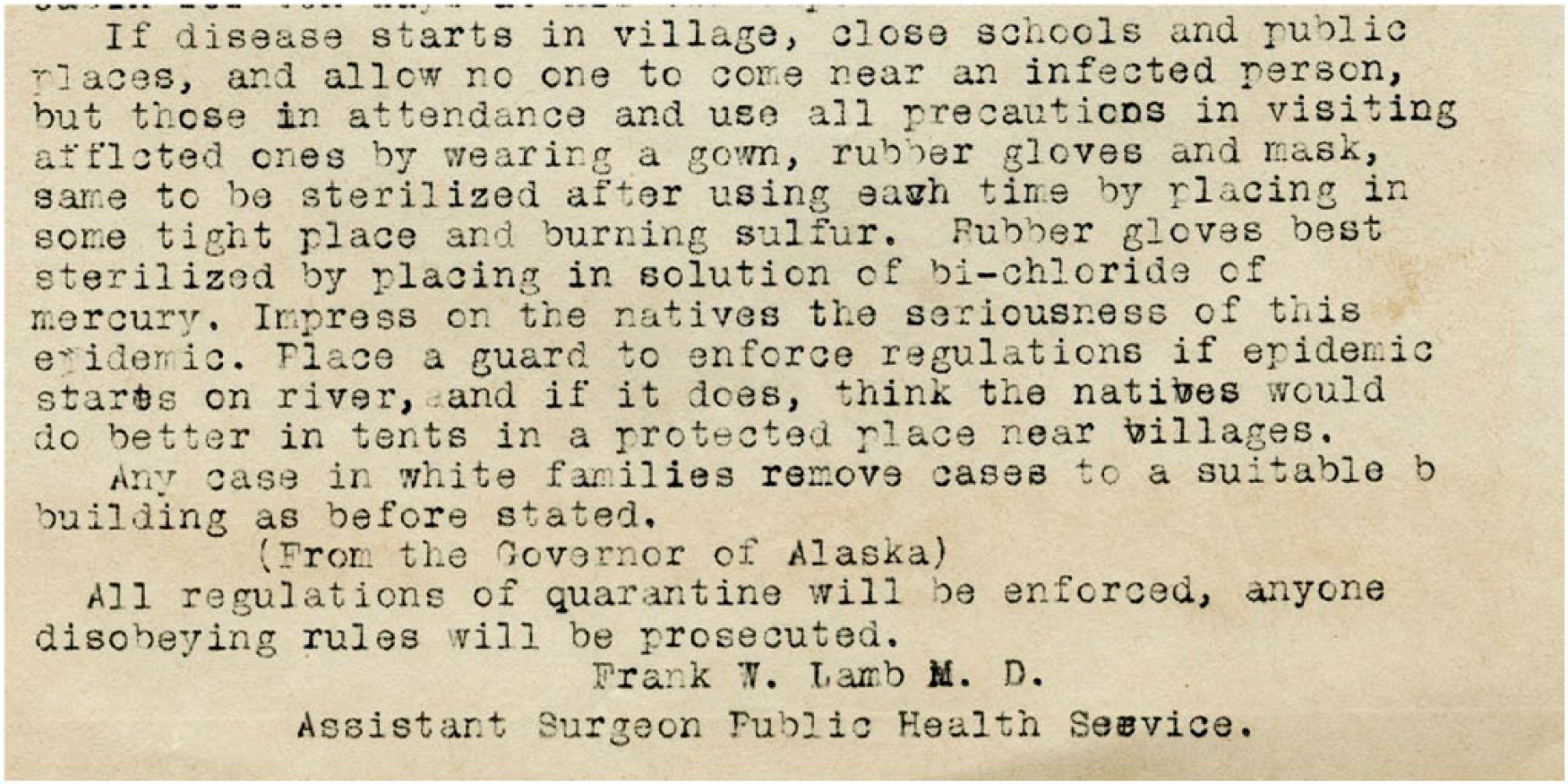
Excerpt from “Instructions for Treatment” and quarantine orders.
Three Stories: A Rashomon
Three sources give differing accounts of the 1919 influenza epidemic that raged in Bristol Bay from May 19th to late July, 1919. Three APA Superintendents kept season chronologies at Nushagak, Naknek, and Kvichak Stations (each station was comprised of two to five canneries or salting facilities around the Bay). Three APA medical officers wrote summaries of the season’s events. The six documents were compiled in October, 1919, into the Report on 1919 Influenza Epidemic: Naknek Station, Nushagak Station, [and] Kvichak Station, Bristol Bay Alaska under the auspices of the APA in San Francisco. The APA also published a public relations pamphlet titled The True Measurement of Any Institution Lies in the Service it Renders in 1922, in which the APA (1922) seeks to give the public a true picture of a side of its Alaska organization of which nothing has heretofore been said and of which few except those who are closely associated with it or its plants have any knowledge. (p. 1)
The Service document is largely a reiteration of the Report on 1919, with the strongest criticisms of the Coast Guard deleted.
U.S. Coastguard ships on their annual survey went north to Alaska when the ice broke up in April 1919, authorized to provide relief and provision residents on the Alaska Peninsula and the Aleutian Chain. The USSS Unalga, Marblehead, and Vicksburg spent late April through early June in Unalaska reporting on efforts to combat influenza there, arriving on June 19th, in Bristol Bay. The Annual Report of the United States Coast Guard for the Fiscal Year Ended June 30, 1920 summarizes the report of Captain Dodge, Commander of the Unalga. The same report is excerpted in the 1920 Congressional Record.
The Department of Commerce Bureau of Fisheries Warden for Bristol Bay, Shirley Baker, traveled on the APA Steamer Nushagak from San Francisco to Clark’s Point in Nushagak Bay, arriving to report on the 1919 fishery’s prospects on May 19th. The Warden’s letter also reported on the condition of the Natives, and the APA, Bureau of Education, and Coast Guard actions during the epidemic. An independent observer, Warden Baker became an inadvertent witness to the evolving crisis and controversy in the Bay.
The Coast Guard’s Cruises in Northern Waters
The 1920 Coast Guard Annual Report chapter, Cruises in Northern Waters, describes its activities in Alaska in the spring and summer of 1919. The Coast Guard summarizes “the valiant service . . . rendered to the natives and others who were stricken down during the terrible scourge of influenza,” focusing on the epidemic at Unalaska (United States Coast Guard, 1920, p. 31). Captain Dodge, the Unalga’s Commander, praised the virtues of “the force attached to the cutter [which] sacrificed every bodily comfort, risked health, and even seriously hazarded their lives” (United States Coast Guard, 1920, p. 25), claiming the Coast Guard’s timely arrival prevented greater loss of life and “contributes an illuminating chapter to the history of the establishment [the Coast Guard]” (United States Coast Guard, 1920, p. 31).
The Coast Guard cutter Unalga sailed from Seattle on April 30, 1919, having stayed in port there for 10 days acquiring provisions. It then stopped in Southeast Alaska to deliver supplies and carry “passengers from place to place and performing other services incident to her cruise” (United States Coast Guard, 1920, p. 31), meandering north toward the Aleutian Chain and the Alaska Peninsula. It stopped but did not stay at Unalaska on May 19th, leaving after 1 day and weathering over on Akun Island. On Akun, it received a wireless appeal for assistance advising “that the Spanish Influenza had broken out in Unalaska and become epidemic.” Returning to Unalaska, “the situation was so serious that Capt. Dodge decided to remain on the ground and afford such medical relief and succor as his force and the facilities of his vessel could supply” (United States Coast Guard, 1920, p. 25).
A week later, the Bureau of Education’s physician at Nushagak, Dr. Hiram French, also wired for help, informing Captain Dodge that “influenza was raging throughout the Bristol Bay district” with “sixty or more deaths . . . [and] . . . no help available to care for the sick or to bury the dead” (United States Coast Guard, 1920, p. 25). Captain Dodge, “explaining to [Dr. French] why he could not, for the present, respond to his call for help,” remained in Unalaska where the wireless operators, White families, teachers, and the government physician were “prostrated by the disease” (United States Coast Guard, 1920, p. 25). The USSS Vicksburg and Marblehead relief ships had also arrived at Unalaska, all three ships staying for the duration of the epidemic there.
Captain Dodge’s health and the situation having improved in Unalaska, another appeal came by wireless from Bristol Bay, this time from the APA’s Naknek Station requesting help for the Natives at nearby Ugashik, all of whom were “sick with influenza, 12 deaths to date: some [white] winter men also affected; can you assist at that station; we can handle situation here at Naknek” (United States Coast Guard, 1920, p. 28). Although the Unalga was able to maneuver quickly at Akun, Captain Dodge decided to sail to Bristol Bay only on June 16th. After moving medical units between ships, the “Unalga steamed out of Unalaska on the afternoon of the 17th bound for the Nushagak River,” arriving at anchor in Dillingham on the evening of the 19th of June (United States Coast Guard, 1920, p. 28), two and a half weeks after the request for assistance and well beyond the peak of the epidemic at both Unalaska and Bristol Bay.
Captain Dodge and his medical staff met with Dr. French at Kanakanak School where they were apprised of 300 sick and dying Natives in neighboring villages and 100 orphans newly transported to the site. A medical party went ashore “on the evening tide” to survey victims at Coffee Point, “where the disease had found a large number of victims” (United States Coast Guard, 1920, p. 29). A detail was also sent ashore “to bury the dead and to shoot stray dogs, a number of which had been feeding upon the bodies of persons who had died unprotected and alone in isolated localities” (United States Coast Guard, 1920, p. 29). Captain Dodge summarizes this first foray finding that “practically all adult natives of that place [Nushagak] had died . . . Also 12 orphan children entirely without protection,” for which arrangements were “promptly made” at the school, now orphanage, in Dillingham(United States Coast Guard, 1920, p. 29). The burial party returned having buried those “partly eaten by dogs,” and “shot all dogs seen” (United States Coast Guard, 1920, p. 29). On subsequent days, medical and burial parties visited villages on the eastern side of the bay, moving the ill and orphaned when found and “carried thither” to Dillingham, (United States Coast Guard, 1920, p. 29), and necessitating one more mention, at length, of the dogs: At one of the settlements visited, the entire population, numbering 7 persons, had died, and the native dogs had stripped their bones. The remains were gathered up and buried. The dogs, as ravenous and ferocious as wolves, promptly attacked the visitors, but the good marksmanship of the detail put an end to them before they could do anybody injury. (United States Coast Guard, 1920, p. 30)
On June 28th, “the services of the relief force being no longer required . . . her work in this district concluded, the Unalga left Nushagak Bay . . . for Unalaska” (United States Coast Guard, 1920, p. 30).
The Coast Guard report concludes with a characterization of Captain Dodge and his crew, “indefatigable in the efforts to relieve suffering,” regardless of the “most menial work” and they are commended by the Secretary of the Treasury, in return, it is just such accomplishments as these for the cause of humanity that have given the coast Guard its high place among our Federal institutions, and the record of the Unalga on this occasion adds another brilliant chapter of endeavor to the annals of the service. (United States Coast Guard, 1920, p. 30)
The Alaska Packer’s Association: Report on 1919 Influenza Epidemic
On May 19th, the same day the Unalga landed at Unalaska, the APA Steamer Nushagak landed at Clark’s Point in Nushagak Bay, which drains into the larger Bristol Bay. A winter watchman reported the influenza had been brought to Nushagak by a Russian Priest from Unalaska, who held services, “attended by virtually every adult Native in the Bay” in mid-May (APA, 1919, p. 27). The disease had spread across Nushagak Bay by the time of the APA’s arrival, and the peak of the epidemic can be seen in the data collected daily by the Kvichak Station Superintendent, J. C. Bell and his medical officer, Isaac B. Wilson (Figure 2). U.S. Commissioner William Neilsen, at Naknek, convalescing from the flu, reported that the epidemic arrived at Kvichak Bay on May 22 (APA, 1919).

Alaska Packers Association medical officer’s mortality frequency table.
The Nushagak Station medical officer wrote that “the influenza had been epidemic throughout the Nushagak district for about a week,” by May 19. “Practically all of the residents, both white and natives,” were ill, and a “considerable number” had died already. “Medical supplies, food and fuel were scarce” (APA, 1919, p. 35). Nushagak Station medical officer, E. B. Robinson found Ekuk Village, a “small place in a deplorable condition.” He left food and supplies, “in care of Mrs. Hansen, herself formerly a trained nurse” to care for the remaining Natives (APA, 1919, p. 28).
Quarantine was an immediate concern, complicated by the seasonal subsistence fishing migration, most of the Natives having just left for fish camps leaving “not a great many in the Koggiung village—only about sixty” (APA, 1919, p. 33). The Kvichak Station Superintendent wrote on May 23 that “immediate measures for its [the epidemic’s] control were taken” (APA, 1919, p. 33), but wired the U.S. Marshall at Naknek asking whether he had authorization to restrict Native travel: “This is very necessary. I have a man acting here now but without authority.” The Marshall replied that he did not have authority but was requesting it, having “notified office of conditions but have not heard anything” (APA, 1919, p. 34).
APA physicians noted that “ . . . the few natives not sick were sitting listlessly around in the cold dirty huts . . . only waiting resignedly to get sick, as is their custom when epidemics are raging” (APA, 1919, p. 21). Whites were also suffering and dying: “Mrs. Fred Blonde, Jr., age 23” and “Mrs. Mike Nergusen, age 42” both died at Clark’s Point early in the epidemic (APA, 1919, p. 21). Linus Hiram French, the U.S. Commissioner for the Bureau of Education and the doctor at Kanakanak Hospital, also came down with the flu and was unable to provide assistance both because he was ill and because he “had more sickness and deaths at Dillingham than he could attend to” (APA, 1919, p. 36). Dr. French requested assistance in the meantime from the Unalga, telling the APA, “have no help here available to send . . . We have the same conditions at Nushagak with probably fifty deaths. I will wire immediately for assistance from outside” (APA, 1919, p. 36). However, the Superintendent at Kvichak Station had already wired Captain Dodge and “received no reply” (APA, 1919, p. 36).
On June 3, the Red Cross at Seward contacted the Naknek Station Superintendent asking for details of the epidemic and offering assistance. By this time, there were already a number of orphans from the epidemic, and the APA had made arrangements to care for the foundlings at the hospitals established at the Native villages around the canneries. J. F. Heinbockel wired back to the Red Cross that “children at Naknek were being well cared for” and assistance was not requested (APA, 1919, p. 4). That decision, however, was informed by the 1,100 mile sea voyage or 300 mile portage over Lake Iliamna required for the Seward Red Cross to offer such assistance. The Superintendent wired the Unalga on the same day requesting assistance for Ugashik village: “Can you assist at this station? We can handle situation here at Naknek at present” (APA, 1919, p. 4). “No answer was ever received to this message” (APA, 1919, p. 5).
The APA’s June 4th discovery of three sick children and two dead adult Natives drifting in a “funeral boat” off Naknek is still referred to at Kanakanak Hospital (Alaska Packers Association, 1922, p. 5). Locating Native orphans before they starved was imperative. Fred Blonde, the winter watchman who lost his wife to influenza at Clark’s Point, was assigned with Edward Smith, an APA nurse, to care for the orphans found by Captain Olaf Hemming of the Star of Iceland, in late May. “Most pitiful was the condition of the poor starved and filthy children . . . covered in reeking vermin . . . crying, huddled about their dead [parents]” (APA, 1919, p. 21). Hospital tents with orphanage facilities were raised, and existing buildings remodeled to accommodate the orphans found in every village surveyed. Surviving adult Natives were “nursed and fed until they could walk to the cannery for their meals” generally for “the entire season” (APA, 1919, p. 22).
On June 23, the Kvichak Station Superintendent received a report of 20 unburied bodies and the possibility of orphans at Lake Iliamna, a 4-day 82 mile journey upriver. The Coast Guard Cutters having arrived 4 days previously were requested to make the journey, the APA lacking low draft vessels for a river journey. Lieutenant Fielder and staff took a boat and provisions but returned after 30 hr, indicating to J. C. Bell “that no effort had been made to carry out the work to find and bury the dead” (APA, 1919, p. 38). Furthermore, Lieutenant Fielder reported back that no bodies had been found. J. C. Bell requested confirmation of the situation via Commissioner Neilsen and a nearby cannery: At Hermans Trading Station there was one woman in tent between the bank and village. Lying under a raincoat was a man and a boy and many lying on the bank. Also there were four or five bodies six or seven miles above Reindeer Station. (APA, 1919, p. 38)
By late June, the Coast Guard’s unresponsiveness and the APA’s lack of authority strained the relationship and dissembling over the dead upriver commanded J. C. Bell’s attention: After Lieutenant Fielder, Dr. Woodruff and their expedition had returned from up the river, I met them in the Alaska Packers Association’s hospital, and in presence of . . . witnesses, informed them that without authority I had assumed the quarantining and policing of the district, had taken the responsibility of care of the sick, burial of the dead, cleaning, clothing and supporting the orphans, feeding the entire village and other work of similar nature. I then requested that as the Marblehead expedition represented the United States Government, the entire proposition would be turned over to it, that the Alaska Packers Association’s employees would be taken away from the village and from the Isolation Hospital, the food patrol stopped and from then on the entire relief to be handled by the Government. At the same time I told Lieutenant Fielder and Dr. Woodruff that I was firmly convinced from what they had done so far, or, rather, what they had failed to do, that they were not serious in their intentions to carry out the relief work. Lieutenant Fielder assured me if he could personally visit his ship and consult with the Commander that he was positive that the Commander would promptly institute measures to take this situation off my hands. (APA, 1919, p. 39)
The APA did not hear from Lieutenant Fielder or Dr. Woodruff again. The Coast Guard relief cutters set sail on June 25th or 28th, depending on which source is used. Subsequently, J. C. Bell learned that Lieutenant Fielder, eager to leave, sent the following telegram to the Marblehead: “Conditions on the Kvichak River satisfactory. Natives dead and buried. No children. Conditions warrant our return to ship. (Signed) Fielder” (APA, 1919, p. 40). In a scathing July 5th letter, J. C. Bell reported to San Francisco, We have not been able to fathom whether the conditions were satisfactory to them or to the natives who are dead and buried. At any rate that is the last we have heard of them. And as usual the job is up to the Alaska Packers Association. (APA, 1919, p. 41, italics in the original)
The Bureau of Fisheries Letter
The Bureau of Fisheries Warden Shirley Baker sailed from Seattle to Bristol Bay on the APA’s Steamer Nushagak, arriving on May 19th, a week after influenza reached the region from Unalaska. He filed his “report of the general operations for the fishing season of 1919,” with the Department of Commerce on November 16th, and through the letter reported on the fishery, Warden Baker was immediately caught up reporting on the rescue of the Natives (Baker, 1919, pp. 1-7). Describing the “Flu Plague” that “threatened the utter extinction of the entire Eskimo population,” Warden Baker describes the region in a “demoralized condition” and the Natives without the “power of resistance to fit them to cope” (Baker, 1919, p. 1). The hospital was overcrowded, the “dead were lying unburied in the barabas [Native dugout dwellings]” and “half-starved children” in the dwellings “with the badly decomposed bodies of their elders.” As was characteristic of the W-shaped pandemic, “these children died only” rarely; “it was the young people and the adults that felt the full force of the plague,” dying shortly after infection (Baker, 1919, p. 2).
Warden Baker and his assistant, Lemuel C. Wingard, worked on the relief effort at Clark’s Point where they first anchored, and on the other side of the Nushagak River, at Kanakanak Hospital in Dillingham, “with a little assistance, the U.S. Deputy Marshall and I interred almost the entire adult population of the Eskimo village of Kanakanak” (Baker, 1919, p. 2). He reiterated the dramatic dog-eating episodes mentioned in the APA 1919 report, as well as the heroic dog shootings in the Coast Guard report, but avoided further elaboration saying “conditions were too harrowing to narrate in this report in detail” (Baker, 1919, p. 2).
In a long paragraph titled “Operations of the U.S.R. Cutter Relief Service During ‘Flu’ Plague,” Warden Baker described the Coast Guard dispatch of medical personnel and supplies as “sincere in its intention,” yet he was “sorry to have to inform” that the “relief work was a failure in all the region where its operations—or rather lack of operations—fell under [his] observation.” Anchoring off a “stricken village,” the Unalga landing parties paid “little or no attention” to the “sick and dying Eskimos.” Instead a “desperate hunt was kept up for souvenirs,” invading Eskimos’ homes, and rifling their possessions in acts “bordering on vandalism” (Baker, 1919, p. 2). The Coast Guard staff and medical personnel displayed a “callous disregard” for the “sick and dying Eskimos to whom they had been sent to minister . . . ” (Baker, 1919, p. 2). After the APA established a Native hospital at Koggiung village, the relief cutter sent a landing party ashore, according to Warden Baker, to “relieve [the APA] of the great responsibility” of caring for the Natives as was their charge. Instead, the physicians, and “particularly the nurses” remained only briefly, “declaring that the natives were ‘too dirty,’ and after looking around the village for souvenirs and furs” returned to their ship (Baker, 1919, p. 2).
The same “distressing failure on the part of those on board the cutter whose duty it was” to treat the victims was displayed at the government hospital and orphanage at Dillingham. According to Warden Baker, the Coast Guard nurses invited two Bureau of Education nurses “to a dance on board the cutter that evening” (Baker, 1919, p. 3). Nurses Ray and Conley “declined the invitation,” and described working conditions during the epidemic to Warden Baker. They had been working practically night and day for weeks on end—doing all the janitor’s work, the cooking for the entire hospital, all the nursing and caring for a number of children and babies whose parents were either dead or dying—on duty until 11 p.m., and getting up thereafter during the night to attend to babies and sick parents urgently demanding attention (Baker, 1919, p. 3).
The Coast Guard nurses “who should have come ashore to help, went back the following day to dance” (Baker, 1919, p. 3). Hospital staff rejected subsequent offers of help from the Coast Guard: The Bureau of Education nurses “did not care to be bothered [further] with them in the crisis existing” (Baker, 1919, p. 3). Warden Baker amends his narrative to exclude the Coast Guard physician who “seemed to have a high moral sense of obligation” and briefly took over the running of the hospital. Mr. Baker further commends Bureau of Education nurses Conley and Ray for their “strikingly effective service . . . and devotion to duty” describing such service as “of a very high order” and deserving of medals if it had been performed “on the field of battle” (Baker, 1919, p. 3).
Warden Baker’s distress extended from the Coast Guard’s actions to the resources expended “in order to give aid to those most unfortunate Eskimos in the astounding calamity that had swept over them” (Baker, 1919, p. 4). Physicians and nurses were well paid and “expensive Red Cross supplies intended to alleviate suffering at the hospitals and Native villages were either not distributed or ineffectively so.” Warden Baker’s report on the relief efforts concludes, “the abject failure of the [relief] expedition . . . is the saddest repudiation of a benevolent intention that I have ever heard of or seen” (Baker, 1919, p. 4).
“The Saddest Repudiation of a Benevolent Intention”
The Bureau of Education had facilities and staff on the ground in Bristol Bay. Funding for large-scale, emergent efforts, however, was a problem in the Territory. Territorial Governor Riggs requested funds to combat the epidemic in early 1919. The Congressional Committee on Appropriations Resolution 199 reveals bickering over the amount spent in Alaska and the uses to which it was put. The Public Health Service complained that the $1 million awarded to it was to be spent on medical services, not “furnishing relief for destitution.” For such a disease at the time, however, food, water, and basic nursing care, or “relief for destitution,” were instrumental to survival (United States Senate, 1919, p. 16). The Public Health Service noted doctors and nurses were not to be had in Alaska, having already been furnished and sent north by the Coast Guard.
Congress appropriated $100,000 in 1918 for relief in Alaska, but it was for Coast Guard, not Bureau of Education, use. Ironically, news reports depicted the Coast Guard relief cutters steaming into Bristol Bay on June 7th, while they remained ensconced in Unalaska on the downside of the epidemic there (Helena Independent, June 16, 1919). A July 15th note in the Oakland Tribune quotes one R. C. Weightman of the Unalga, “epidemic conditions in the Nushagak region of Bristol Bay were not serious at present” (Editor, 1919). Conditions were no longer serious because the epidemic was over and the adult Native population expired.
Journeying up the coast in April, there is no indication that the Coast Guard planned to engage in large-scale relief exercises. The Coast Guard report describes in detail the epidemic at Unalaska, but gives very little information of its trip in Bristol Bay. The Coast Guard stayed at Unalaska until the epidemic was largely over, arriving in Bristol Bay near the end of the epidemic there, although assistance had been requested on at least three prior occasions. The APA recorded the relief cutters’ visit to Clark’s Point Native village on the eastern side of Nushagak Bay—the same day as the Coast Guard’s western village survey, burials, dog shootings, and orphan collections—where they decided “nothing needed their attention” and left (APA, 1919, p. 23). The Coast Guard makes no mention at all of the events near Lake Iliamna, where the conflict between it and the APA ended in confrontation and abandonment.
The APA, arriving at the ascendant curve of the epidemic in Bristol Bay to prepare for fishing, instead set up hospitals, established quarantines, surveyed villages, buried the dead, collected orphans, and dropped 50 tons of provisions. The rapid initiation of private quarantines first raised the question of authority and responsibility for the relief efforts. The 1922 APA Service document commends company action in particular for rescuing the orphans, “with no thought of recompense” (APA, 1922, p. 23) and reiterates the problem of authority and responsibility in a closing letter dated November 17, 1919, from Alaska Territorial Governor Riggs to Henry Fortnam, President, APA, “The government has been very lax in taking care of its wards and the epidemic ending January cost the Territory some hundred thousand dollars . . . ” (APA, 1922, p. 33).
Alfred Crosby (1989) characterized efforts in Alaska as too little, too late, noting that “effective leadership was vital to keeping death rates down” (p. 257). Effective leadership in Bristol Bay came from the APA which acted “without portfolio” when confronted with the devastation in Nushagak Bay. The 1922 Service document depicts a funeral boat, “its sails fluttering idly in a listless breeze,” coming aground at Naknek. Describing the APA-sponsored succor provided to the children in the boat, the story ends boldly, “this is not fiction.” The APA (1922) describes itself as “the only human agency that could have coped” with the local epidemic because it was already on the ground with food, supplies, and medical personnel (p. 5). The APA came prepared for a full season of fishing and was capable of resupplying for the relief effort in mid-season. The company was accustomed both to working with the Natives and to standing up and taking down an entire region’s care and employment operations in a matter of days at both ends of the fishing season. It was an operation remarkably militaristic in character, but unhampered by the weak leadership characterizing the governmental organizations involved in 1919. Profit motivation by a private company must obviously be considered, and yet, the 1919 fishing season was notable for being the lowest run in history (reported in the remainder of Warden Baker’s report; Baker, 1919). Even so, the APA refused to calculate its relief expenditures when encouraged to do so by the Territorial Governor, who wished to draw “attention to the neglect of the natives by the Government” (APA, 1922, p. 6).
The contradictions between the Coast Guard and the APA reports are startling. The Coast Guard’s annual summer mission had long included incidental rescue and medical care, but Congress had allocated an additional $100,000 specifically for the purpose of feeding, supplying, and caring for Native Alaskan residents of Alaskan coastal communities during the pandemic. The Coast Guard reported to Congress that it provided such aid and claimed responsibility for saving innumerable lives, burying the dead, and dispatching starving dogs feasting on human remains in Bristol Bay villages. The report characterized the Coast Guard as tireless and heroic and Congress accepted the report uncritically, praising the Coast Guard for its efforts. However, the Coast Guard report was inaccurate. It was the key governmental agency charged with and funded to mitigate the disaster, but largely failed to respond to the tragic circumstances it encountered.
Haycox’s (2006) “American colony” occupied a political status somewhere between a government protectorate and an industrial resource. The 1919 rescue of the Natives in Bristol Bay contrasted governmental and private actions in a place that existed only once in U.S. history. Dereliction seems the best characterization of the federal response; at worst, the Coast Guard betrayed its mission to rescue the Natives with appalling callousness and perfidy. Private efforts remained unknown until years after events: Neither Congress nor history attended to the APA account.
In spite of all efforts, the loss of life in the region was stupefying. At the end of the 1919 fishing season, 238 orphans remained of 800 to 1,000 adult Native Alaskans formerly inhabiting Nushagak Bay (Riggs, 1919; VanStone, 1967). The salvage of the children, however, is well remembered. The Native Health Corporation built at the site of the old hospital, school, and orphanage grew out of the orphaned remnants of the three tribes inhabiting the region (Bristol Bay Area Health Corporation, 2003).
Footnotes
Declaration of Conflicting Interests
The author(s) declared no potential conflicts of interest with respect to the research, authorship, and/or publication of this article.
Funding
The author(s) received no financial support for the research and/or authorship of this article.