



Abstract
Dietary disparities due to socioeconomic status have raised recent concerns, prompting the need for more comprehensive research. Using nationwide Japanese data from the COVID-19 pandemic period, this study investigates the influence of both socioeconomic status and cooking behavior on dietary habits. The data were obtained from a December 2020 survey, “Survey of Attitudes Toward Shokuiku,” which was conducted during the COVID-19 pandemic and specifically targeted Japanese adults 20 years and older. We measured the frequency of balanced meals and breakfast to assess healthy eating habits, with subjective economic status, subjective spare time, and cooking behavior being the independent variables. Then, we applied multivariate logistic regression analyses to elucidate the relationships between these variables. The results showed a noticeable trend; of those classified as economically disadvantaged or time-pressed, respondents who prepared their meals from basic ingredients had a higher likelihood of having balanced meals and breakfast compared to those who primarily relied on commercial food. We conclude that promoting healthy cooking behaviors and giving advice on cooking skills could alleviate the socioeconomic disparities in healthy eating habits.
Plain Language Summary
Why was the study done?
This study was conducted to explore how socioeconomic status and cooking behavior influence dietary habits. There has been growing concern about dietary disparities based on socioeconomic status, especially during the COVID-19 pandemic.
What did the researchers do?
Researchers used data from a December 2020 survey titled “Survey of Attitudes Toward Shokuiku,” which targeted Japanese adults aged ≥20 years. They examined the frequency of balanced meals and breakfast, taking subjective economic status, subjective spare time, and cooking behavior as independent variables. Multivariate logistic regression analyses were applied to understand the relationships between these factors.
What did the researchers find?
Individuals who were economically disadvantaged or had limited spare time but prepared their meals from basic ingredients were more likely to have balanced meals and breakfast compared with those who relied on commercial food. This trend suggests that cooking behavior significantly influences healthy eating habits, regardless of socioeconomic challenges.
What do the findings mean?
The findings imply that promoting healthy cooking behaviors and providing advice on cooking skills can help mitigate the dietary disparities caused by socioeconomic status. Encouraging individuals to prepare their meals from basic ingredients might improve their dietary habits despite their economic or time constraints. This approach could be a practical solution to enhance overall public health.
Introduction
The World Health Organization (n.d.) defines the social determinants of health as “the non-medical factors that influence health outcomes,” and continues to claim that “in countries at all levels of income, health and illness follow a social gradient: the lower the socioeconomic position, the worse the health.” Many economic factors, such as income, have been highlighted as contributing to health. For example, Kondo et al. (2009) conducted a multilevel meta-analysis and found that economic inequality was associated with mortality and self-rated health, and Pickett and Wilkinson (2015) explored the causal relationships between income inequality and health.
Economic inequality has been found to negatively impact health because of unhealthy dietary habits (Kondo, 2012). People with higher socioeconomic status tend to consume nutrient-rich diets, while those with lower socioeconomic status are more likely to face obesity due to a reliance on low-cost, energy-dense, and nutrient-poor foods (Darmon & Drewnowski, 2008, 2015; Drewnowski & Specter, 2004). The Japanese National Health and Nutrition Survey and several previous studies have reported that these dietary disparities are because of economic status differences (Fukuda & Hiyoshi, 2012; Kurotani et al., 2020; Machida, 2022; Nagahata et al., 2018; S. Nakamura et al., 2016; Nishi et al., 2017; Sakurai et al., 2018; Sugisawa et al., 2015). Another social factor related to dietary habits is time availability. A Ministry of Agriculture, Forestry and Fisheries (2020) survey on the dietary habits of the younger generation found that the earlier people get up in the morning, the more likely they are to have breakfast. A 2019 Ministry of Health, Labor and Welfare (2020) national health and nutrition survey also found that busyness and lack of time are the most common reasons for poor eating habits. Therefore, strategies that can correct the dietary disparities from economic and time factors are needed.
Cooking at home is known to be positively associated with healthy dietary habits. Several previous studies suggest that people who regularly cook and prepare meals are more likely to have healthier diets (Clifford Astbury et al., 2019; Goffe et al., 2017; Hanson et al., 2019; Kitano et al., 2012; Lam & Adams, 2017; Machida & Sugiura, 2022; Nakade et al., 2021; Wolfson et al., 2020). Home cooking generally enables people to prepare more well-balanced and lower-cost meals compared to eating out or consuming processed foods, even people in poor economic circumstances would be more likely to eat a well-balanced meal. Many time-poor people tend to eat out or eat processed food instead of cooking; however, if they make time to cook, they may eat healthier meals. However, no studies have examined whether cooking can mitigate the dietary disparities caused by economic status or time constraints.
During the COVID-19 pandemic, changes in people’s dietary habits and cooking behaviors were observed globally, including in Japan (Akaiwa et al., 2022; Bennett et al., 2021; Hayashi & Takemi, 2021, 2023; Ministry of Agriculture, Forestry and Fisheries, 2021a; Shimpo et al., 2021; Takano et al., 2023). A review by Bennett et al. (2021) on the impact of the COVID-19 pandemic on global dietary habits found that both positive and negative changes were reported, although the majority of changes were negative. In Japan, the December 2020 Ministry of Agriculture, Forestry and Fisheries (2021a) survey results revealed that there had been a significant increase in the frequency of eating balanced meals (12.8%), cooking (26.5%), and eating meals at home (35.5%), and Hayashi &Takemi’s (2021) Japanese survey in July 2020 revealed that 24.6% of respondents reported an increase in cooking frequency, which was greater than the 7.3% who reported a decrease. Takano et al. (2023) also reported that expenditure on home cooking increased during the COVID-19 pandemic compared to the pre-pandemic period. In addition, Shimpo et al. (2021) found that 20.3% of respondents had adopted healthier eating habits, compared to 8.2% who had shifted to unhealthy eating habits. Moreover, Hayashi et al. (2023) found that those who improved their dietary quality during the COVID-19 pandemic were more likely to cook from ingredients. However, considering the economic circumstances, it has also been reported that participants facing worsening economic conditions tended to spend less time cooking, while those with higher household incomes were more likely to shift to healthier eating habits during the COVID-19 pandemic (Hayashi & Takemi, 2021; Shimpo et al., 2021). Conversely, another study reported an increased cooking frequency among those whose household income decreased due to the COVID19 pandemic (Akaiwa et al., 2022). Thus, the association among socioeconomic factors, cooking behaviors, and healthy dietary habits during the COVID-19 pandemic is complex, and consistency in results has not been achieved in some areas.
Given these interesting survey results from the COVID-19 period in Japan, we sought to establish whether cooking could be an intervention in attenuating socioeconomic dietary disparities by investigating the intersectional influences of socioeconomic status and cooking behaviors on healthy dietary patterns during the COVID-19 pandemic.
Materials and Methods
Study Design and Data
This study was cross-sectional. This secondary analysis was based on the 2020 “Survey of Attitudes Toward Shokuiku (Food and Nutrition Education)” conducted by the Ministry of Agriculture, Forestry and Fisheries (2021a), for which the data were drawn from the Social Science Japanese Data Archive (2021), Center for Social Research and Data Archives, and Institute of Social Science at The University of Tokyo. The Ministry of Agriculture, Forestry, and Fisheries survey is conducted annually to ascertain the current public attitudes toward Shokuiku and serve as a reference for future Shokuiku promotions. The survey we consulted for this study was administered in December 2020 (during the COVID-19 pandemic) to people aged 20 and older, for which a stratified two-stage random sampling method was applied to contact 5,000 residents, from which 2,395 (47.9%) valid responses were received (Ministry of Agriculture, Forestry and Fisheries, 2021a). Therefore, for this study, we interrogated the data from 2,288 (45.8%) responses that had no missing values for our required variables.
As this study was based on anonymous information, it was in accordance with the ethical guidelines for life science and medical research involving human subjects in Japan (Ministry of Education, Culture, Sports, Science and Technology et al., 2021).
Variables
Dependent Variables
We used balanced meal intake and breakfast intake frequencies as the healthy dietary habit-dependent variables. The balanced meal intake frequencies were determined from the survey question responses to the question “How many days per week do you eat meals at least twice a day that include a complete set of staple, main, and side dishes?,” which respondents had answered on a scale: nearly every day, 4 to 5 days/week, 2 to 3 days/week, rarely, and never. The following examples were given for each dish category: staples (e.g., rice, bread, and noodles), mains (e.g., meat, fish, eggs, and soy products), and sides (e.g., a small bowl or plate of vegetables, mushrooms, potatoes, and seaweed) (Ministry of Agriculture, Forestry and Fisheries, 2021a). Meals that include a staple food, a main dish, and a side dish are widely used as balanced diet indicators in Japanese studies and are significantly associated with necessary nutrient intake (Kurotani et al., 2018). Previous studies found that adherence to Japanese dietary guidelines, which includes the staple, main, and side dish concepts, can reduce mortality rates (Kurotani et al., 2016; Oba et al., 2009). The aim of the Basic Plan for the Promotion of Shokuiku in Japan is to increase the number of people who have a complete staple, main, and side dish meal at least twice a day (Ministry of Agriculture, Forestry and Fisheries, 2021b). Therefore, we used the categories “nearly every day” and “not every day” in our analyses.
Breakfast intake frequency was determined using the following question: “Do you usually eat breakfast?,” the responses from which were categorized using four choices: nearly every day, 4 to 5 days/week, 2 to 3 days/week, and rarely or never (Ministry of Agriculture, Forestry and Fisheries, 2020). Several meta-analyses found that skipping breakfast is associated with a higher risk of obesity, type-two diabetes, and heart disease (Ballon et al., 2019; Bi et al., 2015; Horikawa et al., 2011; Ma et al., 2020; Takagi et al., 2019; Wicherski et al., 2021). The Basic Plan for the Promotion of Shokuiku in Japan also has a goal to increase the number of people who eat breakfast every day (Ministry of Agriculture, Forestry and Fisheries, 2021b). Therefore, we used the categories “nearly every day” and “not every day” in our analyses.
Independent Variables
We used the following intersectional variables as the independent variables: subjective economic status, subjective spare time, and cooking behavior.
The subjective economic status asked participants about their current economic situation (Ministry of Agriculture, Forestry and Fisheries, 2021a), which respondents answered using five choices: good, somewhat good, fair, somewhat poor, and poor (Ministry of Agriculture, Forestry and Fisheries, 2021a). Hayashi et al. (2015) examined the correlations between subjective economic status and household income and found subjective economic status to be more strongly associated with dietary habits than household income. Therefore, we used subjective economic status as an indicator of economic status, which we categorized into good (good and somewhat good), fair, and poor (poor and somewhat poor) in our analyses.
The survey participants were given five choices to rate their subjective spare time: a lot, somewhat a lot, neither a lot nor too little, not a lot, and little (Ministry of Agriculture, Forestry and Fisheries, 2021a). Although subjective spare time was not tested for criterion-related validity, K. Nakamura et al. (2022) found a significant inverse association with household food waste, and both Jabs and Devine (2006) and Escoto et al. (2012) found an association between lack of time and unhealthy eating habits. Therefore, in our analyses, we categorized the responses into “a lot of” (a lot of and somewhat a lot), “neither a lot nor too little,” and “little” (not a lot and little).
In the survey, cooking behavior was rated using the question “Do you prepare your daily meals by yourself?” which respondents answered using the following choices: “I prepare most of my meals from ingredients” (home-cooked), “I prepare meals by incorporating some commercial foods” (semi homecooked), “I prepare meals using commercial foods for most things” (ready-made), and “I do not prepare meals by myself” (someone else prepares). Notably, an annotation was added to the question that “Preparing meals includes not only cooking but also warming and serving meals. It does not include just buying a lunch box. Commercial foods include frozen foods, retort-pouch foods, and other foods that can be prepared as is or simply heated” (Ministry of Agriculture, Forestry and Fisheries, 2021a).
To examine the combined effect of both cooking behavior and subjective economic status or subjective spare time, we created another variable by combining these variables. We divided each of the four cooking behavior categories by the three economic status categories and used these 12 variable categories in our analyses. Using the same procedure, we also created a variable combining cooking behavior and subjective spare time.
Other Variables
We also used the following characteristics as covariates in the multivariate analyses: gender (male, female), age (20 to 39, 40 to 59, 60 to 79, and 80 or more), employment status (employed, self or family employed, and other), living region (city and town/village), agricultural experience (with and without), self-rated health (good, fair, and poor), and attitude toward a healthy diet (with and without).
Data Analysis
We first described the characteristics based on cooking behavior using chi-square tests. We then determined the detailed proportions for each dependent variable based on subjective economic status, subjective spare time, and cooking behavior and again performed chi-square tests. Subsequently, we determined the proportions for each dependent variable for each of the 12 categories we created to examine the intersectional influences of cooking behavior and subjective economic status and cooking behavior and subjective spare time. We then examined the relationships between each dependent variable and these 12 categories using univariate and multivariate logistic regression analyses that were adjusted for each characteristic. The logistic regression analyses defined the reference categories as people whose cooking behavior was “home-cooked,” had a poor economic situation, and had little of spare time. Lastly, we calculated the odds ratios (OR) and 95% confidence interval (95% CI) for each category.
We conducted the analyses using IBM SPSS Statistics for Windows, version 28.0 (IBM Japan, Ltd., Tokyo, Japan). We set the significance levels for the chi-square tests at 5% (two-tailed test) and determined the logistic regression analyses significance by ensuring that the 95% confidence interval of the odds ratio did not include 1.
Results
Participant Characteristics
Table 1 shows the participant characteristics for each cooking behavior. The chi-square test results for gender, age, employment status, agricultural experience, self-rated health, attitude toward a healthy diet, subjective economic status, and subjective spare time were found to be significantly related to cooking behavior.
Participant Characteristics.

Note. p Value (Chi-square test).
Dietary Habits According to Subjective Economic Status, Subjective Spare Time, and Cooking Behavior
Table 2 shows the percentage of people who ate balanced meals and breakfast, categorized by subjective economic status, subjective spare time, and cooking behavior. The results revealed that better subjective economic status was associated with more frequent consumption of balanced meals and breakfast. Similarly, having more spare time was also associated with more frequent consumption of balanced meals and breakfast. The frequency of eating a balanced meal was higher for the “home-cooked” group, while the frequency of eating breakfast was higher for the “home-cooked” and “semi home-cooked” groups. All chi-square test results were significant.
Dietary Habits: Subjective Economic Status, Subjective Spare Time, and Cooking Behavior.
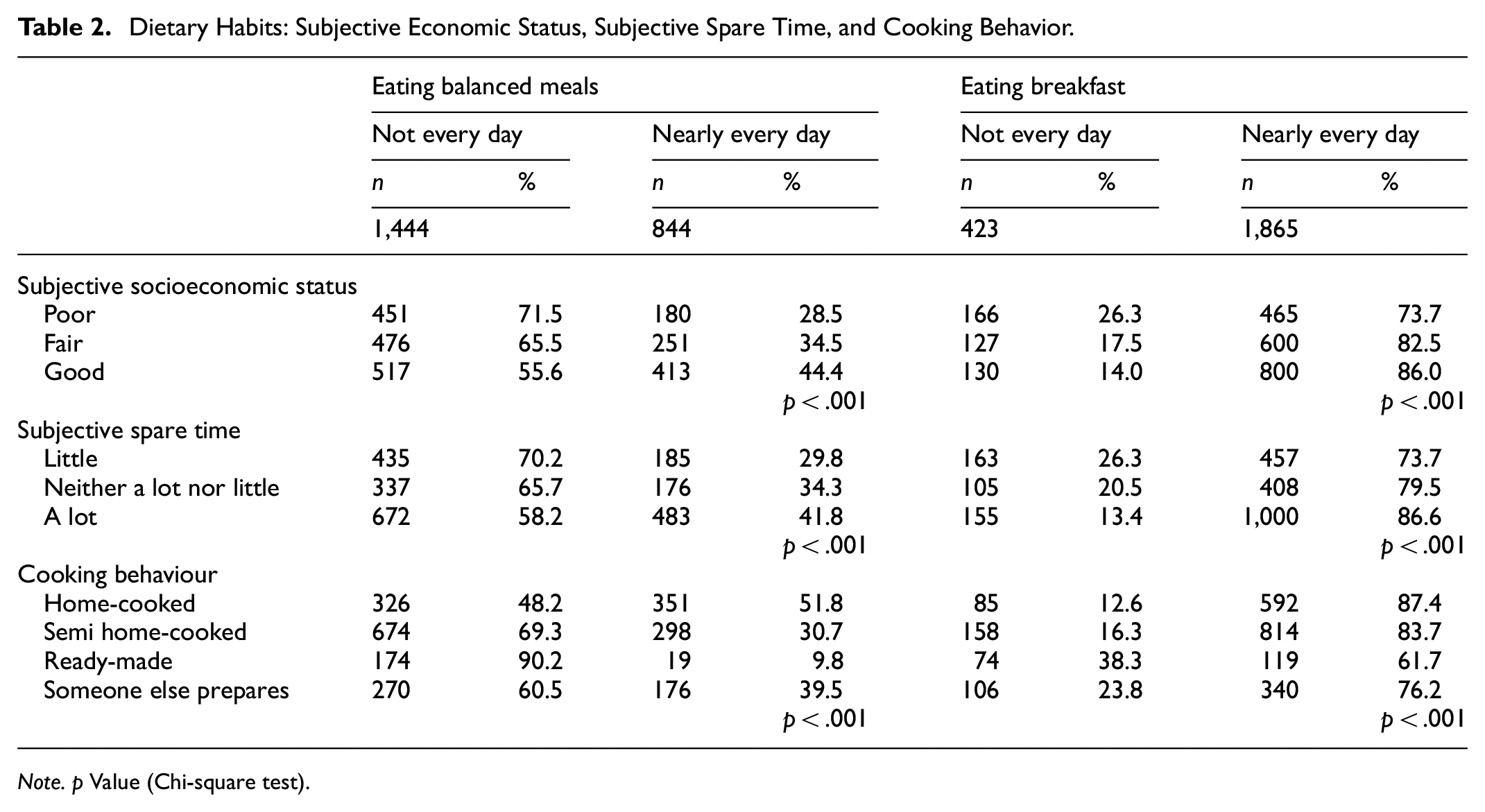
Note. p Value (Chi-square test).
Intersectional Influence of Socioeconomic Status and Cooking Behaviors on Dietary Habits
Table 3 shows the descriptive statistics for dietary habits based on the combination of cooking behavior and socioeconomic status, and Table 4 shows the results of the logistic regression analyses.
Dietary Habits Based on Cooking Behavior and Socioeconomic Status.

Relationship Between Dietary Habits, Cooking Behavior, and Socioeconomic Status: Logistic Regression Analyses.

Note. Bold means significant. Adjusted models: gender, age, employment status, living region, agricultural experience, self-rated health, and attitude toward healthy diet were adjusted. OR = odds ratios; 95% 95% CI = 95% confidence intervals (lower limits, upper limits).
When cooking behavior was combined with economic status, people who “home-cooked” and had a good economic status ate more daily balanced meals than those with a poor economic status (adjusted model; OR: 1.555). However, people in the “semi home-cooked” category who had a good economic status had a similar likelihood to eat daily balanced meals as people from the “home-cooked” category with a poor economic status. When compared to people from the “home-cooked” category with a poor economic status, those under the “semi home-cooked” category with poor or fair economic status were significantly less likely to eat daily balanced meals (adjusted model; OR: poor: 0.500, fair: 0.511). The comparison of people in the “home-cooked” category and a poor economic status found that people from all economic status categories in the “ready-made” category were significantly less likely to eat daily balanced meals (adjusted model; OR: poor: 0.214, fair: 0.136, good: 0.332).
The analyses of the relationships between cooking behavior, spare time, and the frequency of eating balanced meals found no significant differences among people within the “home cooked” category by spare time. When compared to the people in the “home cooked” category with little spare time, the people in all subjective spare time categories in the “semi home-cooked” and “ready-made” categories were significantly less likely to eat daily balanced meals (adjusted model; OR: semi home-cooked [little]: 0.378, [neither a lot nor little]: 0.432, [a lot]: 0.403; ready-made [little]: 0.163, [neither a lot nor a little]: 0.148, [a lot]: 0.159). Compared with people in the “home-cooked” category with little spare time, people in the “someone else prepares” category with little spare time were significantly less likely to eat daily balanced meals (adjusted model; OR: 0.564).
The analyses of the relationships between cooking behavior, economic status, and the frequency of eating breakfast found that people in the “home-cooked” and “semi home-cooked” categories who had good economic status ate breakfast more frequently (adjusted model; OR: home-cooked: 1.930, semi home-cooked: 1.868) than people in the “home-cooked” category with a poor economic status. Compared to people in the “home-cooked” category with a poor economic status, people in the “ready-made” category with a good economic status were significantly less likely to eat breakfast (adjusted model; OR: 0.450).
The analyses of the relationship between cooking behavior, spare time, and the frequency of eating breakfast found no significant differences in the frequency of eating breakfast for all subjective spare time categories within the “home-cooked” and “semi home-cooked” categories. When compared with the people in the “home-cooked” category with little spare time, the people in the “ready-made” category with all subjective spare time categories were significantly less likely to eat breakfast (adjusted model; OR: little: 0.456, neither a lot nor little: 0.379, a lot: 0.477). When compared with the people in the “home-cooked” category with little spare time, the people in the “someone else prepares” category with little spare time were significantly less likely to eat breakfast (adjusted model; OR: 0.437).
In summary, even if people were economically disadvantaged or had little spare time, those who prepared most meals from ingredients were more likely to eat balanced meals compared to those who partially relied on commercial foods or rarely cooked. For breakfast, those who prepared most meals from ingredients or partially used commercial foods had higher consumption frequencies, even under economic or time constraints, compared to those who rarely cooked.
Discussion
This study examined the intersectional influences of socioeconomic status and cooking behavior on dietary habits using data from a Japanese nationwide survey during the COVID-19 pandemic. We found that even if people were economically poor or had little spare time, if they prepared most meals from ingredients, they were more likely to eat balanced meals than those who prepared their meals partially from commercial foods or rarely cooked. We also found that people who prepared the majority of their meals from ingredients even if they were economically poor or had little time to spare were more likely to eat breakfast than those who rarely cooked. In summary, cooking behavior tended to partially mitigate the disparities in healthful eating habits due to economic status and spare time. Previous studies also suggest that there are positive associations between socioeconomic status, spare time, and dietary habits (Escoto et al., 2012; Fukuda & Hiyoshi, 2012; Kurotani et al., 2020; Machida, 2022; Ministry of Agriculture, Forestry and Fisheries, 2020; Ministry of Health, Labor and Welfare, 2020; Mullainathan & Shafir, 2013; Nagahata et al., 2018; S. Nakamura et al., 2016; K. Nakamura et al., 2022; Nishi et al., 2017; Sakurai et al., 2018; Sugisawa et al., 2015; Takagi et al., 2019), and others found that positive cooking behaviors can lead to healthful eating habits (Clifford Astbury et al., 2019; Goffe et al., 2017; Hanson et al., 2019; Kitano et al., 2012; Lam & Adams, 2017; Machida & Sugiura, 2022; Nakade et al., 2021; Wolfson et al., 2020). However, no studies to date have reported on the intersectional influences of socioeconomic status and cooking behavior on dietary habits. Therefore, our study provides important information for developing positive cooking behavior strategies to improve Japan’s socioeconomic status disparities in healthy eating habits. In Japan, eating out at an affordable price often does not provide a balanced meal. While it is sometimes possible to add healthy options by paying more, this can be challenging for those who are not financially well off. In contrast, when eating at home, healthy foods are available at a lower cost compared to eating out. Therefore, we believe that preparing meals at home, especially from ingredients, is a cost-effective way to achieve a balanced diet. However, we cannot ignore the possibility of reverse causation in the relationship between breakfast intake and cooking behavior. In Japan, it is customary to eat breakfast at home, which may mean that people who eat breakfast are more likely to prepare meals at home. This study did not elucidate the mechanisms behind these associations, highlighting the need for further research.
One method to encourage more positive cooking behaviors could be to improve cooking skills, which would allow people to easily use available, inexpensive items or leftovers from previous meals to prepare relatively balanced dishes even in economically challenging circumstances. Having good cooking skills could also expedite meal preparation, which, in turn, could increase the likelihood of cooking even for people with time constraints. Previous studies have found positive relationships between cooking skills and healthy eating habits, nutritional status, and even social health (Lam & Adams, 2017; Tani et al., 2020, 2021, 2023). Other recent studies also reveal that excellent cooking skills are associated with high cooking frequencies (Tani et al., 2020, 2021). However, whether improved cooking skills can mitigate the dietary socioeconomic status disparities remains unclear and requires a more detailed examination in the future. In Japan, cooking workshops aimed at improving the health and cooking skills of residents are regularly conducted in communities by health promotion volunteers with local government. Additionally, all students in elementary, junior high, and high schools receive practical cooking training as part of home economics education to acquire basic cooking skills. Moving forward, it is desirable to enhance these activities further and evaluate the effectiveness of such programs in addressing dietary disparities.
This study also observed unique differences. When eating breakfast was used as the outcome, there were no differences in the percentages of people eating breakfast daily by “cook” and “partially cook.” However, when balanced meal intake was used as the outcome, a smaller percentage were found to eat a daily balanced meal in the “partially cook” category than in the “cook” group. One implication from this result is that although partial cooking with commercial food is sufficient for eating breakfast, cooking most meals from basic ingredients is important for a balanced diet. In addition, respondents who answered “do not prepare” include not only those who eat out or use take-out but also those whose family prepares meals at home. Therefore, interpreting the “do not prepare” responses was difficult and the results should be assessed with caution as more precise verification is required.
Limitations
This study had several limitations. First, the survey data were collected in December 2020. Due to the global spread of COVID-19, different lifestyles were prevalent at this time; therefore, given this context, the survey data were collected under unusual conditions and additional research is required to determine whether the same trends are true in normal conditions. Further, this study was based on a sample of 2,288 responses from 5,000 targeted individuals, which was a relatively low response rate (45.8%). Therefore, there may have been inherent bias in the data due to the underrepresentation of those who did not respond. This study also had a higher percentage of female participants than the typical Japanese demographic (Statistics Bureau, Ministry of Internal Affairs and Communications, 2020). However, we have statistically adjusted for gender by multivariate analysis. Only utilized a cross-sectional design, that is, it was conducted at a single point in time; therefore, it was only possible to establish the correlations but not the causalities. The participant responses were based on self-reported indicators, which makes them somewhat susceptible to recall or social desirability bias. Additionally, as this is a secondary analysis of existing data, it is important to note that certain factors, like education level, could not be statistically adjusted. Therefore, verifying these results using more objective and subjective indicators would be a better focus for future research. Finally, as this survey was conducted in Japan, the findings may not be generalizable to other cultural or ethnic groups. In other countries, an increase in home cooking during the COVID-19 pandemic, similar to that in Japan, has also been reported (Bennett et al., 2021). However, no reports have addressed dietary disparities related to cooking behavior. Therefore, conducting similar investigations in other countries could better verify the results
Conclusions
This study used survey data from a survey conducted in December 2020 (during the COVID-19 pandemic), the results from which reveal that regardless of economic status or spare time, people who frequently cook from scratch have healthier eating habits because they eat more balanced meals and regularly eat breakfast. These findings provide a new perspective on public health interventions, that is, promoting home cooking and teaching cooking skills could help mitigate socioeconomic disparities in healthy eating habits. However, as the data used for this study were based on self-report indicators and gathered under the atypical conditions of COVID-19, further research is needed to explore these results in greater depth.
Footnotes
Acknowledgements
Data for this secondary analysis, “The Survey of Attitude Toward Shokuiku 2020 (Ministry of Agriculture, Forestry and Fisheries),” were provided by the Social Science Japan Data Archive, Center for Social Research and Data Archives, Institute of Social Science, University of Tokyo.

Ethical Considerations
Not applicable. This study was exempt from the ethical guidelines for life science and medical research involving human subjects in Japan, as it utilized publicly available secondary data under the following conditions: the provided individual data could not be used to identify specific subjects; appropriate security measures were in place for the data.
Consent to Participate
Not applicable. Informed consent was waived because the secondary data used were publicly available and contained no personally identifiable information. The surveys had been conducted by a survey company commissioned by the Ministry of Agriculture, Forestry and Fisheries of Japan, in accordance with relevant domestic laws and regulations on personal information protection, as well as applicable guidelines.
Author Contributions
The author confirms sole responsibility for the following: study conception and design, data collection, analysis and interpretation of results, and manuscript preparation.
Funding
The author disclosed receipt of the following financial support for the research, authorship, and/or publication of this article: D.M. was funded by JSPS KAKENHI; grant number JP21K13503 and JP25K05812.
Declaration of Conflicting Interests
The author declared no potential conflicts of interest with respect to the research, authorship, and/or publication of this article.
Data Availability Statement
It is available by applying to the Social Science Japan Data Archive, Center for Social Research and Data Archive, which is affiliated with the Institute of Social Sciences, University of Tokyo.