




Abstract
This empirical study is based in Malta, a small island state with the highest rate of economically inactive women in the European Union (EU). Using a random sample of 402 inactive female homemakers, the responses to a telephone survey revealed that (a) this inactive group is motivated by aspects of social and economic well-being and to a lesser extent by aspects of personal and professional development; (b) work hindrances include low wages, family responsibilities, and a dependency on social security contributions/benefits; (c) the intention to work in the future is significantly associated with work motives, work hindrances, and demographic variables, resulting in an overall holdout accuracy of 84.8%; and (d) the respondents would be encouraged to work if there are more supportive/flexible work structures available for working mothers, equal opportunities for women at the workplace, and employment opportunities through in-work benefits that make work pay (particularly for those aged 40+, with limited skills and with low work intensity). The findings are discussed, and the study concludes by providing four policy recommendations aimed at addressing the present shortcomings of the Maltese labor market.
Introduction
Malta stands out as the country in the European Union (EU) with the highest inactivity rate of females in the labor market. “Inactivity” refers to all persons who are not classified as employed or unemployed (Eurostat, 2011). In recent years, the EU has impressed on governments to evaluate the underlying reasons for inactivity and to deploy policies that encourage the transition from “inactive” to “employed.” Economists have also focused their attention on this portion of society because inactive persons are potential workers (Barham, 2003; Leaker, 2009), and thus, societies are not making efficient use of their potential in terms of human resources. Furthermore, modern day problems of suffering from social exclusion and poverty, syphoning off of social benefits, and the graying of the population (leading to bigger pension outlays) urgently need a wider labor supply to increase the contributions toward such payments (Carcillo & Grubb, 2006). Inactive individuals are not homogeneous and only by understanding why they do not choose to work, can adequate and targeted policies be devised to attract this resource to contribute toward the economy.
In most European countries, inactive persons constitute less than half of the labor force. In Malta, for the month of September 2013, inactive persons accounted for 46.7% of the working age population, but the figure for inactive females rose to 60.5% of all females aged 15 and above (National Statistics Office [NSO], 2014). Furthermore, one fourth of women in the workforce are only working part-time. In recent years, the Government of Malta has introduced several policies (such as tax breaks and financial incentives for self-employment) to encourage females to engage in the official labor market, with some success; however, Eurostat data show that female inactivity still remains the highest in the EU (Eurostat, 2014).
The labor market inactive population includes several categories: homemakers/carers, students, early retirees, and disabled/sick individuals. Inactivity is commonly gender and age specific: Women, youths, and older individuals are more likely to be inactive. This study focuses primarily on women aged 23 and older, not only because they form the greater percentage of the inactive population but also because of the traditional role that many women still appear to endorse.
In Malta, women’s role has been primarily tied to the home and the care of children. This is also reflected in the way social institutions, until recently, used to view women’s position in the family. Women were considered to be solely dependent on their husbands and were required to leave employment upon marriage to take care of the home and children. (Employment and Training Corporation [ETC], 2007, p. 3)
The study aims to better understand and assess what motivates Maltese female homemakers to work, and to determine which factors are preventing them from engaging in the labor market. This is important in the context of the EU encouraging governments to attract more women to join the labor force. The focus within the EU has moved from passive to active labor market policies (see Azzopardi, 2013a for an extended discussion of this) because the latter have shown to have been more successful in the long run. Academic research on the Maltese female inactive population is unfortunately rather sparse, and the research conducted so far is more in the form of institutional or commissioned reports. Such research suggests that there are a variety of reasons why Maltese women appear reluctant to join the labor market or to become entrepreneurs, and who face hindrances for advancement due to glass ceiling effects (National Commission for the Promotion of Equality [NCPE], 2012).
Our study is focused on homemakers who form the majority of inactive females. It seeks to determine the work motives of this inactive group and the reasons that are preventing them from working. The study also investigates whether the intention to work in the future is directly associated with work motives, work hindrances, and demographic variables. In the light of the findings that emerge, the study goes on to provide feasible recommendations that could facilitate their entry or re-entry into the Maltese labor market.
Female Economic Inactivity
In most countries, the inactivity rate of females tends to be higher than males. However, there are differences across countries with percentages for female inactivity ranging from 88% in Syria to 24.5% in Norway (International Labor Organization [ILO], 2013). In the EU, the call for convergence of activity rates is being done through legislative processes, which target equality between the sexes and by offering institutional support for working parents. The inactivity rates for females range from 22.1% in Sweden to 52.2% in Malta (for the year 2012), while the rates for males tend to be less divergent and range from 15.8% in the Netherlands to 33.9% in Croatia. A comparative analysis of small sized economies (similar to Malta) has also found significant difference among them in terms of female labor market participation rates (Azzopardi, 2013b). Eurostat data show that during 2012, there were 74 thousand inactive females in Malta. Data suggest that the older the woman, the more likely she is to be inactive, and the lower the level of education, the higher the probability of inactivity. Females who have completed a tertiary level degree course are less likely to be inactive, at every age group (see Table 1 below). However, the level of intention of women to work is low. A study in Malta (Employment and Training Corporation [ETC], 2007) indicated that actually only “. . . 47.5% of inactive women showed an interest in finding a job” (p. 39).
Inactive Females (in thousands) in Malta by Age Group and Level of Education, 2012.
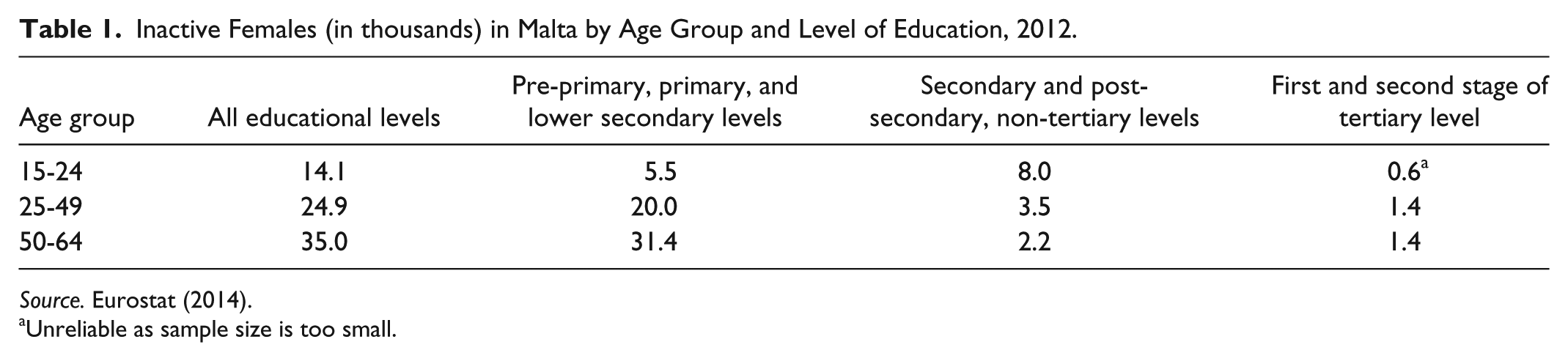
Source. Eurostat (2014).
Unreliable as sample size is too small.
International research finds diverse reasons for inactivity. These may be grouped into four categories: the home environment, discouraged workers, the unwilling-to-work, and the informally active. The most common reason is that related with the constraints or strains in the home/personal environment, including early retirement, sickness, training and education, and caring for children, elderly, disabled, and/or dependent family members. Carers, usually women, are frequently found in this category. They may wish to work but their responsibilities may make it impossible to do so. Homemakers in Malta make up 55% of all inactive females (National Statistics Office [NSO], 2013). Institutional structures may have changed over the years but females are more likely to be the carers in the home. Although legislation allows fathers to take up unpaid parental leave to take care of young children, it is almost always the mother who utilizes this possibility in Malta.
The second group includes those who feel that there are no jobs available for them and therefore do not actively seek employment. If the possibility of employment is made available, such persons may be encouraged to begin looking for employment. Economists at the ILO believe that it is the lack of employment possibilities that discourages some inactive people from seeking a job.
People who were not counted as unemployed (because they were not actively searching for work) when there were few jobs to be had may change their mind and look for work when the odds of finding a job improve. (ILO, 2009)
The third group refers to those persons who are unwilling to work for various reasons such as laziness or cultural taboos regarding working mothers and wives. These are the most difficult group to attract to the labor market, because they are uninterested.
The fourth group is more complicated to analyze as they may find casual or occasional employment (such as child-minding, cleaning residences, mail order agent, outwork or seasonal work, doing odd jobs for friends and acquaintances, bartering systems, and unpaid family workers), which are not officially recorded or registered for tax purposes. Results from the 1980 Women and Employment Survey (in the United Kingdom) suggest that about 1.5 million women (out of a total 11.3 million women classified as economically inactive) actually earned small sums of money doing odd or subsidiary jobs, even if this sometimes only entailed working a few hours a week (Martin & Roberts, 1984 as cited in Hakim, 1992). Although data are not available for Malta, Camilleri-Cassar (2010) maintains that undeclared work is not necessarily low.
A study by the European Central Bank showed that “a significantly higher proportion of female workers in Europe prefer inactivity and a significantly lower percentage prefer full-time, over part-time employment, than in the US, with considerable variation across EU countries” (Buddelmeyer, Mourre, & Ward-Warmedinger, 2005, p. 4). The study also discovered that inactive females were more likely to remain inactive or take up a part-time job rather than engage in a transition from inactivity into a full-time job.
Further results indicate that similarities of inactivity rates and transition patterns can be found in some Mediterranean countries, including Greece, Portugal, Spain, Italy, with Malta appearing to follow the same trend.
Greek, Portuguese and Spanish females, for example, are significantly less likely to remain in part-time work for more than one year and significantly more likely to move from part-time employment to either full time work or inactivity, in comparison with the EU average. (Buddelmeyer et al., 2005, p. 14)
The study concludes that about 85% of respondents remain in the same labor market state: full-time employment for men and inactivity for women. Change, especially for women from inactivity to employment, may be traced to traditional outlooks in these countries, as opposed to their more northern neighbors, such as the Scandinavian countries, where female activity rates tend to be much higher and equality between the sexes is more evident in society and institutional frameworks.
Italy and Malta are often said to have the same cultural traits: Both countries are patriarchal. In Malta, the main role of the female has tended to be that of a housewife (Boissevain, 2006; Camilleri, 1997; Sammut, 2005). Moreover, females above the age of 40 may not be working in the formal economy but nonetheless are “providing social welfare services for others that are free of charge” in the form of taking care not only of children but also of older people and the disabled, and are likely to be more involved in voluntary work (National Commission for the Promotion of Equality [NCPE], 2007, p. 6). This implies that the role of women in Maltese society, while possibly changing for the younger generation, appears to be more hewn out in the traditional sphere particularly for older women.
In 2005, Italy had the third lowest activity rate (after Hungary and Malta) when compared with the EU average. According to Romano and Ranaldi (2007), the gap was mostly attributable to the female portion of the population; because the division of labor in the Italian homes remains traditional, women prefer to remain economically inactive.
The NCPE (in Malta) in late 2011 presented research findings during a national conference titled “Unlocking the Female Potential.” One of the six research projects analyzed inactive females. Eighteen reasons were provided to the respondents, where 37.7% indicated “caring for children” as their main reason for non-employment, with “family as main priority” coming second at 13.8%. A further 13.2% said they were not motivated to work, while 11.8% felt they were too old to look for a job (NCPE, 2012). It would appear that home responsibilities are the top reasons for not working while some form of discouragement also plays a significant role. The Labor Force Survey (LFS) for 2012 (NSO, 2013) shows that 50.4% of inactive females saw family responsibilities as their main reason for staying at home, while the figure was only 1.9% for inactive males (although the latter figure has low reliability; Eurostat, 2014). “Family responsibilities” remain the main cause for inactivity, following on earlier research such as the study by Baldacchino (2003), which found that in Malta, the “caring obligation” was the top reason for women staying at home, where they said they feel fulfilled. Nine years later, Eurostat data confirm that family responsibilities still account for 77.5% of inactivity for women aged between 25 and 49, whereas education is the main reason for the younger age group between 15 and 24. For females above 50 years of age, home responsibilities remain the main cause of inactivity (see Table 2 below).
Inactive Females in Malta, by Age Group and Reason Given for Inactivity, 2012.

Source. Eurostat (2014).
The above discussion has focused mainly on research in Malta and neighboring countries, which have brought forth several reasons for women’s decision to engage in the labor market or refrain from it. The top motive, which seems to be acting as an inhibitor for fuller participation, remains family conditions.
Work Motivation Theories
Motivation is a concept that relates to several characteristics and perceptions of the individual. It is linked to both motives and needs. Motives are the “desired goals which influence behaviour” (Feldman, 1999), while needs are internal drivers, which can be physiological, social, or self-esteem rewards (Rosenfeld & Wilson, 1999).
Theories of motivation have evolved moving from content theories (needs), which focused on the individual, attempting to identify factors both inside and outside of work, which can motivate workers, to process theories (motives) focusing on the cognitive, and trying to understand the process of developing motives and how an individual can be encouraged to act in a different way. “Content theories search for the specific things within individuals that initiate, direct, sustain, and stop behavior. Process theories explain how behavior is initiated, directed, sustained, and stopped” (Segal, Borgia, & Schoenfeld, 2005, p. 43). The former deals with “what motivates people” while the latter is concerned with “how motivation occurs.” From these different perspectives, theorists have tried to understand what drives and motivates human beings in their behavior and actions. These included Murray (1938); Maslow (1954) McGregor (1960); McClelland (1961, 1971); Herzberg’s (1966); Alderfer (1972); Deci and Ryan (2000); Osterloh and Frey (2000); and many more. Major motivation theories can be grouped into those looking at “exogenous causes or with endogenous processes” (Katzell & Thompson, 1990). It is the endogenous processes that explain motivation, while exogenous causes are evaluated to improve the performance of workers by increasing their motivation to work. Motivation theories have been extensively applied within the work environment to increase productivity and maximize output, the most notable studies that triggered this movement being Elton Mayo’s Hawthorne studies, which may have been criticized for the methodology but which nonetheless changed attitudes toward work design.
International research on what motivates people to work has drawn on such theories and results have continued to distinguish between visible/tangible/exogenous factors such as salary, work environment, promotion, job security, praise from supervisor, friendliness, and respect of co-workers, and invisible/non-tangible/endogenous factors such as self-satisfaction, skill development, learning, accomplishment, and freedom. Such studies have mainly focused on individuals already in employment or those seeking employment, assuming therefore that these persons want to work. In the case of inactive individuals (those not seeking employment), theory does not explain whether exogenous factors are in fact more important to attract uninterested/hindered individuals, more than endogenous ones, which would be more difficult to instigate. “Intrinsic motivation” is when there is a desire to do something that is enjoyable and appealing in itself and not because of pressure or some external incentive. “Extrinsic motivation” is directly related to external rewards or pressure, which need not necessarily engage the individual in her or his inner wishes. Yet more recent studies suggest that it is becoming more difficult to separate intrinsic and extrinsic motivations because they may in fact interact (Adler & Chen, 2011).
According to Herzberg (1966), the main motive for people to work is the salary, which “permeates the thought and expressions of people when they view their jobs” (p. 5). While such an assertion may still be valid almost half a century later, distinctions nonetheless exist between countries, cultures, age, and gender.
Literature using gender-based analyses suggests that women, compared with men, may have different motivations not only to work but also in the choices they make about balancing work and home life. Few women in the United Kingdom in 1980 felt that work was related to a career; in fact, Dex (1987) only found 5% of women who felt that a career was the main motivation to work. A follow-up study by Dex, Ward, and Joshi (2008) has shown that improvements have become evident in the intervening 25 years, although downward occupational mobility may still be evident especially for the lower educated after the birth of their child. In the higher level occupations, there is more stability. Women tend to consider their decisions needing a “trade-off” between family and career (Gallos, 1989) and often opt for the former. Furthermore, women choose jobs that allow them to juggle family and job (Powell & Mainiero, 1992), but such jobs need not necessarily lead to a solid career path. Hunt and Rasmussen (2010) maintain that societies need to evolve in such a way as to provide for more flexibility on the workplace and at home, meaning that men are being expected to share in the childrearing of their offspring.
Similar to Dex et al. (2008), Healy and Kraithman (1991) researched women in the United Kingdom who return to work and those who do not. The incentives for women who return were mainly economic, but also included non-tangible ones such as a career, personal development, job status, and also the idea of making new friends at work. A relatively significant percentage of women (30%) did not want to return to work, either because they enjoyed staying at home or because of reservations about viability and effectiveness of child care. Nonetheless, old-fashioned reasons such as a woman’s place is at home or husbands/partners did not want them to work were not commonly mentioned.
Irrespective of the type of job, research conducted in Malta finds that for more than 80% of female respondents (and almost 90% for those in elementary jobs and the unemployed), financial necessity was the primary reason for working (NCPE, 2012). In a more recent study, Bezzina, Azzopardi, and Vella (2013) examined what motivates Maltese employed women to work. They identified two main dimensions or factors: “personal and professional development” and “social and psychological well-being.” The former includes “skill/ability utilization,” “career advancement,” “gaining a sense of achievement/success,” “creativity,” “recognition,” “climbing social ladder,” “supervision,” “responsibility/accountability,” and “enhancing self-esteem.” The latter includes “meeting more people and making new friends,” “financial independence,” “forgetting/escaping from bad habits and problems,” “affording a more comfortable lifestyle,” “better provide for basic necessities,” “doing something different from housework,” and “keeping busy.” They also found that those who intend to work in the future are likely to have higher levels of education and greater levels of work motivation related to “social and economic well-being” and “personal and professional development.” This present article will extend the study by Bezzina et al. (2013) by focusing on the work motives and hindrances of Maltese female homemakers (an inactive group) and to determine which variables (motives, hindrances, and demographic) can adequately distinguish between those who intend to work and those who do not want to work in the future.
Method
The goal of the present study is to determine what could motivate and is hindering inactive Maltese female homemakers to work. Previous studies with Maltese inactive persons used judgment samples, and many of the conclusions drawn from such studies were not backed by the empirical evidence. This study adopts a probability sample of inactive female homemakers and aims to formulate suggestions backed by empirical evidence.
The main research questions addressed in this empirical study are the following:
We believe that answers to these four questions will provide us with a more comprehensive picture of the work motives and work hindrances that may be affecting economically inactive female homemakers in Malta, with the scope of being in a better position to provide policy recommendations based on empirical evidence.
Sampling and Data Collection Procedures
Table 3 shows a summary of the inactive population in Malta, according to the annual LFS of 2010.
Inactive Persons by Perceived Labor Status (Malta).

Source. National Statistics Office (NSO; 2011), March 28.
As outlined in Table 3, the population of Maltese inactive female homemakers consists of 63,290 women (NSO, 2011). Using this as the sampling frame, and assuming a 95% confidence level, a 5% margin of error, and a true sample proportion of 0.5 (worst case for categorical items), we estimated that the minimum sample size required with these pre-set criteria was 383 (Lenth, 2012). With the help of a research grant from the University of Malta, we commissioned the NSO to conduct a telephone survey on our behalf. To take into consideration potential non-response, NSO selected 500 respondents at random from the sampling frame. In total, we collected 424 complete surveys. The responses of 22 participants had to be discarded because 10 respondents began working and another 12 reached the retirement age (65+). A week after the data collection period, NSO forwarded to us a copy of cleaned and anonymized data in SPSS format. Thus, the final sample used in this study consisted of 402 female homemakers. The majority of the respondents were married (86.3%), had a secondary level of education (55.2%), and had previously worked (78.4%). The mean age of the respondents in our sample was 51.85 years (SD = 10.49), with ages ranging from 23 to 65 years.
The Survey
The survey titled “Inactive Female Homemakers in Malta” consisted of two sections. Section A was composed of a set of 16 possible reasons (adapted from Bezzina et al., 2013) that might encourage a person to seek employment (e.g., “Work would give me the chance to meet more people and make new friends”) and a set of 8 possible reasons that might hinder a person from seeking employment (e.g., “The wages are so low that it is not worth it to work”). In Section A, respondents were asked to indicate how important each reason was for them, by choosing one of the following: “strongly disagree,” “disagree,” “neutral,” “agree,” or “strongly agree.” In Section B, the respondents were asked to respond to a closed-ended question that used the nominal scale of measurement (no/yes) related to their intention to work in the future (“Do you intend to work in the future?”) and an open-ended question, “What are your recommendations to Maltese labour market policy makers?”
The respondents were informed that there were no “right” or “wrong” answers for the statements because responses could vary from person to person and that we were committed to assuring confidentiality and anonymity. In fact, all data, which participants provided, were used only when combined with other respondents’ answers to help see the “big picture.” We also highlighted that the responses were to be used solely for research purposes.
Apart from the information gathered from the telephone interviews, NSO provided us with demographic information about the respondents, which was already available—age (in years), marital status (single and never married, married, widowed, legally separated/divorced/annulled marriage), and past occupation (if any).
Data Analysis Procedures
For the first two research questions, we started by generating descriptive statistics (the median and the range) of the 16 work motives and the 8 work hindrances (ordinal scales) to determine their relative importance for the female homemakers. To investigate whether an overall statistically significant difference existed in mean ranks, the Friedman test was used. This was followed by a series of Wilcoxon signed-rank tests (as post hoc tests) across groups, with the Bonferroni correction being applied to counteract the problem of multiple comparisons and to control the family-wise error rate. We then grouped the various motives into two dimensions (“personal and professional development” and “social and economic well-being”) as proposed by Bezzina et al. (2013). To determine whether the mean scores pertaining to these two scales differed significantly from each other, a paired samples t test was used.
For the third research question, we computed correlation coefficients to determine the strength and direction of the relationship between intention to work (no = 0, yes = 1) and each of the work motivation dimensions, the work hindrances and the demographic variables of age (in years), level of education, marital status (categorical variable), and previous work experience (no = 0, yes = 1). Because “intention to work” is dichotomous and nominal, the Pearson correlation coefficient (r) simplified to a Point–Biserial coefficient (rpb), a Rank–Biserial coefficient (rrb), and a Phi coefficient (Φ) when the second variable was ordinal but dichotomous, ranked, and nominal, respectively. After this, we conducted Binary Logistic Regression to determine which of the work motivators, work hindrances, and demographic variables (entered as covariates) emerged as significant predictors of the intention of Maltese female homemakers to work in the future (the binary dependent variable). For this analysis, a Forward: Likelihood Ratio (LR) stepwise logistic regression was specified. Predictors were entered based on the most significant score statistic with a p of .05 or less and were removed if the p of the “−2 log likelihood” was greater than .1 (Cramer, 2003). Before making any conclusions from the model output, we examined basic residual statistics (Cool’s distance, Leverage statistics, DFBeta values, and standardized residuals) to make sure that there are no influential cases that have a negative effect on the model (Field, 2009). All statistical analyses were carried out in the IBM SPSS Version 20 software.
Finally, for the fourth research question, the responses to the open-ended question were coded to conduct a qualitative content analysis of the text.
Results
How Important Are the Identified Work Motives for Female Homemakers?
Descriptive statistics (see Table 4) revealed that the respondents in our study agree that work would allow them to (a) afford a more comfortable lifestyle, (b) better provide for the day-to-day needs, (c) meet more people and make new friends, (d) gain a sense of achievement, (e) utilize abilities and skills, (f) do something different from housework (variety), (g) enhance self-esteem, (h) be responsible/accountable for their work, (i) be financially independent, (j) be creative, (k) be recognized/appreciated for their work, (l) advance in their career, (m) keep busy, and (n) climb the social ladder. However, they neither agreed nor disagreed that work would give them the opportunity to forget/escape from their bad habits or problems, and they disagreed that a job would give them the chance to supervise others.
Work Motives: Descriptive Statistics, Friedman Test, and Wilcoxon Signed-Rank Test Output (N = 402).

Scales are ordinal and range from 1 (strongly disagree) to 5 (strongly agree).
Different letters signify statistically significant differences in mean ranks at p ≤ .00042 (after applying Bonferroni correction); Friedman test: χ2(15) = 1797.64, p ≤ .001.
A Friedman test revealed that there was, overall, a statistically significant difference between the mean ranks of these 16 related groups, χ2(15) = 1797.64, p < .001. A Wilcoxon signed-rank test on each possible combination (with statistical significance set at p ≤ .00042 after applying a Bonferroni adjustment) revealed that the most important motive for Maltese female housewives to engage in the labor market would be “to enjoy a more comfortable lifestyle,” and this was followed by “money to pay for daily necessities.” The remaining motives, ranked in order of importance, are exhibited in Table 4.
We then grouped the various work motives into two dimensions—“personal and professional development” (Cronbach’s α = .78) and “social and economic well-being” (Cronbach’s α = .73), as recommended by Bezzina et al. (2013). A paired samples t test, t(401) = −10.61, p < 0.001, revealed that Maltese female homemakers were significantly more motivated by social and economic well-being aspects (M = 3.86, SD = 0.48) rather than by “personal and professional development” aspects (M = 3.64, SD = 0.44).
How important are the identified work hindrances for female homemakers?
With respect to the work hindrances (see Table 5), the Friedman test generated an overall statistically significant difference in mean ranks across the related groups, χ2(7) = 194.45, p < .001. A summary of descriptive statistics and Wilcoxon signed-rank tests output is presented in Table 5.
Work Hindrances: Descriptive Statistics, Friedman Test, and Wilcoxon Signed-Rank Test Output (N = 402).

Scales are ordinal and range from 1(strongly disagree) to 5 (strongly agree).
Different letters signify statistically significant differences in mean ranks at p ≤ .0018 (after applying Bonferroni correction); Friedman test: χ2(7) = 194.45, p ≤ .001.
It is important to note that from these eight statements, the most important reason that is hindering Maltese female homemakers from working is that of losing part of the financial allowance that they currently receive. This has important policy implications, which will be discussed at a later stage of this article.
Can the intention to work in the future be significantly predicted by work motivation factors, work hindrances, and demographic variables?
In preliminary analysis, we determined that only 36.1% of the respondents reported that they have an intention to work in the future. We also obtained correlations between intention to work and the two work motivation dimensions, the eight work hindrances, and the four demographic variables. Significant relationships emerged between the intention to work and,
the demographic variables of age (rpb = .53, p < .01), education (rrb = −.24, p < .01), work experience (Φ = .22, p < .01), and single (and never married) status (Φ = .17, p < .01);
the work motivation dimension related to social and economic well-being needs (rrb = .17, p = .001);
work hindrances resulting from an unwillingness to undertake specialized training (rrb = .44, p < .01), enjoying staying at home (rrb = −.37, p < .01), losing financial allowance (rrb = −.26, p < .01), interference from husband/partner (rrb = −.20, p < .01), low wages (rrb = −.18, p < .01), and losing most of their flexibility/freedom (rrb = −.18, p < .01).
All the other variables including “personal and professional development” (rrb = .04, p = .398) did not produce any significant relationships with intention to work in the future.
Binary logistic regression was then used to determine which of the two work motivation dimensions, eight work hindrances, and four demographic variables emerged as significant predictors of the intention of Maltese female homemakers to work in the future (see Table 6). “Age” was entered first (χ2 = 133.63, df = 1, p < .001), “undertaking specialised training” second (χ2 = 42.09, df = 1, p < .001), a greater motivation for “social and economic well-being” aspects third (χ2 = 23.99, df = 1, p < .001), “enjoying staying at home” fourth (χ2 = 12.47, df = 1, p < .001), “losing the flexibility/freedom” fifth (χ2 = 6.46, df = 1, p = .007), and “previous work experience” sixth (χ2 = 4.42, df = 1, p = .035). The other variables did not provide a significant increment to the fit of the model.
Variables in the Binary Logistic Equation (Step 6).
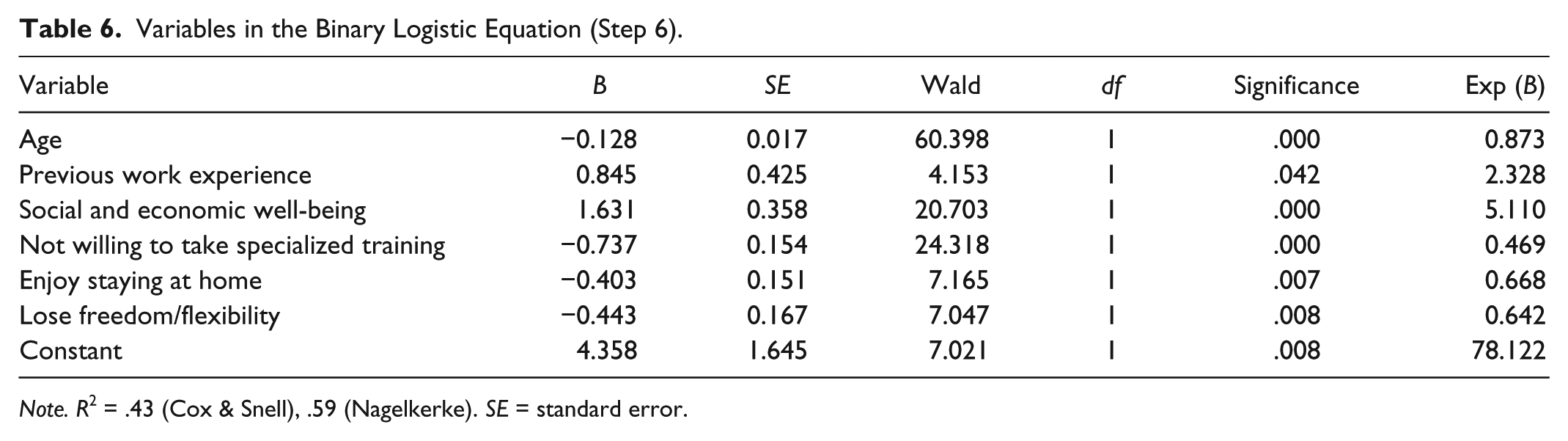
Note. R2 = .43 (Cox & Snell), .59 (Nagelkerke). SE = standard error.
Before drawing any conclusions, we examined the residuals to ensure that there were no influential cases that had an effect on the model. We found that all Cook’s distance and DFBetas were less than 1, and the leverage statistics were close to the calculated expected value of 0.017. Only 4.7% of standardized residuals had absolute values ±2, with only 1.1% lying outside ±2.58, and there were no values above 3. According to guidelines provided by Field (2009), there seemed to be very little here to concern us. Thus, we concluded that the probability of Maltese female homemakers working in the future was associated with (a) a younger age (B = −0.13), (b) previous work experience (B = 0.85), (c) a higher motivation for social and economic well-being aspects (B = 1.63), (d) a lower level of resistance (i.e., more willingness) to undertake specialized training (B = −0.74), (e) a lower level of enjoyment from staying at home (B = −0.40), and (f) a lower level of agreement that work reduces flexibility/freedom (B = −0.44).
The final classification table (see Table 7) revealed that the percentage of correct predictions made by the model was 84.8. This classification accuracy rate was more than 25% higher than the proportional by chance accuracy rate of 63.9% (1.25 × 63.9% = 79.9%), thus confirming the utility of the binary logistic regression model (Hosmer & Lemeshow, 2000).
Classification Table (Step 6).
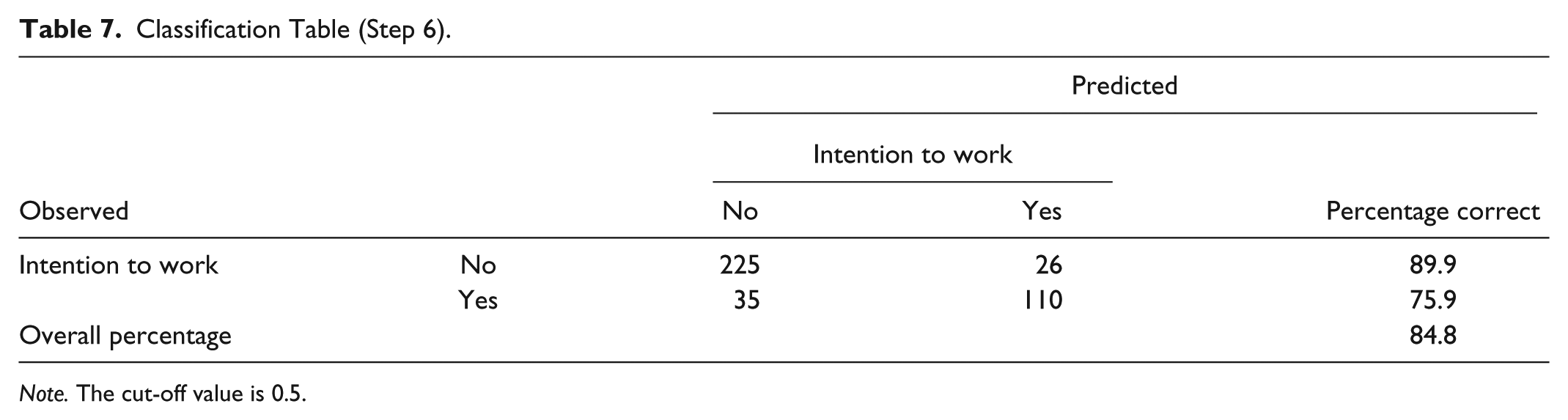
Note. The cut-off value is 0.5.
What Are the Recommendations of Maltese Female Homemakers to Labor Market Policy Makers?
In an open-ended question, we asked the participants to provide us with suggestions for policy makers that would better enable them to boost female participation rates in the Maltese labor market. This resulted in 215 suggestions, which were grouped as follows: (a) more affordable child care centers, close to the place of work (16.7%); (b) better wages and work conditions (15.3%); (c) more jobs available for women (13.4%); (d) jobs with flexible hours (12.1%); (e) reduction in gender discrimination at the place of work (5.7%); (f) increased family friendly incentives (5.5%); (g) increased fiscal incentives (4.7%); (h) making more part-time jobs available (4.7%); (i) increasing school hours (4.7%); (j) creating jobs specifically for the elderly (4.2%); (k) more specialized training programs (4.2%); (l) creating jobs for those who are uneducated and unskilled (3.7%); (m) opportunities to work from home (2.1%); (n) no reduction in husband’s social security benefits when wife works (2.0%); and (o) more advertising on available jobs (1.2%). The remaining 187 participants either claimed that they were not interested in working or else did not make any suggestions.
These recommendations may be grouped under three themes: a more supportive structure for working mothers and those taking care of elderly/disabled, equal opportunities for women at the workplace, and employment opportunities with in-work benefits that make work pay particularly for those aged 40+, with limited skills and with low work intensity.
Conclusion
This study provides empirical evidence that Maltese female homemakers are motivated by “social and economic well-being” aspects and to a lesser extent by “personal and professional development” aspects. The finding may be attributed to the fact that the majority of Maltese homemakers have a low level of education, and this might be limiting their personal and professional development aspirations. The study also shows that the main hindrances to work arise from losing social security benefits, enjoyment from staying at home, family responsibilities, and losing the freedom/flexibility that they currently have.
A striking result in this study is the fact that 63.9% of respondents reported they have no intention of working in the future. This figure is even higher than the 52.5% reported by ETC in 2007. This puts greater pressure on Maltese policy makers who may find that they have an uphill road to actually entice homemakers to join the labor market, given the high female inactivity rate (Eurostat, 2014). This finding is congruent with results that emerged from the European Central Bank study across EU countries (Buddelmeyer et al., 2005). This is particularly significant considering the present emphasis and ongoing campaigns to entice women to become active. Our study also reveals that those who intend to work in the future are relatively younger, are more likely to have previous work experience, are less likely to enjoy staying at home, are more willing to lose the freedom/flexibility they currently have, are more willing to take specialized training to find a job, and reported a greater motivation for social and economic well-being aspects.
In the light of the above findings, we propose the following recommendations in an attempt to integrate more female homemakers into the Maltese labor market:
A more efficient and effective labor market policy: There is a need for a more effective and efficient market policy that avoids a “one-size fits all” approach (Union Haddiema Maghqudin [UHM], 2012). This policy needs to address employability issues pertaining to the society at large including inactive female homemakers, particularly those who are aged 40+ (because most inactive homemakers emanate from this category) and those with limited or no skills.
In-work benefits that make work pay: This study shows that inactive female homemakers have on average a low level of education, and the latter is normally associated with low wages (Card, 1999), thus making it “not worth it to work.” A feasible solution, which has been recently proposed by Jobs Plus (an initiative where social partners and representatives of the political parties are entrusted with the task of advising and coordinating with Maltese Government issues relating to the labor market), is the phasing-out of social security contributions over a span of 3 years for inactive persons who start working. These contributions will continue to be provided by the Government of Malta, and after a 3-year period, such persons will retain a portion of the social security contributions/benefits (say 25%) over and above their salary. In turn, to incentivize employers, the Government of Malta will compensate them with a bonus of say 10,000 Euro for every inactive person they employ. We believe that this proposal would increase the opportunity cost of being inactive, thereby encouraging those with limited skills and with low work intensity to work. Such an initiative could also help to address the growing concern for Malta on the sustainability of welfare dependants (UHM, 2012).
More affordable child care centers and supportive work environments: Family responsibilities, which comprise taking care of children, grandchildren, the elderly and disabled, accounted for more than 43% of the work hindrances of inactive homemakers. This finding is in line with other studies conducted in other European countries such as Italy, Spain, Luxembourg, and Ireland (e.g., International Training Center of the International Labor Organization (ITC-ILO), by the Association of Mediterranean Businesswomen [AFAEMME] and by the Services, Industrial, Professional, and Technical Union [SIPTU] of Ireland, 2010; Romano & Ranaldi, 2007; Valentova, 2006). Cheaper child care services (close to the work environment) as well as flexible and supportive work environments may mitigate this difficulty (Bezzina et al., 2013; Jaumotte, 2004). Such flexibility could include working from home, extended school hours, working-non-standardized hours, and no gender discrimination, thus offering more chances of promotion. Family-friendly measures come in various forms and need to include the father in these systems. Successful examples from other countries can be used as reference. Any policy developments and initiatives need to be viewed within the context of involving both parents in the process, because fathers also have childrearing responsibilities.
Campaigns emphasizing the widening of horizons when a woman works: While staying at home can be an option, the benefits of working go beyond financial incentives (including a pension) and contributing to the economy by paying taxes. These include non-tangible benefits such as taking better care of oneself (grooming), meeting more people and making new friends, and doing something different from housework (variety), as well as various personal and professional development aspects (Bezzina et al., 2013; Dex et al., 2008; Healy & Kraithman, 1991). In this regard, one may need to re-evaluate how effective governmental policies on tax incentives are as a means of attracting female homemakers to the labor market.
Our recommendations thus rest on the need to acknowledge the barriers engrained in the cultural context of females as main homemakers and carers, and to try to mitigate these through institutional changes. In this regard, we stress the need for countries such as Malta with gendered welfare systems and strong culturally constructed ideologies not only to find ways of eradicating hostile working environments, which discriminate against women, but also to provide supportive working structures.
Although this study provides a better understanding of the work motives and hindrances of Maltese inactive homemakers, there are limitations to the findings that must be noted. First, we cannot exclude that some of the inactive homemakers who participated in this study participate in the gray economy. The second limitation is the fact that the work motives, work hindrances, and demographic variables incorporated in this study are not exhaustive. Third, this study was conducted in the specific Maltese context, and hence, the findings and implications might not necessarily lend themselves to generalization over other cultures and societies.
Following this study, some interesting suggestions for further research emerge. First, this study focused on inactive female homemakers; further empirical and inductive studies could be conducted with other segments of the inactive population—the disabled, students, and early retirees. Second, studies could examine the impact of specific intervention strategies in encouraging inactive women to seek employment. Third, studies need to examine the impact of the gray economy on the employment rates of women (and men) and to identify key recommendations for controlling its impact. Such studies would better guide Maltese policy makers in their quest to increase labor market participation rates.
Footnotes
Acknowledgements
We would like to thank all those who participated in our survey. We would also like to thank the editor and the anonymous reviewers for their constructive feedback and insightful comments.
Authors’ Note
Both authors contributed equally to this article.
Declaration of Conflicting Interests
The author(s) declared no potential conflicts of interest with respect to the research, authorship, and/or publication of this article.
Funding
The author(s) disclosed receipt of financial support for the research and/or authorship of this article from the Univerity of Malta [grant number MGTRP04-01].