




Abstract
Conventional literature associates large youth cohort size (YCS) with increased risk of political violence in countries with such demographic profiles. Key questions which remain unanswered, however, are whether YCS is also associated with young people’s proclivities toward more peaceful forms of protests, and whether structural socioeconomic conditions influence such a relationship? Using multilevel binary logistic regression techniques on pooled individual level data for 51 democratic countries purposively sampled from World Values Survey Waves 3 to 6, and country level data from World Bank, and UN Population Division, I show that YCS demonstrates a positive relationship with young people’s participation in peaceful demonstrations. This relationship is, however, moderated by structural factors such as education and unemployment, which end up reducing young people’s likelihood of participation. I argue that resource limitation, as predicted by the Civic Voluntarism Model, better explains the relationship between YCS and individual youth protest behavior in democratic societies, more than socioeconomic grievance, as suggested by grievance theory. An important implication of this finding is that participation in elite-challenging behaviors such as peaceful protests, can be expected to be more common among young people in affluent democratic societies, than their peers elsewhere in the democratic world.
Introduction
The proportion of young people in the adult population of a country is a subject with long tradition of interest within the literature on political violence. Young people have been described as the protagonists in politically destabilizing acts such as ethnic conflicts, civil wars, and riots (Ganie, 2020; Huntington, 1996). Countries faced with youth bulge, defined as a disproportionately large number of young people within the adult population (Farzanegan & Witthuhn, 2017), have also been labeled as particularly prone to political instability and various forms of armed conflicts (Urdal, 2006). The argument is that the growing numbers of young people make available a large reservoir of agents, who can easily be mobilized for such political and social upheavals (Goldstone, 2002; Ozerim, 2019). The series of political protests which led to the “Arab Spring” in 2011, for example, saw the mobilization and participation of one-third of youth in the Arab world (Thyen, 2018, p. 92).
Studies have also suggested various mechanisms linking youth cohort size (YCS; i.e., the proportion of youth within the adult population of a country) to acts of political violence. Some scholars believe socioeconomic grievance, arising from limited labor market opportunities for educated youth, to be a key moderating mechanism which interacts with large YCS to instigate protests and riots (Alfy, 2016; Campante & Chor, 2014; Weber, 2019). Others point to factors such as political grievance, political opportunity, and even the increased access to Information and Communication Technologies (ICTs) as more important mediating and moderating mechanisms (Ang et al., 2014; Romanov & Korotayev, 2019). In this paper, I draw on the above-mentioned youth bulge theory and associated socioeconomic moderating mechanism, to explore the relationship between YCS and young people’s likelihood to participate in peaceful demonstrations. I ask whether the propensity of young people to engage in nonviolent protests is affected by their relative cohort size in the adult population? And whether this relationship is moderated by structural socioeconomic factors? The paper’s focus differs from past studies on the relationship between YCS and protest actions in the sense that all extant studies so far reviewed, use YCS as a predictor of macro level political actions, such as the likelihood of occurrence of protests within a country (Ang et al., 2014; Campante & Chor, 2012b; Costello et al., 2015; Romanov & Korotayev, 2019). By contrast, I focus on YCS as a predictor of individual level youth protest behavior. I also explore the structural socioeconomic mechanisms which interact with YCS to shape such individual level protest decisions.
Furthermore, in contrast to past research which included both democratic and non-democratic countries in their universe of cases, this paper limits the investigation to only democratic countries. This defined focus of the paper on the relationship between YCS and youth protest behavior in democracies is important for the following reasons. Firstly, the present literature on youth protest behavior in democratic societies shows a strong Western bias and only largely reveals patterns in advanced democracies of the West and Australia (see Dalton, 2009; Martin, 2012; Sloam, 2016; Sloam & Henn, 2019). We are, therefore, unable to tell whether these patterns are generalizable across space and time, or only reveal specific patterns of youth participation in the West. Secondly, and even more importantly, YCS as an explanatory variable for young people’s individual proclivities toward non-institutionalized politics remains unexplored in the literature. The aim of this paper to explore how young people’s individual engagements in protest behavior is influenced by their cohort size, therefore, addresses a critical gap in our existing understanding of youth participation in non-institutionalized politics, across both advanced and developing democracies. It also provides insights into trends to be expected in the foreseeable future.
This paper shows that YCS exerts a significant positive effect on young people’s likelihood of engagement in peaceful demonstrations. The study also reveals that the joint effect of YCS, rising youth unemployment rates and increased enrollment in higher education of a country (i.e., the interaction effect of all three variables) on young people’s propensity to engage in demonstrations is negative. Resource limitations due to high unemployment rates within an educated youth bulge, therefore, seem to be a key barrier to young people’s effective participation in protests. The present finding is at variance with the predictions of socioeconomic grievance theory, which suggest an increase in protest activities in response to socioeconomic hardships. By contrast, the effect shows strong consistency with the predictions of the Civic Voluntarism Model (CVM) of political participation, which proposes lower levels of engagement under such circumstances. The findings are based on a series of multilevel binary logistic regression analyses with pooled individual level data from World Values Survey (WVS) Waves 3 to 6 (1995–2014) for 51 democratic countries, and country level demographic and socioeconomic data from the United Nations Population Division and the World Bank respectively.
Following this introduction, the remainder of the paper is structured as follows. The next section presents the theoretical framework for the study and hypotheses for testing. This is followed by the methodological section which discusses the research design, datasets, and variables operationalization. Following that is the results section. The paper ends with the discussion and conclusion sections fused together. I use the term youth interchangeably with young people to refer to persons aged between 15 and 29 years. Peaceful demonstration is used in reference to mass protests by citizens which are lawful and devoid of violence and riots.
Theoretical Framework
Youth, Youth Cohort Size, and Non-Institutionalized Political Participation
The literature on youth political participation argues that young people are increasingly showing disengagement from institutionalized politics, such as voting and party activities (Furlong & Cartmel, 2012; Putnam, 2000; Sloam, 2016), but progressively turning toward non-institutionalized politics, such as participation in new social movement networks (Gaiser et al., 2010), demonstrations, signing of petitions and boycotts (Marien et al., 2010; Sloam et al., 2018; Soler-i-Martí, 2015; Treviño et al., 2019), and various issue-based democratically innovative ways of protest engagement (Huttunen & Christensen, 2020). Explanations to this changing trend have notably been rooted in cultural and value change theory, particularly for post-industrialized Western societies. Postmaterialist theorists argue that evolving values and cultures since the 1960s, have led to the development of more individualized, libertarian, and self-expressive values, over the more conservative and dutiful loyalties to institutionalized political systems, among the contemporary younger generation (Inglehart, 1990; Inglehart & Norris, 2016; Norris & Inglehart, 2019). Importantly, the switch to the more personalized liberal and secular values is believed to have motivated the increased engagement of young people in protests, as they offer greater opportunities for self-expression (Inglehart, 1990; Sloam & Henn, 2019).
Apparently missing, however, from the ongoing debate on young people’s engagement in protest activities is the influence of their cohort size within the population. This is against the backdrop of a growing body of scholarship which strongly links the growing cohort size of young people to increased risks of conflicts, riots, and other acts of political instability. Popularly known as the youth bulge theory, the argument goes that the growing demographic size of young people within the adult population of a country puts the country at a considerably high risk of political and civil instability (Alfy, 2016; Gaan, 2015; Olaiya, 2014; Pruitt, 2020; Sukarieh & Tannock, 2018; Yair & Miodownik, 2016). This is because young people are the main protagonists in acts of political and civil violence (Goldstone, 2002; Huntington, 1996) Empirically, Henrik Urdal found that a one percentage point increase in the YCS relative to the adult population of a country increases the risk of internal conflict by 4%. Also, countries with YCS of 35% or more run the risks of conflicts three times higher than countries with demographic structures similar to that of developed societies (Urdal, 2006). It has also been shown that liberal democracies with large YCS stand a greater risk of deconsolidation into dictatorships, through revolutions and acts of political instability, than others with small YCS (Cincotta, 2009). More recent empirical investigations also generally affirm the youth bulge-instability correlation (Flückiger & Ludwig, 2018; Hafeez & Fasih, 2018; Weber, 2019).
Cincotta (2009) argues that growing YCS births in its wake, youth cultures which “coalesce around distinctive identities and untampered ideologies and find expression through experimentation and risk-taking” (p. 11). As a group, young people, and particularly male youth, tend to be “highly idealistic, sensitive to peer approval, prone to risk-taking and naively accepting of ideological explanations” (Cincotta & Doces, 2011, p. 102). This tendency of young people is argued to be part of socio-biological changes young people experience in their transition to adulthood, during which, being now significantly disconnected from parental values and influence, become “obsessed by an overwhelming desire to join a peer group and, above all, to participate in its collective aggression” (Weber, 2013, p. 338). Importantly, however, as the YCS increases, this propensity of young people to join peers in collective aggression increases further, because the greater the numbers of the young people, the more they influence themselves in their attitudes and behaviors, due to a “self-enhancing socialization” effect (Weber, 2013, p. 350). Young people growing in communities with youth bulge are argued to interact more with their peers, and are also more influenced by their peers, than young people living in communities which are adult dominated (Hart et al., 2004). A significant implication from the above arguments is, therefore, that young people growing within a youth bulge are more likely to show similar behavioral tendencies which manifest in terms of experimentation, risk taking, and proclivities toward collective aggression, than their peers in adult dominated societies.
Drawing parallels with the predictions of the youth bulge theory leads us into a few inferential propositions. Firstly, it is reasonable to assume that since young people show strong propensity to engage in political violence, they will be even more likely to engage in peaceful demonstrations. This is because, while we can expect the fear of injury, arrest, or even death to restrain some youth from engaging in political violence, the peaceful nature of demonstrations should significantly reduce such concerns. We can, therefore, expect the nonviolent nature of peaceful demonstrations to considerably motivate them to join in such events, as the opportunity cost of participation, in terms of risk of injury and fatality is considerably low. Secondly, because youth bulges induce collective youth behavioral tendencies, which find expression through experimentation in risk-taking, we can expect the occasion of large YCS within a country to promote greater interactions among the growing young population, and also mobilize them around the idea of joining in peaceful demonstrations. This decision to participate can be either for the sheer fun and exhilarating experience of being a part of a political demonstration, irrespective of the outcomes (Teorell, 2006), or due to the cause-oriented and biographical relevance of the protest to them as young people (Soler-i-Martí, 2015) . This leads to my first proposition:
H1: There is a significant positive relationship between YCS and young people’s propensity to engage in peaceful demonstrations.
Youth Bulge and Grievance Theory
One of the main mechanisms linking youth bulge and protest actions is grievance. The grievance mechanism traces its roots to the relative deprivation theory (Asingo, 2018; Runciman, 1966; Smith & Pettigrew, 2015; Walker & Smith, 2002). Gurr (1970) is generally credited with the initial development and robust application of relative deprivation theory to political actions, more specifically aggressive political participation (Muller, 1979). Relative deprivation is defined as: “. . .actors’ perception of discrepancy between their value expectations and their environment’s apparent value capabilities. Value expectations are the goods and conditions of life to which people believe they are justifiably entitled. The referents of value capabilities are to be found largely in the social and physical environment [. . .] For purposes of general theoretical specification I assume that perceived discrepancies between expectations and capabilities with respect to any collectively sought value – economic, psychosocial, political – constitute relative deprivation [. . .]” (Gurr, 1968, pp. 252–253).
Gurr argues that when people feel what they are getting does not meet their expectations, or feel deprived of what they deserve, they nurse grievances toward the state. This is because the state is the primary agent to blame for both individual and group deprivations and, hence, the target of any collective action (Gurr, 1970, p. 180). Gurr importantly traces the source of the grievances and discontent of the affected individuals or groups to unfavorable political, economic, and social conditions. Since such structural conditions affect everyone in the society (Taylor, 2001, p. 18), groups which feel relatively deprived in comparison with their own expectations, or to other groups, can be expected to react. Linked to this possibility, T. Gurr (1968) proposes three main reactions by such aggrieved persons and groups: apparent resignation, nonviolent protest, and full-blown civil violence (p. 252). In other words, people express their structural conditions induced grievances against the state, by disengaging altogether from political life, engaging in peaceful protests to register their discontent, or resorting to civil violence. In relation to youth bulge and political violence, the argument is still that, the above-mentioned structural conditions can conflate to create or increase grievances in a large cohort of young people, which can foment nonviolent protests or full-blown political violence. These conditions are believed to include the combined effects of increased access to education and poor labor market conditions (Bricker & Foley, 2013; Campante & Chor, 2014).
Multiple studies have suggested that the failure of the labor market to absorb the growing proportions of youth is among the key factors which cause grievances among young people, leading to their involvement in conflict and violence (Apolte & Gerling, 2018; Flückiger & Ludwig, 2018; Goldstone et al., 2010). Korenman and Neumark (2000) argue that, there is a positive relationship between YCS and youth unemployment. They aver that large youth cohorts entering the labor market suffer high rates of unemployment, due to competition amongst themselves. Even where there are jobs, young people trapped within a large cohort tend to earn reduced wages, due to the saturation of the labor market by a generation with comparatively same skillsets, who are imperfect substitutes for the older generation (Brunello, 2010; Morin, 2015). A counter argument, however, holds that large YCS is rather advantageous for youth unemployment, as it represents a cheap and more malleable labor force, ready to take on even tasks they are not originally skilled at performing (Moffat & Roth, 2017; Shimer, 2001). This notwithstanding, the prospect that labor supply will outstrip demand for a large cohort of young people can be thought of as a stronger possibility, particularly across countries with large YCS.
Besides, the level of grievance within a growing youth cohort can be expected to heighten if the affected youth represent a cohort educated at higher levels. Hannes Weber suggests that higher education increases the expectations of young people for well paid jobs. They consequently become disillusioned and frustrated when, after school, they are faced with prolonged periods of unemployment or underemployment (Weber, 2019). This is because, for many educated young people, good employment offers both economic and social value, as it gives a sense of dignity, pride, social inclusion, and also importantly represents a major milestone on the road to social recognition as adults in many societies (Ozerim, 2019). Unemployment for educated young people therefore represents a major setback in terms of their capacities to meet socially constructed markers of adulthood such as marriage and the financial capacity to rent your own accommodation (Quintelier, 2007), the capacity to support your significant others, and hence, quit depending on parents for assistance (Eguavoen, 2010; Roche, 2010). This likelihood of social exclusion, and the sense of lagging behind in life, arising from the afore-mentioned circumstances can therefore be expected to create discontent among affected youth, or even provoke latent grievances already held up within them.
Recent evidence shows that while educational attainment continues to increase in many parts of the developing world, including sub-Saharan Africa, the Pacific, Asia, the Middle East, and North Africa, corresponding employment opportunities for the large educated youth populations in these regions have been on a consistent decline (Ozerim, 2019, p. 422). Much of the literature on the Arab Spring protests, for example, identify, in addition to political grievances, the disequilibrium between education and employment opportunities for the large youth populations within the affected countries, as among the foremost factors which underlined the protests (Alfy, 2016; Campante & Chor, 2012b; LaGraffe, 2012). Moreover, even apart from the grievances such a situation may create among young people, it can reasonably be argued that the excess time available on their hands due to their unemployed status, can also easily be channeled into aggressive collective actions. Afterall, the opportunity cost of venting grievances through protest acts is significantly low for youth, especially where they are unmarried and unemployed, as such statuses give them relatively fewer social and economic responsibilities, which would ordinarily have made it more costly for them to participate in such collective actions (Campante & Chor, 2012a; Urdal, 2004).
Once again, drawing parallels with the predictions of grievance theory, we can expect that the moderating effects of socioeconomic grievance would be equally significant in terms of youth participation in peaceful protests. Recent empirical studies by Kern et al. (2015), show significant positive relationship between rising unemployment rates and citizens’ propensity to protests against the government over their deteriorating economic conditions. Campante and Chor (2014) also similarly highlight the positive relationship between socioeconomic grievances and the likelihood of protests. Importantly, however, we know that grievance increases with population growth (Collier & Hoeffler, 2004, p. 588), due in part to competition over limited resources and opportunities. An evident implication is therefore that, the tendency to protest may be strongly linked to the relative numbers of the youth in the population, such that the larger the YCS of a country, the stronger the propensity of the young people in the country to protest, particularly where considerable socioeconomic grievance is apparent within the population. Also importantly, the very nature of higher education, and its demands for critical thinking, politicizes young people by the time they come out of the educational system (Briggs, 2017). This critical nature of higher education is among the main reasons why educated young people prefer elite-challenging forms of participation such as protests, over the more institutionalized modes, in communicating their grievances with the political system (Dalton, 2009). The growing numbers of youth educated at higher levels within the population, therefore, represent an ever-expanding reservoir of critical agents with a strong inclination to challenge the political system through the more direct modes of participation such as protests.
In sum, the rising numbers of unemployed educated youth embody alienation, a growing feeling of disenfranchisement, and social anger (Ikelegbe, 2020, p. 78). We can accordingly expect such grievances to be major fuels for protests among young people. We can, therefore, hypothesize as follows:
H2: The positive effect of YCS on young people’s propensity to engage in peaceful demonstrations is stronger for individuals in countries with high unemployment rates.
H3: The positive effect of YCS on young people’s propensity to engage in peaceful demonstrations is stronger for individuals in countries with rising higher education enrollment rates.
H4: The positive effect of YCS on young people’s propensity to engage in peaceful demonstrations is stronger for individuals in countries with a combination of rising unemployment and rising higher education enrollment rates.
Youth Cohort Size and Civic Voluntarism Model
A persuasive counter argument is that economically deprived youth would, rather than spend their precious time engaging in violence and protests, channel them into more productive uses. Sommers (2011) has consequently criticized the youth bulge theory as one with weak explanatory power, arguing that it is a correlation which provides “an incomplete and fairly distorted picture of the broader reality” (p. 295). Using the case of Africa’s youth bulge, Sommers contends that the typical youth on the continent are more concerned with improving their socioeconomic situation, which has to a large extent, limited their social inclusion into adulthood, than joining violent movements. As argued earlier, the social expectations of youth to be economically independent at some point in their development, marry, have a decent accommodation, and support ageing parents, among others, places considerable pressure on those who lack the material means to do so, to strive to achieve such ends (Eguavoen, 2010; Wyn & White, 1997). The imagery of young people within large youth cohorts being preoccupied with violence is, therefore, a marked departure from the reality, as evidenced by the strikingly low levels of political and civil conflicts in many states with youth bulge, and even where conflicts have been in recent years, have not seen the participation of most youth in those countries (Sukarieh & Tannock, 2014, p. 107).
Sommers’ position shares commonalities with the predictions of resource-based models of political participation, such as the CVM. The developers of the model argue that the decision to participate in politics depends, among others, on the socioeconomic status (SES) of individuals (Verba et al., 1995). People’s SES (i.e., education, income, and employment) provide them with three main resources: time to participate in political activities, the money to contribute to political activities and the civic skills - i.e., the organizational and communication skills which enable effective participation in politics (Brady et al., 1995). Thus, the higher the SES of an individual, the more time, money, and civic skills the individual possesses to participate effectively in politics. Since access to resources is fundamental to active participation in politics, the positive relationship between large YCS and youth unemployment already discussed, can in this case, be expected to impact negatively on young people’s resources. Put another way, high rates of unemployment among many educated young people considerably extinguishes their capacity to meet their own needs and that of their significant others. Besides, because they are less skilled, inexperienced, and also earn relatively less even when employed (Brunello, 2010; Moffat & Roth, 2016), the expectation that they would have fewer excess resources to commit to political activities sounds particularly plausible.
In the first place, gaining access to the labor market itself to create the opportunity to earn some income is a challenge for young people (Bricker & Foley, 2013). As earlier discussed, however, youth bulge presents the extra challenge of oversupply of labor force, which renders a large proportion unemployed, while also reducing the wages of those fortunate enough to be employed. In this way, the employed face limited earnings and a tendency to use excess time for extra jobs to top up their incomes, or even pursue further capacity building opportunities to improve their market value. The unemployed on the other hand, faced with limited financial capacity or lacking it altogether, can be expected to be occupied with job searches with the excess time on their hands. This argument certainly does not overlook the active engagement of many young people with minimal capital in various political activities. Jan Teorell has aptly argued that two main reasons motivate the political participation of people: because they have the resources to do so, and also because they have the incentives to participate (Teorell, 2006, p. 801). Focusing on the resource component of the motivations of participation, which is the interest of this study, however, an evident inference which can be drawn from the above argument is the fact that rising unemployment rates would present considerable constraints on young people’s ability to participate politically, especially in the more time consuming and resource demanding activities.
Joining a protest takes hours, compared to voting, which is by the click of the button in most instances. Faced with employment uncertainties as educated youth, we can reasonably expect that a growing proportion of young people in the population, would be more likely to spend their time looking competitively for jobs and other opportunities to improve their socioeconomic situation, and also meet the social markers of adulthood, than to protest. Accordingly, we can propose the following as counter to H4.
H5: The effect of YCS on young people’s propensity to engage in peaceful demonstrations is negative and stronger for individuals in countries with a combination of rising unemployment and rising higher education enrollment rates.
I now test all five hypotheses with individual level and country level data from the WVS, World Bank and the UN Population Division.
Data and Methods
The study utilized a combination of pooled individual level data for only young people (15–29 years), drawn from WVS Waves 3 to 6 (1995–2014) 1 and country level data from the World Bank 2 and the United Nations Population Division, 3 in a large-N statistical design with democratic country-year as the unit of analysis. The WVS provided a full sample of individual level data on the political attitudes, protest behavior, sociodemographic, and socioeconomic statuses of young people, while the World Bank and UN World Population Prospect report provided country level information on youth unemployment rates, school enrollment rates, and YCS, respectively. Democratic countries included in the respective Waves were purposively sampled, based on the mean Polity IV index scores 4 of the countries during the years in which the surveys were conducted. These were 1995 to 1998, 1999 to 2004, 2005 to 2009, and 2010 to 2014 for Waves 3, 4, 5, and 6 respectively. Democratic countries are defined by the Polity index as countries which score between 6 and 10 on the 0 to 10 Polity scale. All countries with scores below 6 are classified as non-democratic. The study accordingly excluded all countries which scored below the minimum threshold of 6 in each round of the WVS. Despite the strengths of alternative democracy indices such as the V-DEM liberal democracy index (Boese, 2019), the study preferred the Polity index. This was because preliminary comparisons of democratic countries generated by both indices from the same set of WVS countries, showed the Polity index as better at generating the preferred mix of countries, with appreciable variations in YCS, from both established and developing democracies. The V-DEM index on the other hand, generated a list overly dominated by established Western democracies with small YCS. As the multilevel nature of the study required significant variations in the main explanatory variable, YCS, at the country level, I found the Polity IV and its choice of countries better suited for the study.
The decision to limit the study to democratic countries was because only democracy, as a regime type, affords citizens the liberty to participate in politics as a fundamental right, guarantees freedom of expression and freedom of association, ensures suffrage and clean elections, and also elects its executive (Dahl, 1971). Democracy is also characterized by judicial and legislative oversights as means of restraining abuse of exercise of power, the rule of law, and the protection of individual rights and liberties (Lührmann et al., 2018), and as a result, importantly embraces elite challenging and authority defying modes of participation, such as protests as part of its repertoire of citizen engagement activities (Dalton, 2009; Norris, 1999, 2003). While acknowledging reports of suppression of protest actions and attacks on free speech in some established and developing democracies in recent years, the above-mentioned characteristics can be related to as the more typical features of democratic regimes. By contrast, authoritarian regimes offer less freedom to citizens to challenge the political system, suppress political participation, and also restrict citizen mobilization (Marshall et al., 2017). Respondents under such regimes are, therefore, typically unable to freely express themselves in such political surveys, which brings the validity of survey results from authoritarian regimes into question (Holmberg et al., 2017). The final analysis included a total of 51 countries with datasets on all key variables, selected from both the developed and developing worlds. Table 1 in the Supplemental Appendix section of this paper provides the full list of selected countries.
Logit Regression Table for Predictors of Youth Participation in Peaceful Demonstrations.

Note. Entries are the logit coefficients and robust standard errors in parenthesis for multilevel binary logistic regression Models. All Models were estimated with individual level data on youth non-violent protest behavior collated from 38,149 youth respondents in 51 countries drawn from WVS Waves 3 to 6.
Reference category: aMale.
Married.
Below secondary school.
Unemployed.
p ≤ .05. **p ≤ .01. ***p ≤ .001.
Dependent Variables
The dependent variable for the study was peaceful demonstrations. The study chose peaceful demonstrations as the proxy for protest behavior from the different kinds of protest actions, because it is relatively more common, familiar, and also received the highest response rate from young people among the four types of protest activities within the WVS database. Also importantly, the literature identifies peaceful demonstrations as one of the most common “public displays of protests” (Campante & Chor, 2014, p. 497), and a growing form of non-institutionalized political expression among the youth (Kalogeraki, 2021; Sloam, 2016). The WVS asked respondents whether in relation to peaceful demonstrations, they; “have done, might do it or would never under any circumstances.” Norris (2003, p. 11) argues, however, that hypothetical questions such as asking whether a respondent “might do” something are limiting in their ability to predict actual behavior, compared with others which assess routine behavior actually done or not done. Following from Norris’ argument, the study sought to measure actual behavior in relation to peaceful demonstrations, as having done or not done. The variable was, hence, recoded into a binary, with “never do and might do” collapsed into one category – “Not Done” and assigned the value of 0, while “Have Done” took on the value of 1. Across the full sample of 51 countries, an average of 85.8% of respondents reported not to have ever joined a peaceful demonstration, while 14.2% affirmed to have ever done so. The range of youth protestors, however, varied widely across countries, constituting as high as 50% in Italy, to as low as 1.5% in Japan.
Explanatory Variables
The main independent variables of the study were YCS, youth unemployment rates, and tertiary enrollment rates of countries. YCS was operationalized as the share of individuals aged 15 to 29 years within the adult population of a country (15 years and above). The study settled on the 15 to 29 years age group because their cohort size has been shown in past studies to significantly predict collective social actions (Weber, 2013, 2019). This range also includes an important group of young people (25–29 years old) who are often overlooked in youth bulge related studies (e.g., see Flückiger & Ludwig, 2018; Urdal, 2006), but are undergoing crucial life experiences (including transition into social adulthood ) which are of theoretical relevance to the present study. The proportion ranged from a minimum of 18.4% in Japan to 51.5% in Mali, with a mean of 34.9% and standard deviation of 8.7. Along with Japan, Italy, and Germany were the two other countries with YCS less than 20%. By contrast, developing countries such as Ghana, Guatemala, and Bangladesh, along with Mali, had YCS more than 47%. Youth unemployment rate was operationalized as the percent of total labor force aged 15 to 24 years who are unemployed and used as the main proxy for structural economic conditions which can induce either grievance or apathy toward protest among young people. Country unemployment rates ranged from as low as 3.4% in Pakistan, to as high as 59.4% in Macedonia, with a mean of 19.8% and standard deviation of 12.5. Tertiary enrollment rate 5 was measured as School enrollment, tertiary (% gross), and ranged from a minimum of 5.7% in Mali, to a maximum of 99.7% in South Korea, with a mean of 41.5% and standard deviation of 21.8. It was also used as the proxy for higher education among countries.
Control Variables
Based on existing literature on protest behavior, the study controlled for predictors which have shown strong relationships with protest at the individual level. Past empirical studies on sociodemographic predictors argue that by age, young adults are more likely to protest than the older generation (Melo & Stockemer, 2014). The gender of protestors is, however, nuanced. While recent evidence in developing democracies in Africa show that women have less proclivities toward protests (Asingo, 2018), other studies in more established democracies of the West show the growing dominance of women in recent protests (Bowman, 2019; de Moor et al., 2020; Wahlstrom et al., 2019). The married on the other hand are argued to be less likely to engage in non-institutionalized political behaviors (Weiss, 2020, p. 4). Socioeconomic predictors such as education and employment have also shown strong positive associations with protest behavior in past research (Dalton et al., 2010; Dalton, 2020; Kern et al., 2015). Similarly, political interest (Dalton, 2009) and postmaterialist values (Norris & Inglehart, 2019; Sloam & Henn, 2019) are argued to strongly predict protest behavior among young people. The study also included variables such as satisfaction with your life and satisfaction with the income levels of your household as proxies for individual level cause of grievance or apathy toward protests (Kern et al., 2015). I maintained their original 10-point Likert scale, ranging from “Very dissatisfied to Very satisfied.” Marital status was, however recoded from original eight-categories into two (due to unclear distinctions): married and not married. Educational attainment was similarly recoded from original eight-category list with blurred distinctions, into four-clear categories, while employment statuses were also collapsed into three-groups: unemployed, student, and employed, from originally seven blurred categories. I also reversed the scale for political interest from the original order to; “Not at all interested to Very interested.”
At the country level, the Polity IV score of countries served as proxy for democratic maturity and hence the political opportunity to protest. Since all the selected countries were democratic, I expected that political grievance due to constricted liberties would be a less probable motivator of protest. Instead, the guaranteed liberties of citizens within democracies implied that the political freedom to protest could motivate young people to express themselves without fear and intimidation. Thus, increasing Polity scores would associate with increased propensities of protest by young people. GDP per capita measured at Purchasing Power Parity (PPP), also served as proxy for economic development, and was log-transformed to minimize skewness and outliers. Both political opportunity and economic development have been reported in past research to significantly predict protest activities (Dalton & Sickle, 2005). For all country level variables, the mean value for each Wave years (e.g., mean of GDP for 1999–2004 for India) was calculated and assigned to each observation within the country for the period.
Results
The analyses utilized random intercept multilevel binary logistic regression models, where individuals are nested within countries, and followed Sommet and Morselli’s (2017) recommended techniques for multilevel logistic modeling. An initial estimation of the Intraclass Correlation (ICC) established evidence of clustering within the data (ICC = .146), and hence, the need for multilevel modeling. Further likelihood ratio tests between standard logistic regression models and the multilevel models reported in this paper also showed statistically significant differences, and hence the suitability of a multilevel approach. The outcomes of the multilevel logistic analyses for four different models are presented in Table 1 below. The effects of interactions between and among the three explanatory variables on young people’s predicted probabilities of joining in peaceful demonstrations are also displayed in the Figures 1 to 3 below.

Interaction of YCS and youth unemployment on the predicted probability of participation in peaceful demonstrations for young people.
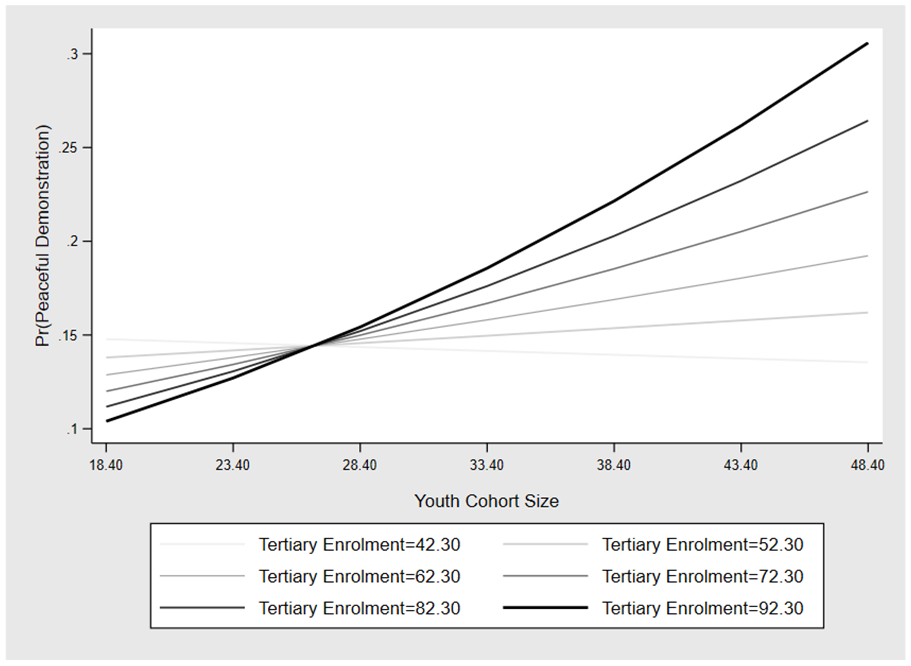
Interaction of YCS and tertiary enrollment rates on the predicted probability of participation in peaceful demonstrations for young people (darker and thicker lines represent increasing tertiary enrollment).

Interaction effects of YCS, youth unemployment, and tertiary enrollment on young people’s propensity to have ever engaged in peaceful demonstration.
Beginning with Model 1, I assessed the direct or independent effect of YCS on young people’s individual likelihood to have ever protested, as proposed in H1. As with all the other models, I controlled for all the country level and individual level variables previously discussed. The outcome confirmed H1: YCS showed a positive significant effect on young people’s propensity to have ever participated in peaceful demonstrations. Put another way, the result shows that the growing cohort size of young people within a country’s population increases the individual likelihoods of young people within the country to protest. This effect is, however, relatively marginal (β = .008*), yet not unexpected, because country level variables accounted for only 14.6% of variations in the data, per the ICC. Substantively, notwithstanding, the significant direct positive effect of YCS on youth protest behavior, demonstrates strong similarities with the dominant position within the youth bulge literature. The finding shows congruence with past evidence of strong correlation between growing YCS and increased likelihoods of protests and various forms of social unrests and upheavals (Alfy, 2016; Goldstone, 2002; Urdal, 2006; Weber, 2013, 2019; Yair & Miodownik, 2016). I address this finding in detail in the discussion section of the paper.
Model 2 tested H2 by assessing the moderating effect of youth unemployment on the relationship between YCS and youth propensity of engagement in peaceful demonstrations, and accordingly created an interaction between YCS and youth unemployment rates. The effect of this interaction was significant, yet not in the hypothesized direction. Contrary to expectations, the confluence of growing YCS with rising youth unemployment rate, surprisingly, rather suppressed youth participation in demonstrations, although the effect size was marginal (β =− .001**). This strikingly unexpected result is apparently in difference to a large body of past scholarship which associate rising unemployment rates within a youth bulge with increased incidences of protests and various forms of political and social upheavals (see Campante & Chor, 2014; Flückiger & Ludwig, 2018; Ikelegbe, 2020; Weber, 2019). Figure 1 below displays the predicted probabilities of young people joining in peaceful demonstrations across different levels of YCS and youth unemployment rates. Consistently across countries, we find that as youth unemployment rate increases within a growing YCS, the probability of young people engaging in demonstrations reduces (darker and thicker lines represent increasing youth unemployment rate). A higher probability to demonstrate among young people (0.2), occurs when YCS is large, but youth unemployment rate is low. By contrast, the probability of youth engagement in demonstrations reduces very considerably with the conflation of large YCS and high youth unemployment rates.
In Model 3, I tested H3 by examining the moderating effect of rising tertiary education rates on the association between YCS and the propensity of demonstrations among young people, and thus replaced country youth unemployment rate with country tertiary enrollment rates in interaction with YCS. This time, there was a highly significant and positive interaction effect, in support of expectation in H3 that increasing access to higher education within a growing YCS will enhance young people’s propensity to demonstrate. Figure 2 shows the positive effect of the congruence of these two structural conditions on individual youth nonviolent protest behavior. The highest probability of joining demonstrations is seen in the context of simultaneous increases in YCS and access to tertiary education within countries. Notwithstanding, interpreting the interaction effect of Model 3 in the light of the arguments within the paper required caution, since both CVM and grievance theory could account for the reported outcome. Education, as earlier argued, increases the resource capacity of beneficiaries for political participation (Dalton, 2009; Verba et al., 1995). It can also fuel increased participation through grievances due to unmet expectations of youth educated at higher levels (Alfy, 2016; Weber, 2019). To further explore the explanatory power of both theories, I consequently ran a three-way interaction of all three explanatory variables, to assess their combined effect on youth participation in peaceful demonstrations, in response to H4 and H5, which predicted contrasting outcomes based on the two theories.
Model 4 shows the results of the three-way interaction. The result showed a marginal, but significant negative effect on peaceful demonstrations, in support of H5. In other words, the conflation of the three structural factors tended to weaken young people’s individual proclivities to participate in peaceful demonstrations. Once again, the result is quite surprising as it contradicts the findings of the more dominant position with existing scholarship on youth bulge, which suggest higher risks of grievance induced acts of social upheavals and violence, among a growing population of unemployed educated youth (Alfy, 2016; Flückiger & Ludwig, 2018; Weber, 2019). Figure 3 displays the predicted probabilities for individual youth participation in peaceful demonstrations for different levels of the three variables. Notably, we see that as youth unemployment rate rises, it tends to reduce young people’s propensity of protesting, despite increases in YCS and tertiary enrollment rates within a country. When tertiary enrollment is high, but unemployment within a youth bulge is low, the effect shows in the positive direction. However, as unemployment rate increases, the probability of protesting among young people reduces significantly, even if tertiary enrollment rates within a growing youth bulge is high. This can be seen in the consistent drop in the darker and thicker lines for every 10 points increase in youth unemployment.
In respect of the control variables, the two other contextual variables; GDP and Polity IV were only significant in Model 2. Across all models, however, the strongest predictors of individual youth protest behavior were the level 1 variables. Consistently across all four models, an individual’s age, sex, marital status, educational background, political interest, employment status, postmaterialist values, and household income situation showed strong influence on their decisions to partake in demonstrations. Interestingly, females in this study showed less likelihood, compared to males to participate in peaceful protests, in contrast with recent findings which showed higher levels of participation in protests among females (Bowman, 2019; de Moor et al., 2020). Lower levels of satisfaction with life and household incomes also significantly associated with increased tendencies to protest across all four models (Kern et al., 2015). I discuss the effects of the levels of satisfaction in appreciable detail in the next section. The remaining variables, namely age, marital status, educational attainment, postmaterialist values, and political interest, all showed congruence with past findings in terms of their predictive influences on protest behaviors.
Discussion and Conclusion
This study set out to ascertain whether the propensity of young people to engage in peaceful demonstrations is affected by their relative cohort size in the adult population of democratic countries. It also sought to assess whether this relationship is moderated by structural socioeconomic factors, notably youth unemployment and higher education. This research focus had so far been unexplored within the literature on youth political participation. Notwithstanding, as existing literature strongly associates youth bulge with the increased likelihood of political conflicts and riots, with the youth as the main actors, the study hypothesized based on the youth bulge theory that young people growing as part of a youth bulge, would be similarly inclined to engage in the less risky collective acts such as peaceful demonstrations. The study also hypothesized that these tendencies would be significantly influenced by the socioeconomic conditions of a country, since structural conditions affect everyone in society (Taylor, 2001, p. 18).
Firstly, the findings of the paper show that YCS has a significant positive effect on young people’s propensity to participate in peaceful demonstrations. Put another way, the results suggest that where a country has a youth bulge, the probability of young people within such a large cohort participating in peaceful demonstrations increases significantly. The earlier theoretical argument put forward by the paper in support of young people’s natural inclinations toward collective actions, provides valuable insights into why this outcome should not be unexpected. For instance, young people are well known for their high idealism, vulnerability, and naivety to accepting new ideologies without adequate interrogation of such, high risk-taking inclinations and strong tendencies to challenge the status quo and old forms of power (Cincotta & Doces, 2011, p. 102; Goldstone, 2002, pp. 10–11). This is inherently socio-biological, and forms part of changes they go through in their transition into adulthood, particularly during the stage when they begin to develop independence from parental influence, and high affinity for peer approval (Weber, 2013). They are also less burdened in terms of career, family, and other social responsibilities, which combine to considerably reduce the opportunity cost of a decision on their part to engage in protest actions (Romanov & Korotayev, 2019; Urdal, 2006).
Importantly, however, large YCS provides the additional incentive of facilitating the mobilization of young people for collective political actions such as demonstrations. As asserted earlier, youth bulge creates in its wake a youth culture which expresses itself in experimentation with risk-taking (Cincotta, 2009), and makes readily available, a large pool of peer agents, who interact more and influence themselves more (Hart et al., 2004), and being now significantly disconnected from parental values and influence, become infatuated by an overwhelming longing to be associated with peer groups, and even more importantly, take part in collective undertakings (Weber, 2013). Their relative ease of mobilization for such activities also makes them an attractive target for organizers of such political activities at a significantly low cost, compared with the adult population (Collier, 2000; Collier & Hoeffler, 2004). The positive effect of YCS on youth participation in peaceful demonstrations can, therefore, summarily be understood in terms of an increase in the number of agents who; naturally love to experiment with collective youth pursuits even if risky, influence each other’s attitudes and behaviors as peers, and can also be easily mobilized by political actors for collective pursuits such as demonstrations, due to natural inclinations toward challenging existing norms, and power relations.
Secondly, however, while existing literature strongly associates rising unemployment within an educated youth bulge with the growing propensity of involvement of affected young people in various politically destabilizing acts due to grievance (Alfy, 2016; Ganie, 2020; Ikelegbe, 2020; Weber, 2019), the findings of this study depart quite significantly from this well-founded expectation. The evidence presented in this paper shows that on the contrary, and particularly within democracies, rising unemployment among highly educated youth tends to reduce their engagement even in peaceful demonstrations. Quite interestingly, the study found that the only time the labor market exerted a positive influence in its interactions with education and demography, on individual youth nonviolent protest behavior, was when unemployment rates were low. In effect, the expectation that rising unemployment rates among well-educated and critical young citizens, would create a feeling of frustration, disenfranchisement, and social anger, leading to their inclinations to demonstrate against their socioeconomic hardships, according to the predictions of the grievance theory, proved unsupported by the data. On the contrary, this finding is consistent with the earlier theorization within the CVM, that where resources are limited, due to factors such as unemployment, individuals would be less likely to participate in politics (Kern et al., 2015; Verba et al., 1995).
As argued elsewhere in this paper, educated young people are more likely to believe they must focus on improving their socioeconomic situations, meet the social markers of adulthood and consequently gain social recognition and inclusion into the adult community, with the limited resources they have at their disposal, than to commit them to demonstrations, even if peaceful. Since large YCS tends to further limit their labor market opportunities through labor oversupply, it is reasonable to expect that educated young people, growing as part of such a large cohort would, recognizing the competition they face among themselves, be more focused on improving their own integration into the socioeconomic system, rather than the political. Although, as already argued, higher education politicizes young people toward activism, it as well increases their opportunity cost of participating in violent political activities (Barakat & Urdal, 2009; Østby & Urdal, 2010) and political protests (Campante & Chor, 2012a). Sandwiched between the choices of committing scarce resources to economic production – to improve their lot as young people aspiring for social recognition as adults—and participating in resource consuming activities such as protests, it is plausible that most young people would prefer the economic over the political.
Besides, economic security in terms of gainful employment for educated young people presents the benefits of money, time, and civic engagement skills which importantly motivate political participation (Brady et al., 1995). Employment, thus, resources the educated youth for active political engagement in ways which allow them to free up time and financial resources, and channel them into political causes. In the absence of security for daily bread, however, the capacity to participate is significantly curtailed. The composition of protestors in the Arab Spring of 2011 lends important insight in this respect. Evidence shows that the proportion of employed young protestors were significantly higher than the unemployed, while affluent middle class youth with wider discontents beyond limited labor market opportunities, were the main protagonists of the upheavals (Tzannatos, 2021, p. 311). Additionally, the constraint of unemployment on young people’s engagement in protests may be seen in social perceptions held toward such a decision to engage in protests, given their economic challenges. Most likely, they would be seen as a bunch of unserious fellows, who, instead of spending their time growing a business or looking for employment, are rather wasting their lives away in unproductive protests. Thus, the social expectations of their roles as educated youth, coupled with resource constraints, are reasonable barriers which are also unfortunately aggravated by their growing numbers within the population. Over 30 years ago, Easterlin (1987), argued that ceteris paribus “the economic and social fortunes of a cohort . . . tend to vary inversely with its relative size” (p. 1). This evidently seems to underlie the participation of young people trapped within a youth bulge in protest activities.
Thirdly, the effects of individual level predictors included in the study on youth protest behavior are a bit more nuanced, and thus call for caution in interpretation. On the one hand, we find that consistently across all four models presented in Table 1, educated, and employed youth are the likeliest to have ever participated in demonstrations. This is coherent with the CVM’s argument of the place of resources in motivating participation. Notwithstanding, young individuals who are dissatisfied with their micro level economic conditions, such as the financial conditions of their households, and also dissatisfied with their own lives are also highly likely to have ever participated in a demonstration. This may be related to Asingo’s (2018, p. 79) assertion that personal grievances due to an individual sense of relative deprivation is a more significant predictor of individual protest behavior, than other forms of grievances. A possible implication could, therefore, be that young individuals look more likely to join in a demonstration due to their personal unfavorable economic circumstances, than because of the poor macroeconomic conditions in a country. This implication is, however, drawn with much caution. Importantly, though, and much in consonance with value change theory, young people with postmaterialist values came across as being among the most likely to join peaceful demonstrations across all the models (Norris & Inglehart, 2019; Sloam & Henn, 2019).
In conclusion, the findings of this paper stand in contrast with the notion that youth bulge may increase the risk of protest actions, particularly where it conflates with unmatched employment opportunities for educated youth within such a bulge. I have argued to the contrary, based on the CVM of political participation that economic prosperity, rather than deprivation within a youth bulge is the more likely motivating mechanism for youth nonviolent protest behavior within democracies. In this respect, the paper associates itself with the strand of literature which argues that economic security, rather than resource scarcity, fundamentally drives non-institutionalized forms of political participation such as demonstrations (e.g., see R. J. Dalton & Welzel, 2014, p. 15; Kern et al., 2015). The paper argues this to be the case within the democratic context, where liberties are guaranteed, and political grievance due to suppression and disregard of such freedoms is less likely to motivate protest actions. An apparent implication of this position is that, despite the sheer volumes of young people presently located in many developing democracies, the democratic world would continue to see higher levels of youth participation in protests in advanced democracies, than in developing democracies, until some level of economic resource parity is achieved in developing democracies with youth bulge. Additional research is certainly needed to interrogate the findings of this paper further. In addition, further research can focus on the effect of YCS on other forms of protest behavior such as signing petitions and joining boycotts. The paper in the meanwhile, recognizes its inability to include several other factors which may also account for young people’s motivations to engage in demonstrations, such as ethical commitments and social obligations, among many others, as a limitation. The study’s choice of Polity IV as the index for the categorization of countries as democracies or otherwise may have also affected the eventual list of countries included in the analysis. These notwithstanding, the defined focus of the study on the effect of structural demographic and socioeconomic factors on youth protest behavior represents a major step forward in improving our understanding of the implications of the growing cohort size of young people within democracies, on the future of the democratic tradition.
Supplemental Material
sj-docx-1-sgo-10.1177_21582440221096146 – Supplemental material for Youth Cohort Size, Structural Socioeconomic Conditions, and Youth Protest Behavior in Democratic Societies (1995–2014)
Supplemental material, sj-docx-1-sgo-10.1177_21582440221096146 for Youth Cohort Size, Structural Socioeconomic Conditions, and Youth Protest Behavior in Democratic Societies (1995–2014) by Godfred Bonnah Nkansah in SAGE Open
Footnotes
Acknowledgements
I would like to say thank you to my supervisors, Attila Bartha and Zsófia Papp, three anonymous reviewers, and the editors of SAGE open for their insightful comments.
Declaration of Conflicting Interests
The author declared no potential conflicts of interest with respect to the research, authorship, and/or publication of this article.
Funding
The author received no financial support for the research, authorship, and/or publication of this article.

Supplemental Material
Supplemental material for this article is available online.
Notes
References
Supplementary Material
Please find the following supplemental material available below.
For Open Access articles published under a Creative Commons License, all supplemental material carries the same license as the article it is associated with.
For non-Open Access articles published, all supplemental material carries a non-exclusive license, and permission requests for re-use of supplemental material or any part of supplemental material shall be sent directly to the copyright owner as specified in the copyright notice associated with the article.
