




Abstract
This study investigated the effects of three strategies (i.e., guided discovery, think-pair-share, and lecture) on senior secondary school students’ achievement in chemistry. A pretest, posttest, control group quasi-experimental design with a 3 × 3 × 2 factorial matrix was adopted for the study. Treatment was at three levels (guided discovery, think-pair-share, and lecture strategies). Intervening variables were cognitive entry behavior at three levels (high, middle, and low) and gender at two levels (male and female). Two hundred forty-two Senior Secondary 1 students in intact classes from six secondary schools in Ijebu Ode and Odogbolu Local Government Areas of Ogun State were randomly assigned to the treatment and control groups. Three instruments were developed and used to collect data from students during the 8-week treatment program. The data collected were subjected to analysis of covariance and multiple classification analysis. Scheffé test was further used as post hoc measures. Where significant interactions were observed, they were represented with graphical illustrations. It was found that students taught with guided discovery and think-pair-share strategies obtained significantly higher posttest mean scores than those in the lecture strategy, F(4, 223) = 51.66, p < .05. The use of guided discovery and think-pair-share strategies had great potential for improving achievement in chemistry and science learning generally.
Introduction
Science education plays prominent roles in determining scientific and technological advancement of every individual and the nation as a whole. According to Alebiosu (1998), the major goal of science education is to develop scientifically literate and personally concerned individuals with high competence for rational thought and actions. Also, science educators significantly contribute to the development of scientifically literate persons who will further use the achievement and experiences in science and technology for the benefit of mankind. Hence, steps toward developments in science education are inevitable. Bilesanmi-Awoderu (2002) noted that in Nigeria the Federal Government recognized the potency of science education in improving the nation’s technological and industrial development. Hence, there have been some concerted efforts on the part of successive governments to improve the participation and academic achievement of science students.
According to Godek (2004), there cannot be any meaningful development without science education. Science advancement has been seen as the single most important factor in sustained economic growth. It has also been described as the principal driving force behind long-term economic growth of developed countries and their rising standard of living. According to Bilesanmi-Awoderu (2006), the level of development of a country is a measure of its scientific advancement, as such science education cannot be undermined in any country’s development.
The process of teaching consists of three phases of preinstructional, instructional, and postinstructional. The instructional phase is the one that involves the implementation of plans and designs of all activities. The quality of instructional strategy employed by the teacher at this phase is a potentially powerful determinant of the levels of learner’s achievement, affection for the subject, and involvement in the learning process. Despite very many efforts that have been made over the years to improve the quality of science learning in our schools, students’ achievement in chemistry has remained persistently not encouraging at the Senior Secondary Certificate Examination (SSCE; Adeyemi, 2002; Alebiosu, 2000). The inconsistencies in achievements are obvious as shown in Table 1.
Students’ Achievement in the May/June Chemistry Between 2000 and 2008.
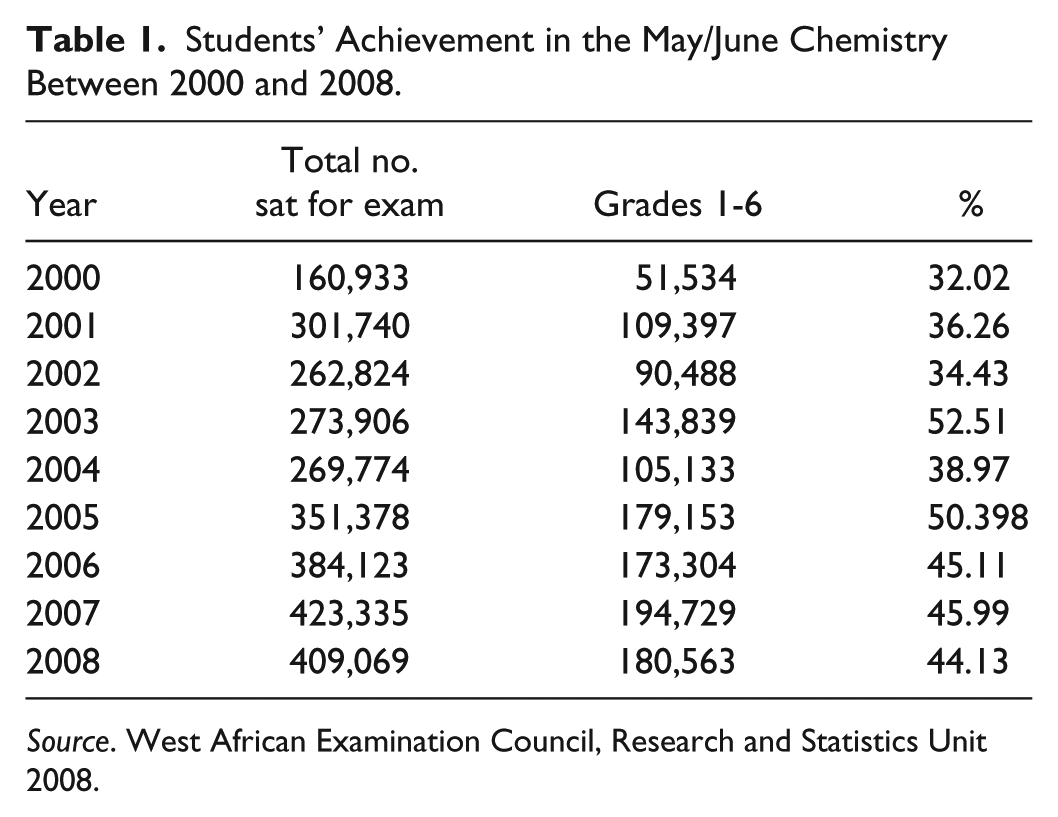
Source. West African Examination Council, Research and Statistics Unit 2008.
Table 1 shows that in all the 9-year period considered (2000-2008), it was only in 2 years (i.e., 2003 and 2005) that more than 50% of the candidates who enrolled for the May/June SSCE in chemistry obtained credit-level pass (Grades 1-6). This implied that less than 50% of the students who wrote the examination in 7 out of the 9 years considered could pursue chemistry-related courses. The implication for manpower development cannot be overemphasized; it calls for concern.
A key determinant of students’ achievement is the quality of instructional strategies employed by the teacher (Adeyemi, 2002; Alebiosu, 1998; Bilesanmi-Awoderu, 2006). The traditional pedagogical practice, which is confined to transmitting information and involves telling, reading, and memorizing, and the teacher adopting the “fountain of knowledge” approach, have failed to cope with the problems of scientific knowledge needed for development (Kohle, 2002). Appropriate pedagogical approaches need to be sought in passing the message of science across to the learners.
Ajiboye and Ajitoni (2008) observed that children learn best by being interested fully in their own work, by seeing themselves, doing themselves, by puzzling themselves, by verifying their own suppositions; by experimenting themselves, by drawing conclusions themselves on the strength of evidence which they have collected themselves. They should always make mistakes which they then should rectify themselves in the light of new information and evidence that they have uncovered themselves. This pedagogic concept should be participatory through social interaction, togetherness, and action-oriented communication. Guided discovery and think-pair-share strategies belong to these pedagogic concepts.
Guided discovery strategy as a philosophy or strategy of learning is based on the constructivist views of learning. It is a learning approach where the learners take an active part in the learning process in which they have maximum measure of freedom and self-determination. In this strategy the teacher guides the students in their learning task by asking them thought-provoking questions that would assist them to generate their own correct ideas of the subject matter. The students were made to be active participants in the teaching–learning process individually. Studies from literature suggest that guided discovery strategy could have positive impact on students’ learning outcomes (Hake, 2002).
Think-pair-share is a cooperative learning strategy that includes three components, namely, time for thinking, time for sharing with a partner, and time to share among pairs to a larger group. The use of the strategy unites the cognitive and social aspects of learning, promoting the development of thinking and the construction of knowledge. Think-pair-share strategy has many advantages over the traditional questioning structure. The “think time” incorporates the important concept of “wait time.” It allows all children to develop answers, longer and more elaborate answers can be given, and answers will have reasons and justifications because they have been thought about and discussed. Students are more willing to take risks and suggest ideas because they have already “tested” them with their partner. This strategy differs from guided discovery in that it allows for interaction among the learners during the pairing and sharing stages.
The need for inquiring into guided discovery and think-pair-share strategies is founded on certain considerations. First, the situation in Nigerian schools is such that much of the learning that actually take place is one of reception with the teacher (or text) presenting verbal expositions of the facts or concepts to be learned (Ajewole, 1991; Ajeyalemi, 1995; Ajiboye & Ajitoni, 2008; Alebiosu, 1998; Bajah, 1986; Bilesanmi-Awoderu, 2006; Mansaray, 1995). The mode of such presentation therefore becomes crucial for learning. It should be useful then, to explore the role that these learning strategies can play in presentation of facts.
The challenge that seems to have lingered for quite some time now is the question of female participation in science and related subjects. Literature shows that gender could be a strong prediction of human conduct and that differences have been documented between the attitudes, behaviors, and achievement of males and females (Aguele & Uhumuavbi, 2008). Some studies have shown that there are distinguishing differences in the cognitive, affective, and psychomotor skill achievements of students with respect to gender (Ogunkola, 1998), whereas some others provided reports that there are no distinguishing differences (Bilesanmi-Awoderu, 1998; Duch, 2001). This tends to suggest that there is need to examine gender influence in teaching strategies as one of the intervening variables in this study.
Many factors other than teaching strategies and gender that could influence students’ achievement are of importance to researchers in education. One of such factors is cognitive entry behavior of students. Cognitive entry behavior is the amount of prerequisite types of knowledge, skills, and competences that are essential to the learning of particular new tasks or set of tasks (Ogunkola, 1998). Very central to determining the degree and type of learning taking place in a student (irrespective of the students’ gender) is, among others, his or her cognitive entry behavior. Thus, if prerequisite knowledge necessary for learning a particular skill is absent or inadequate in a student, the teacher’s effort to persuade, reinforce, or motivate the student may be ineffective (Ogunkola, 2000). This study, in addition to gender, examined the likely influence of cognitive entry behavior on the achievement of students to chemistry when they are taught with the use of guided discovery, think-pair-share, and lecture strategies.
Statement of the Problem
The problem of this study was to investigate the effects of three teaching strategies (guided discovery, think-pair-share, and lecture) on students’ achievement in chemistry. Cognitive entry behavior and gender were incorporated into the research work as intervening variables.
Research Questions
The following research questions were raised:
Method
The design was a quasi-experimental one. Intact classes were subjected to different treatment conditions. The independent and intervening variables were crossed in a 3 × 3 × 2 factorial matrix (three treatment groups—guided discovery strategy group, think-pair-share strategy group, and control group; three levels of cognitive entry behavior—high, medium, and low, and two gender groups—male and female). The layout of the design is as shown below:


where O1, O3, and O5 were observations in form of pretests;
O2, O4, and O6 were observations in form of posttests;
X1 and X2 were the experimental treatments of Guided Discovery Strategy and Think-Pair-Share Strategy; and
X3 was the lecture strategy used in the study as the control condition.
Population
The target population for the study consisted of all Senior Secondary 1 (SS1) science students in public schools in Ogun State, Nigeria. Their age range is between 14 and 16 years.
Sample
Six senior secondary schools selected from a total of 19 senior secondary schools in Ijebu Ode and Odogbolu Local Government areas of Ogun State, Nigeria were used for the study. In selecting the schools, first, judgmental sampling was used. Each school was ensured to
be a mixed school;
be a senior secondary school offering chemistry as one of the science subjects and also registered by West African Examination Council (WAEC) and National Examination Council (NECO) as a center conducting SSCE in the subject.
Simple random sampling was then used to select six of the schools that satisfied the conditions. In each selected school, an arm of SS1 participated in the study. Chemistry teachers in each of the selected schools were encouraged and used as research assistants. Altogether, from the six schools, a total of 242 students in intact SS1 classes participated in the study.
Instrumentation
Three instruments were developed, validated, and used to collect data for the study.
Learning Instructional Guide (LIG)
It consisted of notes of lessons in which the major roles of everyone participating in the study (teachers and students) were clearly stated. These guides were given to four science educators, four graduate students in science education, as well as four chemistry teachers at the SS1 level to determine their face and content validity. The reactions of these experts contributed to the refinement of the final draft for use in the classroom. The guides were trial tested on teachers and students of SS1 and useful comments were obtained. Its trial testing gave a reliability index of 0.85.
Chemistry Cognitive Entry Point Test (CCEPT)
This was a 40-item multiple choice test constructed on topics in basic science considered as prerequisites to the instructional content of the study by the researcher. It was to determine the cognitive entry behavior of the students after it might have been administered to them. An initial pool of 50 items was evolved from a test blueprint indicating the topics and number of test items based on three categories of objectives, namely, knowledge, understanding, and application. The face and content validity were determined through the expert opinion of five senior secondary chemistry teachers. The items were adjudged adequate for administration and the final set of items were trial tested on some SS1 chemistry students, different from the schools selected for the main study. From the responses of the students, discrimination and difficulty indices were used to remove some of the items. Forty items were finally selected for the purpose of the study. The 40 items were readministered to the same set of students after 2 weeks. These students were similar to those for whom the instrument was intended. From the responses of the students, a test-retest reliability coefficient of 0.78 was established for the test.
Chemistry Achievement Test (CAT)
This was to determine the cognitive achievement of the students before and after the experiment. It had an initial pool of 60 items constructed by the researcher, which covered the SS1 topics that were taught. The face and content validity of the instrument were determined through the expert opinion of five SS1 chemistry teachers. As the items were adjudged adequate for administration, they were trial tested on some SS1 chemistry students, different from the schools selected for the main study. From the responses of the students, discrimination and difficulty indices were used to remove some of the items. Eventually, 50 items were selected for the purpose of the study. The 50 selected items were readministered to the same set of students after 2 weeks. These students were similar to those for whom the instrument was intended; the result produced a test-retest reliability coefficient of 0.73, which conferred a high internal consistency on the instrument.
Procedure and Data Collection
The researcher visited and sought permission from the principals and teachers of the selected schools. The participating teachers were encouraged so that their maximum cooperation could be obtained. Participating teachers were subjected to training programs, particularly the experimental groups’ teachers. This was done to ensure that teachers did not deviate from the instructional principles and procedures governing the experiment. Demonstration lessons were organized by the researcher. The training session started off with more than the required number of teachers and finally six were selected. Before the commencement of teaching, according to the demands of the teaching strategies of specific treatment groups, CCEPT and CAT were administered to the subjects by the participating teachers in the three treatment groups. The students’ scores on the CCEPT were used to classify them into three levels of cognitive entry behavior: high, medium, and low. Their scores on CAT, was used as pretest scores and served as covariates. This was done in the first week of the experiment. The teaching commenced immediately after the students’ cognitive entry behavior had been sampled through pretesting. The teaching lasted for 6 weeks. At the end of the sixth week, the teachers administered the CAT as posttests.
Data Analysis
The data collected were analyzed with the use of inferential statistics. Analysis of covariance (ANCOVA) was computed for the dependent variable for the three instructional groups to test for possible postexperimental differences with respect to treatments, cognitive entry behavior, and gender. Pretest scores were used as covariates so as to cater for initial difference in the dependent variable and other factors that could compound treatment effect. Where the main effects were significant, multiple classification analysis (MCA) technique was employed to detect the direction of the difference among the groups and to ascertain the amount of variation due to treatment. Scheffé statistical techniques were further employed as post hoc measures. Where significant interactions were observed, graphs were plotted to depict the nature of interaction. The summary of ANCOVA is presented in Table 2.
Summary of Analysis of Covariance on Students’ Achievement Scores According to Treatment, Cognitive Entry Behavior, and Gender.

Denotes significant F at .05 level.
Results
The result in Table 2, with respect to the main effect of treatment on the students’ achievement scores in chemistry, revealed significant outcome, F(2, 223) = 51.66, p < .05. To determine the magnitude of the mean achievement scores of students exposed to the different treatment conditions, the result of the MCA presented in Table 3 was used.
Multiple Classification Analysis of Students’ Achievement by Treatment, Cognitive Entry Behavior, and Gender.

Note. Grand mean = 35.476.
The result of the MCA in Table 2 revealed that, with a grand mean of 35.746, the students exposed to the think-pair-share strategy recorded the highest adjusted posttest mean achievement score of 38.516 (35.476 + 3.04). The students exposed to the guided discovery strategy had the next higher adjusted posttest mean achievement score of 38.296 (35.476 + 2.82) while the students exposed to the lecture strategy obtained the least adjusted posttest mean achievement score of 32.456 (35.476 – 3.02). This result thus showed that the think-pair-share teaching strategy had the greatest effect on the students’ achievement in chemistry. The result in Table 2 further revealed that while teaching strategy alone accounted for 31.36% (0.56)2 of the variance in the students’ achievement in chemistry, the independent and intervening variables jointly accounted for 43% (0.656)2 of the variation in the students’ achievement scores in chemistry. In probing further into the source/direction of the significant difference recorded in Table 2, the Scheffé post hoc analysis presented in Table 4 was carried out.
Summary of Scheffé Multiple Range Test of Achievement Scores on Treatment Groups.

Denote pairs of group 7, which are significantly different at p < .05.
The result in Table 4 revealed that the source of the observed significant difference was due to the difference between the pairs of students exposed to the guided discovery and lecture strategies, and think-pair-share and lecture strategies.
The result of the two-way interaction in Table 1 revealed significant effect on the students’ achievement in chemistry, F(4, 223) = 3.568, p < .05. This implied that students’ achievement in chemistry, as a result of exposure to the different teaching strategies, was sensitive and varied significantly among the students with low, medium, and high cognitive entry behavior. Figure 1 was used to illustrate graphically the significant two-way interaction effect recorded in Table 2 with the purpose of disentangling the group effect of teaching strategy and cognitive entry behavior.
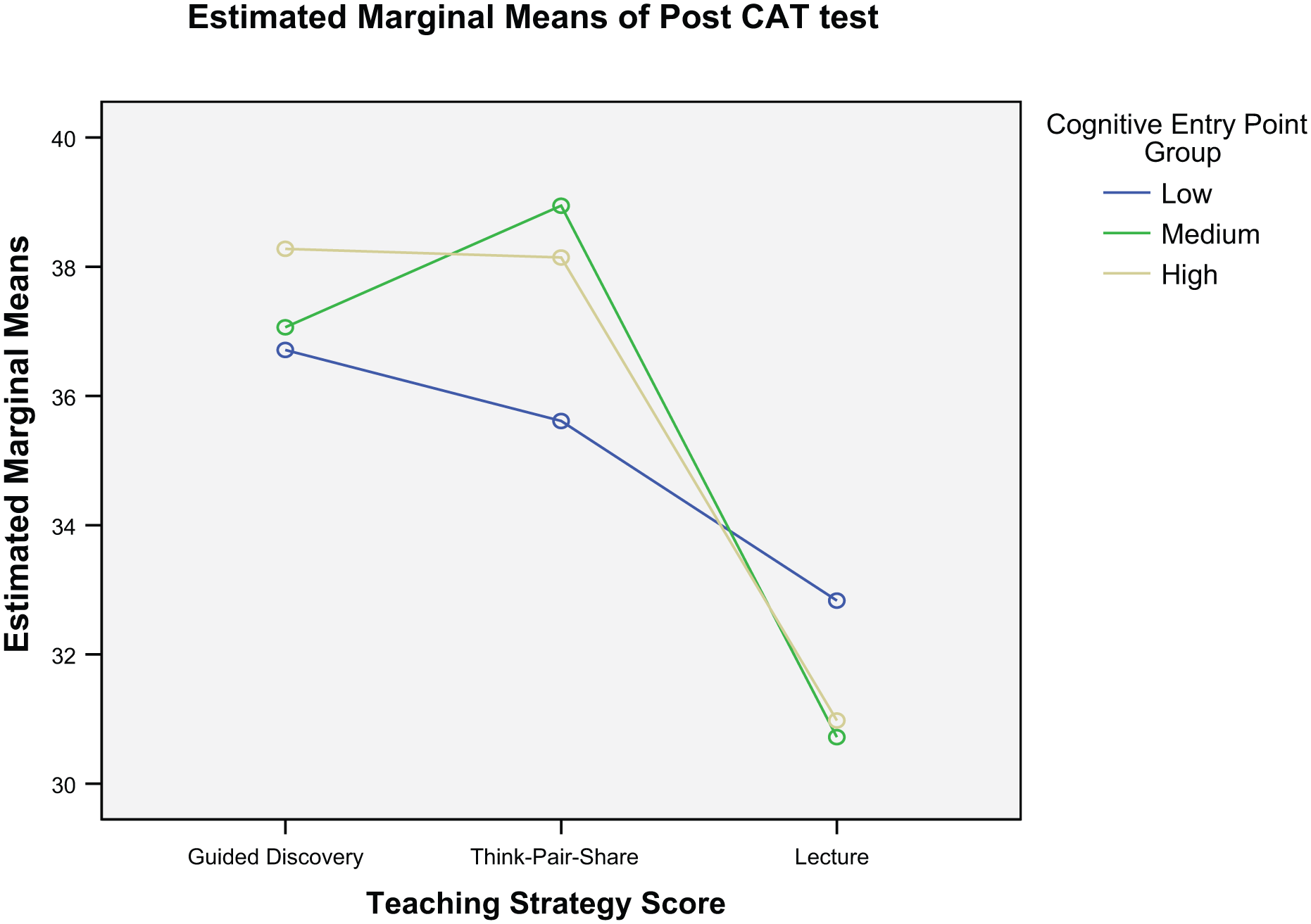
Graphical illustration of teaching strategies and levels of cognitive entry behavior on students’ achievement scores.
The two-way interaction effect illustrated above revealed that there were two significant interaction effects of teaching strategies and cognitive entry behavior that were not ordinal on students’ achievement in chemistry. This implied that there was inconsistent significant interaction between teaching strategies (guided discovery, think-pair-share, and lecture) and different levels of low, medium, and high cognitive entry behavior of the students as they jointly affect achievement in chemistry.
Discussion
The findings of this study proved the effectiveness of guided discovery and think-pair-share strategies over the lecture strategy in enhancing students’ achievement. Walters and Ginns (2001) in their various researches revealed the effectiveness of think-pair-share strategy in producing significantly higher achievement posttest mean scores than the conventional groups. The result of the study found out that there was no significant main effect of cognitive entry behavior on students’ achievement in chemistry. This view is in conflict with research findings of Ogunkola (2000), Afuwape and Olatoye (2004), and Bilesanmi-Awoderu (2007). The research further found out that there was no significant main effect of gender on students’ achievement in chemistry. This finding was contrary to those of Billings (2000), Croxford (2002), and Aguele and Uhumuavbi (2008) who at various times found that male students achieved significantly better than female students in science education. However, the result corroborated the study findings of Ogunkola (2000) in biology and Erinoso (2005) in physics, which showed that there were no significant effects of gender on students’ achievement in the various science subjects.
Conclusion and Recommendations
The use of guided discovery and think-pair-share strategies, are capable of promoting learning through discovery, which eventually leads to the development of higher quality cognitive skills, which in effect enhances problem-solving skills in students. Based on the findings of this study, it is hereby recommended that teachers should make guided discovery and think-pair-share strategies fundamental parts of their instructional strategies and that practicing science teachers should use guided discovery and think-pair-share strategies in science classroom. According to the finding relating to treatment (i.e., the use of guided discovery, think-pair-share, and lecture strategies) and gender, in which case there was no interaction effect, it is recommended that more efforts should be geared toward popularizing the strategies for use among students of the two gender groups. Capacity building opportunities and exposure of teachers to challenging tasks for updating their teaching skills and techniques are tools for improving productivity and these are strongly recommended. Further research on these strategies could be carried out in various other classes in other countries of the world.
Footnotes
Declaration of Conflicting Interests
The author(s) declared no potential conflicts of interest with respect to the research, authorship, and/or publication of this article.
Funding
The author(s) received no financial support for the research and/or authorship of this article.