




Abstract
This study aims to compare efficacy of self-learning, audiovisual, and fun activity instructional approaches among school students of Patna, the capital city of Bihar state of India, to develop environmental awareness. The study participants include 144 randomly selected students (72 girls and 72 boys) from eight different schools of Patna. During a weeklong environmental awareness program, students were instructed using above three approaches of instruction. Data have been analyzed by using linear regression. Regression was carried out to eliminate the effect of general mental ability (GMA) scores. The results suggest about overall superiority of fun activity approach over other approaches tested in the present study. However, awareness gain has been significant among the students with high GMA when instructed through audiovisual approach.
Introduction
Environmental resources form the basis of economic growth and development of a country. Economic development in Asian countries including India is adversely affecting their natural environment. The phenomenal increase in human population followed by rapid industrialization and urbanization in the last century has put tremendous pressure on the natural resources. Depleting natural environment has posed a serious threat to the survival of human beings (Sahu & Ghildayal, 2007). Environmental problems in the developing countries arise either from condition of poverty and underdevelopment or from negative effects of the very process of development (Sahu & Ghildayal, 2007).
As environmental issues are becoming more complex and challenging, the need to act becomes more imperative. School students should be equipped with appropriate skills that can help them make better decisions and choices (Joseph, Victoria, Campbell, & Louie, 2004). Therefore, it is crucial to expose the youth to environmental education, so that they acquire the essential values, attitudes, commitment, and skills needed to preserve and protect the environment (Bradley, Waliczek, & Zajicek, 1999). It is widely recognized that environmental education can help create awareness, concern, and recognition of the consequences of people’s actions. Moreover, it can promote environmentally responsible behavior among youth (Bradley et al., 1999; Fien, 1997; Salequzzaman & Stocker, 2001).
Environmental education has been defined in many ways. Filho (1997) described environmental education as a process of understanding and clarifying the value of the environment as well as the relevance of environmental resources, with a view to encourage people to use such resources in a more sustainable way. Stapp (1969) asserted that the ultimate goal of environmental education is to produce a citizenry that is knowledgeable concerning the biophysical environment and its associated problems, is aware of how to help solve these problems, and is motivated to work toward their solutions. This view is echoed and endorsed by the Tbilisi Conference Declaration (1977), stating that the aims of environmental education are as follows: to foster clear awareness of, and concern about, economic, social, political, and ecological interdependence in urban and rural areas; to provide every person with opportunities to acquire values, attitudes, commitment, and skills needed to protect and improve the environment; and to create new patterns of behavior of individuals, groups, and society as a whole toward the environment. Many researchers, including Hines, Hungerford, and Tomera (1987) and Hungerford and Volk (1990), have advocated that environment-friendly behavior is the ultimate goal of environmental education.
Research studies by Grodzinska and Ballantyne (2003) and Martin (1999) indicated that exposure to environmental education programs affected positively upon students’ environmental knowledge. However, they were not effective in their attitudes and behaviors toward the environment. The students exposed to environmental education programs designed by Leeming and Porter (1997) and Kruse and Card (2004) displayed significantly more environmentally desirable behaviors. The programs that combined school-wide educational activities with a knowledge base could be effective in complementing the goals of environmental education (Tung, Huang, & Kawata, 2002). Findings of various research studies reveal that people’s environmental concern is greatly affected by positive experiences of the natural world acquired in childhood (Chawla, 1988, 1998; Palmer, 1993; Tanner, 1980). It is also acknowledged that the formation of attitude toward the environment begins at an early age (Bryant & Hungerford, 1977). Thus, the implementation of environmental education needs to be undertaken in a mission mode to germinate the seeds of positive attitude toward nature among youth leading to a sustainable future.
The theory of reasoned action postulates that the best determinant of actual behavior is behavioral intention. Thus, there is also growth in the field of environmental education research to investigate the influence of learner’s cognitive and affective factors on responsible environmental behavior (Boerschig & De Young, 1993; Hungerford & Volk, 1990; Kaiser, Wolfing, & Fuhrer, 1999; Khalid, 2003; Middlestat, Ledskey, & Sanchak, 1999; Moseley, Reinke, & Bookout, 2002; Plevyak, Bendixen-Noe, Handerson, Roth, & Wilke, 2001; Sia, Hungerford, & Tomera, 1985). An important way of improving student’s motivation and performance is to adapt teaching approaches in accordance to meet the different learning style preferences of students (Miller, 2001).
Learning style preferences include conditions under which learners most efficiently and effectively perceive, process, store, and recall what they have learnt (James & Gardner, 1995). Such studies in the context of India are, however, rare. To assure that the environmental education is being understood and assimilated by young children, more attention needs to be given to the process of how this information is transmitted. Lack of appropriately structured environmental education in selected study locale (Patna, India) motivated researchers to carry out the present study.
Patna is situated on the southern bank of the river Ganges and is approximately 35 km long and 16 to 18 km wide. On the basis of assumed average annual growth, Patna has been ranked as 21st fastest growing city in the world and 5th fastest growing city in India by City Mayors Foundation. Patna is a medium-sized city which is declining from economic stagnation to positive regression. Local administration is unable to meet the needs resulting from the natural increase in the population. The poverty in the rural periphery is even greater. Entire city has been affected by this influx. The perpetual chock-a-block situation is visible on all major roads of the capital (Pandey & Salomi, 2012) contributing to air pollution which has sharply increased in the last 2 years. The new housing cooperative societies are constructing building without getting maps approved by the corporation. Drains are choked causing sewage to flow on the roads. In addition, several tonnes (approximately 160 million liters) of untreated sewage are poured into the river Ganges causing organic and bacterial pollution (Tripathi, 2011). Besides, poor civic sense of the citizens further aggravates the problem. Therefore, a well-structured and executed environmental education program, addressing regional issues, is needed.
In Patna, there are 103 government and private schools administered by different boards of education. Environmental education does not exist as an independent discipline in the school curriculum in most of the schools in the locale. For this reason, there is a need to discover ways to effortlessly and interestingly impart environmental education to the youth. The present study compares three selected instructional approaches, namely, self-learning, audiovisual, and fun activity, to develop environmental awareness among ninth-grade students studying in different schools of Patna.
Material and Method
A pretest and posttest experimental design is used to understand the effectiveness of the selected instructional approaches. The sample of students was exposed to an environmental awareness program for a week. It was assured that they are not exposed to such an environmental activity earlier. The change in awareness after the experiment has been accredited to evaluate the effect of intervention program. The schematic layout of the design has been shown in Figure 1.
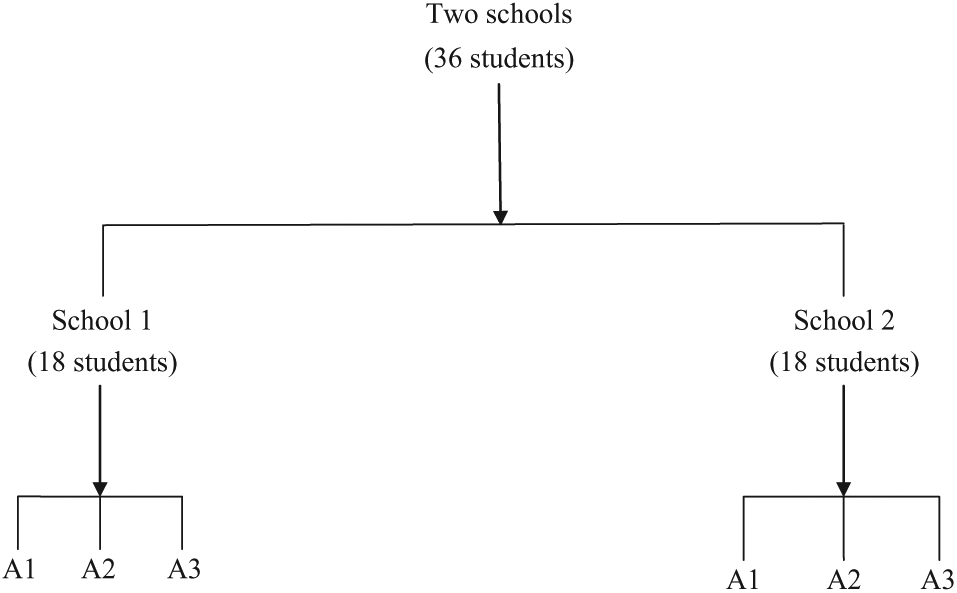
Phase-wise schematic layout of the experimental design.
Sample
The population consists of ninth-grade students studying in 103 government and private schools in Patna. The sample was drawn in two stages. In the first stage, a random sample of eight schools of Patna was drawn. The eight schools selected for the study were Rajkiya Kanya Ucch Vidalaya, Dak Bunglow (Boring Road), Government Girls High School, Shastri Nagar, Hartmann Girls’ Higher Secondary School, Bankipore Girls High School, International Public School, B.D. Public School, Baldwin Academy, and St. Paul’s Academy. Investigators personally visited the selected schools to seek permission for conducting the environment awareness program. After obtaining the consent, a list of students studying in the ninth grade was procured from each of the selected schools. In the second stage, a random sample of 18 students was drawn from each school. Thus, the sample consisted of 144 students.
Measuring Instruments
Data were collected by using Environmental Awareness Ability Measure (EAAM) developed and standardized by Jha (1998) and General Mental Ability (GMA) scale developed and standardized by Mohsin (1990).
EAAM is based on the following dimension of the environment: causes of pollution; conservation of soil, forest, and air, and so on; energy conservation; conservation of human health; conservation of wild life; and animal husbandry. It consists of 51 test items. Of 51 statements, 43 were positively worded and 8 were negatively worded. Each test item has two options for responding agree/disagree. Split half-reliability of the measure is .61 and by K-R method it was found to be .84. Coefficient of correlation between the scores of the present measure with environment awareness scale of Tarniji was .83, measure also possesses face and content validity. GMA measure spreads over six subtests having a total of 156 questions. Each subtest is required to be attempted in a fixed duration. Each correct test item carries one mark except for Subtest Number 4. In Subtest Number 4, each test item has two correct answers, thus each test item carries two marks. Reliability of the GMA by test–retest method is found to be .68.
Procedure of Experimentation
Authors visited the selected schools after being granted permission for conducting the environmental awareness program. Selected students were informed about the duration, place, and details of the program. Environmental awareness program was carried out in four phases. At a time only two schools (36 students) were engaged for the awareness program. On the first day of the program, students were administered with EAAM as pretest and GMA scale. Students from each school (18) were then randomly divided into three groups (A1, A2, and A3) on the basis of three different instructional approaches. Group A1 students were given environmental education through self-learning material. Group A2 students were taught environmental concepts through audiovisual aids. Fun activities were used to instruct students of Group A3. Intervention was carried out daily for 5 hr for a week. On the concluding day, EAAM was readministered as posttest, and data were collected.
Three types of variables were identified for the present study. The independent variable was experimental treatment, which was given in the form of Environmental Awareness Program. Dependent variable, that is, environmental awareness was assessed through an EAAM and the scores on EAAM were recorded before and after the experiment. In the experimental study, there were many intervening variables that were taken into consideration, for example, educational level, teacher behavior, physical environment, and so on.
To control for educational level, students of same grade were selected. Teacher behavior was polite and encouraging throughout the exercise for the participants. Teacher variation was also eliminated. For uniform physical environment, the experiment was conducted in the months of April to May. The participants were taught under the same seasonal conditions in the same building, that is, Department of Education, Patna Women’s College, Patna. Finally, the experimental process was controlled by keeping experimental situations, classroom environment, and duration of experiment same for all the participants.
Statistical Analyses
To determine the effectiveness of instructional approaches, the significance between the mean scores of the data collected during pretest and posttest was analyzed using paired t tests. Regression is used to remove the effect of GMA and to compare the selected instructional approaches for their effectiveness.
Results
The present study experimented with three instructional approaches, namely, the self-learning approach, the audiovisual approach, and the fun activity approach vis-à-vis their effectiveness in imparting environmental awareness. The average score for self-learning material approach increased from 38.33 to 42.10. The increases in the cases of audiovisual approach and fun activity approach are from 38.96 to 42.81 and 39.56 to 43.73, respectively. These increments are found to be statistically significant (Table 1).
The Pretest and Posttest Scores for Selected Instructional Approaches and the Test of Significance for Their Differences for Mean and Variance.

The variance of the scores reflects the individual differences that are present among the scores of the students in the case of the pre- or the posttests. A decrease in the variance in the scores is observed for all the instructional approaches. The variance in scores declined from 42.82 to 23.78, from 32.21 to 18.24, and from 29.79 to 10.88 for self-learning material approach, audiovisual approach, and fun activity approach, respectively. This indicates that all approaches were doubly beneficial in improving the environmental awareness among the students by improving the level of awareness and by decreasing the variation among the students, as shown in Table 1. However, the improvements in its scores that are reflected in the results of the posttest are correlated with the GMA levels of the students.
GMA and Pretest/Posttest Scores
The effect of GMA on the pre- and posttest scores is studied for two purposes. First, to estimate the effect of GMA on the pretest/posttest scores and second to remove the effect of GMA from the scores. In this way, we control for the effect of GMA on the pretest scores. Similarly, the posttest scores are controlled for GMA. This makes the posttest scores comparable for studying the effect of instructional approaches. For this purpose, we us the following regression model:

where Si represents the pretest/posttest score of the ith student and (GMA)
i
is the GMA of the ith student,
Self-learning approach

Audiovisual approach

Fun activity approach

For the pretest scores, the regression equation is as follows:

The intercept with a value of 24.63 in the regression equation for the pretest scores indicates the general level of environment awareness among the students. The coefficient of GMA has a value of 0.14. It shows a positive association between GMA and the pretest scores. This value can be interpreted as there is an increase of 0.14 in the pretest score when the GMA is increased by 1 unit.
The exposure to the selected instructional approaches improves the average scores. This is clear from the Equations 1, 2, 3, and 4 as is indicated in the intercept for self-learning approach, audiovisual approach, and fun activity approach that are higher than the intercept of pretest scores. The intercepts in the cases of self-learning approach, audiovisual approach, and fun activity approach are 32.90, 30.20, and 34.22, respectively. Table 2 shows the regression parameters as obtained for the pretest scores and the posttest scores for the selected instructional approaches. The regression parameters are found to be significant.
Regression Parameters for Estimating the Effect of GMA on the Pre- and Posttest Scores.

Note. GMA = general mental ability.
The effectiveness of GMA in improving the levels of environmental awareness is reflected in the coefficients of GMA in the regression equation. The coefficient for audiovisual approach is 0.12, the highest among the three of the selected instructional approaches. Gain from GMA is maximum for the students instructed through audiovisual approach among the three approaches. One-unit increase in GMA transforms it into a gain of 0.12 score for audiovisual approach, whereas the corresponding gain in the score is 0.09 for the other two approaches (Figure 2).

Regression lines showing the dependence of posttest scores on GMA.
However, the fun activity approach is the best among the three selected approaches as it has the highest value of intercept, 34.22, followed by self-learning and audiovisual approaches with values of 32.90 and 30.20, respectively. In a nutshell, the three selected instructional approaches can be ordered with respect to the effect of GMA as follows:

With respect to the values of intercepts, the order is as follows:

As the pretest/posttest scores are correlated with the GMA levels of the students, it is necessary to remove the effect of GMA on these scores. The scores after controlling for the effect of GMA shall be called the adjusted scores.
Comparing the Adjusted Pretest and Posttest Scores
We assume a simple linear model for estimating the effect of GMA on the scores. The model for the pretest scores is given as follows:

For the posttest scores, the model is as follows:

Thus, the pretest score of any student is the sum of a general effect α0 added to α1 times his or her GMA and the error. The regression parameters α0 and α1 can be estimated using the method of least squares. Let these estimates be denoted by
Table 3 shows the adjusted pretest and posttest scores for the selected instructional approaches. Similar to the unadjusted scores, the adjusted scores are higher in the posttest scores. For the self-learning material approach, the average adjusted scores increased by 14.58 from 24.32 to 39.90. Similarly for audiovisual, the average adjusted scores increased by 5.59 from 24.61 to 30.20. The average adjusted scores for fun activity approach increased by 9.26 from 24.96 to 34.22. However, the variances of adjusted scores also show decline. These variances decreased from 36.10 to 19.95, from 22.37 to 13.48, and from 25.93 to 8.48 for self-learning material approach, audiovisual approach, and fun activity approach, respectively.
The Posttest Scores for Selected Instructional Approaches and the Test of Significance for Their Differences for Mean.

Discussion
In India, environmental education is still in its infancy and is evolving gradually. Systematic efforts with respect to all aspects of teaching and learning about environment need serious consideration, essentially toward selecting an appropriate teaching approach to comprehend their environment. Findings of the present study help understand the efficacy of some of the instructional approaches in disseminating environmental awareness among students.
Two sets of the results have been obtained from the present investigation. First set of results compared the selected instructional approaches for intervention in correlation with GMA scores obtained by the participants. Significant improvement in the environmental awareness scores of children when instructed through the selected instructional approaches, namely, self-learning (38.33-42.10), audiovisual (38.96-42.81), and fun activity (39.56-43.73), leads one to conclude that approaches are beneficial in developing environmental awareness. However, the GMA scores of the participants substantially influence the environmental awareness scores of the individuals as seen in regression equation. With an increase of 0.14 in the pretest score, the GMA is increased by 1 unit.
In the second analysis, the researchers eliminated the stronger and significant link between GMA scores and environmental awareness scores (adjusted scores). Thus, adjusted pretest and posttest environmental scores facilitate one to identify the unadulterated effect of the instructional approaches in developing environmental awareness. Yet again, the increment in postintervention adjusted environmental awareness score was seen for three of the instructional approaches: self-learning material (14.58), audiovisual (5.59), and fun activity (9.26). In addition, variances of the adjusted scores also decreased for each of the selected instructional approaches. Thus, present findings suggest that three of the instructional approaches not only promote environmental awareness but also cater to individual differences.
To determine the most effective strategy in the existing culture and region, the researchers used regression model. Results obtained thereby imply that children with better GMA scores seek maximum benefit from audiovisual approach in comparison with other two approaches (slope value = 0.12). Apparent reason could be because media is the most powerful and interesting medium for the children and those with an average or above general intelligence are able to absorb and retain the content shown more efficiently. Conclusion derived from the present study provides support to a large-scale survey of teacher in the United States conducted in 1991 by the Corporation for Public Broadcasting, which indicated that “instructional television is a firmly established teaching tool that is positively regarded by classroom teachers and increasingly well supported with equipment and programming” (Seels, Berry, Fullerton, & Horn 1996). Writing in the Encyclopedia of Educational Research, Dorr (1992) concluded, “There is no doubt that television is an effective means of achieving traditional instructional goals (p. 1398).
With respect to the overall effectiveness of instructional approaches, fun activity appeared to be the best (intercept = 34.22). These results are quite encouraging when there is a lack of economic resources in the schools to install audio-video resources. Thus, it can be suggested that incorporating activity approach into teaching environmental education is worth serious consideration.
Findings of the present study also contribute to the previous research by Ramsey, Hungerford, and Tomera (1981); Ramsey and Hungerford (1989); and Ramsey (1993) on classroom educational interventions in the United States, which showed that environmental education emphasizing issue investigation and action training did promote students’ responsible environmental behavior. Results are also consistent with the findings of Hewitt (1997), pointing that children taught environmental topics through the use of games significantly improve reported environmental behavior. Present study also confirms the findings of Hsu and Roth (1998), recognizing the importance of formal and nonformal environment education as an appropriate tool for gaining responsible environmental behavior. Furthermore, Disinger (1990) performed research, which indicated that many students and young adults attribute a large amount of their knowledge of environmental concepts, problems, and issues to out-of-school education settings and experiences. Tung et al. (2002) concluded that combining teaching and activities made an improvement in the area of environmental behavior among fifth-grade students. Results obtained by the researchers are extension to the findings of Lieberman and Hoody (1998) that environment-based service learning not only enhanced environmental awareness but also made students more responsible toward environmental problems and their solutions.
Research has substantiated that an empathy with and love of nature along with later positive environmental behaviors and attitudes grow out of children’s regular contact with and play in the natural world (Phenice & Griffore, 2003). By providing appropriate natural outdoor environments and programs, schools can help our children to become responsible stewards of the Earth (Herrington & Studtmann, 1998; Sobel, 2004). Many studies have shown that people’s environmental concern is greatly affected by positive experiences of the natural world acquired in childhood (Chawla, 1988, 1998; Palmer, 1993; Tanner, 1980). These studies have, however, been conducted in Western industrialized countries where people’s perceptions of the natural environment differ from those of most Asians. Asian countries such as India are passing through rapid development in all spheres, consequently, witnessing major deterioration of natural resources. Environmental awareness is thus necessary to achieve environment protection and restoration (Madsen, 1996). In addition, multigrade situation still exists in many parts of India and to teach children in a mixed-age group scenario effectively, activity learning in the forms of group activity, peer learning, role-play, and collaborative learning would offer scope for diverse learning styles, intelligences, and abilities. Therefore, the findings of the present study are imperative to promote the use of practical activities as a major tool for teaching and developing positive values and attitudes toward the environment looking beyond the accumulation of knowledge about the environmental phenomena and processes.
Besides improving teaching approaches for environmental education, the real benefit of this program shall be assessed by tracking children through their school years to examine how their awareness has translated into actions. Further researchers suggest that similar programs should be designed for primary school children to nurture early environmental awareness and examine its benefit. However, it is strongly recommended to teachers, teacher educators, and educational functionaries that for environmental education they should identify and address the challenges in the local context for its greater impact.
Limitations
Although this research came up with interesting findings, these findings need to be duplicated among other cultures and regions in India as well as other developing nations. We still need to know the difference in environmental awareness among different genders and for different age groups. There is also a gap in understanding the appropriate duration required to inculcate environmental awareness. Environmental issues are very sensitive and important for the well-being of the society; therefore, more awareness is needed to make Earth a sustainable planet for future generations.
Footnotes
Declaration of Conflicting Interests
The author(s) declared no potential conflicts of interest with respect to the research, authorship, and/or publication of this article.
Funding
The author(s) received no financial support for the research and/or authorship of this article.