




Abstract
We examined how self-determination, the subjective experience of one’s behavior as internally initiated and personally endorsed, depends on one’s standing in real-world social hierarchies. We predicted that those with the traits most relevant to status attainment would be those afforded the most opportunities to be self-determining. We examined the trait of physical attractiveness, given its documented association with social status and no known association with self-determination. First-year undergraduates living in same-sex residences rated their housemates’ social status, while an independent set of observers rated the participants’ physical attractiveness. Consistent with prediction, physically attractive individuals attained the highest levels of social status; in turn, those who attained the highest levels of social status experienced the highest levels of self-determination. These findings provide new insights into self-determination as an inherently relational phenomenon and specifically highlight the formative influence of social status on people’s capacities for self-determination.
Keywords
One of the most widely studied phenomena in social and personal relationships research is the formation of social hierarchies. Social hierarchies form spontaneously when individuals congregate and are reflected in the variable levels of prominence and influence that individuals hold within a social group (Anderson, John, Keltner, & Kring, 2001; Anderson & Kilduff, 2009; Harms, Roberts, & Wood, 2007). Given the ubiquity of social hierarchies (Barkow, 1989; Hogan, 1983; Hogan & Hogan, 1991), one longstanding question concerns how social stratification tips the balance of forces between the social order and the self. Although social hierarchies are known to influence many distinct aspects of human functioning—from what we attend to, to what we think, to how we feel, and to how we behave (Keltner, Gruenfeld, & Anderson, 2003)—research has yet to examine how naturally occurring social hierarchies influence people’s abilities to develop and act from a coherent sense of self. In the present research, we accordingly sought to examine whether an individual’s standing in the social hierarchy predicts his or her capacity for self-determined action, and whether the traits that predict status attainment in turn predict the experience of self-determination.
Self-Determination
Self-determination (or, equivalently, autonomy) refers to the subjective experience of congruence between one’s values, goals, and behavior (Deci & Ryan, 2000), the sense that one’s behavior is internally initiated and personally endorsed rather than externally pressured or coerced. The concept of self-determination has been the cornerstone for a large body of theorizing and research concerned with self-regulation and the quality of motivation known as self-determination theory (or SDT; Deci & Ryan, 2000). Within SDT, the subjective experience of self-determination is conceptualized as a necessary condition for psychological growth, integrity, and well-being. This proposition has been supported by more than three decades of empirical work undertaken across a variety of cultural contexts and applied domains, including parenting, health care, education, work, sport, and psychotherapy (Chirkov, Ryan, & Sheldon, 2011). For instance, the experience of self-determination has been associated with a range of positive outcomes, including intrinsic motivation, effective performance and creativity, relationship satisfaction, self-actualization, and overall psychological well-being, whereas the absence of self-determination has been associated with a range of negative outcomes, including decreased self-control, rigid behavioral patterns, oppositional defiance, physical illness, and psychopathology (Vansteenkiste & Ryan, 2014). Given its status as a necessary condition for healthy human functioning, a central task for SDT researchers is to determine the contextual factors that both support and undermine people’s capacities for self-determined action (Deci & Ryan, 2000). In the present research, we examined how the capacity for self-determination depends on one’s standing in the social hierarchy. We reasoned that those who happen to possess the traits most relevant for the attainment of social status in a specific social context would be those who, in turn, subjectively experience the highest levels of self-determination.
Status Dynamics and Self-Determination
There is a long line of research examining how status dynamics underscore people’s capacities for self-determined action (Deci & Ryan, 1987). The specific focus of this research has been on the role of those in formalized and legitimized positions of authority (e.g., parents, teachers, physicians) in either supporting or undermining the personal autonomy of those in their care (e.g., children, students, patients). In such cases, the relevant authority figures are primarily concerned with and/or responsible for some dimension of individual functioning—for instance, social and emotional development (in the case of parents), academic and intellectual development (in the case of teachers), or health and recovery (in the case of physicians). Their primary goal is to ensure that those in their care willingly adopt and adhere to the relevant behavioral regulations for them to function adequately, a developmental process known as internalization (Deci & Ryan, 1991, 2000).
Decades of SDT research have since determined the contextual factors relevant to internalization, development, and performance across a wide range of life domains (Chirkov et al., 2011). This research has demonstrated the critical importance of contextual differences in autonomy support, defined as the extent to which socializing agents validate one’s subjective frame of reference, encourage initiation, and provide meaningful choices. Autonomy support has been found to enhance the expression of intrinsic motivation, to facilitate internalization, and to improve performance outcomes, not only because autonomy-supportive contexts represent a relative absence of constraints or demands, but also because autonomy-supportive contexts provide people with opportunities to self-reflect and to chart the most appropriate course for their own behavior. Autonomy-supportive contexts thus stand in contrast to excessively rigid or controlling contexts (which can thwart the individual’s sense of self-determination) and to excessively flexible or permissive contexts (which can fail to scaffold the individual’s sense of self-determination) that have been found to overwhelm people’s capacities to effectively make self-endorsed decisions (Deci & Ryan, 2000).
Previous SDT research has thus largely concentrated on a delimited range of interpersonal situations that share several features in common (cf. Deci, La Guardia, Moller, Scheiner, & Ryan, 2006). First, the interpersonal context has tended to be formally structured, such that differences in authority are codified and legitimized through social roles (e.g., parent and child, teacher and student, doctor and patient). Second, these social role relationships can be productively described in terms of the progress that individuals in these relationships make toward the goals, standards, and/or expectations of the authority figure (e.g., developmental milestones, learning objectives, treatment gains). Third, research questions to date have focused on the perceived autonomy support of the authority figure, and whether or not that level of autonomy support leads to the internalization of the relevant behavioral regulations and corresponding performance outcomes. Previous research has thus tended to focus on formal authority-ranked relationships, in which one party in the relationship is in some way responsible to or accountable for the other and in which both parties can be characterized, to varying degrees, as sharing a common set of goals and standards; research has yet to examine the status dynamics that occur in the informal relationships that form naturally and spontaneously emerge between individuals, in which each individual is primarily motivated by his or her own goals and interests, and in which motivational disputes between individuals are typically resolved without deferring to some formal authority.
From this vantage point, the formal authority-ranked relationships that have been the focal point for research in SDT can be understood as a specific class within the broader domain of hierarchical relationships. Social stratification can be found to varying degrees wherever humans congregate (Barkow, 1989; Hogan, 1983; Hogan & Hogan, 1991). For example, social hierarchies form rapidly in leaderless group discussions (Bass, 1954), possibly even at first glance (Kalma, 1991). Hierarchy formation has been documented in the free play of children (Hawley, 1999); in the social ecologies of early, middle, and late adolescents (Fournier, 2009); and in the fraternities, sororities, and dormitories of both male and female university students (Anderson et al., 2001; Harms et al., 2007). Indeed, hierarchy formation is commonly found throughout the natural world (Bernstein, 1981; Drews, 1993). Among nonhuman species, social hierarchies serve to mitigate the extent of conflict (and the ensuing risks of injury and death) among members of the same species when their individual motivational priorities come into conflict over the allocation of, or priority of access to, reproductively relevant resources (Ellis, 1995). Social hierarchies among humans are certainly more complex (Cummins, 2005; Hawley, 1999; Henrich & Gil-White, 2001; Magee & Galinsky, 2008), serving not only to regulate goal-directed behavior at the individual level (e.g., Fournier, Moskowitz, & Zuroff, 2002; Keltner et al., 2003) but also to facilitate the coordination of group members’ behavior toward collective goals (e.g., Anderson & Kilduff, 2009; Van Vugt, Hogan, & Kaiser, 2008).
Given the complex nature of human social hierarchies, a natural turn of interest concerns how one’s social status in the eyes of others influences one’s capacity for self-determination. Traditionally, the pursuit of social status has been construed as a goal that is inherently antithetical to self-determined functioning (Kasser & Ryan, 1993 1996). We concur that striving to exert control over others or to stand out among them as “superior” could be detrimental to self-determined functioning. Such desires are likely to interfere with people’s abilities to cultivate supportive relationships and lead them to regulate their behavior according to external standards of excellence rather than according to their personally established goals, values, and interests (Deci & Ryan, 2000). However, we propose that the hierarchical differences that naturally and spontaneously emerge between individuals are likely to have significant consequences for the extent to which they can be self-determining and predict that higher levels of social status facilitate people’s capacities for self-determined action.
There are at least two reasons why higher levels of social status may facilitate self-determined functioning in naturally occurring, face-to-face groups. First, higher levels of social status by definition entail wielding higher levels of prominence and influence (e.g., Anderson et al., 2001; Harms et al., 2007). This affords status-holders increased opportunities to voice their opinions, to have their perspectives understood and validated by others, and to shape their external circumstances to better fit their personal goals and values. Each of these factors, in turn, is likely to facilitate the abilities of status-holders to more choicefully regulate their behavior vis-à-vis their social group. Second, social status is often conferred upon an individual by his or her peers, and individuals who hold higher levels of social status within informal groups are often well-liked by others and receive more social support (Anderson & Kilduff, 2009; Cummins, 2005; Fournier, 2009; Hawley, 1999; Henrich & Gil-White, 2001). Against the backdrop of a more accepting and supportive relational context, status-holders may thus be socially aided and empowered to choicefully regulate their behavior in accordance with their personal goals and values rather than being preoccupied by relational insecurities and ambient threats of rejection, factors well-known to forestall people’s capacities for self-determination (Deci & Ryan, 2000). Thus, although wanting social status may be inherently antithetical to self-determined functioning (Kasser & Ryan, 1996, 1999), having social status in naturally occurring hierarchies may broaden an individual’s opportunities for self-determination.
It is not our intent to suggest a purely deterministic relationship between social status and self-determination, whereby those who hold subordinate positions in a hierarchy are bound to feel pressured or coerced; as we have already discussed, a large body of work within SDT has plainly demonstrated that individuals in subordinate positions to authority (e.g., children, students, patients) are capable of making self-determined accommodations to a wide range of behavioral requests if provided adequate levels of autonomy support. Rather, we mean only to suggest that descending levels of social status probably signify less frequent opportunities for self-determined action.
The Socioecological Hypothesis
Individuals differ in their likelihood to attain social status on the basis of their preexisting characteristics. For instance, anthropologists and evolutionary psychologists have long suggested that individuals are inclined to preferentially attend and defer to others who display expertise and skill within important life domains (Barkow, 1989; Gilbert, 1989; Henrich & Gil-White, 2001). Similarly, functionalist theories of hierarchy formation, which are popular in contemporary research on social status, emphasize the role of group members in collectively allocating social status to those who possess (or at least, appear to possess) socially valued characteristics (e.g., Anderson & Kilduff, 2009; Van Vugt et al., 2008). Sociocultural theories highlight the fact that individuals may create (and reinforce existing) social hierarchies by bringing their shared cultural schemas about the evaluative ranking of people to bear on their face-to-face social encounters (e.g., Ridgeway, 2006a, 2006b). Once activated, status beliefs can operate as self-fulfilling prophecies by shaping and constraining social interactions in ways that are consistent with preexisting stereotypes about the social significance and competence of particular individuals and their traits. In this manner, status beliefs imbue interpersonal situations with the power to create and proliferate ideas that stratify individuals on the basis of their preexisting characteristics, thereby transforming status beliefs into social realities. Thus, whether considered at the micro- (i.e., individual actors), meso- (i.e., small group collectives), or macro- (i.e., sociocultural processes) level of analysis, the status positions that individuals attain are oftentimes foreseeable on the basis of their preexisting characteristics.
If individuals differ in their likelihood to attain social status on the basis of their preexisting characteristics, then the individual difference variables that predict social status attainment may also predict the extent to which people can act in a self-determined manner. We therefore propose the socioecological hypothesis, that those individuals with the physical, intellectual, and behavioral traits most relevant for the attainment of social status will be those afforded the most opportunities to be self-determining. We recognize that the traits most relevant to the attainment of social status likely vary across contexts; for instance, the traits that predict social status in team-oriented situations are likely to differ from the traits that predict social status in task-oriented situations (e.g., Anderson, Spataro, & Flynn, 2008). The socioecological hypothesis thus stipulates that the relationship between particular traits and self-determination is context specific, or in other words, that status attainment mediates the relationship between status-relevant traits and self-determination.
The Present Research
In the present research, we tested the socioecological hypothesis with a sample of first-year university students living in university dormitories. Members of same-sex households were asked to provide round-robin ratings of their respective housemates’ prominence and influence, which together defined the social status of each housemate; household members also completed a self-report index of their general level of self-determination. To provide a stringent test of the socioecological hypothesis, we sought to examine the relationship between self-determination and an individual difference variable that (a) is a well-established predictor of status attainment in student residences, and (b) has no documented relationship with self-determination. Individual differences in physical attractiveness met these two criteria.
Physical attractiveness is a well-established predictor of social status in both formal and informal social settings (e.g., Anderson et al., 2001; Hochschild & Borch, 2011). Although the mechanisms that mediate the link between physical attractiveness and status attainment are not precisely understood, a distinct possibility is that physically attractive individuals are perceived as possessing socially valuable characteristics and accordingly have social status conferred on them by others (cf. Anderson & Kilduff, 2009; Gilbert, 1989; Henrich & Gil-White, 2001). Indeed, physical attractiveness is known to activate a powerful stereotype—that is, “what is beautiful is good”—as people are more likely to attribute positive characteristics to more physically attractive individuals (Dion, Berscheid, & Walster, 1972). Meta-analyses indicate that physically attractive individuals are evaluated and treated favorably by others, even by strangers (Langlois et al., 2000). It is not surprising, then, that research has specifically found that physically attractive individuals are perceived as possessing leadership skills (e.g., Cherulnik, 1995) and that physical attractiveness is an established predictor of status attainment in university residences (Anderson et al., 2001).
Interestingly, to the best of our knowledge, there is neither theoretical nor empirical precedent of a positive relationship between physical attractiveness and self-determination. Physical attractiveness also confers the methodological advantage of an individual difference characteristic that lends itself to objective measurement, as studies have established that people evidence substantial agreement in their attractiveness ratings of others (Langlois et al., 2000). In the present research, we exploited this fact by having an independent set of judges rate the physical attractiveness of the target participants. The design of the present research thus ensured a relative absence of shared method variance: Independent observers provided ratings of participants’ physical attractiveness, participants’ housemates provided ratings of their social status, and finally, participants provided self-reports of their own experiences of self-determination. We predicted that (a) observer-rated physical attractiveness would predict peer-rated social status, (b) observer-rated physical attractiveness would predict self-reported self-determination, and (c) peer-rated social status would account for the relationship between observer-rated physical attractiveness and self-reported self-determination.
Before undertaking a painstaking and labor-intensive field study for testing whether status attainment mediates the supposed relationship between physical attractiveness and self-determination, we conducted a pilot study to first ascertain whether physical attractiveness bears any association with self-determination among first-year university undergraduates. Given that physical attractiveness is an established predictor of status attainment in undergraduate social settings (e.g., Anderson et al., 2001), we predicted that more physically attractive students would report elevated feelings of self-determination. This would constitute preliminary support for the socioecological hypothesis, which presupposes a positive relationship between status-relevant traits and self-determination.
Pilot Study
Method
Participants
A total of 61 undergraduate students (18 men, 43 women) from a university in southern Ontario participated in this study for course credit in their introductory psychology course. The participants ranged in age from 19 to 24 (M = 19.66, SD = 1.24), though two participants did not report their age. With respect to ethnic heritage, 25 (41%) participants reported being South Asian, 19 (31%) participants reported being Chinese, 3 (5%) participants reported being Black, and the remainder (23%) reported coming from a range of ethnicities. Only 2 (3%) participants reported being White. Participants self-reported their fluency in English on a Likert-type scale as follows: 1 = poor, 2 = adequate, 3 = good, 4 = excellent. Forty-two (69%) participants rated their fluency in English as excellent, 17 (28%) participants rated their fluency in English as good, no participant rated their fluency in English as adequate, and only 1 participant rated his or her fluency in English as poor. One participant did not report his or her fluency in English.
Materials
Physical attractiveness
Participants were asked to stand on a designated spot in front of a white background while the experimenter stood approximately 2 meters away to obtain their waist-high photographs with a digital camera. The participants did not receive any instruction for how to pose or behave while their photographs were being taken and the photographs were not subsequently edited. The participants’ photographs were later presented to 10 (5 males, 5 females) coders in a random order. Coders rated each participant on a scale from 1 (not at all attractive) to 7 (very attractive). The coders were instructed to not spend much time in rating any one photograph and to rely on their subjective impressions when completing the rating procedure. This method for assessing physical attractiveness is widely used in person perception research (e.g., Rule & Ambady, 2011). The ratings that each participant received were aggregated to form a composite index of their physical attractiveness (M = 4.48, SD = 1.22, α = .90).
Self-determination
Participants completed the five-item Choicefulness subscale of the Self-Determination Scale (Sheldon, 1995; Sheldon, Ryan, & Reis, 1996), which was designed to assess individual differences in the extent to which people experience a general sense of personal endorsement and choice with respect to their behavior. For each item in this scale, respondents are asked to indicate which of two opposing statements feels more personally true. For example, one item in the scale is as follows: “I do what I do because it interests me” (Statement A) and “I do what I do because I have to” (Statement B). Participants provided their responses on a scale from 1 (only A feels true) to 5 (only B feels true). Participants’ responses were aggregated to form a composite index of self-determination (M = 16.18, SD = 4.51, α = .84).
Results and Discussion
To examine the relationship between physical attractiveness and self-determination, we computed the correlation between these two variables and the corresponding 95% confidence interval (CI) using a nonparametric bootstrapped procedure with 10,000 resamples. Consistent with prediction, these two variables were significantly associated, r = .34, p < .01, 95% CI = [0.12, 0.56]. As the confidence interval for this correlation did not include zero, we can infer that the observed relationship between physical attractiveness and self-determination was not driven by outlying values. The scatter plot of this correlation is presented in Figure 1A. Participants’ sex, age, and fluency in English were associated neither with physical attractiveness nor with self-determination. These pilot data provide preliminary support for the socioecological hypothesis: Among emerging adults, the experience of self-determination is associated with physical attractiveness, a status-relevant trait for which the relation with self-determination has no direct precedent in theory or research. Given these encouraging findings, we turned to examine the most crucial implication of the socioecological hypothesis, namely, that status attainment mediates the relationship between physical attractiveness and self-determination.

Scatter plots of physical attractiveness, status, attainment, and self-determination.
Field Study
Method
Participants
Undergraduate students living in dormitories at a university in southern Ontario were recruited through emailed letters of invitation and compensated financially for their participation. First-year students were selected to participate because (a) first-year residences are gender-segregated, (b) first-year students are randomly assigned to residences (rather than self-selected), and therefore (c) have no prior acquaintance at the start of the academic year. As a consequence, first-year students living in residence have all lived together for the same extended period and thus have had the same opportunities to become acquainted. First-year students reside in townhouses and suite-style apartments in groups of four or six. To qualify for the present study, all members of each household were required to individually express their interest in participating. Data collection for the present study occurred on two separate occasions spaced 2 weeks apart at the start of the second half of the academic year.
Researchers have previously studied the emergence of social hierarchies within fraternities, sororities, and dormitories and the present research was modeled after that of Anderson et al. (2001). These researchers obtained an average correlation of r = .35 between physical attractiveness and peer-ratings of social status among university students living in same-sex dormitories after 4 months of acquaintanceship. Given this effect-size, we used G*Power 3.1.5 (Faul, Erdfelder, Buchner, & Lang, 2009) to determine that the sample size required for a one-sided test against the null hypothesis with 80% statistical power is N = 49. A total of 52 (26 men, 26 women) first-year undergraduate students of 10 same-sex residences were accordingly recruited for the present investigation. The households comprised of either four or six individuals.
Given that all participants were first-year students living in residence, there was minimal variation in age: 33 (63%) participants were 18 years old, 16 (31%) were 19 years old, and 3 (6%) participants were 20 years old. With respect to ethnic heritage, 21 (40%) participants reported being White, 22 (42%) reported being Chinese, 5 (10%) reported being South Asian, 6 (12%) participants reported being Black, 1 (2%) participant reported being Latin American, and 1 (2%) participant reported being Korean. Although nearly half of all participants (48%) reported that English was not their first language, 31 (60%) participants rated their fluency in English as excellent, 14 (27%) rated their fluency in English as good, and 7 (13%) participants rated their fluency in English as adequate. No participant rated his or her fluency in English as poor.
Materials
Physical attractiveness
Participants’ physical attractiveness was assessed following the methods of Anderson et al. (2001). In total, 10 (5 males, 5 females) coders viewed 10-s video clips of each participant as they sat relatively motionless and received instructions from lab personnel. The coders in the present study had not participated in the pilot study. Coders were asked to rate each participant on a scale from 1 (not at all attractive) to 5 (very attractive). The ratings that each participant received were aggregated to form a composite index of their physical attractiveness (M = 2.38, SD = .73, α = .92).
Status attainment
Participants’ social status was assessed on two separate occasions, with the first assessment occurring in the second half of the academic year and the second assessment occurring 2 weeks later. On each occasion, participants were asked to rate how prominent and how influential they perceived each of their housemates on a scale ranging from 1 (not at all) to 5 (extremely). Prominence and influence are widely used indicators of social status (e.g., Anderson et al., 2001). These round-robin ratings were then subjected to Kenny’s (1994) social relations analysis, which we describe in more detail below.
Self-determination
Participants completed the same five-item choicefulness scale that was used in the pilot study (M = 17.96, SD = 4.40, α = .81).
Results
All statistical analyses were carried out in R version 2.14.1 (R Development Core Team, 2011). We began by conducting a series of social relations analyses of the round-robin rating tasks that we utilized to index participants’ status attainment. We then conducted a series of correlational analyses between physical attractiveness, status attainment, and self-determination. We concluded by estimating a series of path models contrasting the socioecological hypothesis with alternative models of the associations between the constructs of interest.
Social relations analyses (Kenny, 1994) of the four round-robin rating tasks were conducted using the TripleR package (Schönbrodt, Back, & Schmukle, 2012). In a social relations analysis, i’s rating of j can be understood as a function of a perceiver effect (i.e., how i generally rates others), a target effect (i.e., how others generally rate j), a relationship effect (i.e., i’s unique or idiosyncratic rating of j), and error. Our primary interest was in the participants’ target effects, which indicate how each participant was rated by his or her housemates, controlling for idiosyncratic perceiver- and relationship-specific biases.
As the social status indicators (i.e., prominence, influence) had each been assessed on two separate occasions, both were modeled as latent variables using the univariate latent analyses function (Schönbrodt et al., 2012). Findings from the univariate analyses of each latent construct can be found in Table 1. The target effects for prominence and influence evidenced adequate reliability, and variance in the target effects was found to account for almost half of the total variance in the round-robin ratings. As the latent constructs for prominence and influence were highly correlated (r = .98, p < .001), a composite social status index was formed by aggregating across occasions and indicators. A social relations analysis of this composite status attainment index was subsequently conducted to obtain each participant’s target effect, and determined the reliability of the target effects to be more than satisfactory (reliability = .88).
Social Relations Analyses.
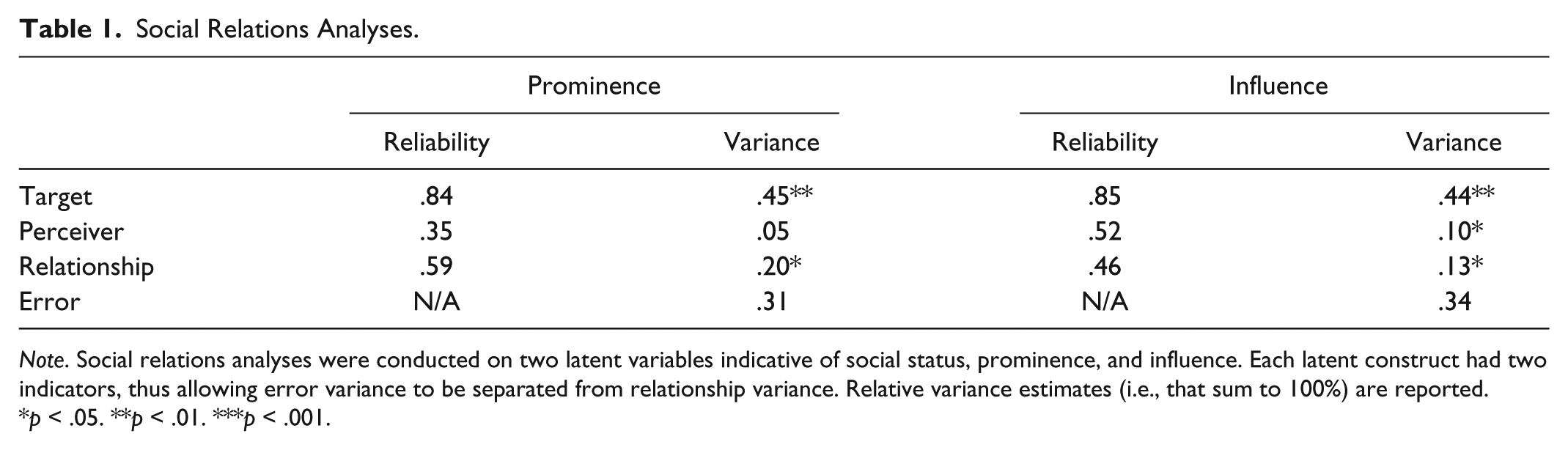
Note. Social relations analyses were conducted on two latent variables indicative of social status, prominence, and influence. Each latent construct had two indicators, thus allowing error variance to be separated from relationship variance. Relative variance estimates (i.e., that sum to 100%) are reported.
p < .05. **p < .01. ***p < .001.
We then ran a series of multilevel unconditional means models on physical attractiveness and self-determination to determine whether or not there were any dependencies in the data due to household. These models were estimated with the multilevel and nlme packages (Bliese, 2013). Intraclass correlations (ICCs) were calculated to determine what proportion of the variation in each variable could be attributed to differences between households. The ICCs for physical attractiveness and self-determination were .03 and 1.2 × 10⁻⁸, respectively. These ICCs were not significantly different from zero, suggesting no household-level differences in either physical attractiveness or self-determination. Correlations were subsequently calculated among the variables of interest. For each correlation, a 95% CI was computed through a nonparametric bootstrapped procedure with 10,000 resamples. Consistent with prediction, physical attractiveness was significantly correlated with both status attainment, r = .43, p < .01, 95% CI = [0.26, 0.61], and self-determination, r = .30, p < .05, 95% CI = [0.09, 0.51]; also consistent with prediction, status attainment and self-determination were themselves significantly correlated, r = .42, p < .01, 95% CI = [0.21, 0.64]. As none of the confidence intervals estimated for these correlations included zero, we can infer that the observed relations were not driven by outlying values. Scatter plots of these correlations are respectively presented in Figures 1B, 1C, and 1D.
We next examined three alternative path models to formally examine the social ecological hypothesis. Model 1 represented the socioecological hypothesis, according to which status attainment mediates the observed relationship between physical attractiveness and self-determination. Model 2 represented an alternative explanation for the observed relationships between physical attractiveness, status attainment, and self-determination, namely, that self-determination mediates the relationship between physical attractiveness and status attainment. Finally, Model 3 represented the possibility that the observed relationship between status attainment and self-determination is explained by a common cause, namely, physical attractiveness.
All three models were estimated using the Lavaan package (Rosseel, 2012). Overall model fit was assessed with the model chi-square statistic and its associated p value, the comparative fit index (CFI), the root mean square error of approximation (RMSEA), and the standardized root mean squared residual (SRMR). Good fit is provided by a model when the chi-square statistic is not significant, when .97 ≤ CFI ≤ 1.00, 0 ≤ RMSEA ≤ .05, and when 0 ≤ SRMR ≤ .05 (Schermelleh-Engel, Moosbrugger, & Müller, 2003). Although we report the 90% confidence interval for the RMSEA, it should be noted that there is greater sampling error in the RMSEA for models estimated on smaller samples and for models using few degrees of freedom. Such models can accordingly produce large confidence intervals.
As indicated in Table 2, Model 1 representing the socioecological hypothesis provided the best fit to the data with a nonsignificant chi-square statistic. The parameter estimates for Model 1 are summarized in Table 3. To test the most crucial aspect of the socioecological hypothesis, that the traits predictive of status attainment would also predict self-determination, we computed the indirect effect of physical attractiveness on self-determination through status attainment using a nonparametric bootstrap procedure with 10,000 resamples (Preacher & Hayes, 2004). In keeping with our prediction, this indirect effect was reliably greater than zero with a standardized point estimate of .18, 95% CI = [0.06, 0.32]. In subsequent analyses that controlled for variation in ethnic heritage and self-reported fluency in English, status attainment continued to mediate the relationship between physical attractiveness and self-determination.
Fit Indices for Estimated Path Models.

Note. CFI = comparative fit index; RMSEA = root mean square error of approximation; 90% CIRMSEA = 90% confidence interval for RMSEA; SRMR = standardized root mean square residual; BIC = Bayesian information criterion; AIC = Akaike’s information criterion.
Best-fitting model.
Parameter Estimates for Model 1.

Note. Single arrowheads (→) represent direct effects; all listed parameter estimates are rounded to the nearest hundredth.
p < .001.
Ancillary Analyses
In a series of ancillary analyses, we repeated all of the previously reported analyses using the perceiver effects in place of the target effects. Whereas the target effects capture how each participant was rated by his or her household, the perceiver effects instead capture how each participant tended to rate his or her housemates. We speculated that individuals might experience higher levels of self-determination not only because others tend to perceive them as more prominent and more influential, but also because they tend to perceive others as less prominent and less influential. However, the social status perceiver effects were uncorrelated with both physical attractiveness, r = .08, p = n.s., and self-determination, r = −.06, p = n.s. With respect to status attainment, an individual’s subjective experience of self-determination would thus seem to depend not on how he or she generally perceives others, but rather on how others generally perceive the individual in question.
Discussion
In the present research, we sought to test the socioecological hypothesis, that those with the traits most relevant to status attainment would be those afforded the most opportunities to be self-determining. We obtained support for this hypothesis in a sample of first-year undergraduate students living in same-sex residences: physical attractiveness predicted the experience of self-determination due to the contributions it made to status attainment. These findings are impressive given the relative absence of shared method variance: Independent observers provided ratings of participants’ physical attractiveness, participants’ housemates provided ratings of their social status, and finally, participants provided self-reports of their own experiences of self-determination.
The present findings attest to how individuals’ traits correlate with socioecological outcomes that carry important implications for self-determination. We chose to focus on the trait of physical attractiveness, given that there is no literature linking this individual difference to self-determination. Although physical attractiveness was predictive of status attainment and self-determination in the present research, future research should examine other traits that could be relevant to both outcomes in other social contexts. We expect that the relationship between traits and self-determination is fundamentally context dependent, such that a particular trait should predict self-determination to the extent that it is also predictive of status attainment within a particular social ecology. In regard to the present research, we would note that the observed association between physical attractiveness and self-determination—for which there is neither theoretical nor empirical precedent—provides a dramatic and usefully counter-intuitive demonstration of the socioecological hypothesis and its contextual dependency.
Future studies can also investigate the contextual dependency of the socioecological hypothesis by examining how a single trait may differentially predict people’s feelings of self-determination across multiple social contexts as a function of status attainment. In this regard, it is useful to highlight that the results of the present study were consistent with the broadly applicable “what is beautiful is good” stereotype (Dion et al., 1972) in that physically attractive undergraduate students attained the highest levels of social status within their university dormitories and, in turn, experienced the highest levels of self-determination. However, should physical attractiveness be expected a priori to negatively influence status attainment within a particular setting, then the socioecological hypothesis would specify a negative association between physical attractiveness and self-determination for individuals operating within such a context. For example, research on the “beauty is beastly” effect (Heilman & Saruwatari, 1979; Heilman & Stopeck, 1985) suggests that more physically attractive women are at a disadvantage for status attainment within masculine sex-typed work settings. The socioecological hypothesis would accordingly propose that, within such workplace settings, physically attractive women would be afforded fewer opportunities to be self-determining as a consequence of their diminished social standing. Future studies could utilize statistical models of mediated moderation (e.g., Muller, Judd, & Yzerbyt, 2005) to formally examine the contextual dependencies that are proposed by the socioecological hypothesis.
For some, the association between social status and self-determination may seem reminiscent of the much-discussed association between social power and approach motivation (e.g., Keltner et al., 2003). For example, a critic might suggest that status-holders are more likely to experience approach-motivated positive affect and this, in turn, may heighten their sense of self-determination. Although this possibility should be examined in future research, we believe that the relationship between status attainment and self-determination cannot be fully understood in terms of enhanced approach motivation. There is ample evidence to suggest that the approach–avoidance distinction cannot encompass self-determination (Deci & Ryan, 2000). Although the experience of self-determination may be correlated with approach-motivated states, there are clear instances of approach-motivated states that do not entail a reflective endorsement of one’s behavior (e.g., impulsivity) and of avoidance-motivated states that are crucial for self-determined functioning (e.g., adherence to health care regimen). Findings from recent neurophysiological studies suggest that self-determination entails a flexible and adaptive situation-specific attunement of approach and avoidance tendencies. Specifically, basic psychological need fulfillment—which includes the experience of self-determination—has been associated both with enhanced medial prefrontal activation (indicative of self-reflection) during the resolution of decisional conflicts (Di Domenico, Fournier, Ayaz, & Ruocco, 2013) and with enhanced anterior cingulate activity (indicative of behavioral inhibition) during the processing of avoidance goals (Di Domenico, Le, & Fournier, 2014). Furthermore, a motivational orientation toward self-determination has been associated with enhanced neuroaffective responsiveness to self-regulatory errors during response inhibition tasks (Legault & Inzlicht, 2013).
Importantly, empirical support for the socioecological hypothesis was obtained with target effects (which capture how each participant was rated by his or her household) and not with perceiver effects (which capture how each participant tended to rate his or her housemates). These findings suggest that it is not a question of whether or not an individual perceives others as prominent and influential that then determines his or her capacity for self-determination; rather, an individual’s capacity for self-determination would appear to depend on whether or not others perceive him or her to be prominent and influential. These findings suggest that the association between traits and self-determination exists beyond the subjective experience of the individual; people’s traits are correlated with their socioecological outcomes (e.g., their status attainment), and people’s consensually determined positions in their respective social ecologies are in turn reflected in their relative capacities for self-determination.
Evidence for the socioecological hypothesis was obtained using the Choicefulness subscale of the Self-Determination Scale (Sheldon, 1995; Sheldon et al., 1996). We focused on this subscale given that the item content provides good coverage of the central facets of self-determination, as they have been stated most recently (Weinstein, Przybylski, & Ryan, 2012). The Self-Determination Scale also includes a subscale for self-contact, defined as the extent to which individuals are aware of their feelings and sense of self. However, recent theorizing within SDT suggests that self-contact/self-awareness is conceptually distinct from self-determination, and that both of these processes make unique contributions to the integrative process underlying unified self-functioning (Weinstein, Przybylski, & Ryan, 2013). Consistent with these ideas, self-contact was not significantly correlated with status attainment, r = −.02, p = n.s., in the field study, or with physical attractiveness in either the pilot study, r = .11, p = n.s., or the field study, r = .17, p = n.s. Moreover, self-contact was only modestly correlated with choicefulness in both the pilot study, r = .43, p < .001, and the field study, r = .32, p < .05. These findings suggest that self-contact/self-awareness, like mindfulness (Brown, Ryan, & Creswell, 2007), is perhaps more productively construed as a process that contributes to the experience of self-determination rather than as a component of self-determination per se.
Future Directions
Given that the present investigation was partly predicated on the assumption that social status permits the relatively unhindered pursuit of personal goals, future research could more closely investigate this proposition by examining the negotiation and conflict resolution strategies that are utilized by high-status individuals (cf. Zuroff, Fournier, Patall, & Leybman, 2010). Given that prominence and influence are conferred upon an individual by his or her peers (Anderson & Kilduff, 2009; Cummins, 2005; Hawley, 1999; Henrich & Gil-White, 2001) and that high-status individuals are often well-liked by their peers (Fournier, 2009), we suspect that status-holders are skilled at advancing their own goals while simultaneously taking part in and cooperating with the goal pursuits of others. The capacity to forge integrative solutions—that is, to get ahead by getting along—may thus be one pathway through which higher levels of social status afford higher levels of self-determination.
Another direction for future research concerns the role of self-determination in mediating the relationship between social status and subjective well-being. Sommer and Bourgeois (2010) found that individuals with the perceived ability to influence others reported higher levels of self-worth, control, and life meaning, and that these experiences in turn enhanced subjective well-being. More recently, Anderson, Kraus, Galinsky, and Keltner (2012) found social status in face-to-face groups to be a robust predictor of subjective and affective well-being. Given its role as a determinant of healthy psychological functioning (Deci & Ryan, 2000), self-determination may be an important mediator of the relationship between social status and subjective well-being and we hope that the present findings help bring attention to this aspect of status dynamics.
Conclusion
The purpose of the present research was to examine how social status influences the capacity for self-determination in naturally occurring social hierarchies. Although the present research relied on a cross-sectional design that limited our capacity to make causal inferences, our findings suggest that the experience self-determination is inextricably tied to the social world (Deci & Ryan, 1991, 2000): The less prominent and influential one is in the social world, the fewer opportunities one will have to be self-determining.
Footnotes
Authors’ Note
As both authors contributed equally to the preparation of this article, names are listed in alphabetical order.
Declaration of Conflicting Interests
The author(s) declared no potential conflicts of interest with respect to the research, authorship, and/or publication of this article.
Funding
The author(s) disclosed receipt of the following financial support for the research and/or authorship of this article: This research was supported by a grant to the second author from the Social Sciences and Humanities Research Council of Canada.