




Abstract
The potential of information technology (IT) as an enabler of customer service process continues to generate interest, which is reflected in the large number of IT-related studies. In spite of the significant progress made in this area, research findings have been mixed and inconsistent. Also, the underlying mechanisms by which IT can affect customer service process remain underexamined. The aim of this study was to find out whether IT investments and IT managerial capabilities can account for variations in customer service performance among insurance companies in Nigeria. Using survey research design, the three formulated hypotheses were tested with data gathered from 402 staff at the managerial level drawn from the selected insurance companies in Nigeria, which have been among the largest investors in IT, and where customer service is widely perceived as strategically important. Responses were analyzed using linear regression. A major finding of this study is that IT is a necessary, but not sufficient, condition for sustainable competitive advantage in customer service. Results show that the interaction of IT investments and tacit, path-dependent, and firm-specific IT managerial capabilities significantly explains variations in customer service performance. Consequently, this study recommends that to realize IT-business value, investments in IT should be accompanied by building and developing IT managerial capabilities.
Keywords
Introduction
The increased competition in market place has empowered consumers to become more astute in their buying, less loyal to a particular financial institution, and more demanding of products and services that fit their specific needs and time schedules (Ehikhamenor, 2003). At the same time, studies have shown that attracting and retaining customers have become some of the toughest and most challenging activities of financial institutions, including insurance companies, in Nigeria (Appah & Banabo, 2012; Banabo, Ndiomu, & Koroye, 2011). Appah and Banabo (2012) observe that most of these institutions fail to identify new opportunities to meet and satisfy the growing needs of their customers. Asikhia (2010) submits that unless they are able to deliver their services in a very efficient manner, with technology playing a major role, financial institutions may not be able to keep their customers.
Improving customer satisfaction is one of the prime motivations for making information technology (IT) investments, because heavy investment in IT resources in recent years is a reflection of the industry belief that IT resources can enhance the business–customer interface (Chopra & Meindl, 2003; Karimi, Somers, & Gupta, 2001). The relationship between IT and firm performance has been documented (Evangelia & Michalis, 2006; Karimi et al., 2001; Oghojafor, Aduloju, & Olowokudejo, 2011). The increased awareness that IT is a critical enabler of business performance has led to more research that examines the interactions between a firm’s information systems and other drivers of performance (Banker & Kauffman, 2004; S. Bharadwaj, Bharadwaj, & Bendoly, 2007; Steckel & Gupta, 2004).
While some studies have found that IT can affect business performance directly or indirectly (Duh, Chow, & Chen, 2006; Neirotti & Paolucci, 2007), others suggest that IT cannot be a source of competitive advantage as it does not fulfill the requirements of the competitive advantage concept (Carr, 2005; Venkatraman & Zaheer, 1990), yet others have found negative impact of IT on firm performance (Berndt & Morrison, 1995; Warner, 1987).
Some studies, many of which are recent, tend to suggest that, aside from differences in methodology and variables used, IT managerial capabilities might be responsible for variations in findings of IT-business value studies (A. S. Bharadwaj, 2000; Gheysari, Rasli, Roghanian, & Jebur, 2012; Mithas, Ramasubbu, & Sambamurthy, 2011; Tarafdar & Vaidya, 2006; Yongmei, Hongjian, & Junhua, 2008). For instance, A. S. Bharadwaj (2000) suggests that a firm’s IT capability enables it to achieve higher returns on its IT investments. In an extensive literature review on IT-business value, Breznik (2012) concludes that exploring the value of IT in firm performance still remains inadequately researched and empirically tested.
This article attempts to provide answer to the following two questions: Does firm expenditure on IT per se have effects on firm performance? Or do the IT effects on firm performance come more through an interaction effect with IT managerial capability? The remainder of the article is organized as follows. The next section reviews the existing literature on IT investments and IT managerial capabilities, including the theoretical underpinning, and develops our hypotheses. The methodology section describes the empirical analysis, including the sample and data collection procedure, the measurement of the variables of interest, and the results. The concluding section presents the discussions of research findings, the limitations of the study, and suggestions for future research.
Literature Review
The study is anchored on the resource-based view (RBV) of the firm, a more popular theory among IT researchers. Traceable to the work of Penrose (1959), this theory was originally developed as a means of understanding the conditions under which firms are able to gain and sustain competitive advantage (Ray, Muhanna, & Barney, 2005; Rivard, Raymond, & Verreault, 2006). Today, this theory is also being applied to understanding why the performance of processes within a firm may vary across a set of competitors (Schroeder, Bates, & Junttila, 2002). The RBV conceptualizes the enterprise as a bundle of unique resources (Spanos & Lioukas, 2001), and posits that the sources of firm heterogeneity underlie competitive advantage because of the unique combination of resources that are scarce, valuable, and difficult to imitate (Helfat & Raubitschek, 2000; Rumelt, 1984; Wernerfelt, 1984). According to Penrose (1959), a firm’s performance is said to be dependent on the best use of available resources. Later, Barney (1991) expands this view by describing resources as consisting of assets, capabilities, processes, attributes, knowledge, and know-how that are possessed by a firm and that can be used to formulate and implement competitive strategies.
IT refers to the total investment, expenditure, and know-how in computing and communication technology, including hardware, software, processes, and people, dedicated to providing these services (Bullon, 2009; Weill & Broadbent, 1998). It is a group of engineering tools that facilitate market entry through operational and dynamic capabilities (Saini & Johnson, 2005). Jeffers (2003) refers to IT resources as the technology assets available to the firm. These would necessarily include shared technology and technology services across the enterprise and the business application. The scope of IT resources may be widened to include IT technical skills (programming, systems integration, and database development) and monetary investments.
The importance of IT can be seen from the huge investments on it around the world. Perhaps, owing to the belief that IT is a source of competitive advantage, in the United States alone, a whopping sum of US$1.0 trillion was spent on IT in 2007 and a projected sum of US$1.5 trillion made in 2010 (Bullon, 2009). Organizations are making huge investments in IT to align business strategies, allow innovative, functional operations, and provide enterprise network (Chen & Tsou, 2007), which are critical to creating competitive advantage (Huang, Li, & Chen, 2009). Hoping in its potentials to contribute heavily to the growth of a nation’s economy (Harchaoui, Tarkhani, Jackson, & Armstrong, 2002), a policy on the adoption of information and communication technology was initiated by the Nigerian government in 1999 (Posu, 2006).
Ray et al. (2005) argue that failure to invest in IT resources and capabilities, by sourcing them internally or externally, may put a firm at a competitive disadvantage in terms of the performance of its customer service process. One may then reason that firms in a particular industry have a strong incentive to invest in the IT assets necessary to maintain its level of competitiveness. As studies have shown, IT has become a critical enabler of business performance by enhancing or supporting a business process (Banker & Kauffman, 2004; S. Bharadwaj et al., 2007).
The approach used by Bakos and Treacy (1986) is to view opportunities arising from the use of IT from three perspectives: (a) that of an organization trying to improve the efficiency and effectiveness of the current status; (b) that of an industry insider, trying to out maneuver other participants in a competitive rivalry; and (iii) that of an outsider, investigating whether or not to enter an industry. In their approach, Rockart and Morton (1984) identify three types of opportunities that can create competitive advantage, and these are (a) improve each value adding function, (b) link with customers and suppliers to increase their switching costs, and (c) create new businesses through services or products.
Consequently, while some firms deemed it necessary due to economic reasons to reduce capital investment in other projects, they continue to invest more on IT resources that they see as strategically important to customer service. For example, modern technologies allow customers to make deposits at automated teller machines (ATMs), to make airline reservations online, or to place orders, using an automated telephone system. As a consequence, service organizations are increasingly involving their customers in the production and delivery of their services (Bowen, Schneider, & Kim, 2000; Groth, 2005). Sambamurthy, Bharadwaj, and Grover (2003) provide a theoretical framework to understand the effect of IT infrastructure capabilities on the ability of firm to manage its customer base. They argued that deployment of appropriate IT resources would enhance customer interface with firms and thereby help in proactively managing customer information.
While the modern firms cannot survive without IT resources, the failure of a large number of firms that invested heavily in IT may make one to wonder if IT per se does guarantee success (Neal, 2001). Carr (2005) argues that computers confer no meaningful gains due to their ubiquity and commodity nature. The weak relationship between IT investment and financial performance even leads researchers to challenge the effect of IT on performance (Liang, You, & Liu, 2010), giving rise to the so-called productivity paradox, which is often cited as a phenomenon associated with non-productive use of IT in industries. To justify enormous IT investments, it is necessary to establish some relationship between the impact of IT investments and overall firm performance (Pavlou, Housel, Rodgers, & Jansen, 2005). This leads to the formulation of our first hypothesis:
Interest in the study of organizational capabilities developed over the years, which Zollo and Winter (2002) trace to the pioneer works of Selznick (1957) on distinctive competence. This foundation was built upon by the work of Cohen and Levinthal (1990) on absorptive capacity and Teece, Pisano, and Shuen (1997) on dynamic capabilities. Amit and Schoemaker (1993) define capabilities as the firm’s capacity to deploy resources, usually in combination, using organizational processes, to achieve a desired end. Capabilities are developed over time through complex interactions among the firm’s resources and can be thought of as intermediate goods generated by the firm to provide enhanced productivity of its resources, as well as strategic flexibility and protection for its final product or service.
Capabilities are a part of organizational resources but unique in some ways. While resources refer to the stocks of available factors of production owned or controlled by a firm, capabilities are a firm’s capacity to deploy resources, using organizational processes (Amit & Schoemaker, 1993). Capabilities can even be viewed as the capacity of a team of resources to perform some task or activity (Grant, 1991) and are often developed in functional areas by combining physical, human, and technological resources (Amit & Schoemaker, 1993). In this regard, Makadok (2005) considers capability as a special type of resource which is non-transferable and embedded in the basic fabric of the firm, which improves the productivity of the other resources possessed by the firm.
Scholars have also distinguished between ordinary capabilities and dynamic capabilities. Dynamic capabilities are “a firm’s behavioural orientation to constantly integrate, reconfigure, renew and recreate its resources and capabilities, and most importantly, upgrade and reconstruct its core capabilities in response to the changing environment to attain and sustain competitive advantage” (Wang & Ahmed, 2007, p. 10). This is in line with the argument of Barney, Wright, and Ketchen (2001) that the ability to change quickly and adapt to changes in the market is costly for others to imitate and thus can be a source of sustained competitive advantage.
An example of dynamic capability is the IT managerial capability, which refers to a firm’s ability to develop high-quality IT applications in a timely and cost-effective manner. This is a critical capability that is likely to affect technology deployment (Ravichandran & Lertwongsatien, 2005). According to Melville, Kraemer, and Gurbaxani (2004), IT managerial capabilities include the ability to identify appropriate projects, marshal adequate resources, and lead and motivate development teams to complete projects according to specification and within time and budgetary constraints. Specifically, Powell and Dent-Micallef (1997) include in their study IT managers’ business knowledge and line managers’ IT knowledge as measures of IT managerial capability.
In making reference to what they call IT management capability, Dehning and Richardson (2002) explain that combining hardware and software assets to create a flexible and sophisticated IT infrastructure can be inimitable, because creating such an infrastructure requires carefully melding technology components to fit a firm’s needs and priorities. Of the commonly cited sources of sustainable competitive advantage from IT, only managerial IT capability is said to be a source of sustainability (Mata, Fuerst, & Barney, 1995). The importance of IT managerial capability, argued Chatterjee, Richardson, and Zmud (2001), can be seen in the interest shown in the appointment of chief information officers by many organizations. IT capability also includes the ability of a computer system to store, process, and communicate information (Bakos & Treacy, 1986).
A. S. Bharadwaj (2000) found that firms which possess superior IT capabilities have a significantly better performance than firms that do not possess and exploit superior IT capabilities. Peppard and Ward (2004) argued that IT alone is unlikely to be a source of sustainable competitive advantage, but the IT capability, which is embedded within the fabric of the organization, can be tacit and difficult to imitate. In their study, Mithas et al. (2011) find that IT managerial capability plays an important role in developing other firm capabilities for customer management, process management, and performance management. Empirical study of Yongmei et al. (2008) suggests that IT managerial capability is an important moderating variable linking IT investments to firm performance. This leads to the other two propositions we make for this study:
Research Methodology
Generally, IT researchers have overwhelmingly favored quantitative approaches, with surveys being the predominant method (S. Bharadwaj et al., 2007; Ravichandran & Lertwongsatien, 2005; Ray et al., 2005). Surveys have been found to be appropriate for social and behavioral research, especially where some types of behaviors that interest the researcher cannot be arranged in a realistic setting (Zikmund, 2000). Thus, the research design adopted for the current study is the survey design.
Materials and Method
The study population was made up of all the staff at managerial level of the 48 insurance companies in Nigeria. The list of insurance companies was compiled from the website of the National Insurance Commission (NAICOM). Seventy percent were randomly selected from the 48 direct insurance companies in Nigeria. The 34 companies that emerged from this exercise then formed the basis of drawing our sample size. Thereafter, 15 managers were randomly selected from the 34 insurance companies, giving a sample size of 510.
This study adopts the use of primary data, which were collected with the use of a structured questionnaire. Questionnaires are capable of being used to acquire a very large quantity of data from a widely dispersed geographical area at a relatively low cost (Dillon, Madden, & Firtle, 1994), and can also guarantee a relative degree of anonymity, which, in turn, may have the advantage of eliminating interviewer’s bias (Hooper, 2006).
Variables used are IT investments and IT managerial capabilities. IT investments consist of 6 variables, one of which was adapted from Ray et al. (2005), while the remaining 5 were from Ravichandran and Lertwongsatien (2005). IT managerial capabilities consist of 12 variables. Two variables were adapted from Jeffers (2003); 2 from Vargas, Hernandez, and Bruque (2003); 5 from Ray et al. (2005); and 3 from Ravichandran and Lertwongsatien (2005). Customer service performance measure consists of eight items. These items were originally developed within the marketing sector by Parasuraman, Zeithaml, and Berry (1985), and have since then been used in a variety of organizational settings (Akbar & Parvez, 2009; Landrum, Prybutok, Zhang, & Peak, 2009; Ray et al., 2005). For the present study, the eight items used were adapted from Ray et al. (2005) and were measured on a 5-point Likert-type scale.
A pilot test was conducted with 70 copies of the questionnaire administered to managers of randomly selected insurance companies in Lagos, and the 62 correctly filled were used for the reliability test. Field (2009) asserts that Cronbach’s α values above .7 are acceptable values of consistency. The results of the pilot study show α values of .889 both for IT investments and IT managerial capabilities, and .899 for customer service performance, indicating a high degree of reliability of the research instrument.
To ensure high levels of construct validity of the research instrument, we have adapted, to a great extent, existing surveys that have previously been successfully used to measure similar constructs. Also, to ensure content validity, a draft of the questionnaire was given to 10 knowledgeable practitioners at the senior level in insurance companies and experienced lecturers, who are experts in the fields of marketing, management, and statistics in line with the method advocated by Cooper and Schindler (2001). Suggestions and recommendations made were incorporated in the final instrument.
Ordinary least-squares regression was used to test the various propositions. Tests were carried out to ensure that various assumptions of regression were met. Normality assumption of multivariate statistics is regarded as the most fundamental by Tabachnick and Fidell (2007). The results of our test show that all the study variables are normally distributed, because the rule is that a distribution is normal if the skewness value is below the threshold of 3 and that of kurtosis is below the threshold of 10 (Vincent, 2012). Also, in this study, the linearity assumption was checked and both equations satisfied the assumption, considering that F statistic was significant at 5% and 1% levels, respectively. In addition, SPSS was used to perform collinearity diagnostics on the variables used. With tolerance values of all the independent variables greater than 0.1, and variance inflation factor (VIF) values well below the cutoff point of 10, the problem of multicollinearity does not arise. Finally, in this study, no sign of heteroskedasticity and autocorrelation was detected in the model used after conducting Durbin–Watson d test with a reported value close to 2.
Results
Of the 510 copies of the questionnaire administered to the target members, 435 were returned, 402 of which were fully completed, giving a usable response rate of 78.8%. This response rate is quite high compared with those obtained in some previous studies in the field of IT research. For instance, Wagner (2008) obtained a response rate of 13.6%, Ray et al. (2005) 13%, Jeffers (2003) 12.3%, and Vargas et al. (2003) 21.86%.
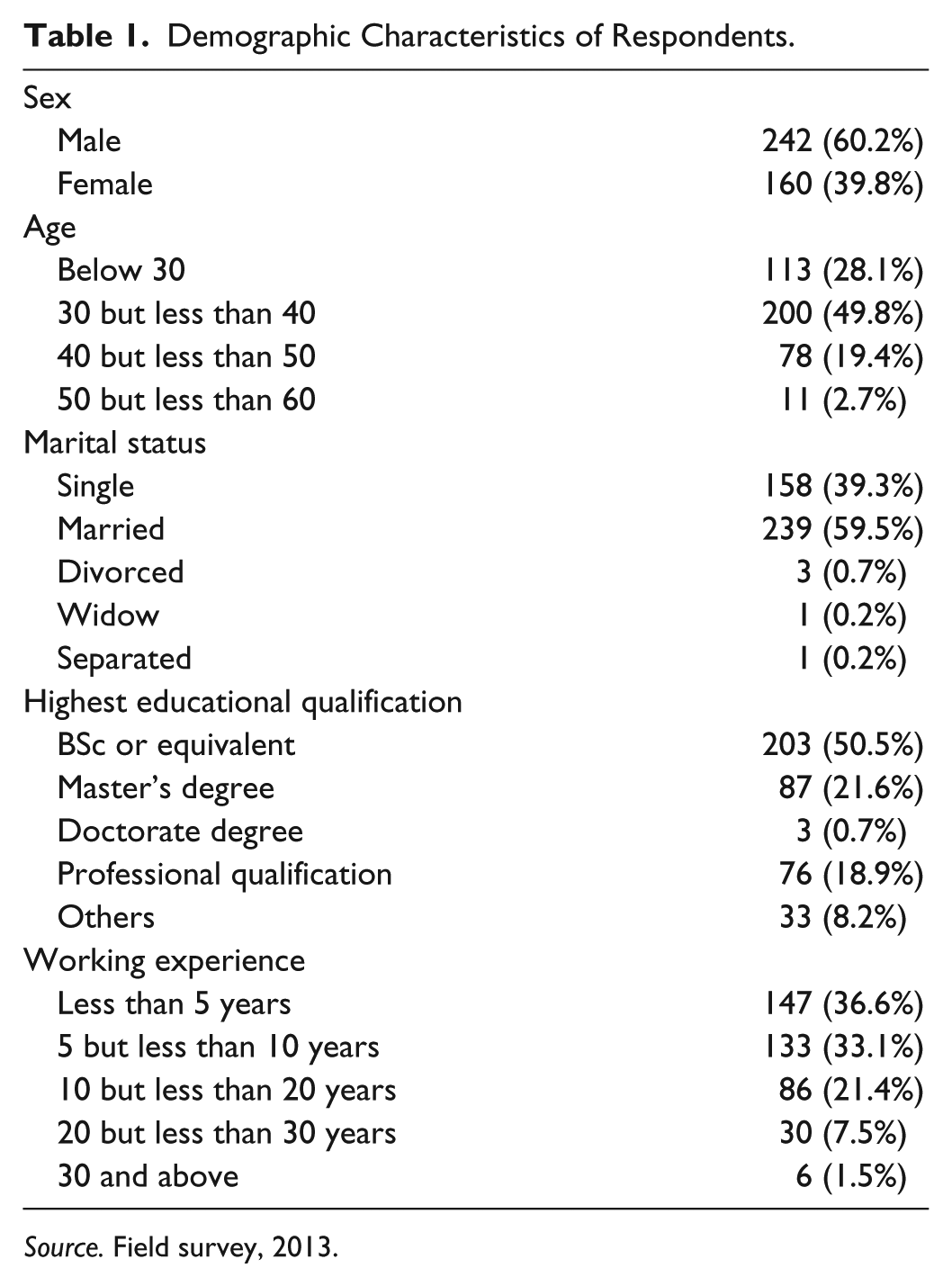
Table 1 presents the demographic characteristics of the respondents in terms of sex, age, marital status, educational qualifications, and working experience. As shown in the table, of the 402 respondents, 60.2% were male and 39.8% were female. In addition, most of the respondents (69.2%) fell within the age bracket of 30 to 50, an indication that the Nigerian insurance industry is dominated by a dynamic workforce, which is well placed to comment on issues relating to the use of technology. Also, of this total number, 60.7% have been married one time or the other. The level of education of the respondents is also very high as shown in Table 1. In addition, the fact that 62% had between 5 and 30 years of working experience implies that they could really provide a credible answer on the way IT resources affect their operations.
Demographic Characteristics of Respondents.
Source. Field survey, 2013.
Tests of Hypotheses
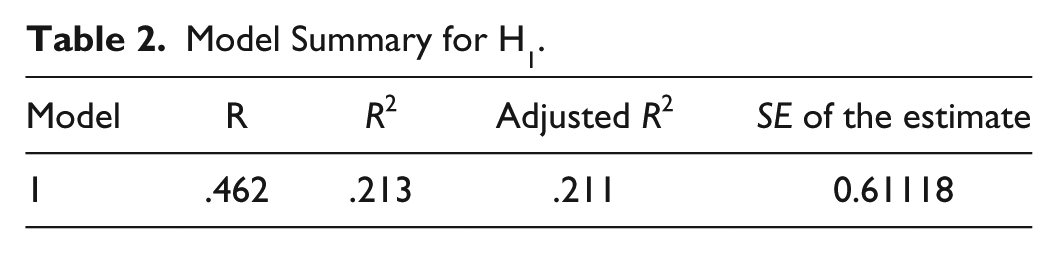
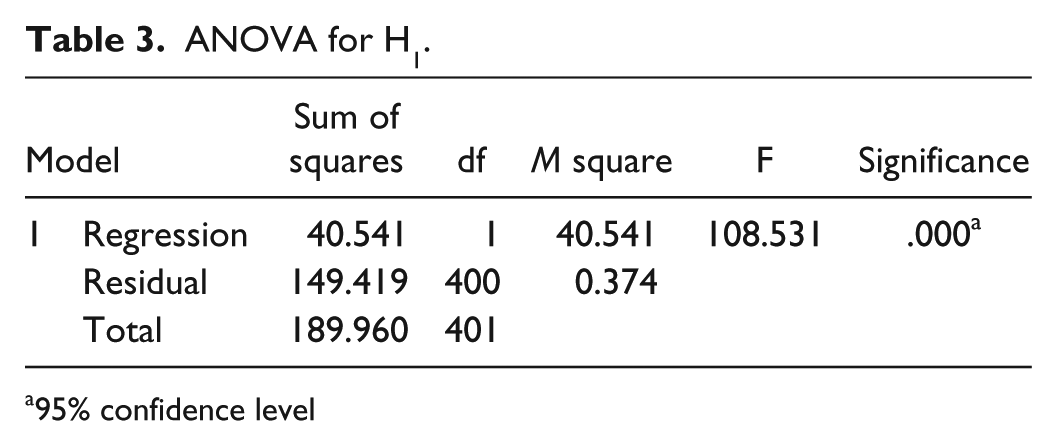
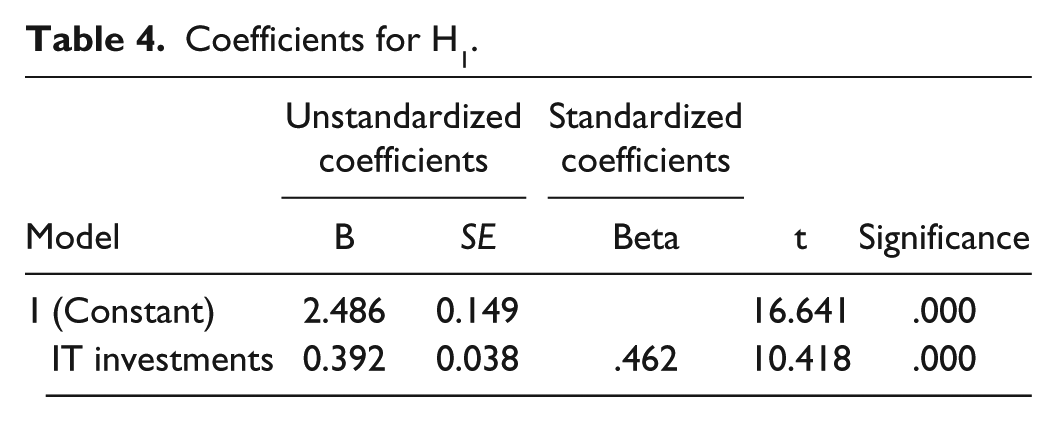
Table 2, which is the model summary for H1, shows a R value of .462, which, according to the guidelines provided by Cohen (1998), is a moderate correlation between IT investments and customer service performance. With the coefficient of determination, R2 of .213, IT investments help explain about 21% of the variance in the respondents’ scores on the customer service performance scale. Although the relationship between IT investments and customer service performance is a moderate one, the correlation is statistically significant (R = .462; n = 402; p < .05). We thus reject the null hypothesis that states IT investments per se will not account for variation in customer service performance among insurance companies in Nigeria. In Table 4, both the IT investments and the constant are shown to contribute significantly to the model (as can be seen from the “Significance” column). From the “B” column, the regression equation can be presented as follows:
Customer service performance = 2.486 + 0.392 (IT investments).
Model Summary for H1.
ANOVA for H1.
95% confidence level
Coefficients for H1.
As is the case with IT investments regarding H2, Table 5 shows a low R value of .435, and R2 of .189, indicating that IT managerial capabilities only help explain about 19% of the variance in customer service performance scale. At R = .435; n = 402; p < .05, we reject the null hypothesis that states IT managerial capabilities do not affect customer service performance among insurance companies in Nigeria. Table 7 shows that both the IT managerial capabilities and the constant contribute significantly to the model (as can be seen from the “Significance” column). From the “B” column, the regression equation can be presented as follows:
Customer service performance = 2.068 + 0.475 (IT managerial capabilities).
Model Summary for H2.

ANOVA for H2.
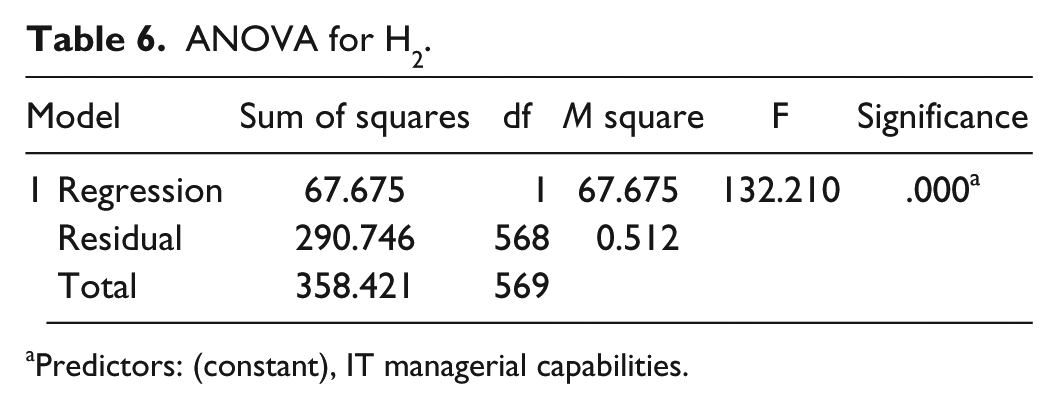
Predictors: (constant), IT managerial capabilities.
Coefficients for H2.

As shown in Tables 8, 9, and 10, R2 is .330, and the p value is less than .05. This shows that about 33% of the variation in customer service is explained by both IT resources and its managerial capabilities. This percentage may suggest the need for a review of this model but Table 9 shows that the two variables, namely, IT resources and its managerial capabilities, are jointly strong predictors of customer service among financial institutions in Nigeria (F = 98.076, p < .5). Therefore, H3 is also rejected.
Model Summary for H3.

Note. Predictors: (constant), IT managerial capabilities, IT Investments.
95% confidence level
ANOVA for H3.

Note. Dependent variable: customer service performance. Predictors: (constant), IT managerial capabilities, IT investments.
Coefficients for H3.

Note. Dependent variable: Customer service performance.
Discussion
This study proposes that the variation in customer service performance across firms is explained not by the level of IT investments per se but by the extent of interaction of IT investments and IT managerial capabilities. Our results indicate that there is a correlation between IT investments and customer service performance, but only about 23% of the variance in customer service performance is explained by IT investments. This result is in agreement with the findings of Prasad, Heales, and Green (2009), where IT resources were found to have a direct but marginal impact on customer service. In Ray et al.’s (2005) study, it was found that IT spending did not explain significant variance in customer service performance, and Vargas et al. (2003) found no significant links between general level of IT and competitive position. Jeffers (2003) empirically proved that IT resources alone were not a predictor of customer service. Regarding our second hypothesis, although our results show a relatively low correlation between IT managerial capabilities and customer service performance, the relationship is statistically significant (R = .435; n = 402; p < .05), indicating that IT managerial capabilities can actually have an impact on customer service performance.
The focus of Hypothesis 3 was to determine the effects of the interaction of IT managerial capability with IT investments on customer service among insurance companies in Nigeria. With an R value of .574, the interaction of these two independent variables is a good predictor of customer service performance among insurance companies in Nigeria. This result is consistent with those of some past studies that have emphasized the rent-yielding potential of IT managerial capability (S. Bharadwaj et al., 2007; Dehning & Stratopoulos, 2003; Feeny & Willcocks, 1998). For instance, Dehning and Stratopoulos (2003) empirically prove that companies with superior IT managerial capability are more likely to sustain an IT-enabled competitive advantage. In addition, the interaction of IT managerial capability with IT investments was consistently significant on business process (Jeffers, 2003), and the relationships between IT resources and IT capabilities were positive (Ravichandran & Lertwongsatien, 2005). Finally, in Ray et al.’s (2005) finding, the hypothesis regarding IT managerial knowledge, moderating the impact of generic technologies, was supported in the regression analysis.
While some organizations continue to be able to record impressive performance due to their IT investments, others record low or negative IT-business value. This, therefore, creates the need to better understand the sources of such variations and, consequently, the mechanisms by which IT contributes to firm performance. This need provides motivation for the present study. This study thus provides theoretical and empirical insights into the complex realm of successful IT management. This study appears to be the first to study the interaction effects of IT investments and IT managerial capabilities on customer service performance among insurance companies in Nigeria. While it is necessary for firms to invest in building and deploying IT to improve their customer service process, the performance effects of such investments depend on the presence of certain firm-specific resources such as IT managerial capabilities. IT managerial capabilities help facilitate rich information sharing and joint problem-solving among IT and customer service managers, a necessary requirement for an organization to move beyond mere acquisition of IT applications toward open communication and diffusion of IT knowledge. As the results show that IT managerial capability is a crucial factor for realizing IT-business value, top executives are urged to recognize the strategic thrust of developing and maintaining IT capabilities.
Although the main contribution of this study has been highlighted above, one main limitation should be kept in mind in interpreting its findings. The propositions of this study were tested, based on cross-sectional data, which, when compared with longitudinal data, have some weak points. As the data represent a snapshot in time, because they capture the perceptions of respondents at a point in time, the imputation of cause–effect relationships between the constructs in the model should be made with caution. It may be noted that because the methodology is cross-sectional, it can only show association, not causality. Although the only solid way of testing causal relationships among constructs is through longitudinal studies, the constructs of this study were developed through appropriate theoretical arguments, which suggest the validity of the results. Further studies using longitudinal data through which causation could be inferred would be needed. With this, tracing IT usage and customer service performance right from the outset of IT adoption would be made easier.
Footnotes
Appendix
Declaration of Conflicting Interests
The author(s) declared no potential conflicts of interest with respect to the research, authorship, and/or publication of this article.
Funding
The author(s) received no financial support for the research and/or authorship of this article.