




Abstract
The television viewing experience has been completely revolutionized with the advent of digital video recorder (DVR). The comfort and ease of watching programs at one’s own convenience and saving time by fast forwarding the commercials have completely changed the viewers’ life style. Considering the fact, that fast forwarding of commercials defeats the ultimate purpose of reaching out to TV viewers, a lot is at stake for the advertisers who ignore the impact of DVRs on advertising. International advertising market has already started adopting creative ways to hold the viewers’ attention in this time-shifted world. The available literature review on impact of DVRs is mainly related to the United States and European countries; hardly any research has been done in this regard in context to India. This study is based on literature review to understand the threats and opportunities of DVRs in global market, identify the creative strategies adopted by other countries to combat these threats, analyze the current situation of impact of DVRs in Indian market, and make recommendations for future in context to India.
Introduction
A digital video recorder (DVR) enables viewers to pause, rewind, record, and playback selected programs at their convenient time. Although video cassette recorder (VCR) also offered most of these features, the ease and significant recording capacity attracted users toward DVR.
The practice of fast forwarding the commercials has led to serious concerns regarding the effectiveness of advertisements when fast forwarded by the viewers (Maddox, 2006). Although various interesting studies have suggested that smart advertisements make an impact on TV viewers even when fast forwarded, these concerns have still persisted (Consoli, 2005, 2007; Wurtzel, 2006).
Kishore (2003) highlights the claims made by early DVR users regarding the impact of new technology on television viewing and skipping the advertisements leading to adverse impact on traditional television advertising. As a result, it is estimated that by 2007, practice of time-shifted viewing and skipping of advertisements would reduce traditional ad-viewing by 19% leading to loss of US$7 billion from traditional TV ad revenue (Forrester, 2002).
Hollis (2005) also opines that attractive features of DVRs such as time shifting, recording, pausing live TV and replaying where it was left, and saving time by fast forwarding boring advertisements would soon make it an indispensable home appliance. A study conducted by Fann-Im (2004) revealed that more than 50% of all DVR users found fast forwarding through commercials as their favorite feature. Hollis (2005) brings a ray of hope for the advertisers and expresses that this however does not imply that the viewers would not see advertisement at all. The study indicated that even while fast forwarding, the viewers get to see rapid sequence of images with no sound, which still creates some impact. Therefore, fast forwarding may pose a threat to advertising business but cannot completely destroy the impact of ads on the viewers. Gilmore and Secuna (1993) also expressed that fast forwarded ads bring back memories of the product in the viewers’ mind. This argument was contradicted by Cronin and Menelly (1992) who mentioned that viewers fast forward all the ads without any selection and prior judgment.
Negroponte (1995) opines that increasing access to digital technologies has enhanced the consumers’ control over media consumption, thus leading to lesser requirement for real-time broadcast. It has been predicted by forecasters that this rapid shift from “a world of linear TV to on-demand” would require a “radical rethink of advertising supported programming.”
Aim of the Study
The available literature review on DVR is mainly related to the United States and European countries. The research on impact of DVRs in context to India has been very limited. Therefore, this study, conducted in 2012-2013, is a literature review to
Understand the threats and opportunities of DVRs in global market
Identify the creative strategies adopted by other countries to combat threats posed by DVRs
Analyze the current situation of impact of DVR in Indian market and make recommendations for future in context to India.
Method
An extensive literature review was done to understand the impact of DVR on global market. Approximately 45 research papers and articles were studied to get an in-depth understanding of the topic.
Results and Discussion
DVR Penetration
In the United States, DVR was introduced in 1999, developed and marketed by TiVo, Inc. Since then, the product has been made available in many other countries such as Australia, Canada, Mexico, New Zealand, Puerto Rico, Taiwan, and the United Kingdom. In developed markets such as the United States and the United Kingdom, DVR numbers have reached a critical mass. The DVR penetration in the United States had gone from 1% in 2006 to 43% of all TV viewing households in 2011 as per a “Pay TV in the US” report by Mintel, a market research firm (Bapna, 2012a).
Brecht (2011) expressed that DVR penetration had doubled in the previous 2 years with its presence in 38.1% of all U.S. homes; thus, advertisers cannot afford to ignore this rapid growth of DVR while planning television marketing campaigns. Figure 1 indicates estimates of revenues attributable to the U.S. DVR industry from 1999 to 2010 (Schaeffler, 2009) according to which the DVR revenue significantly increased from US$111 million to US$5,200 million in these years.

Estimates of revenues attributable to the U.S. DVR industry from 1999 to 2010.
In the United Kingdom, penetration has crossed 50% in 2011, according to Deloitte Technology’s media and telecommunication practice (Bapna, 2012a). A report in Cable Quest Broadband (2009) projected that in the United Kingdom and Ireland, the DVR service was in more than 5 million homes; in Australia, two out of three set top boxes (STBs) deployed were DVR enabled; and in the United States, DVRs were provided as a standard feature by most operators.
In India, DVR adoption is still nascent and is estimated at 400,000 households, or less than 4% of the TV viewing homes till 2011 (Bapna, 2012a). A rapid growth rate in DVR ownership has been predicted in Asian countries with India having the second highest level of DVR subscribers in Asia by 2013 and overtaking Japan to have the highest number of DVR subscribers by 2018 (refer Table 1).
DVR Subscribers in Asia.
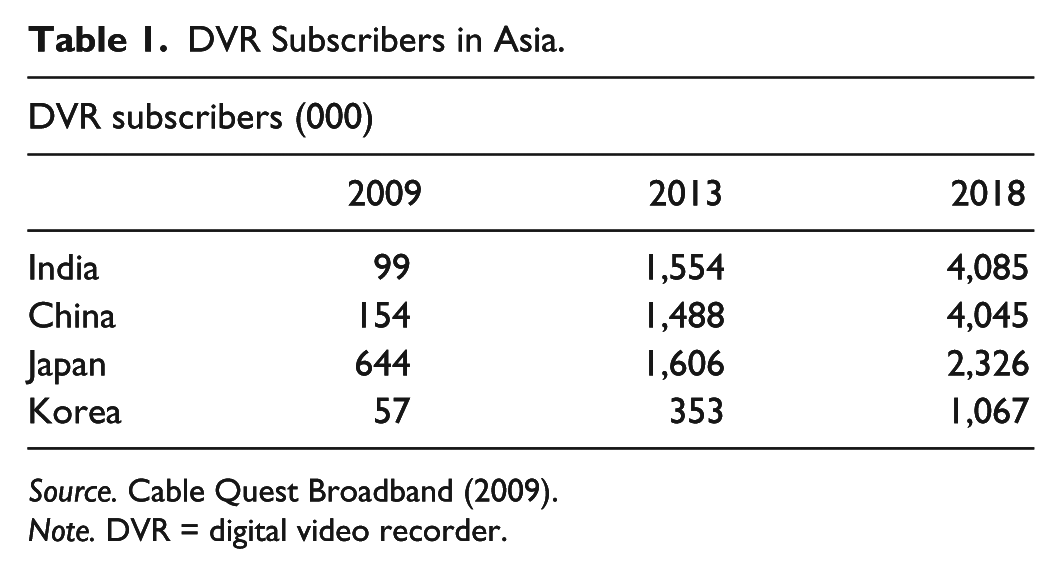
Source. Cable Quest Broadband (2009).
Note. DVR = digital video recorder.
DVR revenues in Asia Pacific have been predicted to be witnessing significant growth rates. With Japan as leader, China, Korea, and India are other major Asian markets that would witness large increase in DVR revenues. DVR revenue of US$68 million is projected to be generated by India till 2018 (refer Figure 2).

DVR revenues.
A recent review of digitization progress by the Ministry of Information and Broadcasting (2012) has revealed that 68% of cable TV digitization has already been achieved in the four metro cities of India—Delhi, Mumbai, Kolkata, and Chennai. City-wise data show that digitization in Mumbai is 95%, in Kolkata 67%, in Delhi 53%, and in Chennai 49%. A study by Media Partners Asia predicted India to be the largest direct to home (DTH) market in the world in terms of subscribers by 2012 and estimated 45 million subscribers by 2014. These are massive numbers for an industry that has not even completed a decade since its inception (Sawant, 2011).
With the exceptional growth of telecom sector in India in the past few years, it can be safely said that Indian market is ripe for adopting new technologies. DVR will soon be considered as essential as the mobile phone as in other leading markets in the world. Navin Talreja, president of Ogilvy for Mumbai and Kolkata, emphasizes that huge social factors that could make DVR big in India are large families and the nature of programming (Bapna, 2012a). In a detailed chat with the Economic Times (Bapna, 2012b), Atul Phadnis opines that TV series, which hold the viewers’ attention and force them to regularly follow these programs, are one of the major reasons for DVR’s success in India. Although for serials in mainline languages there are repeat telecasts, they are generally broadcast at odd hours; hence, the DVR acts as a useful resource. For programs broadcast in regional languages, the main TV serials are not repeated; hence, viewers are even more anxious about missing any episode, thus increasing the possibility of increased DVR penetration in the Indian market. The other element for better DVR penetration in India could be increasing interest of newer generation in sports. With international live matches being telecast on a U.S. time or Euro time, the need of DVR becomes all the more relevant. Moreover, TV viewers in India have been frustrated with too many ads within the programs and wish to opt for interruption-free entertainment. Therefore, India could be considered a major potential market for DVR in future; however, the price may be one of the major stumbling blocks for its penetration.
With the launch of DVR in the United States in 1999, research has proven that it posed major challenges to advertising world forcing advertisers to think of innovative strategies. In India, DVR was first launched by Tata Sky in 2008 followed by other players such as Dish TV, Airtel, Reliance, and so on. The penetration of DVR in India was less than 4% till 2011, which currently may not be an alarming situation. However, Indian market is quite receptive to technological innovations and with the mandatory digitization process in metropolitan cities, increase of affluent class, and working couples, the chances of DVR penetration in coming years are quite high.
Impact of DVRs on Advertising
Many researchers believe that DVR threatens television advertising because of the commercial skipping feature (Association of National Advertisers/Forrester Research Survey, 2006; Goetzl, 2006), whereas others downplay such concerns (W. Friedman, 2006; Solman, 2007). Depending on different viewpoints, DVRs are either boon or bane. It may be considered a boon for TV viewers because DVRs allow them to watch their favorite programs at their convenient timings. Moreover, it is also beneficial for television networks as they are able to reach out to viewers who are not able to watch programs when they are broadcast. The advertisers may consider it a bane as this facility allows viewers to skip through the television commercials by fast forwarding and ultimately, reducing the overall return on investment (ROI) of television advertising funds.
It is surprising to know that despite the extent of TV advertising market and the impact DVRs already have on advertising business, the advertisers, agencies, and about 70% of advertising executives lack understanding on the change in advertising strategies required due to DVR revolution (DVR Research Institute, 2010).
Brown (2011) comments that advent of DVR is not the sole reason behind the change in TV viewing environment. Other devices and technologies such as smart phones, tablets, social media, and TV viewing over the Internet pose more substantial challenges to TV advertising than DVRs. However, TV remains a formidable advertising vehicle and thus, it is important to discuss TV advertising, the challenges it faces, and the way advertisers can respond to those challenges.
DVRs as a Threat
The advertising world has witnessed a significant stir since the advent of DVR. Goetzl (2006) reports that essentially all DVR users fast forward through advertising, and marketers are considering this crucial change in TV viewing very seriously. An alarming response of survey done with large national advertisers (Bernoff, 2004) revealed that due to drastic increase in DVR usage, 75% of respondents planned to reduce the budget allocation for television advertising and 70% responded that DVRs would minimize the efficacy of “traditional 30-second commercials.”
Debraj Tripathy, managing director of MediaCom India, a media planning and buying agency, comments that if DVR numbers explode, planners and advertises will have a tough time. Consumers will skip through ads and watch what they want at a time that is suitable to them; and planners will virtually be able to do nothing about it (Bapna, 2012a). Thus, media planning and creative execution will be significantly affected with excessive control of consumers on advertising medium.
Research claims that up to 80% of all primetime programming in DVR households are time-shifted and out of this, 65% to 75% of all commercials are skipped by the users (Posnack, 2004). Mandese (2004) also reports that “an average of 53 percent of TV commercials are skipped in DVR households, but the ad zapping is much higher, 77 percent, for the portion of programming they view on a recorded basis.” Thus, time-shifting feature and convenience to skip commercials are two major challenges faced by advertisers in getting their commercials noticed.
DVR Research Institute (2010) projects that more than 80% of advertising executives are concerned about the crucial impact of DVR on TV advertising and consider this even a bigger threat to TV advertising than the shift in media consumption or the increased use of Internet. As per the study, impact of DVR on efficacy of TV advertising is based on the components such as “number of TV households with DVR; percentage of TV watching time-shifted in DVR households; number of ads skipped in time-shifted mode; impact of DVRs on the cost of advertising.” The impact measured on these components could vary depending on “the target audience and its ethnicity, location, socio-demographics, age, etc., and with factors like program genre and day part.”
Brecht (2011) mentions in a report that the percentage of DVR users, who skip all or most commercials, is approximately 80%, which may lead to significant reduction in ROI for television advertising. Another report projected that “with total TV advertising in 2008 estimated at $80 billion, the value foregone from fast-forwarding of commercials currently reflects approximately $5 billion.” The end of 2008 witnessed 6% fast-forwarded commercials of all TV commercials; however, this percentage is likely to nearly triple by the end of 2011. Therefore, there is a lot at stake for advertisers who are striving to get the best returns on investments made on TV advertising (Research and Markets, 2009). This is further validated by research quoted in Campaign (2005, PHD) reporting 32% loss of commercial impacts if personal video recorders (PVR) and video on demand (VoD) reach all U.K. homes by 2010. Therefore, DVR’s impact on ROI from TV advertising cannot be ignored and requires significant measures to control the extent of losses made by DVRs.
DVRs as an Opportunity
TV viewers enjoy great choice and control through DVR. Ferguson and Perse (2004) make an interesting claim that DVR owners not only relish recorded television programs but also enjoy watching live programs as this gives them greater control on media choice. Hollis (2005) shows a ray of hope to the media planners and highlights that not all viewers are Type “A” go-getters with busy schedules who consider their TV viewing a business task. Others, who may be categorized as Type “B,” still like to utilize the TV viewing experience as time to relax and would not completely depend on time-shifted programming. The study also adds that even if viewers fast forward ads, they are at least engaged and not distracted by other technical gadgets. DVRs have an added advantage over VCRs as while fast forwarding through DVR, the viewers can see images and they can stop and replay the ad if something attracts them in terms of relevant information or enjoyable content. If, by 2010, DVR penetration is 40%, with 33% viewing pre-recorded content, and 80% of ad exposures being avoided, then only 10% of potential exposure will be lost to DVR usage. Although it would adversely affect the impact of TV advertising, it is definitely not an indicator of end of TV advertising. Even in a worse scenario of 60% DVR penetration, 50% pre-recorded viewing, and 80% avoidance to lower ad exposure by 25%, it cannot be claimed that fast-forward exposure has no benefit. However, undoubtedly, TV advertisers and agencies will have to change their strategies in developing and positioning of ads to maximize their effectiveness.
Nielsen (2010) reports an interesting observation and states that “Contrary to fears that DVRs would wipe out the value of commercials because of viewers fast-forwarding through ads, DVRs actually contribute significantly to commercial viewing.” A study conducted with DVR users between 18 and 49 years reported an increase of 44% rating in 3 days following the broadcast for a primetime commercial minute.
Stelter (2010) adds that DVR owners are spending more time on watching TV and the ratings of commercials for some shows targeted for youngsters increased by more than 50% when played back within 3 days. Interestingly, most of the DVR users are the ones who are tech savvy and during the commercials, they are also actively engaged in media multitasking such as texting, face booking, and so on, using that time until the commercial is over. Therefore, instead of fast forwarding the ads, this segment uses the commercial breaks for effective multitasking.
Even if we assume that most of the DVR owners fast forward the commercials, another U.K.-based research proves that fast-forward exposure too has an impact. In a controlled experiment of fast-forward viewing at 30 times the normal speed, it was concluded that this induced a positive emotional response for ads previously run on primetime TV. This emotional response was not observed for the ads to which respondents were not exposed earlier, hence proving that “prior exposure leads the mind to respond positively even to a subsequent fleeting exposure” (Hollis, 2005). du Plessis (2009) also highlights that by giving attention while fast forwarding, people not only recognize the advertisement, but in the process of recognition, they experience similar emotional memories as when they first cognized the advertisement. Thus, in contrast to “live or by appointment” TV viewing, where viewers tend to skip ads by surfing other channels or getting involved with other activities, DVR users are glued to the screen while fast forwarding through ads, hence increasing the possibility of experiencing the ads at some level (Tse & Lee, 2001; Van Meurs, 1998).
A. Friedman (2010) brings another interesting aspect that although TV viewing through DVR enhances ad skipping, the demand for advertised product does not get affected by owning a DVR. This gives another sigh of relief to the advertisers as DVRs may not have a direct impact on ROI. With DVRs getting more affordable, they are the second most important household item, after the mobile phone.
The wide penetration and popularity of the DVR may, however, lead to threat for other businesses in entertainment sector. Purchasing and renting of DVDs is one such business that has got immensely affected by this. In a survey done with DVR owners who actively utilized the recording facility of DVR in the previous year, it was found that 40% of them purchased fewer DVDs and 38% rented fewer DVDs in that duration (Technology, Media, and Telecommunications Predictions, 2011).
Implications for Media Planning and Creative Development
Although the extent to which the economic structure of broadcast and cable television would be affected by DVRs is not certain, the strong possibility of these devices changing the current “advertising-supported business model” is definitely indicated by industry experts (Learmonth, 2003). If advertisers are to keep up with the changing force in the media marketplace, they must thoroughly understand how audiences “behave” in the emerging media environment (Lin, 1994, p. 30). It has been researched that DVR owners have higher incomes, better education, and more children than other television viewers (Story, 2007). They tend to be younger than the average viewer and exhibit increased television usage (W. Friedman, 2006). Thus, advertisers will have to analyze the target audience and their behavior to combat the challenges posed by DVR.
In the countries with significant DVR penetration, advertisers are already indulging in designing creative TV advertising strategies to combat the challenges imposed by DVRs. The report by DVR Research Institute (2010) suggests the following three-step approach that advertisers may consider to reach out to consumers even in time-shifted world:
Step 1—
Step 2— Using alternate forms of TV advertising (e.g., product placement, pop-up ads, sponsorship, etc.) Selecting appropriate time of ad broadcast (primetime, night time, day time, etc.) Reconsidering TV budget allocations (vs. Internet or other media) Advertising in the programs that viewers prefer watching when broadcast (news, sports, etc.) Positioning of advertisement (first, middle, last) Strategizing the length of the advertisement and the airing frequency
Step 3—
The challenges posed by DVRs have motivated advertisers to identify strategies that effectively help overcome the challenges imposed by DVR and leverage its benefits. The creative strategies that have been identified through literature review are as follows (Brecht, 2011; Brown, 2011; Hollis, 2005):
Contextual advertising: By integrating the advertising product in show’s context, the advertisement subtly creates an impact on the viewers.
Addressable advertising: This strategy works smartly by telecasting targeted ads in different households based on certain characteristics or demographics. As a result, viewers watch ads of their interest during a program leading to a possibility of ad avoidance.
Designing of ads to work well in fast-forward environment: Placing the most powerful branding cues in the center of the screen; identifying the features that trigger positive brand associations; and using attractive colors, logos, or characters enhance the ad visibility even when fast forwarded. Another interesting strategy to hold audience’s attention is to create ads that play in slow motion during live viewing, so that all of the ad’s content, not just the brand cues, is clearly recognizable when fast forwarded.
Knowing your audience: Knowing the target audience; knowing what their time-shifting/fast-forwarding style is; tailoring ads and media placement accordingly helps in reaching out to TV viewers. Initial ad placements in programs with high levels of live viewing (e.g., sports, news) would maximize the probability that they will be seen in “normal” viewing mode prior to fast forwarding.
Using strong visual icons and compelling campaign themes to perform better in a fast-forward world: Strong visual icons related to the category, brand, prior ads in a campaign, or target audience need to be featured in the ad preferably near the beginning to ensure that viewers do not skip the ad. All these techniques will help the viewer identify, although at a non-conscious level, whether the ad is going to be of interest to him or her.
Engaging people emotionally: People who may have shifted their focus to other technological gadgets will get attracted by ad that interests them. If ads engage people emotionally, they will be watched over and over again, just because they enjoy the viewing experience.
Using high-interest product categories and high-affinity brands for having an innate advantage in a DVR world: Having an interest in the brand and product category increases the possibility of stopping and watching a specific ad, thus indicating that high-interest product categories and high-affinity brands will have an innate advantage in the DVR world.
DVR companies have been experimenting various methods to debilitate the impact of fast forwarding. In one such attempt, advertisements of branded products were placed at the end of recorded shows, but their effectiveness could not be measured (Gonsalves, 2006; Shim, 2005). To avert the DVR impact, some companies even went to an extent of suggesting disabling of fast-forward button during commercial break (Stross, 2006) but anticipated the strong consumer resistance. Therefore, instead of avoiding the fast-forwarding feature, advertisers will have to make the ads as effective as possible even when watched in fast-forwarded mode.
Therefore, it is critical to use the appropriate advertising strategies for right impact. Advertising costs are significant and wrong allocation of funds can result in major losses. The need of the hour is to have perfect blend of placement and creative strategy while designing ads so as to get the maximum attention of the viewers. Hence, in the DVR age, it is the job of media planners to ensure that content attracts people even if it is fast forwarded.
Conclusion and Recommendations
There is no doubt that DVRs pose lot of challenges to media planners, but it is definitely not the end of TV advertising. To convert these challenges into opportunities, the advertisers and media planners have to be much more creative in designing and positioning of ads during the programs. Till 2011, DVR penetration in India was less than 4% in contrast to 43% in the United States and about 50% in the United Kingdom; therefore, the challenges posed by DVRs on TV advertising in Indian market are not alarming in near future. A Coca-Cola spokesperson opines (Bapna, 2012a) that DVR market is in the initial stage in India and will take some time to have an impact. However, Indians’ fad for technology may lead to its fast adoption and therefore, a timely strategic planning to effectively manage the DVR challenges will be of great help.
Taking clue from the strategies followed by the countries where DVR penetration is much higher than India, media planners can consider them as precedent and customize in Indian context to combat the DVR challenges in Indian market. These may include buying ad spots at the start or the end of a commercial break; resorting to other forms of TV advertising such as product placements, pop-up ads, and sponsorships; relying on strong iconic and visual imagery that can stand out during fast forwarding; and widening the basket of allocation to include different kinds of programming, from news to sports.
Moreover, to overcome the possible downside of DVR fast forwarding, media planners will have to ensure that the fast-forwarded ads have already been seen by viewers at normal speed. This could be done by preliminary placement of ads in programs that are generally not fast forwarded such as sports, news, and so on. Hence, media departments’ planning will have to emphasize programming, not time slots to understand which programs are most often viewed in real time and which are likely to be time-shifted.
An interesting observation made on viewing behavior is that it is older male viewers who are most likely to fast forward through commercials; younger people are more likely to let the commercials play. This is not because the younger people are riveted to their TV screens during the commercial break but because they have other screens to attend to—their phones, their tablets, and their PCs—and so live viewing still predominates (Brown, 2011). This observation may be judiciously utilized by the media planners in positioning of the TV ads.
Many researchers do not consider DVR to be a threat and believe that this would not lead to the end of TV advertising and all the panic was uncalled for. They have expressed that fast forwarding through commercials requires an active involvement that not all viewers bring to their leisure time TV entertainment; thus, it would remain a “lean-back” medium where many viewers would take the path of least resistance and let the commercials roll. Even if DVR users fast forward the advertisements, it has been observed that they are attentive to commercials. Thus, the impact of fast forwarding of advertisements on sales may not be equal to the ads that are not seen at all.
Over and above, smart phones, tablets, and social media, working in concert with ever-decreasing attention spans, pose more substantial challenges to TV advertising than do DVRs. Therefore, it can be concluded that DVR is a boon for the TV viewers and with smart advertising strategies, media planners can excel in reaching out to viewers with significant ROI.
Footnotes
Declaration of Conflicting Interests
The author(s) declared no potential conflicts of interest with respect to the research, authorship, and/or publication of this article.
Funding
The author(s) received no financial support for the research and/or authorship of this article.