




Abstract
This two-phase mixed-methods study investigates the impact of a hybrid educational model integrating teacher-recorded lectures and peer-generated videos for first-year College Algebra (MATH1) students at Imam Abdulrahman bin Faisal University (IAU), in Saudi Arabia (KSA). A sequential explanatory design was employed. The quantitative phase involved 4,954 students across five cohorts (2018–2023). Data from pre- and post-Mathematics Competency Tests (MCT) were analysed using ANCOVA to control for baseline differences. Results indicate that students with full access to hybrid resources (2022–2023) achieved the highest post-MCT scores (M = 78.12), greatest normalised gains (0.59), large effect sizes (Cohen’s d > 2.0), and reduced score variability. Attrition rates, used as a proxy for retention, dropped to 5% in hybrid cohorts, down from 12.3% in pre-intervention years. The subsequent qualitative phase, based on 16 semi-structured interviews with the hybrid cohort, revealed that teacher videos provided structure and accuracy, while peer videos enhanced motivation, confidence, and engagement through relatable, cognitively congruent explanations. Flexibility and self-paced learning were critical supporting mechanisms. Students also emphasised the value of concise videos and instructor-led quality assurance. These findings demonstrate that the combined teacher-peer video strategy synergistically enhances conceptual mastery, persistence, and equity in STEM education. Importantly, the study contributes to hybrid STEM pedagogy research by providing empirical evidence on how integrating expert-led and peer-mediated resources can effectively address both cognitive and affective learning barriers. The model offers a scalable framework for broader application in higher education.
Keywords
Introduction
In an era where Science, Technology, Engineering, and Mathematics (STEM) proficiency is pivotal for global competitiveness, mathematics education is a key determinant of student success. These challenges are acutely visible in nations like Saudi Arabia (KSA), which ranked among the lowest-performing nations in the 2018 Programme for International Student Assessment (PISA). Learning deficits, exacerbated by post-COVID disruptions, highlight the urgent need for innovative strategies to improve engagement, retention, and conceptual mastery.
To address these challenges, educators in KSA and globally have turned to Technology-Enhanced Learning (TEL) tools. Among these, recorded lectures have emerged as a key response, offering flexible access to quality instruction (Eltaiba et al., 2025). This shift reflects the global adoption of blended learning models, which have been shown to improve outcomes across contexts (Means et al., 2013; Zhu et al., 2021). Extensive research supports the efficacy of video in education (Kay, 2012), with the use of such recordings becoming a cornerstone of modern pedagogy (Kulgemeyer, 2020). Specifically, teacher-recorded lectures support iterative review of complex material (O’Callaghan et al., 2017; Yoon et al., 2014), though critics warn of risks of fostering passive learning (Trenholm et al., 2019). Conversely, peer-mediated instruction, grounded in cognitive congruence, leverages relatable explanations to deepen understanding and motivation (Dosoftei & Alexa, 2024; Lockspeiser et al., 2008). Large-scale studies have shown that instructional videos authored by students can significantly enhance conceptual knowledge and critical thinking skills (Atkinson et al., 2024). Yet, challenges remain regarding variability in quality and scalability (Box et al., 2024; Viamonte et al., 2023).
Despite their complementary strengths, these approaches are typically studied in isolation. To address this gap, this study proposes and tests a hybrid model that blends teacher-recorded lectures with peer-generated videos. The model is grounded in social learning theory (Bandura, 1977) and cognitive congruence theory (Lockspeiser et al., 2008). Teacher recordings ensure accuracy and curricular alignment, while peer videos provide relatable scaffolding that enhances engagement.
Accordingly, this study investigates the impact of this blended approach on learning gains, performance variability, and attrition rates in a foundation-year mathematics programme in KSA. Using a quasi-experimental design, it compares outcomes between groups exposed to the hybrid model and those using traditional resources or teacher-recorded-only resources. Beyond the local context, the findings may provide a transferable framework to enhance mathematics preparedness in similar settings.
Research Questions
Two research questions guided this study:
What is the impact of integrating teacher-recorded and peer-generated videos on students’ mathematics competency gains and attrition rates compared to a control group and a teacher-recorded-only group?
How do students perceive the relative benefits and challenges of teacher-recorded and peer-generated videos within this hybrid learning model?
Literature Review
Teacher-recorded Lectures: Benefits and Limitations
As a cornerstone of blended learning, teacher-recorded lectures are valued for delivering expert-led, curriculum-aligned content while offering flexible access. Their effectiveness increases when designed in line with evidence-based principles, such as signalling key points, chunking content, and aligning modality (Brame, 2017). Empirical studies confirm that these recordings support self-paced review of complex material and improve both academic performance and conceptual mastery (Howard et al., 2018; O’Callaghan et al., 2017). For instance, Zimmermann et al. (2013) observed reduced failure rates in an introductory geometry course when videos supplemented live lectures.
Subsequent research reinforces these benefits. Furini et al. (2020) reported enriched learning experiences and better learning outcomes, particularly among students who engaged consistently with recordings. Edwards and Clinton (2019) further demonstrated that students who adopted deep learning strategies while using recordings achieved higher academic performance. This suggests that purposeful rather than passive use enhances knowledge consolidation. Students also perceive recorded lectures as a practical supplementary resource that supports exam preparation and helps balance academic and personal commitments (Nkomo & Daniel, 2021).
Despite their benefits, critics argue that recordings may encourage selective skipping or passive strategies that weaken engagement (Trenholm et al., 2019), a concern supported by findings that overreliance on recordings can reduce cognitive engagement (Kinnari-Korpela, 2015). Faculty often express concern that lecture capture may diminish the live experience and potentially encourage absenteeism. However, a comprehensive study by Nordmann et al. (2019) found no correlation between attendance and recording use. They suggest that the availability of recordings is a negligible factor in attendance decisions compared to individual student differences and course design. This aligns with other empirical evidence showing that lecture quality and pedagogical approach are stronger predictors of attendance than recording availability (MacKay, 2019). This divergence in perception creates a ‘contested space’ between staff and student perceptions (Morris et al., 2019).
Beyond attendance concerns, critics highlight risks to conceptual understanding and equity. Trenholm (2022) described recordings as ‘digital crutches’ that prioritise convenience over deep learning. Similarly, large-scale analyses of popular mathematics videos on YouTube show that, while technically accurate, many neglect conceptual meaning and real-world connections (Thurm, 2025).
Other evidence points to uneven effects across ability levels. Le (2022) found that asynchronous lectures reduced achievement for lower-ability students but had little impact on stronger peers. Together, these findings suggest that recorded lectures support learning when integrated thoughtfully but may disadvantage students lacking prior knowledge or effective strategies. Complementary supports are therefore essential to sustain engagement, promote equity, and deepen understanding.
Peer-mediated Instruction: Opportunities and Challenges
While recorded lectures provide expert-driven content, their limitations in fostering active engagement highlight the need for peer-mediated approaches that prioritise interaction and learner relatability. Peer-mediated instruction (PMI) refers to strategies that leverage shared cognitive frameworks and relatable communication styles to clarify complex concepts (Atallah et al., 2021; Dosoftei & Alexa, 2024; Teixeira, 2022). By facilitating social learning (Bandura, 1977) and drawing on cognitive congruence (Lockspeiser et al., 2008), PMI enables explanations that are more intuitive and contextually familiar for learners.
The benefits of PMI extend beyond cognition, as it fosters a sense of community that sustains motivation and persistence – sometimes more effectively than instructor-led formats (Mean & Maciejewski, 2021). Peer support encourages learners to feel less isolated and more engaged in their studies. Importantly, PMI is intended to complement, not replace, instructor guidance.
Peer-generated videos, a specific PMI tool, have been associated with measurable learning outcomes. In a STEM study (n = 557), students showed significant gains in critical thinking and conceptual understanding (Atkinson et al., 2024). In mathematics, engineering students creating linear algebra videos reported increased confidence and mastery (Caldeira et al., 2024). Similarly, Currlin (2015) found that algebra problem-solving improved through peer video modelling, attributing these gains to the approachable authority of peer tutors and illustrating why peer videos are effective.
In addition to individual benefits, peer-generated videos can enrich reusable learning repositories. Arruabarrena et al. (2019) found that integrating student-generated content with peer review and flipped classroom practices fostered shared knowledge bases, increased satisfaction, and stronger learner ownership. Although formal outcome measures were limited, these findings support PMI’s potential to enhance both conceptual development and collaborative learning ecosystems.
Despite these benefits, PMI presents several challenges. Variability in academic rigour may lead to conceptual oversimplifications or factual errors, particularly in structured subjects like mathematics (Box et al., 2024; Khosrav et al., 2021). Additionally, students often lack the metacognitive skills to critically evaluate peer explanations, sometimes relying on superficial cues like popularity rather than accuracy (Biton, 2025; Esparza Puga & Aguilar, 2023; Zhan, 2024).
Instructors face additional burdens, as curating and reviewing peer-generated content can be time-consuming (Abdi et al., 2021; Viamonte et al., 2023). Moreover, the research landscape remains fragmented. Studies on student-generated videos are mostly small-scale, with limited theoretical grounding and inconsistent outcome measures, hindering PMI from becoming a robust, generalisable pedagogy (Liu et al., 2022).
Addressing these challenges is best achieved through structured hybrid models that integrate PMI with instructor guidance. Techniques such as structured peer evaluation using rubrics can enhance rigour and mitigate risks (Gyamfi et al., 2022). In mathematics, where precision is crucial, deliberate integration of PMI with expert oversight appears most effective. Embedding peer activities within expert-led curricula, supported by rubrics and iterative feedback, ensures both accessibility and precision. This balance mitigates equity risks and maintains educational standards while fostering PMI’s cognitive and motivational benefits.
Bridging the Gap: The Need for a Hybrid Model
The complementary strengths and contrasting weaknesses of teacher- and peer-generated resources highlight the need for integration. Despite growing interest, research largely examines these approaches in isolation, revealing a critical gap. This gap is particularly evident in mathematics, where generic video design principles often fail to address subject-specific needs for conceptual depth and accurate mathematisation (Kulgemeyer, 2020; Otten et al., 2020). This siloed perspective reinforces a false choice between expert accuracy and active engagement, potentially undermining both equity and effectiveness.
While peer tutoring has proven effective in small-group settings (Pilzer, 2001; Webb et al., 2009), limited research has explored its digital applications at scale or its sequencing with teacher-led resources. Critiques of passive video use also tend to overlook the engaging potential of peer explanations. Together, these findings point to the value of hybrid models that deliberately sequence expert-led and peer-mediated resources by using teacher recordings to establish foundational accuracy before peer videos offer alternative explanations and applications. This structured-yet-relatable approach provides essential guidance for lower-ability students while benefiting all learners.
We propose a model (see Figure 1, Conceptual Framework) that synergistically integrates teacher-recorded and peer-generated videos and test its impact on performance and retention in a foundational mathematics course. Designed to address both cognitive gaps (e.g., from passive video use) and emotional barriers (e.g., disengagement, anxiety), the model aims to promote equity, sustain engagement, and deepen conceptual understanding. It aligns with Meehan and Howard’s (2024) call for ‘layered’ resources and explores whether integration can provide a scalable and effective alternative to siloed instructional approaches. In doing so, it seeks to bridge the contested space between staff expectations for rigour and students’ desire for accessible, engaging learning.
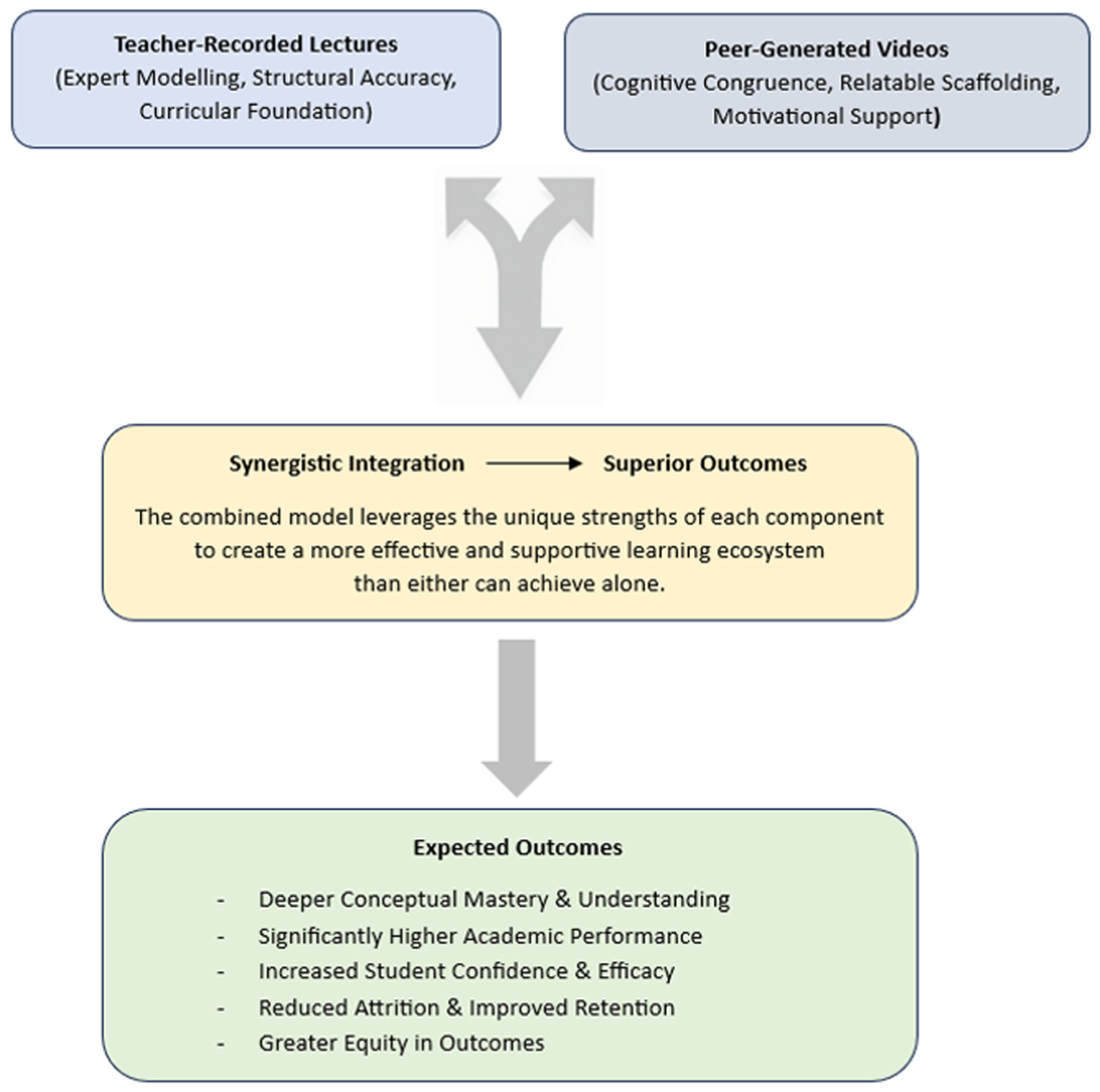
Conceptual framework of the hybrid video model, illustrating the integration of teacher-recorded lectures (accuracy, structure, and curricular foundation) with peer-generated videos (cognitive congruence, relatability, and motivational support). The synergistic combination is designed to enhance conceptual mastery, improve performance, boost confidence, reduce attrition, and promote equity in mathematics learning.
Context: Addressing Mathematics Challenges in KSA
Educational contexts facing significant challenges in mathematics proficiency, such as Saudi Arabia, represent compelling settings for such a hybrid model. For instance, Saudi students ranked 74th of 77 in mathematics in PISA 2018, with nearly three-quarters scoring below Level 2 proficiency, compared to less than one-quarter in OECD nations. These gaps persist into higher education, limiting readiness for STEM and other disciplines requiring strong analytical skills. At Imam Abdulrahman bin Faisal University (IAU), attrition from the foundation-year programme, heavily influenced by failure in mathematics courses, remained high (see Figure 3). This reflects systemic struggles in student preparedness and retention. COVID-19 disruptions further widened these learning deficits.
Diagnostic assessments confirmed significant knowledge gaps, while traditional remediation (e.g., extra classes, worksheets) had limited impact. In response, IAU adopted technology-enhanced interventions. Teacher-recorded lectures were introduced in 2020, and peer-generated content emerged through SANAD (support in Arabic), a student-led initiative akin to a peer-driven YouTube channel that provides explanations from a student’s point of view. This dual development created an opportunity to formally evaluate the impact of combining expert- and peer-based video resources.
Methods
Research Design
This study applied a sequential explanatory mixed-method design (QUAN → qual; Creswell, 2013; Ivankova et al., 2006). The quantitative phase employed a quasi-experimental pre-test-post-test non-equivalent group design. This approach was selected as the most rigorous design feasible within the naturalistic educational setting, as random assignment of entire cohorts across academic years was logistically impossible. Although this design carries potential threats to internal validity, it provides strong ecological validity by testing the intervention under real-world conditions. The subsequent qualitative phase used semi-structured interviews to further interpret the quantitative findings and gain deeper explanatory insights.
Participants and Sampling
This study involved 4,954 first-year students enrolled in the College Algebra (MATH1) course at IAU over five academic years (2018–2019, 2021–2023; see Table 1). The 2020 academic year was excluded due to emergency remote teaching during the COVID-19 pandemic, which prevented the administration of the post-test. The only inclusion criterion was enrolment in the MATH1 course during the specified academic years, with no additional exclusions, ensuring a representative sample of the course population. All students were admitted through a competitive, merit-based admissions system using a composite score derived from their high school grades (30%), performance on the General Aptitude Test (Qudurat, 30%), and results from the Academic Achievement Test (Tahsili, 40%).
Number of Students Who Took the MCTs Between 2018 and 2023

The post-MCT was not administered in 2020 due to the COVID-19 pandemic.
Accordingly, participants were divided into three groups based on their academic year and the resources available that year. The control group (2018–2019; n = 2,029) had no access to any video resources. The teacher-recorded group (2021; n = 1,167) had access only to teacher-recorded videos. Finally, the hybrid group (2022–2023; n = 1,758) had access to both teacher-recorded and peer-generated videos. Baseline characteristics for each group are summarised in Table 2.
Baseline Characteristics of Experimental Groups.

Cohort-based assignment was necessary to prevent cross-condition contamination. Randomly assigning students within a single cohort would have risked control group students accessing the video resources provided to the treatment groups. While this quasi-experimental design introduces the potential for pre-existing differences between year groups, the pre-MCT score was used as a covariate in the primary analysis to control for baseline mathematical competency.
For the qualitative phase, purposive sampling was used to select interviewees from the hybrid cohort (2022–2023). The selection criteria ensured a mix of gender, final course grades (high, medium, low), and self-reported video usage. Interviewing continued until thematic saturation was reached (i.e., no new themes emerged from the data), which occurred after 16 interviews.
Interventions and Procedure
Teacher-Recorded Lectures
Introduced in 2021, these lectures followed a Khan Academy-style format (Howard et al., 2018), featuring real-time digital annotations, narrated problem-solving, and the dynamic development of proofs and visualisations. Recorded during live Zoom sessions, videos were edited to remove silence and off-topic discussions. Lectures (30–50 min) and tutorials (15–30 min) mirrored in-person content and were hosted online as asynchronous resources.
Peer-Generated Videos
These were created through Sanad, a student-led initiative. High-achieving students were recruited and trained to produce 20- to 40-min tutorials after each lecture. To ensure fidelity and quality, all peer videos were reviewed by course instructors for accuracy, clarity, and pedagogical effectiveness before release. Although no videos were rejected outright, some were revised based on instructor feedback to meet these quality standards. These peer-generated videos provided cognitively congruent perspectives that complemented the expert-led instruction.
After quality review, all video resources were hosted on the university’s Learning Management System (LMS) and were also uploaded to a dedicated YouTube channel. Access to the respective video libraries was automatically granted to all students in each cohort via the LMS. The YouTube channel served as an additional, easily accessible platform. LMS and YouTube analytics were monitored to ensure availability and access; however, individual student usage patterns (e.g., viewing frequency and duration) were not tracked in this study.
Implementation Fidelity
To ensure the validity of the experimental conditions and allow for replication, consistent procedures were stringently applied to maintain consistency across the study’s duration (2018–2023). The core curriculum, learning objectives, textbook, high-stakes assessments (e.g., midterm and final exams), and pool of instructors remained unchanged, controlling for potential confounds across academic years. This consistency was fundamental to isolating the effect of the video-based interventions.
The procedure for each group was as follows. The control group (2018–2019) received traditional, face-to-face instruction and had access only to the standard LMS course page, which contained the syllabus, lecture slides, and assignments, with no supplementary video resources. The teacher-recorded group (2021) received the same face-to-face instruction but was additionally granted access to the library of teacher-recorded videos on the LMS. Building on this, the hybrid group (2022–2023) received the same instruction and teacher-recorded videos as the teacher-recorded group and was further given access to peer-generated videos.
Critically, access to the respective video libraries was automatically enabled for all students in each cohort via the LMS based on their group assignment. This automated process ensured consistent implementation of the treatment and prevented cross-contamination. This technical control was a key feature of the study design, guaranteeing that group assignment directly determined the resources available to each student.
Instruments and Data Collection
Mathematics Competency Test (MCT)
A 60-item, multiple-choice test was used to assess proficiency in key college algebra topics. These included basic arithmetic and algebra (sets, polynomials, radicals), equations and inequalities, coordinate geometry (lines, circles, and graphs), functions, exponential and logarithmic functions, and mathematical modelling. The same MCT was administered as a pre-test at the beginning of the semester and a post-test after the end of the semester across all 5 years.
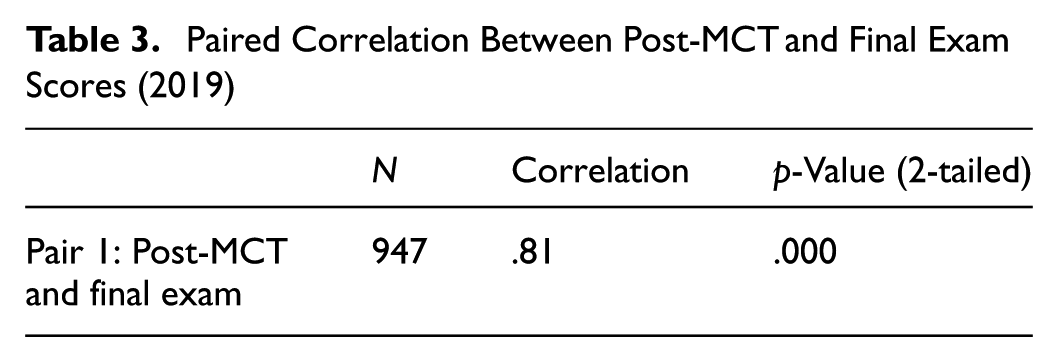
The MCT was validated by a panel of mathematics education experts from Saudi Arabia and the United Kingdom. The internal consistency reliability of the dichotomously scored MCT was assessed using the Kuder-Richardson Formula 20 (KR-20). The analysis yielded excellent reliability, with coefficients of .93 for the pre-test and .92 for the post-test. Its construct validity was further established by a strong positive correlation with final exam grades (r = .81, p < .001 for the 2019 cohort; see Table 3 and Figure 2). This high correlation, despite the post-MCT being administered 2 months after the final exam, underscores its utility as a measure of retained mathematical competency.
Paired Correlation Between Post-MCT and Final Exam Scores (2019)

Scatter plot of post-MCT scores versus final exam marks for the 2019 cohort.
To minimise practice effects and cross-cohort contamination, the MCT was presented as an ungraded diagnostic tool. Test items were neither discussed nor released to students afterward. The test was kept secure by the research team.
Semi-structured Interviews
Semi-structured interviews were conducted with 16 participants from the hybrid group using a phenomenological framework to capture their lived experiences. Participation was voluntary, and informed consent was obtained from all participants. The interview protocol was guided by the research questions but allowed flexibility for participants to discuss other relevant aspects of their experience.
To prevent language barriers from affecting data quality, interviews were conducted in either English or Arabic, based on student preference. All interviews were audio-recorded and transcribed verbatim. Interviews conducted in Arabic were subsequently translated into English for analysis.
Data Analysis
Quantitative Analysis
Pre- and post-MCT scores were analysed using descriptive statistics. Normalised gain (Hake, 1998) and Cohen’s d (Cohen, 1988) were calculated to measure learning gains and effect sizes. Preliminary screening was conducted to ensure all ANCOVA assumptions were met, including linearity, homogeneity of regression slopes, normality, and homoscedasticity. An Analysis of Covariance (ANCOVA) was then conducted on the post-MCT scores using the instructional group (Control, Teacher-Recorded, Hybrid) as the fixed factor and the pre-MCT score as the covariate. This analysis controls for baseline differences in mathematical competency and tests for statistically significant differences between the adjusted group means.
Qualitative Analysis
Interview transcripts were analysed using Braun and Clarke’s (2019) reflexive thematic analysis. The approach was inductive, with themes derived directly from the data. These themes were subsequently interpreted in relation to the quantitative findings. The process involved a thorough reading of transcripts and notes for familiarisation, followed by the systematic coding of key concepts, sentences, and phrases. Codes were then grouped into categories aligned with the research questions. Finally, themes were refined and reviewed for coherence and specificity across the dataset before being finalised for analysis.
To ensure credibility, two researchers independently coded a 25% subset of transcripts. An initial intercoder reliability check was conducted, and all coding discrepancies were discussed in consensus meetings until agreement was reached, thereby refining the codebook. In addition, the entire research team participated in peer debriefing sessions to validate the thematic structure.
Mitigation of Confounding Variables
Several potential confounding variables were considered to ensure the validity of the findings. To minimise instructor-related bias, the same teaching staff coordinated the delivery of all courses across groups. Course materials were standardised, so all students received identical content. Most importantly, MCT functioned as the primary standardised outcome measure, providing a consistent benchmark of performance and enabling comparability across cohorts, independent of variations in grading practices. Together, these measures were crucial for isolating the effects of the intervention, ensuring that observed differences could be attributed with confidence to the instructional model.
Results
Quantitative and qualitative findings are presented sequentially, with statistical results on mathematics competency and attrition followed by thematic insights from student interviews.
Quantitative Results
MCT Outcomes
Pre-MCT scores revealed significant baseline challenges across all cohorts, with over 90% of students scoring below minimum standards (see Table 4). This baseline performance underscored the need for targeted interventions. The quantitative results demonstrated a significant, positive impact directly linked to access to video resources.
Mean Scores and Standard Deviations on the MCT (2018–2023) 1 .

The 2020 academic year was excluded due to the COVID-19 pandemic.
The ANCOVA, with pre-MCT score as the covariate, revealed a statistically significant effect of instructional group on post-MCT scores, F(2, 4954) = 310.05, p < .001, partial η2 = .112. The covariate, pre-MCT score, was significantly related to post-MCT performance, F(1, 4954) = 3,507.76, p < .001. The group factor accounted for 11.2% of the variance in post-test scores, representing a large effect size according to conventional guidelines.
Bonferroni post-hoc tests were conducted to examine pairwise differences between the adjusted means. The hybrid group demonstrated significantly higher adjusted post-MCT scores (M = 71.26) than both the Teacher-Recorded group (M = 66.69, p < .001) and the Control group (M = 60.89, p < .001). The teacher-recorded group also significantly outperformed the control group (p < .001). These results confirm that both video-based interventions were effective; however, the hybrid model, which combined teacher and peer videos, yielded superior learning outcomes.
As shown in Table 5, normalised gains and effect sizes progressively increased from the control group to the hybrid group. The significant gains in the Teacher-Recorded group (d = 1.75) can be attributed to access to expert modelling, which allowed for iterative review and mastery of core algebraic procedures. The superior performance of the hybrid group (d > 2.0) suggests that peer videos did not merely add more content but provided the cognitively congruent scaffolding necessary to transform observed expert behaviour (from teacher videos) into deeply understood personal knowledge.
Normalised Gains and Cohen’s d Effect Size (2018–2023).

The 2020 academic year was excluded due to the COVID-19 pandemic.
Although the post-MCTs were optional and ungraded, potentially affecting students’ motivation, the findings provide valuable insight into the benefits of video access on students’ learning outcomes in College Algebra.
Attrition Rate
Attrition rates serve as a proxy for both academic preparedness and the effectiveness of institutional support. For this study, the attrition rate is defined as the percentage of students who either formally withdrew from the university or who failed to meet the passing requirements of the foundation-year policy and were subsequently excluded from the university. Historically, failure in mathematics has been a key element driving high attrition rates in this foundational year.
Figure 3 illustrates a marked decline in attrition from 12.3% (2019) to 5% (2023), meaning significantly fewer students were forced to abandon their university studies. The most notable decrease occurred between 2019 and 2021, with attrition rates dropping by nearly 6% points (from 12.3% in 2019 to 6.5% in 2021). This significant improvement coincided with the introduction of in-house, teacher-recorded lectures, which enabled flexible and self-paced learning for students. Over the subsequent 2 years (2022 and 2023), attrition rates stabilised at 5%. This period aligns with the implementation of the hybrid model, in which peer-led videos complement teacher recordings by addressing engagement gaps through relatable explanations.

The attrition rate at IAU (2018–2023).
Overall, the strong temporal alignment between decreasing attrition rates and the gradual implementation of the hybrid teacher-peer video model suggests these resources played a key role in improving retention. While multiple institutional changes may have contributed, the findings indicate that this flexible and relatable support system was crucial for motivating students to persist and succeed, particularly in mathematics.
Qualitative Results
Interviews clarified why the hybrid group outperformed others, revealing that gains and reduced attrition were closely linked to students’ experiences. These outcomes stemmed less from the mere addition of content than from key perceptual and experiential factors that shaped the learning process. Five themes capture these mechanisms, with the first three directly explaining performance improvements, and the remaining two providing essential context for effective implementation.
Flexibility and Self-Paced Learning
Participants emphasised flexibility as a key benefit of video resources, enabling them to tailor their learning to their individual cognitive and logistical needs. This autonomy offered more than mere convenience. It empowered students to manage attention lapses, accommodate busy schedules, and engage more deeply with content.
The most frequently cited advantage was control over the timing and setting of the study. Students valued learning at peak focus in environments of their choice. One remarked: “I think that having video lectures is an amazing thing. I can study wherever I want, on any topic I choose.” This adaptability also acted as an academic safety net, allowing students to recover from absences or lapses in attention: “Sometimes I miss a class, or I forget something the teacher said. So, I go to the recording to review it, especially if I didn’t understand something well.”
Beyond when and where, students described strategies for shaping their engagement. Many manipulated playback speeds, reviewing familiar content quickly (“Increasing the speed of the video to 2X or 3X”) and slowing down for challenging concepts (“1X to watch that part as many times as I need”). These strategies supported deliberate, multi-step study routines: “My study habits changed since I discovered these recordings. First, I read the summary, then I watch a recording, and then I review the slides myself, solving each question.” Such control also reduced anxiety and fostered concentration: “I cannot focus during lectures. When I am alone, I can focus better.”
Collectively, these accounts indicate that flexibility and self-pacing supported persistence, with the safety net providing a foundation for consistent engagement and recovery from setbacks
Complementary Value of Teacher and Peer Videos
Building on flexibility, students also highlighted the distinctive but complementary value of teacher and peer resources. Teacher videos were valued for their depth and accuracy, providing a structured, authoritative foundation: “Teacher recordings enhance understanding in a more general way, for long-term retention.” This aligns with the retention phase of social learning, in which learners rely on expert models to develop durable conceptual frameworks.
Peer videos, in contrast, were appreciated for their relatability and targeted support. One student noted, “The peers understand our struggles and how we think. This helps me understand more deeply. Of course, the combination is beneficial, but I mostly watch the peer videos when they are available.” Another emphasised the value of both resources: “Both types of materials were indispensable for me ... I just felt reassured by combining both.”
These observations illustrate cognitive congruence: peers anticipate common stumbling blocks and present solutions using familiar language. By complementing expert instruction, peer videos reduce cognitive load, reinforce understanding, and enhance self-efficacy. Together, teacher and peer resources create a synergistic environment that explains the higher performance gains observed in the quantitative phase.
Impact on Motivation, Confidence, and Performance
Alongside flexibility and complementarity, students described how access to on-demand videos bolstered motivation and confidence. Importantly, these psychological shifts often relied on the safety net established through flexible access. One student reflected: “My motivation is not the greatest, but the recordings give me extra time so I can actually understand the material even a day or two before the exam.”
Students frequently linked this combination of access and confidence to measurable performance gains. For example: “I did not use the recordings in MATH1 and got a B. The next semester, I watched the recordings, and I earned an A in MATH 2. I think it was largely due to the recordings.” Another emphasised: “The grades improved beautifully, especially thanks to the Sanad YouTube page. If I had not used it, my grades could have been very bad.”
The transformative role of these resources was captured by a student: “I cannot imagine my learning journey without having recordings. It would be very, very hard.” These insights suggest that motivation and confidence, scaffolded by the safety net, sustained effort, and built resilience, supporting both persistence and performance in the hybrid model.
Challenges of Length and Focus
Even though students emphasised the benefits of flexibility and motivation, they also identified constraints that moderated these mechanisms. A recurring concern was video length, which sometimes undermined attention and engagement. From a cognitive load theory perspective, long recordings increased extraneous cognitive load, reducing the efficiency of self-paced learning: “When the video is too long, I lose focus and get distracted.”
Students also described a subtler challenge: unstructured access occasionally encouraged passivity, which limited engagement and weakened motivational gains. One candidly admitted: “Maybe it’s the laziness, because if you know there is a recording, you get distracted easily.” This highlights how motivation and persistence depend not only on availability but also on deliberate, active engagement strategies to manage cognitive load.
Taken together, these challenges show that features supporting flexibility, motivation, and confidence can, if unmoderated, reduce learning efficiency and engagement. Addressing video length and encouraging active use, therefore, refines the mechanisms underpinning the hybrid model, ensuring that autonomy, competence, and relatedness translate into sustained performance gains
Recommendations for Improvement
Students also suggested refinements that directly strengthen the mechanisms identified above. To support cognitive processing and retention, many requested concise summaries: “Adding a summary at the end of recordings … would help highlight the key points.” Others stressed the need to maintain accuracy and trust, proposing instructor oversight: “I suggest having a teacher check the videos before they are published… it would be really helpful.”
Looking to more transformative improvements, students envisioned strategies that extend flexibility and self-pacing into more structured guidance. One explained the value of an “interactive platform that offers guided, step-by-step problem-solving support to help students learn the process, not just the answer.” Such ideas highlight refinements of the very mechanism of persistence, cognitive congruence, and motivational support that underpinned the hybrid model’s effectiveness, moving beyond mere convenience. In this sense, student feedback signals a pathway from static video libraries to adaptive systems that scaffold both understanding and application, thereby strengthening long-term learning outcomes.
Synthesis
Together, these themes illuminate the mechanisms through which the hybrid model produced its quantitative effects. Flexibility enabled persistence by allowing students to regulate pace, attention, and recovery. Complementarity between teacher and peer videos deepened understanding through a balance of authority and relatability. Motivation and confidence sustained effort, translating access into tangible performance gains. Challenges of length and passivity moderated these benefits, showing where mechanisms could falter without careful design. Finally, student recommendations revealed pathways for refinement, pointing toward adaptive systems that more deliberately scaffold both understanding and application. This multi-layered perspective underscores not just that the hybrid model was effective, but why and how its effects emerged.
Discussion
This study demonstrates that a hybrid model combining teacher-recorded and peer-created videos significantly boosts student performance and persistence in college algebra, effectively answering both research questions. These findings provide one of the first large-scale, empirical investigations into the impact of student-generated video content, addressing a critical gap identified in the literature. A review by Liu et al. (2022) noted that the field is nascent and that strong statements on impact would be premature without research complying with standards of strong educational design. Our quasi-experimental design with a control group, large sample size (N = 4,954), and mixed-methods approach offers robust evidence that addresses this gap. Thus, our study directly responds to this call for more rigorous design by providing the large-scale, controlled evidence the field currently lacks.
Quantitatively, the hybrid group achieved the strongest outcomes, including marked learning gains, large effect sizes, and reduced score variability. These results indicate more consistent learning across the cohort, suggesting that the hybrid model effectively supports student performance. Attrition rates also declined to 5%, highlighting the model’s positive impact on retention.
Qualitative findings provide insight into mechanisms driving these gains. The flexibility and self-paced nature of videos lowered stress and helped students feel more in control of their learning. They acted as an academic safety net, reducing the fear of failure and preventing students from falling behind. This support mechanism likely contributed to the lower attrition rates by bolstering academic integration and mitigating the anxiety that theory links to student departure (Tinto, 1993). One participant noted, “In-person classes are important, but having recordings in my hand too is very helpful and very beneficial. I know that it enhances my performance.” Students also emphasised the complementary roles of teacher and peer videos. Teacher recordings provided structured, authoritative guidance, while peer videos offered relatable scaffolding that addressed specific difficulties through cognitive congruence. A student explained, “Peers understand our struggles... This personal aspect helps me understand deeper,” illustrating how relatability enhanced comprehension alongside expert instruction.
The combination of quantitative and qualitative results indicates that the interplay of Bandura’s (1977) social learning theory and the theory of cognitive congruence (Lockspeiser et al., 2008) best explains the effectiveness of the hybrid model. The improvements in the teacher-recorded group reflect the power of expert modelling, where students observe and imitate mathematical problem-solving. However, the hybrid group’s superior performance reveals that expert modelling alone is insufficient for a deeper understanding. The qualitative data illustrate how peer videos provided the crucial complementary layer of cognitive congruence. Peers reframed complex concepts using accessible language and metaphors that resonated with the learner’s perspective, effectively scaffolding the transition from observed procedure to deep conceptual knowledge. This synergy, with teacher videos providing structural accuracy and peer videos providing relational accessibility, directly catalysed significant gains observed in the quantitative phase.
Mandatory instructor reviews mitigated risks associated with passive use of lecture captures (Trenholm, 2022) and variability in peer content (Box et al., 2024). This crucial quality assurance mechanism, however, presents a challenge for widespread implementation. This concern was echoed by one participant, who explained: “Post processing, let’s say, or validation. I think if the instructor helps the peer check for errors, it will ensure quality. The peer is a student like me; mistakes can happen.” While structured faculty training, shared peer-video repositories, or centralised institutional support can mitigate this burden, sustainable adoption may also require policy-level commitment, such as recognition of student contributions or faculty workload credits.
By reducing score variability and attrition, the hybrid approach promotes fairer outcomes and aligns with calls for innovation in higher education pedagogy (Caldeira et al., 2024; Feudel & Panse, 2025). The study demonstrates that a carefully designed hybrid model can harness the strengths of both teacher and peer instruction while minimising their individual weaknesses. This integrated approach provides a validated and transferable framework for enhancing both performance and persistence in foundational courses, as supported by similar evidence from across STEM disciplines (Atkinson et al., 2024).
Limitations and Future Research
Despite its strengths, this quasi-experimental study has limitations that may influence the interpretation of the results. Although rigorous controls were implemented for curriculum, instructor pool, and pre-test scores, unmeasured variables – such as subtle year-to-year shifts in student demographics or institutional policies – remain potential sources of confounding. The single-institution context limits generalisability, underscoring the need for cross-institutional replication.
A significant limitation is the absence of detailed engagement data, which prevents a nuanced understanding of how students used teacher versus peer videos. Without data on individual viewing frequency, duration, or choice of resource, we cannot determine whether high usage correlated with high gains or analyse the specific consumption patterns that drove the observed outcomes. Future research should collect granular usage analytics to link these engagement patterns with outcomes and assess long-term persistence in STEM pathways. Additionally, investigations into structured peer video production, quality assurance mechanisms, and scalable institutional support are needed to ensure the effectiveness and sustainability of hybrid models across diverse educational contexts.
Furthermore, future research should adopt the theoretical framework of self-regulated learning (SRL), as suggested by Nordmann et al. (2019), to investigate how students strategically use teacher and peer videos within a hybrid model to manage their cognition, motivation, and learning behaviours. An SRL lens would provide deeper insights into the metacognitive and motivational mechanisms underlying our observed results, moving beyond what students did to understand the strategic processes behind their choices.
Conclusion
This study provides strong evidence that a hybrid video model, integrating teacher-recorded and peer-generated content, improves outcomes in foundational college algebra. Quantitative findings show higher post-test scores, larger effect sizes, greater normalised gains, and reduced score variability, while qualitative insights highlight flexible, self-paced design and complementary scaffolding that reduced attrition. Taken together, these results underscore the model’s potential to enhance both performance and equity in STEM education.
Beyond empirical results, this work extends existing blended learning and SRL frameworks by clarifying how hybrid models generate their effects. The theoretical contribution lies in mapping the synergistic interaction of expert modelling, cognitive congruence, and quality assurance as mechanisms that connect instructional design to equitable learning outcomes. This advance elevates the study from evidence of effectiveness to a theoretical refinement of hybrid and blended learning models.
Practically, the findings suggest that institutions can adopt this hybrid model without major infrastructure investment by strategically leveraging existing teacher and peer resources. The model’s balance of expert authority, peer relatability, and quality safeguards offers a replicable design that addresses common challenges in STEM instruction. Future research should track engagement patterns, test transferability across disciplines and contexts, and evaluate long-term impacts on STEM persistence to guide sustainable implementation.
Footnotes

Ethical Considerations
The study was approved by the Institutional Review Board of Imam Abdulrahman bin Faisal University (IRB-2025-19-0045 on 19/01/2025). Written informed consent was obtained from all participants. The study was performed in accordance with the Declaration of Helsinki.
Funding
The authors disclosed receipt of the following financial support for the research, authorship, and/or publication of this article: The sixth Author Khaled Kefi extend his appreciation to the Deanship of Scientific Research at Northern Border University, Arar, KSA for funding his research work through the project number NBU-FFR-2025-1706-10.
Declaration of Conflicting Interests
The authors declared no potential conflicts of interest with respect to the research, authorship, and/or publication of this article.
Data Availability Statement
The raw data and processed data are available on request to interested researchers. You can direct your inquiries to the corresponding author.