




Abstract
The concept of happiness has been discussed long time ago by economists. Recently, it became the most related and important thing to be studied because of its impact in societies. Discussion about happiness basically interprets within two separate views. First, happiness related with economic variable, for instance, how money can create happiness. Second happiness is discussed within the context of religion. However, the discussion did not combine both contexts, economic variable and religion, to interpret happiness. Therefore, it is important to highlight the concept of happiness in a different way such as in this article. Different cultures will have their own perspective on the determination of happiness. From just “individual perspective” of happiness, they then formed an ism through involvement of a big society from the same culture. Some isms such as hedonism and materialism are synonyms in characterizing the concept of happiness in this modern world. At the same time, the isms are actually working with the economic and non-economic indicators as elements to strengthen the ism itself. On the other hand, the concept of happiness from the perspective of religion will also be a part of discussion in this article. Therefore, this article will reveal that the meaning of happiness is different in terms of religion and ism. So, to carry out both ism and religion simultaneously in shaping a more intrinsic value of happiness is not an easy task. Furthermore, religion is always associated with spiritual value that makes it hard for some people to practice religion and their isms at the same time. Thus, this article will propose that the right interpretation of isms based on their faith in religion can contribute to the concept of genuine happiness.
Introduction
An article that appears in Asian-Pacific Economic Literature (Volume 23, 2009) has attracted the attention of neither policy makers nor society. Bates (2009) has addressed the importance to maximize happiness through maximizing well-being. However, the measurements of well-being we have today, for instance GDP and HDI, still bring a criticism. Therefore, Bates suggests improving the measurement by looking into a more comprehensive indicator that will able to capture well-being from all sides. In a system economics, there are different ways on how government can measure their citizen’s happiness. Some focused on maximizing well-being among citizens (for instance, socialism: the happiness determined on how societies benefit from the government, without material motives) and some on maximizing material achievement as the ultimate goal (for instance, capitalism) to reflect happiness. Nevertheless, both manners are imperfect if it is stand-alone. Policy makers should combine material achievement and well-being as a target in a policy.
The concept of happiness was pioneered by Socrates and his followers such as Aristipus, Plato, Epicurus, Aristotle, and Jeremy Bentham. In fact, happiness cannot be separated from human life because of its nature. Every person in this world has their own perception of happiness, and this has led to a debate on how people pursue their happiness. Hedonism and materialism are among the topics that have been discussed widely by philosophers to associate with the topic of happiness. For instance, hedonism began actively discussed since the idea was propounded by a student of Socrates, Epicurus, “The Father of Hedonism” (Rodhy, 2009) who claimed hedonism to be an intrinsic pleasure. From that point, various forms of hedonism have been expanded, which relate to the maximization of pleasure and minimization of pain.
Nevertheless, hedonism was rejected during the middle ages because of its incompatibility with Christian ideals (Booth, 2002) and the lack of spiritual value in human action, which suggests that human beings must forgo pleasure and endure pain to get a genuine goodness. However, Renaissance philosophers (such as Erasmus and Sir Thomas More) have made the idea emerge again with reason that humans are created by God to attain happiness; therefore, hedonism is actually connecting the human with God. After that phase, the 19th-century British philosophers John Stuart Mill and Jeremy Bentham established the ethical theory of utilitarianism, which contains hedonistic orientation. This view suggests that all action should be directed toward achieving the greatest amount of happiness for the greatest number of people (Grisez, 2008). The divergent views on the meaning of hedonism show us that this terminology will always be a part of debate among philosophers until they reach a suitable meaning.
Jeremy Bentham, especially with his popular statement, “greatest happiness with greatest number” or in other words, “more is better,” is actually misleading society with the real meaning of happiness. His view, which tries to glamorize the function of happiness, neglects the concept of justice. Happiness is a subjective matter, and it is hard to describe our happy feeling into a specific number. For instance, two different people, “A” and “B,” rate their feeling from driving a sport car in a rainy day, into 10-point Likert-type scale. “A” rates the feeling happy from driving a sport car as 6 while “B” rates it as 4. In fact, “A” and “B” have the same interest to the sport car, but “B” seems unhappy at the mean time. If the weather is clear, “B” might rate it highest than in a rainy condition. This means the use of numbers in rating happiness from using something seems to have be a constraint. It needs to depend on another aspect to determine this feeling. Imagine a big country produces a large number of weapons at one point in time to get a big profit from its customer. As we know, it is the vision for every state to have a high income per capita, and selling this merchandise is one of the ways. However, at the end, the weapon will be used to destroy other countries and contribute to war. Bentham’s theory aimed that greatest happiness should be spread into the greatest number of peoples. Bentham’s theory does not take into account the “right” and “wrong” from the action, thus make the claimed seems arguable. Of course, a weapon manufacturer country will be happy when the other country bought from them. But if the “right” and “wrong” (for instance, a transaction done with a motif to destroy other countries) are considered in the “buy and sell process,” Bentham’s theory could be argued. Greatest happiness for the greatest number of peoples should not happen in a “worse off” situation but in a “win–win situation.” Here, we can see that happiness does not merely depend on the quantity of utility but actually contains another factor essential in achieving happiness.
Therefore, researchers try to relate happiness with economic variables such as income, unemployment, inflation, and consumption (Bates, 2009; Frey & Stutzer, 2001), and non-economic variables such as utility (including pleasure of sense, wealth, skill, amity, a good name, power, piety, benevolence, malevolence, memory, imagination, expectation, relief, and the pleasures dependent on association) and welfare. However, it is not clear yet how these variables are being discussed in different isms and religion.
Furthermore, the discussion on non-economic variables focuses on utility theory. As stressed by Johannessen and Olaisen (2008), utility theory is likely to focus on rational behavior. It does not attempt to explain current behavior. DeVree and Dagevos (1997) also reported it only entertains a certain variable such as a person’s interests, preferences, and attitudes that symbolize rational behavior. We believe that utility should be given consideration in terms of happiness and be measured cardinally rather than ordinally.
Some researchers consider those non-economic variables as economic variables. For example, utility theory, which involved person’s value judgment and a law of choice (Rothbard, 1997), needs to justify utility as subjective matter into the calculation related to happiness. For instance, when someone is considering which job will give him or her more pleasure. (Awdesh divides the types of pleasure into three. First, “the pleasure of darkness,” which arises from a bad attitude in a person’s life such as laziness and contributes to ignorance. Second is the “pleasure of sense,” which includes the normal needs every human and animal seeks, such as tasty food, life of comfort, money, wealth, power, and so on. The last one is the “pleasure of truth,” which is the true pleasure in the process of seeking happiness.) Ironically, this type of pleasure functions like medicine; to get real happiness, one must face difficulty at the beginning and this will make happiness more meaningful in the end; it will involve calculating how much utility one might gain from a job using his or her own rational expectation. Even James Stuart Mill believes that the greatest happiness suggested in Bentham’s theory can be harmonized with looking not only for the quantity of utility received but also for the moral sentiment contained in the utilities. Thus, the utility itself is not merely seen as a non-economic variable (its discussion always focuses on the inner aspect; maximize pleasure and minimize pain) but also as an economic variable, which can be measured and contributes to the happiness calculation.
While some researchers consider those variables from the “ism perspective,” others look at it from a religious perspective. The question is how we could mix ism and religion together to create happiness. In Islam, we are happy if we obey Allah although it might not lead us to have more material. Culturally, we may be happy if we have more material, but the question is where we got our material from and how we got it. So, we believe that the economic variables and non-economic variables that we suggest from Islamic perspective can give answer to this question on the path to achieve genuine happiness.
Therefore, the aim of this article is to see how the economic and non-economic indicators will contribute to the ism in the context of materialism and hedonism. In addition, five different religions—Islam, Christian, Jews, Buddha, and Hindu—will also be a part of discussion to see how they can contribute to a more worthy concept of happiness through the role played by the variables.
The remaining of this article will be divided into three sections. The section “Happiness in Relation to Economic and Non-Economic Variables” will discuss how economic and non-economic indicators can contribute to the ism of happiness and its affect to the culture. The contribution of religion to the right meaning of a person’s interpretation of happiness will be discussed in the “Future Research—A Suggestion” section. After that, readers will be exposed to a further discourse on the link between spirituality and religion with happiness. The “Conclusion” section is the suggestion that we provide for a better research in the future.
Happiness in Relation to Economic and Non-Economic Variables
Happiness may emerge as a key signifier for third-way ideology. The first-way ideology can be explained through the way of capitalist thinking, which is popular with materialistic ideology, institutionalize greed, and injustice distribution, while second-way ideology uses a practice of socialism, which states well-being depends on citizens’ work, but must sacrifice efficiency for a justice. In pursuing happiness, we need a more flexible policy which encourage to a healthy competition in economic and at the same time promoting welfare of the society. Capitalist ideology is seen too individualistic to be practiced in a system economic. Every person has no limit to seek their material interest without bothering what happens to the other person. In the other hand, policy formed in a socialist ideology just leads to the insufficient citizen because the policy is too overprotecting, even the motif to promote justice, from which its peoples get the same benefit and chance. For example, the ideology of happiness in socialism, which reflects the loss of the alternative utopian vision and a loss of confidence, is unfettered in capitalism (Duncan, 2007). It is true that money, wealth, or high income (Herzberg, 1986; as economic variables) and a good name, power, or credibility (as non-economic variables) become the motivating factors for someone to work better and become more dedicated. Nevertheless, if their effort will not bring an equitable income due to the policy, the workers will feel unfairness, no passion in doing work, and reduced efficiency, and finally, this will make them unhappy. Perhaps in a certain way, the unemployment can be reduced, but it is not the best way to enhance a nation’s well-being and happiness. For example, research done by Ohtake (n.d.) in Japan found that reducing unemployment can contribute to a happier nation. It is better for governments to create jobs rather than redistribute wealth to the unemployed to increase people’s happiness. However, capitalism may also make it hard to seek happiness. Although some might see capitalism as a booster to achievement in something and have a well-planned life, it only happens to someone who has a strong ability to compete with others. Only some will be happy in that situation, despite some philosophers arguing that capitalism is not merely greed in obtaining wealth but also proposes the concept of non-selfishness through the term of “virtue of selfishness” (Ayn Rand Center for Individual Right, 1963)
Therefore, whether it is economic or non-economic variables, happiness will bring a very important meaning in determining a nation’s well-being. This is because from income, it will provide a path to happiness through the fulfilment of human utilities and desires. However, some people tend to be happier when they have “social success” (Veenhoven, n.d.) such as recognition, power, credibility, and credence from others, which money cannot buy and are more precious to our life. Both things cannot be separated in whatever economic understanding. Thus, it is not strange if people nowadays translate their ism into seeking happiness based on the experience gained from their state. It will be highlighted in this article whether religion and ism in happiness are complementary or merely stand-alone ideologies.
In this section, the ism of happiness from hedonism and materialism will be highlighted first, and the religious perspective of happiness will be discussed next.
Ism of Happiness
This section will try to highlight two main isms that appear in most studies from the conventional point of view, namely, hedonism and materialism.
Hedonism
Hedonism is one of the isms that always related with happiness in a conventional perspective. In this ism, peoples seek their happiness without any constraint, for example, the forbidden in religion (sexual promiscuity), culture (intermarriages), and even in the matter dealing with their own dignity (transgender). Peoples with this ism feel free to do anything they want as long as they feel happy. The idea of hedonism was founded by the ancient Greek philosophers, Socrates, Plato, Aristotle, Epicurus, Aristipus (341-270 B.C.E.), and their followers developed ethical theories centered on the “good life” (the ideal life, the life most worth living, eudemonia, happiness) and the role of pleasure in achieving it. People who have ethics are happy people (James & Chymis, 2004) but to have ethic in every action is not easy. Kant said (as cited in Wike, 1994) a good ethic in happiness means a highest good toward others that can be achieved by unity without an individual’s selfishness. His idea was in line with what Aristotle has pointed out in his theory, which stated morale as the most important thing in achieving happiness. At the same time, he stressed that a complete virtue can only be reached through a virtuous surrounding—act as virtuous mankind and in accordance with virtue. By practicing virtue and making it one of the obligations in our life, there will be spontaneity in every virtue, which can be practiced by everybody without difficulty as stated by Al-Ghazali (Zaroug, 1999).
As a culture in life, hedonism is seen to have a strong relationship with ethics. The word Hedonism actually comes from two words, hedone and isme. Hedone means pleasure or enjoyment (Bagus, 2000), and isme, which is the suffix in the word, refers to belief, political or religious movement, and attitudes and behavior (Kamus Dewan, 2000). By term, hedonism means ideology or worldview that favors only fun or enjoyment of life Kamus Dewan (2010), which has always been a way of life in today’s society. This is in line with Ayub (1994) and Bozkurt, Bayram, Furnham, and Dawes (2008) who stated hedonism is a capitalist value system, which assesses goodness based only on sheer pleasure. Bagus (2005) also says that the term hedonism is a moral concept that equates goodness with pleasure. Hedonism is not merely the way of thinking, but it also can affect on how peoples react in their action. In whatever condition, they will try to pursue happiness through avoiding pain and maximizing pleasure in their action. For instance, there are trends for some peoples to use branded goods as this can symbolize their high standard and give them pleasure. So in any condition, they will try to buy branded goods even though they have to sacrifice a big amount of money. Otherwise, they will feel shame, and this will lead to pain. Continuously, this becomes their standard behavior of life.
Each person lives with his or her basic needs and desires. So, he or she will try to pursue all the needs and desires to fulfill or maximize his or her utility. By using the same concept, Aydin (2012) argues that policy makers will also try to fulfill a society’s needs by providing such facilities as a low cost housing, subsidy, free education, and scholarships. He also stressed that hedonism ideology plays a bigger role because it can influence a person’s behavior whether it is legal or illegal, wrong or right, or good or bad.
When discussing hedonism, the most important thing that we cannot overlook is utility. Hence, we notice that hedonism’s objective is actually similar to the utility theory, that is, maximizing the things that symbolize good to human life, namely, pleasure and utility. However, this view has been criticized by Frey (2008) and Ott (2009) on the ground that a person can achieve happiness in two ways. First, it can be achieved through “outcome utility,” which particularly focuses on monetary terms or, in simple terminology, on income. In other words, a hedonistic person will only grab something that is valuable in life without the need to sacrifice his or her wealth or even his or her pleasure. Second, happiness can be achieved through “procedural utility,” which means every well-being must go through a right way and process that lead to the well-being outcome. Frey, Benz, and Stutzer (2004) further argue that procedural utility refers to the non-instrumental pleasures and displeasures of processes. The different concept of utility is very important in today’s society because it creates a new angle of ism for happiness. Furthermore, we can see that almost all economic activities only focus on the final outcome.
Materialism
Wealth is not everything. Nevertheless, for the materialistic person, happy or not is dependent on how much wealth he or she obtained. This thing can be related to materialism, which was pioneered by Marx (1844) when he gave a superficial view of French materialism in edited Krilische Literaturzeitung. His idea basically comes from Descartes, a physician who completely severes physics from metaphysics. In his view also, a materialistic term is related to people and wealth. A materialistic person who undergoes a change in income will directly affect his or her level of happiness. Diener and Diener (2002) found that people who experience “drastic improvement in income” will only feel high happiness at first, compared with those who experience a “gradual increase in income” (assuming “drastic improvement in income” as a first group and “gradual increase in income” as second group, respectively), but in the end, the former will reach the same maximum level of happiness with the latter. Thus, although the materialist is able to obtain high income or wealth in a short time, it seems that there is no difference between his or her level of happiness and an ordinary person’s.
Islam, Herrera, and Hamilton (2009) also found that income is related with happiness through the role of social classes in life. Their research had conceptualized two different forms of social class: objective social class (OSC), or social segmentation based on materially observable consumption habits and subjective social class (SSC), or the “feeling” of being in a high, middle, or low class, which found that a high social class (that is categorized in SSC and usually come from higher income group) has a major impact on people’s happiness rather than on their luxury (that is categorized in OSS). Despite this symbolized class, how does society evaluate their status? Therefore, in their attempt to get a happier life, the materialists not only obtain the wealth but also the acceptance from the society, which is something valuable in life.
A materialistic person who always measures happiness with the wealth at the end will only experience further dissatisfaction. When their ability to buy something is gone, they will feel dissatisfaction until they get that material. This is referred to as hedonic treadmill (Sinha, 2012). In other words, we can say that a person under this situation has an “infinity desire” that will lead to “impossible happiness” in his or her life.
Others argue that happiness in this perspective is something that is difficult to measure and is very subjective, depending on each person. Happiness level interpretation for each person is different from others. If “A” said his happiness level is 8, and “B” said it is 9, how relatively can the rating differentiate their meaning of happiness for that day? Assume “A” and “B” are given the same experience on that day. However “A” feels that 8 is the best to rate his feeling while “B” feels more happy and rates 9 as his feeling. Although they go through the same experience, the results differ. Therefore, it is hard to identify actual experience into a “relative amount.” Some researchers might see materialism and hedonism as a same thing because both mean seeking pleasure, but we can differentiate between them because hedonism means seeking pleasure without any barriers but materialism means only seeking the material parts in life. Mann (2007) mentions that an economic term often refers to the concept of happiness through higher utility level obtained by any person who would choose something that gives pleasure to him or her and avoid things that cause pain.
Positivism thinking confines itself to the data of experience and excludes metaphysical speculations. Therefore, to measure utility from using a product, positivist groups require “some number” to recognize something as a result. Whereas the utility level can also be measured subjectively, that is, by evaluating other things that bring satisfaction to a person, other than the quantity itself. For example, a factory manufacturer who produces rare earth materials is said to have received a high level of utility due to the high profit earned while supplying radioactive and nuclear materials to the parties involved. However, the subjectivism will oppose this action because of the risks that society has to bear such as handicapped children and death due to the spread of the hazardous materials. Therefore, the term happiness for positivists is only seen from the view of high profit because only maximum profit can lead to higher utility. However, the subjectivist view, as reported in Frey and Stutzer (2001), is not accepted as it is purportedly unscientific, although it can actually deliver more accuracy in assessing the level of happiness.
Hedonism and materialism as culture
The ideology of hedonism and materialism that has been practiced has become a culture for most people. In effect, the Protestant Ethic as a social reality and a lifestyle for the middle class was replaced by materialistic hedonism and the Puritan Temper by a psychological eudemonism (Bell, 1972).
Perhaps some people might say that we need to be materialistic to achieve what we think can give us pleasure nowadays. The reason being not only the conditions to meet the basic needs but it is far from that. Kaaser (2002) says that today’s world requires everybody to compete with each other, and this has made them become selfish. Moreover, materialistic behavior accompanied by selfishness or individualism, according to Ger and Belk (1999), is not merely seen as a moral problem but more as a cardinal goal of life by greedy people.
Hedonism and materialism also affect people in their consumption behavior. All products have a certain degree of hedonism as a symbolic meaning and arouse at least some degree of hedonic motivations among individuals (Kaul, 2006). Therefore, every person will try to maximize his or her hedonic consumption behavior until he or she achieves pleasure. When a person has a strong desire to buy something, it will do anything to ensure the desire can be fulfilled. Usually, this situation appeared in the desire to have material wealth, for example, buying a huge house and car, jewelry, and branded goods. Because all of the things are source of happiness, people will try to seek it. By time, the pleasure from possessing material wealth has lead them to a materialistic behavior especially when buying something (Kacen and Lee, 2002). Although the action will differ from one to another, it seems to be a culture for a modern society, where everybody will fight to get the best for themselves. Ger and Belk (1999) stated that it is a false path to happiness when people show excessive orientation toward consumption, thereby competing with each other to get a status in this evil world.
However, we cannot deny that attitude or behavior typically has implications for more than one value (Schwartz, 2006), that is, individual value and cultural value (Gudykunst and Nishida, 2000). Each group of society is holding a different value of culture. In fact, what we believe and how we react in daily life depends on how strong our culture influences us. If our culture is strong with the practice of charity, then it will affect our own value to help others. Same goes if the culture practices selfishness; indirectly, the value will be adopted by our self. For instance, hedonism and materialism, which are so dominant in Western culture, have created an unhealthy culture in the societies; everyone is full of greed and does not care for others. Therefore, it is no wonder that a society based on capitalist economy is full of materialistic and individualistic behavior, thus illustrating a hedonistic way of life.
In whatever condition, it is not easy to separate hedonism and materialism from our life. Although these matters are prohibited in religions (Anielski, 2007), it is not an easy task to naturalize societies’ conception or ideology in pursuing the right path to happiness. Hedonism and materialism have long been practiced by the societies and had become a part of their culture since introduced by Marx. Although some people might see materialism and hedonism as a must in today’s world, they actually become catalyzers to a fragmented society. It is worse when in a materialistic society, money and wealth take the place of God, as the only things that can give joy and happiness to people. Furthermore, there are other ways to fulfill our soul with real happiness, which take into account the role of religion.
Socialism
It is common for a society that shares the same tradition and value of life to form the same ism through the judgments and draw conclusions about the quality of their lives within the cultural framework (Lu, 2001). In a socialist community, where most of the decisions are made by government, there are restraints in deciding what people want to do especially regarding their happiness.
In fact, socialism has received critique due to its inability to solve pure economic problem (Dickinson, 1933). If someone asks us, “Which one do you prefer in this life, get something you need without much effort or get what you need and desires using all abilities you have,” what will we choose? In a socialist country, the ism that has been formed tends to favor the first option through the control of the government. May be there are some perceptions that say it is the easiest way to be a passive receiver; no need to work hard because the portion is already there. True, happiness is surely possible at this stage but only for a short time. Those who consider their unlimited desires the first choice will only end up in an unhappy state. Why? In the long term, people are not guaranteed to be satisfied with what they have now because, by nature, they are full of greed. Government will only provide for the need of the people, not for their desires. In a long run, people will have unlimited desires, and the needs and wants might be higher than today. However, due to the constraint in making wealth in a socialist country, they have no choice than just to accept what the government decided. Therefore, they have no possibility in a socialist country to obtain happiness in the future, through expanding wealth.
Happiness in socialist countries is also closely related to self-esteem, which is the main source of survival. Let us ponder that statement. According to Baumeister, Campbell, Krueger, and Vohs (2003), people do need a high self-esteem in their life to boost happiness, which can be obtained from success and performance in their job. However, how can performance be better if there is no competition among the workers and within the firm itself? Workers are only hired to get a specified wage while entrepreneur motive is just to fulfill what the government wants. There are no motivations to become a good worker because extra workload does not promise them anything. Then how come happiness can be obtained through socialism? That is why Baumeister et al. (2003) found that socialist countries have a low correlation between self-esteem and happiness although it is known that the effect will also contribute to the betterment of society.
Human relationships are an important resource to pursue happiness through actions performed with social community (Murray, 1991). Nevertheless, unity within a society can also turn negative if it is built in a system that is full of controlled decisions and if there is no chance to seek a better life than others. Their lust, greed, and feeling to get a better life will lead them to bad actions such as corruption. When corruptions take part in society due to the dissatisfaction in the economic system, policy formed by government to spread welfare will not be successful. In this case, a worker and entrepreneur will run their activity with a personal motive to grab salary and maximum revenue. As stated by Verdery (1996) in his lecture, corruption, especially among the socialist managers, will entirely damage the socialist system through the problem of shortage. Hoarding and bargaining raw materials, which can be seen as deceiving the government, will give the socialist manager profit. The society will also be affected if they reduce the quantity of supply due to the “limited” resources. Due to the problem of hoarding and bargaining (apart of corruption) among supplier, the citizen will get the negative impact. The supply of goods cannot fulfill overall needs even if the government actually provides enough source to the suppliers. If this happens continuously, it eventually leads to a deterioration welfare among the citizen. Besides, socialist motives to maximize welfare as a way to promote happiness among citizens become harder.
Religion and Happiness
Most of the revealed religions put the utmost emphasis on the subject of happiness. A study by Khalek (2011) found that people who are happy are those who have a strong relationship with religion. People with religious beliefs in their lives are said to have a strong physical and mental health, have a high degree of confidence, are more satisfied and enjoy life, and are finally feel happy with the life they have. Our effort in this section is to examine Christians, Jews, Islamists, Buddhists, and Hindus on the concept of happiness. Because there is not much effort involved in examining this subject, we will examine each of them separately.
Christians
A lot of research has been done in terms of Christian faith in happiness, for example, by Miller (n.d.), Sanderson (1915), Kirsch (2004), Cooling (2010), Phelps and Waalkes (2012), and Gibbons (1901), directly and indirectly. This has led to a discussion on happiness in Christianity (e.g., Charry, 2011; Larrimore, 2010; Liu, Koenig, & Wei, 2012; Wilkins, 2008). For Christianity, the holy Bible is the major source that can contribute to their ism of happiness. Some views said that education, science, and other religion failed to contribute to an understanding of abundant life in God’s perspective, but Christian religion is able to do so. For this statement, they provide a strong reason based on their worldview. To get a blissful life, Christians believe that we can get it from “God the Father” because He has the element of the human including the sense of happiness. However, there is a condition that humans must first believe in “God the Father” and have faith in Him. After that, humans have a chance to get happiness that spreads from God. However, to get this, the servant must follow all the words from God. For example, some verses from the Bible said, 20He who gives attention to the law of right will get good; and whoever puts his faith in the Lord is happy. (Proverbs 16:20, Basic English Version)
These verses clearly state that to get the good and happiness, a servant must follow and be conscientious in obeying God’s rules with full faith. In this context, the “good” is articulated as the reward due to the right attitude in doing something, and this only happens when someone believes in God.
Generally, we can see that the source of happiness in Christianity is not different from other religions because it also comes from God. Immortality is one aspect contained in each religion, which refers to life after death. The place where our soul will live forever. To get the best place for our soul is to depend on our action in this world. So, if humans want the best place in hereafter, they must seek as much goodness in this world. This means we must make sure to do the right things in this world to get the best place for our soul after death (Miller, n.d.). Therefore, Christian religion also believes that every man should pursue goodness as much as possible to get the highest place from God thus achieving genuine happiness there.
However, for them, the happiness is already contained in Jesus because God has given his Son the ability to bring blessings to the entire universe. So Christians believe that they do not have to spend their entire life doing good deeds (Miller, n.d.) as long as they put their faith in Jesus Christ. The reason being Jesus is actually a visible image for invisible God. From here, we can see that normally, we put our belief and hope directly in God to get genuine happiness. However, in the Christian context, it is pious enough to have faith in Jesus only. In other words, Jesus works as a connection between humans and the real God before happiness can be spread among the followers. This is similar to what has been stated in Webb (2010), that is, when the Christian followers’ relationship with God appears due to their trust that Jesus will always forgive their sins, then happiness will come to our life.
In another way, Christian devotees are also taught not to make material and wealth their ultimate purpose in life. This is said in the Bibles in Timothy 6:17-19: 17Command those who are rich in this present world not to be arrogant nor to put their hope in wealth, which is so uncertain, but to put their hope in God, who richly provides us with everything for our enjoyment. (1Timothy 6:17, New International Version [NIV])
From this verse, Christian teaching forbids followers from excessive pursuit of wealth. Moreover, it also encourages them to share their grace of wealth with others who are in need. This is also stated in verses: 18Command them to do good, to be rich in good deeds, and to be generous and willing to share.19 In this way they will lay up treasure for themselves as a firm foundation for the coming age, so that they may take hold of the life that is truly life. (1 Timothy 6:18-19)
Although from the verses, we know that Christianity gives a command in terms of good deeds, there is no statement that makes it an obligation in religion. More precisely, it is not a compulsory obligation that someone must obey to prove his or her faith to God; thus, no instruments are created for that purpose.
Jews
The faith from the Judaism perspective always becomes a discussion among the philosophers, for example, Wenley (1897), Schechter (1888), Peter (2012), and van Praag, Romanov, and Ferrer-i-Carbonell (2010), in fact, have contributed to the concept of happiness for Jews indirectly. Such situations happened since the 1920s and 1930s, which show more Jews converted to another religion (Peter, 2012) has generated a question in terms of the ability of this religion to give its followers a good and happier life. Jews are said (see Rosmarin, Pargament, & Flannelly, 2009) to have different spiritual struggles than other religions, but the fact is no one will leave their original belief except to get teachings that can suit their lifestyle.
Basically, practical life in a Jewish community is based on the holy book the Torah, which is one of the primary Jewish holy books (Jewish Bible). It is usually used as a fundamental law of moral and physical conduct for the Jews. The Torah has five books, namely, Genesis, Exodus, Leviticus, Numbers, and Deuteronomy. This entire book is usually called as “The Book of Law.” Like doctrine that is thought in Christian and Islam, Jewish people also hold a view that the key to success in life is our adherence to the word from God. In many aspects, Jews and Christian share the same thought. In terms of faith, basically, Jews and Christian believe that there is a God whose word needs to be obeyed. What differentiates it is just how the God was viewed (e.g., Christians viewed the God with three person in one substance, while Jews view the God as one substance one person.). Christians and Jews also believe that to achieve happiness, they need to do good deeds to seek eternal heaven. Jews believe Jesus exists, but only as an ordinary human. Therefore, they put their faith on the prophet as stated in The Old Testament. Thus, to achieve happiness, the key is actually contained in “The Book of Law,” which is the most important guidance to Jews’ daily life. The set of rules are usually called Halakhic (legal; Cohen, 2002 & Samuelson, 2003). For example, the Torah stated, 12And now, Israel, what does the Lord your God ask of you but to fear the Lord your God, to walk in obedience to him, to love him, to serve the Lord your God with all your heart and with all your soul,13 and to observe the Lord’s commands and decrees that I am giving you today for your own good? (Deuteronomy 10:12-13)
From that verse, we noted that God only wants his servant to obey everything he said. Nevertheless, reading a Torah without a deep understanding about its content is not enough to become a pious servant. Samuelson (2003) in his book Happiness in Pre-modern Judaism said that understanding the rules of behavior, seeking the love of God, and doing good deeds need wisdom. Basically, Aristotle’s idea put emphasis on that subject because of its impact on someone in terms of his or her ability to differentiate between good and bad things. To build a strong spirituality that linked our soul with the God, we need wisdom of the way to achieve that purpose. This includes the forbidden and the things we need to obey from the word of God. That is the key to achieve the genuine happiness as practiced by Rabbinic Judaism in their ethics of life (Samuelson, 2003).
In an attempt to make sure all Jews are sticks in a right track of law, Maimonides (1135-1204), a Jewish philosopher (Fox, 1990), has compiled “Thirteen Fundamental Principles” that touch Jewish faith and spirituality. The principles include the following: (a) belief in God as the Creator; (b) God is unity; (c) God is not physical, thus does not get affected with any physical occurrences; (d) God is eternity; (e) there is no other god that can be worshiped; (f) the words from prophets are true (because they come from the divine); (g) Moses was the greatest of the prophets and our teacher; (h) Torah is given by the God; (i) the follower may not add or take away from the written or oral Torah (the written Torah is the Torah itself; the oral Torah is the Talmud); (j) everything that happens in this world is under supervision of a god; (k) God has it reward and punishment; (l) the Messiah will come in a proper time; and (m) the dead will be resurrected (Rich, 2011). It seems to show that happiness in Judaism really emphasizes the relation between a servant and God. Nonetheless, not all of the Jewish community can accept that doctrine with a vengeance. The aims of the Judaism teaching is to serve the Jewish a blissful life by obeying the rules and command stated in the teaching. This includes the need to obey the law contained in the Jewish “Oral Law.” Nevertheless, not all Jews can accept the “Oral Law” as a complement to explain the Torah. As Jews are not able to absorb a full teaching from Judaism (the Written and also Oral Law), the attempt to pursue happiness among them will not fully work. Karaite Judaism, for example, does not recognize oral law in Torah as a divine authority despite its use by Rabbinic Judaism to interpret Jewish Scripture.
Islam
Islam as a universal religion is very concerned about the happiness in the life of the believer. However, the principles and methods to achieve happiness are different from other religions. This is because the goal of achieving happiness in the world is accompanied by a goal in the hereafter. This goal was not touched by conventional researchers.
The holy book of al-Quran also discusses the secret of happiness, which comes from the creator of humanity itself. Happiness in Islam is very much related to the current world and the hereafter, and will be more meaningful and permanent if people who spend their lives in following His commandments receive the grace of God (see Haque, 2004; Ullah, n.d.). Islamic scholars also explain that the virtue and good character can be created by training Nafs al Ammarah (animal soul) and the body by Nafs al Lawwamah (rational soul) that drives human action based on thought and reflection (Al Attas, 1993). Thus, this suggests that pursuing happiness in Islam does not merely rely on our rational thinking to get joy for ourselves but also considers how to manage the greed of lust as human.
Fulfilment on welfare can also lead to happiness. As presented in Maslow’s Theory of Needs, people will feel happy when five level needs are met: (a) the basic requirements, (b) security, (c) sense of ownership, (d) self-esteem, and (e) self-actualization. Maslow denies human beings as persons who have a soul, heart, mind, desires, and bodies that exist in an integrated manner. He focused only on external behavior embodied by psychological, environmental, or human inner nature. However, in Islam, Maslow’s denial of the existence of the spirit, heart, intellect desires, and integrated body is denied. Humans live full of desires, need, and passion to do a lot of things in this world. To ensure the desires, need, and passion are go through the right path, humans need to educate Nafs al Ammarah (animal soul) and Nafs al Lawwamah (rational soul), so that humans are able to integrate their soul, which contain desires, and balance it with the need for hereafter. Attainment of happiness in this way is seen in the context of meeting the basic needs rather than wants, because the requirement of humans is unlimited. Therefore, if the term of happiness is placed only after all requirements are met, humans actually will never achieve a sense of happiness, and that happiness can also be characterized as infinity. Thus, defining happiness in the right context is very important so that every person can achieve happiness based on the right assessment.
There are many verses from the Quran and Al-Hadith mentioned about happiness. Allah says in Surah Al-Qasas, Verse 77, But seek, through that which Allah has given you, the home of the Hereafter; and [yet], do not forget your share of the world. And do good as Allah has done good to you. And desire not corruption in the land. Indeed, Allah doesn’t like corrupters.
Based on this verse, Allah has given wealth and happiness in the form of reward in the Hereafter, and Allah does not forbid people to find parts of the world.
Allah gives guidance to achieve the happiness of those who are given hidayah and guidance. This can be understood based on the word of Allah in Surah Al-Isra, Verse 97, and Surah Al-Kahf, Verse 17, respectively: . . . And he whom Allah has guided, so he is to truly achieve happiness, and those who misleadeth then you will never find for them protectors besides Him . . . . He whom Allah guides, he is led aright, and whoever misleadeth then you never will find no protector can show (the right way) to him.
The question is, what category of person will be given hidayah by Allah? This question is found in Surah Ali Imran, Verse 101, Sura Al-An ‘am, Verse 82, and Surah Al-A’raf, Verse 52: . . . And who hold fast to (the cause of) Allah, he indeed is guided to the right path (straight). Those who believe and not confuse their belief with wrong (polytheism), they are the ones who found peace and are the ones that receive guidance . . . And We have brought to them a Book (the Qur’an) which We have explained in detail based on the knowledge (we are covering everything), for a guidance and mercy for those who (want to) believe.
Happiness is also a feeling that resides in the heart. It is characterized by peace of mind, tranquility, a sense of well-being, and a relaxed disposition. It comes as a result of proper behavior, both inward and outward and is inspired by strong faith. Allah’s Messenger (peace be on him) said, True enrichment doesn’t come through possessing a lot of wealth, but true enrichment is the enrichment of the soul. (
Hadith in Shahih Al Bukhari
)
Hence, happiness is not restricted to material prosperity, although material reasons make up some elements of happiness. The material aspect is merely a means but not an end in itself. The main focus in attaining happiness is on non-material concerns. Happiness depends totally on the degree of growth and development attained by the soul. It shows that the Qur’an provides a detailed route, as mentioned by Ullah (n.d.), toward perfect happiness for both body and soul, both in this world and in the eternal Hereafter.
The debate about the concept of happiness has also been discussed by the great philosopher Al-Ghazali (1910) in his work the Alchemy of Happiness. In his argument, Al-Ghazali uses the term the light of God to reflect the happiness of persons who get away from all the cleaning results of a bad feeling in the heart. According to Al-Ghazali, seeking real happiness must be accompanied by cleaning our soul from the feeling, for example, of jealousy, selfishness, ripple, greed, and gripe. Those feelings, according to him, just lead a person to find fake happiness in this world. In the other hand, a clean soul is not merely able to seek his or her happiness in this world but also how they can use this world to find lasting happiness.
In a recent study, Khalek (2010) did a study of 224 Muslim students about associations between quality of life, spiritual well-being, and religiosity at Kuwait University. He found a very significant relationship between religion and quality of life. This proves that the relationship between man and the creator is important in contributing to the quality of life and happiness.
The above discussion shows that happiness in this world is obscured by only physical pleasures and material things, simply evil passions that encourage people to continue to seek false happiness. Happiness in this world is closely linked with pleasurable things such as wealth. In this situation, wealth accumulation is encouraged if it is use to find happiness in hereafter, so that whenever people seek the pleasure, they will consider their happiness in hereafter. Wealth bestowed on man will pay big rewards on the owner if it is used for the purpose of jihad to the path of Allah. Similarly, having a wife and children taught with the fear of God will be as an asset, which can bring us to heaven full of grace and happiness that is unparalleled in the world. Nonetheless, in practicing all this command, we believe that there is only a direct relation between humans and God. No intermediary needs to connect his or her religious practice to God.
Buddha
According to “The Buddhaweb,” the basic for Buddhist teaching comes from Four Noble Truth. The teaching contains the Noble Truth of Suffering, The Noble Truth of the Origin of Suffering, The Noble Truth of the Cessation of Suffering, and the Noble Truth of the Way Leading to the Cessation of Suffering. This teaching is also the main source for Bhutan Kingdom (which practice Buddha) for a guidance in the pursuit of happiness (Watson, 2008). However, in this teaching, happiness is seen in a realistic way, which is associated with suffering (dukkha). Like other religions, Buddhism realizes the fact that humans are full of unlimited desires in this world such as craving for pleasant experiences and material things, sensual pleasures, wealth, and power. Once they get what they desired, they will feel comfortable with that situation without realizing that the situation is only temporary. When the comfort zone is gone, that is the time suffering will come because they cannot accept the fact that the happiness is only for a while. Things will not always happen as we plan even if everyone wishes so, and it cannot be objectified and grasped; thus, this has contributed to suffering of changing process (Gaskins, 1999). In a simple meaning of Buddha’s teaching, “If you don’t want to suffer, don’t ever have a desire.”
Some people label Buddha’s thoughts in happiness as pessimistic because it claims that humans desire in this world will only lead to suffering. However, such claim is only true in a condition that the Buddhist did not have strong spirituality in life. If the spirituality aspect is taken into account, a view on happiness in the Buddha teaching will be changed. The first view only depends on the unbalanced emotional states of the mind. However, in a deeper way, Buddhists actually can experience a true happiness by spiritual activity. Wiist, Sullivan, Wayment, and Warren (2010) found a strong relation between years of practicing Buddhism and spending more time in a typical meditative session and rituals (Lu, 2001) with a psychological mindfulness, which is a source of being happy. In addition, a true happiness can also be found when one avoids a selfish behavior, not looking their self as “me” or “mine” in their action. As written by Rahula (1974) cited in Gaskins (1999), According to the teaching of the Buddha, the idea of self is an imaginary, false belief which has no corresponding reality, and it produces harmful thoughts of “me” and “mine,” selfish desire, craving, attachment, hatred, ill-will, conceit, pride, egoism, and other defilements, impurities and problems. It is the source of all the troubles in the world from personal conflicts to wars between nations. In short, to this false view can be traced all the evil in the world.
This is also supported by Payutto (1994) who stated that enlightenment in Buddhism cannot be reached without freedom of all selfishness (Arahant) both internally and externally. Therefore, Buddhists are encouraged to practice a constructive behavior among themselves as the way to find virtue and truth (dhamma; Payutto, 1994) and the way to the enlightenment (nirvana). Achieving the highest happiness (nibbana) for Buddhists through the enlightenment (nirvana) is not just a day. Gradually, Buddhist practitioners have to go through the long journey of an awakening process. Starting from building basic kindness, generosity must be practiced in their self before the virtue can take place in their action. With that type of combination of kindness, Buddhists have a chance to get rebirth in heaven although in time, this will make them realize it is merely a temporary happiness (rebirth happened because people cannot purse what they want in the past life). This final stage will make them start realizing that only renunciation will lead to unconditional happiness. Thus, for Buddhists, the experience gained through the gradual process has made them able to reach the happiness suggested in the Noble Path in the Buddha’s teachings.
Hindu
A clear sign that a person is a Hindu is that he or she embraces Hindu scripture as his or her guide and solace throughout life. While the Vedas as Ancient Scriptures of Hinduism are accepted by all denominations, one of the happiness quotes taken from the scripts states, O seeker, know the true nature of your soul, and identify yourself with it completely. O Lord, (may we attain) the everlasting consciousness of Supreme Light and Joy. May we resolve to dedicate our life to the service of humankind, and uplift them to Divinity.
The above script has (Yajur Veda) denoted the interrelation of the human (as a seeker) and God in terms of finding the everlasting happiness through the right path in life. Such happiness in Hinduism according to Nishpapananda (2010) can be divided into two types: happiness generated from our achievement and pleasure and happiness that comes from God without any mediation.
As any other religion, Hindus also believe that true happiness can only be reached through the spiritual element involved in their way of life. Humans are free to choose the way they seek for the blissful life whether to go along the path of darkness or to go through the enlightened path. This all depends on how they view and react to the knowledge of Artha, Kama, Moksha, and Dharma. Artha (wealth in terms of physical wealth and the wealth of the soul) coupled with Kama (pleasure in doing or having something) is functional in giving humans a desired life, but this is not eternal happiness. With the practicing of Dharma (virtue and goodness to others) in entire life, true happiness (which in Sanskrit is called Ananda) can be accomplished whenever there is a unity between the human soul and the Supreme Brahman (God). The unity stage (Moksha) means the human has reached the highest goal in life through the liberation of attachment to this world and its transient pleasures. Therefore, ignorance of Artha, Kama, Moksha, and Dharma will make the path to the highest stage of happiness hard.
In some part, the perspective of happiness in Hinduism seems to be similar to the idea stated in Buddhism, for instance, the view of renunciation and liberation. True Hinduism forbids its adherents from having an excessive love to the worldly pleasures, but there is also flexibility in that condition. It does not mean Hinduism simply condemns material success (Goel, 2002). Seeking too much Artha and Kama will bring humans far from the light of the Supreme Brahman, thus enlightenment is impossible. Denying both of them is also difficult as it is human nature to find a pleasurable thing to get a good life. Thus, Hindus take a middle way and are not too extreme regarding this matter. The adherents are allowed to fulfill their material needs in this world but not in an excessive way. At the same time, they are also subject to the rules provided, which formed to ensure their desires and spiritual well-being are on the same track.
The spirituality aspects involve the way a person externally manifests individual spiritual beliefs and inner spiritual state. Most people find spirituality through religion or through meditation with the divine (Anandarajah & Hight, 2001). In this contemporary time, it is not easy for Hindu followers to make sure their spirituality remains stable in a world that is full of negative and cruel thoughts. For that reason, Hinduism believes it is crucial for its followers to follow the 20 ethical guidelines called yamas and niyamas (“restraints and observances”; Palaniswami, Kumarswami, Arumugaswami, Senthilnathaswami, & Satyanatha, 2007) to ensure their level of spirituality remains the same. Maybe, some people will ask why don’t Hindus just practice yoga as their traditional meditation to become spiritual? In fact yamas and niyamas are a part of yoga practice, which is recorded in the final section of the Hindu Scripture the Vedas. Following these rules, achieving the highest happiness (Moksha) is easy, particularly achieving liberation. Genuine happiness is not merely reading and understanding the scripture but how the Hindus practice it in the whole life.
Conclusion
Below is a summary for the happiness achieved between ism and religion:
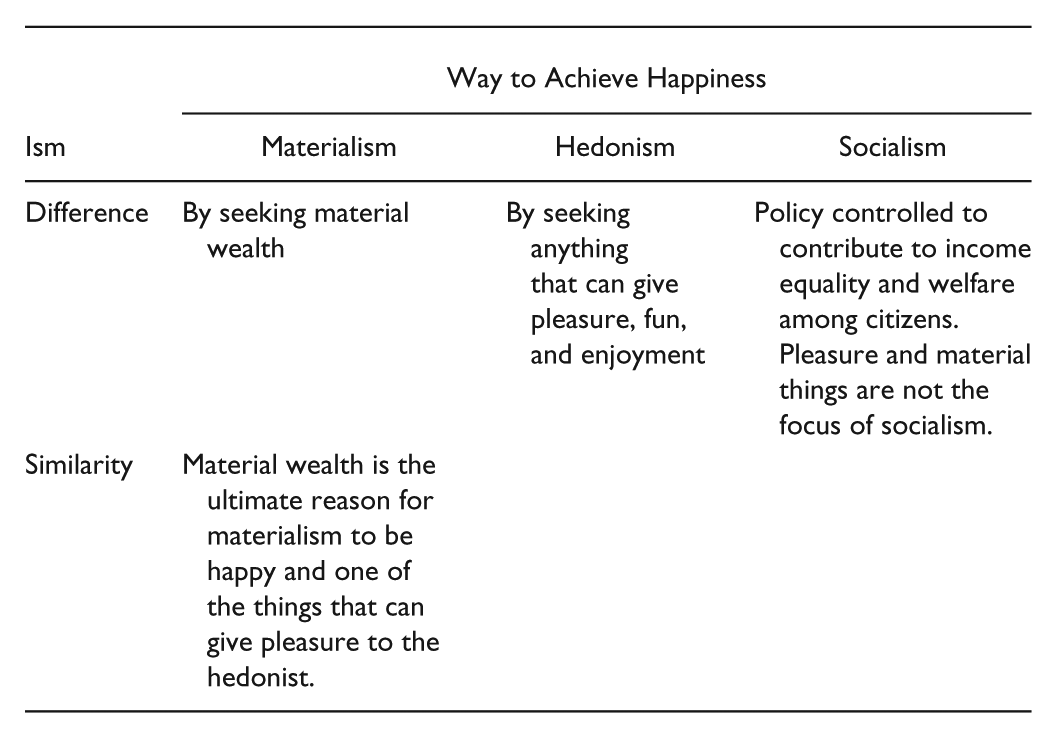

Happiness may be universal, but its meaning remains complex and ambiguous (Lu, 2001). Every ism and religion have their own way to interpret how happiness can be achieved. Some isms when practiced in a community can form a systematic rule by the policy makers while some will only remain as a way of thinking practiced all over the world (such hedonism and materialism). In a specific manner, religion can also form an ism among the followers based on the diversity of religious teaching, which exists.
Spirituality and Economy—Further Discourse
Every rational person definitely wants a high income to provide for a comfortable life. However, in Islam, a high income is to have a relationship with the creator of the high sources of revenue such as God, and this relationship should be seen in the concept of spirituality.
In general, the concept of spirituality is seen as having a close relationship with religious values. However, for some researchers, such as Koenig (2004), spirituality and religion are separated. Spirituality is a more popular (and useful) term than is religion. The reason being spirituality makes no distinctions or divisions—everyone at some level can consider himself or herself spiritual. Not so with religion. Religion involves beliefs, doctrines, and rituals that distinguish one group from another. Religion emphasizes involvement in a faith of this baggage. Spirituality is person and personal. Spiritual beliefs can be any kind of belief (including no belief) and may or may not involve adherence to any particular doctrine, moral, or ethical principle, or hold one accountable to others. This statement is not true because spiritual values should contain moral values recommended in the religion itself.
In Islam, every action must be accompanied by a certain value inside the action. This value is derived from the ethical guidelines from the Al-Quran and Hadith. Besides, the final motive in every action should be the route to what Al-Quran and Hadith propose, that is, to get a blissful life in the world and hereafter. The ultimate goal is the achievement of what is actually required by each human action, namely, to get blessings from God. Therefore, it is impossible to distinguish between spirituality and religion because both are interrelated. This point is in line with the statements of Wiliasih, Usman, Marzuki, Mardoni, and Marcelo (2011). According to them, this spiritual issue cannot be excluded from the religious issue. This is because spirituality talks about the existence of God and reflects it in the daily life. Later on, the research regarding spirituality began to be related to the socio-economic issue.
In the other hand, Mandhouj, Etter, Courvoisier, and Aubin (2012), through the idea of several writers, state that differentiating spirituality from religiosity can be useful, particularly in secular countries where religiosity levels are low. Spirituality can be defined as experiences that seek to transcend self and to find meaning and purpose through connection with others, nature, and/or a supreme being, and same with what is stated by Koenig (2004). These experiences may or may not involve religious structures or traditions. Spirituality, like personality and character, is an attribute of persons. Religiosity, in contrast, refers to a link with an organized social entity. For example, in health care settings, spirituality has been studied in people from diverse religious backgrounds and in people with no religious background. This shows that religion itself can bring a different interpretation and have an impact on someone’s level of spirituality. It is true that each religion has its own ability to bring spiritual power to a person. However, based on the multiple religions we have in this world, for instance, Christian, Jews, Islam, Buddha, and Hindu, each carries a different meaning of spirituality to its practitioners. For instance, a Muslim can capture his or her spirituality by praying solah while a Buddhist finds his or her spiritual power through the meditation practice. To avoid using a misleading dichotomous classification, spirituality is best understood as a multidimensional construct in which every person can be located. Like personality, culture, or cognition, spirituality can be classified as a latent construct that cannot be observed directly but is inferred from observations of its component dimensions. What can be seen nowadays is that a lot of people forget to relate the deities with all the blessings they received in life, especially those who are blessed with an abundance of riches. Greed in the pursuit of wealth often makes people think that all property enjoyed are from their hard work alone but forgot to think and even refuse to acknowledge that these blessings are just temporary borrowings from God.
Human life would disappear if religion and spiritual guidance or spiritual values are seen as two different things. For example, Islam as a religion prohibits the pursuit of worldly materials. Islam also demands that every man find blessings in his life. To find blessing in this life, peoples should ensure every property they make in this world can give them some value of shares in the hereafter. However, what if someone is holding the principle that religion and spirituality are two unrelated things? Surely, all ethics, guidelines, and restrictions given in the religion of Islam to the happiness of this world and hereafter will not be complied. In more simple words, people actually have neglected both religion and spirituality at once. The reason being Islam itself already contained the spiritual element in relation to finding the blessings of the Creator. Separating the two elements is impossible because the negligence of spirituality will cause religion to be ignored, and vice versa.
Future Research—A Suggestion
The right interpretation of happiness (for instance, what does happiness mean for us? how can we gain the happiness? does the happiness we seek last?) is important so that people can pursue their happiness in the right path. This includes to ensure ourself from holding an ism or value that could bring to a fake happiness. This research has the constraint of looking only to some isms and their links with happiness, while there are many other isms that could be explored, for instance, capitalism and communism (ism which related to economic), feminism and sexism (ism related with social condition), and shiism (ism related to religion). However, it will be more valuable if future research would be done combining isms and other religions such as Buddhism and Hinduism to see a greater interpretation of happiness from different points of view.
Furthermore, income, ism, policy of a state, and religion actually have a close linkage with human happiness. Therefore, it will be interesting if future research could explore how those aspects work and interact to form a happier nation, because the current researchers only focus on the income and policy implementation that can affect a nation’s well-being. Not just income and policy but also ism and religion practiced by the nations play an important role in determining happiness. Moreover, religion also contains an instrument to spread the happiness, for example, zakat in Islam, rather than using tax as conventional tools. Other religions also might have their tools to make sure happiness can be shared among the followers.
Happiness concept needs to be determined by a different background of researchers such as from the background of psychology, religion, and economic. Therefore, the interpretation of happiness will cover all aspects of human life. This eventually will yield a generation with a deep understanding on how real happiness should be achieved in their life.
Conclusion
The discussion on happiness has emerged as an important topic among researchers lately. Whether its focuses on religions, economics, or psychology, its aim is only one, that is, to find the best way in improving a person’s happiness. In this research, an economic indicator, for instance, money, wealth, and high income, had contributed to the ism of materialism, while there is also an integration of non-economic (for instance, good name, power, or credibility) and economic indicators as included in hedonism. From that, it has contributed to a range of meaning of happiness, which relies on the ism a person holds. If isms are practiced with a beneficial value, then they will show a right route to the happiness. Furthermore, isms cannot be separated from religion, thus also having their impacts on a person’s happiness. The fact is every religion teaches its followers to obey God to get genuine happiness. However, not all persons will follow this rule because sometimes they cannot liken the isms they hold with the teaching of their religion. Therefore, in this situation, spirituality element functions as the most important thing to ensure that happiness is pursued with the blessing from God.
Footnotes
Declaration of Conflicting Interests
The author(s) declared no potential conflicts of interest with respect to the research, authorship, and/or publication of this article.
Funding
The author(s) disclosed receipt of the following financial support for the research and/or authorship of this article: The authors would like to thank to Ministry of Education for funding this research under the Exploratory Research Grant Scheme.