




Abstract
This study examines the effects of affect on public opinion on foreign policy. It extends the existing studies which show a significant role that affect, as measured by feelings toward a country, plays in shaping public opinion on military action. According to the existing theory, the mass public, which does not have high levels of political information and knowledge, can rely on affect to make reasonable decisions and opinions. This is possible because affect works as an information shortcut or heuristic that can help those individuals who lack cognitive capacity to engage in a systematic search for information and a decision-making process. The research finding confirms this theory. More importantly, this study extends the existing studies by elaborating the conditions under which affect works in accounting for individuals’ support for military intervention. The effect of affect is conditioned by the level of political knowledge, which shows that knowledgeable individuals are more adept at using affect as a heuristic tool.
Introduction
Recent studies of public opinion on foreign policy have focused exclusively on the rational aspect of decision making and opinion formation. While these studies have expanded our understanding of the existence of an organized structure of belief system among the public (e.g., Bardes & Oldendick, 1978; Chittick, Billingsley, & Travis, 1995; Richman, Malone, & Nolle, 1997), the role of foreign policy beliefs in forming opinion (e.g., Holsti, 2004; Wittkopf, 1986), and the effects of strategic and instrumental considerations in decision making (e.g., Herrmann, Tetlock, & Visser, 1999; Jentleson, 1992; Jentleson & Britton, 1998; Knopf, 1998; Nincic, 1992), they have paid relatively little attention to the role of affect in understanding public opinion in the area of foreign policy. As the majority of studies work to counter the pessimistic view of the public’s capacity to form opinions on international affairs, they focus exclusively on showing the existence of organized belief systems and their structures (see Holsti, 1992, for an extensive discussion on this topic). Consequently, few studies of public opinion on foreign policy pay heed to the role of affect.
This lack of attention to the role of affect in understanding public opinion on foreign policy is acute when we examine the studies that focus on public support for military action. Most studies that address the question of what contributes to citizens’ support for war emphasize the effect of an instrumental consideration: citizens’ engagement in cost–benefit analysis in forming their opinions on war. Mueller (1971) is a representative scholar who shows that the public withdraws its support for war when the number of soldiers killed in the war increases. Subsequent studies have corroborated his findings and have contributed to elaborating some specific conditions of this cost–benefit analysis. For example, Gartner (2008) demonstrates that the number of casualties itself is not the major factor that influences citizens’ support for a war, but their evaluation of the contexts of those casualties (e.g., future projection of war) rather than the simple accumulation of them plays an important role in predicting their support for a war. Herrmann et al. (1999) elaborate a model that captures individuals’ support for war by incorporating the motivations, military power, and cultures of the aggressor countries as well as U.S. interests in the area in accounting for individuals’ decisions to support war. They found that not only individuals’ predispositions (e.g., militarism, internationalism, ideology) but also their understanding of instrumental conditions—whether or not the invaded countries are critical to U.S. interests or the aggressor country has the military power that can increase the cost of winning the war—matters in deciding their support for war efforts in dealing with potential aggressors. Another group of scholars suggests an alternative explanation for the sources of public support for war (Gelpi, Feaver, & Reifler, 2006). They argue that not the number of casualties but the possibility of winning in the war is a more important factor in predicting citizens’ support for war. According to them, even if casualties increase, citizens keep their support for war if they see a higher probability of winning the war. Although these scholars differ on the specific reasons for citizens’ support for war, they share a similar assumption that individuals behave instrumentally: They engage in cost–benefit analysis.
Still another group of scholars pays attention to the role of the media or elites in influencing citizens’ prospects for war (e.g., Baum, 2003; Bennett & Paletz, 1994; Berinsky, 2007, 2009). For example, Berinsky (2007) shows that elites’ agreement or disagreement on war is the most influential factor in accounting for individuals’ support for war. When elites agree on the goals and means of wars, individuals are more likely to support the war, but when elites are divided on these, they are less likely. In this process, individuals’ political predisposition, partisanship, becomes more important in shaping their support for war. These studies show that individuals are influenced by the media or elites because they take cues and information from them, and this third party can influence the way the individuals process the information by framing the issues in different ways. While all of these studies pay attention to the sources that influence individuals’ support for war or other military actions, they mainly focus on either instrumental elements of reasoning or the influence of third parties. Few pay attention to the role of emotion or affect in understanding public opinion on war in the United States (cf. Huddy, Feldman, & Cassese, 2007).
As Crawford (2000) pointed out, emotion or passion was considered as an impediment to rational thinking in studying international relations. Similar attitudes were widely accepted in the area of behavioral studies and neuroscience. However, studies (e.g., Damasio, 1994; Marcus, Neuman, & MacKuen, 2000; Neuman, Marcus, Crigler, & MacKuen, 2007; Rahn, 2000) show that emotion and passion do not hinder rational thinking, but they are important components and sources for instrumental reasoning and opinion formation. In addition, other scholars suggest that emotions toward specific targets (e.g., individuals or groups) influence individuals’ behavior. For example, they show that anger, fear, and anxiety toward outgroups or target individuals are important sources for their support for war in the United States (Huddy et al., 2007) or in accounting for intergroup behaviors in Israel (e.g., Halperin, 2011; Halperin, Russell, Dweck, & Gross, 2011). Similarly, others (e.g., Sniderman, Brody, & Tetlock, 1991) propose that affect works as an information shortcut to help individuals form their opinions on policies and vote choices. All these studies instruct us that emotion and affect are important elements of reasoning and opinion formation. Thus, it is necessary to take them into account to better understand public opinion on foreign policy. Despite the fact that few scholars pay attention to the role of emotion and affect in understanding public opinion on U.S. foreign policy, there are some scholars who call attention to the role of emotion and affect in this area. Page and Bouton (2006) examine the sources and effects of affect using surveys conducted by the Chicago Council on Foreign Relations. They show that affect has a limited effect on public support for troop use in 2002. Although their study took a first step toward opening the door to studying the role of affect in understanding public opinion on foreign policy, their emphasis was more on the existence of the purposive belief system. Huddy et al. (2007) examine more directly the effect of anger and fear on American citizens’ support for the Iraq War right after the 9/11 attacks. Similarly, Miller (2011) explores the effect of discrete emotions (e.g., anger, fear, hope, and pride) and sophistication and shows that more sophisticated individuals are better in using emotion in forming their opinions. While his study is one of the first studies that explores the interaction between emotion and cognition in accounting for political behavior and provides an important insight to the study of this question, still the major findings are based on college students and have a limitation in generalizing the results in foreign policy opinion formation. Thus, the questions on the role and working mechanism of affect in accounting for public opinion on foreign policy remain to be explored.
This article addresses two questions regarding the role of affect in foreign policy opinion. What role does affect play in accounting for individuals’ choices in foreign policy issues? If it does, how do cognition and affect work together in accounting for citizens’ foreign policy choices? In examining these questions, I use a survey on public opinion on the use of U.S. troops to defend allies from hostile countries.
To address these questions, two hypotheses are proposed. First, individuals’ affects—their feelings toward a country—play a significant role in accounting for their support for U.S. troop deployment to defend allies. Second, the effect of individuals’ affects on their support for military use will be conditioned by their levels of sophistication. The survey conducted in June 2006 by the Knowledge Network and supported by the Chicago Council on Global Affairs is used to test the hypotheses. 1 I proceed with the discussion on the theories of affect and public opinion in foreign policy. Then, I propose hypotheses, present information on the data and measurements, provide findings, engage in discussing the findings, and draw conclusions.
Theory of Affect and Public Opinion on Foreign Policy
Emotion and affect has drawn significant attention in recent studies of political behavior in general and public opinion on foreign policy in particular. Studies (e.g., Marcus, 1988; Marcus et al., 2000; Sniderman et al., 1991) show that individuals’ emotion and affect is a major source for their political choices and opinions. For example, Marcus (1988) demonstrates that voters’ feelings toward candidates play a significant role in accounting for their voting choices. As they feel warmly toward candidates, they are more likely to vote for them. The impact of gut feelings is comparable with, or even stronger than, those elements traditionally considered as important political predispositions, including partisanship and ideology. Sniderman et al. (1991) consider affect as an important element of reasoning. They argue that individuals’ feelings toward groups, an operational definition of affect (Sniderman et al., 1991), work as heuristics with which they can compensate for the lack of knowledge and information. They term this feeling toward certain groups or individuals as “likeability heuristics” (p. 7). As feelings toward groups are considered as information shortcuts or heuristics, affect becomes an important piece of information. From this perspective, affect provides individuals with a relatively easy way to figure out complex political phenomena without knowing much detail about the objects of evaluation or judgment. Consequently, those individuals who are less sophisticated could make choices that are qualitatively close to the choices of more sophisticated persons.
Similarly, Rahn (2000) proposes that affect functions as information, in that knowing the mood of individual members in a community can help understand individual members’ attitudes and behaviors. For example, her findings showed that the public mood—whether individuals felt positively or negatively about the country in general—accounted for a significant portion of the variance in individuals’ perceptions of the North American Free Trade Agreement (NAFTA) and trust toward government. Although this public mood works similarly to affect toward other groups in functioning as information shortcuts, they differ in that this public mood is not an emotional feeling toward target groups but a general feeling regarding the status of their own life. In this sense, the concept of affect that I use in this study is different from the public mood.
More relevant studies to this research are the studies that explore the role of emotion and affect in intergroup relations. They suggest that individuals’ feelings toward groups (e.g., Blacks, minorities, or other outgroups) are important reference points for explaining their preferences or attitudes toward those groups (e.g., Halperin, 2011; Huddy et al., 2007; Iyer & Leach, 2008; Kuklinski, Riggle, Ottati, Schwarz, & Wyer, 1991; Neuman et al., 2007; Smith & Mackie, 2008). Kuklinski et al. (1991) demonstrate that those Whites who possess negative feelings toward outgroups (i.e., Blacks) are less likely to support affirmative action or school integration, programs originally intended to redress discrimination against Blacks. Smith and Mackie (2008) suggest that the intergroup-based emotion (e.g., anger, anxiety, fear toward outgroups) plays a key role in accounting for the ingroup members’ attitudes and behaviors. In studying the role of different emotions—anger, hatred, and fear—Halperin (2011) shows that each of these emotions explains individual Israeli citizens’ public opinion on the peace process between Israel and Palestine in 2005. Those individuals who feel fear and hatred are less likely to support the peace process with the Palestinians, but those individuals who feel anger are more likely to take the risk of engaging in negotiation.
Similarly, Huddy et al. (2007) examine the effect of anger and fear on target groups (e.g., anti-war protesters, terrorists, and Saddam Hussein) and support for war. They found that these two emotions, which were considered as the components of the same negative emotion by Marcus et al. (2000), have distinctive effects on individuals’ support for the Iraq War: Those individuals who have a higher level of anxiety are less likely to support the war, whereas those individuals who have a higher level of anger are more likely to support the war. These studies show that emotion and affect toward specific targets play a major role in accounting for individuals’ opinion and behaviors.
In this study, I follow Sniderman et al.’s (1991) definition of affect, measured by feeling toward objects. They provide three distinctions to show their definition of affect. First, their definition of affect is closer to “trait” than “state,” in that feelings are characterized by “a disposition regularly to experience an emotion” rather than by “an emotion experienced at a given moment” (Sniderman et al., 1991, p. 7). Second, their definition of affect is “quantitative” rather than “qualitative,” in that a person’s feeling is “positive or negative” rather than that it is distinguished by varieties of specific emotions (e.g., fear, anxiety, hope, and pride). Finally, it is “focused” rather than “diffused,” because affect is emotional feeling toward specific targets or groups instead of a readily available chronic emotional status (e.g., anxiety). In this sense, it is different from Rahn’s (2000) concept of “public mood,” which describes a diffuse affective state in general.
Furthermore, the operationalization of affect in this study is different from that of emotion suggested by other scholars (e.g., Marcus, 1988; Marcus & MacKuen, 1993; Marcus et al., 2000; Neuman et al., 2007) who propose a multidimensionality of emotion. This theory of the dual structure of emotion is based on the studies of psychology (e.g., Chaiken & Yaacov, 1999; Watson & Clark, 1992; Watson & Tellegen, 1985) and neuropsychology (e.g., Damasio, 1994; Gray, 1987; Le Doux, 1996). Marcus and MacKuen (1993) argued that there are two emotions—anxiety and enthusiasm—that can capture the distinctively different ways emotions work. They show that anxiety and enthusiasm are two distinctive emotional elements, they influence individuals’ political participation and choices differently, and anxiety can help individuals engage in rational behaviors. Other studies (e.g., Halperin, 2011; Huddy et al., 2005; Huddy et al., 2007; Redlawsk, Civettini, & Lau, 2007) also use the specific emotions (e.g., anger, hatred, fear, happiness) in accounting for individuals’ policy preferences or behaviors. This definition and measurement of emotion is not used in this study. Thus, the findings of this study on the effect of affect are pertinent to the narrow definition of affect based on a one-dimensional valence scale.
This study will extend the theoretical arguments that are well established in studying public opinion in the area of domestic politics to public opinion on foreign policy. In doing so, I examine public support for U.S. troop deployment in various scenarios. As U.S. military involvement is one of the most important issues in foreign policy, exploring the effect of affect on this issue can provide important insights into public opinion on foreign policy in general. Consistent with the previously mentioned studies, I hypothesize that affect, measured by individuals’ feelings toward a country, plays a significant role in accounting for their choices regarding sending U.S. troops to other parts of the world.
The second theoretical question asks, what is the relationship between affect and cognition? Would cognitively sophisticated individuals differ from those who are less sophisticated in relying on affect? The existing studies offer different answers to this. One group of scholars agrees that cognitive sophistication will condition the effect of emotion and affect on individuals’ behavior (e.g., Huddy et al., 2007; Miller, 2011; Rahn, 2000; Sniderman et al., 1991). But they differ on how affect influences sophisticated and unsophisticated individuals. Sniderman et al. (1991) argued that the more sophisticated individuals are less likely, and the less sophisticated ones are more likely, to rely on affect in forming their policy preferences. Their empirical results support their argument in their study: Those who had more education were less likely than those with less education to depend on affect toward Blacks in making their decision on racial equality policies. Individuals’ ideologies played a prominent role in accounting for the more educated individuals’ choices of racial policies. However, those who had less education were more likely to depend on affect toward Blacks and less on ideology in accounting for their support for racial equality. Similarly, Rahn (2000) showed that among those who have a higher level of information, the impact of a “public mood” tends to decrease. These scholars suggest that affect works to compensate for those individuals’ lack of information and cognitive ability in forming their opinions and policy preferences. Thus, those individuals who have higher levels of cognitive ability and information are less likely to rely on affect in making their opinions. According to them, the effect of affect is more pronounced among the less sophisticated individuals.
In contrast, others who mainly argued the symbolic politics theory (e.g., Kinder & Sears, 1981; Sears, 1993) maintain that the role of affect will be universal, regardless of cognitive level. Still others (e.g., Marcus & MacKuen, 1993) do not make specific claims about the relationship between these two in explaining their role in forming public opinion. They show that a particular emotion, anxiety, leads to more learning, which implies that an emotional signal helps individuals engage in information seeking, and the existence of emotion is a critical condition for instrumental thinking and behavior.
Still others suggest that the effect of emotion will be greater among politically more sophisticated individuals than among less sophisticated ones. Miller (2011) shows that individuals who are more knowledgeable are more likely to be good at feeling emotion, are quicker to feel emotion, and are more likely to use different types of emotions in forming their vote choices and opinions on Iraq War policy. According to him, the more politically sophisticated individuals are better at dealing with information processing, combining their cognitive ability with emotion, and acting on this emotion in forming their opinions. Similarly, Schreiber (2007) suggests that the more sophisticated individuals are more likely to be good at using emotional feeling toward political figures in forming their opinion than the less sophisticated individuals.
Huddy et al. (2007) also examine whether the level of political information conditions the effect of anxiety and anger. They found that those individuals who have a higher level of information and feel anxiety are less likely to support the Iraq War, which is consistent with the expectation that political information conditions the effect of emotion.
In line with the last group of scholars, I argue that the effect of affect will be more pronounced among individuals who have a higher level of political knowledge. Although gut feelings can work as heuristics and provide useful information, if individuals lack contextual information and general knowledge about politics, it will be very difficult for them to develop any meaningful feeling. Without a basic cognitive ability to comprehend politics, no feeling will be evoked to provide meaningful information to individuals. This is particularly germane in the case of international affairs. Americans who do not have any substantive understanding of international politics will have difficulty in relying on affect as a meaningful tool in forming their opinion on foreign policy relative to a specific country. This does not mean that those individuals who are politically less sophisticated fail to feel emotion toward the objects. Instead, their affect will not influence their behavior as strongly as it will among the more sophisticated individuals. Individuals who know a lot about international politics are more likely to pay attention to the current events and world politics and, in turn, they could more easily maintain and use affect than those who are less politically sophisticated. 2 In line with this argument, I propose the hypothesis that affect and political sophistication, measured by factual knowledge on international politics, interact. Specifically, affect has limited empirical power among less sophisticated individuals, but it has a stronger impact among more sophisticated individuals.
To test these hypotheses about the role of affect and cognition in understanding public opinion on foreign policy, this study uses three different scenarios of war in which the United States would have to make a decision on troop deployment. Three countries, South Korea, Israel, and Taiwan, are chosen, because these American allies are facing plausible threats from neighboring countries. The truce agreement made in 1953 by North Korea and the United States ended the Korean War, but the tension between North Korea and South Korea remains high and could be escalated even further due to North Korea’s pursuit of nuclear weapons. 3 Since the truce was signed, the United States has stationed troops in South Korea. Due to this strategic situation and the treaty between South Korea and the United States, U.S. troops would engage militarily if war broke out on the Korean Peninsula.
Although the situation is not so dire as that between North Korea and South Korea, U.S. interest in keeping Taiwan safe from Chinese military attack is a critical one. While the tension between the two countries depends on the speed and will of Taiwan to move toward complete independence, whenever any emergency occurs, the United States strengthens its ties with Taiwan. The current rise of China and the increased interdependence between China and the United States might make it difficult for the United States to act decisively in case a conflict occurs between China and Taiwan. Despite this complexity, so far the United States has sided with Taiwan in dealing with the possibility of any military conflict between them. Ever since the Seventh Fleet was sent to the Taiwan Straits in 1950, the United States has maintained its military ties with Taiwan.
Among these three U.S. allies, Israel is the most important to the United States. After the 9/11 attacks, the Bush administration categorized “Iraq, Iran, and North Korea” as an “Axis of Evil.” After the Hussein regime in Iraq was toppled by the Bush administration, only North Korea and Iran were left as nations of concern for U.S. national security. Iran’s efforts to develop nuclear weapons provided ample reason for the United States and Israel to express concern. These three scenarios describe situations in which Americans could quite plausibly be faced with the question of what to do in case a conflict occurs between enemy countries and allies.
One important characteristic of these questions is the way in which each scenario represents a peculiar situation covering various conditions in terms of the enemy country’s capacity and motivation and the allies’ importance. For example, China owns nuclear weapons, and the power balance between China and Taiwan increasingly favors the growing Chinese military power. On the economic side, China and the United States are heavily intertwined. Thus, people would perceive a high cost in case war should break out between the United States and China. At the same time, the stake that the United States has in Taiwan is not as high as it is in other allies it is committed to protect. Faced with this high cost and low-benefit situation, the American public would not be so enthusiastic about sending troops to defend Taiwan. In contrast, North Korea’s and Iran’s military power are relatively limited compared with that of China, but the level of threat from these countries might be more significant, in that the two countries could become more salient in the mass media than the one, even when that one is significantly larger. In addition, when President Bush depicted them as parts of the “Axis of Evil” in his State of the Union Address in 2002, North Korea and Iran became symbols projecting a negative image. In terms of diplomatic and economic relations with these countries, North Korea has not had any formal relationship with the United States since the truce of 1953. Although Iran had a close relationship with the United States during the Shah’s regime before the revolution in 1979, it has not had any diplomatic relationship since then. Also, these two countries do not share any cultural understanding with the United States. Americans are far more likely to have a negative image of these countries than of China. But both allies—South Korea and Israel—are critically linked to U.S. national security in East Asia and the Middle East. Thus, citizens are more likely to perceive a higher stake in protecting these two countries from aggressors than in defending Taiwan.
These scenarios can provide us with a tool to examine the role of affect and cognition in various contexts in terms of an aggressor’s capacities, closeness to U.S. culture and interests, and motivations. One expectation from the various scenarios is whether the effect of affect is reduced significantly when the aggressor country is militarily powerful (e.g., China) or not. I do not have a specific hypothesis to test in terms of the effect of political context in addition to the interaction between affect and political knowledge. It is more of an exploratory attempt to check whether the different scenarios relative to the aggressors’ power, interests, and motivations make a difference as to the effect of the interaction or not.
In addition to affect, I include other independent variables that influence individuals’ support for U.S. military action. They are political dispositions and foreign policy postures. As the existing studies show, individuals’ political predispositions are important sources for their support for military action (e.g., Berinsky, 2007; Holsti, 2004; Zaller, 1992). Although scholars and pundits tend to suggest that “politics ends at the water’s edge,” this is not a valid observation anymore in recent American politics. Especially, political polarization has grown since the Iraq War in 2003 (e.g., Bafumi & Shapiro, 2009). Given this high level of polarization and the central role of political predispositions (e.g., ideology and partisanship) in accounting for individuals’ political choices and opinions, ideology and partisanship will be controlled in the model.
Also, studies (e.g., Herrmann, Tetlock, & Visser, 1999; Holsti, 2004; Hurtwiz & Peffley, 1987; Wittkopf, 1986) have shown that citizens’ foreign policy postures (e.g., internationalism, militarism, idealism, domestic concerns) are the major sources of public opinion on foreign policy. For example, they show that those who believe in militarism are more likely to be supportive of active involvement in military action, whereas those individuals who believe in domestic interests are less likely to be supportive of military action. These variables will be controlled to test the alternative explanations.
Hypotheses
I draw two hypotheses based on the theoretical discussion on the role of affect in accounting for individuals’ opinions on military action. The first hypothesis states that individuals’ feelings toward a country will be a significant source in accounting for their support for U.S. troop use in defending allies. If individuals have negative feelings toward the invading country, they are far more likely than those who have warm feelings to support deploying the military to defend our ally. The second hypothesis posits that the effect of feeling toward a country will be more pronounced among those who have a higher level of political sophistication in forming their opinion on using the military to defend our allies. Specifically, that effect of negative feeling toward the invading country will be stronger in predicting support for troop deployment among those who have a higher level of sophistication than among those who have a lower level.
Data and Measurement
For this study, the survey conducted in June 2006 by the Knowledge Network and supported by the Chicago Council on Global Affairs is used. As the survey included a variety of questions that are relevant to foreign policy–related issues, it provides scholars with a useful tool to test our hypothesis. 4 The survey included 1,227 respondents.
To measure the dependent variables—support for U.S. involvement in the war—three questions were used. Respondents were asked whether they would favor or oppose the use of U.S. troops in other parts of the world in the following cases: if North Korea invaded South Korea, if China invaded Taiwan, and if Iran attacked Israel. Respondents’ support for troop deployment to defend these allies varies somewhat. About 48%, 34%, and 56% of respondents, respectively, support military action. It seems that their reaction varies by the strength of the enemy countries and closeness of the allies. On average, citizens are least likely to support engaging war with China and most likely to support military action against Iran.
The major independent variable—affect—was measured using the traditional question that asks respondents to rate their feelings toward specific countries, with 100 meaning a very warm, favorable feeling; 0 meaning a very cold, unfavorable feeling; and 50 meaning not particularly warm or cold. 5 The objective countries included North Korea, China, and Iran. The mean feeling thermometer readings for these countries were 23 (SD = 22.17), 40 (SD = 23.62), and 21 (SD = 21.15), respectively. It shows that Americans have fairly cold feelings toward Iran and North Korea, both of which were named as part of an “Axis of Evil” by President Bush, whereas they have warmer feeling toward China. The variable affect is centered around the mean in the actual estimation. It makes the mean of the centered affect variable 0. This centering (subtract the mean of the variable from each respondent’s value on the affect) will reduce the multicollinearity between the main variable and the interaction terms and make it easier to interpret the coefficient of the interaction term (Aiken & West, 1991; Gelman & Hill, 2007). Thus, the centered affect toward North Korea ranges from −22.86 to 77.14 (M = 0, SD = 22.17), the centered affect toward Iran ranges from −21.08 to 78.92 (M = 0, SD = 21.15), and the affect toward China ranges from −40.61 to 59.38 (M = 0, SD = 23.62).
To measure the level of sophistication, two knowledge questions were used. The first question asked the name of the Secretary General of the United Nations, and the second one, the name of the currency of the European Union (EU). About 24% of respondents correctly named Kofi Annan. For the EU currency question, 53% of respondents answered it correctly. The two questions were added to create a scale for sophistication, ranging from 0 to 2. About 42% of respondents failed to answer these questions correctly, 35% got one answer correct, and 23% provided two correct answers. Some studies (e.g., Sniderman et al., 1991; Zaller, 1992) use education as a proxy for the measurement of knowledge or sophistication. But researchers (e.g., Deli Carpini & Keeter, 1996) show that knowledge questions provide a more adequate measurement of sophistication level than does the level of education. Although only two questions on factual items may be less than ideal compared with what Deli Carpini and Keeter (1996) have suggested, it is still more appropriate than using education as a measure for sophistication, given that the questions are available in the survey.
Other independent variables included political predispositions (i.e., partisanship and ideology), foreign policy postures (i.e., militarism, internationalism, domestic interest, and global altruism), and demographic variables (i.e., gender, race, age, and religiosity). Partisanship was measured based on a 7-point scale, ranging from 0 (strong Republican) to 6 (strong Democrat). The median of this variable is 4, which includes Independents and undecideds without leaning toward either party (SD = 2.06). Approximately 22% of respondents belong to this category. Similarly, ideology was measured on a 6-point scale from 0 (strong conservative) to 5 (strong liberal). The median of this variable is 4, which is middle of the road (SD = 1.19). About 46% of respondents consider themselves as moderates.
A group of independent variables is worthy of note. It included foreign policy postures. This group measures the postures which capture individuals’ beliefs about the goals that reflect a desired end-state. Whereas some scholars (e.g., Hurtwiz & Peffley, 1987) distinguish a difference between values and postures, others (e.g., Holsti, 2004; Zaller, 1992) use these concepts interchangeably. This study follows the former practice in defining and measuring the beliefs in goals. Militarism reflects the belief that maintaining strong military power is a critical goal in world politics, as it is the last resort and essential in ensuring national security. This is the realist’s core belief. To establish this measure, the question is used which asked respondents whether they believe that “maintaining superior military power worldwide” is the most important (56%), a somewhat important (37%), or not at all an important goal (7%). It is rescaled from 0 and 1 (M = 0.74, SD = 0.31). Another belief which represents the realist perspective is National Interest. It is measured using two questions, which asked respondents whether “protecting the jobs of American workers” and “securing adequate supplies of energy” should be the most important, somewhat important, or not at all important goals. These questions are added together to create an index and rescaled from 0 to 1 (M = 0.86, SD = 0.21) While these two beliefs represent the realist’s view, two other beliefs represent idealism. For Global altruism, three questions were used as to whether respondents believe that “helping to improve the standard of living of less developed nations,” “helping to bring a democratic form of government to other nations,” “protecting weaker nations from foreign aggression,” and “combating world hunger” should be the most important, somewhat, or not at all important goals. 6 These questions were added and rescaled from 0 to 1 (M = 0.56, SD = 0.23). To measure Internationalism, the following question was used: “Do you think it will be best for the future of the country if we take an active part in world affairs or if we stay out of world affairs?” About 73% of respondents believe that taking an active part in world affairs is best for the future of the country, whereas 37% disagree. The distribution shows that citizens care more about realist goals, national interests, and militarism than about idealistic goals. Also, internationalism is still popular among the public.
Findings
Affect and Support for Troop Deployment
The results of estimations in Table 1 show that affect plays a significant role in accounting for the public’s support for sending troops in the three scenarios. As the model includes the interaction term, it is necessary to take into account all three coefficients that involve the knowledge variable. One way to test the first hypothesis on the effect of affect is to do the Wald test against the null hypothesis: Affect does not affect individuals’ support for troop deployment. It is testing whether all the coefficients of affect (b = .00), affect* middle-level knowledge (b = −.03), and affect* high-level knowledge (b = −.02) are 0 while controlling for other independent variables. The Wald test is done using χ2 values with three degrees of freedom (Griffiths, Hill, & Judge, 1993; Kam & Franzese, 2007). The χ2 value for the first scenario (North Korea invades South Korea) is 34.91 (p = .00). The p value is smaller than the traditional significance level .05. Thus, we can reject the null hypothesis that affect does not matter in accounting individuals’ support for troop deployment in South Korea. The same process can be applied to the other two models. The χ2 values for the second scenario (Iran invades Israel) and the third scenario (China invades Taiwan) are 15.28 (p = .002) and 15.05 (p = .002). These show that the null hypotheses are all rejected in these cases, too. Thus, the results support the proposition that individuals’ feelings toward a hostile country matter in accounting for individuals’ support for military action in all three cases. Individuals who feel negatively about the aggressor country are far more likely to support sending U.S. troops to defend allies in the three cases. Those who feel coldly toward North Korea, China, and Iran are far more likely to send U.S. troops to defend South Korea, Taiwan, and Israel.
Interaction Model for U.S. Troop Deployment.

p < .1. *p < .05. **p < .01. ***p < .001. Logit estimation: two-tailed.
The second hypothesis focuses on the conditional role of cognition in accounting for the impact of affect on support for troop deployment. It was expected that those who are more sophisticated are more likely to be able to rely on affect in forming their opinions on the support for war. Table 1 shows the results of the model estimations including the interaction term. The first column shows the estimation result for sending troops to the Korean Peninsula in the case of war. While the main effect of knowledge is positive and significant, that of affect has a limited influence. As the sophistication-level variable is treated as a category in this case, there will be three categories: The base group includes those who fail to answer both questions (42% of respondents); the second group (middle), those who correctly answer at least one question (35%); and the third group (high), those who answer both questions correctly (23%). The variable affect has a 0 coefficient, which means that there is no effect of affect among the least knowledgeable individuals (base group). The coefficients of the interaction term between knowledge level and affect are negative (b = −.03, p < .05; b = −.02, p < .05) and statistically significant in this scenario. Thus, the negative sign of the interaction terms means that among the sophisticated (the middle and high groups), the influence of affect is more significantly negative than among those who are not sophisticated (the base group). In other words, the slope of the measure of the impact of affect among the more sophisticated individuals will be significantly different from that of the less sophisticated individuals.
As the logit coefficients are difficult to interpret from the original estimation, the first differences were calculated. The probability change in Table 2 provides that information. 7 When the level of affect toward North Korea changes from 0 (very cold) to warm by 1 standard deviation (13.28) while other variables are set either at their mean or mode, the probability of supporting U.S. troop deployment on the Korean Peninsula goes down by .01. 8 Its magnitude of influence is not that big. But the effect of feeling toward North Korea is getting bigger among those who know more than do those who know very little about international politics. The probability of supporting troop deployment in South Korea decreases by .19 points when the affect is moved from very cold by 1 standard deviation. Similarly, the effect of affect among those who have the highest level of knowledge is bigger than among those who know very little. The probability of supporting troop deployment decreases by .15 when the affect is moved from very cold by 1 standard deviation. This effect is comparable with the impact of traditional internationalism, which accounts for the probability change of troop deployment support by .11.
First Difference: Interaction Model for U.S. Troop Deployment.
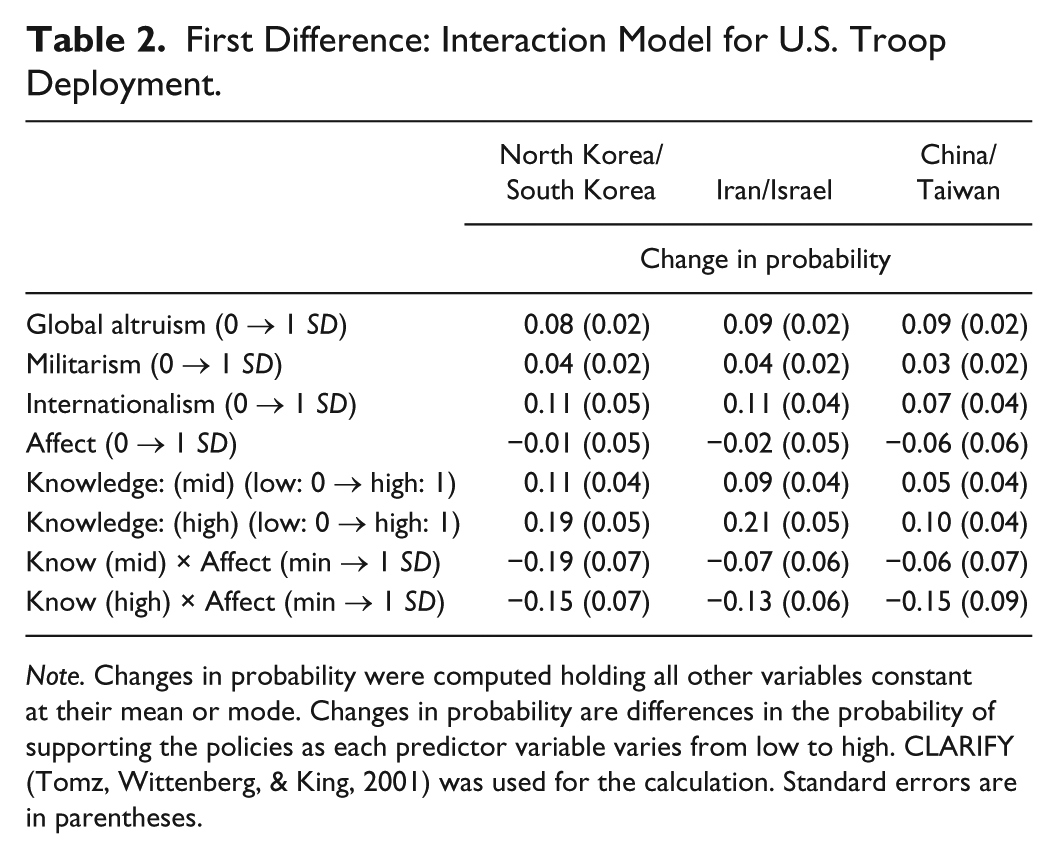
Note. Changes in probability were computed holding all other variables constant at their mean or mode. Changes in probability are differences in the probability of supporting the policies as each predictor variable varies from low to high. CLARIFY (Tomz, Wittenberg, & King, 2001) was used for the calculation. Standard errors are in parentheses.
A similar tendency appears in accounting for the support for sending troops to Israel. As in the previous case, the effects of middle-level knowledge (b = .46 p < .01) and high-level knowledge (b = .97, p < .01) are strong and significant, but the effect of affect is very limited (b = .00). The effect of affect shows up only among the highly sophisticated individuals but not among the less sophisticated ones. The interaction term between high knowledge and affect (b = −.02) is significant at the .05 level. Compared with the less knowledgeable individuals, feeling toward Iran has a more meaningful influence among the more knowledgeable individuals. The first difference in Table 2 demonstrates that, as we change from very cold feeling to warm feeling by one standard deviation among the highly sophisticated individuals, the probability of support for troop deployment to Israel goes down by .13. The magnitude of the influence is greater than that of internationalism, which has a .10 increase when there is a change in its support from no (0) to yes (1).
Consistent with other models, the third column in Table 1 shows that the interaction term of high knowledge and affect (b = −.01) is significant at the .10 level. Although the effect of middle (b = .27, p < .10) and high-level knowledge (b = .51, p < .01) is positive and significant, that of affect (b = .00) is negative and insignificant. The more central finding is that the influence of affect is differentiated by the level of sophistication. The coefficient of the interaction term (for the highly sophisticated ones) is significant at the .10 level. This means that citizens’ feelings toward China account for their support for U.S. troop deployment among those who are highly sophisticated. But the effect of feeling toward China does not have a significant influence among the less sophisticated ones. The first difference in Table 2 shows this result from a different perspective. As we change the level of affect from very cold to a warmer direction by 1 standard deviation among the highly sophisticated individuals, the probability of support for sending troops to Taiwan goes down by .15.
Another way of examining the interaction effect is using graphs (Kam & Franzese, 2007). As the estimation results in Table 1 do not show the full range of the effect of affect among the base group, it is more intuitive and helpful to present the interaction effect graphically. Figure 1 shows the relationship. The first panel in the figure shows the probability changes in supporting troop deployment by sophistication level and feeling toward North Korea in the case of North Korea invading South Korea. While the feeling toward North Korea does not have any meaningful effect among those who have the lowest level of knowledge (the solid line), support for sending troops drops significantly as individuals’ feelings toward North Korea get warmer among those who know somewhat and a lot about politics. The same relationship is found in the second and third panels. The effect of feeling toward a country by different levels of knowledge is even greater at the end of the feeling scale. As there are a large number of individuals who have very cold feelings (0 in the original scale) toward these countries (28%, 27%, and 9% for North Korea, Iran, and China, respectively), this effect is a realistic one. The estimation results in Table 1 show the interaction effect between knowledge and affect around the mean of affect level (0 in the x axis in Figure 1). Thus, the interaction effect is even greater when the affect level is toward the end of the scale. These findings support the second hypothesis and show that the effect of feeling on individuals’ support for troop deployment depends on individuals’ sophistication levels.
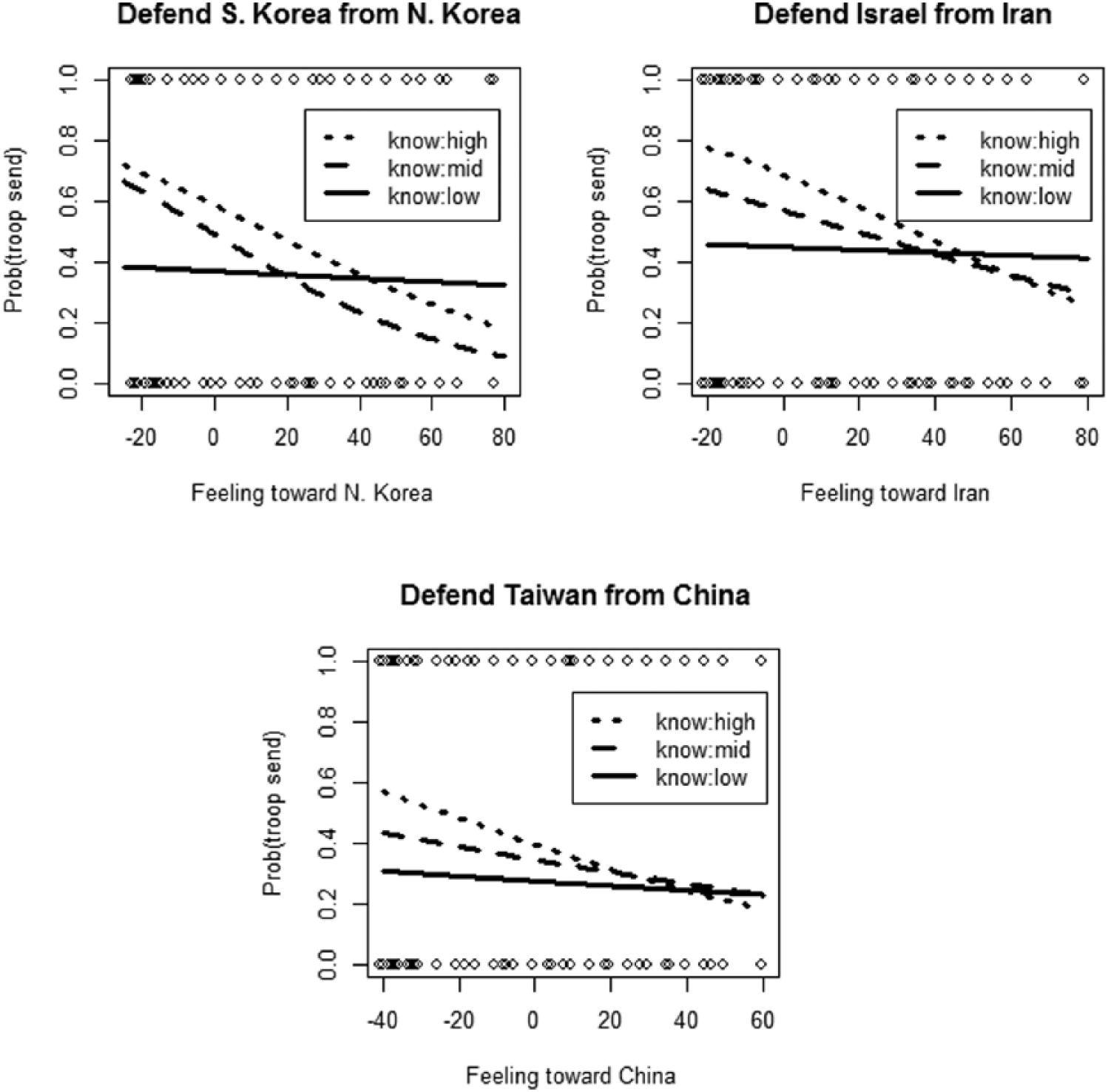
Support for troop deployment by knowledge and affect.
Also, interesting findings are the roles played by global altruism and internationalism. The strong influence of belief in global altruism in sending U.S. troops to help allies is consistent with other scholars’ claims (e.g., Lieven, 2004; Monten, 2005; Pei, 2003) that concerns for human rights and democracy have been part of the core idealism in U.S. foreign policy. The public believes in the idea that the United States extends these ideals into other parts of the world. Those who cherish democracy and humanitarianism are substantively more likely to be supportive of sending troops to South Korea, Taiwan, and Israel, regardless of the capacity and motivation of aggressors. The coefficients of this variable in the three estimates (b = 1.74 for the first model, b = 1.95 for the second, b = 1.99 for the third) are statistically significant at the .05 level.
The first differences in Table 2 show that the magnitude of this variable is one of the highest ones. As we are moving the level of belief in global altruism from low (0) to high direction by 1 standard deviation, the probabilities of support for going to war in Korea, Taiwan, and Israel increase by .08, .09, and .09, respectively. Regardless of the strategic situation of the militaristic conflict, citizens who believe in the ideals are far more likely to support the war effort. A noteworthy point is that American citizens are more likely to rely on these ideals in justifying their choice of sending U.S. troops in the case in which China invades Taiwan. In general, the level of support for troop deployment is low in this case (only 34% support the option in this case, compared with 48% for South Korea and 56% for Israel). But global altruism is the most powerful factor in eliciting support for troop deployment in defense of Taiwan.
Finally, the traditional foreign policy belief—internationalism—plays an important role in accounting for the support for troop deployment in these countries. Those who believe that it is important for the United States to be actively involved in international affairs are more likely than those who believe in isolationism to be supportive of sending U.S. troops to help allies, given the other conditions that are being considered. The coefficients are statistically significant at the .05 level in the three scenarios (b = .78 for South Korea, b = .64 for Israel, b = .50 for Taiwan). The impact of this variable is shown in Table 2. Across the scenarios, the changes in the commitment to internationalism from low to high increase the probability of support for sending troops to South Korea, Taiwan, and Israel by .11, .11, and .07, respectively. This finding confirms the previous studies (e.g., Holsti, 2004; Wittkopf, 1986) that show the central role of internationalism in defining citizens’ foreign policy opinions.
Although it is not formally tested, the potential effect of different scenarios on the interaction effect of affect and knowledge in accounting for support for military action shows that there is a limited effect of these different scenarios. The effects of interaction terms are relatively stable over different scenarios. For example, China’s military power does not influence the way that affect and knowledge work in accounting for citizens’ support for military action. Regardless of the potential costs of war, those individuals, who feel negatively toward China and are knowledgeable, are more likely to support military action.
Conclusion
The role of affect in opinion formation and decision making has been examined extensively in the context of domestic politics. Regardless of the characteristics of the influence of affect on decision making or judgment, studies have shown the active effect of affect. In line with these findings, the present study confirms the previous studies and extends some aspects of them. First, the roles of beliefs in goals and postures in international politics remain strong in accounting for citizens’ support for war efforts in the three scenarios used. Internationalism and global altruism each support the claim that affect contributes to accounting for citizens’ opinion formation. As has been established in numerous studies, belief in internationalism versus isolationism plays an influential role in understanding public opinion on foreign policy. In addition, global altruism significantly shapes public support for sending troops in all three cases. Regardless of the motivation of enemies, military power, or level of relationship between the United States and the enemy countries, this idealistic belief defines citizens’ support for troop deployment to defend our allies.
Identifying the role of affect in shaping public opinion on foreign policy sheds light on how citizens understand and make up their minds about foreign policy. This study is not about the impact of general mood as affect on individuals’ decision making or judgment. Instead, it deals with the role of the affect toward specific groups—especially countries—in international affairs. What we have found here is that feelings toward a country do provide a valuable clue for understanding citizens’ decision making relative to actions relating to that country. Affect proved to be an important piece of information which individuals use to come up with their decisions in the foreign policy area as well as in domestic politics.
But the more important part of the findings is the way in which political sophistication is seen to condition the influence of affect in accounting for the variation of citizens’ choices for troop deployment. This finding seems to contradict the likeability heuristics theory (e.g., Sniderman et al., 1991). According to this theory, feelings toward groups are more likely to be used by those who are less knowledgeable about politics. The difference may stem from the different levels of familiarity with objects. Unlike domestic groups (e.g., Blacks, labor unions, the Democratic or Republican party, communists, or gays and lesbians), foreign countries could present a challenge for American citizens to recognize. Without knowing anything about international politics in general and the evaluation object in particular, it may not be possible to have an affect or emotion in relation to it. This is especially true when the evaluation objects are foreign to individuals. If affect needs a minimum level of cognitive function for formation, it will be necessary for individuals to know or to be familiar with international politics and the object to be able to feel emotion in relation to it. Thus, affect will more readily influence the decisions of those who know more about international politics. Consistent with what Miller (2011) found in his study on sophistication and emotion, the more sophisticated individuals are more likely to use and rely on affect in forming their foreign policy opinions.
A possible reason of this contradiction may come from the different political contexts. As Sniderman (2001) argues, the political setting could play a role. In other words, whether individuals are making choices in “a fixed choice” setting or not makes a significant difference in their decisions and judgments. In a political situation in which the players are clearly defined in terms of their policy positions, and the dislikes or likes are readily available, individuals’ affect toward these groups could work as heuristics which can compensate their lack of political knowledge or information. Typically, this occurs in domestic politics. In sharp contrast, the area of international politics is much more difficult and fluid; thus, there are more steps involved for individuals to be able to have feelings toward international objects and opinions on foreign policy. It is not a fixed choice but a more open and complex choice situation. This foreignness, complexity, and fluidity of the situation hinder those less knowledgeable individuals from even having feelings toward certain countries. Consequently, those who know a lot more about international politics are more likely to be competent in relying on feelings. This implies that the way affect and cognition interact depends on the characteristics of the evaluation task and the context: domestic versus foreign.
Another implication of this study is that the relative influence of affect varies depending on the object of evaluation and the specific situation. There exists a good chance that this variation is an outcome of how political elites—especially President Bush and the media—brought attention to the countries, North Korea and Iran. Related to the issue of familiarity, the salience of the object and direction of feeling could be influenced by the external conditions (e.g., Hibbings & Theiss-Morse, 1998). Affect toward a specific group could be invoked, and that, in turn, would influence citizens’ decisions and evaluations of the policy. Thus, another element of the political context that influences the effect of affect is the external actors—in this case, the President and the media. The symbolic rhetoric of “Axis of Evil” introduced during his presidency had the power to evoke negative feelings toward North Korea and Iran. The less prominent influence of feeling and sophistication in accounting for citizens’ support for sending troops to defend Taiwan from China’s aggression is consistent with this explanation. The effect of affect depends on cognitive capacity and political context.
Footnotes
Appendix
The surveys were conducted by the Chicago Council on Foreign Relations in 2006. This data set is available from the Interuniversity Consortium of Political and Social Research (ICPSR).
Declaration of Conflicting Interests
The author(s) declared no potential conflicts of interest with respect to the research, authorship, and/or publication of this article.
Funding
The author(s) received no financial support for the research and/or authorship of this article.