




Abstract
The frequent occurrence of doctor-patient disputes in pediatrics departments in China has led to more doctor-patient online public discussions. The effects of comprehensive evolution have become the focus of public opinion governance. This paper obtains social media data regarding pediatric care from Sina Weibo, and analyzes changes in emotional tendencies and the evolutionary characteristics of public emotional events. Simulation experiments are conducted by constructing a comprehensive evolution model of public emotion to reveal the derivation rules of the information community. The results of the study show that: (1) the Chinese public’s attention in the field of pediatrics in recent years is focused on children medicine; (2) emotional tendencies show a small fluctuation, and the positive emotions are mainly stable; (3) when the public opinion evolves, the evolution effect of the community has a great effect on the topic escalating and social emotions strengthening; (4) other relevant events could promote the exacerbation of current events, making the expansion of the topic larger and longer. Research on pediatric doctor-patient online public emotional events is beneficial to the public’s key needs for pediatric medical care, and provides effective information for stakeholders to effectively monitor and guide public emotional events.
Background
Since China implemented the two-child policy, which has been followed by the rapid development of the social economy, the demand for pediatric medical services has increased dramatically within the country. However, problems such as insufficient medical resources for children and the lack of medication for children are still significant. According to data released by the National Children’s Medical Center, as of 2018, there were 0.92 practicing pediatricians per 1,000 children in China. The number of pediatricians increased from 120,000 in 2015 to 230,000 in 2018, helping to alleviate this scarcity problem to some extent (Economic Daily, 2019). However, children’s difficulty in seeing a doctor due to the high turnover rate of pediatricians, uneven distribution of pediatric medical resources, inadequate capacity of primary pediatric medical services, and lack of service capabilities of main supply institutions are still prominent (Zhang et al., 2015). Due to factors such as high family attention to children, large shortage of pediatricians, acute onset of children, and rapid changes in the patient’s condition, doctor-patient conflicts become more serious. “Pediatrics” has become one of the three most frequent departments of medical disputes (Wang, 2018). In Chinese children’s hospitals, medical staff are very likely to suffer violence. For example, there were medical disputes in the pediatric department of the Central Hospital of Laifeng County, Hubei Province in 2017, which caused all medical staff to leave the department (Sohu, 2020) . In 2018, a pediatrician in Shaoxing reported a case of scarlet fever in a 7-year-old boy, and was subsequently beaten by the child’s parents because they did not want their child to miss school (Sina News, 2020) . Li et al. (2017) shows that a total of 68.6% of respondents experienced at least one occurrence of workplace violence in 2016. The field of pediatrics has become an important source of public emotion because of the increase in the public’s revelation of medical disputes.
The volatility and groupness surrounding the public opinion of doctors and patients show that the result of public emotion has a bipolar effect. It may promote the government to improve work efficiency and increase the transparency of news events, but it may also evolve into rumors and cause anxiety in society (Zhou, 2019). Therefore, understanding the characteristics and influencing factors of public emotional derivation are crucial for efficiently implementing monitoring strategies and governance.
Comprehensive evolution refers to the development of multiple related events, including not only the topic evolution (Jung & Wan, 2020; Lu et al., 2019), but also other related events involved in the event evolution (Ahirrao & Patel, 2013; Ubaidullahbokhari & Adhami, 2015). The evolution effect of public opinion is a new phenomenon and problem, which is a concept derived from biology. It is mainly studied in two directions: One is to take a single independent public opinion event as the research object, and the evolution effect is reflected in the evolution topic replacing the original topic to bring “secondary impact” to the public opinion event. Another is to take multiple related public opinion events as the research object. The evolution effect is reflected in taking a public opinion event as the fuse, and multiple similar public opinion events are interrelated and resonant (Tian et al., 2020).
Paying attention to children’s health is paying attention to the future of the country. The UN Sustainable Development Goals (SDGs) calls for reducing child mortality and strengthening attention to global children’s health. Pediatric nursing, as one of the effective ways to improve children’s health, is becoming more and more important. To the best of our knowledge, research on the comprehensive evolution effect of the public’s emotions regarding pediatric care is limited. This paper uses a breadth-first algorithm to crawl public data related to pediatrics from Sina Weibo, analyzes the development and trend of the public’s emotion, and grasps the focus of information topics on medical issues. The emotional tendency is used to analyze the temporal differences in the views and attitudes of information topics. A comprehensive evolution factor model is constructed to explore the evolution relationship between pediatric medical dispute topics. The purpose of this paper is to (i) study the public’s emotions related to pediatric care and development trends, (ii) to provide the government with effective information for monitoring and guiding the public’s emotions, and (iii) to provide insights that can ultimately support the preservation of social harmony and stability.
The rest of this paper is organized as follows: Section 2 summarizes the literature review, Section 3 expands on the data collection methodology and analyzes the temporal trends in the public’s emotions, Section 4 constructs the comprehensive evolution model and analyzes the effect of public opinion, and Section 5 concludes this paper and provides some future research directions. The methodologies used throughout this paper are presented in Figure 1. In sum, we adopt and bring together theoretical insights from the domains of Natural Language Processing and mathematical epidemic theory/communication theory.

The research framework followed throughout this study.
Literature Review
Public Opinion Pattern and Social Media in China
The public sphere is a space in which citizens can freely participate and carry out free, open, and rational dialogue and debate on public topics, and finally form public opinions (Habermas, 1990). In the process of discussing public opinions, Lippmann (1922) linked the formation of public opinions with mass media, and revealed the relationship between the formation and action mechanism of public opinions and mass communication. The two-step flow concept points out that mass media messages affect people’s knowledge, attitudes, and behaviors through the stimulation of conversation within their social networks (Katz & Lazarsfeld, 1955).
In China, social media has become widely utilized, and has changed the way of human communication and interaction (Tan & Zhang, 2017). More and more people use the Internet to discuss various events in society, express relevant opinions and express their attitudes. Weibo is one of the most important network platforms. With the characteristics of openness, convenience, and efficiency, Weibo has become the social platform with the most active users. Weibo is a leading social media for people to create, share, and discover content online. It combines the means of public self-expression in real time with a powerful platform for social interaction, content aggregation, and content distribution (Weibo, 2021). Aside from its advertising and marketing services, Weibo plays a very important role in emergency management. Based on Weibo messages that can reflect the mood of users, Bai and Yu (2016) developed a structured framework that is useful to monitor incidents such as aftershocks and potential public crises. Xiao et al. (2018) introduced a literature review on disaster extraction based on micro-blogs, and applied Weibo data to emergency management in urban torrential rain disasters. Bai et al. (2020) summarized the research on the importance and function of social media in flood disaster situations, and used Chinese social media Weibo effectively to translate qualitative descriptions from disaster victims into quantitative analyses for emergency rescue decision-making.
Sentiment Analysis Research in the Context of Chinese Social Media
The popularity of various social software and the development of online media have greatly increased the speed of information transmission, and have formed a massive network of public opinion events. Tan et al. (2012) proposed an approach to obtain netizen dynamics opinions from online comments on food safety events in China, which provides valuable insights for social management. There are many studies that focus on the emotional tendencies of the comments and how to quantify emotions. Tian et al. (2015) proposed a semantic recommendation mechanism for web publishing based on sentiment analysis of microblogs. Zhang (2019) studied and summarized the development status and the application of sentiment analysis in commodity reviews from online reviews. To analyze user sentiment and opinions on take-away food safety, Song et al. (2020a) used Latent Dirichlet Allocation (LDA) and k-means to extract and cluster the topics in Weibo posts, and found that consumers had an overall positive attitude toward food safety. Li, Wei et al. (2020) used social network analysis combined with sentiment analysis to track the temporal evolution of Chinese public emotions related to COVID-19 from microblogging contents. Based on the comments of passengers who had experienced flight delays on Skytrax, Song et al. (2020b) used sentiment analysis and co-occurrence analysis to identify passengers’ concerns on different aspects of service in the aviation industry.
The analysis methodology of public emotional information often includes text classification and clustering to accurately discover trends (Naseem et al., 2020; Qi et al., 2020). Emotional tendency analysis is used to detect, analyze, and mine subjective text data to find the underlying emotion, opinion, and/or preference (Song et al., 2020b). Text emotional analysis refers to the processing, summarization, analysis, and reasoning of text with underlying emotional value, so as to understand the attitudes and sentiments on events or related topics. Rana and Singh (2016) used Naïve Bayes, linear Support-Vector Machine (SVM), and compound words to analyze film users’ reviews, considering the emotional tendency of positive and negative emotions. The experimental results show that linear SVM has the best accuracy and the second is the compound word method. Meena and Prabhakar (2007) showed that combining phrase level sentiments to sentence level sentiments may result in an improved learning accuracy.
Epidemiology Models to Study Information Dissemination
Social network and mathematics researchers have investigated information dissemination within networks by adopting the classic Susceptible-Infected-Recovered (SIR) model from the field of (mathematical) epidemiology (Gruhl et al., 2004). Kermack and McKendrick (1927) proposed the SIR model, which is the most classic and basic model of infectious disease models, and made a groundbreaking contribution to the study of infectious disease dynamics. For example, Kuniya and Wang (2018) proposed a multi-group SIR epidemic model and conducted in-depth research on its stability. In recent years, some authors have also conducted in-depth studies on the Susceptible-Exposed-Infected-Recovered (SEIR) epidemic model (Diaz, 2018), Susceptible-Infected-Quarantined-Recovered-Susceptible (SIQRS) epidemic model (Huang, 2017), and Susceptible- Infected-Recovered-Susceptible (SIRS) epidemic model (Cai, 2017). Further, some scholars extended the SIR model for use in the media industry. Wang et al. (2019) proposed a multilingual SIR rumor propagation model and studied its dynamic behavior. Zhao et al. (2013) used the SIR model to modify the flow chart of the rumor propagation process, which makes the propagation process more real and obvious. Tian et al. (2020) improved the SIR model to study the horizontal and vertical evolution of public emotion, and used the control variable method to quantitatively study the influence of initial nodes, evolution rates, and other parameters on topic derivation. They pointed out that the integration relationship between single topics in similar events is mainly caused by the horizontal evolution of public emotion, whereas the inheritance relationship between multiple topics in a single event is caused by the vertical evolution of public emotion.
Based on the above-mentioned multi-group infectious disease model, this paper proposes a comprehensive evolution model based on the public’s emotions, and analyzes the evolution of public emotion on the topic of pediatric care using functions and graph theory, which fills the research gap on the pediatric public emotional comprehensive evolution analysis.
Review of the Analyses of Doctor-Patient Public Opinion
At present, research on doctors’ and patients’ public opinion in China is mainly from the perspective of communication journalism, which is divided into strategic research and exploratory research (Zhang & Cai, 2019). Strategic research focuses on the analysis of the characteristics of online public emotion communication and the game relationship between the parties involved in doctor-patient disputes, and suggests monitoring and guiding the public emotions (Hilligoss, 2014; Utz et al., 2013; Xie et al., 2020). The evaluation of the media, netizens, and domain experts on social platforms relating to doctor-patient disputes spurred the public’s emotional fermentation. The orientation of the public’s opinion may cause the events to develop into rumors, causing serious negative impacts on parties and hospitals. Exploratory research focuses on the doctor-patient public opinion events, and explores the evolutionary characteristics of public opinion events, mainly by simulating the propagation process of specific cases, and deducing the evolution path of public opinions (He & Qian, 2016). The aim is to understand the development of public opinions, grasp the evolutionary characteristics of domain-based public opinions, and provide suggestions to monitor and guide public opinions. Like human life, Vernon (1966) proposed product life cycle theory that suggests products go through the cycles of formation, growth, maturity, and decline. Based on life cycle theory, the characteristics of doctor-patient public opinion events can be used to explore the development and progression of public opinions.
Zheng (2019) proposed to use system dynamics to simulate the cases of doctors’ and patients’ public opinions, and to understand the internality and evolution mechanisms from the perspective of qualitative and quantitative integration. Based on the principle of social network analysis, Hu (2019) constructed a “five-stage” model of an event-specific public opinion evolution, along with a network community map, and analyzed the role of key nodes in the evolution of public opinions. Based on the public opinion events of doctors and patients within 5 years, Fan (2018) crawled the relevant microblog content and used text analysis methods to explore the characteristics, development status, and trend changes of online public opinions. Hu et al. (2019) identified the emotional polarity of social media on healthcare services in China. However, through mining textual data in85der to analyze the evolution effect and evolution trend of doctor-patient public opinion topics, the research based on specific medical departments and events is scarce.
To date, there is little research on the topic of doctor-patient public opinions, and most of the previous research mainly conducted empirical studies on social networks Zhao & Zhang, 2017. Some scholars suggested that opinion leaders play the biggest role by studying the influence relationship between subjects in online social media. For example, Hadjipanayis et al. (2018) analyzed the impact of online public opinion on younger netizens, and suggested that pediatricians play an active role on social networks and appropriately guide children and their families to use social media.
Methods
Sina Weibo is a social media platform based on user relationships, providing users with a variety of presentation and expression mechanisms, where users can participate in topic discussions in real time. Baek and Lee (2020) explored a content analysis to compare the effect of public and elite sources in economic news. Smirnov (2020) made estimation of various users’ characteristics from texts on social media, which demonstrates the effectiveness of the social network is needed.
According to “2018 Weibo User Development Report” (Microreports, 2020), the number of Weibo’s daily active users has increased to 200 million with an average daily text release volume of 130 million. Since 2014, social crowdfunding companies focusing on the field of public health have been established one after another. The public has also been encouraged to use Weibo to conduct online consultations on children health issues. Since the public has gradually increased their attention to the field of children medical care, we are motivated to study the public’s opinion in this domain. In this paper, we employ the breadth-first search strategy to collect data from June 2013 to April 2020. The data collected and analyzed contains Chinese postings published in Sina Weibo, and we directly translated these postings to English. Using Sina Weibo’s search function, the following keywords/phrases were used to extract the posts: “children’s medical treatment,” “children’s hospital,” “pediatrician,” “children’s medicine,” “children’s vaccine,” “infant emergency,” “infant disease,” “baby’s disease,” “baby vaccination,” and “children’s disease.” We searched each of the keywords independently. After aggregating and cleaning the data, we ended up with a total of 9,834 postings that were used for our analysis.
Emotional Classification of Chinese Text
This paper uses a customized professional corpus and stop words to clean the original Weibo postings that are used for the analysis. We employ Boson Natural Language Processing (NLP) emotional dictionary, HowNet emotional analysis adverb list (Github.com, 2022), and online Chinese negative vocabulary to construct a corpus of emotional classification. After matching the emotionally-related words of target text through the emotional corpus, the polarity value of the text was calculated according to the preset text emotional calculation rules. In this paper, emotional tendency of the target text is a linear superposition of all vocabulary emotional values. Finally, the content of Weibo is classified into three categories: positive, negative, and neutral.
According to the emotional calculation rules (Li et al., 2020), target text S is split into a vocabulary set W at first. After calculating the emotional value of each small set of emotional words,





The target text
Comprehensive Evolution Model of Public Opinions
In the field of information dissemination, the SIR (Susceptible-Infected-Recovered) model means that initially all nodes are in a susceptible state, and some susceptible nodes are exposed to specific information, and their state changes to an infected state. Infected nodes can be transmitted to susceptible nodes or become immune nodes, that is, the infected node is recovered to the immune state and no longer participates in the dissemination of information. The set of susceptible nodes is considered as a community S, which is composed of the public on the micro-blogging platform without contact with information. The set of infected nodes is considered as a community I, which is composed of the public who have been exposed to information and may spread the information. The set of immune nodes is considered as a community R, which is composed of the public who understand specific information but do not make statements or do not disseminate information on the platform.
Due to the similarities between homogenous events, when a new event A occurs and propagates on the platform, the old event B, which is similar to A and has a greater impact, may be mentioned and propagated again. In other words, the public opinions caused by event A has occurred horizontal evolution. The horizontal evolution of public opinion refers to the process of population expansion of communities with the same public opinion tendency when they spread. For example, given the event that many children in an orphanage in Tokyo were infected with COVID-19 in 2020, and the event that the world’s youngest infected child died in 2020, due to the relevance of the topic, a horizontal evolution phenomenon is occurred in the process of public opinion dissemination. In addition, the public opinion on the platform caused by events with greater social impact is initially in the equilibrium of public opinion tendency C, which is promoted to an equilibrium state of another public opinion tendency D driven by certain factors, that is, the public opinion of a specific event has occurred vertical evolution. The vertical evolution of public opinion refers to the process of changing from a low-level equilibrium to a high-level equilibrium. For example, 92 children in Jiangxi Province were burned due to the Sanfutie prescribed by the hospital in 2019. Under the impact of some groups, the majority of the public initially denied or vilified the efficacy of traditional Chinese medicine. This emotional tendency occupied the majority of communicators. As the heat of the event subsided, some netizens believed that the situation was caused by hospital negligence, and therefore they could not completely deny the efficacy of traditional Chinese medicine. Although the new public opinion tendency of the event has not been further developed, it can also reflect the vertical evolution of the public opinion tendency of a particular event to a certain extent.
General events and public opinions are more likely to demonstrate that multiple communities coexist for a period of time, and multi-directional fusion and derivation among communities occur, that is, a comprehensive evolution phenomenon. For example, at early stages, there was a correlation between the events that the public discussed such as the difference between the dosage of children’s medications and the dosage of adults’ medications. Due to the high public attention to children’s medicines, it promoted the convening of the first conference on the dissemination and development of children’s safe medicines in September 2016, the popularization of experts on the safety of children’s medicines, and the addition of children’s medicines, and therefore, the public opinion of similar events experienced horizontal evolution. With the popularization of relevant policies and knowledge, the initial “question,” “worry” and other negative emotion gradually turned into positive emotion such as “collection” and “science popularization.”
Based on Tian et al. (2020) and Chen et al. (2020), the comprehensive evolution model constructed in this paper is based on three hypotheses, which are shown in Figure 2.
Hypothesis 1: A susceptible community S1 of current public opinion event A; a susceptible community S0 of similar event B; a communicator community I1 of a public opinion topic 1; a communicator community I2 of a public opinion topic 2; and an immune group R exist in the system.
Hypothesis 2: The susceptible community S1 of event A is converted to I1 with infection rate β1 and converted to I2 with lateral evolution rate β2. The susceptible community S0 of event B is converted to I2 with infection rate ρ2 and converted to I1 with lateral evolution rate ρ1. Topic I1 is converted to topic I2 with vertical evolution rate ρ3.
Hypothesis 3: The topic I1 is converted to the immune R with degradation rate γ1. The topic I2 is converted to the immune R with degradation rate γ2.

Comprehensive evolution rules of public opinion.
According to Figure 2 and the classic SIR model, a comprehensive evolution model of public opinions is developed in equation (6).

When community S1, S0, I1, and I2 are 0, there is no propagation of these two types of events within the system and the equilibrium state is 0. This paper focuses on the comprehensive evolution effect mechanism of public opinions in non-zero equilibrium.
Results
Time Series Analysis of Text
Based on the collected data and the monthly average of text emotion, this paper studies time series statistics of emotional value. Figure 3 shows that from 2013 to 2014, the public’s emotion about pediatric related events gradually decreased from extreme positive to negative, and there were two highly negative situations in late 2013 and early 2014. In 2015, public emotion showed a gradual positive development. In October 2015, the emotional average value reached the peak, and then gradually decreased and maintained positive. The emotional changes in 2016 to 2020 are small fluctuations, and mainly are positive with moderate intensity.

Emotional sequence chart.
Figure 3 shows that the public’s emotional fluctuations are large. Once the extreme change of emotion caused by the small amount of data is removed, the public’s emotion is positive at certain points in time, including July 2013, March 2014, July 2015, September 2016, September 2017, December 2018, and May 2019. Combining with the main events that occur each year, we found that the extreme points of public emotional value coincide with the news events listed in Table 1. According to an annual search of core events, the related events in Table 1 are selected based on the co-occurrence with the main temporal fluctuations observed in Figure 3.
Related Events.

In particular, from 2013 to 2015, the occurrence of emotional extremes was more relevant to the public’s description about their children’s illness, and the discussion about the dosage of children’s medicines and the storage of children’s tablet medicines. Among them, the awareness of children’s drug dosage popularized by experts and the children’s medication safety song released by the Chinese Pharmaceutical Association have caused heated discussions among the public.
The high emotional value in May 2016 was mainly related to two events. First, the launch of the 19th Children’s Health Festival and the popularization of children’s medicine knowledge once again triggered widespread public discussion. The second is that Johnson’s talcum powder was caught in a carcinogenic turmoil overseas, but products were not yet removed from the market, which was questioned by the public (CIConsulting, 2016). It can be found that the emotional polarity of the two events is opposite. Due to the difference in the amount of discussion and transmission, the overall emotional value presents a medium positive intensity, that is, the aggregated emotional value reflects the cumulative effect of multiple events. The emotional extreme value of 2016 appeared in September, and that month was widely discussed in the 2016 White Paper on Children’s Medication Safety Investigation Report, which stated that due to improper medication, about 30,000 children in China fall into a silent world every year (Sohu, 2016).
The investigations related to children’s medicines released in 2017 have aroused public attention. Three major organizations, such as the Global Child Safety Organization, released the status report on the safety of children’s medicine and the status report on the safety of children’s medicine in 2017. Dean Ni Xin of Beijing Children’s Hospital said that children’s drug poisoning is a public problem faced by the world, and the new version of the drug catalog has added 91 children’s drug varieties.
In October 2018, the National Health and Health Commission released the 2018 version of the National Essential Medicines Catalogue, which would be implemented from November 1st. However, in December 2018, many experts pointed out that China is one of the countries with the most serious abuse of antibiotics in the world, and drug abuse is the primary cause of the frequent illness of children, which caused a rapid decrease in emotional value.
In 2019, the negative events related to children’s medicine safety and policies related to children’s medicines have made children’s medicine safety a hot topic for the public again. At the same time, the Chinese Child Obesity Survey has also caused widespread public discussion. Figure 2 shows that the public’s emotion remains high in the first 4 months of 2020, which are mostly related to coronavirus pandemic (COVID-19). For example, Zijian Feng, deputy director of the Chinese Center for Disease Control and Prevention, said that the symptoms of children with COVID-19 seem to be milder than adults. Eight infants were diagnosed with a COVID-19 infection in a nursery in Japan, and the youngest patient in the world to die due to COVID-19 complications was a 6-week-old baby in the United States. In addition, the relevant arrangements for spring vaccination of children have also become a major public concern.
Based on the emotional analysis in the pediatric field, it can be found that the relevant micro-blogging data presents the correlation in the time dimension, and the topic correlation between events is shown. By mining the hidden content of micro-blogging text data, the development, fusion, intersection, and derivation of public opinions in specific fields are studied in previous research. The current relevant research lacks the comprehensive evolution effect of public opinion among multiple related events based on the mechanism of action and objective laws. Therefore, based on the improved SIR model, this paper builds a comprehensive evolution model of public opinion, and simulates and analyzes it from the three perspectives of the evolution direction, the distribution status of the initial community, and the horizontal and vertical evolution rate.
Simulation of Comprehensive Evolution Model of Public Opinions
This paper employs parameter adjustment via the control variable method, and simulates and analyzes the comprehensive evolution model. The impact of horizontal and vertical evolution on community derivation, the impact of initial state on derivation effect when horizontal and vertical evolution exists, and the impact of horizontal and vertical evolution rate on derivation effect are mainly studied.
The impact of horizontal and vertical evolution on the derivation of public opinion
There are four types of horizontal and vertical evolution: (a) neither horizontal nor vertical evolution exists; (b) only horizontal evolution exists; (c) only vertical evolution exists; and (d) both horizontal and vertical evolution exist. In this section, we apply the baseline data set as β1a = β1b = β1c = β1d = .4; ρ2a = ρ2b = ρ2c = ρ2d = .4; and γ1a = γ1b = γ1c = γ1d = .15 (Tian et al., 2020). We mainly explore the influence of the horizontal evolution rate ρ1, β2, and the vertical evolution rate ρ3 on the derivation of public opinions. The simulation results of the four situations are provided in Figure 4. The Y axis represents the state of public opinion derivation, and the X axis represents time.
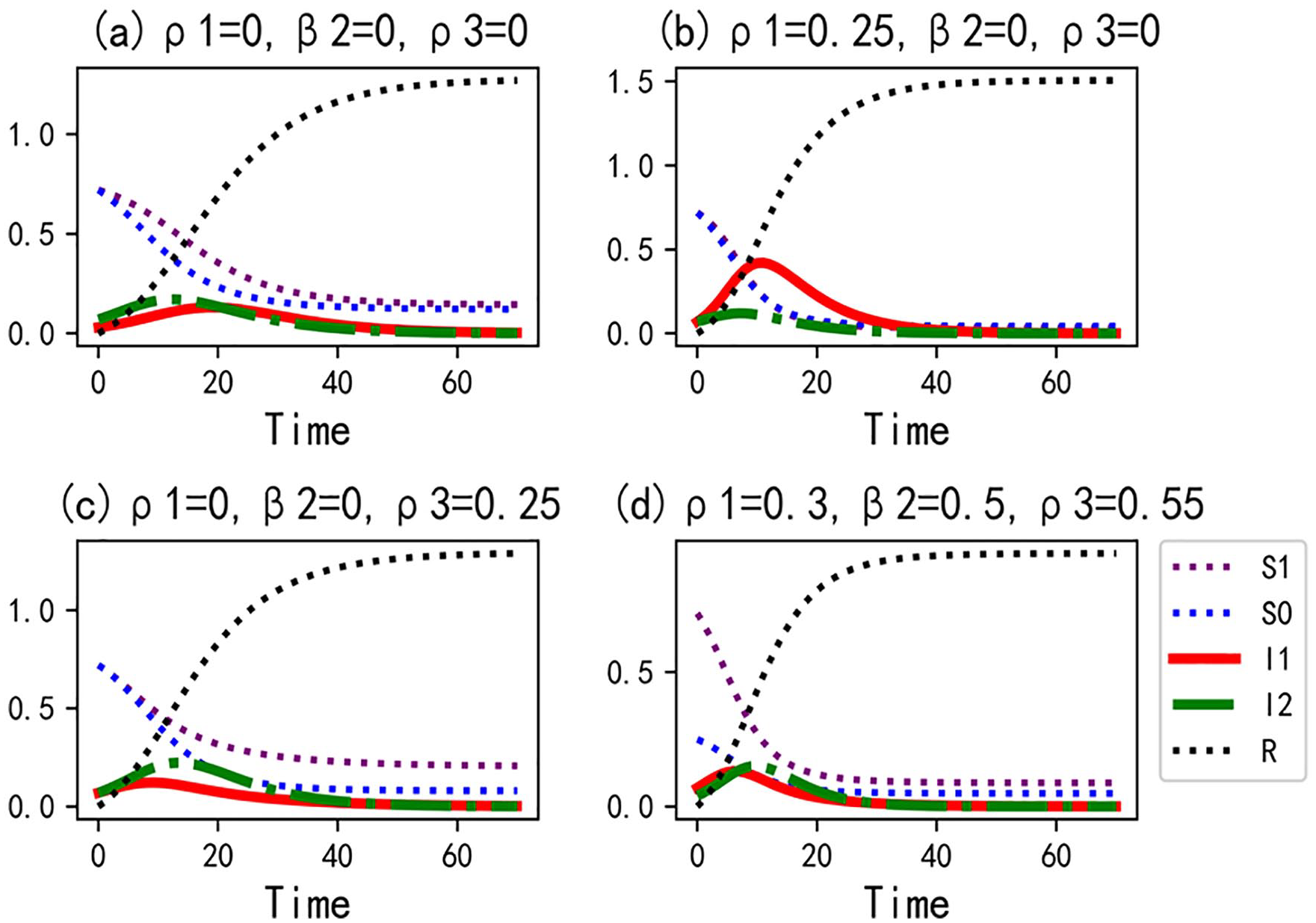
The influence of the horizontal and vertical evolution rate on the state of public opinion derivation: (a) ρ1 = 0, β2 = 0, ρ3 = 0, (b) ρ1 = .25, β2 = 0, ρ3 = 0, (c) ρ1 = 0, β2 = 0, ρ3 = .25, and (d) ρ1 = 0, β2 = .5, ρ3 = .55.
Figure 4(a) shows that when there is no derivation effect in the system, both events have undergone evolutionary processes of formation, fermentation, digestion, and regression (Zheng, 2019). In the model simulation, the initial value of the I1 community is 0.03, and the initial value of I2 is 0.07. Other initial values and conversion rates are consistent. Figure 4(a) shows that the I2 community with a larger initial value reaches its peak at an earlier time, and its peak value is greater than the one of community I1.
Figure 4(b) shows that when horizontal evolution rates are ρ1 = .25 and β2 = 0, and vertical evolution rate is ρ3 = 0, only topic I1 has horizontal evolution of S0, and topic I2 does not have horizontal evolution nor vertical evolution. It also shows that the peak value of the topic community in the presence of horizontal evolution is much higher than that of the same initial state without horizontal evolution, and the fermentation period is much longer, that is, the horizontal evolution makes the communicator’s community expand.
Figure 4(c) shows that when the horizontal evolution rate is set to 0 and the vertical evolution rate is ρ3 = .25, there is only vertical evolution. The community I2 has been expanded to some extent when only vertical evolution exists, and the outbreak period and fermentation period of the event are delayed. Compared with that when only horizontal evolution exists, the scale of community expansion is not as obvious as that of horizontal evolution. The life span of events is not far apart, but the community derivation cycle shows a slower characteristic.
Figure 4(d) shows that the initial state and parameters of the community are {β1 = .4, β2 = .45, ρ1 = .25, ρ2 = .6, ρ3 = .55, γ1 = .15, γ2 = .25, 0 = .25, S1 = 0.72, I1 = 0.07, I2 = 0.0.4}. The peak value of topic I2 in the high-level equilibrium state is not as good as the one when only the vertical evolution exists. The expansion of the topic I1 is also significantly limited, which is associated with the possibility of multiple infections in susceptible communities that is more consistent with the actual situation.
The impact of the initial state of horizontal and vertical evolution
The initial state in horizontal evolution refers to the distribution state of communities S0 and S1. For the topic I1, the existence of the S0 community is an important prerequisite for horizontal evolution. The proportion of S0 in the system affects the horizontal evolution. It is similar to the topic I2. The initial state in vertical evolution refers to the distribution state of communities I1 and I2 with different public opinion tendencies in a similar event or an event within a period of time. It examines the derivation of public opinion tendencies, and the impact of the proportion of the two types of topics on vertical evolution.
When both horizontal and vertical evolutions exist, the impact of the initial states of S0 and S1 on the comprehensive evolution are shown in Figure 5. The values of parameters are β1 = .4, β2 = .5, ρ1 = .3, ρ2 = .4, ρ3 = .55, γ1 = .15, γ2 = .25, the values of initial state A = {S0 = 0.25, S1 = 0.72, I1 = 0.07, I2 = 0.04}, and values of the initial state B ={ S0 = 0.5, S1 = 0.72, I1 = 0.07, I2 = 0.04}. It shows that when the conversion rate is the same and the community S0 of similar events is larger, the peak of topic I2 at the advanced equilibrium state is larger. It means that when the proportion of initial state of similar events is larger, it can promote the change of the topic of public opinion to a greater extent. For example, in Table 1, from 2013 to early 2014, the public mainly discussed the general practice of children’s medication dosage and storage on the platform, which only promoted the emergence of the topics of children’s safety songs and professional science medication knowledge in 2014. In September 2016, the “White Paper on the Children’s Medication Safety Survey” stated that improper use of drugs caused about 30,000 children to become deaf in China every year. A series of events, such as global public issues, prompted the National Health and Family Planning Commission to accelerate the development of major new drugs and increase the urgently needed varieties of children’s drugs in October 2017.

Impact of initial states of S0 and S1 on the comprehensive evolution.
When both horizontal and vertical evolutions exist, the impact of the initial state of I1 and I2 on the comprehensive evolution is shown in Figure 6. The parameters are set as the initial state C = {S0 = 0.25, S1 = 0.72, I1 = 0.07, I2 = 0.04}, and the initial state D = {S0 = 0.25, S1 = 0.72, I1 = 0.05, I2 = 0.04}. It is observed that when the conversion rate is the same and the initial proportion of the topic I1 is relatively small, the expansion range of the topic I2 is larger. The first-level public opinion community is smaller, which is more beneficial to the development of the second-level public opinion community. However, comparing to the impact of similar events in Figure 5, its promotion of topic conversion is relatively small. The negative emotion of the public regarding children’s medication knowledge is lower than that of social events, and therefore, it is much easier to use third-party intervention to convert the public’s emotional tendency. For example, the conversion of topic tendencies from 2013 to 2014 is not as great as that from 2016 to 2017. This is mainly due to the discussion of common events at the early stages, where the third party involved was the science expert. However, in the later stages, many social events appeared uninterrupted, and the impact of similar events increased significantly. The third party involved in these stages was the National Health and Family Planning Commission, who issued a new policy.

Impact of initial states of I1 and I2 on the comprehensive evolution.
The impact of horizontal and vertical evolution rate
The vertical evolution rate determines the possibility of substitution between the topic communities, whereas the horizontal evolution rate determines the possibility of the susceptible community conversion into a communicator community.
Figure 7 provides the simulation results when the initial values of community are set as {S0 = 0.5, S1 = 0.72, I1 = 0.05, I2 = 0.04}, and the vertical evolution rate is 0.25 and 0.55, respectively. It is observed that the topic I1 dominated at the beginning, however, with the development of the community, topic I2 gradually replaced the dominance of I1. The peak value of I2 with a larger vertical evolution rate is much higher than the peak value of I1; the vertical evolution rate has a greater impact on the comprehensive evolution, which can promote the development of public opinion tendency to an advanced equilibrium state.

Impact of vertical evolution rate on synthetic derivation.
When the emotional tendency of the first-level topic community is easily infected and affected by the second-level topic community, the topic I2 has a high possibility to replace I1, and to obtain a larger advanced public opinion tendency community from the fermentation period to the digestion period of public opinion evolution. For example, in February 2020, the Guangzhou Women and Children’s Medical Center received and cured a 2-month-old COVID-19 patient. As the child’s condition improved, the public’s focus on the Center gradually changed from worry to happiness, and the topic was also converted to high-level issues of child health protection and pediatric reliability.
As for I1, ρ1 of S0 is the horizontal evolution rate; for I2, β2 of S1 is the horizontal evolution rate; therefore, the four evolution rates need to be divided into two groups. Figure 8 shows the simulation results when the values of the initial state are the same as above; the horizontal evolution rate at Group E = {β2 = .45, ρ1 = .35}, the horizontal evolution rate at Group F = {β2 = .55, ρ1 = .25}, and the vertical evolution rate is 0.25. Group E means that the susceptible community is less likely to convert to I2, and it is more likely to convert to I1—in other words, the similar events are more relevant for the topic I1. Group F means that the susceptible community is more likely to convert to I2, and the possibility of conversion to I1 is low—in other words, the similar events have a high correlation for the topic I2. Figure 8 shows that when the vertical evolution rate is not high, once the horizontal evolution rate of the topic I2 is low, it may lead to the communities of the two topics to be similar. If the horizontal evolution rate of topic I2 is higher, the development of the community is more likely to reach an advanced equilibrium. For a certain topic, the higher the correlation between events is, the faster the scale of public opinion on the topic develops. For example, Johnson & Johnson’s children’s medicine had been exposed with safety issues, while China has not been included in the recall. When the Johnson & Johnson talcum powder saw a carcinogenic turmoil overseas in May 2016, the brand was questioned and plunged into greater public opinion turmoil.

Impact of horizontal evolution rate on synthetic derivation.
Concluding Discussion
This paper collects data related to pediatric care from the Weibo platform in the form of users’ postings, and extracts the emotional information from the text. Based on the emotional classification and emotional value calculation results, the monthly emotional value of microblog text is aggregated, and the change of emotional value in the annual span is obtained. The change in the public’s attention to the pediatric field from the time dimension, and the emotional tendency of the public’s opinions, are analyzed. The findings from this research can benefit medical decision makers, medical practitioners, and other social actors with regard to the improvement of the doctor-patient relationships.
Through this research, we have identified that in recent years, the core of the public’s attention in the field of pediatrics is children’s medicines, including the safety of medicines, storage methods, dosage judgment, and the creation of types of urgently needed products. To explain the large variations in public emotion in earlier years, we turn to two potential reasons: First, Weibo users or the Weibo platform deleted part of the posts or hid the original content, so that the amount of early data is less. Second, the public did not conduct extensive discussions on a specific pediatric event on the Weibo platform in the early days, and mostly focused on popularization of science and online consultation. From an annual perspective analysis, we find that local emotional changes generally develop from short-term negative to long-term positive in the following months, which may be related to the resolution of negative social events or related policies.
Moreover, this study combines Natural Language Processing, mathematical epidemic theory, communication theory, and public opinion theory in order to conduct an evolutionary analysis of the comprehensive evolution of public opinions in the field of pediatric care. The research results show that the correlation between general domain events is relatively large, resulting in a comprehensive evolution between related topics. When the public’s opinion evolves, the evolution effect of the community has a greater impact on escalating issues and strengthening social emotions.
Our results indicate that the existence of similar events can promote the development of current events, inciting the public opinion tendencies, making the fermentation time of events longer than that of general social events, and lengthen the duration of social events in the public attention. The superposition effect of similar events strengthens social emotion. If the intervention of a third party does not solve the essential problem of the event, a good conversion of the topic cannot be achieved. After that, when similar events occur again, the superposition effect of similar events is further strengthened, and the phenomenon of out-of-control public opinions on the internet may occur, which would increase the difficulty of governance.
The conversion of the topic community is relatively slow, and the effect of vertical evolution on the state of public opinion is slightly weaker than that of horizontal evolution, but the conversion of the topic is toward a high-level equilibrium state, which promotes the resolution of events. Besides, the horizontal evolution mainly shows the expansion of similar tendencies, which means that the vertical evolution is more meaningful. In addition, when multiple events and topics exist at the same time, the tendency of similar events has a dominant significance for the equilibrium development. And the proportion of the initial dominant emotional topic has a greater impact on the development of the public opinion tendency in the later period. If the third party’s intervention is not deep or not fundamentally resolving the focus event, this may make it difficult for public opinions to develop to an advanced equilibrium, and the difficulty of public opinion governance may increase when similar events occur again. When a third party is involved in a social event with greater impact, appropriate changes in the vertical evolution rate can prevent public emotions from developing in an uncontrollable direction, such as an effective statement or relevant policies issued by the government. In addition, the changes of the public concern would also spontaneously change the vertical evolution rate, making the topic change greatly.
In the two aspects of text sentiment analysis and public opinion evolution analysis, the existing literature mainly focuses on a single aspect of research. However, based on the results of text sentiment analysis in a specific field, there are relatively few studies on the comprehensive evolution of public sentiment in this field. Therefore, we focused on the field of pediatric care, combined with the results of emotional tendency analysis of online texts and theoretical research on the comprehensive evolution of public opinion, and analyzed the development trend of public opinion, influencing factors and effective intervention methods.
However, there are some shortcomings in the research process, mainly including three aspects: First, the data obtained is not comprehensive enough to fully cover the entire public opinion related to the pediatric field in recent years. It is likely that not all relevant events are included in the keywords set in the experiment. Besides, there are operations such as deleting blog posts and restricting reading on the Weibo platform, which can result in a lack of data, especially in earlier years. Second, the emotional analysis is not carried out from the perspective of spatial dimension. This is because the platform selected is the mobile microblog, and the geographic information of each blog post is missing. Third, the relationship between social events and data is not established in the research of public opinion evolution effects, but the development of public opinions is mainly summarized from the simulation results.
Future work should collect and analyze big data relating to relevant events, and should study the evolution of public opinions. The effective data needs to be extracted and transformed to further improve the public opinion comprehensive evolution model.
Footnotes
Author Note
The frequent occurrence of doctor-patient disputes in pediatrics departments in China has led to more public discussions. This paper analyzes the changing rules of emotional tendency and the evolutionary characteristics of public emotional events. The results of the study show that: (1) The Chinese public’s attention in the field of pediatrics in recent years is focused on children medicine; (2) Emotional tendencies show a small fluctuation, and the positive emotions are mainly stable; (3) When the public opinion evolves, the derivative effect of the community has a great effect on the topic escalating and social emotions strengthening; (4) Other relevant events could promote the fermentation of current events, making the expansion of the topic larger and longer. Research on pediatric doctor-patient online public emotional events is beneficial to the public’s key needs for pediatric medical care, and provides effective information for stakeholders to effectively monitor and guide public emotional events.
Availability of Data and Materials
The datasets used and/or analyzed during the current study are available from the corresponding author on reasonable request.
Declaration of Conflicting Interests
The author(s) declared no potential conflicts of interest with respect to the research, authorship, and/or publication of this article.
Funding
The author(s) disclosed receipt of the following financial support for the research, authorship, and/or publication of this article: The first two authors of this research were partially funded by (National Natural Science Foundation of China) grant number (71901218).
