




Abstract
Nigerian English (NigE), like other new Englishes, possesses its unique features at various domains of phonology. This article examined aspects of connected speech processes (CSPs), the phenomena that account for sound modifications and simplifications in speech, with a view to establishing features that characterize Standard NigE connected speech. Natural phonology (NP), which provides explanations for substitutions, alternations, and variations in the speech of second language speakers, was adopted as theoretical framework. The subjects of the study were 360 educated NigE speakers, accidentally sampled from different language groups in Nigeria. The CSPs found in their semi-spontaneous speeches were transcribed perceptually and analyzed statistically, by allotting marks to instances of occurrence and converting such to percentages. Three categories of CSPs were identified in the data: dominant, minor, and idiosyncratic processes. The study affirms that only the dominant CSPs, typical of NigE speakers, are acceptable as Standard Nigerian spoken English.
Introduction
Speech is not just sounds in isolation, but a continuous sequence of words through which phonemes are connected, grouped, and modified in a certain manner. Native speakers of English, in particular, do not pick and choose their words, but link them together in a stream of sounds. This makes it possible for them to speak quickly and fluently. In the course of speaking, single words, which ordinarily are pronounced distinctly in isolation, undergo a number of context-induced phonetic modifications, especially at word boundary. The less prominent consonants, vowels, or whole syllables in words may be modified or totally dropped; adjacent sounds may become more like each other or a sound may be inserted to allow for speech fluency (Kerswill, 1985). Sometimes, the change may be so complex that it does not even reflect the sound’s properties. To buttress this claim, Nolan and Kerswill (1990) provide the example of an utterance: I don’t suppose you could make it for five, transcribed phonemically as /ai deunt sǝpǝuz ju: kʊd meik it fɔ: faiv/, but which becomes /nspeuӡxebme:xif̩faiv/ when rendered in fluent and fast speech through the processes of reduction, lenition, assimilation, and deletion. The phenomena that account for such sound alterations and modifications are known as connected speech processes (Nolan & Kerswill, 1990). These are various types of assimilation, elision, reduction, lenition, liaison, epenthesis, juncture, smoothing, and so forth.
Besides being associated with articulatory economy (Abercrombie, 1967; Foulkes, 2006) and operations of aerodynamic principles in the vocal tract (Ohala, 1983), the occurrence of most of these CSPs has been observed to be language, variety, or dialect-specific: each language, variety, or dialect appears to have its set of rules that regulate their occurrence (Byrd, 1994; Kerswill, 1987; Laver, 1994; Lindblom, 1963; Nolan & Kerswill, 1990). For instance, French permits the kind of regressive assimilation of voice in which a word-final voiceless consonant usually becomes voiced if followed by a voiced sound, for example, avek/ becomes [aveg] in the phrase “avec vous”: [aveg vu]. However, Standard British English does not allow this type of regressive voicing assimilation. What is rather commonly acceptable is devoicing whereby a word-final voiced consonant becomes voiceless when followed by a word beginning with a voiceless sound, for example, “I have to” is pronounced as [aɪ hæf tu:], not as [aɪ hæv tu:]; nice voice as [naɪs vɔɪs], not as [naɪz vɔɪs].
Kerswill (1987) also reveals how CSPs in Durham English are significantly different from those of received pronunciation (RP). According to him, Durham English permits the regressive voicing assimilation similar to what obtains in French, whereby the phrase “this village” is realized as [dɪz vɪlɪʤ] rather than [dɪs fɪlɪʤ] as in RP. Conversely, it is uncommon to find, in Durham English, cases of regressive assimilation of place whereby there is a loss of word-final alveolar sound as in RP, for example, “had been,” usually pronounced as [hæbi:n] in RP, is commonly realized as [haedbi:n] in Durham English.
In view of this and pursuant to the wide agreement of scholars on the existence of a variety of English called Nigerian English (NigE) in dire need of definition, characterization, standardization, and codification, it becomes pertinent to examine the disposition of its speakers not only to segmental features but also to CSPs. It is against this backdrop that this study investigated aspects of CSPs of NigE speakers, with a view to establishing Standard NigE CSPs and, by extension, Standard Nigerian spoken English.
CSPs in NigE
Much research effort has been expended by scholars (e.g., Adetugbo, 2004; Atoye, 1991, 2005; Awonusi, 2004; Jowitt, 1991, 2000; Oladipupo, 2008) on describing NigE at both segmental and suprasegmental levels with a view to providing bases for its standardization, but little attention has been paid to what happens to sounds when they combine in speech; that is, CSPs. Few studies in this regard are, however, agreed on certain crossword phonological processes that characterize connected speech in NigE. It has been established that NigE demonstrates tendency for regressive assimilation, for example, in case [iŋ kes], not possible [nɒp pɒsibul]; devoicing of final segments, for example, the dog’s mine [dɔgz̥], He’s a nice boy [his]; and consonant elision, for example, don’t buy [don˺ bai], test drive [tεs˺ draiv] (Awonusi, 2004; Jibril, 1982; Josiah, 2009; Laver, 1968; Oladipupo, 2014; Simo Bobda, 2007).
Laver (1968), in particular, claims that NigE exhibits extensive cases of assimilation of place across word or morpheme boundary, for example, hard blow [hab blo], goodbye [gub bai], and allows regressive voicing assimilation, for example, get back [gεb bak], make them [meg dεm], whereas RP does not. Jibril (1982), however, discovers that only nasals undergo assimilation of place in NigE, for example, government council [gʌvməŋ kausl], man power [mam pa:wa:]. Besides, he found that cases of assimilation of manner that affect alveolars are regressive and involve the change of /d/ and /n/ to liquids, for example, would like [wul laik], and that regressive assimilation of voice affects final plosives only, which become devoiced or voiced before a word beginning with voiceless or voiced consonant as the case may be, for example, with the [wid di]. Also, Awonusi (2004) and Simo Bobda (2007) claimed that r-liaison is rare in NigE, for example, four o’clock [fɔ ɔklɔk] and far away [fa ewe].
However, these studies were limited to mere identification of the crossword processes observed; they did not reveal the extent of their usage in NigE. This is the gap the present study intends to fill. It attempts to identify, quantify, and categorize NigE CSPs according to their usage levels, with a view to establishing processes that characterize Standard NigE connected speech.
Natural Phonology (NP)
NP, a brainchild of Stampe (1973, 1979), is an attempt to provide phonetic explanation for phonological systems. The theory is built on the notion that phonological phenomena are “governed by natural forces in human systems of vocalisation and auditory perception” (Grunwell, 1997, p. 37). It presents the focus of phonology as the discrepancies between perceived and intended sound and the actual, pronounced sound (Donegan & Stampe, 1979). Central to NP, therefore, is the concept of universal phonetically motivated phonological processes. According to Stampe (1979), A phonological process is a mental operation that applies in speech to substitute, for a class of sounds or sound sequences presenting a specific common difficulty to the speech capacity of the individual, an alternative class identical but lacking the difficult property. (p. 1)
These processes are results of innate human tendencies to respond to the difficulties of speech by simplifying difficult sounds. On account of aerodynamic principles, some sounds are more natural than others. Such more natural sounds are easier to produce and are attested in more languages (Edwards & Shriberg, 1983). For instance, it takes much more effort to produce a voiced stop than it does to produce a voiceless one. So also, it is more difficult to produce a voiced velar stop than an alveolar one. The easiest of the three is a bilabial stop (Dziubalska-Kołaczyk, 2007). Thus, for reasons of articulatory ease, a child will choose to substitute voiceless plosives for voiced or nasalize vowels before nasal consonants (Clark & Yallop, 1995). According to Dziubalska-Kołaczyk (2007), processes allow for these substitutions so as to “adapt the speaker’s phonological intentions to his/her phonetic capacities as well as enable the listener to decode the intentions from the flow of speech” (p. 71).
Phonological processes are, thus, phonetically motivated and not rule governed as generative phonology proposes. Besides, they are universal (motivated in all languages and all speakers) in view of the universality of human vocal and perceptual apparatus and common capabilities to react to speech difficulty. However, their application is language specific (Dziubalska-Kołaczyk, 2007). Acquiring the phonology of a particular language, therefore, requires learning to gradually constrain, suppress, or order the application of these processes rather than following rules. Donegan and Stampe (2009) are of the opinion that the inability to fully suppress a process by a child, as well as an adult learner of a second language, consequently results in frequent sound change, variable pronunciation, or a speech defect. According to them, such active processes are what “govern allophony, variation, automatic alternations, one’s native accent, and one’s ‘foreign’ accent in second-language learning” (Donegan & Stampe, 2009, p. 1).
NP is, therefore, adopted for this study because it accounts for such substitutions, alternations, and variations usually found in the speech of second language speakers, which consequently define their nonnative accent, as the case is with NigE speakers. However, the theory has not been spared of criticism. It is particularly faulted on the grounds that it reduces all phonology to mechanical, phonetics factors; whereas, as Anderson (1981) opines, language is not just a function of aerodynamic operations but also of the human mind (as cited in Jibril, 1982). This and other criticisms notwithstanding, NP, no doubt, has improved the knowledge of how language functions, and has practical applications to acquisition of second language within which purview the present study is carried out. It, particularly, provides a means of accounting for the second language speaker’s systematic patterns of deviation.
Method
Three hundred and sixty educated Nigerian speakers of English, accidentally sampled from different language groups in Nigeria, produced a semi-spontaneous speech, containing 31 utterance items and a short passage, into digital recording devices. To ensure approximation to natural speech, corresponding questions were constructed to guide each of the 31 utterances, on the basis of which the researcher engaged each subject in a question-and-answer session in a manner that resembled casual conversation. The subjects were also instructed to read the short passage in a natural and casual way possible. The initial attempt was recorded and then played back to verify whether the conversation resembled casual and natural speech. The final recording was then made after the researcher had felt satisfied with each subject’s performance. The recordings were later played back and instances of CSPs identified at different word and morpheme boundaries in the data were transcribed perceptually and analyzed statistically, using percentages. Each variant of pronunciation in each boundary context was allotted one mark; the total scores for all subjects in each variant were then converted to percentages. The phonetic symbols used for transcription reflect NigE pronunciation as identified by scholars (e.g., Adetugbo, 2004). The boundaries identified are as follows:
Word boundaries where a voiced obstruent precedes a voiceless one: cho
−Boundaries where the reduced form of the third person singular of verb be is preceded by a voiced segment at word-final position: sh
−Word boundaries where a voiced obstruent is preceded by a voiceless one: she wore a bla
−Word boundaries where /t/ is followed by bilabial stops /p, k/, and /d/ by velar stops /g, b/: me
−Word boundaries where alveolar nasal /n/ is followed by bilabial or velar stops: there are t
−Word boundaries where /s, z, t, and d/ are followed by the palatal glide /j/: you will m
−All word/morpheme boundaries involving /t, d/ before another consonant: doesn’
−In between two adjacent vowels at word boundaries, for example, Pete
Data Analysis
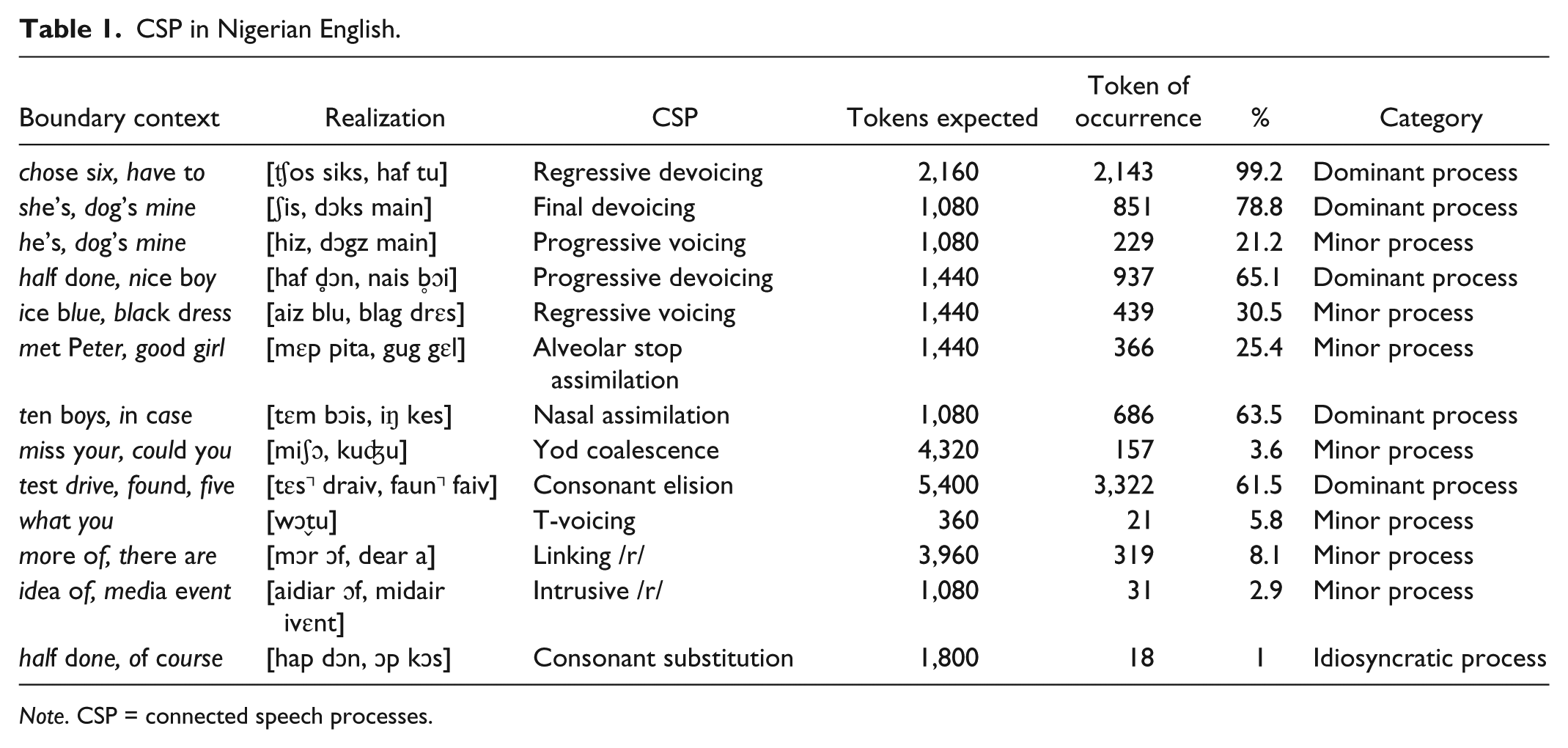
Table 1 contains the results of the CSPs observed at different boundaries identified above, as produced by NigE speakers; their tokens of occurrence, and categorizations.
CSP in Nigerian English.
Note. CSP = connected speech processes.
Table 1 shows that at word boundaries where a voiced obstruent precedes a voiceless one, 99.2% incidences of regressive devoicing were observed, for example, [ʧos siks] we chose six player, [hɑf tu] I have to go. Final devoicing applied 78.8% at word-final position where the reduced form of the third person singular of verb be is preceded by a voiced segment, yielding [ʃis] she’s a good girl, [dɔks main] dog’s mine, and so forth, while there were 21.2% occurrences of progressive voicing, for example, [hiz] he’s a nice boy, [dɔgz main] the dog’s mine, in the same boundary environment. At a word boundary where a voiced obstruent is preceded by a voiceless one, progressive devoicing, for example, [hɑf d̥ɔn] half done, [nais b̥ɔi] nice boy occurred 65.1%, while regressive voicing, for example, [aiz blu] ice blue, [blag drεs] black dress was observed 30.5%. Alveolar stop assimilation was employed 25.4% at word boundaries where /t/ is followed by bilabial stops /p, k/ and /d/ by velar stops /g, b/, for example, [mep pita] met Peter, [gug gεl] good girl. At a word boundary where alveolar /n/ is followed by bilabial or velar stops /b, p, k/, subjects showed 63.5% tendency for nasal assimilation, for example, [tεm bɔis] ten boys, [iŋ kes] in case.
Yod coalescence showed only 6.2% occurrences at word boundaries where /s, z, t, and d/ are followed by the palatal glide /j/, yielding [miʃɔ] miss your, [kuʤu] could you; while t-voicing, a process whereby intervocalic /t/ is realized as a voiced tap rather than a voiceless plosive (Hannisdal, 2006), occurred 5.8% in [wɔt̬u] what you in lieu of yod coalescence. Consonant elision occurred 61.5% in boundary contexts involving /t, d/ before another consonant, for example, [tεs˺ draiv], test drive, [faun˺ faiv] found five. In between two adjacent vowels at word boundaries, linking /r/ was employed 8.1%, for example, [mɔr ɔf] more of, [dear a] there are; while intrusive /r/ occurred 2.9%, for example, [aidiar ɔf] idea of, [midiar ivεnt] media event, as linking devices. Consonant substitution (the realization of /p/ as /f/ in Hausa—a Nigerian indigenous language), for example, [hap dɔn] half done, [ɔp kɔs] of course was employed 1% in the environments of /f, v, p/ at word boundary.
Discussion
An analysis of the semi-spontaneous speeches of NigE speakers revealed different phonological processes that characterize connected speech in NigE at varying degrees. These CSPs can be categorized into three levels: dominant, minor, and idiosyncratic processes. The first category comprises regressive devoicing (99.2%), final devoicing (78.8%), progressive devoicing (65.1%), nasal assimilation (63.5%), and elision (61.5%). These CSPs, as shown by their percentage scores, are prevalent in NigE and cut across ethnic and social considerations. Included in the second category are processes attested to a lesser degree in NigE; these are progressive voicing (21.2%), alveolar stop assimilation (25.4%), regressive voicing (30.5%), yod coalescence (3.6%), t-voicing (5.8%), linking /r/ (8.1%), and intrusive /r/ (2.9%). They are regarded as minor processes, not because they are deviant forms (they are actually prestigious or native English CSPs, except regressive voicing, which is not attested in RP) but because they are used sparingly by a minority of speakers and not as prevalent as those in Category 1 (dominant processes).
Consonant substitution (1% )makes the third category. It is a purely idiosyncratic deviation from native English speech articulated by very few speakers and smacks of ethnic coloration and mother tongue deficiency. This feature of speech is peculiar to speakers from the northern part of the country, where /p/ is substituted for /f/ and vice versa, obviously, due to the influence of Hausa, which is more or less a lingua franca in that region. It is on record that the articulation of /p/ and /f/ poses difficulty to Hausa speakers who, according to Jowitt (1991), frequently realize /p/ as [f] and /f/ as [p] as [p], [f], and [Ф] are allophones of /p/ or /f/ in Hausa.
It follows from the above categorization that NigE speakers tend toward CSPs that are more natural (require less articulatory effort), common, and attested in more languages, and those involving sound segments or features that are easily accessible in their indigenous languages. This is because most dominant CSPs favor devoicing, homorganic nasal assimilation, and deletion. This corroborates Ellis’s (1985) claim that second language learners always attempt to simplify the patterns of the target language. Besides, it justifies the phonetic explanations of NP (adopted for this study) for the substitutions, alternations, and variations of second language speakers in their bid to master the target language. In this regard, NigE speakers had to simplify the target sounds by employing more natural sounds and phonological substitutions, where necessary, in an attempt to match the native pronunciation model.
One other implication of this is that some of the discoveries made by earlier scholars are not as categorical as we were made to believe. For instance, Laver’s (1968) claim that NigE allows regressive voicing assimilation did not absolutely capture the reality of this CSP in NigE. As shown in this study, this process is not a dominant feature of NigE CSPs; only a minority of speakers use it.
Conclusion
In view of the scholarly quest for the identification of Standard Nigerian spoken English, this study affirms that only the dominant processes can be considered as Standard. This is in view of the fact that they are widespread and typical of NigE speakers and, at the same time, acceptable to all categories of speakers regardless of ethnicity or other social considerations. However, this cannot be said of the other categories. Minor processes, though mostly exhibit native forms, are restricted to a very small percentage of speakers and are not always socially acceptable, as they elicit negative reactions. According to Bamgbose (1971), “many Nigerians will consider as affected or even snobbish any Nigerian who speaks like a native speaker of English” (p. 41). Idiosyncratic process, however, deviates completely from the native norm, is ethnic biased, and may threaten intelligibility.
Footnotes
Declaration of Conflicting Interests
The author(s) declared no potential conflicts of interest with respect to the research, authorship, and/or publication of this article.
Funding
The author(s) received no financial support for the research and/or authorship of this article.