




Abstract
Written English is one area in which Nigerian linguists and grammarians do not accommodate variations of spelling for any sociolinguistic reason, even though they at times misspell or forget the spelling of some confusing words. Most people agree that English spelling system is problematic and therefore needs urgent reform, but who bells the cat? This article examines the English spelling system against the backdrop of Educated Nigerian English and the concept of nativization, stressing the need for reform or nativized spelling in Nigerian English. Questionnaires, library research, and the Internet were used to gather data for this study. The qualitative approach has been adopted in the main for the interpretation of data. The educated Nigerians studied admit that the English spelling system is in part so confusing that they misspell words at times. Therefore, they support the reform or nativization of English spelling. Consequently, this article presents and illustrates proposed reformed spelling by deleting redundant letters, unnecessary clusters of letters, dropping useless silent letters, regularizing digraph, and spelling compound words in one form only. These changes will enhance spelling skills, teaching, reading, and writing in English as a Second Language.
Introduction
This article looks at the English spelling system against the background of Educated Nigerian English (ENE), stressing the need for the nativization and reform of English spelling to distinguish the variety called ENE from Standard British English (SBE) and American varieties and to enhance teaching and learning written communication in English as a Second Language (ESL) settings. ENE application of spelling rules and punctuation marks has consistently remained British and sometimes American. All variations of spelling in ENE that do not conform to SBE or American spelling are treated as errors. Yet, spelling is a major aspect of language mechanics that poses an intractable challenge to educated Nigerians. From the primary school to the university level, students and scholars make concerted efforts to achieve mastery in spelling. In addition to concord errors, spelling errors annoy examiners and receive institutionalized penalty during English language paper examining in the West African Examination Council (WAEC), National Examination Council (NECO), General Certificate Examination (GCE), and in language and communication-based fields of study in higher institutions. Usually, half a mark is deducted for any error of spelling. While some morphological, syntactic, and semantic variations may be condoned in ENE, spelling variations are treated as errors. Nevertheless, a critical examination of the situation shows that the same psycho-sociolinguistic factors that cause grammatical and semantic variations also cause spelling variations. Hence, this article critically examines the challenge of spelling in Nigerian English (NE) in particular and World English in general. Several research questions guided the examination of issues in this article: Do educated Nigerians misspell English words? Do educated Nigerians support spelling reform or nativization? What sorts of spelling reform do educated Nigerians prefer?
Method
Observation, interview, and questionnaire were used to generate data from educated Nigerians in 10 federal government owned universities across Nigeria from 2005 to 2012. First, the common, habitual way in which educated Nigerians spelt some words was observed during this period. Second, some of the words were used to construct some questionnaires with general closed-ended questions on the nature of English spelling. The interviews, which were unstructured, took the form of dictation from class to class in the 10 universities visited: Ahmadu Bello University, Zaria, Bayero University, Kano (North); University of Lagos, Federal University of Technology, Akure (West); University of Nigeria, Enugu Campus, Nnamdi Azikiwe University, Awka (East); University of Ilorin, Ilorin, and University of Abuja, Federal Capital Territory (Middle-belt); University of Benin, Benin City, and University of Port Harcourt, Port Harcourt (South-South). The selection of these universities was informed by their strategic locations across Nigeria and the fact that they use a Nigerian Federal Government policy called “Quota System,” or “Federal Character,” to admit students from “catchment areas” and all the regions of Nigeria.
Subjects aged between 19 and 70 years were tested from professors, lecturers, and final year students of English and Literature, Linguistics, and Communication Departments who were considered, or should be, models of English use and usage in Nigeria. The questionnaire was an adaptation or nativization of Robert Baker’s 1979/1980 questionnaire on spelling reforms. Ten thousand of the questionnaire sheets were collated and analyzed for compound word spelling. The result is presented in a table in simple percentile count with annotations. Some other parameters used were observed currency, ubiquity, and acceptability of the examples documented here among educated Nigerians.
Therefore, the article basically adopted both the qualitative and, to some extent, the quantitative methods. The qualitative approach supports the use of the researcher’s sensitivity and keen attention to linguistic details, which determines how the researcher interprets his or her data. In this regard, keen attention was paid to the corpus of data generated on spelling in particular and the English spelling system as well as the structures of words in general. Conclusion and recommendations were drawn from the responses collated and observed trends.
History of English in Relation to Spelling
Little drops of spelling at different times and from different sources made the present mighty and confusing ocean of English spelling system. Etymologically, the words English and England derive from Anglo, Angles, or the Anglos, a group of Germanic invaders of the British Isle who spoke a Proto-Germanic language called Old English from 500 to 1100 AD (Osakwe, 2011). The varieties of English used during Old and Middle English periods were in a flux until the publication of Samuel Johnson’s A Dictionary of the English Language in 1755, which subsequently established relative stability in the spelling and meanings of words. However, the language is still unstable; for even in Modern English, which started in the 15th century, there are different varieties of successive ages. The socio-political events and conquests of each period heavily influenced the features of its English.
The Anglo-Saxon, Danish Invasions, and particularly the Norman Conquest in 1066, left their linguistic imprints in the English that we use now. The Normans were Vikings in the French Coast who invaded the English Isle, led by William the Conqueror, the Duke of Normandy. There language and culture were French. They overwhelmed England militarily, politically, culturally, and linguistically. Of all the invasions of England, the Norman Conquest influenced the English language more than any other (Jowitt, 2009; Kpolugbo, 2006; Ogu, 1992). Indeed, the conquest gave English many French words that are still used today. Coming with these words were new meanings, spellings, and pronunciations. Brook (1958) said that the Norman Conquest introduced “drastic modification of English spelling to make it conform to the practice of French scribes” (p. 50), a view also shared by Baugh and Cable (1978).
Tracing the origin of writing system, Bloomfield (1934) stated that “learned scribes” did “invent pseudo-archaic spelling” from “antiquated” spelling rules: The words debt, doubt, subtle contained no [b]- in Old French, whence English received them, and were written both in French and in English as dette, doute, sutil; the present-day spellings with b were invented by scribes who knew the far-off Latin antecedents of the French words, debitum, dubito, subtilis. (p. 292)
Kimball (n.d.) is likewise of the view that present-day spellings do not really reflect the history of how the words have always been spelt: We can’t change spellings because the current forms reflect their histories . . . ? The “s” in “island” was not in the original spelling, but was inserted later—and thus is etymologically incorrect. The “b” in “crumb” and “thumb” were intentionally added a few centuries ago as silent letters. So was the “g” in “foreign” and “sovereign” (those two words are completely unrelated to “reign”), the “h” in “ghost,” and the “p” in “ptarmigan.” The “h” and the “y” in “rhyme,” and the use of “ch” in “ache” are similarly spurious (one could make a case for the “c” in “ache” having a historic basis, but the use of the “h” after it is purely spurious). “Iland,” “crum,” “thum,” “forein,” “soverein,” “gost,” “tarmigan,” “rime,” and “ake” are spellings that more closely show the true origins of those words, while the current forms that “look right” are not really showing the correct history. (p. 1)
In addition, other factors like the Renaissance, the Great Vowel Shift, the coming of the printing press to England in 1476 by William Caxton, technology, the Industrial Revolution, imperialism, and so on, introduced many words and strange spellings into the English language (Crystal, 2005). The Great Vowel Shift, for instance, which took place in the end of Middle English, witnessed a set of significant vowel changes and additions. These changes led to major differences between the spelling of Modern English and its pronunciation at present (Udofot, 2010). The present spellings of a number of words reflect the pronunciations of the words in Old and Middle English. The Great Vowel Shift created many phonological rules and caused differences between the articulation of some Modern English words and their spellings (Akmajian, Demers, Farmer, & Harnish, 2006). With the emergence of the Internet, computer and cell phones, and the enormous global reliance on them, new spellings of words have emerged and gradually invaded the territory of formal writing in standard spellings in world Englishes, NE inclusive. For example, some SMS and email writers now find it convenient to spell “you” as “u,” “night’ as “nait” or “nite,” “cook” as “kuk,” and so on.
Nativization of English in Nigeria
The reality has been acknowledged that when a language leaves its native land for a foreign land, it is bound to undergo many sociolinguistic changes and manipulations (Ahwefeada & Ojaruega, 2009; Bamgbose, 1995). Nativization is a term now universally used in linguistics to denote the indigenization of language in a nonnative, second language setting (Kachru, 1992). According to Olatinwo (2009), nativization means, Acculturation or adaptability to new environment; it also connotes naturalization, which is the term used when a person takes up the citizenship of another country where he or she is domiciled. Nativization is therefore a term now commonly used among sociolinguists for describing the indigenization of English in a second language environment. (p. 98)
“Nativisation is a common feature of all institutionalized second language varieties of English” (Igboanusi, 2005, p. 35). Bamgbose (1995) said that nativization of English in Nigeria goes beyond the transfer of Nigerian language features into English. It also includes the creative use of English, “including the evolution of distinctly Nigerian usages, attitudes and pragmatic use of the language” (p. 11). “Indigenization,” “domestication,” “naturalization,” “acculturation,” and “Nigerianisation” are also used to denote nativization of English in Nigeria. In relation to the spelling reform suggested here, a more proper term may be Nigerianization or spelling innovation as the proposed changes in spelling involve the manipulation, deletion, addition, and reorganization of English rules and symbols.
Nigerian English Varieties
Three major typologies are usually used for the categorization of NE varieties; namely, regions, formal education, and sociolinguistics. In terms of regions, there exist different varieties of English in Nigeria: Hausa, Yoruba, Ibo, Efik, Urhobo, and so on. Each regional variety has its linguistic variations, on the one hand, and similarities to the others, on the other hand. Phonological features differentiate regional varieties. With formal education, a number of classifications have been made. Prominent among them are Brosnahan’s (1958), Banjo’s (1970, 1996) and Odumuh’s (1980) Varieties I, II, III, and IV and Adesanoye’s (1973) written Varieties I, II, and III (Sunday, 2008). Banjo’s taxonomy, which is the most popular, uses grammatical features and educational levels to classify NE. Variety I is the lowest, which reflects vulgar errors of grammar and broken structures often used by primary school pupils and those with half-baked formal education. Variety II is an improvement on Variety I. This is the variety that secondary school students and school certificate holders use. Variety III is higher standard spoken by highly educated Nigerians, graduates, teachers, lecturers, and so on. He proposes this model for NE. Finally, Variety IV is native English standard which few Nigerians who were born in native English-speaking countries or have a parent of English origin have acquired as their first language or “half mother tongue,” so to speak (Banjo, 1996). But Variety IV is often regarded as too foreign.
On the sociolinguistic plane, three levels or lects are often depicted: basilect, mesolect, and acrolect (Igene, 1992; Ogbulogo, 2005). The educated Variety III of Banjo, which is also acrolect on the sociolinguistic pyramid, is often recommended or preferred as Nigerian standard. Spelling errors are regular features of all the varieties and lects, particularly the lower varieties, for errors of spelling are reduced in acrolect and the Variety III of Banjo, Odumuh, and Adesanoye, which is ENE.
NE is being nativized in three major perspectives, which are creative, contextual/situational, and linguistic. Many creative attempts necessitated by the desire to or exigency of conveying new concepts and meanings have produced variations which distinguish NE varieties. A few examples are “felabration,” a creative coinage for the annual celebration of Fela Anikulapokuti, the legendary Nigerian musician who died in 1997; “aristo babe” used to denote a girl who dates wealthy older men for money; “federal character” and “zoning,” which denote government and political party policy of sharing national positions and resources equally to all federating units and rotating leadership among Nigerian geo-political zones.
Furthermore, the Nigerian peculiar socio-cultural environment has conditioned the use of some English words and expressions in certain ways. Many indigenous Nigerian language words have been borrowed into English, just as some English words and phrases are carefully selected and bonded to convey Nigerian concepts; for example, “guguru,” “akara,” “second burial ceremony,” “fellow-in-law,” and so on, and many other examples annotated in a paper devoted to neologisms in NE (Teilanyo, 2008).
Linguistic nativization is the highest of the three aforementioned nativization dimensions; for all the features and dimensions of nativization are expressed linguistically. Generally, linguistic nativization occurs at all the levels of linguistic organization and also involves the sociolinguistic habit of language transfer and interference. Linguistic domestication equally includes “intralingual interference features” (Richards, 1984, p. 6) or “the overgeneralization of linguistic rules and semantic features” (Selinker, 1984, p. 37), which Ekundayo (2006, 2012) tagged “intraference”; for example in ENE, the use of “trickish” for “tricky”; “calculative” for “calculating,” “upliftment” for “uplift,” “disvirgin” for “deflower” “convocate” for “convoke,” and so on.
In orthography, however, NE has resisted nativization or Nigerianization. The orthography of NE seems not to brook second language learner variations, for all cases of difference in spelling are treated strictly as errors. Yet, many cases of misspelling abound in NE. The logical question, therefore, is why are unconscious variations of spelling regarded as errors while some variations at the other levels are accepted as emerging NE. Current efforts at indigenizing English ought to be extended to the orthographic level of linguistic organization, particularly the spelling system, a preoccupation of this article. Indigenization spelling is another term for spelling reform, an idea or proposal that many linguists support and oppose.
Criticisms of English Spelling
Complaints about English spelling system have been with us since the Middle English period. “In 1151, John Hart complained of the ‘vices’ of English writing, which cause it to be ‘learned hard and evil to read’” (Crystal, 2005, p. 215). Ferdinand de Saussure (1966) called the English spelling system “an edifice of confusion,” “inconsistencies,” and “monstrosities” (pp. 23, 31). Bloomfield (1934) said that English writing system is conservative and some word spelling archaic and so ingrained that people are reluctant to reform them. “Sounds which existed when our spelling became habitual, but have since been lost by linguistic change, are still represented in our writing by silent letters, as in name, know, gnat, bought, would.” (p. 292). Firth (1937) also stated that “English spelling is so preposterously unsystematic that some sort of reform is undoubtedly necessary in the interest of the whole world” (p. 48). Many years after Firth’s statement, Jowitt (2008) reechoed his advice by observing that the vocabulary of English “is vast and constantly expanding, but its grammar contains many anomalies and its spelling is notoriously irregular. Perhaps one day the international community will insist on its reform.” (p. 1). In the same vein, Bezrukova (2003) decried English spelling thus: English spelling is so hopeless at representing phonemes that a reform based on virtually any accent would be an improvement for everyone elsewhere. For instance, words like psychology are pronounced by no one as/psychology/. If we were to spell the <ps> as <s> and <ch> as <k>, we could get/sykology/, which is closer to everyone’s pronunciation. Then there are words with <ph> like photograph where everyone says /f/. (p. 1 )
Yule (1991b) also held this view. In a second language situation, like Nigeria, English spelling system is a serious challenge to writing, reading, teaching, and learning. Some studies have shown how differences in pronunciation and spelling wrongly influence each other: Nigerians pronounce some words as spelt and spell them as pronounced. This habit often leads to misspelling and mispronunciation (Awonusi, 2007; Onose, 2003; Schmied, 1991; Soneye, 2008).
Spelling errors that writers often commit are categorized into four types. These are (a) addition of letters, for example, harrassment for harassment; (b) deletion of letters such as embarasment for embarrassment; (c) replacement or substitution as in using the affix -ant for -ent, for example, superintendant for superintendent; and (d) reversing the order of spelling, for example, feaces for faeces (Crystal, 2005, p. 213). A fifth type common in ESL is the mixture of the four types; for instance, this one taken from a student script: buorgioesie for bourgeoisie.
As there are many inconsistencies in the English spelling system, which constrain writers to commit the above-mentioned categories of misspelling at all levels, many linguists have made a clarion call for the reform of the English spelling system, thereby generating arguments for and against the call. Spelling reform is often suggested in two ways: a standardized, regular use of the existing letters of the alphabet and a more radical reform like the one of new and additional letters proposed by Bernard Shaw (Crystal, 2005, p. 215).
The Arguments Against Spelling Reform
Even though many people agree that spelling reform is desirable, it has been argued that it will cause orthographic confusion in teaching and learning, discontinuity and conflict between new and old spellings, and the massive new printing of old works to reflect new spellings. It has been argued that rigorous and effective teaching and drills in spelling can eliminate or minimize confusion (Chomsky & Halle, 1968). Chomsky and Halle (1968) traced failure in spelling to the fact that English spelling system is taught as a faulty phonemic representation instead of as a mixed level system (Baker, 1980).
In addition to these challenges are people’s attitude to new concepts and innovations. Many people are so conservative that once they are used to a particular way of doing things, they vigorously resist any attempt to introduce a new way. This is why people resist or argue against spelling reform.
When the art of writing becomes well established in a community, not only the spellings of words but even lexical and grammatical forms become conventional for written records. This conservatism, as time goes on, works in another way: The conventions of writing remain unaltered even though the speech-forms have undergone linguistic change (Bloomfield, 1934, pp. 291-292).
Another aspect of attitude is lack of unanimity among the exponents and prospective beneficiaries of spelling reform. The questions invariably are (a) Whose model should be used? (b) which type of reform ought to be carried out, a radical one or a regularized type? and (c) which processes and procedures should be adopted? Furthermore, attitudes resulting from people’s accent may lead to the tendency of generating different spellings to reflect different accents.
Arguments for Spelling Reform
On the other side, many socio-educational, economic, and sociolinguistic merits are often given to strengthen the arguments for spelling reform. One of them is that spelling reform will make spelling easier for both children and adults. Reformed and regularized spelling will help slow learners to learn faster. Regularized spellings which eliminate redundant letters and superfluous sound clusters will certainly save the time of writing both manually and mechanically. By extension, the cost of typing, stationery, and logistics will also be drastically reduced. Above all, for the second language users of this study, spelling reform will be of huge benefit to reading, writing, as well as teaching and learning reading and spelling.
The arguments of discontinuity between old and new spellings, which a reformed spelling system will engender, conservatism and having to embark on the printing of old books to reflect new spellings and attitudes are not water-tight. Sometimes in life, discontinuity between the old and the new is inevitable. In the case of spelling reform, there need not be discontinuity, as feared by critics, because many cases of differences of spelling abound in Middle and Modern English, which we recognize. They do not truncate learning; for example, in King James Bible English, say, do, run, and so on are spelt as sayeth, doeth, and runneth. We do recognize them as Elizabethan or King James English spellings.
Also, spending huge resources to reprint old books as a result of reformed spellings would be absolutely unnecessary because we do not have to reprint old books to reflect new spellings. New editions of old books will have to do that. The transition from the old to the new spelling system will automatically become part of the knowledge that we transmit to the next generation. Confusion should not arise from this. All considered, even at present, people learn and use all different types of spellings: normal spellings with the letters of the alphabet, shorthand, technographic (as in computer and special fields) and cryptographic spellings, as in secret intelligence organizations and cults. In usage, writers are able to separate these various spelling systems. So, a reform of the small part of confused spellings in English cannot generate confusion or necessitate the reprinting of old books.
According to Crystal (2005), A widely cited figure is that English is about 75% regular. On the other hand, the 400 or so irregular spellings are largely among the most frequently used words in the language, and this promotes a strong impression of irregularity. (p. 214)
Well, if the 400 most regularly used English words are irregularly spelt, they must logically create a huge picture of a confused spelling system, which ought to be reformed to increase the percentage of regularity from 75% to 100% or more than 90%.
On conservatism, the point must be made that people have always been conservative. Conservatism is part of human nature. However, a new concept or innovation that has inherent values for the general good of all and the spirit of learning must be pursued and realized with greater tenacity. The fact that many reform attempts have been made in the past with some results shows that spelling reform is worthwhile and portends great hopes for future reform attempts.
As for the argument of not teaching orthography as “a mixed level system” but as “a faulty phonemic representation,” it should be borne in mind that no amount of effective teaching of orthography can erase the obvious mismatch between phonemic representation and spellings. Indeed, a number of studies have shown that teaching reading and writing and reading generally by adults and children will be easier in reformed spellings (Seymour, 2001; Upward, 1995; Yule, 1991a). Yule (1991a), for instance, said that “experiments over the last 150 years have shown that English-speaking children could learn to read more easily in reformed spelling than in traditional orthography” (p. 168). Besides, Yule (1991b) has asked a pertinent question in this regard, which she has also answered confidently: “Does the nature of English spelling handicap learners of literacy more than other writing systems trouble their novices? The obvious answer to me, from observation and experience, is yes.”
Some Major Attempted and Suggested Reforms
Following are some spelling reform attempts and suggestions since the 16th century:
These individual efforts proposed radical reforms of the English spelling system. However, some other works proposed conservative or mild reform based on the extant system:
Coincidently, this is the way a variety of Nigerian written communication writes these words, that is, SMS: text messages.
Theodore Roosevelt, the then U.S. president, instructed the “Government Printing Office” to start using the reformed spellings by SSB. However, the U.S. Congress stopped the changes. Yet, some of the changed spellings survived: anaemia/anæmia to anemia, mould to mold, catalogue to catalog, and so on.
(Sources: Alexandra, 1969; Baugh & Cable, 1978; Crystal, 2009; Yule, 1991a, 1991b; www.spelling-society.org/bulletins/aextra1.php).
There are many other individuals and institutional attempts and proposals on spelling reforms at different times. The few efforts that succeeded, like Harry Lindgren’s SR1 and the American experience, clearly indicate that English spellings can be regularized. American spelling reform, which was based on the rules by Noah Webster (1758-1843), regularized the spellings of many words and discarded some redundant letters and silent sound; for example, <-our> is spelt <-or> as in labour for labor, <ph> is spelt <f> as in sulfur for sulphur, <-ae-> is spelt <e> as encyclopedia for encyclopaedia, silent <-ue> at the end of a word after a consonant is dropped as in catalog for catalogue, and so on. Also, SMS text message and email variety of written English is proving convincingly that spelling can be reformed in some ways.
NE and Spelling Variations
The general consensus among Nigerian linguists at present is that NE does exist and flourish. There are expressions one hears everywhere that one goes and at all levels that are proudly NE: There is absolutely no doubt that Nigerian English does exhibit the characteristics demanded by Kachru, NE has come of age and its recognition as an international variety is a foregone conclusion. What is left is a detailed description of its features and a clear statements [sic] from norm setters that due recognition be given to it. This will eliminate the self-consciousness that accompanies usage that has a distinctive Nigerian flavour. (Dadzie & Awonusi, 2009, p. 96)
It should be added that the detailed description of its features must include variations of spelling in ENE; for example, many educated Nigerians spell accommodation as accomodation or acomodation, pronunciation as pronounciation, embarrassment as embarasment, embarassment, and so on. There are many others that can be treated as variations of spelling because Nigerians have extenuating sociolinguistic backdrops for these spellings. Acomodation, for instance, eliminates redundant letters and saves time. Pronounciation reflects the correct spelling of its stem, which is pronounce.
The Great Spelling “Shift”: Who Bells the Spelling Cat and How?
There ought to be a Great Spelling Shift. If the English spelling system is a wild cat that intimidates and confuses children and writers, then we have to bell it. But who bells the cat in Nigerian and other Englishes and how? Belling the cat through spelling reform is not impossible or as difficult as some people think. The challenges in this regard are adamant conservatism and the lack of the educational and political will to do it. Once norm setters are determined to pursue it to its desired conclusion, it would be achieved. The near success of the British attempt in 1949 and 1953, respectively, should be an impetus and the three procedures for spelling reform in the bill could yet be adopted. There were three stages in the said bill:
First, reformed spelling system was to be introduced into primary school curriculum and be taught for 5 years, after which the teaching of old spelling would stop. Second, in the following 5 years, new spellings would be introduced mandatorily into the media, films, and public announcement. Third, new spellings would be compulsory after 10 years in public documents, literatures, and copy right materials. For our purpose, these procedures can be adopted and Nigerianized for NE in the following ways:
The Nigerian Academy of Letters (NAL), Nigeria English Studies Association (NESA), Linguistic Association of Nigeria (LAN), and English Learning and Teaching Association of Nigeria (ELTAN), among other professional bodies, should spearhead the campaign for spelling reform. The campaign and the entire processes should be funded by the Federal Government of Nigeria through the Ministry of Education with which NESA should work as partners for educational advancement. Where the Federal Government is unwilling, NAL and NESA could undertake the project and source for funding from the Nigerian public and willing individuals. The team of scholars on the International Corpus of English (ICE) NE Codification Project should make it part of their terms of reference to look into the nativization or the reform of spelling in NE. NESA should sensitize and liaise with other sister professional bodies like the Literary Society of Nigeria (LSN), National Association of Teachers and Researchers in English as a Second Language (NATRESL), Nigeria Medical Association (NMA), Nigeria Bar Association (NBA), Nigeria Union of Journalists (NUJ), Nigerian Union of Teachers (NUT), among others. Once the criteria, rules, and aspects of the reform have been determined, they should be introduced to the curricula of schools at all levels and should be seriously taught and publicized.
The print and electronic media, Nigerian “Home Video,” also known as Nollywood, should be used to heavily publicize the new spellings of the words affected; for example, newspaper editorials and headlines should be written in reformed spelling. In no time, the reform will sink into the minds of NE writers. Luckily enough, the English spelling system is already reforming itself in the new variety of email and cell phone (textese and emailese) where all redundant letters and unnecessary repetitions of letters are completely eliminated without compromising meanings. Spelling reform can draw some examples from Nigerian SMS and email varieties.
Is Spelling Reform Indeed Necessary?
This article shows that educated Nigerians agree that English spelling system is confusing and irregular and therefore should be reformed. In addition to American spelling alternatives, English spelling system should be reformed to eliminate redundant letters, unnecessary repetition of letters and clusters, regularize digraph, and to spell compound words in one way only.
Analysis
One thousand questionnaires were administered in the University of Benin in 2011. Fifty copies of the questionnaire were shared to lecturers in English and Literature, Linguistics, Foreign Languages and International Studies, and Diplomacy Departments of the University of Benin, Benin City, Nigeria. The remainders were administered to English and Literature students 100 to 400 levels, University of Benin in September, 2011. All the 800 respondents who returned their questionnaires admitted that the English spelling system is in part confusing and therefore clearly suggested spelling reform. They also prefer the American spelling system which is simpler than British spelling in some words and proposed that in addition to American spelling, further reform should be embarked on in NE. Following are some of the American spellings which respondents prefer:
Deletion of Redundant Consonants and Vowels

With the use of computer and ease of spelling these words, many educated Nigerians now mix-up these American spellings with British spellings, which are taught to them regularly.
Elimination of Redundant and Unnecessary Letters in English Spelling
All letters and combination of letters that are of no morphological and semantic significance should be deleted, as done in textese. Any silent letter that is not relevant in distinguishing forms, synonyms, homophones, and showing nuances of similar forms and derivatives, should be dropped, for example, know contains two silent letters, but the silent letters may not be dropped because their presence distinguishes know from no and now. However, in knowledge, the <w>, <d> and the last <e> can be dropped to have knoleg/knolej, which is easier to spell. The last <e> in complete and rage are silent and so could be dropped. But a critical look will discover that the <e> of rage performs an orthographic function because if the <e> is dropped, rage will become rag. The same thing cannot be said of the last <e> in complete, which can be done away with. Other examples are given below:

If the deletion of a seemingly redundant letter or group of letters make the resultant word appear like another, thereby creating confusion, then the letters should be retained; for example, deleting the redundant -r- in these words will create confusion: art, dart, tar, cart. Similarly, the underlined silent letters in the following words are functional, as they distinguish them from close homophones: whole, where, whose, write, sow, knight, lamb, and so on.
Unnecessary Repetition of Letters
Repetition of letters and consonant clusters also make English spelling confusing. Therefore, all repetitions and clusters that are not affixes but mere repetitions just for the sake of spelling should be deleted. Care should be taken to differentiate between functional repetition and useless repetition. For example, unnecessary and tunnel have double <n>, respectively. While the double <nn> in unnecessary is as a result of the addition of the prefix un- to necessary, and so functional, the <nn> in tunnel is mere repetition. Therefore, one can be dropped to have tunel. Following are more examples:
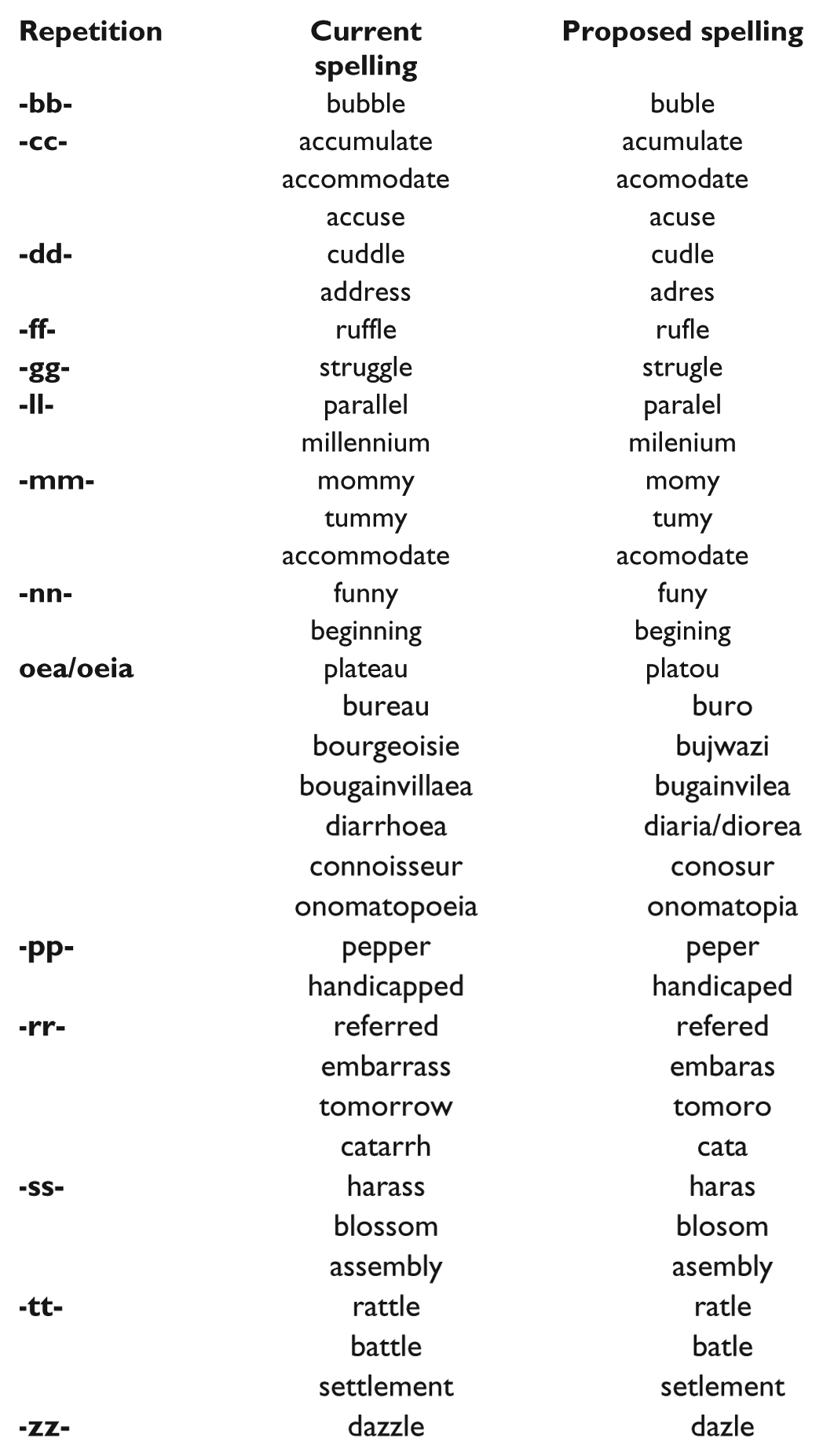
Repeated vowels are not as problematic as consonant clusters. That is why they are not well represented here because double vowels can be pronounced as one long vowel or diphthong, for example, food, soup, soap, but double consonants have only a short pronunciation.
Regularization of Monograph and Digraph
A digraph is a combination of two or more different letters pronounced as one phoneme. In spelling, a digraph comes as two or more letters combined, but in transcription, the two letters are represented by a phonetic symbol and pronounced as a phoneme; for example, <ph> and <ch>, which are pronounced as /f/, /k/, /t
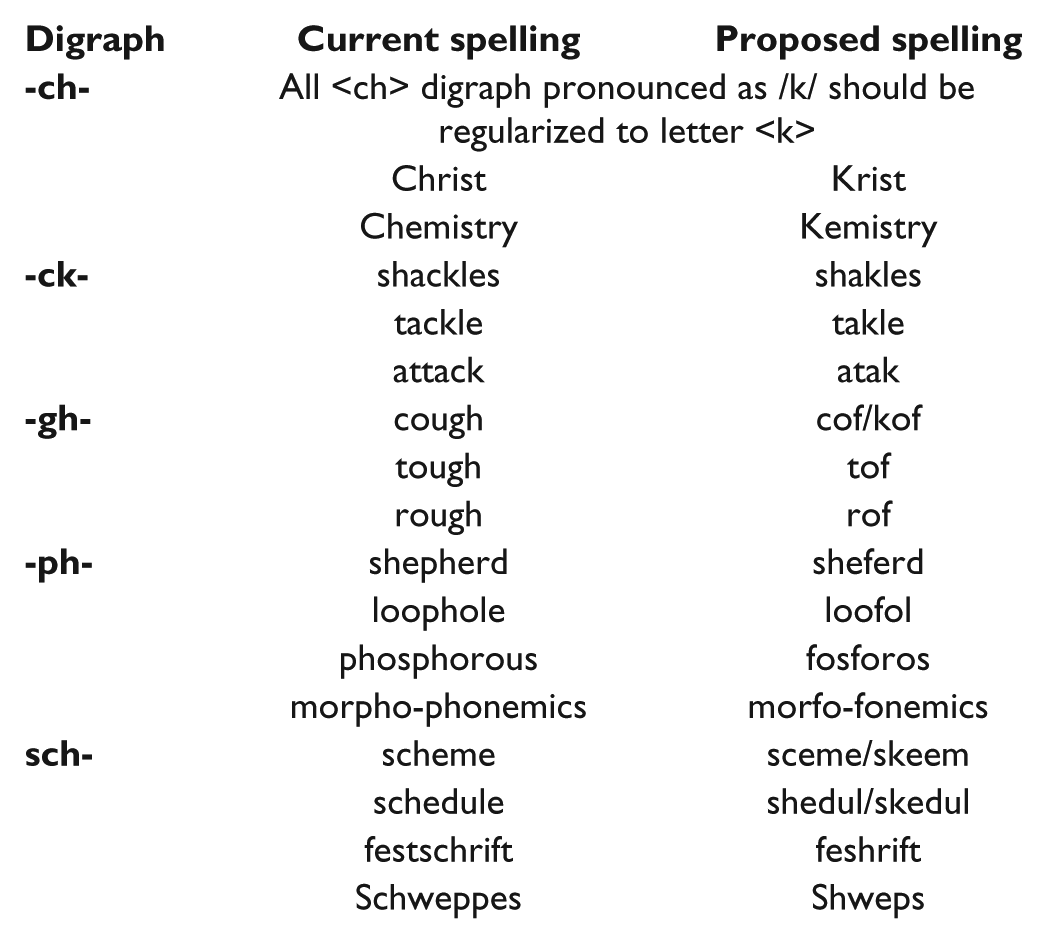
Finally, in this subsection, there are monographs and a partial vowel which create problems for educated Nigerians. These are letter <x> and the partial vowel /j/. Letter <x> is often realized in two phonemes during articulation, and the partial vowel /j/ is often absent in spelling. These two are of a kind because the former <x> has a phoneme absent in spelling but present in pronunciation and the latter /j/ too is sometimes absent in spelling but there in pronunciation. Nigerians do take the -x- for a phoneme and articulate it accordingly and where /j/ should be pronounced, it is usually not pronounced because of its absence in spelling. Therefore, the monograph <x> should be regularized to the two letters it represents during spelling so that readers are in no doubt about its correct pronunciation. The implication is that the letter <x>, apart from just appearing in spelling and in the alphabet, is basically useless for articulation for most educated Nigerians:

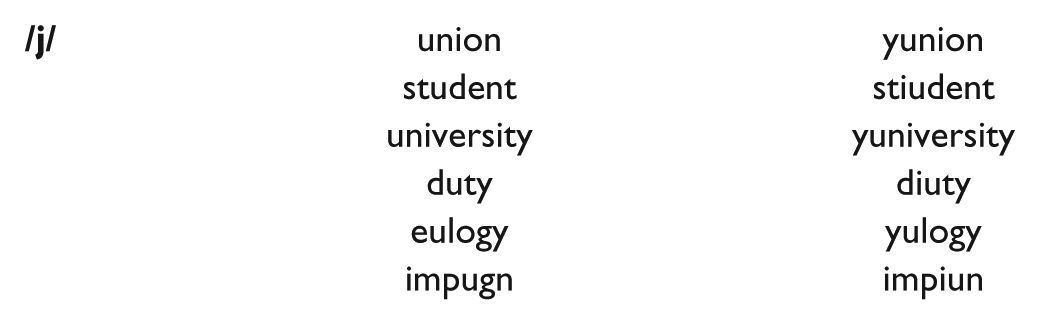
Similarly, the phoneme /j/ should be represented in the spelling of words in NE. The letter <i> or <y> can be used to reflect it, depending on how it can blend well morpho-phonemically:
Now, we look at complication in the spelling of compound and reduplicated words.
Compound Word Spelling
A compound word is a combination of two base forms or two words functioning as one entity with a meaning. Although we have two or more words in a compound formation, the two words together denote one thing, idea or concept. Reduplication is the repetition of similar sound and spelling but not different bases; for example, hocus-pocus, hanky-panky. There are three ways of writing compound words, which create confusion for writers: combined or solid form (as in breakfast), separated or open form (e.g., cassava flower), and hyphenated form (e.g., brother-in-law). Because compound words and their origins are very many, writers do not often know during writing which is which. So, the three rules of writing them are generally mixed up.
In a questionnaire administered to 25,000 educated Nigerians who were mainly lecturers and final year students in English and Literature, Linguistics, and International Studies and Diplomacy, Mass Communication and Theatre Arts Department, all the responses collated and analyzed (10,000 in all) admitted misspelling some words and mixing up the 3 ways in which compound words are spelt. Furthermore, the 22 compound words dictated for them to spell were spelt indiscriminately in any of the three above-given ways. Table 1 (S/No. 1) shows how the 22 compound words dictated were spelt. (A) is SBE.
Cases of Compound Word Spelling

Note. SBE = Standard British English; ENE = Educated Nigerian English.
The table shows a clear preference for the combined and hyphenated compound words in ENE. Asked to state how best they think compound words should be written to avoid confusion, the respondents suggested one-way rule only. Five thousand eight hundred (58%) suggested the hyphenated type, whereas 4,200 (42%) proposed the combined form. All considered, it makes no difference to meaning and it scarcely affects pronunciation if a compound word is written in any of the three forms. Quirk, Greebaum, Leech, and Svatvik (1985) have also acknowledged the inconsistencies that characterize writing compound words. At times, a compound formation is acceptably written in the three ways possible; for example, “a flower pot, a flower-pot, a flowerpot.” Furthermore, they observe that hyphenation is more common in

Conclusion
This article deals with the perennial challenge of the confusing English spelling system and the necessity of spelling reform. It was found that even the most versatile and seemingly perfect of scholars do misspell words or get confused about the correct spelling of a word when writing. They inevitably consult a dictionary, if it is available, or use a synonym, or ignorantly misspell the word. All considered, misspelling does not alter meaning but only shows that the writer does not know the correct spelling of the word. Although this is the case, variations of spelling are regarded by educated Nigerians as clear errors that must be penalized and discouraged. Despite concerted efforts to SBE-fy spellings in NE, educated Nigerians who keep misspelling some words agree that spelling reform is expedient. To this end, different suggested spellings have been made here. Reform should formulate rules for deleting redundant letters, unnecessary sound clusters, regularizing digraph, and spelling compound words in one way only, as illustrated in this article. The kind of reform proposed here will enhance spelling skills and accuracy, reading, and writing, and will relate written English very closely with pronunciation.
Footnotes
Appendix
Declaration of Conflicting Interests
The author(s) declared no potential conflicts of interest with respect to the research, authorship, and/or publication of this article.
Funding
The author(s) received no financial support for the research and/or authorship of this article.